Ghana Prepaid Cards Market Size, Share & Growth Rate
The Ghana Prepaid Cards Market was estimated at USD 485 Million in 2025 and is projected to reach USD 817 Million by 2032, growing at a CAGR of 7.7% from 2026 to 2032. This upward trajectory is being driven by an increasing demand for secure and convenient payment solutions among consumers, particularly in a landscape where access to traditional banking services remains limited. Moreover, the governments efforts to enhance financial inclusion through supportive policies are further propelling the adoption of prepaid cards in everyday transactions.
Ghana Prepaid Cards Market Year-wise Growth Rate and Key Drivers
This graph highlights how the Ghana Prepaid Cards Market has steadily grown over the years, supported by major growth factors.
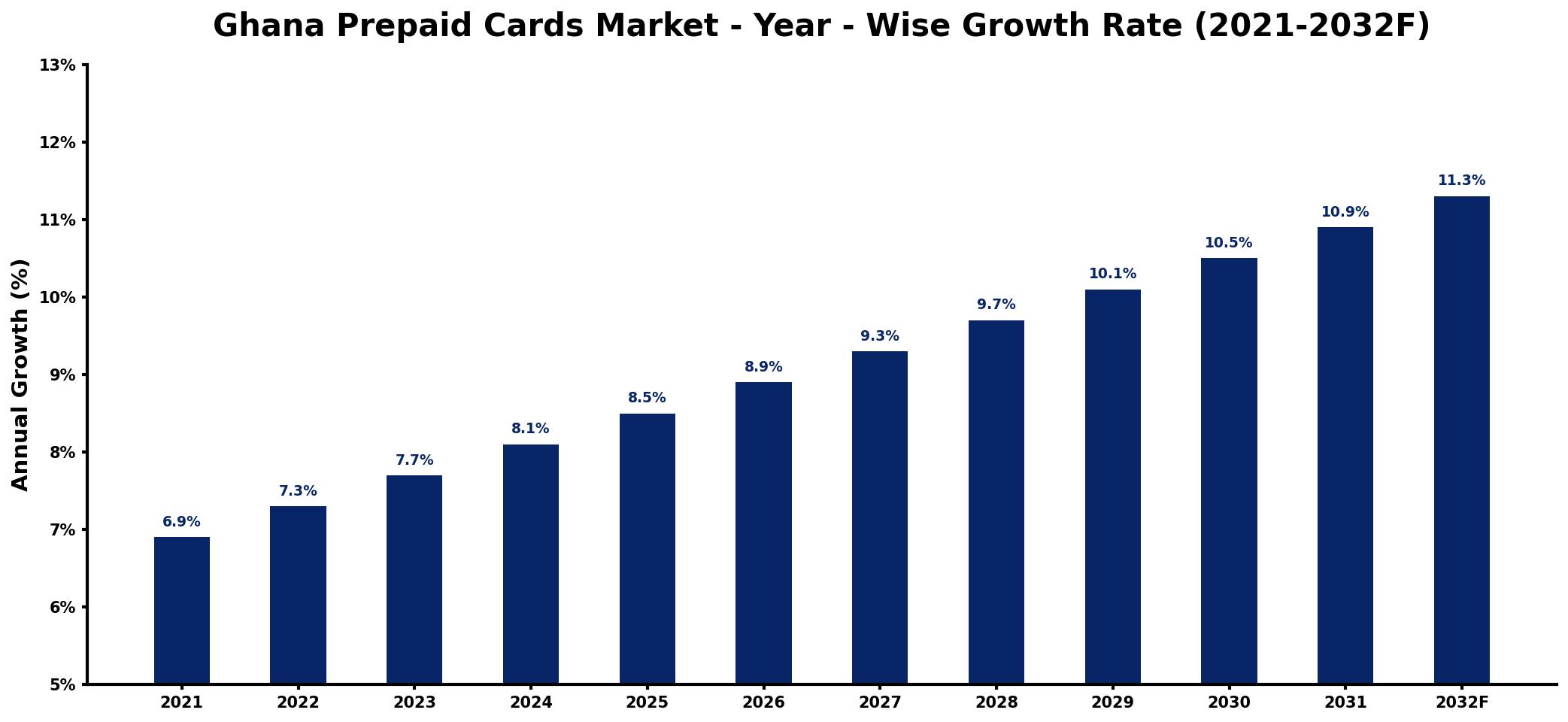
The table below presents the year‑wise growth rates along with the key drivers influencing the market
| Year | Growth Rate | Major Drivers |
| 2021 | 6.9% | Increase in digital payment adoption |
| 2022 | 7.3% | Growing e-commerce transaction volume |
| 2023 | 7.7% | Expansion of financial inclusion programs |
| 2024 | 8.1% | Rise in mobile wallet usage |
| 2025 | 8.5% | stronger distribution network expansion |
| 2026 | 8.9% | Growth in online retail platforms |
| 2027 | 9.3% | rising procurement volume requirements |
| 2028 | 9.7% | improved processing technologies adoption |
| 2029 | 10.1% | increased production capacity utilization |
| 2030 | 10.5% | increased pharmaceutical industry usage |
| 2031 | 10.9% | increased capital investment inflows |
| 2032 | 11.3% | growing automotive sector requirements |
Note: Market size estimations and growth projections presented in this report are based on 6Wresearch's proprietary forecasting methodology, utilizing the latest available industry data, government publications, and primary research inputs.
Ghana Prepaid Cards Market Synopsis
Recently, the Ghana prepaid cards market has gained momentum, largely attributed to the rising need for cashless payment alternatives. This shift, however, is not just a passing trend; it's indicative of a broader change in consumer behavior and preferences towards digital finance. Looking ahead, the market is poised for significant growth as both consumers and businesses recognize the advantages of utilizing prepaid card solutions in various payment scenarios.
Despite the initial growth, the market still faces challenges regarding widespread adoption and acceptance. Many consumers remain hesitant due to issues surrounding trust and financial literacy. Nevertheless, as education around digital finance increases and more infrastructure is built to support these solutions, the long-term prospects for prepaid cards in Ghana appear exceedingly promising.
Ghana Prepaid Cards Market Key Takeaways
- The market is projected to grow significantly, reaching USD 817 Million by 2032.
- Consumer demand for secure payment options is a key growth driver.
- Government policies are focused on enhancing financial inclusion and payment security.
- Ongoing development of payment infrastructure is crucial for market expansion.
- Financial literacy initiatives will play a vital role in increasing prepaid card adoption.
Evaluation of Restraints in Ghana Prepaid Cards Market
The Ghana prepaid cards market is hampered by several restraints that challenge its full potential. Primarily, the barriers to financial inclusion remain significant, with a substantial portion of the population lacking access to basic banking services. Low financial literacy rates further complicate the situation, as many consumers are unfamiliar with electronic payment systems. Additionally, the current payment infrastructure, including inadequate ATM networks and point-of-sale terminals, presents logistical challenges that hinder the seamless use of prepaid cards. Addressing these issues is essential for stimulating broader acceptance and usage of prepaid card solutions.
Ghana Prepaid Cards Market Trends
Several trends are currently shaping the Ghana prepaid cards market. One notable trend is the increasing use of mobile money platforms, which is gradually merging with prepaid card solutions to offer users more flexible transaction options. Additionally, the rise of e-commerce in Ghana is driving demand for online payment methods, further emphasizing the importance of prepaid cards. Another trend is the growing interest in loyalty programs linked to prepaid cards, which incentivize consumer spending and enhance customer retention for businesses.
Ghana Prepaid Cards Market Opportunities
Opportunities for growth within the Ghana prepaid cards market are plentiful. The continued expansion of mobile banking services offers a fertile ground for prepaid card adoption, especially among unbanked populations. Furthermore, collaborations with retailers to create specialized prepaid cards for promotions and loyalty rewards can capture consumer interest. Investment in educational programs about digital finance can also bridge the financial literacy gap, fostering greater acceptance and utilization of prepaid cards across various demographics.
Government Initiatives in the Ghana Prepaid Cards Market
The government of Ghana has recognized the critical role of financial inclusion and digital payment solutions in economic advancement. As such, it has enacted policies aimed at bolstering the prepaid cards market. These initiatives focus on enhancing the payment infrastructure, promoting electronic payment systems, and fostering consumer education on digital finance. By ensuring security and consumer protection in prepaid transactions, the government is working towards creating a conducive environment for market growth and innovation.
Future Insights of the Ghana Prepaid Cards Market
From 2026 to 2032, the Ghana prepaid cards market is expected to evolve significantly. Continued investments in technology and infrastructure will likely enhance the overall user experience. The integration of advanced data analytics for personalized services could further drive consumer engagement. As financial literacy improves and trust in digital payments increases, we anticipate accelerated adoption rates. Ultimately, the combination of government support and evolving consumer preferences will fuel the market's growth, positioning prepaid cards as a cornerstone of Ghana's digital payment landscape.
Ghana Prepaid Cards Market Latest Developments (2025 - 2026)
In recent months, the Ghana prepaid cards market has experienced notable advancements with various stakeholders looking to innovate and expand. Collaborations between financial institutions and technology providers have increased, focusing on enhancing the security and accessibility of prepaid cards. Initiatives aimed at integrating prepaid card services with mobile payment platforms are also emerging, reflecting a growing trend towards unified payment solutions. Additionally, campaigns to improve financial literacy among consumers have gained traction, which is anticipated to bolster the adoption of prepaid card solutions in the near future.
Ghana Prepaid Cards Market - Key Attractiveness of the Report
- 10 Years of Market Numbers
- Historical Data Starting from 2022 to 2025
- Base Year: 2025
- Forecast Data until 2032
- Key Performance Indicators Impacting the Market
- Major Upcoming Developments and Projects
Key Highlights of the Report:
- Ghana Prepaid Cards Market Outlook
- Market Size of Ghana Prepaid Cards Market, 2025
- Forecast of Ghana Prepaid Cards Market, 2032
- Historical Data and Forecast of Ghana Prepaid Cards Revenues & Volume for the Period 2022-2032F
- Ghana Prepaid Cards Market Trend Evolution
- Ghana Prepaid Cards Market Drivers and Challenges
- Ghana Prepaid Cards Price Trends
- Ghana Prepaid Cards Porter's Five Forces
- Ghana Prepaid Cards Industry Life Cycle
- Historical Data and Forecast of Ghana Prepaid Cards Market Revenues & Volume By Offering for the Period 2022-2032F
- Historical Data and Forecast of Ghana Prepaid Cards Market Revenues & Volume By General Purpose Card for the Period 2022-2032F
- Historical Data and Forecast of Ghana Prepaid Cards Market Revenues & Volume By Gift Card for the Period 2022-2032F
- Historical Data and Forecast of Ghana Prepaid Cards Market Revenues & Volume By Government Benefit/Disbursement Card for the Period 2022-2032F
- Historical Data and Forecast of Ghana Prepaid Cards Market Revenues & Volume By Incentive/Payroll Card for the Period 2022-2032F
- Historical Data and Forecast of Ghana Prepaid Cards Market Revenues & Volume By Others for the Period 2022-2032F
- Historical Data and Forecast of Ghana Prepaid Cards Market Revenues & Volume By Card Type for the Period 2022-2032F
- Historical Data and Forecast of Ghana Prepaid Cards Market Revenues & Volume By Closed Loop Card for the Period 2022-2032F
- Historical Data and Forecast of Ghana Prepaid Cards Market Revenues & Volume By Open Loop Card for the Period 2022-2032F
- Historical Data and Forecast of Ghana Prepaid Cards Market Revenues & Volume By End User for the Period 2022-2032F
- Historical Data and Forecast of Ghana Prepaid Cards Market Revenues & Volume By Retail for the Period 2022-2032F
- Historical Data and Forecast of Ghana Prepaid Cards Market Revenues & Volume By Corporate for the Period 2022-2032F
- Historical Data and Forecast of Ghana Prepaid Cards Market Revenues & Volume By Government/Public Sector for the Period 2022-2032F
- Ghana Prepaid Cards Import Export Trade Statistics
- Market Opportunity Assessment By Offering
- Market Opportunity Assessment By Card Type
- Market Opportunity Assessment By End User
- Ghana Prepaid Cards Top Companies Market Share
- Ghana Prepaid Cards Competitive Benchmarking By Technical and Operational Parameters
- Ghana Prepaid Cards Company Profiles
- Ghana Prepaid Cards Key Strategic Recommendations






































