Ghana Radioactive Waste Management Market Size, Share & Growth Rate
The Ghana Radioactive Waste Management Market was estimated at USD 1284 Million in 2025 and is projected to reach USD 1826 Million by 2032, growing at a CAGR of 5.2% from 2026 to 2032. This growth trajectory is propelled by Ghanas ambitions to integrate nuclear energy into its power generation mix, alongside expanding medical and industrial applications of radioactive materials. As the country seeks to enhance its technological capabilities, the need for comprehensive waste management solutions will continue to surge.
Ghana Radioactive Waste Management Market Growth Rate Analysis (2021-2032)
The Ghana Radioactive Waste Management market has shown a resilient growth pattern, with rates ranging from 5.8% to 6.4% over the next several years. Notably, growth peaked at 6.4% in 2024, driven by increased investments in nuclear infrastructure aimed at enhancing energy security. This growth aligns with Ghana's energy transition objectives, as the government actively pursues sustainable nuclear solutions to meet rising energy demands. Fluctuations, like the slight decline to 5.8% in 2026, can be attributed to temporary regulatory adjustments and shifts in policy focus. However, the market is expected to stabilize at around 6.0% in subsequent years, reflecting ongoing digitalization and better waste management technologies that bolster efficiency and safety standards.
Ghana Radioactive Waste Management Market Year-wise Growth Rate and Key Drivers
This graph highlights how the Ghana Radioactive Waste Management Market has steadily grown over the past five years, supported by major growth factors.
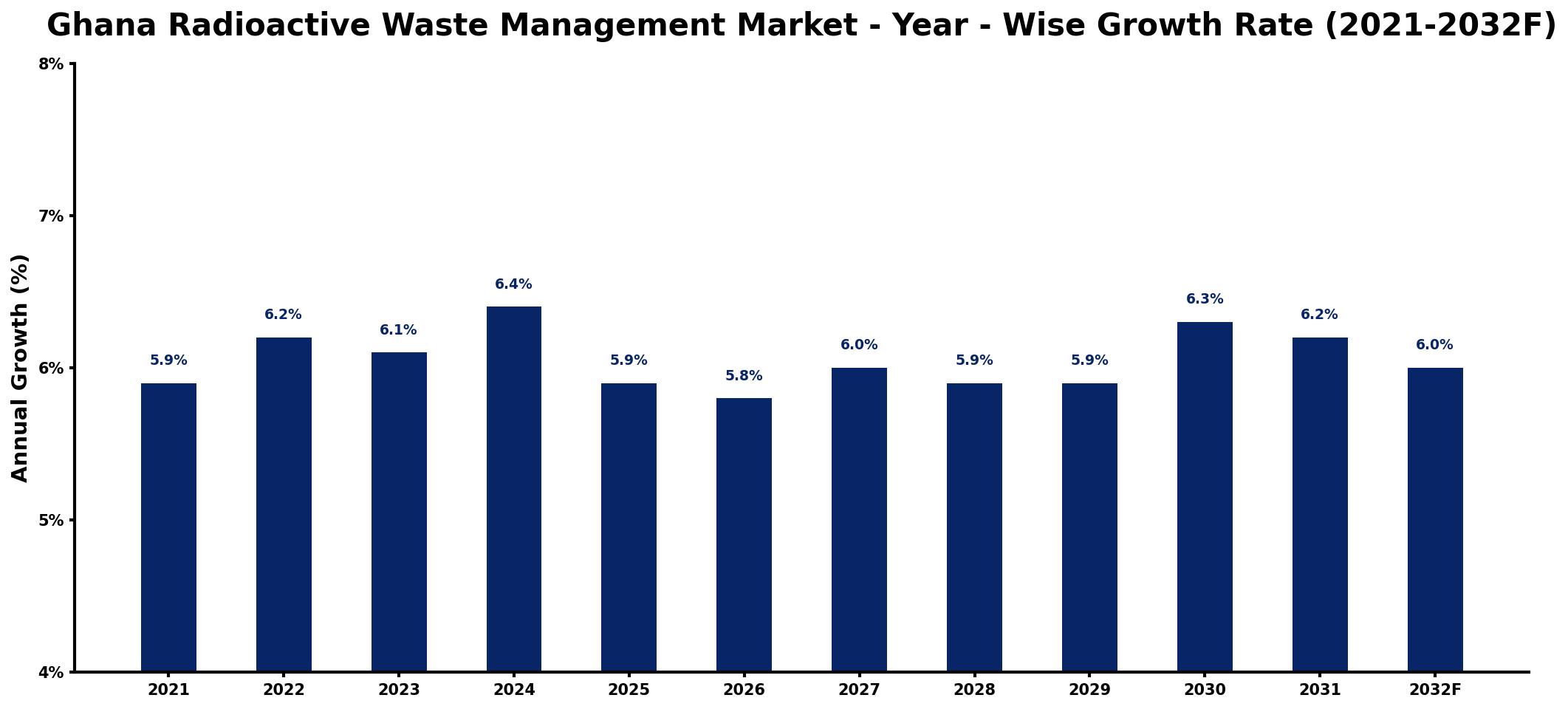
The table below presents the year‑wise growth rates along with the key drivers influencing the market
| Year | Growth Rate | Major Drivers |
| 2021 | 5.9% | Increasing energy sector investments |
| 2022 | 6.2% | Growing regulatory compliance requirements |
| 2023 | 6.1% | Rising public health awareness |
| 2024 | 6.4% | Expansion of industrial operations |
| 2025 | 5.9% | Enhanced recycling technologies adoption |
| 2026 | 5.8% | improved processing technologies adoption |
| 2027 | 6.0% | Strengthening local infrastructure projects |
| 2028 | 5.9% | Increased research funding allocations |
| 2029 | 5.9% | Development of sustainable practices |
| 2030 | 6.3% | Growing interest in environmental initiatives |
| 2031 | 6.2% | increased production capacity utilization |
| 2032 | 6.0% | Strengthened community engagement efforts |
Note: Market size estimations and growth projections presented in this report are based on 6Wresearch's proprietary forecasting methodology, utilizing the latest available industry data, government publications, and primary research inputs.
Ghana Radioactive Waste Management Market Synopsis
The strongest force shaping the Ghana Radioactive Waste Management Market currently is the government's strategic initiative to develop a robust nuclear energy sector. This ambition necessitates an effective and safe management system for radioactive waste, as the country prepares to engage with nuclear technology for both power generation and various industrial applications.
Moreover, the increasing utilization of radioactive materials in medical treatments and diagnostics enhances the demand for specialized waste management services. As these sectors expand, ensuring compliance with both national and international regulatory frameworks becomes increasingly vital, highlighting the importance of effective waste management practices.
Ghana Radioactive Waste Management Market Key Takeaways
- The market is driven by Ghanas commitment to nuclear power generation.
- Growing use of radioactive materials in medical and industrial applications increases demand.
- Regulatory compliance is a significant factor influencing market dynamics.
- Investment in infrastructure and public awareness remains critical for market growth.
- The market is adapting to the evolving landscape post-COVID-19, affecting waste management protocols.
Evaluation of Restraints in Ghana Radioactive Waste Management Market
Despite the positive growth outlook, the Ghana Radioactive Waste Management Market faces notable restraints. One primary concern is the lack of adequate infrastructure and technical expertise for effective radioactive waste management. Developing specialized facilities and training personnel to manage radioactive materials safely presents substantial challenges. Additionally, overcoming public perception and increasing awareness about radioactive waste safety is crucial. Financial constraints further complicate the establishment and sustainability of necessary infrastructure in this developing economy.
Ghana Radioactive Waste Management Market Trends
Current trends within the Ghana Radioactive Waste Management Market include a marked increase in research and development initiatives aimed at improving waste processing technologies. Additionally, there is a growing focus on sustainable waste management practices, aligning with global standards. The use of advanced monitoring and tracking systems for waste handling is also emerging as a significant trend, enhancing safety and compliance in the management of radioactive materials.
Ghana Radioactive Waste Management Market Opportunities
Opportunities within the Ghana Radioactive Waste Management Market are increasingly found in public-private partnerships. By leveraging investment from private entities, Ghana can enhance its radioactive waste management infrastructure. Furthermore, as the nuclear energy sector develops, there will be a pressing need for innovative waste management solutions, presenting a fertile ground for technology providers and waste management specialists to enter the market and expand their offerings.
Government Initiatives in the Ghana Radioactive Waste Management Market
The Ghanaian government is actively promoting policies and programs aimed at developing a comprehensive radioactive waste management framework. Efforts are being made to enhance regulatory compliance through the establishment of stringent guidelines and monitoring systems. Public funding initiatives are also being designed to support the development of necessary infrastructure, showcasing the governments commitment to ensuring safe and effective management of radioactive waste.
Future Insights of the Ghana Radioactive Waste Management Market
Looking ahead, the Ghana Radioactive Waste Management Market is poised for significant evolution between 2026 and 2032. As the nation advances its nuclear energy initiatives, increasing volumes of radioactive waste will necessitate more sophisticated management solutions. The interplay of growing regulatory requirements and technological advancements will create a dynamic landscape, fostering innovation and potentially attracting foreign investment. Continued emphasis on safety, efficiency, and sustainability will guide the market's trajectory.
Ghana Radioactive Waste Management Market Latest Developments (2025 - 2026)
Recent developments in the Ghana Radioactive Waste Management Market indicate a trend towards enhanced regulatory frameworks. Efforts to improve public awareness and education about radioactive waste handling and safety have also been gaining momentum. Moreover, the adaptation of waste management protocols post-COVID-19 reflects an industry-wide response to emerging health and safety requirements, ensuring that waste handling practices remain resilient in the face of challenges.
Ghana Radioactive Waste Management Market - Key Attractiveness of the Report
- 10 Years of Market Numbers
- Historical Data Starting from 2022 to 2025
- Base Year: 2025
- Forecast Data until 2032
- Key Performance Indicators Impacting the Market
- Major Upcoming Developments and Projects
Key Highlights of the Report:
- Ghana Radioactive Waste Management Market Outlook
- Market Size of Ghana Radioactive Waste Management Market, 2025
- Forecast of Ghana Radioactive Waste Management Market, 2032
- Historical Data and Forecast of Ghana Radioactive Waste Management Revenues & Volume for the Period 2022-2032F
- Ghana Radioactive Waste Management Market Trend Evolution
- Ghana Radioactive Waste Management Market Drivers and Challenges
- Ghana Radioactive Waste Management Price Trends
- Ghana Radioactive Waste Management Porter's Five Forces
- Ghana Radioactive Waste Management Industry Life Cycle
- Historical Data and Forecast of Ghana Radioactive Waste Management Market Revenues & Volume By Type for the Period 2022-2032F
- Historical Data and Forecast of Ghana Radioactive Waste Management Market Revenues & Volume By Exempt Waste and Very Low-Level Waste(VLLW) for the Period 2022-2032F
- Historical Data and Forecast of Ghana Radioactive Waste Management Market Revenues & Volume By Low-Level Waste(LLW) for the Period 2022-2032F
- Historical Data and Forecast of Ghana Radioactive Waste Management Market Revenues & Volume By Intermediate-Level Waste(ILW) for the Period 2022-2032F
- Historical Data and Forecast of Ghana Radioactive Waste Management Market Revenues & Volume By High-Level Waste(HLW) for the Period 2022-2032F
- Historical Data and Forecast of Ghana Radioactive Waste Management Market Revenues & Volume By Application for the Period 2022-2032F
- Historical Data and Forecast of Ghana Radioactive Waste Management Market Revenues & Volume By Industrial for the Period 2022-2032F
- Historical Data and Forecast of Ghana Radioactive Waste Management Market Revenues & Volume By Utility for the Period 2022-2032F
- Ghana Radioactive Waste Management Import Export Trade Statistics
- Market Opportunity Assessment By Type
- Market Opportunity Assessment By Application
- Ghana Radioactive Waste Management Top Companies Market Share
- Ghana Radioactive Waste Management Competitive Benchmarking By Technical and Operational Parameters
- Ghana Radioactive Waste Management Company Profiles
- Ghana Radioactive Waste Management Key Strategic Recommendations






































