Ghana Retail Industry Market Size, Share & Growth Rate
The Ghana Retail Industry Market was estimated at USD 490 Million in 2025 and is projected to reach USD 619 Million by 2032, growing at a CAGR of 3.4% from 2026 to 2032. This growth trajectory is driven primarily by an expanding consumer base and increasing disposable incomes, which have fueled demand across various retail channels. Additionally, rapid urbanization and the proliferation of organized retail formats are reshaping the landscape, providing consumers with greater access to a diverse range of products and services.
Ghana Retail Industry Market Year-wise Growth Rate and Key Drivers
This graph highlights how the Ghana Retail Industry Market has steadily grown over the years, supported by major growth factors.
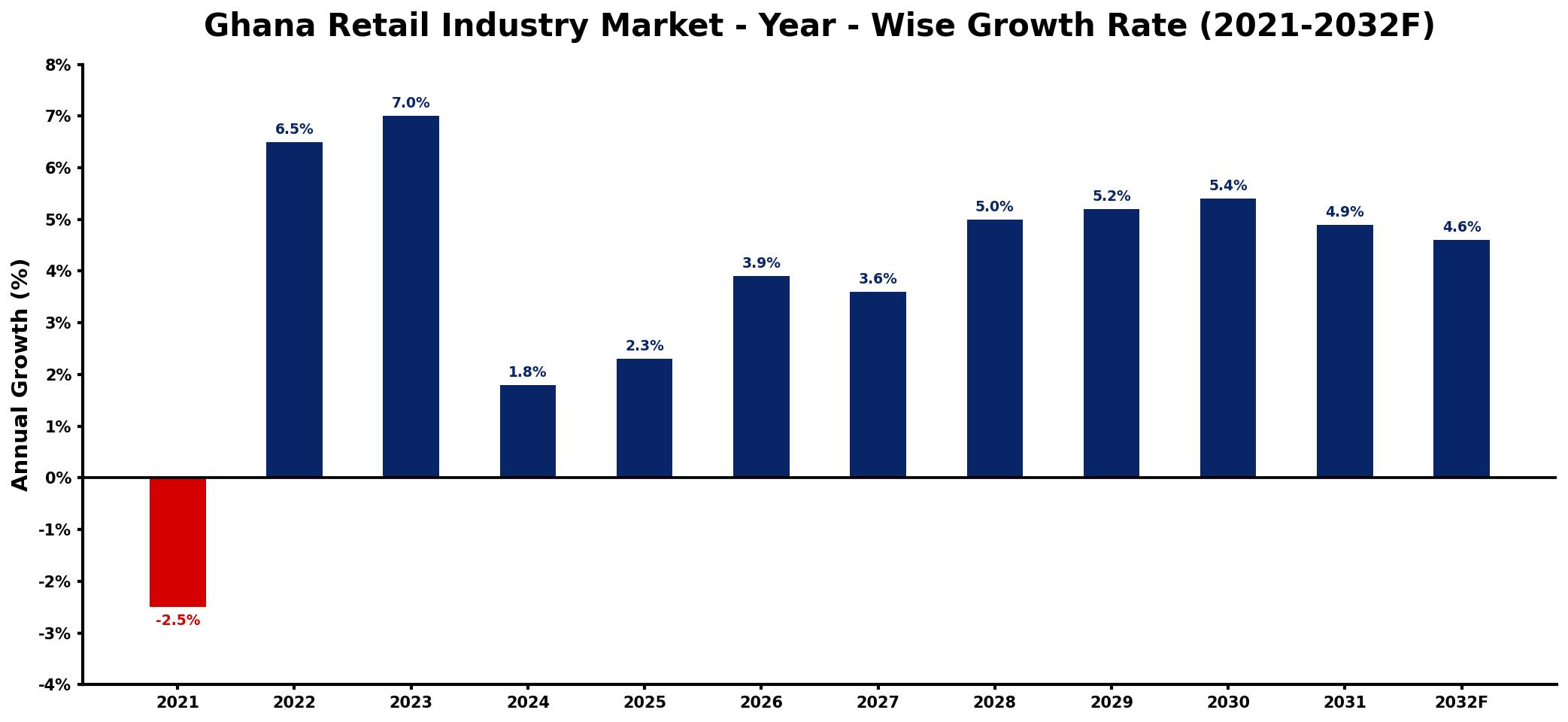
The table below presents the year‑wise growth rates along with the key drivers influencing the market
| Year | Growth Rate | Major Drivers |
| 2021 | -2.5% | Consumer spending showed contraction |
| 2022 | 6.5% | E-commerce platforms gained traction |
| 2023 | 7.0% | Foreign investments increased significantly |
| 2024 | 1.8% | Local production capabilities enhanced |
| 2025 | 2.3% | Sustainable practices attracted consumers |
| 2026 | 3.9% | Technological adoption accelerated growth |
| 2027 | 3.6% | Urbanization drove demand expansion |
| 2028 | 5.0% | Market diversification strategies implemented |
| 2029 | 5.2% | Supply chain innovations improved efficiency |
| 2030 | 5.4% | Consumer preferences shifted positively |
| 2031 | 4.9% | Brand loyalty programs expanded reach |
| 2032 | 4.6% | Digital marketing strategies intensified engagement |
Note: Market size estimations and growth projections presented in this report are based on 6Wresearch's proprietary forecasting methodology, utilizing the latest available industry data, government publications, and primary research inputs.
Ghana Retail Industry Market Synopsis
Urbanization stands out as the most powerful force shaping the Ghana Retail Industry Market today. As more citizens migrate to urban areas, their shopping preferences evolve, leading to increased foot traffic in organized retail spaces. This shift is compelling retailers to adapt their offerings to meet the diverse tastes and lifestyles of a growing urban populace.
The evolution of consumer preferences, driven by exposure to global trends and digital platforms, is another critical factor influencing the market. Retailers are not only expanding their physical presence but also enhancing their e-commerce capabilities to align with the convenience demanded by tech-savvy consumers.
Ghana Retail Industry Market Key Takeaways
- Expansion of organized retail formats is reshaping shopping experiences for urban consumers.
- Government initiatives are fostering a supportive environment for retail growth and investment.
- Digital transformation is crucial as retailers enhance e-commerce and omnichannel strategies.
- Consumer behavior is increasingly influenced by global trends, requiring local adaptation.
- Potential market entrants should be wary of competition from well-established informal sectors.
Evaluation of Restraints in Ghana Retail Industry Market
The Ghana Retail Industry faces notable restraints, particularly from the formidable informal market, which poses a significant challenge to organized retail. Additionally, supply chain inefficiencies contribute to operational hurdles that hinder timely product availability. Economic instability remains a critical concern as fluctuations in consumer purchasing power may affect overall retail performance. These elements necessitate strategic adaptations and innovations by retailers striving to capture market share.
Ghana Retail Industry Market Trends
Several trends are currently reshaping the Ghana Retail Industry. Notably, the rise of sustainability-focused consumerism is prompting retailers to adopt eco-friendly practices and offer sustainable product ranges. Concurrently, there is a significant emphasis on technology integration, with data analytics and artificial intelligence playing a pivotal role in understanding consumer preferences and optimizing inventory management. The increasing importance of convenience and immediacy is driving the expansion of quick-service and online shopping options.
Ghana Retail Industry Market Opportunities
Investment opportunities in the Ghana Retail Industry are promising. Retailers can capitalize on the increasing urban population by developing new stores and enhancing customer engagement through personalized marketing. Furthermore, the rise of e-commerce creates avenues for established businesses and startups alike to reach a wider audience. Technological advancements present opportunities for innovative solutions that streamline operations and enhance customer experiences, positioning retailers to thrive in a competitive market.
Government Initiatives in the Ghana Retail Industry Market
The government of Ghana recognizes the retail sector as a vital component of economic growth and consumer welfare. To support this industry, it has implemented various policies designed to promote fair competition and consumer protection. These initiatives include collaborations with regulatory agencies to establish licensing guidelines and trade practices, as well as programs focused on training and capacity building for retail entrepreneurs. Additionally, incentives such as tax breaks and subsidies aim to encourage investment in retail infrastructure, thereby enhancing market efficiency.
Future Insights of the Ghana Retail Industry Market
Looking ahead to 2026-2032, the Ghana Retail Industry is set to experience significant transformation, primarily fueled by continued urbanization and a growing consumer class. As retailers embrace technology and innovate their service offerings, competition will intensify. The focus will likely shift toward creating seamless omnichannel experiences that blend physical and digital shopping. Furthermore, as economic conditions stabilize, consumer purchasing power is expected to improve, which will positively influence market growth and development.
Ghana Retail Industry Market Latest Developments (2025 - 2026)
Recent developments in the Ghana Retail Industry indicate a strong shift toward digitalization. Many retailers are actively investing in their e-commerce platforms and enhancing their logistics capabilities to meet increasing online demand. Additionally, new partnerships among retailers and tech companies have emerged, focusing on innovative customer engagement solutions. The retail landscape is increasingly characterized by dynamic marketing strategies that leverage social media and data analytics, allowing retailers to better connect with consumers.
Ghana Retail Industry Market - Key Attractiveness of the Report
- 10 Years of Market Numbers
- Historical Data Starting from 2022 to 2025
- Base Year: 2025
- Forecast Data until 2032
- Key Performance Indicators Impacting the Market
- Major Upcoming Developments and Projects
Key Highlights of the Report:
- Ghana Retail Industry Market Outlook
- Market Size of Ghana Retail Industry Market, 2025
- Forecast of Ghana Retail Industry Market, 2032
- Historical Data and Forecast of Ghana Retail Industry Revenues & Volume for the Period 2022-2032F
- Ghana Retail Industry Market Trend Evolution
- Ghana Retail Industry Market Drivers and Challenges
- Ghana Retail Industry Price Trends
- Ghana Retail Industry Porter's Five Forces
- Ghana Retail Industry Industry Life Cycle
- Historical Data and Forecast of Ghana Retail Industry Market Revenues & Volume By Product for the Period 2022-2032F
- Historical Data and Forecast of Ghana Retail Industry Market Revenues & Volume By Food and Beverages for the Period 2022-2032F
- Historical Data and Forecast of Ghana Retail Industry Market Revenues & Volume By Personal and Household Care for the Period 2022-2032F
- Historical Data and Forecast of Ghana Retail Industry Market Revenues & Volume By Apparel, Footwear, and Accessories for the Period 2022-2032F
- Historical Data and Forecast of Ghana Retail Industry Market Revenues & Volume By Furniture, Toys, and Hobby for the Period 2022-2032F
- Historical Data and Forecast of Ghana Retail Industry Market Revenues & Volume By Electronic and Household Appliances for the Period 2022-2032F
- Historical Data and Forecast of Ghana Retail Industry Market Revenues & Volume By Other Products for the Period 2022-2032F
- Historical Data and Forecast of Ghana Retail Industry Market Revenues & Volume By Distribution Channel for the Period 2022-2032F
- Historical Data and Forecast of Ghana Retail Industry Market Revenues & Volume By Supermarkets/Hypermarkets for the Period 2022-2032F
- Historical Data and Forecast of Ghana Retail Industry Market Revenues & Volume By Convenience Stores for the Period 2022-2032F
- Historical Data and Forecast of Ghana Retail Industry Market Revenues & Volume By Department Stores for the Period 2022-2032F
- Historical Data and Forecast of Ghana Retail Industry Market Revenues & Volume By Specialty Stores for the Period 2022-2032F
- Historical Data and Forecast of Ghana Retail Industry Market Revenues & Volume By Online for the Period 2022-2032F
- Historical Data and Forecast of Ghana Retail Industry Market Revenues & Volume By Other Distribution Channels for the Period 2022-2032F
- Ghana Retail Industry Import Export Trade Statistics
- Market Opportunity Assessment By Product
- Market Opportunity Assessment By Distribution Channel
- Ghana Retail Industry Top Companies Market Share
- Ghana Retail Industry Competitive Benchmarking By Technical and Operational Parameters
- Ghana Retail Industry Company Profiles
- Ghana Retail Industry Key Strategic Recommendations






































