Ghana Sail Canvas Market Size, Share & Growth Rate
The Ghana Sail Canvas Market was estimated at USD 1241 Million in 2025 and is projected to reach USD 2222 Million by 2032, growing at a CAGR of 8.7% from 2026 to 2032. This growth trajectory reflects a robust expansion driven by the increasing popularity of recreational boating and yachting in the region, alongside a burgeoning marine industry that prioritizes high-quality, durable materials. As Ghanaians embrace leisure activities on the water, the demand for advanced sail canvas fabrics designed to withstand the rigors of marine environments continues to rise.
Ghana Sail Canvas Market Year-wise Growth Rate and Key Drivers
This graph highlights how the Ghana Sail Canvas Market has steadily grown over the years, supported by major growth factors.
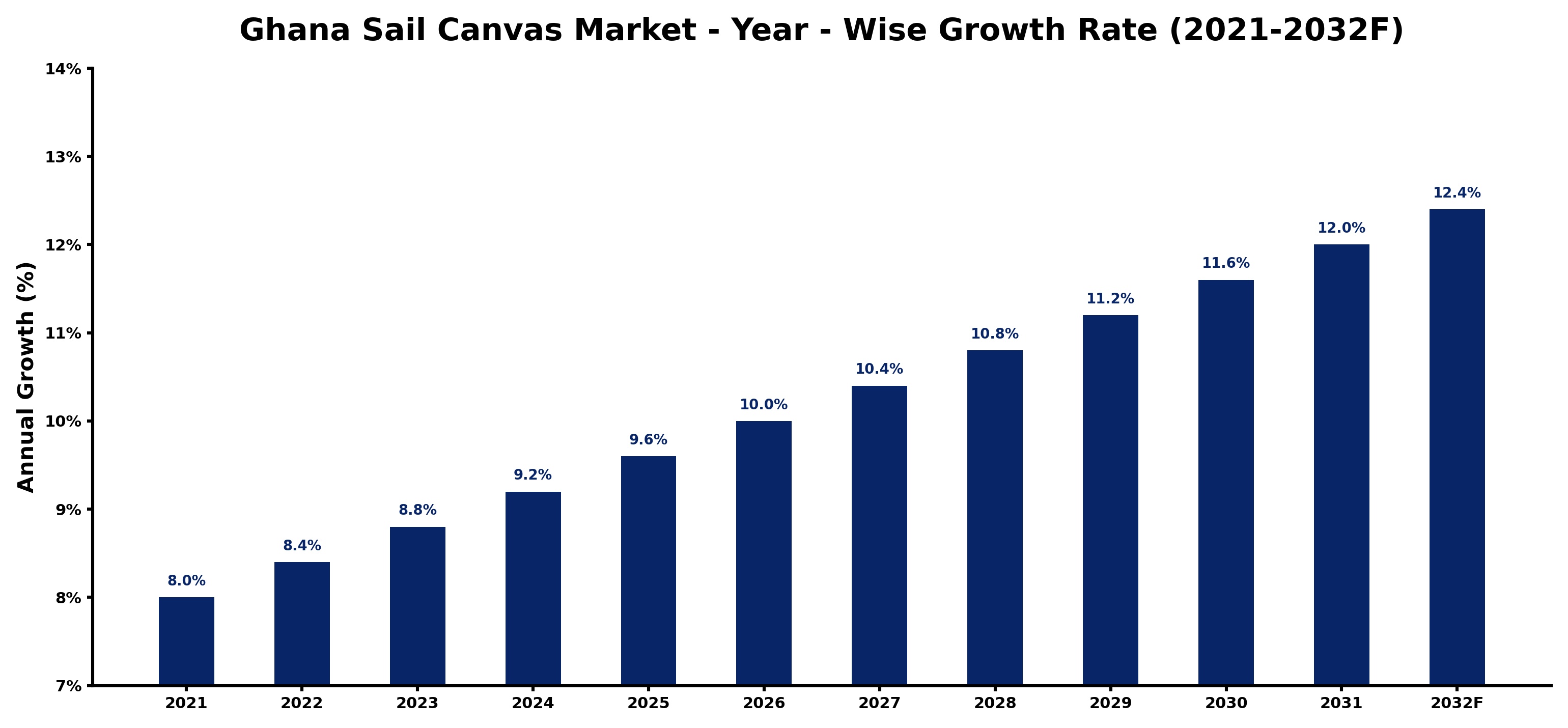
The table below presents the year‑wise growth rates along with the key drivers influencing the market
| Year | Growth Rate | Major Drivers |
| 2021 | 8.0% | Local textile manufacturing upgrades boost Ghana sail canvas output |
| 2022 | 8.4% | New sail production facilities enhance local employment and supply chains |
| 2023 | 8.8% | Local boat manufacturing surge boosts demand for canvas supplies |
| 2024 | 9.2% | Textile facility upgrades boosted sail canvas production capacity significantly |
| 2025 | 9.6% | Digital tools streamline sail canvas production, boosting manufacturing efficiency |
| 2026 | 10.0% | Improved local sourcing boosted sail canvas production efficiency |
| 2027 | 10.4% | Technological upgrades in sail canvas manufacturing boost export competitiveness |
| 2028 | 10.8% | Canvas manufacturing investment boosted local supply chain efficiencies |
| 2029 | 11.2% | New manufacturing facilities boost Ghana's sail canvas production capacity |
| 2030 | 11.6% | Export driven demand for customized sail designs boosts local production |
| 2031 | 12.0% | Increased manufacturing investments boosted local sail production capabilities |
| 2032 | 12.4% | Digital manufacturing tools boost Ghana's sail canvas production efficiency |
Note - Market size estimations and growth projections presented in this report are based on 6Wresearch's advanced forecasting approach, validated with industry datasets as of June 2026.
Ghana Sail Canvas Market Synopsis
In recent years, the Ghana Sail Canvas Market has experienced significant momentum, supported by a growing marine sector and increased interest in water-based recreational activities. However, as the market matures, there is a clear trajectory towards adopting innovative technologies and sustainable practices to meet evolving consumer demands.
Looking ahead, the market is expected to shift towards more environmentally friendly materials and production methods, reflecting global trends toward sustainability. This evolution will not only enhance the performance of sail canvas but also align with broader governmental objectives aimed at promoting environmental responsibility within the industry.
Ghana Sail Canvas Market Key Takeaways
- The market is witnessing rapid growth fueled by the expanding marine industry and recreational boating sector.
- Durable and weather-resistant fabrics are increasingly sought after, supporting enhanced performance in harsh conditions.
- Government policies are actively supporting local manufacturing and product quality standards.
- Trends towards sustainability are shaping consumer preferences for eco-friendly materials.
- Investment opportunities are opening in the realm of technology upgrades and innovative fabric development.
Evaluation of Restraints in Ghana Sail Canvas Market
Despite the promising growth of the Ghana Sail Canvas Market, several restraints persist. The challenge of ensuring that fabrics maintain their durability and performance amidst harsh marine conditions remains paramount. Additionally, concerns surrounding the environmental impact of traditional materials are becoming more prominent, influencing consumer preferences. Competing synthetic alternatives also pose a threat, as they may appeal to cost-sensitive buyers, underscoring the need for innovation and differentiation within the market.
Ghana Sail Canvas Market Trends
Current trends in the Ghana Sail Canvas Market are heavily influenced by the rising interest in sustainable practices. Manufacturers are increasingly exploring the use of eco-friendly materials and processes to attract environmentally conscious consumers. Furthermore, advancements in textile technology are paving the way for innovative fabrics that boast enhanced properties, such as increased UV resistance and durability. This focus on quality and sustainability is redefining consumer expectations and pushing manufacturers to elevate their offerings.
Ghana Sail Canvas Market Opportunities
Opportunities for growth within the Ghana Sail Canvas Market are abundant. The government's commitment to improving local manufacturing capabilities presents a fertile ground for investment in production facilities. Additionally, the growing number of recreational boaters creates a demand for customized sail solutions, allowing businesses to cater to niche markets. Exploring partnerships for research and development can also yield innovations that differentiate offerings and meet specific consumer needs, further solidifying market positions.
Government Initiatives in the Ghana Sail Canvas Market
The Ghanaian government recognizes the critical role that the sail canvas market plays in both marine recreation and economic development. Policies have been enacted to regulate the sector, ensuring adherence to quality standards while promoting local production. Support for research and development initiatives aims to enhance material performance and sustainability. Additionally, incentives such as tax breaks and subsidies are in place to encourage investment in advanced manufacturing technologies, fostering a competitive landscape within the industry.
Future Insights of the Ghana Sail Canvas Market
As we look forward to the years 2026-2032, the Ghana Sail Canvas Market is poised for transformative growth. The trend towards sustainable materials will likely become more pronounced, as both manufacturers and consumers embrace eco-conscious practices. Furthermore, technological advancements in fabric durability and performance will redefine market offerings, making quality a non-negotiable attribute for consumers. Overall, the combination of governmental support, evolving consumer preferences, and the drive for innovation positions the market favorably for long-term growth.
Ghana Sail Canvas Market Latest Developments (May 2025 - June 2026)
Recent developments in the Ghana Sail Canvas Market indicate a concerted effort by stakeholders to integrate sustainability into production practices. Manufacturers are exploring partnerships aimed at enhancing the durability of fabrics while minimizing environmental impact. Concurrently, the government is advancing initiatives to strengthen local supply chains and foster innovation in textile technology. These efforts reflect a market actively responding to both consumer demand and regulatory imperatives.
Ghana Sail Canvas Market - Key Attractiveness of the Report
- 10 Years of Market Numbers
- Historical Data Starting from 2022 to 2025
- Base Year: 2025
- Forecast Data until 2032
- Key Performance Indicators Impacting the Market
- Major Upcoming Developments and Projects
Key Highlights of the Report:
- Ghana Sail Canvas Market Outlook
- Market Size of Ghana Sail Canvas Market, 2025
- Forecast of Ghana Sail Canvas Market, 2032
- Historical Data and Forecast of Ghana Sail Canvas Revenues & Volume for the Period 2022-2032F
- Ghana Sail Canvas Market Trend Evolution
- Ghana Sail Canvas Market Drivers and Challenges
- Ghana Sail Canvas Price Trends
- Ghana Sail Canvas Porter's Five Forces
- Ghana Sail Canvas Industry Life Cycle
- Historical Data and Forecast of Ghana Sail Canvas Market Revenues & Volume By Type for the Period 2022-2032F
- Historical Data and Forecast of Ghana Sail Canvas Market Revenues & Volume By 8 Ann Canvas for the Period 2022-2032F
- Historical Data and Forecast of Ghana Sail Canvas Market Revenues & Volume By 12 Ann Canvas for the Period 2022-2032F
- Historical Data and Forecast of Ghana Sail Canvas Market Revenues & Volume By Polyester Canvas for the Period 2022-2032F
- Historical Data and Forecast of Ghana Sail Canvas Market Revenues & Volume By Others for the Period 2022-2032F
- Historical Data and Forecast of Ghana Sail Canvas Market Revenues & Volume By Application for the Period 2022-2032F
- Historical Data and Forecast of Ghana Sail Canvas Market Revenues & Volume By Sailing for the Period 2022-2032F
- Historical Data and Forecast of Ghana Sail Canvas Market Revenues & Volume By Yacht for the Period 2022-2032F
- Historical Data and Forecast of Ghana Sail Canvas Market Revenues & Volume By Others for the Period 2022-2032F
- Ghana Sail Canvas Import Export Trade Statistics
- Market Opportunity Assessment By Type
- Market Opportunity Assessment By Application
- Ghana Sail Canvas Top Companies Market Share
- Ghana Sail Canvas Competitive Benchmarking By Technical and Operational Parameters
- Ghana Sail Canvas Company Profiles
- Ghana Sail Canvas Key Strategic Recommendations






































