Ghana Styrene Market Size, Share & Growth Rate
The Ghana Styrene Market was estimated at USD 296 Million in 2025 and is projected to reach USD 401 Million by 2032, growing at a CAGR of 4.4% from 2026 to 2032. This growth trajectory is primarily driven by the booming construction and automotive sectors, where styrene's unique properties enhance product performance. As urbanization accelerates and infrastructural projects multiply, the demand for styrene-based products is set to rise sharply in Ghana.
Ghana Styrene Market Year-wise Growth Rate and Key Drivers
This graph highlights how the Ghana Styrene Market has steadily grown over the years, supported by major growth factors.
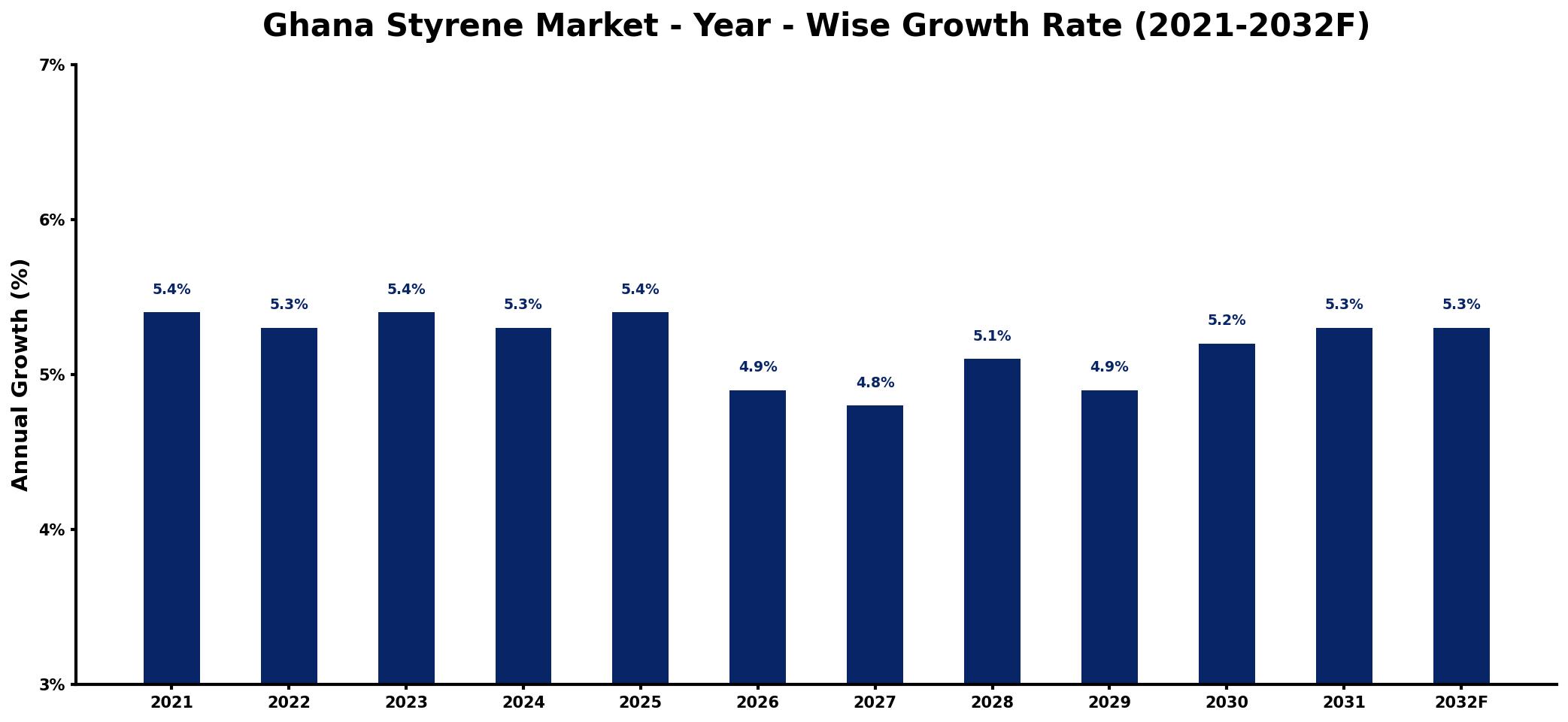
The table below presents the year‑wise growth rates along with the key drivers influencing the market
| Year | Growth Rate | Major Drivers |
| 2021 | 5.4% | Rising construction sector activities |
| 2022 | 5.3% | Increased automotive manufacturing investments |
| 2023 | 5.4% | Growth in consumer electronics market |
| 2024 | 5.3% | Expansion of packaging industry demand |
| 2025 | 5.4% | Surge in infrastructure projects underway |
| 2026 | 4.9% | Stabilization of global supply chains |
| 2027 | 4.8% | Emergence of new industrial applications |
| 2028 | 5.1% | Growing demand for renewable materials |
| 2029 | 4.9% | Increase in export opportunities available |
| 2030 | 5.2% | Rising consumer goods production rates |
| 2031 | 5.3% | Advancements in manufacturing technologies |
| 2032 | 5.3% | Strengthening regional trade agreements |
Note: Market size estimations and growth projections presented in this report are based on 6Wresearch's proprietary forecasting methodology, utilizing the latest available industry data, government publications, and primary research inputs.
Ghana Styrene Market Synopsis
In Ghana, the rising demand for high-performance insulation materials and lightweight components for vehicles is driving the styrene market forward. This surge can be attributed to the expanding middle-class population, which is increasingly capable of investing in quality products across various sectors.
As industries such as packaging and electronics continue to evolve, the need for durable and cost-effective materials has never been more critical. Styrene's versatility makes it a preferred choice, providing manufacturers with innovative solutions to meet modern consumer demands.
Ghana Styrene Market Key Takeaways
- Strong demand from the construction and automotive industries is propelling market growth.
- The shift towards eco-friendly, bio-based styrene is reshaping consumer preferences.
- Investment in local production facilities is crucial for reducing import reliance.
- Government initiatives are promoting sustainable practices within the styrene sector.
- There is a growing potential for recycling styrene-based materials in alignment with sustainability goals.
Evaluation of Restraints in Ghana Styrene Market
Despite the positive outlook, the Ghana Styrene Market faces significant restraints that could hamper growth. Limited domestic production capacity leads to a heavy reliance on imports, thereby making local companies vulnerable to global price fluctuations. Additionally, the existing infrastructure for storage and transportation is inadequate, further complicating market dynamics. Regulatory challenges and limited awareness among end-users regarding the benefits of styrene materials also hinder market expansion. Addressing these issues will be essential for fostering a robust and self-sufficient styrene industry in Ghana.
Ghana Styrene Market Trends
Current trends indicate a notable shift towards sustainable and bio-based styrene alternatives as consumers become increasingly environmentally conscious. This movement is particularly evident in the construction and automotive sectors, where the emphasis is on lightweight and energy-efficient materials. Moreover, ongoing urbanization and infrastructure initiatives are bolstering the demand for styrene in the production of insulation materials and durable components. As industries adapt to changing consumer preferences, innovations in styrene manufacturing processes are expected to enhance product offerings.
Ghana Styrene Market Opportunities
The Ghana Styrene Market presents a wealth of investment opportunities, particularly as demand for styrene-based products continues to soar. Establishing production facilities locally can help reduce dependency on imports and enhance supply chain efficiency. Partnerships with local manufacturers can facilitate capacity expansions, while ventures into recycling styrene materials will align with the global emphasis on sustainability. The confluence of economic growth and urbanization in Ghana sets the stage for promising returns on investment in this sector.
Government Initiatives in the Ghana Styrene Market
The Ghanaian government is actively implementing policies aimed at promoting sustainable development within the styrene industry. The Environmental Protection Agency plays a crucial role in regulating the use of styrene, focusing on minimizing environmental impacts such as air and water pollution. Additionally, there are initiatives to bolster local production capabilities, which not only support the domestic market but also reduce reliance on imports. Encouragement of green technologies aligns with broader goals of achieving environmental sustainability in the industrial landscape.
Future Insights of the Ghana Styrene Market
The outlook for the Ghana Styrene Market from 2026 to 2032 appears encouraging, fueled by persistent demand from key sectors like construction, automotive, and packaging. Urbanization and infrastructure development are likely to accelerate consumption patterns, making styrene a critical material for future applications. Furthermore, the governments support for industrial growth and foreign investment is expected to create a favorable business environment. However, attention must be paid to ongoing challenges, including price volatility and environmental concerns, to ensure sustainable progress in this market.
Ghana Styrene Market Latest Developments (2025 - 2026)
Recent developments in the Ghana Styrene Market have focused on enhancing production capabilities and sustainability efforts. Initiatives targeting the improvement of recycling methods for styrene materials have gained traction, reflecting a global trend towards circular economy practices. Collaborations between industry stakeholders are also on the rise, aimed at fostering innovations in product development. Such advancements indicate a proactive approach to addressing environmental concerns while capitalizing on the growing market demand.
Ghana Styrene Market - Key Attractiveness of the Report
- 10 Years of Market Numbers
- Historical Data Starting from 2022 to 2025
- Base Year: 2025
- Forecast Data until 2032
- Key Performance Indicators Impacting the Market
- Major Upcoming Developments and Projects
Key Highlights of the Report:
- Ghana Styrene Market Outlook
- Market Size of Ghana Styrene Market, 2025
- Forecast of Ghana Styrene Market, 2032
- Historical Data and Forecast of Ghana Styrene Revenues & Volume for the Period 2022-2032F
- Ghana Styrene Market Trend Evolution
- Ghana Styrene Market Drivers and Challenges
- Ghana Styrene Price Trends
- Ghana Styrene Porter's Five Forces
- Ghana Styrene Industry Life Cycle
- Historical Data and Forecast of Ghana Styrene Market Revenues & Volume By Type for the Period 2022-2032F
- Historical Data and Forecast of Ghana Styrene Market Revenues & Volume By Acrylonitrile Butadiene Styrene (ABS) for the Period 2022-2032F
- Historical Data and Forecast of Ghana Styrene Market Revenues & Volume By Expanded Polystyrene (EPS) for the Period 2022-2032F
- Historical Data and Forecast of Ghana Styrene Market Revenues & Volume By Others for the Period 2022-2032F
- Historical Data and Forecast of Ghana Styrene Market Revenues & Volume By Application for the Period 2022-2032F
- Historical Data and Forecast of Ghana Styrene Market Revenues & Volume By Automotive for the Period 2022-2032F
- Historical Data and Forecast of Ghana Styrene Market Revenues & Volume By Construction for the Period 2022-2032F
- Historical Data and Forecast of Ghana Styrene Market Revenues & Volume By Packaging Consumer Goods for the Period 2022-2032F
- Historical Data and Forecast of Ghana Styrene Market Revenues & Volume By Others for the Period 2022-2032F
- Historical Data and Forecast of Ghana Styrene Market Revenues & Volume By Distribution Channel for the Period 2022-2032F
- Historical Data and Forecast of Ghana Styrene Market Revenues & Volume By Offline for the Period 2022-2032F
- Historical Data and Forecast of Ghana Styrene Market Revenues & Volume By Online for the Period 2022-2032F
- Ghana Styrene Import Export Trade Statistics
- Market Opportunity Assessment By Type
- Market Opportunity Assessment By Application
- Market Opportunity Assessment By Distribution Channel
- Ghana Styrene Top Companies Market Share
- Ghana Styrene Competitive Benchmarking By Technical and Operational Parameters
- Ghana Styrene Company Profiles
- Ghana Styrene Key Strategic Recommendations






































