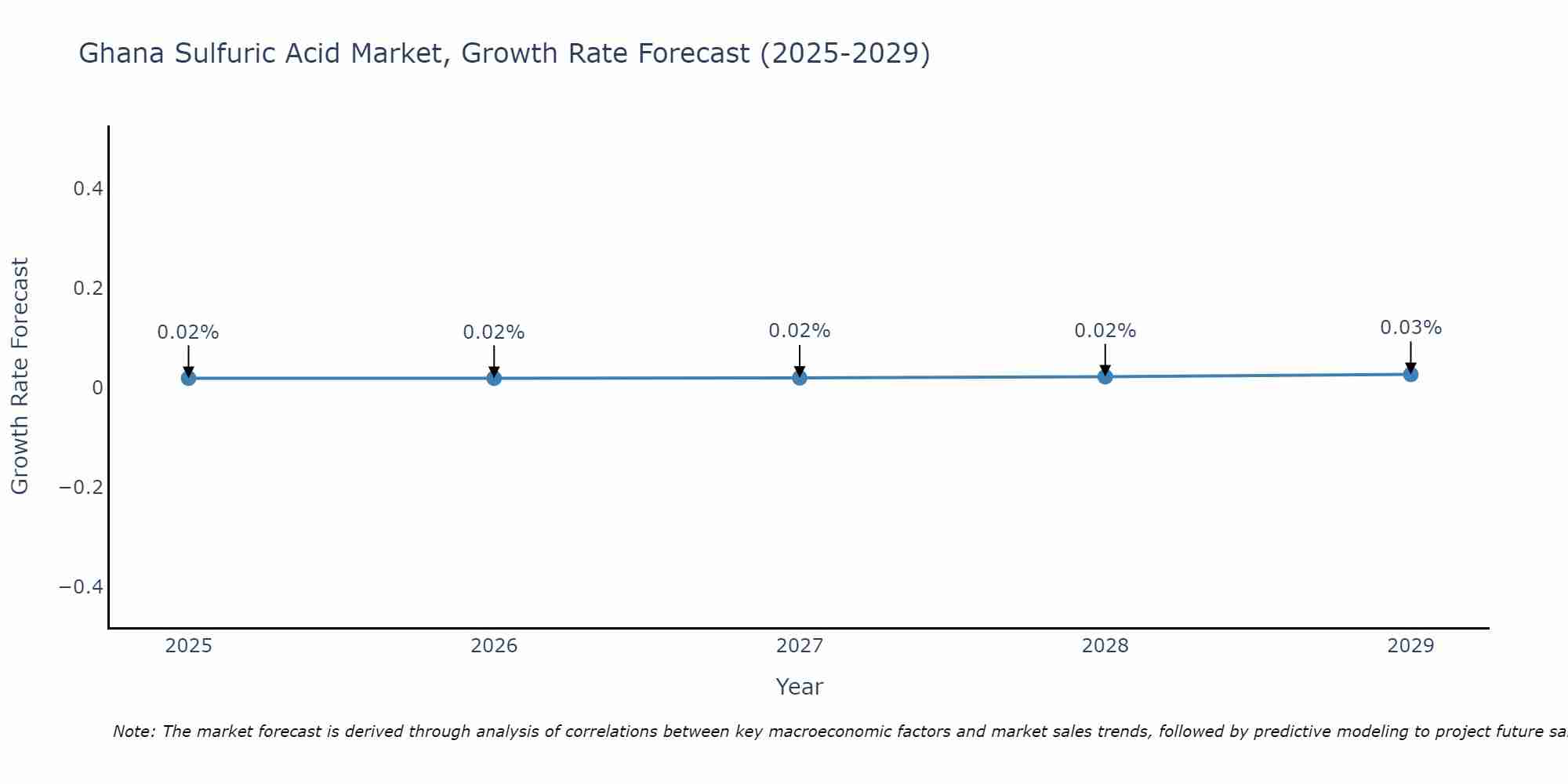
Ghana Sulfuric Acid Market Size Growth Rate
The Ghana Sulfuric Acid Market is likely to experience consistent growth rate gains over the period 2025 to 2029. The growth rate starts at 0.02% in 2025 and reaches 0.03% by 2029.
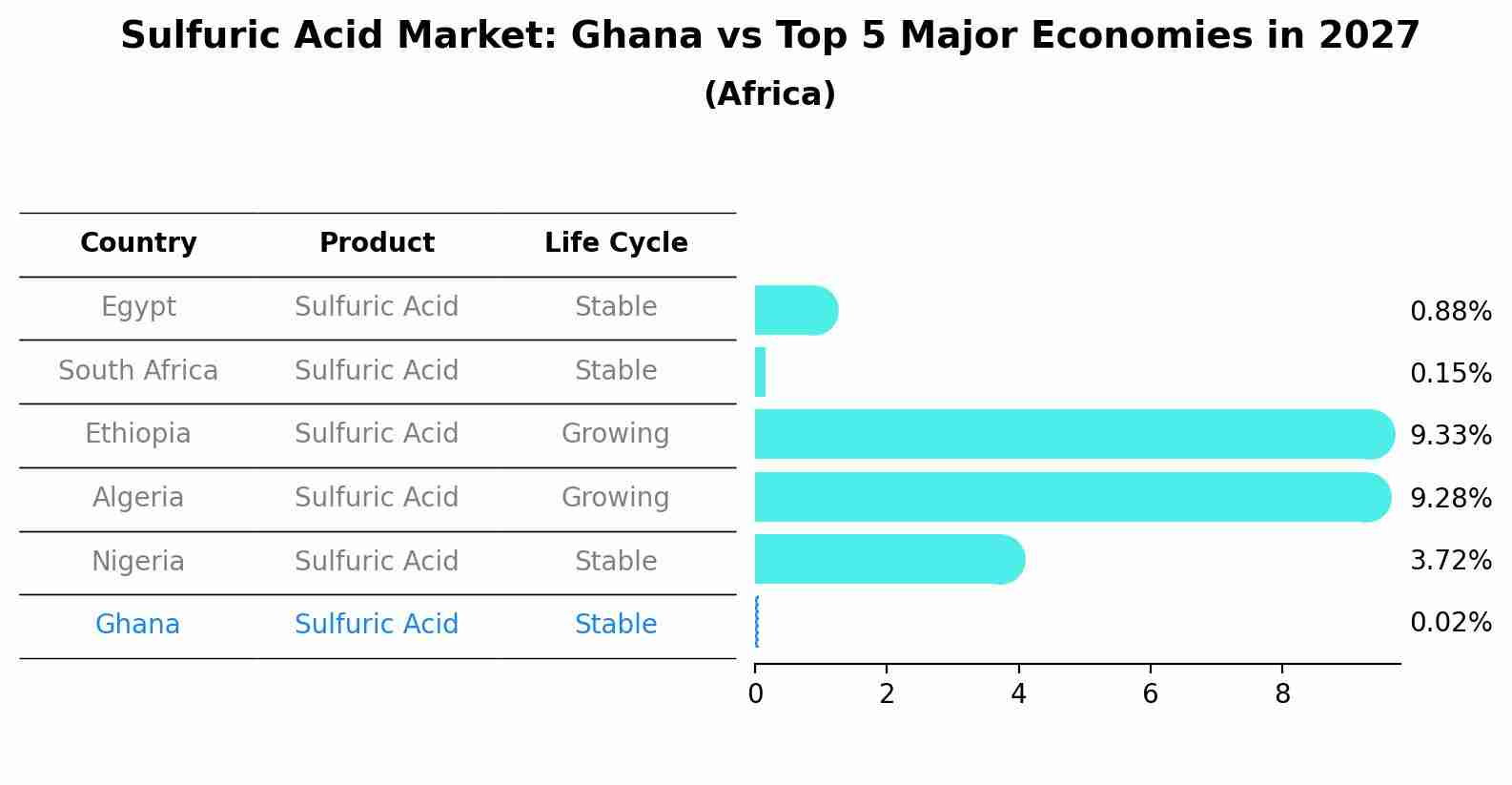
Sulfuric Acid Market: Ghana vs Top 5 Major Economies in 2027 (Africa)
By 2027, Ghana's Sulfuric Acid market is forecasted to achieve a stable growth rate of 0.02%, with Egypt leading the Africa region, followed by South Africa, Ethiopia, Algeria and Nigeria.
Ghana Sulfuric Acid Market Overview
The Ghana sulfuric acid market is primarily driven by its use in various industries such as mining, agriculture, and manufacturing. The demand for sulfuric acid is high in the mining sector for the extraction of minerals, particularly gold. In agriculture, sulfuric acid is used in the production of fertilizers, while in manufacturing, it is utilized in the production of chemicals, pharmaceuticals, and batteries. The market is witnessing steady growth due to increasing industrial activities in the country, coupled with the government`s efforts to promote economic development. Key players in the Ghana sulfuric acid market include local manufacturers as well as international suppliers catering to the diverse needs of the industries. Overall, the market is poised for further expansion driven by ongoing industrialization and infrastructure development in Ghana.
Ghana Sulfuric Acid Market Trends
The Ghana sulfuric acid market is witnessing steady growth driven by the expanding industrial and mining sectors in the country. With increasing demand for sulfuric acid in applications such as fertilizer production, mineral processing, and chemical manufacturing, local producers are ramping up their production capacities. Additionally, the government`s initiatives to promote industrialization and attract foreign investments are further fueling the demand for sulfuric acid in Ghana. However, challenges such as fluctuating raw material prices and environmental regulations regarding sulfuric acid production are influencing market dynamics. The market is also witnessing a trend towards sustainable production practices and the adoption of advanced technologies to enhance efficiency and reduce environmental impact. Overall, the Ghana sulfuric acid market is poised for growth with opportunities for both domestic producers and international suppliers.
Ghana Sulfuric Acid Market Challenges
In the Ghana Sulfuric Acid Market, some of the key challenges faced include fluctuating raw material prices, limited domestic production capacity, and the reliance on imports to meet demand. Fluctuating prices of sulfur, a key raw material for sulfuric acid production, can impact the overall production costs and profitability for manufacturers. Additionally, the limited domestic production capacity in Ghana results in a reliance on imports, which can be affected by international market dynamics and transportation costs. This can lead to supply chain disruptions and potential price fluctuations for consumers. Addressing these challenges would require investments in enhancing domestic production capabilities, securing stable sources of raw materials, and improving logistics infrastructure to ensure a stable and competitive sulfuric acid market in Ghana.
Ghana Sulfuric Acid Market Investment Opportunities
The Ghana sulfuric acid market offers promising investment opportunities due to increasing industrial activities, particularly in mining, agriculture, and chemical manufacturing sectors that rely on sulfuric acid for various processes. With a growing economy and government initiatives to support industrial growth, there is a rising demand for sulfuric acid in the country. Investing in sulfuric acid production facilities or distribution networks can be lucrative, considering the potential for long-term growth and profitability in meeting the domestic demand as well as potential for export to neighboring countries in West Africa. Additionally, focusing on sustainable production methods and environmentally friendly practices can enhance the market positioning and appeal to environmentally conscious consumers and businesses. Conducting thorough market research and strategic partnerships with key industry players will be essential for success in the Ghana sulfuric acid market.
Ghana Sulfuric Acid Market Government Policy
The government of Ghana has implemented policies to regulate the sulfuric acid market to ensure environmental protection and public health. The Environmental Protection Agency (EPA) of Ghana oversees the licensing and monitoring of sulfuric acid producers to ensure compliance with environmental standards and guidelines. Additionally, the government has imposed import restrictions on sulfuric acid to promote local production and reduce dependency on imports. These policies aim to promote sustainable production practices, minimize environmental pollution, and support the growth of the domestic sulfuric acid industry in Ghana.
Ghana Sulfuric Acid Market Future Outlook
The future outlook for the Ghana Sulfuric Acid Market appears promising, driven by increasing industrialization, particularly in the mining, agriculture, and chemical sectors. The demand for sulfuric acid is expected to grow due to its widely diverse applications, including mineral processing, fertilizer production, and chemical manufacturing. Additionally, the government`s focus on infrastructure development and investments in key industries is likely to further boost market growth. However, factors such as fluctuating raw material prices and environmental regulations may pose challenges to the market`s expansion. Overall, with the country`s economic growth and industrial activities on the rise, the Ghana Sulfuric Acid Market is anticipated to experience steady growth in the coming years.
Key Highlights of the Report:
- Ghana Sulfuric Acid Market Outlook
- Market Size of Ghana Sulfuric Acid Market, 2024
- Forecast of Ghana Sulfuric Acid Market, 2031
- Historical Data and Forecast of Ghana Sulfuric Acid Revenues & Volume for the Period 2021 - 2031
- Ghana Sulfuric Acid Market Trend Evolution
- Ghana Sulfuric Acid Market Drivers and Challenges
- Ghana Sulfuric Acid Price Trends
- Ghana Sulfuric Acid Porter's Five Forces
- Ghana Sulfuric Acid Industry Life Cycle
- Historical Data and Forecast of Ghana Sulfuric Acid Market Revenues & Volume By Raw Material Type for the Period 2021 - 2031
- Historical Data and Forecast of Ghana Sulfuric Acid Market Revenues & Volume By Elemental Sulfur for the Period 2021 - 2031
- Historical Data and Forecast of Ghana Sulfuric Acid Market Revenues & Volume By Pyrite Ore for the Period 2021 - 2031
- Historical Data and Forecast of Ghana Sulfuric Acid Market Revenues & Volume By Other Raw Materials (Base Metal Smelters) for the Period 2021 - 2031
- Historical Data and Forecast of Ghana Sulfuric Acid Market Revenues & Volume By End-user Industry for the Period 2021 - 2031
- Historical Data and Forecast of Ghana Sulfuric Acid Market Revenues & Volume By Fertilizer for the Period 2021 - 2031
- Historical Data and Forecast of Ghana Sulfuric Acid Market Revenues & Volume By Chemical & Pharmaceutical for the Period 2021 - 2031
- Historical Data and Forecast of Ghana Sulfuric Acid Market Revenues & Volume By Automotive for the Period 2021 - 2031
- Historical Data and Forecast of Ghana Sulfuric Acid Market Revenues & Volume By Petroleum Refining for the Period 2021 - 2031
- Historical Data and Forecast of Ghana Sulfuric Acid Market Revenues & Volume By Other End-user Industries (Pulp & Paper, Metal Processing) for the Period 2021 - 2031
- Ghana Sulfuric Acid Import Export Trade Statistics
- Market Opportunity Assessment By Raw Material Type
- Market Opportunity Assessment By End-user Industry
- Ghana Sulfuric Acid Top Companies Market Share
- Ghana Sulfuric Acid Competitive Benchmarking By Technical and Operational Parameters
- Ghana Sulfuric Acid Company Profiles
- Ghana Sulfuric Acid Key Strategic Recommendations






































