Ghana Swing Market Size, Share & Growth Rate
The Ghana Swing Market was estimated at USD 264 Million in 2025 and is projected to reach USD 363 Million by 2032, growing at a CAGR of 4.7% from 2026 to 2032. This growth trajectory is driven by the increasing demand for outdoor recreational activities, spurred by urbanization and a burgeoning middle class with disposable income. Furthermore, the influence of social media on consumer preferences is leading to a heightened interest in unique and visually appealing swing products.
Ghana Swing Market Year-wise Growth Rate and Key Drivers
This graph highlights how the Ghana Swing Market has steadily grown over the years, supported by major growth factors.
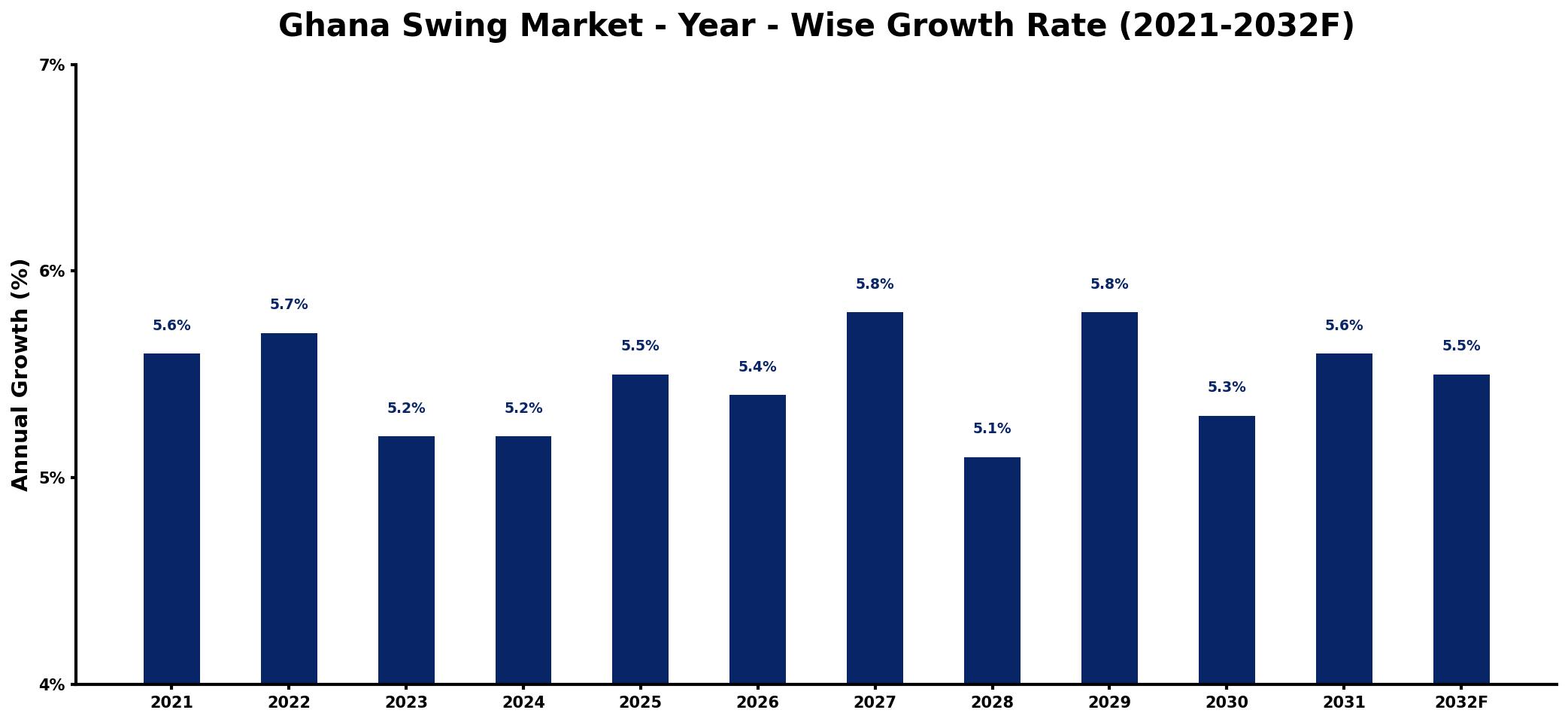
The table below presents the year‑wise growth rates along with the key drivers influencing the market
| Year | Growth Rate | Major Drivers |
| 2021 | 5.6% | Rising consumer spending patterns |
| 2022 | 5.7% | Increased investments in infrastructure |
| 2023 | 5.2% | Expansion of recreational facilities |
| 2024 | 5.2% | Growth in tourism activities |
| 2025 | 5.5% | Emergence of new market entrants |
| 2026 | 5.4% | Development of local manufacturing |
| 2027 | 5.8% | Increase in disposable incomes |
| 2028 | 5.1% | Enhanced marketing strategies adopted |
| 2029 | 5.8% | Boost in youth participation rates |
| 2030 | 5.3% | Diversification of leisure options |
| 2031 | 5.6% | Strengthened distribution networks established |
| 2032 | 5.5% | Growing interest in outdoor activities |
Note: Market size estimations and growth projections presented in this report are based on 6Wresearch's proprietary forecasting methodology, utilizing the latest available industry data, government publications, and primary research inputs.
Ghana Swing Market Synopsis
The Ghana Swing Market is emerging as a dynamic segment within the broader leisure industry, tapping into a growing consumer base eager for outdoor activities. The market comprises a diverse range of swing products, from traditional wooden swings to innovative designs like hammock swings, attracting both children and adults alike.
As more families prioritize leisure and wellness, the demand for high-quality swing products is on the rise. Local manufacturers are increasingly competing with international brands, leading to a vibrant market where customization and eco-friendliness are becoming key selling points.
Ghana Swing Market Key Takeaways
- The market is projected to grow from USD 264 Million in 2025 to USD 363 Million by 2032, with a CAGR of 4.7%.
- Increased urbanization and a rising middle class are driving demand for outdoor recreational products.
- Customization and eco-friendly options are trending among consumers seeking personalized experiences.
- The influence of social media is reshaping consumer preferences and driving visibility for swing products.
- Investment opportunities are expanding as the government promotes infrastructure development and tourism.
Evaluation of Restraints in Ghana Swing Market
Despite its promising trajectory, the Ghana Swing Market faces several constraints that could impede growth. Inconsistent government policies and regulations create uncertainty, deterring potential investors. Additionally, infrastructure challenges, such as unreliable power supply and poor transportation networks, hinder the efficient distribution of swing products. Market saturation and intensified competition among both local and international manufacturers further complicate the landscape, requiring businesses to adopt innovative strategies to maintain a competitive edge.
Ghana Swing Market Trends
The Ghana Swing Market is undergoing significant transformation due to several trends. A strong inclination towards health and wellness is driving consumers to embrace activities like swinging for relaxation and fitness. Moreover, the aesthetic appeal of swings is becoming paramount, with homeowners looking for pieces that enhance outdoor spaces. The rise of influencer marketing on social platforms is amplifying brand visibility, while sustainability is becoming increasingly important, leading to a surge in demand for eco-friendly swing options.
Ghana Swing Market Opportunities
There are substantial growth opportunities in the Ghana Swing Market, particularly as the economy continues to expand. Investors can capitalize on the demand for diverse swing products, particularly those that align with consumer preferences for quality and design. Additionally, the push for sustainable manufacturing presents an avenue for businesses to differentiate themselves. Collaborations between local artisans and international brands can also create unique offerings, enhancing market reach and consumer engagement.
Government Initiatives in the Ghana Swing Market
The Ghanaian government is implementing policies to foster a conducive environment for market growth. Regulatory frameworks, such as the Consumer Protection Act and the Competition Act, aim to safeguard consumer interests and encourage fair competition. The Ghana Standards Authority plays a vital role in ensuring product safety and quality, further establishing trust in the market. These initiatives collectively support a transparent and thriving market landscape for swing products.
Future Insights of the Ghana Swing Market
Looking ahead to 2026-2032, the Ghana Swing Market is poised for continued growth fueled by several factors. A rising disposable income among the middle class, coupled with increasing urbanization, is likely to elevate the demand for recreational options. Enhanced government support for tourism and infrastructure projects will further catalyze market expansion. By focusing on innovation and unique consumer experiences, businesses in the swing market have the opportunity to capture a larger share of this evolving landscape.
Ghana Swing Market Latest Developments (2025 - 2026)
Recent industry developments in the Ghana Swing Market have showcased a shift towards more innovative and sustainable products. Manufacturers are increasingly launching eco-friendly swings that appeal to the environmentally conscious consumer. The influence of social media continues to shape marketing strategies, with brands engaging consumers through visually compelling content and influencer partnerships. Moreover, collaborations between local craftsmen and larger firms are beginning to gain traction, creating a unique fusion of traditional craftsmanship and modern design.
Ghana Swing Market - Key Attractiveness of the Report
- 10 Years of Market Numbers
- Historical Data Starting from 2022 to 2025
- Base Year: 2025
- Forecast Data until 2032
- Key Performance Indicators Impacting the Market
- Major Upcoming Developments and Projects
Key Highlights of the Report:
- Ghana Swing Market Outlook
- Market Size of Ghana Swing Market, 2025
- Forecast of Ghana Swing Market, 2032
- Historical Data and Forecast of Ghana Swing Revenues & Volume for the Period 2022-2032F
- Ghana Swing Market Trend Evolution
- Ghana Swing Market Drivers and Challenges
- Ghana Swing Price Trends
- Ghana Swing Porter's Five Forces
- Ghana Swing Industry Life Cycle
- Historical Data and Forecast of Ghana Swing Market Revenues & Volume By Product Type for the Period 2022-2032F
- Historical Data and Forecast of Ghana Swing Market Revenues & Volume By Full-sized swing for the Period 2022-2032F
- Historical Data and Forecast of Ghana Swing Market Revenues & Volume By Portable Swing for the Period 2022-2032F
- Historical Data and Forecast of Ghana Swing Market Revenues & Volume By Application for the Period 2022-2032F
- Historical Data and Forecast of Ghana Swing Market Revenues & Volume By Household for the Period 2022-2032F
- Historical Data and Forecast of Ghana Swing Market Revenues & Volume By Nursery for the Period 2022-2032F
- Historical Data and Forecast of Ghana Swing Market Revenues & Volume By Hospital for the Period 2022-2032F
- Historical Data and Forecast of Ghana Swing Market Revenues & Volume By Garden for the Period 2022-2032F
- Historical Data and Forecast of Ghana Swing Market Revenues & Volume By Distribution Channel for the Period 2022-2032F
- Historical Data and Forecast of Ghana Swing Market Revenues & Volume By Modern Trade for the Period 2022-2032F
- Historical Data and Forecast of Ghana Swing Market Revenues & Volume By Departmental Stores for the Period 2022-2032F
- Historical Data and Forecast of Ghana Swing Market Revenues & Volume By Specialty Stores for the Period 2022-2032F
- Historical Data and Forecast of Ghana Swing Market Revenues & Volume By Online Stores for the Period 2022-2032F
- Historical Data and Forecast of Ghana Swing Market Revenues & Volume By Others for the Period 2022-2032F
- Ghana Swing Import Export Trade Statistics
- Market Opportunity Assessment By Product Type
- Market Opportunity Assessment By Application
- Market Opportunity Assessment By Distribution Channel
- Ghana Swing Top Companies Market Share
- Ghana Swing Competitive Benchmarking By Technical and Operational Parameters
- Ghana Swing Company Profiles
- Ghana Swing Key Strategic Recommendations






































