Ghana Tractor Market Size, Share & Growth Rate
The Ghana Tractor Market was estimated at USD 205 Million in 2025 and is projected to reach USD 288 Million by 2032, growing at a CAGR of 5.0% from 2026 to 2032. This positive trajectory is largely driven by increased agricultural mechanization and ongoing government initiatives aimed at promoting modern farming practices. As Ghana's agriculture sector continues to evolve, the demand for tractors that enhance productivity and efficiency is anticipated to grow significantly.
Ghana Tractor Market Year-wise Growth Rate and Key Drivers
This graph highlights how the Ghana Tractor Market has steadily grown over the years, supported by major growth factors.
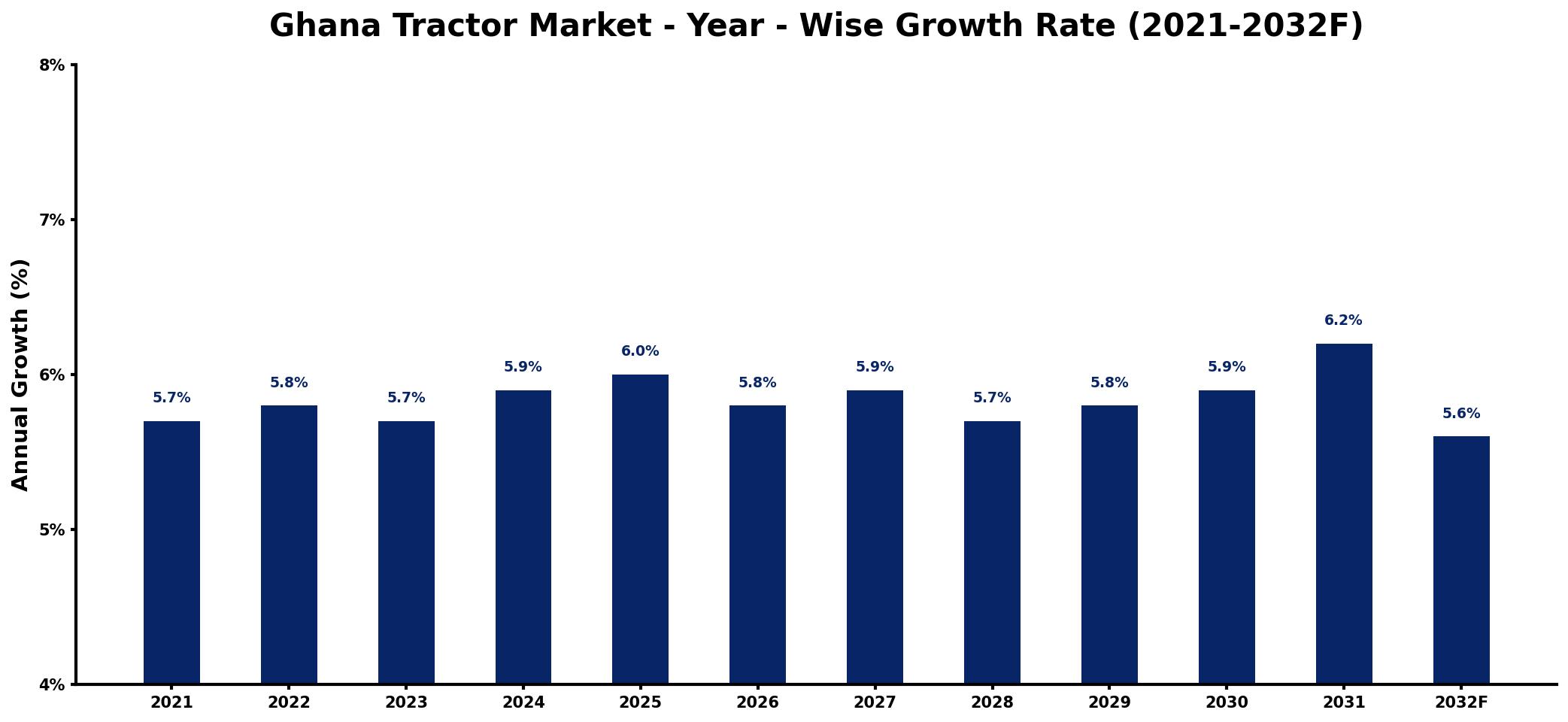
The table below presents the year‑wise growth rates along with the key drivers influencing the market
| Year | Growth Rate | Major Drivers |
| 2021 | 5.7% | Rising agricultural investment levels |
| 2022 | 5.8% | Increasing mechanization in farming |
| 2023 | 5.7% | Expansion of rural infrastructure projects |
| 2024 | 5.9% | Growing demand for crop efficiency |
| 2025 | 6.0% | Surge in export agriculture initiatives |
| 2026 | 5.8% | Enhanced access to financing options |
| 2027 | 5.9% | Government incentives for mechanization |
| 2028 | 5.7% | Development of agricultural cooperatives |
| 2029 | 5.8% | Boost in agritech innovations adoption |
| 2030 | 5.9% | Strengthened supply chain networks |
| 2031 | 6.2% | Heightened focus on sustainable practices |
| 2032 | 5.6% | Continued urbanization driving demand |
Note: Market size estimations and growth projections presented in this report are based on 6Wresearch's proprietary forecasting methodology, utilizing the latest available industry data, government publications, and primary research inputs.
Ghana Tractor Market Synopsis
The Ghana tractor market has witnessed recent momentum fueled by rising mechanization in agriculture, prompting farmers to adopt more efficient farming techniques. This shift is creating a robust demand for tractors tailored to meet the diverse needs of Ghanaian farmers, from smallholders to larger commercial enterprises.
Looking ahead, the market is expected to capitalize on government-backed programs that incentivize the procurement of tractors. These initiatives are paving the way for the integration of advanced technologies, ultimately supporting the sectors transformation towards more sustainable practices.
Ghana Tractor Market Key Takeaways
- Significant growth in the tractor market is fueled by increased mechanization efforts within the agriculture sector.
- Government policies are enhancing access to tractor ownership through subsidies and financial assistance for farmers.
- There is a marked shift toward compact and technologically advanced tractors that cater to smallholder farmers.
- Trends indicate growing demand for environmentally friendly tractors, including electric and hybrid models.
- Investment opportunities abound, particularly in distribution, leasing services, and localized manufacturing.
Evaluation of Restraints in Ghana Tractor Market
Despite the promising growth of the Ghana tractor market, several constraints hinder its full potential. Limited access to financing remains a substantial barrier for many small-scale farmers, making it difficult for them to invest in tractors. The high import duties on agricultural machinery further exacerbate this issue, increasing overall costs. Additionally, a lack of adequate maintenance services leads to extended downtimes, impacting farmers' productivity. The absence of robust infrastructure in rural areas, such as well-maintained roads and storage facilities, also poses significant challenges to effective tractor utilization.
Ghana Tractor Market Trends
The Ghana tractor market is currently characterized by notable trends that are reshaping both demand and technological advancement. Farmers are increasingly favoring compact, versatile tractors, which are essential for navigating smallholder farms effectively. Technological advancements, such as GPS-guided systems and precision farming tools, are gaining traction among progressive farmers looking to optimize productivity and minimize operational costs. Additionally, there is a growing interest in sustainable farming practices, resulting in a heightened demand for electric or hybrid tractors, reflecting the global shift towards environmentally conscious agriculture.
Ghana Tractor Market Opportunities
The Ghana tractor market holds considerable investment potential, given the country's agrarian structure and the urgent need for mechanized farming equipment. Opportunities exist in importing and distributing tractors from established international manufacturers, thereby enhancing farmers' access to modern agricultural technology. Investors may also explore partnerships with local cooperatives to provide tractor services on a rental basis, catering to those unable to afford outright purchases. Furthermore, establishing local manufacturing units can align with national goals of economic independence, potentially yielding long-term returns as the market expands.
Government Initiatives in the Ghana Tractor Market
The Ghanaian government is actively promoting agricultural mechanization through various initiatives aimed at enhancing productivity. Policies include subsidies and incentives for tractor purchases, along with tax exemptions on imported tractors, which aim to alleviate the financial burden on farmers. The establishment of partnerships with private sector players facilitates access to tractor services on a rental basis, making it easier for smallholder farmers to incorporate mechanization into their operations. Such initiatives are designed to modernize the agricultural sector, contribute to food security, and stimulate economic growth.
Future Insights of the Ghana Tractor Market
Looking toward the future, the Ghana tractor market is poised for sustained growth as mechanization becomes increasingly central to agricultural practices. The anticipated expansion will be supported by ongoing government initiatives, enhanced access to financing, and a focus on technological integration within farming. As farmers continue to adapt to the demands of modern agriculture, the market is likely to see innovations that will further enhance productivity and operational efficiency, positioning it for significant developments through 2032 and beyond.
Ghana Tractor Market Latest Developments (2025 - 2026)
Recent industry trends indicate a growing focus on the introduction of technologically advanced tractors equipped with features aimed at enhancing operational efficiency. Companies have begun exploring collaborations with local farmers to provide tailored solutions that meet the unique needs of the Ghanaian agricultural landscape. There is also a noticeable push towards sustainability, with discussions surrounding the integration of eco-friendly alternatives into the market, reflecting a global shift in agricultural practices.
Ghana Tractor Market - Key Attractiveness of the Report
- 10 Years of Market Numbers
- Historical Data Starting from 2022 to 2025
- Base Year: 2025
- Forecast Data until 2032
- Key Performance Indicators Impacting the Market
- Major Upcoming Developments and Projects
Key Highlights of the Report:
- Ghana Tractor Market Outlook
- Market Size of Ghana Tractor Market, 2025
- Forecast of Ghana Tractor Market, 2032
- Historical Data and Forecast of Ghana Tractor Revenues & Volume for the Period 2022-2032F
- Ghana Tractor Market Trend Evolution
- Ghana Tractor Market Drivers and Challenges
- Ghana Tractor Price Trends
- Ghana Tractor Porter's Five Forces
- Ghana Tractor Industry Life Cycle
- Historical Data and Forecast of Ghana Tractor Market Revenues & Volume By Power Output for the Period 2022-2032F
- Historical Data and Forecast of Ghana Tractor Market Revenues & Volume By Less Than 30 HP for the Period 2022-2032F
- Historical Data and Forecast of Ghana Tractor Market Revenues & Volume By 30-50 HP for the Period 2022-2032F
- Historical Data and Forecast of Ghana Tractor Market Revenues & Volume By 51-100 HP for the Period 2022-2032F
- Historical Data and Forecast of Ghana Tractor Market Revenues & Volume By More Than 100 HP for the Period 2022-2032F
- Historical Data and Forecast of Ghana Tractor Market Revenues & Volume By Drive Type for the Period 2022-2032F
- Historical Data and Forecast of Ghana Tractor Market Revenues & Volume By 2 Wheel Drive for the Period 2022-2032F
- Historical Data and Forecast of Ghana Tractor Market Revenues & Volume By 4 Wheel Drive for the Period 2022-2032F
- Historical Data and Forecast of Ghana Tractor Market Revenues & Volume By Application for the Period 2022-2032F
- Historical Data and Forecast of Ghana Tractor Market Revenues & Volume By Agriculture for the Period 2022-2032F
- Ghana Tractor Import Export Trade Statistics
- Market Opportunity Assessment By Power Output
- Market Opportunity Assessment By Drive Type
- Market Opportunity Assessment By Application
- Ghana Tractor Top Companies Market Share
- Ghana Tractor Competitive Benchmarking By Technical and Operational Parameters
- Ghana Tractor Company Profiles
- Ghana Tractor Key Strategic Recommendations






































