Ghana Ultrasonic Cleaning Equipment Market Size, Share & Growth Rate
The Ghana Ultrasonic Cleaning Equipment Market was estimated at USD 460 Million in 2025 and is projected to reach USD 640 Million by 2032, growing at a CAGR of 4.8% from 2026 to 2032. This growth trajectory is fueled by a rising demand for efficient and environmentally friendly cleaning solutions across various industries, including electronics, medical devices, and automotive maintenance. As organizations increasingly recognize the advantages of ultrasonic cleaning, such as its non-invasive nature and reduced reliance on harsh chemicals, market adoption continues to expand.
Ghana Ultrasonic Cleaning Equipment Market Year-wise Growth Rate and Key Drivers
This graph highlights how the Ghana Ultrasonic Cleaning Equipment Market has steadily grown over the years, supported by major growth factors.
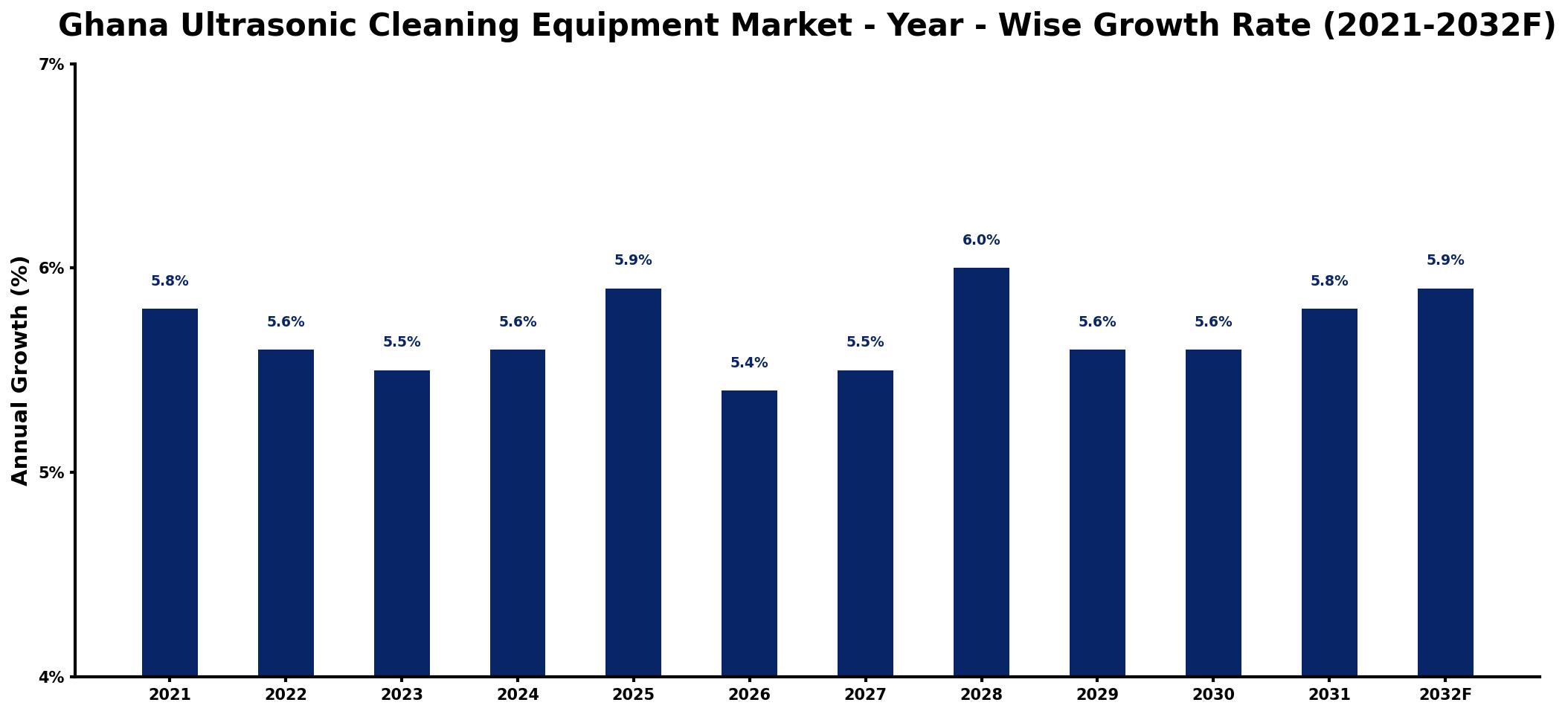
The table below presents the year‑wise growth rates along with the key drivers influencing the market
| Year | Growth Rate | Major Drivers |
| 2021 | 5.8% | Rising industrial automation adoption |
| 2022 | 5.6% | Growing healthcare sector investments |
| 2023 | 5.5% | Increased demand for precision applications |
| 2024 | 5.6% | Expansion in automotive manufacturing facilities |
| 2025 | 5.9% | Surge in electronics production activities |
| 2026 | 5.4% | Growth in research laboratory funding |
| 2027 | 5.5% | Boost in aerospace industry projects |
| 2028 | 6.0% | Heightened focus on sustainable practices |
| 2029 | 5.6% | Increase in consumer safety regulations |
| 2030 | 5.6% | Emergence of advanced technological solutions |
| 2031 | 5.8% | Growing interest in eco-friendly alternatives |
| 2032 | 5.9% | Expansion of educational institutions funding |
Note: Market size estimations and growth projections presented in this report are based on 6Wresearch's proprietary forecasting methodology, utilizing the latest available industry data, government publications, and primary research inputs.
Ghana Ultrasonic Cleaning Equipment Market Synopsis
Recently, the Ghana Ultrasonic Cleaning Equipment Market has gained momentum due to heightened awareness of sustainable cleaning practices and the advantages of ultrasonic technology. However, as the market evolves, there are significant opportunities to improve equipment reliability and compatibility with diverse cleaning agents, shaping its future landscape.
As industries push for cleaner production methods and greater operational efficiency, the ultrasonic cleaning sector in Ghana stands to benefit immensely. The potential for innovation and technological advancement provides a promising outlook for market participants aiming to meet the demand for effective cleaning solutions.
Ghana Ultrasonic Cleaning Equipment Market Key Takeaways
- The Ghana Ultrasonic Cleaning Equipment Market is set to grow significantly, reaching USD 640 Million by 2032.
- Increasing industrial focus on environmentally sustainable cleaning methods is a key market driver.
- Technological advancements are likely to enhance equipment reliability and cleaning efficiency.
- Government policies aimed at promoting industrial productivity will further boost market growth.
- Emerging sectors such as medical device production and electronics manufacturing are expanding the market scope.
Evaluation of Restraints in Ghana Ultrasonic Cleaning Equipment Market
Despite the encouraging growth prospects, several factors are hindering the Ghana Ultrasonic Cleaning Equipment Market. A primary concern revolves around equipment reliability and performance, which can impact the confidence of potential users. There are also issues related to compatibility with various cleaning agents and materials, which require careful consideration when adopting ultrasonic cleaning solutions. Moreover, competition from alternative cleaning technologies may challenge market players, necessitating continuous innovation and adaptation to maintain a competitive edge.
Ghana Ultrasonic Cleaning Equipment Market Trends
The trend toward automation and integration of advanced technologies in ultrasonic cleaning processes is gaining traction. Industries are increasingly adopting smart cleaning solutions that utilize IoT connectivity for enhanced monitoring and efficiency. Furthermore, the demand for customized cleaning solutions tailored to specific industrial needs is on the rise, prompting manufacturers to innovate and offer more versatile equipment.
Ghana Ultrasonic Cleaning Equipment Market Opportunities
The potential for growth in the Ghana Ultrasonic Cleaning Equipment Market is substantial. Key opportunities lie in the expansion of the automotive and medical device sectors, which are increasingly incorporating ultrasonic cleaning into their maintenance and production processes. Additionally, as Ghanas manufacturing capabilities advance, there will be an increasing need for precision cleaning, creating a ripe environment for investment in high-quality ultrasonic cleaning systems.
Government Initiatives in the Ghana Ultrasonic Cleaning Equipment Market
The Ghanaian government is actively promoting investment in ultrasonic cleaning technologies through various initiatives. Policies designed to enhance industrial productivity include incentives for manufacturing facilities to implement ultrasonic cleaning systems. Furthermore, the government is focusing on ensuring compliance with environmental regulations and workplace safety standards. This regulatory framework is poised to encourage companies to adopt ultrasonic cleaning solutions, thereby fostering a competitive manufacturing sector in Ghana.
Future Insights of the Ghana Ultrasonic Cleaning Equipment Market
Looking ahead to 2026-2032, the Ghana Ultrasonic Cleaning Equipment Market is expected to evolve significantly. As industries increasingly adopt sustainability as a core value, the demand for non-invasive and efficient cleaning solutions will continue to rise. Coupled with government support and growing technological advancements, the market is well-positioned for sustained growth and innovation, paving the way for enhanced operational efficiencies across various sectors.
Ghana Ultrasonic Cleaning Equipment Market Latest Developments (2025 - 2026)
Recent developments in the Ghana Ultrasonic Cleaning Equipment Market include heightened industry interest in advanced cleaning technologies and increased investment in research and development. Manufacturers are exploring innovative solutions to enhance the efficiency and effectiveness of ultrasonic cleaning systems, as well as looking into automation features to streamline operations. There is also a noticeable trend of collaboration between industry stakeholders to optimize ultrasonic cleaning processes, reflecting a collective push towards improving standards in manufacturing practices.
Ghana Ultrasonic Cleaning Equipment Market - Key Attractiveness of the Report
- 10 Years of Market Numbers
- Historical Data Starting from 2022 to 2025
- Base Year: 2025
- Forecast Data until 2032
- Key Performance Indicators Impacting the Market
- Major Upcoming Developments and Projects
Key Highlights of the Report:
- Ghana Ultrasonic Cleaning Equipment Market Outlook
- Market Size of Ghana Ultrasonic Cleaning Equipment Market, 2025
- Forecast of Ghana Ultrasonic Cleaning Equipment Market, 2032
- Historical Data and Forecast of Ghana Ultrasonic Cleaning Equipment Revenues & Volume for the Period 2022-2032F
- Ghana Ultrasonic Cleaning Equipment Market Trend Evolution
- Ghana Ultrasonic Cleaning Equipment Market Drivers and Challenges
- Ghana Ultrasonic Cleaning Equipment Price Trends
- Ghana Ultrasonic Cleaning Equipment Porter's Five Forces
- Ghana Ultrasonic Cleaning Equipment Industry Life Cycle
- Historical Data and Forecast of Ghana Ultrasonic Cleaning Equipment Market Revenues & Volume By Type for the Period 2022-2032F
- Historical Data and Forecast of Ghana Ultrasonic Cleaning Equipment Market Revenues & Volume By Standalone for the Period 2022-2032F
- Historical Data and Forecast of Ghana Ultrasonic Cleaning Equipment Market Revenues & Volume By Benchtop for the Period 2022-2032F
- Historical Data and Forecast of Ghana Ultrasonic Cleaning Equipment Market Revenues & Volume By Multistage for the Period 2022-2032F
- Historical Data and Forecast of Ghana Ultrasonic Cleaning Equipment Market Revenues & Volume By Application for the Period 2022-2032F
- Historical Data and Forecast of Ghana Ultrasonic Cleaning Equipment Market Revenues & Volume By Automotive for the Period 2022-2032F
- Historical Data and Forecast of Ghana Ultrasonic Cleaning Equipment Market Revenues & Volume By Healthcare for the Period 2022-2032F
- Historical Data and Forecast of Ghana Ultrasonic Cleaning Equipment Market Revenues & Volume By Electrical & Electronics for the Period 2022-2032F
- Historical Data and Forecast of Ghana Ultrasonic Cleaning Equipment Market Revenues & Volume By Aerospace & Defense for the Period 2022-2032F
- Historical Data and Forecast of Ghana Ultrasonic Cleaning Equipment Market Revenues & Volume By Others for the Period 2022-2032F
- Ghana Ultrasonic Cleaning Equipment Import Export Trade Statistics
- Market Opportunity Assessment By Type
- Market Opportunity Assessment By Application
- Ghana Ultrasonic Cleaning Equipment Top Companies Market Share
- Ghana Ultrasonic Cleaning Equipment Competitive Benchmarking By Technical and Operational Parameters
- Ghana Ultrasonic Cleaning Equipment Company Profiles
- Ghana Ultrasonic Cleaning Equipment Key Strategic Recommendations






































