Ghana Vegetable oils Market Summary
The ghana vegetable oils market was estimated at USD 309 Million in 2025 and is projected to reach USD 429 Million by 2032, growing at a CAGR of 5.8% from 2026 to 2032.
Ghana Vegetable oils Market Year-wise Growth Rate and Key Drivers
This graph highlights how the Ghana Vegetable oils Market has steadily grown over the past five years, supported by major growth factors.
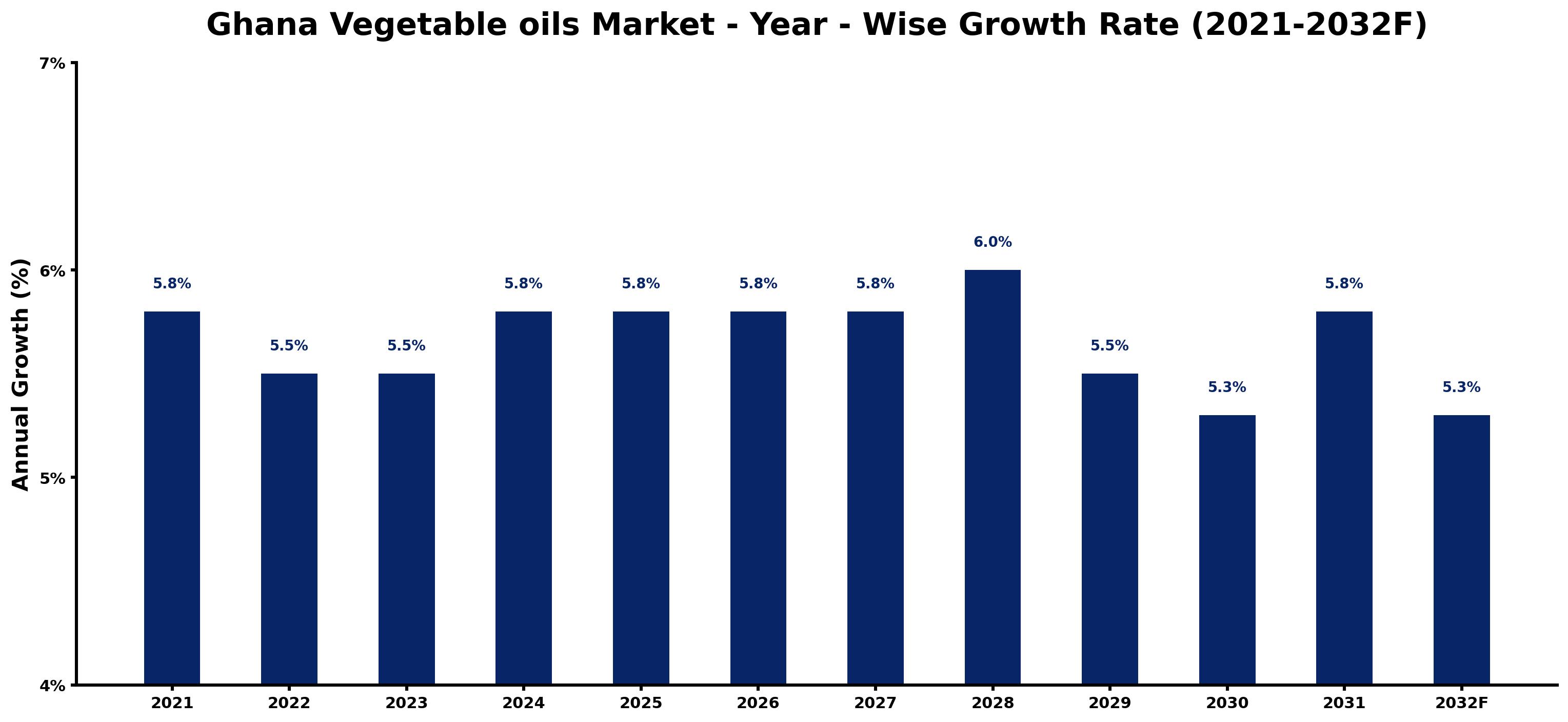
The table below presents the year wise growth rates along with the key drivers influencing the market
| Year | Growth Rate | Major Drivers |
| 2021 | 5.8% | Local production capabilities improved, enhancing the competitive landscape amid imports. |
| 2022 | 5.5% | Consumer preferences shifted towards healthier cooking options, increasing vegetable oil utilization. |
| 2023 | 5.5% | Urbanization trends elevated demand for convenient food products, influencing vegetable oil consumption patterns. |
| 2024 | 5.8% | Innovative marketing strategies emerged, targeting health-conscious consumers and increasing brand loyalty. |
| 2025 | 5.8% | Rising middle-class incomes boosted discretionary spending on quality vegetable oils. |
| 2026 | 5.8% | Sustainability initiatives began shaping consumer choices, favoring eco-friendly oil brands. |
| 2027 | 5.8% | Technological advancements in extraction methods improved oil quality and production efficiency. |
| 2028 | 6.0% | Collaborations among local producers enhanced distribution networks, expanding market reach significantly. |
| 2029 | 5.5% | E-commerce platforms gained traction, providing consumers easy access to diverse oil products. |
| 2030 | 5.3% | Export opportunities emerged as regional markets sought reliable vegetable oil suppliers. |
| 2031 | 5.8% | Increased health awareness linked to cooking oils prompted demand for organic options. |
| 2032 | 5.3% | The culinary tourism sector flourished, promoting local oil varieties internationally, boosting exports. |
Note - Market size estimations and growth projections presented in this report are based on 6Wresearch's advanced forecasting approach, validated with industry datasets as of June 2026.
Ghana Vegetable oils Market Synopsis
The Ghana Vegetable oils Market is projected to reach 5.8% and witness significant growth during the forecast period (2026-2032). This market encompasses a wide range of edible oils derived from various plant sources, including palm, soybean, sunflower, and olive oils. These vegetable oils are integral to culinary practices, serving essential roles in households, restaurants, and food processing industries for applications such as frying, baking, and salad dressing.
Ghana Vegetable oils Market Growth Drivers
Several key factors are driving growth in the Ghana Vegetable oils Market. Firstly, the expanding food and beverage industry is creating increased demand for vegetable oils. Companies are actively sourcing these oils to enhance their product offerings and cater to evolving consumer preferences.
- The rising health consciousness among consumers is significantly influencing the market, as vegetable oils are perceived as healthier cooking options due to their high unsaturated fat content and presence of vital nutrients such as vitamin E.
- As dietary habits change, there is a notable shift toward natural and nutritious food choices, further propelling the demand for vegetable oils in Ghana.
- The government's emphasis on agricultural development and food security is fostering better production practices and investment in the vegetable oils sector, thereby strengthening market growth.
- Urbanization and population growth are contributing to increased consumption rates, as a larger population requires more cooking oils to meet culinary needs.
- The growing interest in plant-based diets is encouraging both consumers and food manufacturers to choose vegetable oils as a sustainable alternative to animal fats, enhancing market opportunities.
Ghana Vegetable oils Market Challenges and Restraints
Despite the promising growth trajectory, the Ghana Vegetable oils Market faces several challenges. One major concern is the volatility of global vegetable oil prices, which can significantly impact local markets.
- Fluctuations in raw material prices can affect production costs, leading to inconsistent pricing for consumers.
- Ensuring the quality and purity of oils remains a critical issue, as consumers increasingly demand products that meet health and safety standards.
- Sustainability concerns related to the environmental impact of vegetable oil production pose a significant challenge, necessitating improved farming practices and resource management.
- Regulatory pressures for sustainable sourcing and ethical production practices are increasing, compelling producers to adapt quickly to meet compliance standards.
- Market fragmentation is another challenge, with numerous small players and informal sectors that can complicate quality assurance and standardization efforts.
Ghana Vegetable oils Market Government Investment and Initiatives
Recognizing the strategic importance of the vegetable oils sector, the Ghanaian government is actively formulating policies to support its development. Initiatives aim to enhance the cultivation and processing of oilseed crops, ensuring sustainable practices that cater to both economic and environmental needs.
- Government policies are being designed to promote the establishment of quality standards for vegetable oil products, enhancing consumer trust and product integrity.
- Incentives for investment in oil extraction and refining facilities are being introduced, fostering a more robust industrial infrastructure that supports local production.
- Collaboration with key stakeholders, including international partners, is being prioritized to innovate production techniques and improve overall supply chain efficiencies.
- The government is focused on agricultural development strategies that integrate vegetable oils into broader food security initiatives, ensuring consistency in market supply.
- Public expenditure on infrastructure improvements is being channeled toward the agriculture sector, including transportation and logistics crucial for efficient market operations.
Ghana Vegetable oils Market Latest Developments (May 2025 - June 2026)
Recent developments in the Ghana Vegetable oils Market highlight a trend of increased investments in production technology and infrastructure aimed at boosting efficiency in the sector. Various stakeholders are exploring innovations that enhance oil extraction processes, which are expected to improve yield and product quality.
In addition, there has been a growing emphasis on sustainability practices among producers, as they seek to align with global standards for environmental responsibility. As consumers become more knowledgeable about the origins and production methods of their food, the market is witnessing a push towards transparency and ethical sourcing.
Research and development efforts are also increasing, focusing on improving the nutritional profiles of vegetable oils, thereby meeting the rising demand for healthier options among consumers.
Ghana Vegetable oils Market - Key Attractiveness of the Report
- 10 Years of Market Numbers
- Historical Data Starting from 2022 to 2025
- Base Year: 2025
- Forecast Data until 2032
- Key Performance Indicators Impacting the Market
- Major Upcoming Developments and Projects
Key Highlights of the Report:
- Ghana Vegetable oils Market Outlook
- Market Size of Ghana Vegetable oils Market, 2025
- Forecast of Ghana Vegetable oils Market, 2032
- Historical Data and Forecast of Ghana Vegetable oils Revenues & Volume for the Period 2022-2032F
- Ghana Vegetable oils Market Trend Evolution
- Ghana Vegetable oils Market Drivers and Challenges
- Ghana Vegetable oils Price Trends
- Ghana Vegetable oils Porter's Five Forces
- Ghana Vegetable oils Industry Life Cycle
- Historical Data and Forecast of Ghana Vegetable oils Market Revenues & Volume By Types for the Period 2022-2032F
- Historical Data and Forecast of Ghana Vegetable oils Market Revenues & Volume By Palm Oil for the Period 2022-2032F
- Historical Data and Forecast of Ghana Vegetable oils Market Revenues & Volume By Soybean Oil for the Period 2022-2032F
- Historical Data and Forecast of Ghana Vegetable oils Market Revenues & Volume By Rapeseed Oil for the Period 2022-2032F
- Historical Data and Forecast of Ghana Vegetable oils Market Revenues & Volume By Sunflower Oil for the Period 2022-2032F
- Historical Data and Forecast of Ghana Vegetable oils Market Revenues & Volume By Olive Oil for the Period 2022-2032F
- Historical Data and Forecast of Ghana Vegetable oils Market Revenues & Volume By Others for the Period 2022-2032F
- Historical Data and Forecast of Ghana Vegetable oils Market Revenues & Volume By Applications for the Period 2022-2032F
- Historical Data and Forecast of Ghana Vegetable oils Market Revenues & Volume By Food for the Period 2022-2032F
- Historical Data and Forecast of Ghana Vegetable oils Market Revenues & Volume By Feed for the Period 2022-2032F
- Historical Data and Forecast of Ghana Vegetable oils Market Revenues & Volume By Industrial for the Period 2022-2032F
- Ghana Vegetable oils Import Export Trade Statistics
- Market Opportunity Assessment By Types
- Market Opportunity Assessment By Applications
- Ghana Vegetable oils Top Companies Market Share
- Ghana Vegetable oils Competitive Benchmarking By Technical and Operational Parameters
- Ghana Vegetable oils Company Profiles
- Ghana Vegetable oils Key Strategic Recommendations






































