Ghana Wall Covering Market Size, Share & Growth Rate
The Ghana Wall Covering Market was estimated at USD 370 Million in 2025 and is projected to reach USD 536 Million by 2032, growing at a CAGR of 5.4% from 2026 to 2032. This growth trajectory is fueled by a combination of increasing urbanization and a rising middle class eager to invest in home aesthetics. Furthermore, the robust expansion of the construction industry aligns with the growing demand for stylish and sustainable interior design solutions.
Ghana Wall Covering Market Year-wise Growth Rate and Key Drivers
This graph highlights how the Ghana Wall Covering Market has steadily grown over the years, supported by major growth factors.
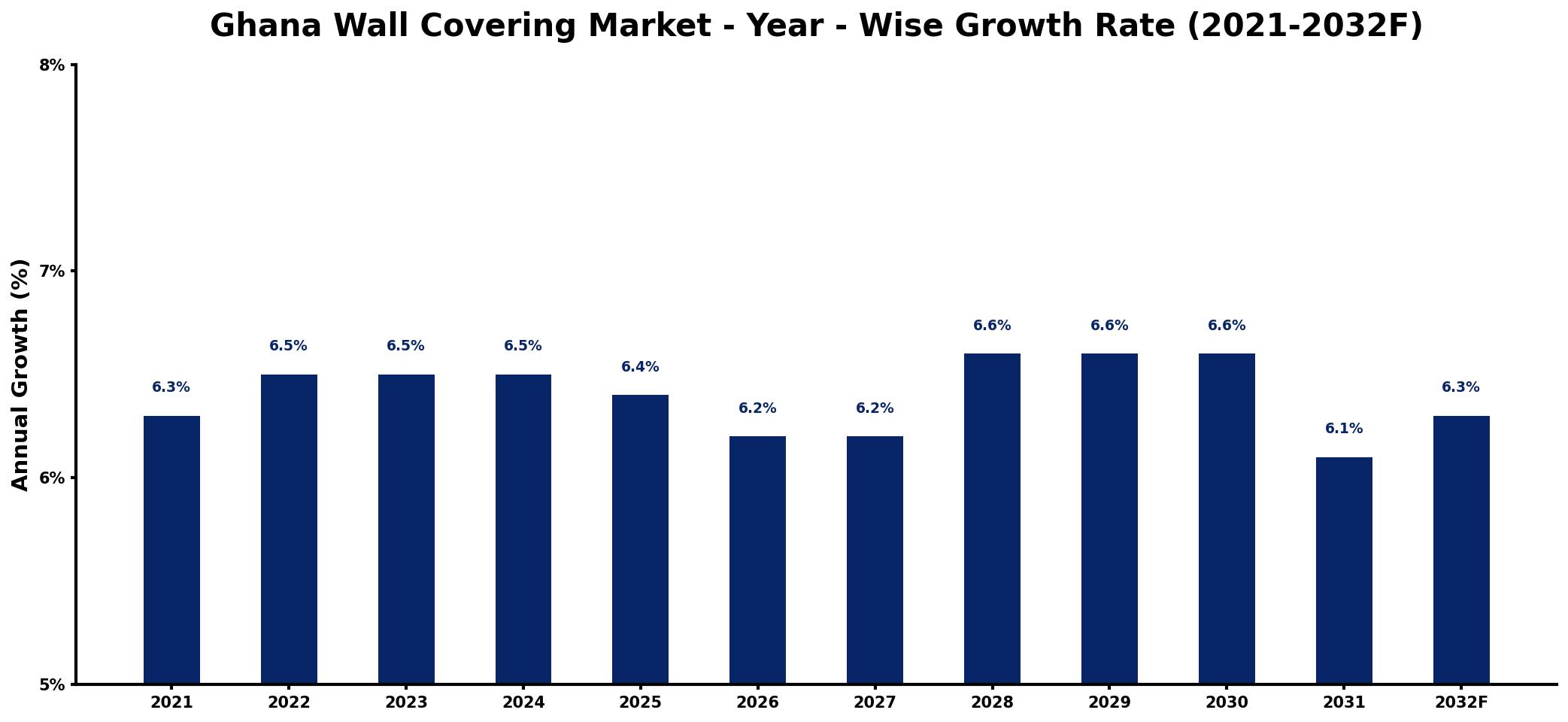
The table below presents the year‑wise growth rates along with the key drivers influencing the market
| Year | Growth Rate | Major Drivers |
| 2021 | 6.3% | Rising residential construction projects |
| 2022 | 6.5% | Increased disposable income levels |
| 2023 | 6.5% | Growing popularity of renovations |
| 2024 | 6.5% | Expansion of commercial spaces |
| 2025 | 6.4% | Surge in interior design trends |
| 2026 | 6.2% | Investment in sustainable materials |
| 2027 | 6.2% | Increase in urban population density |
| 2028 | 6.6% | Emergence of innovative design solutions |
| 2029 | 6.6% | Growth in hospitality sector demand |
| 2030 | 6.6% | Enhanced focus on aesthetic appeal |
| 2031 | 6.1% | Rising interest in DIY projects |
| 2032 | 6.3% | Development of modern living spaces |
Note: Market size estimations and growth projections presented in this report are based on 6Wresearch's proprietary forecasting methodology, utilizing the latest available industry data, government publications, and primary research inputs.
Ghana Wall Covering Market Synopsis
The rising interest in home improvement projects is reshaping consumer preferences, with many seeking innovative wall coverings that reflect personal style. This shift is particularly evident in urban centers where disposable incomes are climbing, allowing for greater spending on interior décor.
In addition to aesthetic considerations, there is an increasing emphasis on eco-friendly and sustainable materials. Consumers in Ghana are becoming more discerning, leading to a surge in demand for wall coverings that are not only beautiful but also environmentally responsible.
Ghana Wall Covering Market Key Takeaways
- Growing urbanization is driving demand for stylish wall covering options across Ghana.
- Consumer preferences are shifting towards sustainable materials, creating opportunities for eco-friendly product offerings.
- Customization is emerging as a key trend, with consumers desiring unique designs for their living spaces.
- The booming construction sector is poised to contribute significantly to market growth.
- Government initiatives are supporting local manufacturing, impacting pricing and availability of wall covering products.
Evaluation of Restraints in Ghana Wall Covering Market
Despite the promising growth potential, the Ghana Wall Covering Market faces several constraints. Limited consumer awareness about the benefits of modern wall coverings presents a barrier, as many still lean towards traditional methods like painting. Additionally, there exists a notable price sensitivity among consumers, leading to a preference for lower-cost alternatives. The challenge is compounded by a lack of variety and high-quality options, particularly in rural areas where distribution channels are less developed. Addressing these issues through targeted marketing and expanded distribution could significantly enhance market penetration.
Ghana Wall Covering Market Trends
The Ghana Wall Covering Market is increasingly influenced by trends toward sustainability. Products made from natural fibers and recycled materials are gaining traction, reflecting a shift in consumer values towards environmental responsibility. Additionally, advancements in digital printing technology enable manufacturers to offer intricate designs and customizable options that appeal to a younger demographic eager to personalize their spaces. This trend towards customization is reshaping the competitive landscape, compelling brands to innovate continuously.
Ghana Wall Covering Market Opportunities
There are significant investment opportunities in the Ghana Wall Covering Market across both residential and commercial segments. The rise of the middle class and their increasing purchasing power creates a favorable environment for quality wall covering products. Investors can capitalize on the demand for sustainable options and unique designs that cater to diverse consumer preferences. Additionally, establishing partnerships with local manufacturers and enhancing distribution networks can facilitate market access and drive growth.
Government Initiatives in the Ghana Wall Covering Market
Government policies have begun to play a pivotal role in shaping the Ghana Wall Covering Market. With an emphasis on bolstering local manufacturing, the government has implemented high tariffs on imported wall coverings, aiming to protect domestic producers. These initiatives not only promote local economic growth but also encourage the development of innovative and quality products. Furthermore, there are regulations in place to ensure compliance with safety and quality standards, contributing to a more reliable market environment.
Future Insights of the Ghana Wall Covering Market
Looking ahead to 2026-2032, the Ghana Wall Covering Market is expected to experience steady growth driven by urbanization, rising disposable incomes, and the ongoing evolution of interior design preferences. The increasing focus on aesthetics and sustainability will further stimulate demand for innovative wall coverings. As the construction industry continues to flourish, manufacturers and retailers must adapt to the changing landscape, ensuring they offer products that align with consumer values while capturing market share.
Ghana Wall Covering Market Latest Developments (2025 - 2026)
Recent developments in the Ghana Wall Covering Market indicate a strong inclination towards technology-driven solutions and sustainable practices. Companies are increasingly focusing on eco-friendly materials and innovative designs that resonate with a more environmentally conscious consumer base. Marketing campaigns have begun to emphasize the benefits of wall coverings over traditional finishes, enhancing awareness and interest in modern options.
Ghana Wall Covering Market - Key Attractiveness of the Report
- 10 Years of Market Numbers
- Historical Data Starting from 2022 to 2025
- Base Year: 2025
- Forecast Data until 2032
- Key Performance Indicators Impacting the Market
- Major Upcoming Developments and Projects
Key Highlights of the Report:
- Ghana Wall Covering Market Outlook
- Market Size of Ghana Wall Covering Market, 2025
- Forecast of Ghana Wall Covering Market, 2032
- Historical Data and Forecast of Ghana Wall Covering Revenues & Volume for the Period 2022-2032F
- Ghana Wall Covering Market Trend Evolution
- Ghana Wall Covering Market Drivers and Challenges
- Ghana Wall Covering Price Trends
- Ghana Wall Covering Porter's Five Forces
- Ghana Wall Covering Industry Life Cycle
- Historical Data and Forecast of Ghana Wall Covering Market Revenues & Volume By Product Type for the Period 2022-2032F
- Historical Data and Forecast of Ghana Wall Covering Market Revenues & Volume By Wall Panel for the Period 2022-2032F
- Historical Data and Forecast of Ghana Wall Covering Market Revenues & Volume By Wall Paper for the Period 2022-2032F
- Historical Data and Forecast of Ghana Wall Covering Market Revenues & Volume By Tile for the Period 2022-2032F
- Historical Data and Forecast of Ghana Wall Covering Market Revenues & Volume By Metal Wall Covering for the Period 2022-2032F
- Historical Data and Forecast of Ghana Wall Covering Market Revenues & Volume By Other Product Types for the Period 2022-2032F
- Historical Data and Forecast of Ghana Wall Covering Market Revenues & Volume By Application for the Period 2022-2032F
- Historical Data and Forecast of Ghana Wall Covering Market Revenues & Volume By Commercial for the Period 2022-2032F
- Historical Data and Forecast of Ghana Wall Covering Market Revenues & Volume By Residential for the Period 2022-2032F
- Historical Data and Forecast of Ghana Wall Covering Market Revenues & Volume By Distribution Channel for the Period 2022-2032F
- Historical Data and Forecast of Ghana Wall Covering Market Revenues & Volume By Specialty Store for the Period 2022-2032F
- Historical Data and Forecast of Ghana Wall Covering Market Revenues & Volume By Home Center for the Period 2022-2032F
- Historical Data and Forecast of Ghana Wall Covering Market Revenues & Volume By Building Material Dealer for the Period 2022-2032F
- Historical Data and Forecast of Ghana Wall Covering Market Revenues & Volume By Furniture Store for the Period 2022-2032F
- Historical Data and Forecast of Ghana Wall Covering Market Revenues & Volume By Mass Merchandizer for the Period 2022-2032F
- Historical Data and Forecast of Ghana Wall Covering Market Revenues & Volume By E-commerce for the Period 2022-2032F
- Historical Data and Forecast of Ghana Wall Covering Market Revenues & Volume By Other Distribution Channels for the Period 2022-2032F
- Ghana Wall Covering Import Export Trade Statistics
- Market Opportunity Assessment By Product Type
- Market Opportunity Assessment By Application
- Market Opportunity Assessment By Distribution Channel
- Ghana Wall Covering Top Companies Market Share
- Ghana Wall Covering Competitive Benchmarking By Technical and Operational Parameters
- Ghana Wall Covering Company Profiles
- Ghana Wall Covering Key Strategic Recommendations






































