Ghana Wireless Charging Market Size, Share & Growth Rate
The Ghana Wireless Charging Market was estimated at USD 382 Million in 2025 and is projected to reach USD 547 Million by 2032, growing at a CAGR of 5.3% from 2026 to 2032. This upward trajectory is propelled by the rising adoption of smartphones and other electronic devices that support wireless charging, alongside a growing desire for user-friendly charging solutions. Moreover, the government's initiatives to foster digital technology adoption are creating a conducive environment for the market's expansion.
Ghana Wireless Charging Market Year-wise Growth Rate and Key Drivers
This graph highlights how the Ghana Wireless Charging Market has steadily grown over the years, supported by major growth factors.
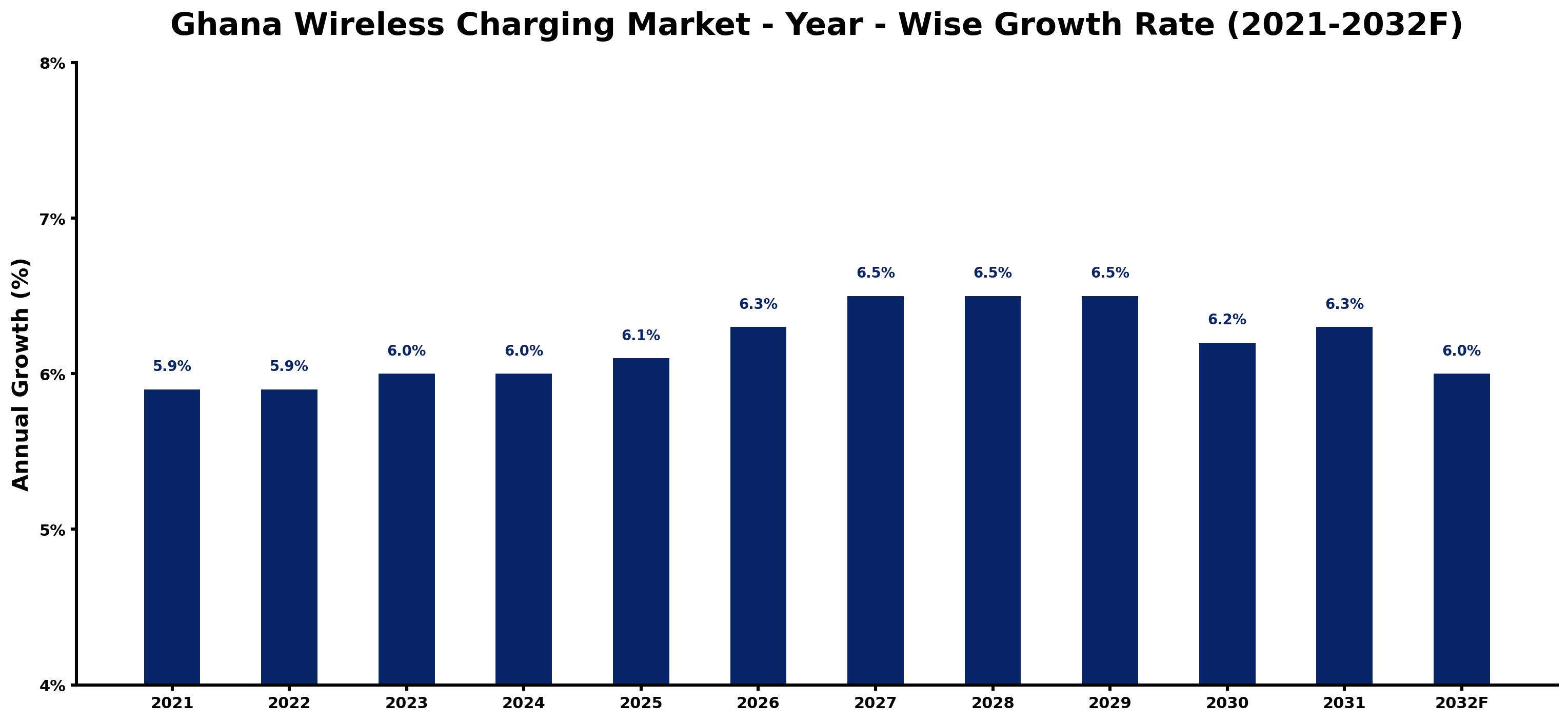
The table below presents the year‑wise growth rates along with the key drivers influencing the market
| Year | Growth Rate | Major Drivers |
| 2021 | 5.9% | Increasing industrial infrastructure investments |
| 2022 | 5.9% | Growing urbanization and commercial development |
| 2023 | 6.0% | Increasing adoption of advanced technologies |
| 2024 | 6.0% | Government infrastructure modernization initiatives |
| 2025 | 6.1% | Increasing adoption of advanced technologies |
| 2026 | 6.3% | Government infrastructure modernization initiatives |
| 2027 | 6.5% | Increasing industrial infrastructure investments |
| 2028 | 6.5% | Increasing adoption of advanced technologies |
| 2029 | 6.5% | Growing urbanization and commercial development |
| 2030 | 6.2% | Increasing industrial automation investments |
| 2031 | 6.3% | Expansion of transportation and logistics networks |
| 2032 | 6.0% | Expansion of transportation and logistics networks |
Note - Market size estimations and growth projections presented in this report are based on 6Wresearch’s advanced forecasting approach, validated with industry datasets as of June 2026.
Ghana Wireless Charging Market Synopsis
In recent years, the Ghana wireless charging market has gained momentum, largely driven by the uptick in mobile device usage. However, this is only the beginning, as the trajectory suggests substantial growth fueled by technological advancements and increased consumer awareness regarding the benefits of wireless charging. As the market evolves, more innovative products and solutions are likely to emerge.
Looking ahead, the market is set to further embrace the convenience of wireless charging options. Growing familiarity with the technology will enhance consumer acceptance, potentially leading to wider implementation across homes, offices, and public spaces. As the demand for wireless charging solutions continues to grow, the market is gearing up for remarkable developments.
Ghana Wireless Charging Market Key Takeaways
- The Ghana Wireless Charging Market is projected to grow significantly, reaching USD 547 Million by 2032.
- Key drivers include the increasing adoption of smartphones and a greater focus on convenient charging methods.
- Consumer awareness is critical for overcoming adoption hurdles and fostering market growth.
- Investment opportunities lie in product innovation and partnerships with local retailers.
- Government initiatives promoting technology and sustainability are supportive of market development.
Evaluation of Restraints in Ghana Wireless Charging Market
Despite the potential for growth, the Ghana wireless charging market faces several constraints. Primarily, limited consumer awareness presents a challenge, as many individuals remain unfamiliar with the technology and its benefits. Additionally, the cost of wireless charging accessories can deter potential users, particularly in a market characterized by price sensitivity. Furthermore, the availability of compatible devices and the need for standardization in charging technology can impede widespread adoption. Addressing these factors through targeted educational campaigns and competitive pricing strategies is essential for unlocking the market's full potential.
Ghana Wireless Charging Market Trends
Current trends indicate a strong shift towards adopting wireless charging solutions, as consumers increasingly prioritize convenience and efficiency. Wireless charging pads and stands are becoming popular choices among tech-savvy individuals. The market is also witnessing a surge in awareness of the advantages of wireless charging, such as the elimination of cable clutter. Technological advancements are leading to faster charging speeds and broader compatibility across devices, further driving the demand for wireless solutions in Ghana.
Ghana Wireless Charging Market Opportunities
Investment opportunities in the Ghana Wireless Charging Market are ripe and varied. With smartphone usage on the rise, there is ample scope for companies to introduce innovative wireless charging products tailored to local needs. Manufacturing and distributing wireless charging devices for households, offices, and public spaces offers considerable potential. Additionally, investing in research and development to create cutting-edge solutions that address the unique challenges faced by Ghanaian consumers could yield fruitful returns. Collaborations with local retailers to promote these products will further enhance market penetration and consumer engagement.
Government Initiatives in the Ghana Wireless Charging Market
While the government of Ghana has not implemented specific policies targeting the wireless charging market, its broader focus on technological innovation is evident. Various initiatives aimed at fostering digitalization and supporting the technology sector indicate a favorable regulatory environment for the adoption of wireless charging technologies. As interest in renewable energy and sustainable solutions grows, there is potential for future government actions to facilitate the expansion of wireless charging, aligning with global trends.
Future Insights of the Ghana Wireless Charging Market
The outlook for the Ghana Wireless Charging Market appears optimistic, with anticipated growth driven by increasing smartphone adoption and the demand for convenient charging solutions. As consumers prioritize efficient charging methods, the trend towards wireless solutions is likely to accelerate. The integration of faster charging technology and the expansion of compatibility across devices are expected to propel market growth further. Collaborative efforts between industry players and supportive government initiatives will continue to foster an environment conducive to market expansion, making wireless charging an integral part of the technological landscape in Ghana.
Ghana Wireless Charging Market Latest Developments (May 2025 - June 2026)
Recent developments in the Ghana wireless charging market indicate a growing focus on product innovation and accessibility. Companies are increasingly introducing new wireless charging devices tailored to local consumer preferences, enhancing their market presence. Strategic partnerships between manufacturers and local retailers are becoming more common as brands aim to leverage local distribution networks. Additionally, heightened awareness campaigns are expected to address consumer education, ultimately driving greater adoption rates in the coming years.
Ghana Wireless Charging Market - Key Attractiveness of the Report
- 10 Years of Market Numbers
- Historical Data Starting from 2022 to 2025
- Base Year: 2025
- Forecast Data until 2032
- Key Performance Indicators Impacting the Market
- Major Upcoming Developments and Projects
Key Highlights of the Report:
- Ghana Wireless Charging Market Outlook
- Market Size of Ghana Wireless Charging Market, 2025
- Forecast of Ghana Wireless Charging Market, 2032
- Historical Data and Forecast of Ghana Wireless Charging Revenues & Volume for the Period 2022-2032F
- Ghana Wireless Charging Market Trend Evolution
- Ghana Wireless Charging Market Drivers and Challenges
- Ghana Wireless Charging Price Trends
- Ghana Wireless Charging Porter's Five Forces
- Ghana Wireless Charging Industry Life Cycle
- Historical Data and Forecast of Ghana Wireless Charging Market Revenues & Volume By Technology for the Period 2022-2032F
- Historical Data and Forecast of Ghana Wireless Charging Market Revenues & Volume By Resonant for the Period 2022-2032F
- Historical Data and Forecast of Ghana Wireless Charging Market Revenues & Volume By RF for the Period 2022-2032F
- Historical Data and Forecast of Ghana Wireless Charging Market Revenues & Volume By Inductive for the Period 2022-2032F
- Historical Data and Forecast of Ghana Wireless Charging Market Revenues & Volume By Others for the Period 2022-2032F
- Historical Data and Forecast of Ghana Wireless Charging Market Revenues & Volume By Applications for the Period 2022-2032F
- Historical Data and Forecast of Ghana Wireless Charging Market Revenues & Volume By Healthcare for the Period 2022-2032F
- Historical Data and Forecast of Ghana Wireless Charging Market Revenues & Volume By Automotive for the Period 2022-2032F
- Historical Data and Forecast of Ghana Wireless Charging Market Revenues & Volume By Consumer Electronics for the Period 2022-2032F
- Historical Data and Forecast of Ghana Wireless Charging Market Revenues & Volume By Industrial for the Period 2022-2032F
- Historical Data and Forecast of Ghana Wireless Charging Market Revenues & Volume By Others for the Period 2022-2032F
- Ghana Wireless Charging Import Export Trade Statistics
- Market Opportunity Assessment By Technology
- Market Opportunity Assessment By Applications
- Ghana Wireless Charging Top Companies Market Share
- Ghana Wireless Charging Competitive Benchmarking By Technical and Operational Parameters
- Ghana Wireless Charging Company Profiles
- Ghana Wireless Charging Key Strategic Recommendations






































