Ghana Wood Charcoal Market Size, Share & Growth Rate
The Ghana Wood Charcoal Market was estimated at USD 254 Million in 2025 and is projected to reach USD 322 Million by 2032, growing at a CAGR of 3.4% from 2026 to 2032. This growth trajectory is driven primarily by the substantial reliance on biomass energy for everyday cooking and heating needs, especially in rural communities. Furthermore, the ongoing urbanization and the burgeoning food and hospitality sectors are expected to bolster the demand for wood charcoal in urban settings.
Ghana Wood Charcoal Market Year-wise Growth Rate and Key Drivers
This graph highlights how the Ghana Wood Charcoal Market has steadily grown over the years, supported by major growth factors.
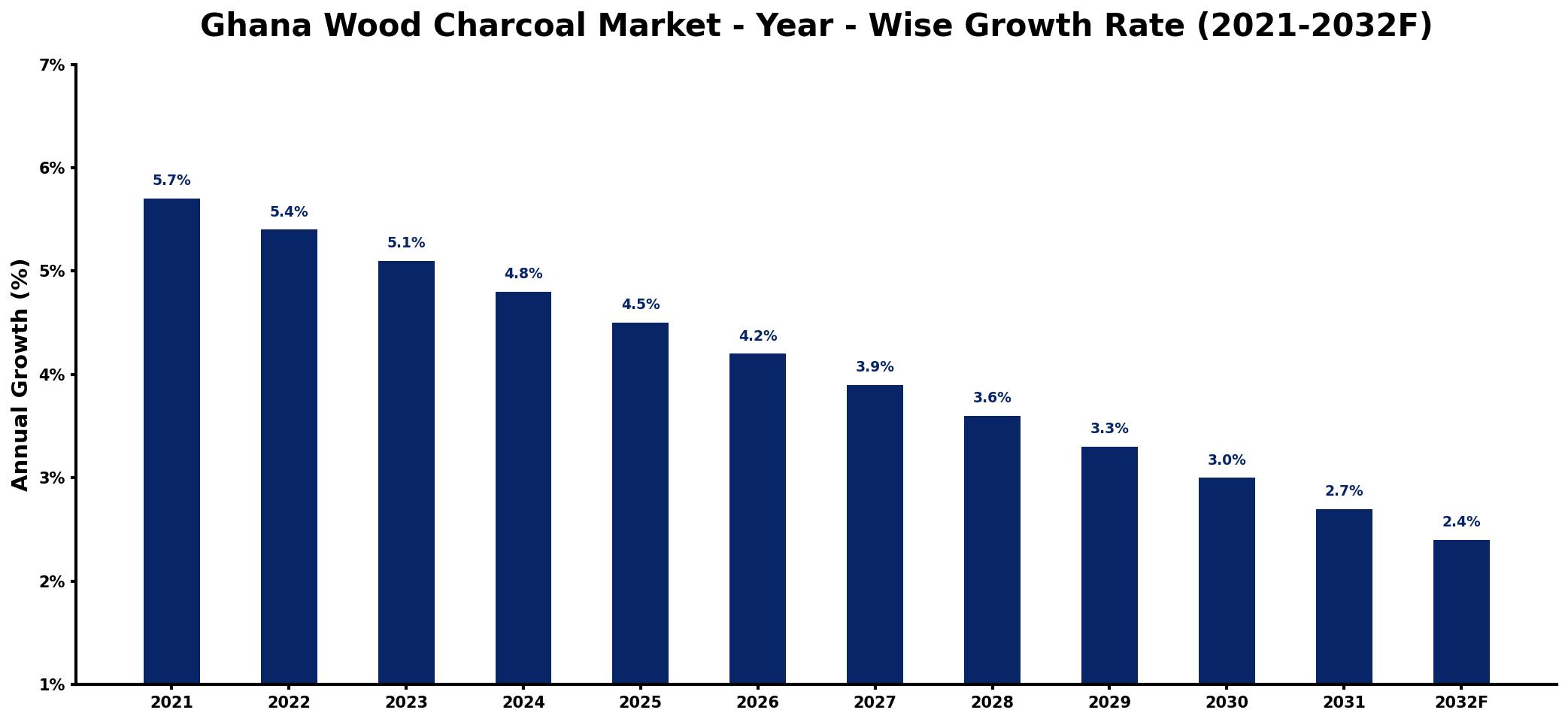
The table below presents the year‑wise growth rates along with the key drivers influencing the market
| Year | Growth Rate | Major Drivers |
| 2021 | 5.7% | Rising demand for energy sources |
| 2022 | 5.4% | Expansion of export markets |
| 2023 | 5.1% | Increased consumer preferences shift |
| 2024 | 4.8% | Growing urbanization and infrastructure |
| 2025 | 4.5% | Investment in sustainable practices |
| 2026 | 4.2% | Emerging market opportunities arise |
| 2027 | 3.9% | Enhanced distribution network efficiency |
| 2028 | 3.6% | Strengthening local production capabilities |
| 2029 | 3.3% | Technological advancements in processing |
| 2030 | 3.0% | Growing awareness of environmental benefits |
| 2031 | 2.7% | Diversification of energy sources available |
| 2032 | 2.4% | Continued focus on renewable alternatives |
Note: Market size estimations and growth projections presented in this report are based on 6Wresearch's proprietary forecasting methodology, utilizing the latest available industry data, government publications, and primary research inputs.
Ghana Wood Charcoal Market Synopsis
The wood charcoal market in Ghana plays a pivotal role in meeting energy needs across households, restaurants, and small-scale industries. Its significance as a primary cooking fuel persists, particularly where affordability and availability remain critical to daily life.
Currently, environmental concerns about deforestation and the quest for sustainable practices are shaping the market landscape. Charcoal serves not only as a fuel source but also as a raw material for various industrial applications, highlighting its versatility in economic activities.
Ghana Wood Charcoal Market Key Takeaways
- High dependency on wood charcoal as a primary energy source for cooking and heating.
- Urban population growth is increasing the demand for charcoal in various sectors.
- Government policies aim to ensure sustainability and environmental conservation in charcoal production.
- Quality assurance in charcoal products is becoming a focal point for producers and regulators.
- Emerging technologies are opening avenues for innovative charcoal-related applications.
Evaluation of Restraints in Ghana Wood Charcoal Market
Despite the promising growth of the Ghana wood charcoal market, several factors restrain its full potential. A significant challenge is the sustainability of biomass production, with concerns regarding deforestation and environmental degradation taking precedence. Furthermore, maintaining the quality of charcoal products in the face of increasing demand can be problematic. Additionally, competition from alternative cooking fuels poses a significant threat to market stability, requiring stakeholders to innovate and adapt.
Ghana Wood Charcoal Market Trends
A notable trend in the Ghana wood charcoal market is the growing shift towards sustainable practices and production methods. This includes the introduction of charcoal briquettes made from agricultural waste, which provides an eco-friendly alternative to traditional methods. Additionally, the urbanization trend has prompted a rise in demand for charcoal in restaurants and food services, pushing producers to cater to this expanding market segment. Enhanced quality controls and the development of activated carbon from charcoal are also gaining traction, catering to diverse industrial needs.
Ghana Wood Charcoal Market Opportunities
Investment opportunities abound in the Ghana wood charcoal market, especially in the realm of sustainable production technologies. Stakeholders can explore eco-friendly charcoal production methods, including the use of biomass waste for briquettes. There is also potential for expanding the market for activated carbon, driven by its increasing application across various industries, including water purification and air filtration. The push for reforestation initiatives presents a unique opportunity for companies to integrate environmentally responsible practices into their operations, enhancing their brand image and market reach.
Government Initiatives in the Ghana Wood Charcoal Market
The Ghanaian government actively regulates the wood charcoal market with policies focused on promoting sustainable forest management and environmental conservation. These regulations encompass aspects of charcoal production, including harvesting and transportation, to mitigate adverse environmental impacts. Furthermore, the government is investing in reforestation initiatives and offering incentives for adopting sustainable charcoal production practices, thereby fostering a more responsible industry landscape. Programs aimed at developing alternative energy sources are also in place, underscoring the government's commitment to a more diversified energy strategy.
Future Insights of the Ghana Wood Charcoal Market
Looking ahead to the period from 2026 to 2032, the Ghana wood charcoal market is set to evolve significantly. The anticipated growth will be underpinned by urbanization trends, which will amplify the demand from both residential and commercial sectors. Furthermore, an increased emphasis on sustainable production practices is likely to reshape the industry, potentially leading to innovations that can meet both environmental and consumer needs. Collaboration among producers, government bodies, and environmental organizations will be critical in navigating challenges while capitalizing on market opportunities.
Ghana Wood Charcoal Market Latest Developments (2025 - 2026)
In recent months, the Ghana wood charcoal market has experienced a number of shifts towards sustainable production practices. Various initiatives have been launched to promote the use of agricultural waste in charcoal briquettes, which are gaining popularity among urban consumers. Concurrently, discussions regarding stricter regulations on charcoal harvesting have intensified, highlighting the government's focus on environmental conservation. Industry stakeholders are also investing in quality assurance measures to meet rising consumer expectations for environmentally friendly products.
Ghana Wood Charcoal Market - Key Attractiveness of the Report
- 10 Years of Market Numbers
- Historical Data Starting from 2022 to 2025
- Base Year: 2025
- Forecast Data until 2032
- Key Performance Indicators Impacting the Market
- Major Upcoming Developments and Projects
Key Highlights of the Report:
- Ghana Wood Charcoal Market Outlook
- Market Size of Ghana Wood Charcoal Market, 2025
- Forecast of Ghana Wood Charcoal Market, 2032
- Historical Data and Forecast of Ghana Wood Charcoal Revenues & Volume for the Period 2022-2032F
- Ghana Wood Charcoal Market Trend Evolution
- Ghana Wood Charcoal Market Drivers and Challenges
- Ghana Wood Charcoal Price Trends
- Ghana Wood Charcoal Porter's Five Forces
- Ghana Wood Charcoal Industry Life Cycle
- Historical Data and Forecast of Ghana Wood Charcoal Market Revenues & Volume By Product for the Period 2022-2032F
- Historical Data and Forecast of Ghana Wood Charcoal Market Revenues & Volume By Charcoal Lumps for the Period 2022-2032F
- Historical Data and Forecast of Ghana Wood Charcoal Market Revenues & Volume By Charcoal Briquettes for the Period 2022-2032F
- Historical Data and Forecast of Ghana Wood Charcoal Market Revenues & Volume By Charcoal Powder for the Period 2022-2032F
- Historical Data and Forecast of Ghana Wood Charcoal Market Revenues & Volume By Wood for the Period 2022-2032F
- Historical Data and Forecast of Ghana Wood Charcoal Market Revenues & Volume By Softwood for the Period 2022-2032F
- Historical Data and Forecast of Ghana Wood Charcoal Market Revenues & Volume By Hardwood for the Period 2022-2032F
- Historical Data and Forecast of Ghana Wood Charcoal Market Revenues & Volume By Application for the Period 2022-2032F
- Historical Data and Forecast of Ghana Wood Charcoal Market Revenues & Volume By Fuel Feedstock for the Period 2022-2032F
- Historical Data and Forecast of Ghana Wood Charcoal Market Revenues & Volume By Reducing Agent for the Period 2022-2032F
- Historical Data and Forecast of Ghana Wood Charcoal Market Revenues & Volume By Filtration Agent & Gas Masking for the Period 2022-2032F
- Historical Data and Forecast of Ghana Wood Charcoal Market Revenues & Volume By Decolorizing Agent for the Period 2022-2032F
- Historical Data and Forecast of Ghana Wood Charcoal Market Revenues & Volume By Gastric Medicine for the Period 2022-2032F
- Historical Data and Forecast of Ghana Wood Charcoal Market Revenues & Volume By Sketches & Paints for the Period 2022-2032F
- Historical Data and Forecast of Ghana Wood Charcoal Market Revenues & Volume By Soil Conditioning for the Period 2022-2032F
- Historical Data and Forecast of Ghana Wood Charcoal Market Revenues & Volume By Others for the Period 2022-2032F
- Historical Data and Forecast of Ghana Wood Charcoal Market Revenues & Volume By End Use for the Period 2022-2032F
- Historical Data and Forecast of Ghana Wood Charcoal Market Revenues & Volume By Residential for the Period 2022-2032F
- Historical Data and Forecast of Ghana Wood Charcoal Market Revenues & Volume By Cooking Fuel for the Period 2022-2032F
- Historical Data and Forecast of Ghana Wood Charcoal Market Revenues & Volume By Gardening for the Period 2022-2032F
- Historical Data and Forecast of Ghana Wood Charcoal Market Revenues & Volume By Commercial Paints & Sketches for the Period 2022-2032F
- Historical Data and Forecast of Ghana Wood Charcoal Market Revenues & Volume By Water Treatment for the Period 2022-2032F
- Historical Data and Forecast of Ghana Wood Charcoal Market Revenues & Volume By Industrial for the Period 2022-2032F
- Ghana Wood Charcoal Import Export Trade Statistics
- Market Opportunity Assessment By Product
- Market Opportunity Assessment By Wood
- Market Opportunity Assessment By Application
- Market Opportunity Assessment By End Use
- Ghana Wood Charcoal Top Companies Market Share
- Ghana Wood Charcoal Competitive Benchmarking By Technical and Operational Parameters
- Ghana Wood Charcoal Company Profiles
- Ghana Wood Charcoal Key Strategic Recommendations






































