Ghana Wood Flooring Market Summary
The ghana wood flooring market was estimated at USD 442 Million in 2025 and is projected to reach USD 584 Million by 2032, growing at a CAGR of 4.4% from 2026 to 2032.
Ghana Wood Flooring Market Year-wise Growth Rate and Key Drivers
This graph highlights how the Ghana Wood Flooring Market has steadily grown over the past five years, supported by major growth factors.
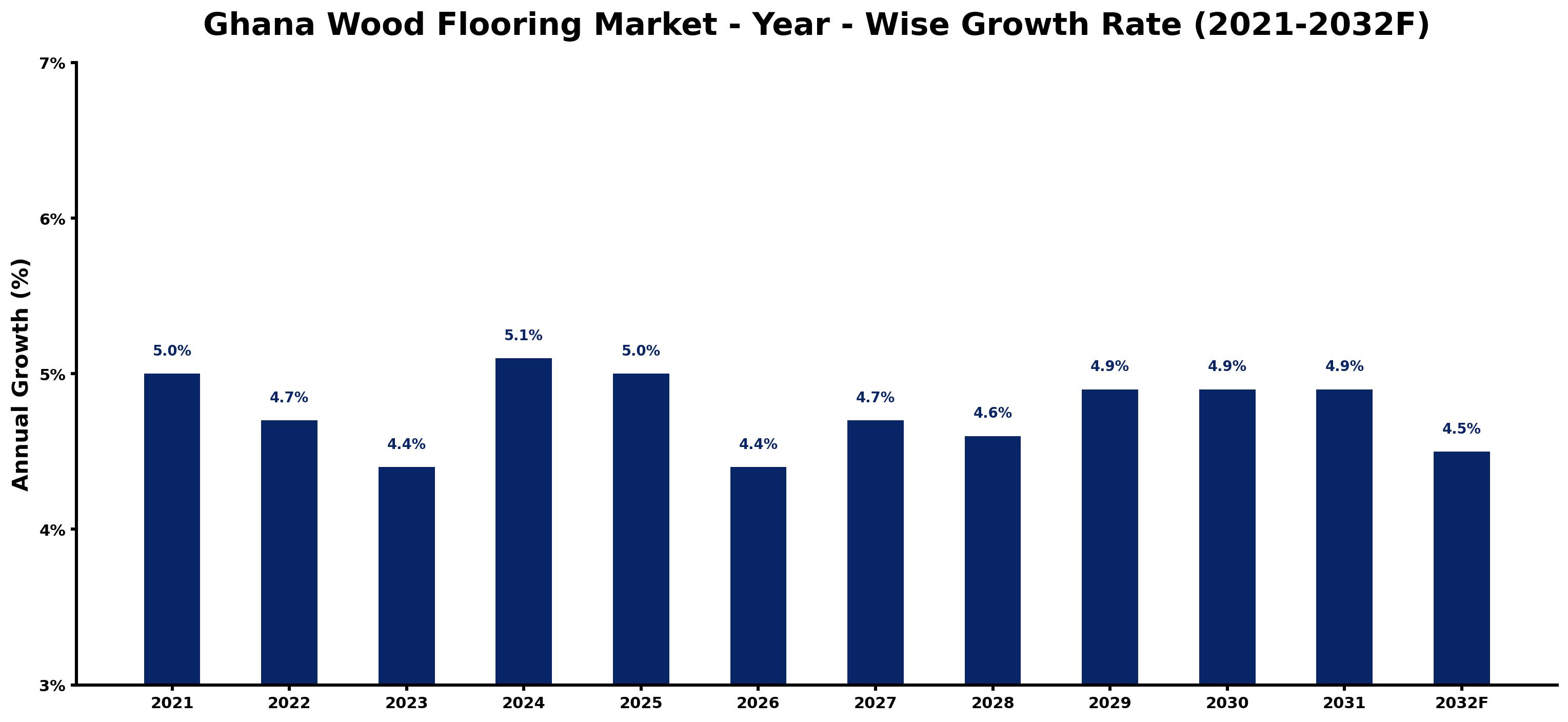
The table below presents the year wise growth rates along with the key drivers influencing the market
| Year | Growth Rate | Major Drivers |
| 2021 | 5.0% | Home improvement enthusiasts increasingly prefer natural materials over synthetic options. |
| 2022 | 4.7% | Urbanization trends lead to more residential construction and renovation projects. |
| 2023 | 4.4% | Consumers show heightened awareness regarding sustainable and eco-friendly flooring options. |
| 2024 | 5.1% | Local manufacturers improve their supply chains, increasing accessibility to quality wood flooring. |
| 2025 | 5.0% | Architects and designers favor wood flooring for its aesthetic and functional benefits. |
| 2026 | 4.4% | International brands enter the market, enhancing product variety and competition. |
| 2027 | 4.7% | The hospitality sector invests heavily in premium flooring solutions for guest experiences. |
| 2028 | 4.6% | Renovation projects flourish, backed by a strong real estate market and investment. |
| 2029 | 4.9% | Increased disposable income empowers consumers to prioritize high-quality interior finishes. |
| 2030 | 4.9% | Technological innovation in wood treatment improves durability and maintenance of flooring. |
| 2031 | 4.9% | Green certifications gain popularity, influencing purchasing decisions toward eco-friendly products. |
| 2032 | 4.5% | Education campaigns promote wood flooring benefits, expanding consumer awareness and interest. |
Note - Market size estimations and growth projections presented in this report are based on 6Wresearch's advanced forecasting approach, validated with industry datasets as of June 2026.
Ghana Wood Flooring Market Synopsis
The Ghana Wood Flooring Market is projected to reach 4.4% and witness significant growth during the forecast period (2026-2032). This market encompasses a wide array of products, including hardwood, engineered, and laminate flooring solutions tailored for various applications such as residential, commercial, and institutional buildings. The appeal of wood flooring lies in its natural beauty, exceptional durability, and warmth, which not only enhances the aesthetic value of interiors but also increases property value sustainably.
Ghana Wood Flooring Market Growth Drivers
The growth of the Ghana wood flooring market can be attributed to several key factors:
- The rising demand for premium flooring options is evident across residential, commercial, and hospitality sectors, as consumers seek products that combine aesthetics with functionality.
- Urbanization continues to accelerate in Ghana, leading to increased construction activities and driving demand for high-quality flooring solutions in new residential and commercial developments.
- With the growth in disposable income, consumers are more inclined to invest in high-quality wood flooring, viewing it as a long-term investment in their property.
- Changing consumer preferences increasingly favor eco-friendly and natural materials, aligning with wood flooring's sustainable image that contributes to environmentally responsible living.
- The influence of interior designers promoting wood flooring as a versatile solution for various design themes further supports market expansion.
Ghana Wood Flooring Market Challenges and Restraints
Despite the positive growth trajectory, the Ghana wood flooring market faces several challenges:
- Concerns regarding product durability are prevalent, particularly in environments subject to high moisture or foot traffic, raising questions about the longevity of wood flooring solutions.
- Installation of wood flooring can be complex, requiring skilled labor and significantly impacting both the cost and timeline of construction projects.
- There is an ongoing challenge in sourcing sustainable timber, given the scrutiny regarding deforestation and the environmental impact of wood harvesting practices.
- The competition from alternative flooring materials, such as vinyl and tile, which often present lower prices and ease of maintenance, poses a significant threat to market share.
- Market participants must navigate fluctuating raw material prices, which can affect production costs and ultimately consumer pricing strategies.
Ghana Wood Flooring Market Government Investment and Initiatives
The Ghanaian government plays a pivotal role in shaping the wood flooring market through various policies aimed at promoting sustainable practices:
- Government policies advocate for sustainable forestry practices, ensuring that timber harvesting is conducted responsibly and without detriment to forest ecosystems.
- Quality standards are enforced to maintain high manufacturing benchmarks for wood flooring products, contributing to consumer confidence and market integrity.
- Certification requirements for wood flooring manufacturers help ensure compliance with sustainability criteria, enhancing the global competitiveness of Ghanaian wood products.
- Incentives for investment in sustainable forestry management and value-added wood products foster growth in local manufacturing and processing capabilities.
- Public spending aimed at developing infrastructure and housing projects also benefits the wood flooring sector by driving demand across multiple segments.
Ghana Wood Flooring Market Latest Developments (May 2025 - June 2026)
Recent trends indicate a continued focus on sustainability and quality within the Ghana wood flooring market. Industry participants are increasingly investing in innovative flooring solutions that emphasize durability and design flexibility, catering to evolving consumer preferences. Additionally, there is a noticeable uptick in partnerships aimed at enhancing technology adoption in the production of engineered wood flooring, intended to improve resilience and reduce environmental impact. The government remains active in promoting initiatives that incentivize local production while ensuring compliance with sustainable practices, which is vital for the market's long-term growth. Collaboration with international organizations to improve wood processing techniques is also gaining momentum, which could enhance the sector's overall competitiveness.
Ghana Wood Flooring Market - Key Attractiveness of the Report
- 10 Years of Market Numbers
- Historical Data Starting from 2022 to 2025
- Base Year: 2025
- Forecast Data until 2032
- Key Performance Indicators Impacting the Market
- Major Upcoming Developments and Projects
Key Highlights of the Report:
- Ghana Wood Flooring Market Outlook
- Market Size of Ghana Wood Flooring Market, 2025
- Forecast of Ghana Wood Flooring Market, 2032
- Historical Data and Forecast of Ghana Wood Flooring Revenues & Volume for the Period 2022-2032F
- Ghana Wood Flooring Market Trend Evolution
- Ghana Wood Flooring Market Drivers and Challenges
- Ghana Wood Flooring Price Trends
- Ghana Wood Flooring Porter's Five Forces
- Ghana Wood Flooring Industry Life Cycle
- Historical Data and Forecast of Ghana Wood Flooring Market Revenues & Volume By Product Type for the Period 2022-2032F
- Historical Data and Forecast of Ghana Wood Flooring Market Revenues & Volume By Solid Wood for the Period 2022-2032F
- Historical Data and Forecast of Ghana Wood Flooring Market Revenues & Volume By Engineered Wood for the Period 2022-2032F
- Historical Data and Forecast of Ghana Wood Flooring Market Revenues & Volume By Distribution Channel for the Period 2022-2032F
- Historical Data and Forecast of Ghana Wood Flooring Market Revenues & Volume By Home Centers for the Period 2022-2032F
- Historical Data and Forecast of Ghana Wood Flooring Market Revenues & Volume By Flagship Stores for the Period 2022-2032F
- Historical Data and Forecast of Ghana Wood Flooring Market Revenues & Volume By Specialty Stores for the Period 2022-2032F
- Historical Data and Forecast of Ghana Wood Flooring Market Revenues & Volume By Online for the Period 2022-2032F
- Historical Data and Forecast of Ghana Wood Flooring Market Revenues & Volume By Other for the Period 2022-2032F
- Historical Data and Forecast of Ghana Wood Flooring Market Revenues & Volume By End-User for the Period 2022-2032F
- Historical Data and Forecast of Ghana Wood Flooring Market Revenues & Volume By Residential for the Period 2022-2032F
- Historical Data and Forecast of Ghana Wood Flooring Market Revenues & Volume By Commercial for the Period 2022-2032F
- Ghana Wood Flooring Import Export Trade Statistics
- Market Opportunity Assessment By Product Type
- Market Opportunity Assessment By Distribution Channel
- Market Opportunity Assessment By End-User
- Ghana Wood Flooring Top Companies Market Share
- Ghana Wood Flooring Competitive Benchmarking By Technical and Operational Parameters
- Ghana Wood Flooring Company Profiles
- Ghana Wood Flooring Key Strategic Recommendations






































