Ghana Wooden Furniture Market Size, Share & Growth Rate
The Ghana Wooden Furniture Market was estimated at USD 352 Million in 2025 and is projected to reach USD 459 Million by 2032, growing at a CAGR of 3.9% from 2026 to 2032. This positive trajectory is fueled by a flourishing construction sector, increased disposable incomes among consumers, and a shift towards more sustainable and appealing furniture choices. These factors contribute to a rising demand for high-quality wooden furniture that aligns with the preferences of both residential and commercial customers.
Ghana Wooden Furniture Market Year-wise Growth Rate and Key Drivers
This graph highlights how the Ghana Wooden Furniture Market has steadily grown over the years, supported by major growth factors.
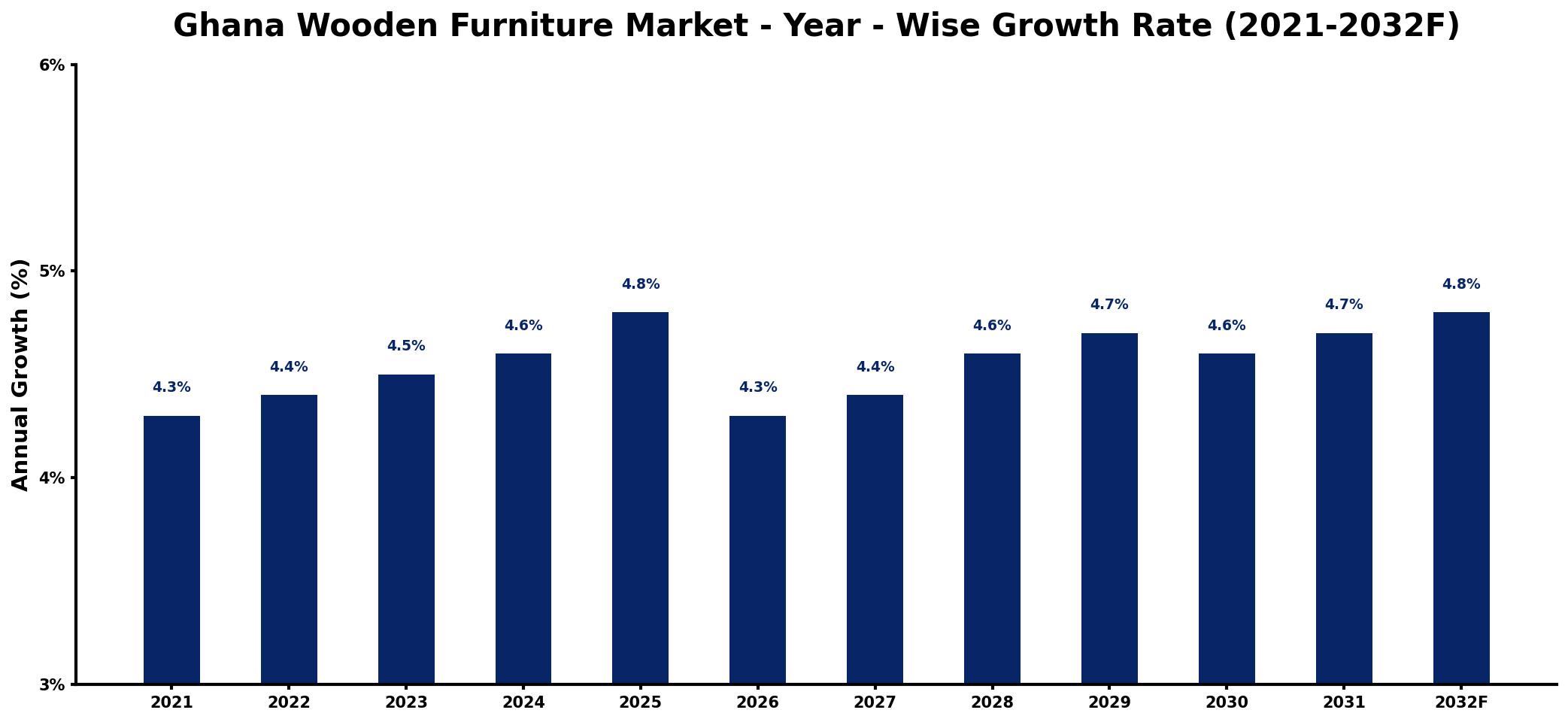
The table below presents the year‑wise growth rates along with the key drivers influencing the market
| Year | Growth Rate | Major Drivers |
| 2021 | 4.3% | Rising urban population growth |
| 2022 | 4.4% | Increased disposable income levels |
| 2023 | 4.5% | Growing construction sector demand |
| 2024 | 4.6% | Surge in interior design projects |
| 2025 | 4.8% | Expansion of e-commerce platforms |
| 2026 | 4.3% | Boost in sustainable material usage |
| 2027 | 4.4% | Increase in local manufacturing capabilities |
| 2028 | 4.6% | Heightened consumer interest sustainability |
| 2029 | 4.7% | Growth in tourism and hospitality |
| 2030 | 4.6% | Emergence of innovative design trends |
| 2031 | 4.7% | Strengthened export market opportunities |
| 2032 | 4.8% | Development of skilled labor force |
Note: Market size estimations and growth projections presented in this report are based on 6Wresearch's proprietary forecasting methodology, utilizing the latest available industry data, government publications, and primary research inputs.
Ghana Wooden Furniture Market Synopsis
As Ghana continues to urbanize and expand its infrastructure, the wooden furniture market is positioned for significant growth. The preference for wooden furniture over alternatives is primarily driven by its durability and aesthetic appeal, making it a favored choice among consumers.
Market players are actively innovating to meet changing consumer preferences, with a focus on sustainable sourcing and craftsmanship. The intersection of traditional techniques with modern design is not only enhancing product offerings but is also helping to establish Ghana as a competitive player in the global furniture market.
Ghana Wooden Furniture Market Key Takeaways
- The market is experiencing steady growth, driven by urbanization and rising incomes.
- Consumer preferences are shifting towards sustainable and aesthetically pleasing designs.
- Government policies promote sustainable forestry practices and innovation in craftsmanship.
- The increasing demand for both residential and commercial furniture presents abundant opportunities.
- Competition from alternative materials continues to influence market dynamics.
Evaluation of Restraints in Ghana Wooden Furniture Market
Despite the optimistic outlook, the Ghana Wooden Furniture Market faces several constraints that can limit its growth. One significant challenge is the competition from alternative furniture materials, which may offer lower prices and different aesthetic options. Moreover, issues surrounding sustainable wood sourcing and environmental concerns pose hurdles that manufacturers must navigate to meet both regulatory and consumer demands. Lastly, the need for improved design and craftsmanship remains essential for distinguishing products in a crowded marketplace.
Ghana Wooden Furniture Market Trends
Several trends are emerging that are reshaping the Ghana Wooden Furniture Market. There is a notable inclination towards minimalistic and multifunctional designs, catering to the urban lifestyle where space is often limited. Additionally, eco-friendly practices, including the use of reclaimed wood and responsible sourcing, are increasingly favored by consumers. Digital marketing and e-commerce platforms are also playing a pivotal role in reaching a broader audience and enhancing sales channels.
Ghana Wooden Furniture Market Opportunities
The market holds significant growth potential for manufacturers willing to innovate and adapt. Opportunities lie in the development of custom-made furniture solutions, particularly for the expanding middle-class demographic. Additionally, investment in technology-driven production processes could lead to enhanced efficiency and product offerings. Furthermore, exporting locally crafted furniture could tap into international markets that value unique, sustainably sourced products.
Government Initiatives in the Ghana Wooden Furniture Market
The Ghanaian government is actively supporting the wooden furniture market through various initiatives aimed at fostering sustainable practices. Policies include regulations governing timber harvesting, promoting responsible sourcing, and supporting innovation in craftsmanship. Furthermore, the government encourages local manufacturers through incentives for investment in furniture design and production, thereby enhancing the overall industry landscape.
Future Insights of the Ghana Wooden Furniture Market
Looking ahead to 2026-2032, the Ghana Wooden Furniture Market is expected to evolve alongside changing consumer behavior and technological advancements. As sustainability becomes a focal point for consumers, manufacturers who prioritize eco-friendly practices will likely see increased demand. Additionally, the expansion of urban areas will fuel the need for quality furniture, thereby providing a robust platform for growth. Innovation and adaptability will be crucial for companies looking to remain competitive in this dynamic environment.
Ghana Wooden Furniture Market Latest Developments (2025 - 2026)
Recent developments within the Ghana Wooden Furniture Market indicate a growing emphasis on design innovation and sustainability. Many manufacturers are exploring collaborations with local artisans to blend traditional craftsmanship with contemporary design elements. Additionally, the sector is witnessing increased investment in technology that enhances production efficiency while maintaining product quality. This focus on modernization aims to position Ghanaian wooden furniture on the global stage.
Ghana Wooden Furniture Market - Key Attractiveness of the Report
- 10 Years of Market Numbers
- Historical Data Starting from 2022 to 2025
- Base Year: 2025
- Forecast Data until 2032
- Key Performance Indicators Impacting the Market
- Major Upcoming Developments and Projects
Key Highlights of the Report:
- Ghana Wooden Furniture Market Outlook
- Market Size of Ghana Wooden Furniture Market, 2025
- Forecast of Ghana Wooden Furniture Market, 2032
- Historical Data and Forecast of Ghana Wooden Furniture Revenues & Volume for the Period 2022-2032F
- Ghana Wooden Furniture Market Trend Evolution
- Ghana Wooden Furniture Market Drivers and Challenges
- Ghana Wooden Furniture Price Trends
- Ghana Wooden Furniture Porter's Five Forces
- Ghana Wooden Furniture Industry Life Cycle
- Historical Data and Forecast of Ghana Wooden Furniture Market Revenues & Volume By Type for the Period 2022-2032F
- Historical Data and Forecast of Ghana Wooden Furniture Market Revenues & Volume By Hardwood for the Period 2022-2032F
- Historical Data and Forecast of Ghana Wooden Furniture Market Revenues & Volume By Softwood for the Period 2022-2032F
- Historical Data and Forecast of Ghana Wooden Furniture Market Revenues & Volume By Material for the Period 2022-2032F
- Historical Data and Forecast of Ghana Wooden Furniture Market Revenues & Volume By Plywood for the Period 2022-2032F
- Historical Data and Forecast of Ghana Wooden Furniture Market Revenues & Volume By Laminates for the Period 2022-2032F
- Historical Data and Forecast of Ghana Wooden Furniture Market Revenues & Volume By MDF for the Period 2022-2032F
- Historical Data and Forecast of Ghana Wooden Furniture Market Revenues & Volume By Other Materials for the Period 2022-2032F
- Historical Data and Forecast of Ghana Wooden Furniture Market Revenues & Volume By Product for the Period 2022-2032F
- Historical Data and Forecast of Ghana Wooden Furniture Market Revenues & Volume By Bedroom for the Period 2022-2032F
- Historical Data and Forecast of Ghana Wooden Furniture Market Revenues & Volume By Seating for the Period 2022-2032F
- Historical Data and Forecast of Ghana Wooden Furniture Market Revenues & Volume By Kitchen for the Period 2022-2032F
- Historical Data and Forecast of Ghana Wooden Furniture Market Revenues & Volume By Other Products for the Period 2022-2032F
- Historical Data and Forecast of Ghana Wooden Furniture Market Revenues & Volume By Application for the Period 2022-2032F
- Historical Data and Forecast of Ghana Wooden Furniture Market Revenues & Volume By Residential for the Period 2022-2032F
- Historical Data and Forecast of Ghana Wooden Furniture Market Revenues & Volume By Commercial for the Period 2022-2032F
- Historical Data and Forecast of Ghana Wooden Furniture Market Revenues & Volume By Distribution Channel for the Period 2022-2032F
- Historical Data and Forecast of Ghana Wooden Furniture Market Revenues & Volume By Offline for the Period 2022-2032F
- Historical Data and Forecast of Ghana Wooden Furniture Market Revenues & Volume By Online for the Period 2022-2032F
- Ghana Wooden Furniture Import Export Trade Statistics
- Market Opportunity Assessment By Type
- Market Opportunity Assessment By Material
- Market Opportunity Assessment By Product
- Market Opportunity Assessment By Application
- Market Opportunity Assessment By Distribution Channel
- Ghana Wooden Furniture Top Companies Market Share
- Ghana Wooden Furniture Competitive Benchmarking By Technical and Operational Parameters
- Ghana Wooden Furniture Company Profiles
- Ghana Wooden Furniture Key Strategic Recommendations






































