Ghana Wooden Toys Market Size, Share & Growth Rate
The Ghana Wooden Toys Market was estimated at USD 480 Million in 2025 and is projected to reach USD 632 Million by 2032, growing at a CAGR of 4.0% from 2026 to 2032. This growth is primarily driven by a cultural shift towards sustainable, safe, and educational toys for children, with parents increasingly prioritizing products that align with these values. Furthermore, as concerns about the environmental impact of plastic toys rise, the appeal of wooden alternatives continues to strengthen in the Ghanaian market.
Ghana Wooden Toys Market Year-wise Growth Rate and Key Drivers
This graph highlights how the Ghana Wooden Toys Market has steadily grown over the years, supported by major growth factors.
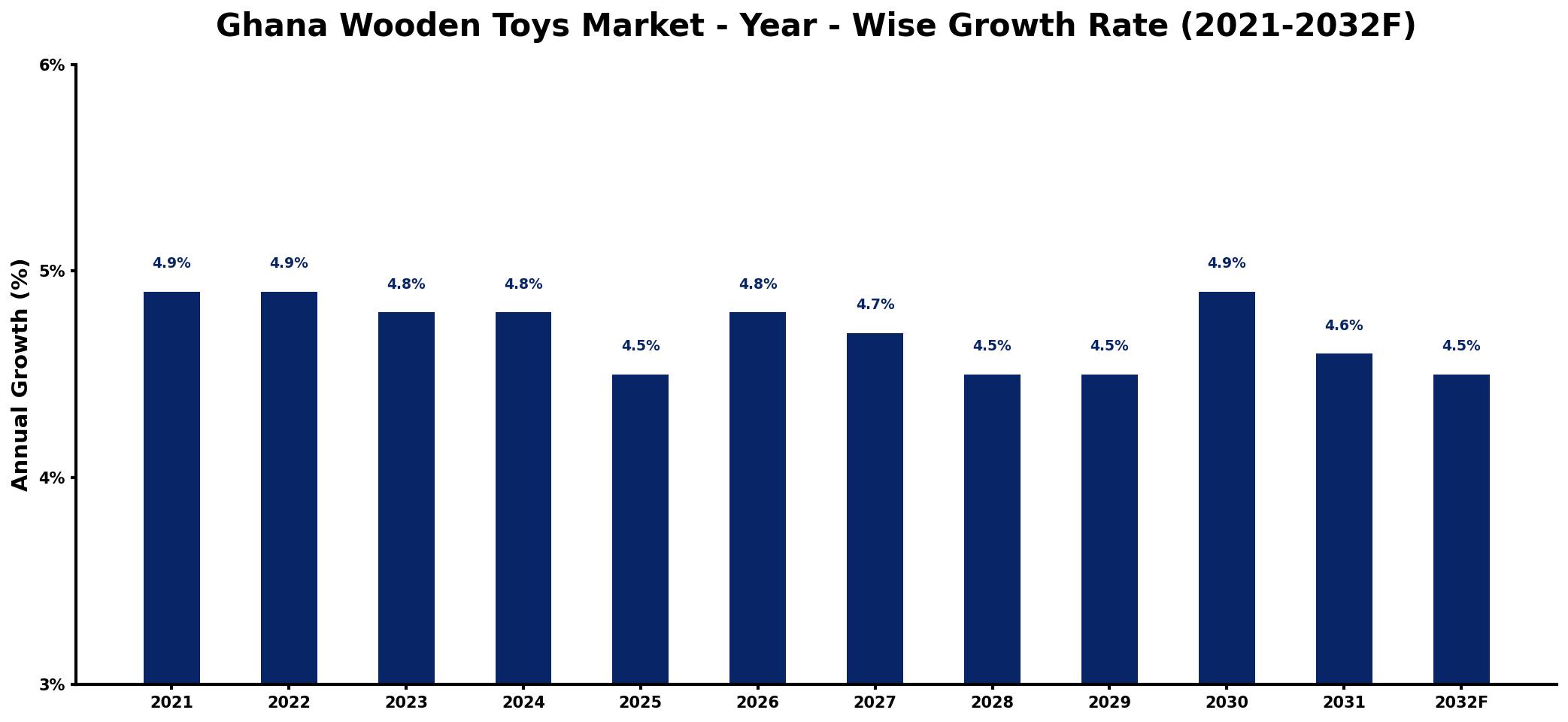
The table below presents the year‑wise growth rates along with the key drivers influencing the market
| Year | Growth Rate | Major Drivers |
| 2021 | 4.9% | Increased consumer interest in sustainability |
| 2022 | 4.9% | Growing demand for eco-friendly products |
| 2023 | 4.8% | Rise in disposable income levels |
| 2024 | 4.8% | Expansion of local manufacturing capabilities |
| 2025 | 4.5% | Strengthened distribution network efficiency |
| 2026 | 4.8% | Increased investment in local artisans |
| 2027 | 4.7% | Surge in educational product popularity |
| 2028 | 4.5% | Diversification of product offerings available |
| 2029 | 4.5% | Heightened awareness of child development |
| 2030 | 4.9% | Boost in online retail channels |
| 2031 | 4.6% | Growing popularity of artisanal craftsmanship |
| 2032 | 4.5% | Strengthened community support initiatives |
Note: Market size estimations and growth projections presented in this report are based on 6Wresearch's proprietary forecasting methodology, utilizing the latest available industry data, government publications, and primary research inputs.
Ghana Wooden Toys Market Synopsis
In Ghana, the wooden toys market is not merely about play; it embodies a commitment to sustainability and child development. Parents are gravitating towards wooden toys for their durability, aesthetic appeal, and educational benefits, providing children with engaging play that fosters creativity and imagination.
The artisanal craftsmanship prevalent in Ghana enriches this market, allowing local artisans to create unique, handmade wooden toys that stand out in a global marketplace. This trend not only reflects the countrys rich cultural heritage but also meets a growing demand for personalized and distinctive products among consumers.
Ghana Wooden Toys Market Key Takeaways
- The Ghana Wooden Toys Market is experiencing significant growth driven by a demand for safe and eco-friendly play options.
- Artisanal craftsmanship is a key differentiator, promoting unique and personalized toy offerings.
- Government initiatives are enhancing market credibility through quality standards and safety regulations.
- Parents increasingly value the educational and developmental benefits of wooden toys over plastic alternatives.
- Environmental concerns are shaping consumer preferences and influencing purchasing decisions in favor of wooden toys.
Evaluation of Restraints in Ghana Wooden Toys Market
While the Ghana Wooden Toys Market shows promise, several restraints persist. Challenges related to maintaining safety and durability standards during production can hinder manufacturer compliance with regulations. Additionally, the need for innovative designs and efficient production processes can pressure small-scale artisans, who may lack resources for compliance. These factors create a complex landscape that requires careful navigation for sustained market growth.
Ghana Wooden Toys Market Trends
A noticeable trend in the Ghana Wooden Toys Market is the increasing emphasis on educational toys that promote cognitive skills and creativity. Theres also a growing movement towards incorporating eco-friendly materials in manufacturing processes, responding to global sustainability demands. Moreover, social media platforms are emerging as pivotal channels for marketing unique wooden toy offerings, as parents look for inspiration and community recommendations for quality products.
Ghana Wooden Toys Market Opportunities
The market presents several opportunities for growth and investment. With a surge in demand for educational and eco-friendly toys, manufacturers can innovate by developing new designs that blend traditional craftsmanship with modern educational principles. Expanding distribution channels, both online and offline, will also enhance market reach. Furthermore, tapping into export markets for unique Ghanaian wooden toys could offer significant revenue potential, capitalizing on the global trend toward sustainable consumer goods.
Government Initiatives in the Ghana Wooden Toys Market
The Ghanaian government plays a pivotal role in supporting the wooden toys market by implementing policies focused on creativity, education, and sustainable forestry. Recent initiatives include establishing quality standards and safety regulations that ensure toys meet international safety benchmarks. Furthermore, incentives for investment in design, production, and distribution are being introduced to encourage the growth of local manufacturers and elevate the overall standard of products available in the market.
Future Insights of the Ghana Wooden Toys Market
Looking ahead to 2026-2032, the Ghana Wooden Toys Market is poised for continued growth, propelled by an escalating awareness of sustainability and the educational value of toys. As parents prioritize quality over quantity, the demand for well-crafted, safe wooden toys is expected to rise. Advances in production techniques and materials will likely enhance product offerings, while ongoing government support will fortify market resilience, setting the stage for a robust future.
Ghana Wooden Toys Market Latest Developments (2025 - 2026)
Recent industry developments indicate a marked increase in collaborations between local artisans and educational institutions aimed at creating innovative, educational wooden toys. Furthermore, various workshops and trade fairs have emerged, showcasing local craftsmanship and fostering partnerships among manufacturers. This focus on innovation and community engagement is transforming the landscape of the Ghana Wooden Toys Market, positioning it as a leader in sustainable toy manufacturing.
Ghana Wooden Toys Market - Key Attractiveness of the Report
- 10 Years of Market Numbers
- Historical Data Starting from 2022 to 2025
- Base Year: 2025
- Forecast Data until 2032
- Key Performance Indicators Impacting the Market
- Major Upcoming Developments and Projects
Key Highlights of the Report:
- Ghana Wooden Toys Market Outlook
- Market Size of Ghana Wooden Toys Market, 2025
- Forecast of Ghana Wooden Toys Market, 2032
- Historical Data and Forecast of Ghana Wooden Toys Revenues & Volume for the Period 2022-2032F
- Ghana Wooden Toys Market Trend Evolution
- Ghana Wooden Toys Market Drivers and Challenges
- Ghana Wooden Toys Price Trends
- Ghana Wooden Toys Porter's Five Forces
- Ghana Wooden Toys Industry Life Cycle
- Historical Data and Forecast of Ghana Wooden Toys Market Revenues & Volume By Product Type for the Period 2022-2032F
- Historical Data and Forecast of Ghana Wooden Toys Market Revenues & Volume By Educational Toys for the Period 2022-2032F
- Historical Data and Forecast of Ghana Wooden Toys Market Revenues & Volume By Construction Toys for the Period 2022-2032F
- Historical Data and Forecast of Ghana Wooden Toys Market Revenues & Volume By Musical Toys for the Period 2022-2032F
- Historical Data and Forecast of Ghana Wooden Toys Market Revenues & Volume By Game Toys for the Period 2022-2032F
- Historical Data and Forecast of Ghana Wooden Toys Market Revenues & Volume By Dolls & Miniatures for the Period 2022-2032F
- Historical Data and Forecast of Ghana Wooden Toys Market Revenues & Volume By Automotive Toys for the Period 2022-2032F
- Historical Data and Forecast of Ghana Wooden Toys Market Revenues & Volume By Pretend Play Toys for the Period 2022-2032F
- Historical Data and Forecast of Ghana Wooden Toys Market Revenues & Volume By Wood Type for the Period 2022-2032F
- Historical Data and Forecast of Ghana Wooden Toys Market Revenues & Volume By Softwood for the Period 2022-2032F
- Historical Data and Forecast of Ghana Wooden Toys Market Revenues & Volume By Hardwood for the Period 2022-2032F
- Historical Data and Forecast of Ghana Wooden Toys Market Revenues & Volume By Age Group for the Period 2022-2032F
- Historical Data and Forecast of Ghana Wooden Toys Market Revenues & Volume By Below 1 Year for the Period 2022-2032F
- Historical Data and Forecast of Ghana Wooden Toys Market Revenues & Volume By Age 1-3 for the Period 2022-2032F
- Historical Data and Forecast of Ghana Wooden Toys Market Revenues & Volume By Age 3-5 for the Period 2022-2032F
- Historical Data and Forecast of Ghana Wooden Toys Market Revenues & Volume By Age 5-12 for the Period 2022-2032F
- Historical Data and Forecast of Ghana Wooden Toys Market Revenues & Volume By Age 12+ for the Period 2022-2032F
- Historical Data and Forecast of Ghana Wooden Toys Market Revenues & Volume By Distribution Channel for the Period 2022-2032F
- Historical Data and Forecast of Ghana Wooden Toys Market Revenues & Volume By Online for the Period 2022-2032F
- Historical Data and Forecast of Ghana Wooden Toys Market Revenues & Volume By Offline for the Period 2022-2032F
- Ghana Wooden Toys Import Export Trade Statistics
- Market Opportunity Assessment By Product Type
- Market Opportunity Assessment By Wood Type
- Market Opportunity Assessment By Age Group
- Market Opportunity Assessment By Distribution Channel
- Ghana Wooden Toys Top Companies Market Share
- Ghana Wooden Toys Competitive Benchmarking By Technical and Operational Parameters
- Ghana Wooden Toys Company Profiles
- Ghana Wooden Toys Key Strategic Recommendations






































