Global Automated Test Equipment Market Highlights
| Market Size (2025) | USD 8.9 Billion |
| Forecast Size (2032) | USD 14.7 Billion |
| CAGR | 4.61% |
| Base Year | 2025 |
| Forecast Period | 2026-2032 |
| Largest Region | North America |
| Fastest Growing Region | Asia |
| Largest Segment | Semiconductor Fabrication |
| Fastest Growing Segment | Automotive |
| Leading Companies | Advantest, Teradyne, Keysight Technologies, National Instruments, and Rohde & Schwarz |
Global Automated Test Equipment Market Size & Growth Rate (2026-2032)
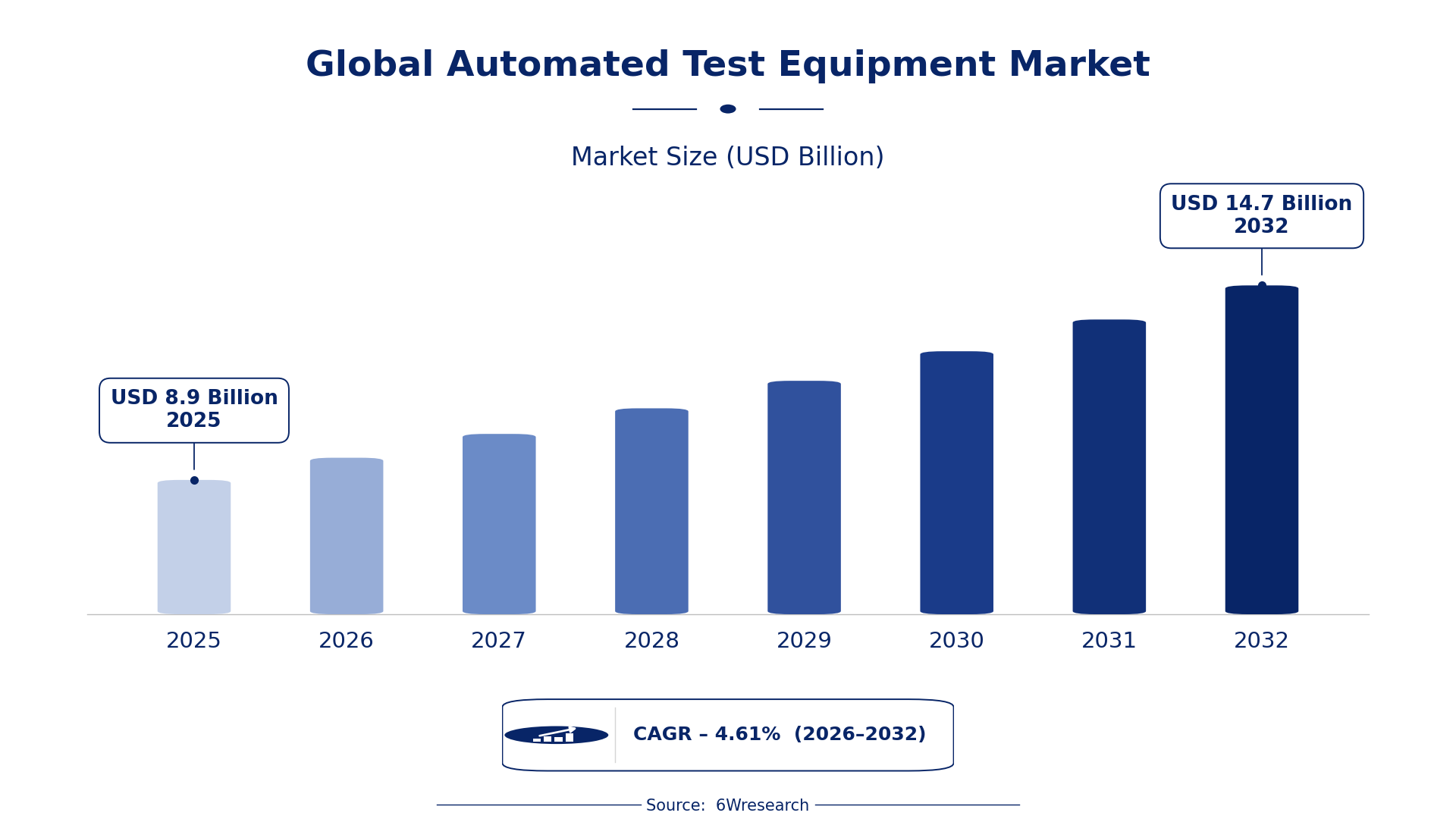
The Global Automated Test Equipment Market was estimated at USD 8.9 Billion in 2025 and is projected to reach USD 14.7 Billion by 2032, growing at a CAGR of 4.61% from 2026 to 2032.
Global Automated Test Equipment Market Synopsis
The Global Automated Test Equipment Market is currently undergoing a structural transformation influenced by technological shifts in electronics manufacturing. High-stakes industries, such as automotive and aerospace, are driving the demand for sophisticated test solutions capable of meeting strict quality and reliability standards. As electronic components become increasingly complex, the role of ATE in ensuring performance has never been more crucial.
Key industry trends include the integration of IoT into various applications, which necessitates enhanced testing protocols. Additionally, the semiconductor industry is transitioning towards more advanced materials and manufacturing methodologies, further increasing reliance on effective automated testing solutions. This evolution sets the Global Automated Test Equipment Market apart from adjacent sectors, establishing it as indispensable for sustaining product integrity across multiple industries.
Global Automated Test Equipment Market Year-wise Growth Rate and Key Drivers
This graph illustrates the annual growth rates of the Global Automated Test Equipment Market from 2022 to 2032, highlighting a steady upward trajectory and projected expansion over the forecast period.
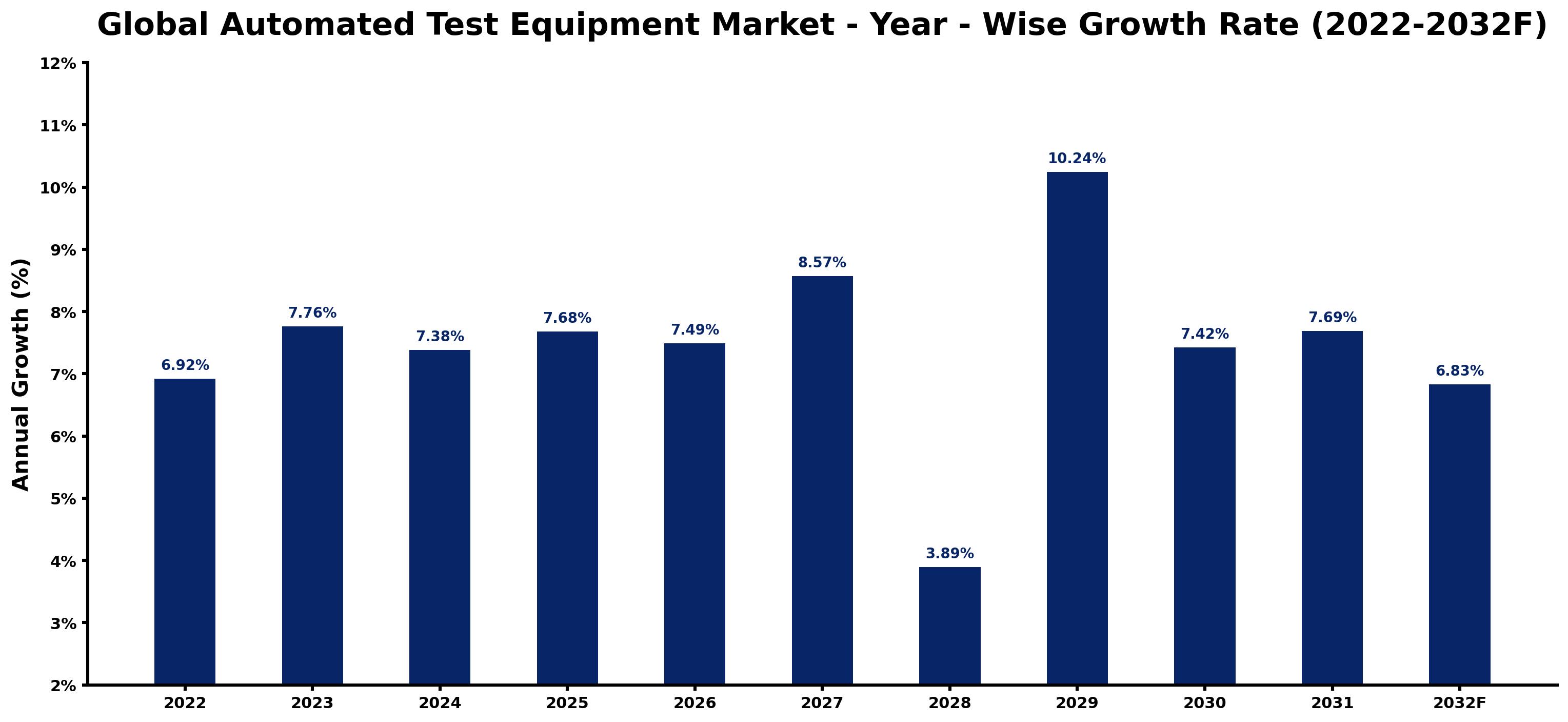
The table below presents the year‑wise growth rates along with the key drivers influencing the market
| Year | Growth Rate (%) | Major Drivers |
| 2022 | 6.92 | Semiconductor manufacturers are enhancing workforce skills to optimize automated test equipment usage. |
| 2023 | 7.76 | Rapidly expanding regional markets in Asia drive a surge in test equipment deployment. |
| 2024 | 7.38 | A shift toward advanced semiconductor designs increases the need for automated testing solutions. |
| 2025 | 7.68 | Expanding supply chain integration enhances the efficiency of automated test equipment production. |
| 2026 | 7.49 | EUV lithography developments lead to more precise automated test equipment capabilities. |
| 2027 | 8.57 | As competitive pressures rise, innovations in automated test equipment gain market traction. |
| 2028 | 3.89 | A focus on improved yield rates among end-users reflects growing reliance on automated testing. |
| 2029 | 10.24 | Advanced packaging technologies are attracting significant investments in automated test equipment. |
| 2030 | 7.42 | In the semiconductor sector, rising raw material costs impact automated test equipment pricing. |
| 2031 | 7.69 | Regulators are enforcing stricter standards, increasing the demand for efficient test equipment. |
| 2032 | 6.83 | Tech companies prioritize sustainability, driving a shift towards eco-friendly automated testing solutions. |
Note - Market size estimations and growth projections presented in this report are based on 6Wresearch's proprietary research methodology, combining internal industry data, secondary research, and primary validation, updated periodically to reflect current market conditions. As markets evolve rapidly, figures for certain industries may vary slightly and are intended as informed estimates rather than absolute figures. For the most current market sizing, we recommend validating figures with a 6Wresearch analyst.
Global Automated Test Equipment Market Key Takeaways
Below are some of the specific key takeaways from the market, including:
- As of 2025, Semiconductor Fabrication commands a ~40% share of the Global Automated Test Equipment Market.
- Asia is projected to be the fastest-growing region, with an expected CAGR of 5.8% from 2026 to 2032.
- The automotive segment is expected to witness a notable CAGR of 6.2% from 2026 to 2032.
- Advantest has introduced its V93000 platform, which enhances testing capabilities specifically tailored for advanced automotive electronics.
- Consumer Electronics are among the most significant applications for ATE, with demand increasing particularly in the context of 5G technology deployment.
Evaluation of Restraints in Global Automated Test Equipment Market
Despite promising growth, the Global Automated Test Equipment Market faces significant challenges. High initial investment costs often deter small and medium-sized enterprises from adopting these advanced solutions, with estimates suggesting that ATE systems can exceed $1 million for comprehensive setups. For example, companies must also navigate complex regulatory environments, such as those governing electronic waste, which add layers of compliance costs to ATE implementation. These obstacles hinder widespread adoption and pose a threat to market expansion.
Global Automated Test Equipment Market Trends
Several critical trends are reshaping the Global Automated Test Equipment Market. Firstly, the growing need for faster and more efficient testing solutions in semiconductor fabrication is facilitating the integration of artificial intelligence into test processes. Companies like Keysight Technologies are improving their systems with AI capabilities, allowing for real-time data analysis. Secondly, the trend of miniaturization in electronics mandates increasingly sophisticated testing tools. For instance, the use of modular test systems enables flexibility and adaptability to meet varying product specifications. Lastly, regulatory pressures surrounding product safety lead to investments in next-generation ATE solutions to enhance reliability and ensure compliance.
Global Automated Test Equipment Market Opportunities
Significant future revenue opportunities lie within the automotive sector, particularly with the advent of electric vehicles (EVs). As the market shifts towards EV production, companies are seeking specialized ATE for testing battery systems and advanced driver-assistance systems. For instance, companies such as Teradyne are developing dedicated test platforms for EV applications, expected to tap into a market projected to be worth $951 billion by 2027. Additionally, advancements in 5G technology present fertile ground for ATE vendors, as networks require rigorous device testing to ensure functionality and compliance.
Global Automated Test Equipment Market by Vertical
In the Global Automated Test Equipment Market, the Semiconductor Fabrication segment leads with a ~40% share in 2025, reflecting its critical role in the electronics manufacturing landscape. Conversely, the Automotive segment is recognized as the fastest-growing vertical, expected to grow at a CAGR of 6.2% from 2026 to 2032. This growth is propelled by the increasing complexity of automotive electronics and the demand for high-performance testing solutions in the development of electric vehicles and autonomous systems.
Global Automated Test Equipment Market by Region
North America stands as the largest region within the Global Automated Test Equipment Market, commanding a ~48% share in 2025, bolstered by its advanced manufacturing ecosystem and significant investments in electronics R&D. Meanwhile, Asia is poised to be the fastest-growing region, with a projected CAGR of 5.8% from 2026 to 2032. This growth is driven by an expanding electronic manufacturing base in countries like China and India, which are increasing their capacity for producing semiconductors and consumer electronics, thus heightening their demand for automated testing solutions.
Government Initiatives in the Global Automated Test Equipment Market
The regulatory environment surrounding the Global Automated Test Equipment Market is marked by initiatives aimed at enhancing technological capabilities and promoting standards in electronic testing. These programs often focus on bolstering innovation and competitiveness.
- The U.S. National Institute of Standards and Technology (NIST) has launched the "National Strategy for Advanced Manufacturing" in 2021, aimed at enhancing advanced manufacturing technologies including automated testing systems.
- The European Union's "Horizon Europe" research and innovation program, initiated in 2021, allocates significant funding for projects that incorporate automation and testing technologies across various industries.
- The Japanese Ministry of Economy, Trade and Industry (METI) announced the "Smart Manufacturing Strategy" in 2020, promoting automation technologies, including ATE, to improve manufacturing efficiency.
- The South Korean government's "K-Smart Project" launched in 2021 aims to boost the semiconductor industry, investing $1.1 billion specifically in automated test technologies.
Future Insights of the Global Automated Test Equipment Market
The trajectory of the Global Automated Test Equipment Market will increasingly center on the integration of advanced technologies such as machine learning and automation. As industries demand more efficient testing processes, companies like Keysight Technologies are investing in AI-driven solutions, enhancing real-time performance analytics. This shift not only reduces testing cycles but also addresses the growing complexity of electronic devices, ensuring higher reliability and compliance with safety standards. Expect new applications in sectors such as automotive, particularly with the rise of electric vehicles, reinforcing the market's evolution toward more specialized testing solutions.
Global Automated Test Equipment Market Latest Developments
The competitive landscape of the Global Automated Test Equipment Market has seen significant movements recently, indicating shifts in technology and market positioning. Noteworthy developments include:
- Advantest has recently completed the enhancement of its V93000 platform, allowing for more precise testing methods tailored for high-frequency applications, particularly in the semiconductor domain.
- In mid-2023, Teradyne introduced innovative features within its test equipment that leverage AI for adaptive learning, improving testing efficiency for automotive electronics.
- Keysight Technologies is expanding its collaboration with industry chains through ongoing partnerships, focusing on next-gen standards for wireless testing in 5G applications.
- Upcoming in 2024, National Instruments plans to launch a modular test system designed explicitly for autonomous vehicle components, aiming to fill a critical gap in the market.
Global Automated Test Equipment Market Key Players and Industry Positioning
The Global Automated Test Equipment Market remains relatively fragmented, with several players vying for leadership through technological advancements and strategic partnerships. This diversity allows for niche specialization, particularly in sectors like semiconductors and automotive.
| Leading Company | Core Strength | Strategic Focus |
|---|---|---|
| Advantest | Expertise in high-speed testing solutions for semiconductor fabrication. | Focus on advanced testing platforms for automotive and high-frequency applications. |
| Teradyne | Strong capabilities in AI integration within testing processes. | Development of adaptive testing solutions tailored for the automotive industry. |
| Keysight Technologies | Market leader in next-generation wireless testing technologies. | Enhancing testing capabilities for 5G and IoT applications. |
| National Instruments | Modular and flexible testing systems for a variety of applications. | Innovating solutions for autonomous vehicle components. |
| Rohde & Schwarz | Comprehensive testing solutions for both consumer electronics and telecommunications. | Expanding capabilities in RF and microwave testing throughout various sectors. |
Moving forward, the competitive dynamics will likely evolve, characterized by increased collaboration among key players to address emerging challenges and sector-specific demands.
Key Attractiveness of the Report
- 10 Years of Market Numbers
- Historical Data Starting from 2022 to 2025
- Base Year: 2025
- Forecast Data until 2032
- Key Performance Indicators Impacting the Market
- Major Upcoming Developments and Projects
Key Highlights of the Report:
- Global Automated Test Equipment Market Outlook
- Market Size of Global Automated Test Equipment Market, 2025
- Forecast of Global Automated Test Equipment Market, 2032
- Historical Data and Forecast of Global Automated Test Equipment Revenues & Volume for the Period 2022-2032
- Global Automated Test Equipment Market Trend Evolution
- Global Automated Test Equipment Market Drivers and Challenges
- Global Automated Test Equipment Price Trends
- Global Automated Test Equipment Porter's Five Forces
- Global Automated Test Equipment Industry Life Cycle
- Historical Data and Forecast of Global Automated Test Equipment Market Revenues & Volume
- Historical Data and Forecast of Global Automated Test Equipment Market Revenues & Volume By Vertical for the Period 2022-2032
- Historical Data and Forecast of Global Automated Test Equipment Market Revenues & Volume By Semiconductor Fabrication for the Period 2022-2032
- Historical Data and Forecast of Global Automated Test Equipment Market Revenues & Volume By Automotive for the Period 2022-2032
- Historical Data and Forecast of Global Automated Test Equipment Market Revenues & Volume By Transportation for the Period 2022-2032
- Historical Data and Forecast of Global Automated Test Equipment Market Revenues & Volume By Medical for the Period 2022-2032
- Historical Data and Forecast of Global Automated Test Equipment Market Revenues & Volume By Aerospace for the Period 2022-2032
- Historical Data and Forecast of Global Automated Test Equipment Market Revenues & Volume By Defense for the Period 2022-2032
- Historical Data and Forecast of Global Automated Test Equipment Market Revenues & Volume By Consumer Electronics for the Period 2022-2032
- Historical Data and Forecast of North America Automated Test Equipment Market Revenues & Volume By Vertical for the Period 2022-2032
- Historical Data and Forecast of North America Automated Test Equipment Market Revenues & Volume By Semiconductor Fabrication for the Period 2022-2032
- Historical Data and Forecast of North America Automated Test Equipment Market Revenues & Volume By Automotive for the Period 2022-2032
- Historical Data and Forecast of North America Automated Test Equipment Market Revenues & Volume By Transportation for the Period 2022-2032
- Historical Data and Forecast of North America Automated Test Equipment Market Revenues & Volume By Medical for the Period 2022-2032
- Historical Data and Forecast of North America Automated Test Equipment Market Revenues & Volume By Aerospace for the Period 2022-2032
- Historical Data and Forecast of North America Automated Test Equipment Market Revenues & Volume By Defense for the Period 2022-2032
- Historical Data and Forecast of North America Automated Test Equipment Market Revenues & Volume By Consumer Electronics for the Period 2022-2032
- Historical Data and Forecast of United States of America Automated Test Equipment Market Revenues & Volume for the Period 2022-2032
- Historical Data and Forecast of Canada Automated Test Equipment Market Revenues & Volume for the Period 2022-2032
- Historical Data and Forecast of Rest of North America Automated Test Equipment Market Revenues & Volume for the Period 2022-2032
- Historical Data and Forecast of Latin America (LATAM) Automated Test Equipment Market Revenues & Volume By Vertical for the Period 2022-2032
- Historical Data and Forecast of Latin America (LATAM) Automated Test Equipment Market Revenues & Volume By Semiconductor Fabrication for the Period 2022-2032
- Historical Data and Forecast of Latin America (LATAM) Automated Test Equipment Market Revenues & Volume By Automotive for the Period 2022-2032
- Historical Data and Forecast of Latin America (LATAM) Automated Test Equipment Market Revenues & Volume By Transportation for the Period 2022-2032
- Historical Data and Forecast of Latin America (LATAM) Automated Test Equipment Market Revenues & Volume By Medical for the Period 2022-2032
- Historical Data and Forecast of Latin America (LATAM) Automated Test Equipment Market Revenues & Volume By Aerospace for the Period 2022-2032
- Historical Data and Forecast of Latin America (LATAM) Automated Test Equipment Market Revenues & Volume By Defense for the Period 2022-2032
- Historical Data and Forecast of Latin America (LATAM) Automated Test Equipment Market Revenues & Volume By Consumer Electronics for the Period 2022-2032
- Historical Data and Forecast of Brazil Automated Test Equipment Market Revenues & Volume for the Period 2022-2032
- Historical Data and Forecast of Mexico Automated Test Equipment Market Revenues & Volume for the Period 2022-2032
- Historical Data and Forecast of Argentina Automated Test Equipment Market Revenues & Volume for the Period 2022-2032
- Historical Data and Forecast of Rest of LATAM Automated Test Equipment Market Revenues & Volume for the Period 2022-2032
- Historical Data and Forecast of Asia Automated Test Equipment Market Revenues & Volume By Vertical for the Period 2022-2032
- Historical Data and Forecast of Asia Automated Test Equipment Market Revenues & Volume By Semiconductor Fabrication for the Period 2022-2032
- Historical Data and Forecast of Asia Automated Test Equipment Market Revenues & Volume By Automotive for the Period 2022-2032
- Historical Data and Forecast of Asia Automated Test Equipment Market Revenues & Volume By Transportation for the Period 2022-2032
- Historical Data and Forecast of Asia Automated Test Equipment Market Revenues & Volume By Medical for the Period 2022-2032
- Historical Data and Forecast of Asia Automated Test Equipment Market Revenues & Volume By Aerospace for the Period 2022-2032
- Historical Data and Forecast of Asia Automated Test Equipment Market Revenues & Volume By Defense for the Period 2022-2032
- Historical Data and Forecast of Asia Automated Test Equipment Market Revenues & Volume By Consumer Electronics for the Period 2022-2032
- Historical Data and Forecast of China Automated Test Equipment Market Revenues & Volume for the Period 2022-2032
- Historical Data and Forecast of India Automated Test Equipment Market Revenues & Volume for the Period 2022-2032
- Historical Data and Forecast of Japan Automated Test Equipment Market Revenues & Volume for the Period 2022-2032
- Historical Data and Forecast of Rest of Asia Automated Test Equipment Market Revenues & Volume for the Period 2022-2032
- Historical Data and Forecast of Africa Automated Test Equipment Market Revenues & Volume By Vertical for the Period 2022-2032
- Historical Data and Forecast of Africa Automated Test Equipment Market Revenues & Volume By Semiconductor Fabrication for the Period 2022-2032
- Historical Data and Forecast of Africa Automated Test Equipment Market Revenues & Volume By Automotive for the Period 2022-2032
- Historical Data and Forecast of Africa Automated Test Equipment Market Revenues & Volume By Transportation for the Period 2022-2032
- Historical Data and Forecast of Africa Automated Test Equipment Market Revenues & Volume By Medical for the Period 2022-2032
- Historical Data and Forecast of Africa Automated Test Equipment Market Revenues & Volume By Aerospace for the Period 2022-2032
- Historical Data and Forecast of Africa Automated Test Equipment Market Revenues & Volume By Defense for the Period 2022-2032
- Historical Data and Forecast of Africa Automated Test Equipment Market Revenues & Volume By Consumer Electronics for the Period 2022-2032
- Historical Data and Forecast of South Africa Automated Test Equipment Market Revenues & Volume for the Period 2022-2032
- Historical Data and Forecast of Nigeria Automated Test Equipment Market Revenues & Volume for the Period 2022-2032
- Historical Data and Forecast of Egypt Automated Test Equipment Market Revenues & Volume for the Period 2022-2032
- Historical Data and Forecast of Rest of Africa Automated Test Equipment Market Revenues & Volume for the Period 2022-2032
- Historical Data and Forecast of Europe Automated Test Equipment Market Revenues & Volume By Vertical for the Period 2022-2032
- Historical Data and Forecast of Europe Automated Test Equipment Market Revenues & Volume By Semiconductor Fabrication for the Period 2022-2032
- Historical Data and Forecast of Europe Automated Test Equipment Market Revenues & Volume By Automotive for the Period 2022-2032
- Historical Data and Forecast of Europe Automated Test Equipment Market Revenues & Volume By Transportation for the Period 2022-2032
- Historical Data and Forecast of Europe Automated Test Equipment Market Revenues & Volume By Medical for the Period 2022-2032
- Historical Data and Forecast of Europe Automated Test Equipment Market Revenues & Volume By Aerospace for the Period 2022-2032
- Historical Data and Forecast of Europe Automated Test Equipment Market Revenues & Volume By Defense for the Period 2022-2032
- Historical Data and Forecast of Europe Automated Test Equipment Market Revenues & Volume By Consumer Electronics for the Period 2022-2032
- Historical Data and Forecast of United Kingdom Automated Test Equipment Market Revenues & Volume for the Period 2022-2032
- Historical Data and Forecast of France Automated Test Equipment Market Revenues & Volume for the Period 2022-2032
- Historical Data and Forecast of Germany Automated Test Equipment Market Revenues & Volume for the Period 2022-2032
- Historical Data and Forecast of Rest of Europe Automated Test Equipment Market Revenues & Volume for the Period 2022-2032
- Historical Data and Forecast of Middle East Automated Test Equipment Market Revenues & Volume By Vertical for the Period 2022-2032
- Historical Data and Forecast of Middle East Automated Test Equipment Market Revenues & Volume By Semiconductor Fabrication for the Period 2022-2032
- Historical Data and Forecast of Middle East Automated Test Equipment Market Revenues & Volume By Automotive for the Period 2022-2032
- Historical Data and Forecast of Middle East Automated Test Equipment Market Revenues & Volume By Transportation for the Period 2022-2032
- Historical Data and Forecast of Middle East Automated Test Equipment Market Revenues & Volume By Medical for the Period 2022-2032
- Historical Data and Forecast of Middle East Automated Test Equipment Market Revenues & Volume By Aerospace for the Period 2022-2032
- Historical Data and Forecast of Middle East Automated Test Equipment Market Revenues & Volume By Defense for the Period 2022-2032
- Historical Data and Forecast of Middle East Automated Test Equipment Market Revenues & Volume By Consumer Electronics for the Period 2022-2032
- Historical Data and Forecast of Saudi Arabia Automated Test Equipment Market Revenues & Volume for the Period 2022-2032
- Historical Data and Forecast of UAE Automated Test Equipment Market Revenues & Volume for the Period 2022-2032
- Historical Data and Forecast of Turkey Automated Test Equipment Market Revenues & Volume for the Period 2022-2032
- Historical Data and Forecast of Rest of Middle East Automated Test Equipment Market Revenues & Volume for the Period 2022-2032
- Global Automated Test Equipment Market - Key Performance Indicators
- Global Automated Test Equipment Market - Import Export Trade Statistics
- Global Automated Test Equipment Market - Opportunity Assessment By Countries
- Global Automated Test Equipment Market - Opportunity Assessment By Vertical
- 0
- Global Automated Test Equipment Market - Top Companies Market Share
- Global Automated Test Equipment Market - Top Companies Profiles
- Global Automated Test Equipment Market - Comparison of Players in Technical and Operating Parameters
- Global Automated Test Equipment Market - Strategic Recommendations
Markets Covered
The Global Automated Test Equipment Market report provides a detailed analysis of the following market segments:
By Regions and Countries:
- North America
- Europe
- LATAM
- Middle East
- Asia
- Africa
By Vertical:
- Semiconductor Fabrication
- Automotive
- Transportation
- Medical
- Aerospace
- Defense
- Consumer Electronics






































