Global Ayurvedic Products Market Highlights
| Market Size (2025) | USD 10.2 Billion |
| Forecast Size (2032) | USD 22.4 Billion |
| CAGR | 6.06% |
| Base Year | 2025 |
| Forecast Period | 2026-2032 |
| Largest Region | Asia |
| Fastest Growing Region | LATAM |
| Largest Segment | Healthcare Products |
| Fastest Growing Segment | Personal Care Products |
| Leading Companies | Himalaya Wellness, Patanjali Ayurved, Dabur India, Baidyanath, and Zandu Pharmaceutical Works |
Global Ayurvedic Products Market Size & Growth Rate (2026-2032)
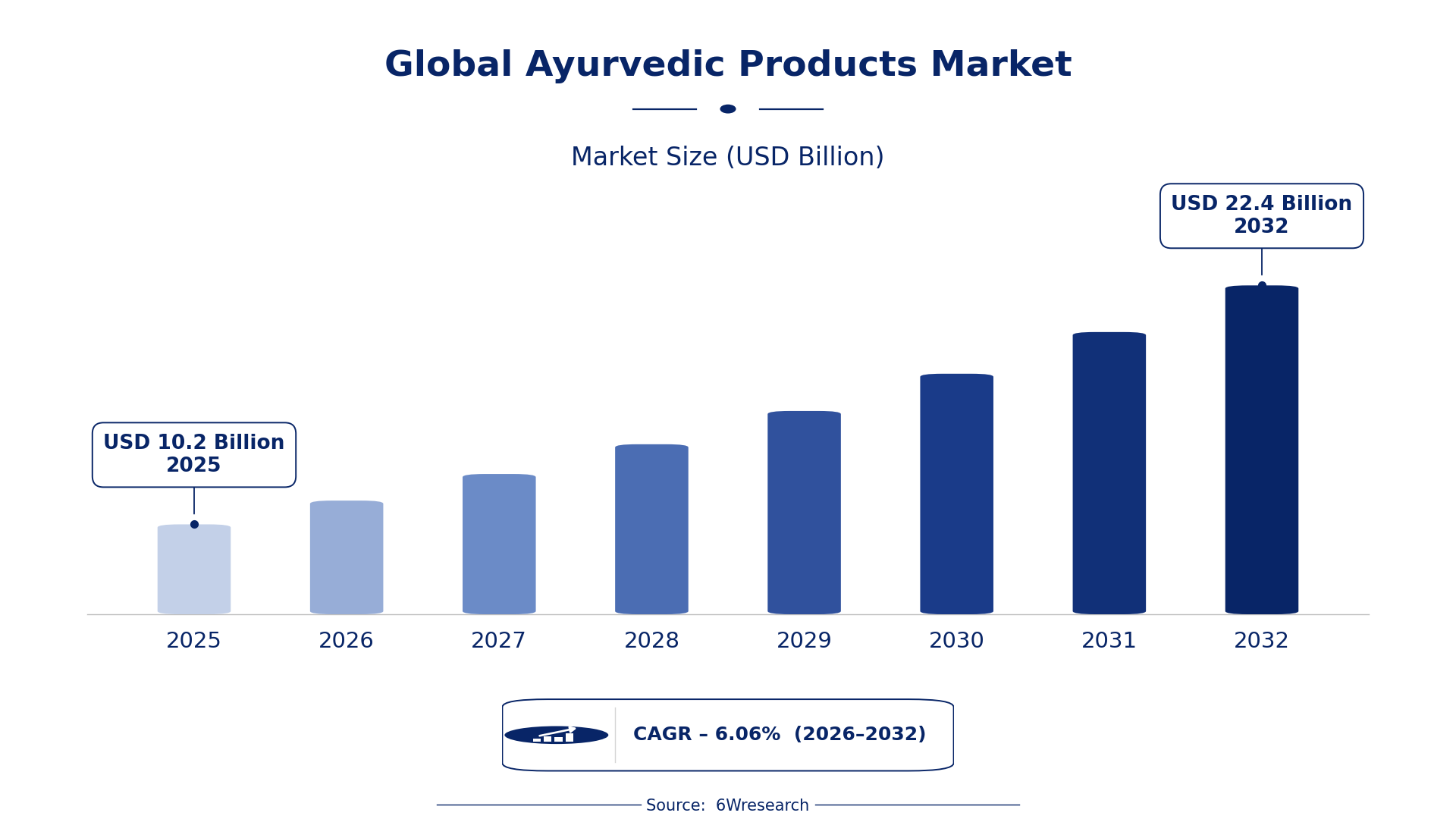
The Global Ayurvedic Products Market was estimated at USD 10.2 Billion in 2025 and is projected to reach USD 22.4 Billion by 2032, growing at a CAGR of 6.06% from 2026 to 2032.
Global Ayurvedic Products Market Synopsis
Currently, the Global Ayurvedic Products Market is experiencing structural changes rooted in both consumer preferences and regulatory factors. With a notable shift towards wellness and natural remedies, Ayurvedic products are increasingly being embraced in Western markets, complementing the traditional stronghold in Asia. This expansion reflects a broader movement favoring herbal and organic solutions, positioned starkly against synthetic alternatives.
This market holds substantial importance for industries such as healthcare, beauty, and dietary supplements, driven by collaborations among key players to enhance formulations and broaden access. The re-emerging interest in Ayurvedic practices not only elevates the market's profile but also brings a competitive edge against adjacent sectors, fundamentally reshaping consumer habits and expectations.
Global Ayurvedic Products Market Year-wise Growth Rate and Key Drivers
This graph illustrates the annual growth rates of the Global Ayurvedic Products Market from 2022 to 2032, highlighting a steady upward trajectory and projected expansion over the forecast period.
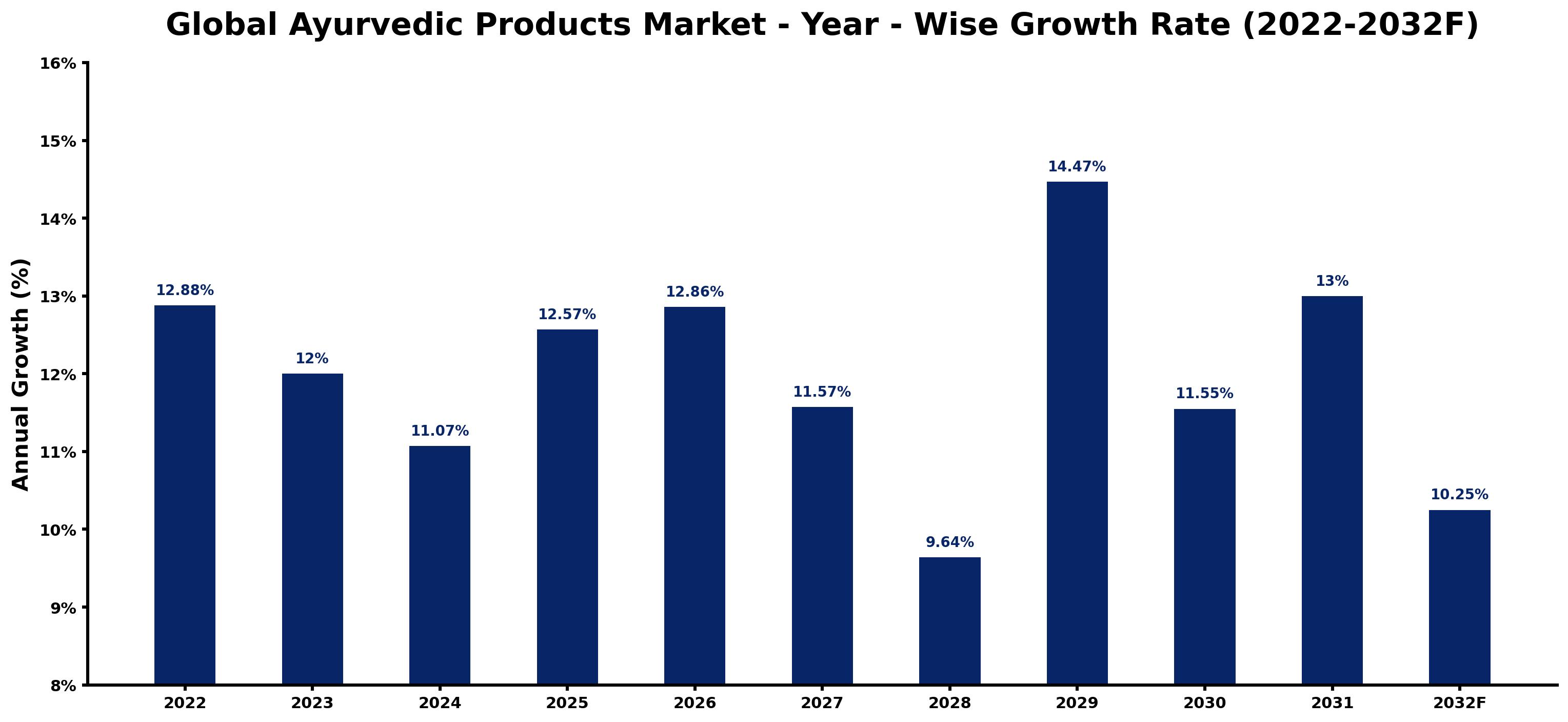
The table below presents the year‑wise growth rates along with the key drivers influencing the market
| Year | Growth Rate (%) | Major Drivers |
| 2022 | 12.88 | The supply chain for Ayurvedic products is adjusting to meet rising consumer expectations. |
| 2023 | 12 | Regulatory changes regarding Ayurvedic product approvals enhance market credibility and consumer trust. |
| 2024 | 11.07 | In North America, the competitive dynamics in Ayurvedic products are shifting towards quality standards. |
| 2025 | 12.57 | Rising raw material costs for Ayurvedic products are pushing manufacturers to seek efficient sourcing solutions. |
| 2026 | 12.86 | As consumers increasingly prioritize natural health solutions, Ayurvedic products gain significant market traction. |
| 2027 | 11.57 | Manufacturers are enhancing workforce training to improve product quality in Ayurvedic offerings. |
| 2028 | 9.64 | Increased online engagement with Ayurvedic products reflects shifting preferences among health-conscious consumers. |
| 2029 | 14.47 | A greater focus on sustainability in product sourcing stimulates innovation in Ayurvedic offerings. |
| 2030 | 11.55 | A shift toward digital therapeutics is changing how Ayurvedic products are marketed and delivered. |
| 2031 | 13 | Telehealth platforms enable wider geographic access to Ayurvedic products and services for patients. |
| 2032 | 10.25 | Retailers are investing in Ayurvedic products to adapt to evolving consumer health needs and preferences. |
Note - Market size estimations and growth projections presented in this report are based on 6Wresearch's proprietary research methodology, combining internal industry data, secondary research, and primary validation, updated periodically to reflect current market conditions. As markets evolve rapidly, figures for certain industries may vary slightly and are intended as informed estimates rather than absolute figures. For the most current market sizing, we recommend validating figures with a 6Wresearch analyst.
Global Ayurvedic Products Market Key Takeaways
Below are some of the specific key takeaways from the market, including:
- The largest segment, Healthcare Products, is anticipated to capture approximately ~60% of the market share in 2025.
- Personal Care Products are projected to be the fastest-growing segment, with a CAGR of 8.2% from 2026 to 2032.
- Patanjali Ayurved reported a revenue of over USD 1.2 Billion in 2022, showcasing the potential for substantial growth from traditional brands.
- The demand for herbal supplements in Europe has increased by 15% annually, pointing to a significant shift in consumer purchasing behavior.
- In 2021, the Indian government approved a dedicated fund of USD 10 Million to promote Ayurveda and traditional medicine on a global platform.
Evaluation of Restraints in Global Ayurvedic Products Market
A significant restraint in the Global Ayurvedic Products Market is the regulatory framework surrounding product certification and standardization. For instance, adherence to stringent quality regulations set by international bodies poses a challenge, particularly for smaller manufacturers. The lack of unified standards can lead to inconsistencies in product quality across regions, which affects market trust. For example, the FDA’s requirements for herbal remedies can necessitate spending upwards of USD 50,000 for compliance, a barrier for many emerging firms aiming to export their products.
Global Ayurvedic Products Market Trends
Currently, two distinct trends are reshaping the Global Ayurvedic Products Market. Firstly, the integration of digital platforms for direct-to-consumer sales is revolutionizing how herbal products are marketed. Companies like Himalaya Wellness have invested in e-commerce strategies, witnessing a 25% increase in online sales over the past year. Secondly, there is a rising demand for personalized Ayurvedic solutions, responding directly to individual health issues. This emphasizes the importance of tailoring product offerings; for example, Patanjali's recent launch of a customized herbal supplement line has gained substantial traction, aligning with the growing consumer preference for bespoke wellness solutions.
Global Ayurvedic Products Market Opportunities
Future revenue opportunities in the Global Ayurvedic Products Market are primarily centered around the expansion of innovative product lines and geographic outreach. One promising avenue is the development of Ayurvedic dietary supplements targeting immunity and stress relief, especially pertinent in today's health-conscious environment. For instance, according to a recent report, products that enhance immunity could see growth rates of up to 9.5% over the next five years. Additionally, collaborations with e-commerce platforms present a lucrative avenue for reaching consumers directly, particularly in regions with burgeoning interest in holistic health solutions.
Global Ayurvedic Products Market by Product Type
Healthcare Products lead the segment, holding a share of approximately ~60% in 2025, due to strong consumer demand for traditional remedies that support physical health. Meanwhile, Personal Care Products emerge as the fastest-growing segment with a CAGR of 8.2% from 2026 to 2032, reflecting an increasing consumer shift towards natural and herbal-based skincare solutions driven by clean beauty trends.
Global Ayurvedic Products Market by Organized/Unorganized
The Organized sector is expected to dominate the Global Ayurvedic Products Market with a share of about ~55% in 2025, driven by brand trust and marketing capabilities. Conversely, the Unorganized sector is projected to grow at a CAGR of 7.5% from 2026 to 2032, appealing to consumers seeking affordable and accessible options, particularly in rural areas where traditional practices hold significant cultural value.
Global Ayurvedic Products Market by Region
Asia commands the largest share of the Global Ayurvedic Products Market, holding an estimated ~48% share in 2025, primarily due to the cultural significance of Ayurveda within the region and established supply chains. Conversely, LATAM is identified as the fastest-growing region, with a CAGR of 7.2% from 2026 to 2032, as increasing interest in alternative medicine and wellness practices drives demand for Ayurvedic products, supported by burgeoning middle-class populations.
Government Initiatives in the Global Ayurvedic Products Market
The regulatory environment for the Global Ayurvedic Products Market is evolving, with various initiatives aimed at enhancing the sector's credibility and fostering growth. Governments are increasingly recognizing the significance of Ayurveda in promoting health and wellness, leading to supportive policies and programs.
- The Ministry of AYUSH, India, launched the 'Ayush Industry Development Scheme' in 2021 to promote the growth of Ayurvedic products through financial grants for innovative industries.
- The Food Safety and Standards Authority of India (FSSAI) issued guidelines on Ayurvedic product labeling in 2020 to ensure transparency and quality in consumer information.
- In 2022, the Government of India dedicated a budget of approximately USD 25 Million for improving Ayurvedic research and development initiatives to enhance product efficacy and consumer safety.
- To boost exports, India implemented the 'Export Promotion Scheme for AYUSH' in 2023 to galvanize international market entry for Ayurvedic products, increasing global competitiveness.
Future Insights of the Global Ayurvedic Products Market
The Global Ayurvedic Products Market is projected to undergo substantial transformations driven by technological advancements in product formulation and consumer behavior regarding wellness. The increasing integration of digital health solutions, such as personalized well-being apps, will enable companies like Himalaya Wellness to enhance customer engagement. This trend is anchored by the burgeoning interest in holistic health and preventive care, allowing brands to tailor products effectively to consumer needs. By 2032, the industry could witness a marked shift toward supply chain transparency, enhancing product traceability and safety standards.
Global Ayurvedic Products Market Latest Developments
Several noteworthy developments are shaping the landscape of the Global Ayurvedic Products Market, as companies strive to strengthen their market presence and address consumer needs.
- In early 2023, Dabur India launched a new line of Ayurvedic hair care products targeting urban consumers concerned about environmental stressors and hair health. This expansion broadens their market reach and aligns with the growing clean beauty trend.
- Recently, Patanjali Ayurved announced plans to enhance its distribution network across Latin America. This strategic move aims to capture the emerging interest in Ayurvedic solutions among younger consumers in these markets.
- In mid-2022, Himalaya Wellness revealed an investment in AI-driven research to develop personalized Ayurvedic supplements. This approach leverages technological advancements to refine product offerings based on consumer health profiles, ultimately enhancing customer satisfaction.
- Zandu Pharmaceutical Works is currently collaborating with local herbal farmers to ensure a consistent supply of high-quality raw materials. This initiative, launched in late 2022, strengthens their commitment to sustainable sourcing, an increasingly vital factor for consumers.
Global Ayurvedic Products Market Key Players and Industry Positioning
The Global Ayurvedic Products Market remains fragmented, with a mixture of consolidated leaders and numerous smaller entities competing for market share. Major players leverage brand loyalty and robust distribution networks to maintain their positions, while smaller firms often capitalize on niche segments and local specialties.
| Leading Company | Core Strength | Strategic Focus |
|---|---|---|
| Himalaya Wellness | Strong brand equity and extensive distribution channels. | Emphasizing digital marketing and personalized nutrition. |
| Patanjali Ayurved | Wide range of herbal products backed by traditional formulations. | Expanding international presence and accessibility. |
| Dabur India | Diverse product portfolio with strong R&D capabilities. | Innovating product lines to attract modern consumers. |
| Baidyanath | Reputation for authenticity with a focus on traditional Ayurvedic practices. | Building partnerships to enhance raw material sourcing. |
| Zandu Pharmaceutical Works | Established presence in traditional medicine with modern formulations. | Integration of sustainable practices in sourcing and production. |
Ongoing competition will likely emphasize innovation and quality assurance, pivotal for driving consumer trust in Ayurvedic products.
Key Attractiveness of the Report
- 10 Years of Market Numbers
- Historical Data Starting from 2022 to 2025
- Base Year: 2025
- Forecast Data until 2032
- Key Performance Indicators Impacting the Market
- Major Upcoming Developments and Projects
Key Highlights of the Report:
- Global Ayurvedic Products Market Outlook
- Market Size of Global Ayurvedic Products Market, 2025
- Forecast of Global Ayurvedic Products Market, 2032
- Historical Data and Forecast of Global Ayurvedic Products Revenues & Volume for the Period 2022-2032
- Global Ayurvedic Products Market Trend Evolution
- Global Ayurvedic Products Market Drivers and Challenges
- Global Ayurvedic Products Price Trends
- Global Ayurvedic Products Porter's Five Forces
- Global Ayurvedic Products Industry Life Cycle
- Historical Data and Forecast of Global Ayurvedic Products Market Revenues & Volume
- Historical Data and Forecast of Global Ayurvedic Products Market Revenues & Volume By Product Type for the Period 2022-2032
- Historical Data and Forecast of Global Ayurvedic Products Market Revenues & Volume By Healthcare Products for the Period 2022-2032
- Historical Data and Forecast of Global Ayurvedic Products Market Revenues & Volume By Personal Care Products for the Period 2022-2032
- Historical Data and Forecast of Global Ayurvedic Products Market Revenues & Volume By Organized/Unorganized for the Period 2022-2032
- Historical Data and Forecast of Global Ayurvedic Products Market Revenues & Volume By Organized for the Period 2022-2032
- Historical Data and Forecast of Global Ayurvedic Products Market Revenues & Volume By Unorganized for the Period 2022-2032
- Historical Data and Forecast of North America Ayurvedic Products Market Revenues & Volume By Product Type for the Period 2022-2032
- Historical Data and Forecast of North America Ayurvedic Products Market Revenues & Volume By Healthcare Products for the Period 2022-2032
- Historical Data and Forecast of North America Ayurvedic Products Market Revenues & Volume By Personal Care Products for the Period 2022-2032
- Historical Data and Forecast of North America Ayurvedic Products Market Revenues & Volume By Organized/Unorganized for the Period 2022-2032
- Historical Data and Forecast of North America Ayurvedic Products Market Revenues & Volume By Organized for the Period 2022-2032
- Historical Data and Forecast of North America Ayurvedic Products Market Revenues & Volume By Unorganized for the Period 2022-2032
- Historical Data and Forecast of United States of America Ayurvedic Products Market Revenues & Volume for the Period 2022-2032
- Historical Data and Forecast of Canada Ayurvedic Products Market Revenues & Volume for the Period 2022-2032
- Historical Data and Forecast of Rest of North America Ayurvedic Products Market Revenues & Volume for the Period 2022-2032
- Historical Data and Forecast of Latin America (LATAM) Ayurvedic Products Market Revenues & Volume By Product Type for the Period 2022-2032
- Historical Data and Forecast of Latin America (LATAM) Ayurvedic Products Market Revenues & Volume By Healthcare Products for the Period 2022-2032
- Historical Data and Forecast of Latin America (LATAM) Ayurvedic Products Market Revenues & Volume By Personal Care Products for the Period 2022-2032
- Historical Data and Forecast of Latin America (LATAM) Ayurvedic Products Market Revenues & Volume By Organized/Unorganized for the Period 2022-2032
- Historical Data and Forecast of Latin America (LATAM) Ayurvedic Products Market Revenues & Volume By Organized for the Period 2022-2032
- Historical Data and Forecast of Latin America (LATAM) Ayurvedic Products Market Revenues & Volume By Unorganized for the Period 2022-2032
- Historical Data and Forecast of Brazil Ayurvedic Products Market Revenues & Volume for the Period 2022-2032
- Historical Data and Forecast of Mexico Ayurvedic Products Market Revenues & Volume for the Period 2022-2032
- Historical Data and Forecast of Argentina Ayurvedic Products Market Revenues & Volume for the Period 2022-2032
- Historical Data and Forecast of Rest of LATAM Ayurvedic Products Market Revenues & Volume for the Period 2022-2032
- Historical Data and Forecast of Asia Ayurvedic Products Market Revenues & Volume By Product Type for the Period 2022-2032
- Historical Data and Forecast of Asia Ayurvedic Products Market Revenues & Volume By Healthcare Products for the Period 2022-2032
- Historical Data and Forecast of Asia Ayurvedic Products Market Revenues & Volume By Personal Care Products for the Period 2022-2032
- Historical Data and Forecast of Asia Ayurvedic Products Market Revenues & Volume By Organized/Unorganized for the Period 2022-2032
- Historical Data and Forecast of Asia Ayurvedic Products Market Revenues & Volume By Organized for the Period 2022-2032
- Historical Data and Forecast of Asia Ayurvedic Products Market Revenues & Volume By Unorganized for the Period 2022-2032
- Historical Data and Forecast of China Ayurvedic Products Market Revenues & Volume for the Period 2022-2032
- Historical Data and Forecast of India Ayurvedic Products Market Revenues & Volume for the Period 2022-2032
- Historical Data and Forecast of Japan Ayurvedic Products Market Revenues & Volume for the Period 2022-2032
- Historical Data and Forecast of Rest of Asia Ayurvedic Products Market Revenues & Volume for the Period 2022-2032
- Historical Data and Forecast of Africa Ayurvedic Products Market Revenues & Volume By Product Type for the Period 2022-2032
- Historical Data and Forecast of Africa Ayurvedic Products Market Revenues & Volume By Healthcare Products for the Period 2022-2032
- Historical Data and Forecast of Africa Ayurvedic Products Market Revenues & Volume By Personal Care Products for the Period 2022-2032
- Historical Data and Forecast of Africa Ayurvedic Products Market Revenues & Volume By Organized/Unorganized for the Period 2022-2032
- Historical Data and Forecast of Africa Ayurvedic Products Market Revenues & Volume By Organized for the Period 2022-2032
- Historical Data and Forecast of Africa Ayurvedic Products Market Revenues & Volume By Unorganized for the Period 2022-2032
- Historical Data and Forecast of South Africa Ayurvedic Products Market Revenues & Volume for the Period 2022-2032
- Historical Data and Forecast of Nigeria Ayurvedic Products Market Revenues & Volume for the Period 2022-2032
- Historical Data and Forecast of Egypt Ayurvedic Products Market Revenues & Volume for the Period 2022-2032
- Historical Data and Forecast of Rest of Africa Ayurvedic Products Market Revenues & Volume for the Period 2022-2032
- Historical Data and Forecast of Europe Ayurvedic Products Market Revenues & Volume By Product Type for the Period 2022-2032
- Historical Data and Forecast of Europe Ayurvedic Products Market Revenues & Volume By Healthcare Products for the Period 2022-2032
- Historical Data and Forecast of Europe Ayurvedic Products Market Revenues & Volume By Personal Care Products for the Period 2022-2032
- Historical Data and Forecast of Europe Ayurvedic Products Market Revenues & Volume By Organized/Unorganized for the Period 2022-2032
- Historical Data and Forecast of Europe Ayurvedic Products Market Revenues & Volume By Organized for the Period 2022-2032
- Historical Data and Forecast of Europe Ayurvedic Products Market Revenues & Volume By Unorganized for the Period 2022-2032
- Historical Data and Forecast of United Kingdom Ayurvedic Products Market Revenues & Volume for the Period 2022-2032
- Historical Data and Forecast of France Ayurvedic Products Market Revenues & Volume for the Period 2022-2032
- Historical Data and Forecast of Germany Ayurvedic Products Market Revenues & Volume for the Period 2022-2032
- Historical Data and Forecast of Rest of Europe Ayurvedic Products Market Revenues & Volume for the Period 2022-2032
- Historical Data and Forecast of Middle East Ayurvedic Products Market Revenues & Volume By Product Type for the Period 2022-2032
- Historical Data and Forecast of Middle East Ayurvedic Products Market Revenues & Volume By Healthcare Products for the Period 2022-2032
- Historical Data and Forecast of Middle East Ayurvedic Products Market Revenues & Volume By Personal Care Products for the Period 2022-2032
- Historical Data and Forecast of Middle East Ayurvedic Products Market Revenues & Volume By Organized/Unorganized for the Period 2022-2032
- Historical Data and Forecast of Middle East Ayurvedic Products Market Revenues & Volume By Organized for the Period 2022-2032
- Historical Data and Forecast of Middle East Ayurvedic Products Market Revenues & Volume By Unorganized for the Period 2022-2032
- Historical Data and Forecast of Saudi Arabia Ayurvedic Products Market Revenues & Volume for the Period 2022-2032
- Historical Data and Forecast of UAE Ayurvedic Products Market Revenues & Volume for the Period 2022-2032
- Historical Data and Forecast of Turkey Ayurvedic Products Market Revenues & Volume for the Period 2022-2032
- Historical Data and Forecast of Rest of Middle East Ayurvedic Products Market Revenues & Volume for the Period 2022-2032
- Global Ayurvedic Products Market - Key Performance Indicators
- Global Ayurvedic Products Market - Import Export Trade Statistics
- Global Ayurvedic Products Market - Opportunity Assessment By Countries
- Global Ayurvedic Products Market - Opportunity Assessment By Product Type
- Global Ayurvedic Products Market - Opportunity Assessment By Organized/Unorganized
- Global Ayurvedic Products Market - Top Companies Market Share
- Global Ayurvedic Products Market - Top Companies Profiles
- Global Ayurvedic Products Market - Comparison of Players in Technical and Operating Parameters
- Global Ayurvedic Products Market - Strategic Recommendations
Markets Covered
The Global Ayurvedic Products Market report provides a detailed analysis of the following market segments:
By Regions and Countries:
- North America
- Europe
- LATAM
- Middle East
- Asia
- Africa
By Product Type:
- Healthcare Products
- Personal Care Products
By Organized/Unorganized:
- Organized
- Unorganized






































