Global Biobanking Market Highlights
| Market Size (2025) | USD 4.1 Billion |
| Forecast Size (2032) | USD 7.1 Billion |
| CAGR | 4.90% |
| Base Year | 2025 |
| Forecast Period | 2026-2032 |
| Largest Region | North America |
| Fastest Growing Region | Asia |
| Largest Segment | Consumables |
| Fastest Growing Segment | Services |
| Leading Companies | Thermo Fisher Scientific, BioBank, Brooks Life Sciences, Qiagen, Hamilton Company |
Global Biobanking Market Size & Growth Rate (2026-2032)
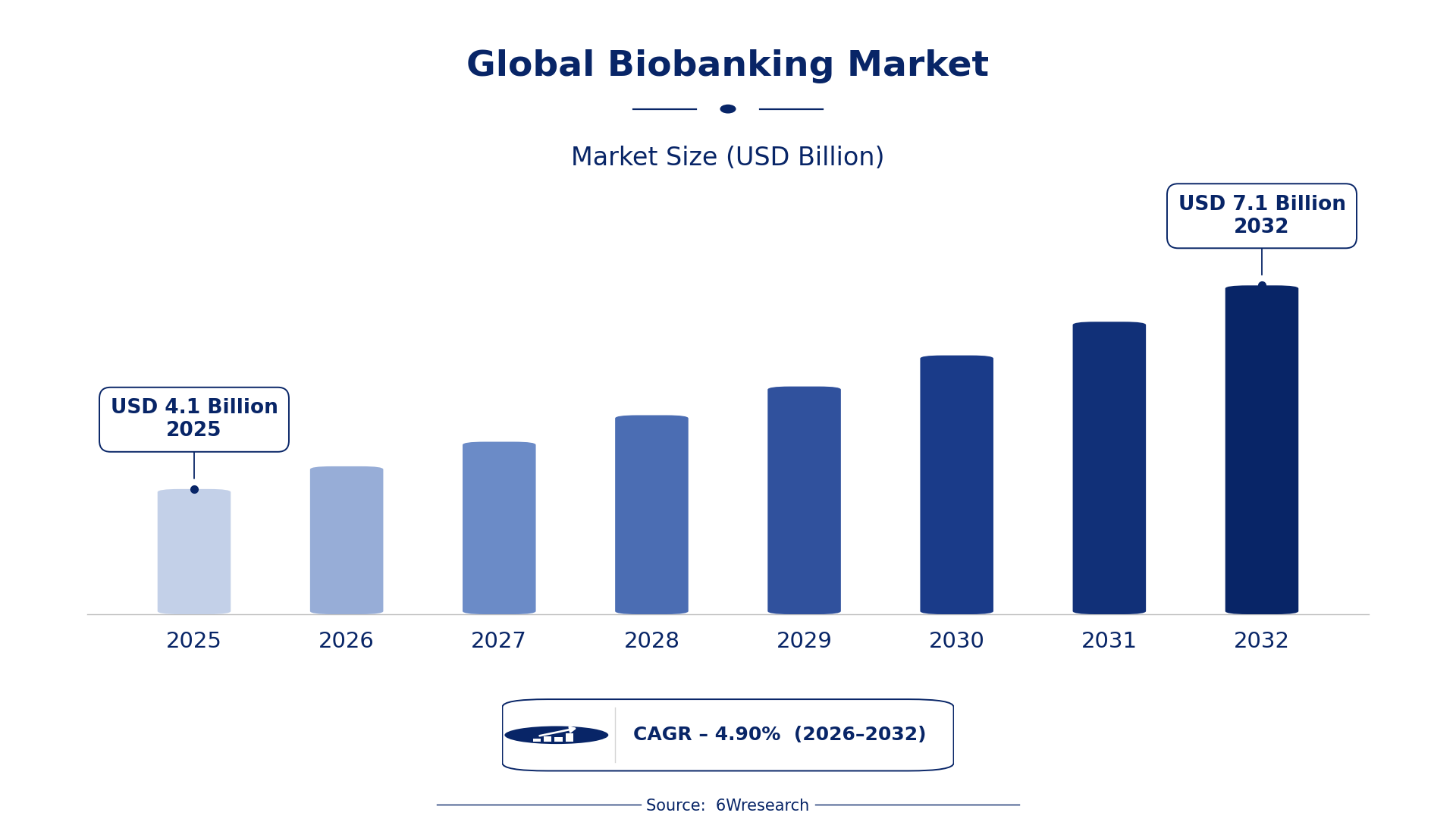
The Global Biobanking Market was estimated at USD 4.1 Billion in 2025 and is projected to reach USD 7.1 Billion by 2032, growing at a CAGR of 4.90% from 2026 to 2032.
Global Biobanking Market Synopsis
The Global Biobanking Market is witnessing a transformative phase, driven by increasing needs in clinical research and regenerative medicine. This demand is supported by advances in sample storage technologies and regulatory policies that favor biobanking initiatives across various healthcare sectors.
As healthcare systems prioritize personalized medicine and drug discovery, biobanks have become essential. Their role in facilitating research and innovation in genetics and therapeutics positions them uniquely in the broader life sciences ecosystem, showcasing their importance beyond mere sample storage.
Global Biobanking Market Year-wise Growth Rate and Key Drivers
This graph illustrates the annual growth rates of the Global Biobanking Market from 2022 to 2032, highlighting a steady upward trajectory and projected expansion over the forecast period.
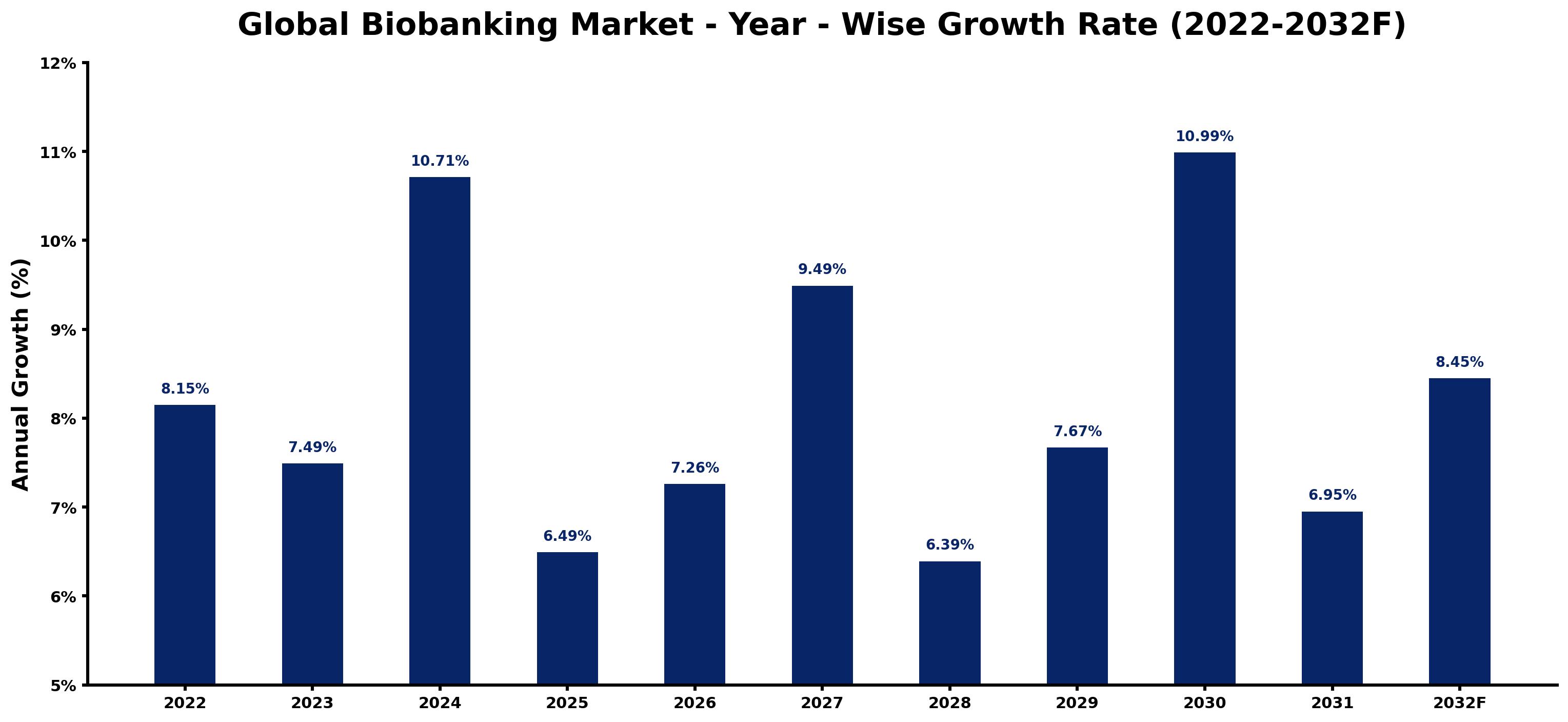
The table below presents the year‑wise growth rates along with the key drivers influencing the market
| Year | Growth Rate (%) | Major Drivers |
| 2022 | 8.15 | Biosensor technology enhancements catalyze increased end-user interest in biobanking solutions. |
| 2023 | 7.49 | In North America, expanding clinical trial pipelines drive regional biobanking growth opportunities. |
| 2024 | 10.71 | While patient outcomes data utilization rises, biobanking adoption among healthcare providers accelerates. |
| 2025 | 6.49 | Expanding hospital infrastructure enables better biobanking services and patient data management. |
| 2026 | 7.26 | Growing sustainability initiatives reinforce the importance of biobanking in chronic disease research. |
| 2027 | 9.49 | Pharmaceutical companies are increasingly investing in biobanking to support drug delivery systems. |
| 2028 | 6.39 | Logistics providers enhance supply chain dynamics for effective biobanking sample management. |
| 2029 | 7.67 | Regulators push for innovative biobanking practices to ensure quality in diagnostic imaging. |
| 2030 | 10.99 | FDA approvals streamline biobanking processes for new telehealth platforms in healthcare. |
| 2031 | 6.95 | Increased raw material costs challenge the growth of biobanking infrastructures worldwide. |
| 2032 | 8.45 | A shift toward integrated digital therapeutics changes operational strategies in the biobanking sector. |
Note - Market size estimations and growth projections presented in this report are based on 6Wresearch's proprietary research methodology, combining internal industry data, secondary research, and primary validation, updated periodically to reflect current market conditions. As markets evolve rapidly, figures for certain industries may vary slightly and are intended as informed estimates rather than absolute figures. For the most current market sizing, we recommend validating figures with a 6Wresearch analyst.
Global Biobanking Market Key Takeaways
Below are some of the specific key takeaways from the market, including:
- North America accounts for approximately ~39% of the market share as of 2025, driven by high demand for biobanked samples in research.
- Consumables currently represent the largest segment, holding a ~50% market share in 2025.
- The Services segment is projected to grow at a CAGR of 6.8% from 2026 to 2032, reflecting shifts towards integrated biobanking solutions.
- Brooks Life Sciences has invested over USD 30 million in expanding biobanking infrastructure to enhance sample management services across platforms.
- Thermo Fisher Scientific remains a market leader due to its robust portfolio of biobank solutions, capitalizing on strategic partnerships with academic institutions.
Evaluation of Restraints in Global Biobanking Market
Despite the promising outlook, the Global Biobanking Market faces significant restraints. One primary challenge is the regulatory environment, which can impede expansion due to stringent compliance costs. For instance, obtaining certifications can cost upwards of USD 500,000, particularly in regions with rigorous standards like North America. For example, biobanks must navigate multiple federal and state regulations, which can delay operations and increase overheads. This complexity may deter smaller entrants from competing effectively.
Global Biobanking Market Trends
Several transformative trends characterize the Global Biobanking Market. First, the integration of AI in biobanking processes enhances operational efficiency. For instance, a leading firm projected a 20% increase in processing speed through AI-driven data management systems as of 2023. Secondly, there is a notable shift towards personalized medicine, exemplified by a partnership between BioBank and a major pharmaceutical company, focusing on genetic sample collection to tailor drug therapies. Additionally, the advent of automated cryogenic storage solutions is changing the landscape, making long-term preservation of biological samples more efficient and reliable, essential for clinical research needs.
Global Biobanking Market Opportunities
The future of the Global Biobanking Market presents numerous revenue opportunities, particularly in regenerative medicine. Companies like Qiagen are developing innovative tools that cater to cellular therapies, a market expected to grow to USD 22 billion by 2027. For example, the European Union's investment in innovative healthcare projects has led to collaborations that enhance biobanking capabilities. Moreover, the rise in demand for long-read sequencing technologies in genomics is propelling investments in biobanks, highlighting their critical role in precision medicine.
Global Biobanking Market by Type
In the Global Biobanking Market, Consumables hold the largest share, representing approximately ~50% in 2025. This dominance is attributed to their essential role in sample collection and preservation. Meanwhile, the Services segment is the fastest-growing, anticipated to expand at a CAGR of 6.8% from 2026 to 2032. This growth is largely due to increasing demand for specialized biobanking solutions that integrate with clinical workflows, enhancing research accuracy and efficiency.
Global Biobanking Market by Applications
Life Science Research accounts for the largest segment in the Global Biobanking Market, holding a share of approximately ~54% as of 2025. This segment benefits from heightened investments in research initiatives across institutions and pharmaceuticals. Conversely, Clinical Research is expected to grow rapidly, with a noteworthy CAGR of 7.2% from 2026 to 2032. This is driven by escalating demand for biobanked samples in trial phases of new therapies, necessitating access to diverse biological materials.
Global Biobanking Market by Sample Type
Blood Products dominate the Global Biobanking Market, accounting for roughly ~45% of the share in 2025. This prevalence stems from their critical role in clinical diagnostics and therapy developments. Meanwhile, Biological Fluids are the fastest-growing segment, projected to expand at a CAGR of 8.2% from 2026 to 2032, propelled by an increase in research focused on non-invasive testing methods that utilize these samples.
Global Biobanking Market by Region
North America represents the largest region in the Global Biobanking Market, capturing around ~39% share as of 2025, thanks to its established healthcare infrastructure and significant investments in biomedical research. Conversely, Asia is expected to be the fastest-growing region, with a projected CAGR of 8.0% from 2026 to 2032. This growth is fueled by increasing healthcare investments and a burgeoning demand for personalized medicine across countries such as China and India.
Government Initiatives in the Global Biobanking Market
The regulatory environment surrounding the Global Biobanking Market is becoming more supportive, aiming to enhance operational standards and encourage research and innovation. Several initiatives demonstrate this commitment, facilitating financial support and collaborative frameworks across various sectors.
- National Institutes of Health (NIH), "Genomic Data Sharing Policy," effective January 2015; aims to support open access to genomic data.
- European Biobanking and Biomolecular Resources Research Infrastructure (BBMRI), initiative launched in 2013, focuses on strengthening biobanking capabilities across Europe.
- U.S. Food and Drug Administration (FDA), "Regulatory Framework for Regenerative Medicine," established in March 2022; aims to streamline approval processes.
- Canadian Institutes of Health Research (CIHR), "Strategy for Patient-Oriented Research," introduced in April 2021; funds biobanking initiatives for improved health research.
Future Insights of the Global Biobanking Market
As the Global Biobanking Market approaches 2032, a transformation in sample management technology is anticipated, significantly influencing operational capabilities. Companies like Brooks Life Sciences are investing heavily to enhance infrastructure, targeting advancements that integrate biobanking solutions with new healthcare technologies. This integration will facilitate superior data analysis and improve sample tracing, ultimately enhancing the research process in regenerative medicine. The demand for comprehensive biobanking services, particularly in personalized medicine, is projected to lead to partnerships aimed at augmenting service offerings and operational efficiency.
Global Biobanking Market Latest Developments
Recent developments in the biobanking sector reflect emerging trends and strategic maneuvers aimed at bolstering capacity and capabilities. Key activities include:
- In August 2023, Thermo Fisher Scientific expanded its biobanking platform to incorporate advanced data analytics, enhancing the quality and accessibility of samples for research.
- As of July 2023, Qiagen launched a series of innovative kits designed to streamline the extraction and analysis processes, which should attract more clients in the clinical research space.
- Brooks Life Sciences is currently finalizing the construction of a new biobanking facility in Europe, aimed at enhancing their service footprint and operational capacity by 2024.
- Hamilton Company, in June 2023, unveiled an automated liquid handling system specifically tailored for biobanking applications, which is expected to improve throughput and accuracy in sample processing.
Global Biobanking Market Key Players and Industry Positioning
The Global Biobanking Market exhibits a fragmented competitive structure, characterized by numerous players specializing in distinct aspects such as sample management, technology development, and services. This diversity allows companies to tailor offerings based on specific regional and operational demands, thus enhancing overall market resilience.
| Leading Company | Core Strength | Strategic Focus |
|---|---|---|
| Thermo Fisher Scientific | Extensive portfolio of biobanking solutions | Strategic partnerships with academic institutions |
| BioBank | Customizable biobanking services | Focus on genetic sample collection for personalized medicine |
| Brooks Life Sciences | Strong investment in infrastructure | Enhancing sample management across platforms |
| Qiagen | Expertise in molecular diagnostics | Accelerating development for clinical research tools |
| Hamilton Company | Automation technology for laboratory workflows | Expanding automated solutions in biobaking |
A diversified approach among leading companies allows for tailored solutions and enhanced service delivery, crucial as market needs evolve towards advanced technological integrations and personalized applications.
Key Attractiveness of the Report
- 10 Years of Market Numbers
- Historical Data Starting from 2022 to 2025
- Base Year: 2025
- Forecast Data until 2032
- Key Performance Indicators Impacting the Market
- Major Upcoming Developments and Projects
Key Highlights of the Report:
- Global Biobanking Market Overview
- Global Biobanking Market Outlook
- Global Biobanking Market Forecast
- Historical Data of Global Biobanking Market Revenues & Volume for the Period 2022-2032
- Global Biobanking Market Size and Global Biobanking Market Forecast of Revenues & Volume, Until 2032
- Historical Data of Global Biobanking Market Revenues & Volume, by Type, for the Period 2022-2032
- Market Size & Forecast of Global Biobanking Market Revenues & Volume, by Type, Until 2032
- Historical Data of Global Biobanking Market Revenues & Volume, by Applications, for the Period 2022-2032
- Market Size & Forecast of Global Biobanking Market Revenues & Volume, by Applications, Until 2032
- Historical Data of Global Biobanking Market Revenues, by Sample Type, for the Period 2022-2032
- Market Size & Forecast of Global Biobanking Market Revenues, by Sample Type, Until 2032
- Historical Data of Global Biobanking Market Revenues, by Regions, for the Period 2022-2032
- Market Size & Forecast of Global Biobanking Market Revenues, by Regions, Until 2032
- Historical Data of Asia Pacific Global Biobanking Market Revenues, for the Period 2022-2032
- Market Size & Forecast of Asia Pacific Global Biobanking Market Revenues, Until 2032
- Historical Data of Latin America Global Biobanking Market Revenues, for the Period 2022-2032
- Market Size & Forecast of Latin America Global Biobanking Market Revenues, Until 2032
- Historical Data of Europe Global Biobanking Market Revenues, for the Period 2022-2032
- Market Size & Forecast of Europe Global Biobanking Market Revenues, Until 2032
- Historical Data of Middle East Global Biobanking Market Revenues, for the Period 2022-2032
- Market Size & Forecast of Middle East Global Biobanking Market Revenues, Until 2032
- Historical Data of North America Global Biobanking Market Revenues, for the Period 2022-2032
- Market Size & Forecast of North America Global Biobanking Market Revenues, Until 2032
- Historical Data of Africa Global Biobanking Market Revenues, for the Period 2022-2032
- Market Size & Forecast of Africa Global Biobanking Market Revenues, Until 2032
- Market Drivers and Restraints
- Global Biobanking Market Trends and Industry Life Cycle
- Porter’s Five Force Analysis
- Market Opportunity Assessment
- Global Biobanking Market Share, By Players
- Global Biobanking Market Share, By Regions
- Global Biobanking Market Overview on Competitive Benchmarking
- Company Profiles
- Key Strategic Recommendations
Markets Covered
The Global Biobanking Market report provides a detailed analysis of the following market segments:
By Regions and Countries:
- North America
- Europe
- LATAM
- Middle East
- Asia
- Africa
By Type:
- Equipment
- Consumables
- Services
- Software
By Applications:
- Regenerative Medicine
- Life Science Research
- Clinical Research
By Sample Type:
- Blood Products
- Human Tissues
- Nucleic Acids
- Cell Lines
- Biological Fluids
- Human Waste Products






































