Global Car Accessories Market Highlights
| Market Size (2025) | USD 480 Billion |
| Forecast Size (2032) | USD 690 Billion |
| CAGR | 6.20% |
| Base Year | 2025 |
| Forecast Period | 2026-2032 |
| Largest Region | North America |
| Fastest Growing Region | Asia |
| Largest Segment | Interior Accessories |
| Fastest Growing Segment | Exterior Accessories |
| Leading Companies | 3M, Bosch, AutoZone, Denso, Pioneer Electronics |
Global Car Accessories Market Size & Growth Rate (2026-2032)
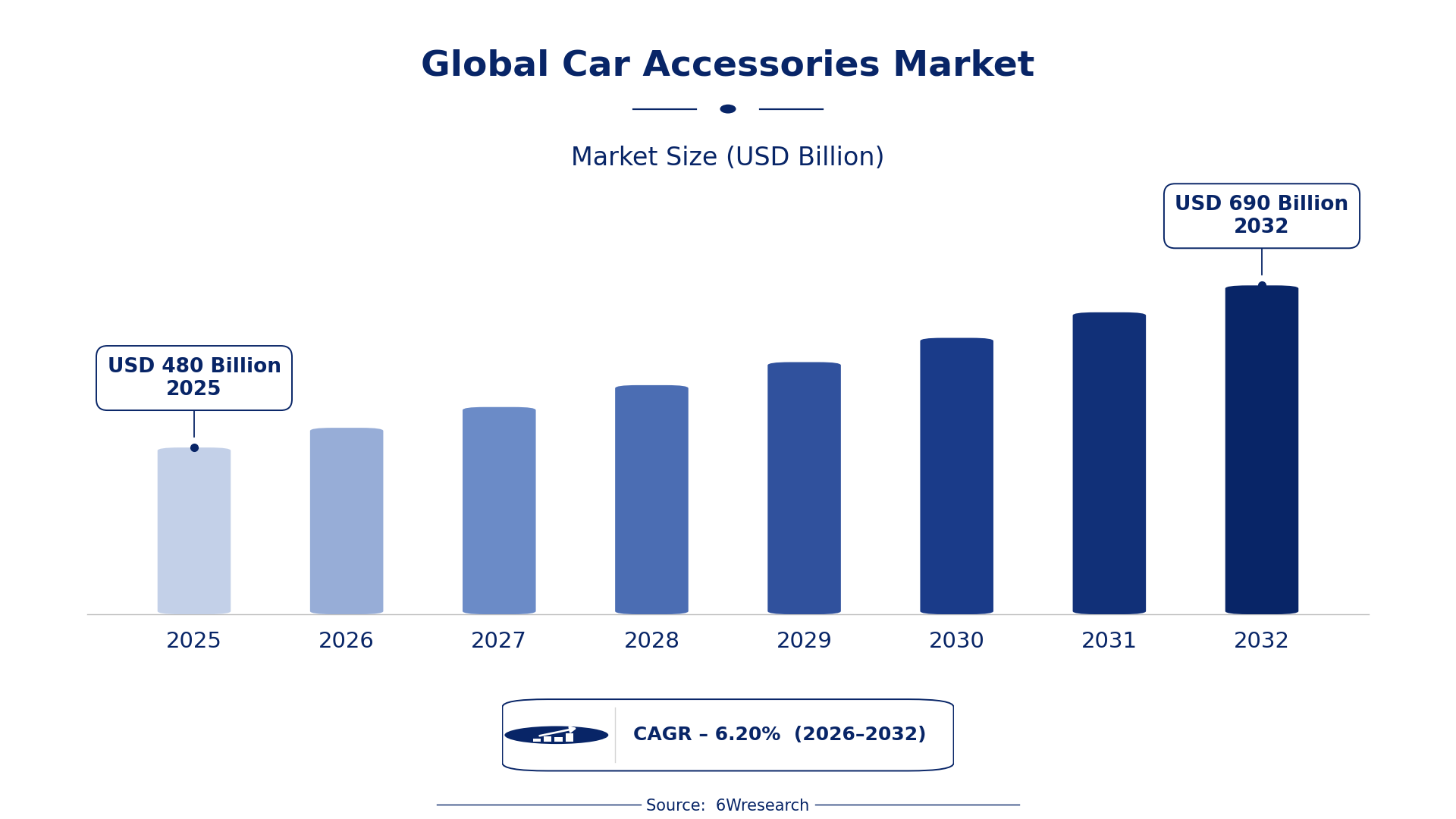
The Global Car Accessories Market was estimated at USD 480 Billion in 2025 and is projected to reach USD 690 Billion by 2032, growing at a CAGR of 6.20% from 2026 to 2032.
Global Car Accessories Market Synopsis
The Global Car Accessories Market is witnessing structural transformations driven by shifts in consumer preferences toward customization and functionality. Enhanced aesthetics and advanced technology integration, such as the rise of smart accessories, are influencing market dynamics significantly.
E-commerce platforms have emerged as vital channels, expanding market accessibility while driving innovative product developments. This sector's unique position, in conjunction with increased disposable income globally, positions the Global Car Accessories Market as a crucial component of the automotive ecosystem.
Global Car Accessories Market Year-wise Growth Rate and Key Drivers
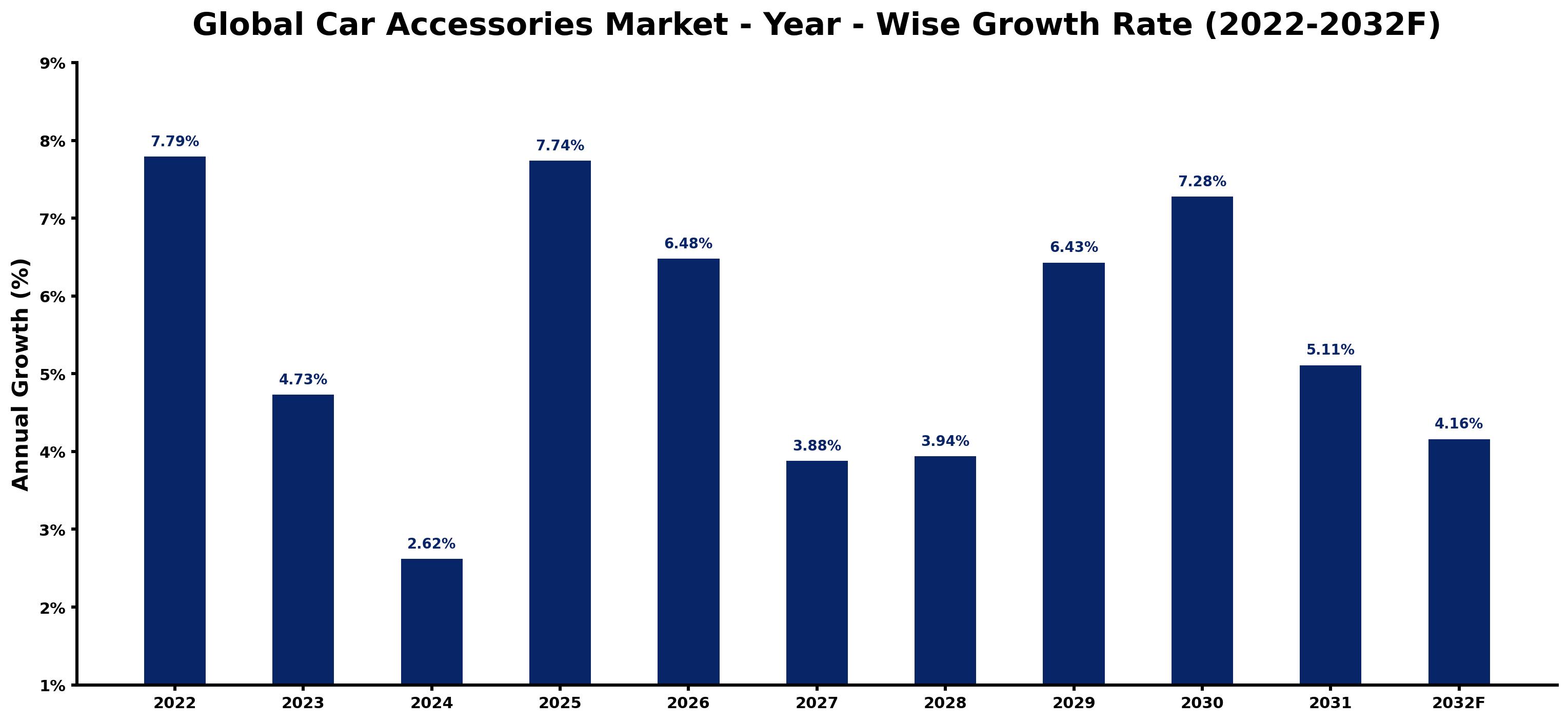
This graph illustrates the annual growth rates of the Global Car Accessories Market from 2022 to 2032, highlighting a steady upward trajectory and projected expansion over the forecast period.
The table below presents the year‑wise growth rates along with the key drivers influencing the market
| Year | Growth Rate (%) | Major Drivers |
| 2022 | 7.79 | Automotive manufacturers are experiencing increasing demand for innovative car accessories. |
| 2023 | 4.73 | A shift toward sustainability influences the design of car accessories in production. |
| 2024 | 2.62 | Consumers increasingly favor advanced car accessories that enhance vehicle performance. |
| 2025 | 7.74 | Expanding charging infrastructure enables greater adoption of electric vehicle accessories. |
| 2026 | 6.48 | Emissions regulations are driving car accessory manufacturers to innovate eco-friendly solutions. |
| 2027 | 3.88 | While regional markets expand, the demand for car accessories grows steadily worldwide. |
| 2028 | 3.94 | ADAS systems are enhancing the function and appeal of modern car accessories. |
| 2029 | 6.43 | Advanced materials in car accessories signal a shift toward greater market sophistication. |
| 2030 | 7.28 | Manufacturers are altering designs to meet evolving consumer preferences for car accessories. |
| 2031 | 5.11 | Increased M&A activity among car accessory firms shapes competitive dynamics in the sector. |
| 2032 | 4.16 | Across North America, raw material costs are influencing pricing strategies for car accessories. |
Note - Market size estimations and growth projections presented in this report are based on 6Wresearch's proprietary research methodology, combining internal industry data, secondary research, and primary validation, updated periodically to reflect current market conditions. As markets evolve rapidly, figures for certain industries may vary slightly and are intended as informed estimates rather than absolute figures. For the most current market sizing, we recommend validating figures with a 6Wresearch analyst.
Global Car Accessories Market Key Takeaways
Below are some of the specific key takeaways from the market, including:
- The demand for customization in vehicles is reflected in a market surge, with consumers willing to spend up to 15% more on personalized accessories.
- Interior Accessories command about 55% of market share in 2025, highlighting their dominance in consumer preferences for functional enhancements.
- The fastest-growing segment, Exterior Accessories, is expected to expand at a CAGR of 7.5% from 2026 to 2032, driven by rising interest in vehicle aesthetics and performance.
- Major company Bosch reported a 20% increase in sales for car accessories in North America in 2023, positioning them as a market leader.
Evaluation of Restraints in Global Car Accessories Market
The Global Car Accessories Market faces several constraints impacting growth. Regulatory challenges surrounding safety and environmental standards remain significant; for instance, non-compliance fines can reach upwards of $500,000 for manufacturers failing to meet safety regulations. For example, stringent emission regulations are causing some accessory manufacturers to recalibrate their products to adhere to evolving laws, which can increase production costs and slow down the innovation cycle.
Global Car Accessories Market Trends
Transformations in the Global Car Accessories Market are driven by distinct trends, notably the integration of smart technology in products. Companies like Pioneer Electronics are introducing advanced dash cams that not only serve safety purposes but also enhance connectivity. The rise of electric vehicles (EVs) further influences accessory designs, as manufacturers shift focus toward EV-compatible products. For example, an estimate of 30% of new vehicle sales by 2025 is expected to be electric, pushing accessory manufacturers to innovate in this sector rapidly. Automation in manufacturing processes, especially in custom interior accessories, is enabling quicker response to changing consumer preferences, which is becoming critical in a competitive landscape.
Global Car Accessories Market Opportunities
Emerging opportunities within the Global Car Accessories Market are set to fuel future revenue streams, particularly in the EV ecosystem. As electric vehicle adoption grows, companies are positioning themselves to cater to a new wave of accessory demands, focusing on charging solutions and lightweight materials. For instance, Tesla’s commitment to an expanded product range offers a revenue potential estimated at $2 billion by 2026 for companies providing specialized accessories. Innovations in sustainable materials are also gaining momentum, with companies like 3M exploring eco-friendly alternatives to traditional plastic components, creating new competitive avenues while appealing to environmentally conscious consumers.
Global Car Accessories Market by Application
Within the Global Car Accessories Market, Interior Accessories lead with a commanding 55% share in 2025, emphasizing their essential role in consumer decisions for vehicle enhancements. However, the Exterior Accessories segment, showing a CAGR of 7.5% from 2026 to 2032, is witnessing the fastest growth, driven by escalating consumer interest in aesthetic modifications and performance enhancements. The need for durable, high-performance exterior products cannot be overstated, as consumers increasingly seek items that not only beautify but also fortify their vehicles against the rigors of everyday use.
Global Car Accessories Market by Sales Channel
The Global Car Accessories Market operates primarily through two channels: OEM and Aftermarket. The OEM segment captures around 60% of the market share in 2025, owing to partnerships with major automotive manufacturers that ensure high compatibility and quality standards. In contrast, the Aftermarket, projected to grow at a CAGR of 8.0% from 2026 to 2032, is thriving due to rising consumer preference for customizations and the availability of diverse options online. This growth in Aftermarket sales is propelled by an increasing consumer willingness to personalize their vehicles, as well as competitive pricing available through e-commerce platforms.
Global Car Accessories Market by Region
North America dominates the Global Car Accessories Market with a ~48% share in 2025, driven by a well-established automotive manufacturing base and a high per capita income that supports luxury accessory spending. Meanwhile, the Asia region is expected to showcase the fastest growth, with a CAGR of 8.5% from 2026 to 2032, thanks to rising urbanization, increasing disposable incomes, and a burgeoning automotive sector across countries like India and China. This transformation is further supported by local manufacturing initiatives and improvements in supply chain logistics that facilitate quicker access to global markets.
Government Initiatives in the Global Car Accessories Market
The regulatory landscape for the Global Car Accessories Market is shaped by several government initiatives aimed at fostering innovation, ensuring safety, and promoting sustainability. These policies guide the direction of market development and set standards for product quality and environmental considerations.
- Environmental Protection Agency (EPA), Clean Cars Program, 2021 - This initiative mandates stricter emission regulations that all vehicle accessory manufacturers must comply with, encouraging sustainability within the market.
- Department of Transportation, Vehicle Safety Standards Update, 2022 - This ongoing framework ensures that all accessories sold meet federal safety criteria, directly impacting manufacturers and shaping product offerings.
- European Commission, Circular Economy Strategy, 2020 - Planned for full implementation in 2024, this strategy incentivizes manufacturers to adopt sustainable practices and materials in their accessory production processes.
- National Highway Traffic Safety Administration (NHTSA), Advanced Vehicle Technology Incentive, 2023 - This newly introduced program promotes the development and adoption of innovative safety accessories, offering grants to eligible manufacturers.
Future Insights of the Global Car Accessories Market
As the global automotive landscape undergoes significant transformations, the Global Car Accessories Market is expected to see adaptive shifts in manufacturing and design processes. The integration of artificial intelligence within car accessories, tailored to enhance user experiences, will likely become more mainstream. Companies like Bosch are already investing in AI-driven accessories for better vehicle integration. Furthermore, sustainability will push manufacturers to explore biodegradable materials, potentially reshaping the supply chain dynamics and enhancing customer satisfaction through eco-conscious choices.
Global Car Accessories Market Latest Developments
Recent developments in the Global Car Accessories Market reflect the industry's adaptive strategies to meet evolving consumer needs. These initiatives are vital for bolstering competitive positions and fostering innovation.
- In September 2023, AutoZone expanded its product line with innovative storage solutions aimed at increasing space optimization in vehicles, enhancing its market position by addressing customer convenience.
- Recently, Denso launched a new line of smart batteries designed for electric vehicles, strategically positioning itself within the growing EV market and showcasing its commitment to sustainable technology.
- In early 2024, 3M announced a partnership with Tesla to develop advanced window films that improve energy efficiency, highlighting its drive for environmentally friendly solutions in automotive applications.
- Pioneer Electronics is set to unveil a new infotainment system in late 2024 that enhances connectivity options, which may strengthen its foothold in the increasingly tech-driven automotive accessories segment.
Global Car Accessories Market Key Players and Industry Positioning
The Global Car Accessories Market is relatively fragmented, characterized by a mix of established players and emerging companies. This fragmentation allows for diverse product offerings, catering to various consumer preferences and price points.
| Leading Company | Core Strength | Strategic Focus |
|---|---|---|
| 3M | Expertise in sustainable materials | Leading in eco-friendly automotive solutions |
| Bosch | Powerful R&D capabilities | Focusing on smart technology integration |
| AutoZone | Extensive retail network | Expanding aftermarket product offerings |
| Denso | Innovative engineering | Pioneering EV accessory developments |
| Pioneer Electronics | Strong brand presence in infotainment | Enhancing digital connectivity features |
Recognizing individual strengths allows these companies to carve unique paths in an increasingly competitive environment, ultimately benefiting consumers through a wider range of advanced accessory options.
Key Attractiveness of the Report
- 10 Years of Market Numbers
- Historical Data Starting from 2022 to 2025
- Base Year: 2025
- Forecast Data until 2032
- Key Performance Indicators Impacting the Market
- Major Upcoming Developments and Projects
Key Highlights of the Report:
- Global Car Accessories Market Outlook
- Market Size of Global Car Accessories Market, 2025
- Forecast of Global Car Accessories Market, 2032
- Historical Data and Forecast of Global Car Accessories Revenues & Volume for the Period 2022-2032
- Global Car Accessories Market Trend Evolution
- Global Car Accessories Market Drivers and Challenges
- Global Car Accessories Price Trends
- Global Car Accessories Porter's Five Forces
- Global Car Accessories Industry Life Cycle
- Historical Data and Forecast of Global Car Accessories Market Revenues & Volume
- Historical Data and Forecast of Global Car Accessories Market Revenues & Volume By Application for the Period 2022-2032
- Historical Data and Forecast of Global Car Accessories Market Revenues & Volume By Interior Accessories for the Period 2022-2032
- Historical Data and Forecast of Global Car Accessories Market Revenues & Volume By Exterior accessories for the Period 2022-2032
- Historical Data and Forecast of Global Car Accessories Market Revenues & Volume By Sales Channel for the Period 2022-2032
- Historical Data and Forecast of Global Car Accessories Market Revenues & Volume By OEM for the Period 2022-2032
- Historical Data and Forecast of Global Car Accessories Market Revenues & Volume By Aftermarket for the Period 2022-2032
- Historical Data and Forecast of North America Car Accessories Market Revenues & Volume By Application for the Period 2022-2032
- Historical Data and Forecast of North America Car Accessories Market Revenues & Volume By Interior Accessories for the Period 2022-2032
- Historical Data and Forecast of North America Car Accessories Market Revenues & Volume By Exterior accessories for the Period 2022-2032
- Historical Data and Forecast of North America Car Accessories Market Revenues & Volume By Sales Channel for the Period 2022-2032
- Historical Data and Forecast of North America Car Accessories Market Revenues & Volume By OEM for the Period 2022-2032
- Historical Data and Forecast of North America Car Accessories Market Revenues & Volume By Aftermarket for the Period 2022-2032
- Historical Data and Forecast of United States of America Car Accessories Market Revenues & Volume for the Period 2022-2032
- Historical Data and Forecast of Canada Car Accessories Market Revenues & Volume for the Period 2022-2032
- Historical Data and Forecast of Rest of North America Car Accessories Market Revenues & Volume for the Period 2022-2032
- Historical Data and Forecast of Latin America (LATAM) Car Accessories Market Revenues & Volume By Application for the Period 2022-2032
- Historical Data and Forecast of Latin America (LATAM) Car Accessories Market Revenues & Volume By Interior Accessories for the Period 2022-2032
- Historical Data and Forecast of Latin America (LATAM) Car Accessories Market Revenues & Volume By Exterior accessories for the Period 2022-2032
- Historical Data and Forecast of Latin America (LATAM) Car Accessories Market Revenues & Volume By Sales Channel for the Period 2022-2032
- Historical Data and Forecast of Latin America (LATAM) Car Accessories Market Revenues & Volume By OEM for the Period 2022-2032
- Historical Data and Forecast of Latin America (LATAM) Car Accessories Market Revenues & Volume By Aftermarket for the Period 2022-2032
- Historical Data and Forecast of Brazil Car Accessories Market Revenues & Volume for the Period 2022-2032
- Historical Data and Forecast of Mexico Car Accessories Market Revenues & Volume for the Period 2022-2032
- Historical Data and Forecast of Argentina Car Accessories Market Revenues & Volume for the Period 2022-2032
- Historical Data and Forecast of Rest of LATAM Car Accessories Market Revenues & Volume for the Period 2022-2032
- Historical Data and Forecast of Asia Car Accessories Market Revenues & Volume By Application for the Period 2022-2032
- Historical Data and Forecast of Asia Car Accessories Market Revenues & Volume By Interior Accessories for the Period 2022-2032
- Historical Data and Forecast of Asia Car Accessories Market Revenues & Volume By Exterior accessories for the Period 2022-2032
- Historical Data and Forecast of Asia Car Accessories Market Revenues & Volume By Sales Channel for the Period 2022-2032
- Historical Data and Forecast of Asia Car Accessories Market Revenues & Volume By OEM for the Period 2022-2032
- Historical Data and Forecast of Asia Car Accessories Market Revenues & Volume By Aftermarket for the Period 2022-2032
- Historical Data and Forecast of China Car Accessories Market Revenues & Volume for the Period 2022-2032
- Historical Data and Forecast of India Car Accessories Market Revenues & Volume for the Period 2022-2032
- Historical Data and Forecast of Japan Car Accessories Market Revenues & Volume for the Period 2022-2032
- Historical Data and Forecast of Rest of Asia Car Accessories Market Revenues & Volume for the Period 2022-2032
- Historical Data and Forecast of Africa Car Accessories Market Revenues & Volume By Application for the Period 2022-2032
- Historical Data and Forecast of Africa Car Accessories Market Revenues & Volume By Interior Accessories for the Period 2022-2032
- Historical Data and Forecast of Africa Car Accessories Market Revenues & Volume By Exterior accessories for the Period 2022-2032
- Historical Data and Forecast of Africa Car Accessories Market Revenues & Volume By Sales Channel for the Period 2022-2032
- Historical Data and Forecast of Africa Car Accessories Market Revenues & Volume By OEM for the Period 2022-2032
- Historical Data and Forecast of Africa Car Accessories Market Revenues & Volume By Aftermarket for the Period 2022-2032
- Historical Data and Forecast of South Africa Car Accessories Market Revenues & Volume for the Period 2022-2032
- Historical Data and Forecast of Nigeria Car Accessories Market Revenues & Volume for the Period 2022-2032
- Historical Data and Forecast of Egypt Car Accessories Market Revenues & Volume for the Period 2022-2032
- Historical Data and Forecast of Rest of Africa Car Accessories Market Revenues & Volume for the Period 2022-2032
- Historical Data and Forecast of Europe Car Accessories Market Revenues & Volume By Application for the Period 2022-2032
- Historical Data and Forecast of Europe Car Accessories Market Revenues & Volume By Interior Accessories for the Period 2022-2032
- Historical Data and Forecast of Europe Car Accessories Market Revenues & Volume By Exterior accessories for the Period 2022-2032
- Historical Data and Forecast of Europe Car Accessories Market Revenues & Volume By Sales Channel for the Period 2022-2032
- Historical Data and Forecast of Europe Car Accessories Market Revenues & Volume By OEM for the Period 2022-2032
- Historical Data and Forecast of Europe Car Accessories Market Revenues & Volume By Aftermarket for the Period 2022-2032
- Historical Data and Forecast of United Kingdom Car Accessories Market Revenues & Volume for the Period 2022-2032
- Historical Data and Forecast of France Car Accessories Market Revenues & Volume for the Period 2022-2032
- Historical Data and Forecast of Germany Car Accessories Market Revenues & Volume for the Period 2022-2032
- Historical Data and Forecast of Rest of Europe Car Accessories Market Revenues & Volume for the Period 2022-2032
- Historical Data and Forecast of Middle East Car Accessories Market Revenues & Volume By Application for the Period 2022-2032
- Historical Data and Forecast of Middle East Car Accessories Market Revenues & Volume By Interior Accessories for the Period 2022-2032
- Historical Data and Forecast of Middle East Car Accessories Market Revenues & Volume By Exterior accessories for the Period 2022-2032
- Historical Data and Forecast of Middle East Car Accessories Market Revenues & Volume By Sales Channel for the Period 2022-2032
- Historical Data and Forecast of Middle East Car Accessories Market Revenues & Volume By OEM for the Period 2022-2032
- Historical Data and Forecast of Middle East Car Accessories Market Revenues & Volume By Aftermarket for the Period 2022-2032
- Historical Data and Forecast of Saudi Arabia Car Accessories Market Revenues & Volume for the Period 2022-2032
- Historical Data and Forecast of UAE Car Accessories Market Revenues & Volume for the Period 2022-2032
- Historical Data and Forecast of Turkey Car Accessories Market Revenues & Volume for the Period 2022-2032
- Historical Data and Forecast of Rest of Middle East Car Accessories Market Revenues & Volume for the Period 2022-2032
- Global Car Accessories Market - Key Performance Indicators
- Global Car Accessories Market - Import Export Trade Statistics
- Global Car Accessories Market - Opportunity Assessment By Countries
- Global Car Accessories Market - Opportunity Assessment By Application
- Global Car Accessories Market - Opportunity Assessment By Sales Channel
- Global Car Accessories Market - Top Companies Market Share
- Global Car Accessories Market - Top Companies Profiles
- Global Car Accessories Market - Comparison of Players in Technical and Operating Parameters
- Global Car Accessories Market - Strategic Recommendations
Markets Covered
The Global Car Accessories Market report provides a detailed analysis of the following market segments:
By Regions and Countries:
- North America
- Europe
- LATAM
- Middle East
- Asia
- Africa
By Application:
- Interior Accessories
- Exterior accessories
By Sales Channel:
- OEM
- Aftermarket






































