Global Coastal Maritime Tourism Market Highlights
| Market Size (2025) | USD 12.8 Billion |
| Forecast Size (2032) | USD 18.9 Billion |
| CAGR | 8.10% |
| Base Year | 2025 |
| Forecast Period | 2026-2032 |
| Largest Region | North America |
| Fastest Growing Region | Asia |
| Largest Segment | Passenger Ticket Services |
| Fastest Growing Segment | Onboard & Other Services |
| Leading Companies | Carnival Corporation, Royal Caribbean Group, Norwegian Cruise Line Holdings, MSC Cruises, Genting Hong Kong |
Global Coastal Maritime Tourism Market Size & Growth Rate (2026-2032)
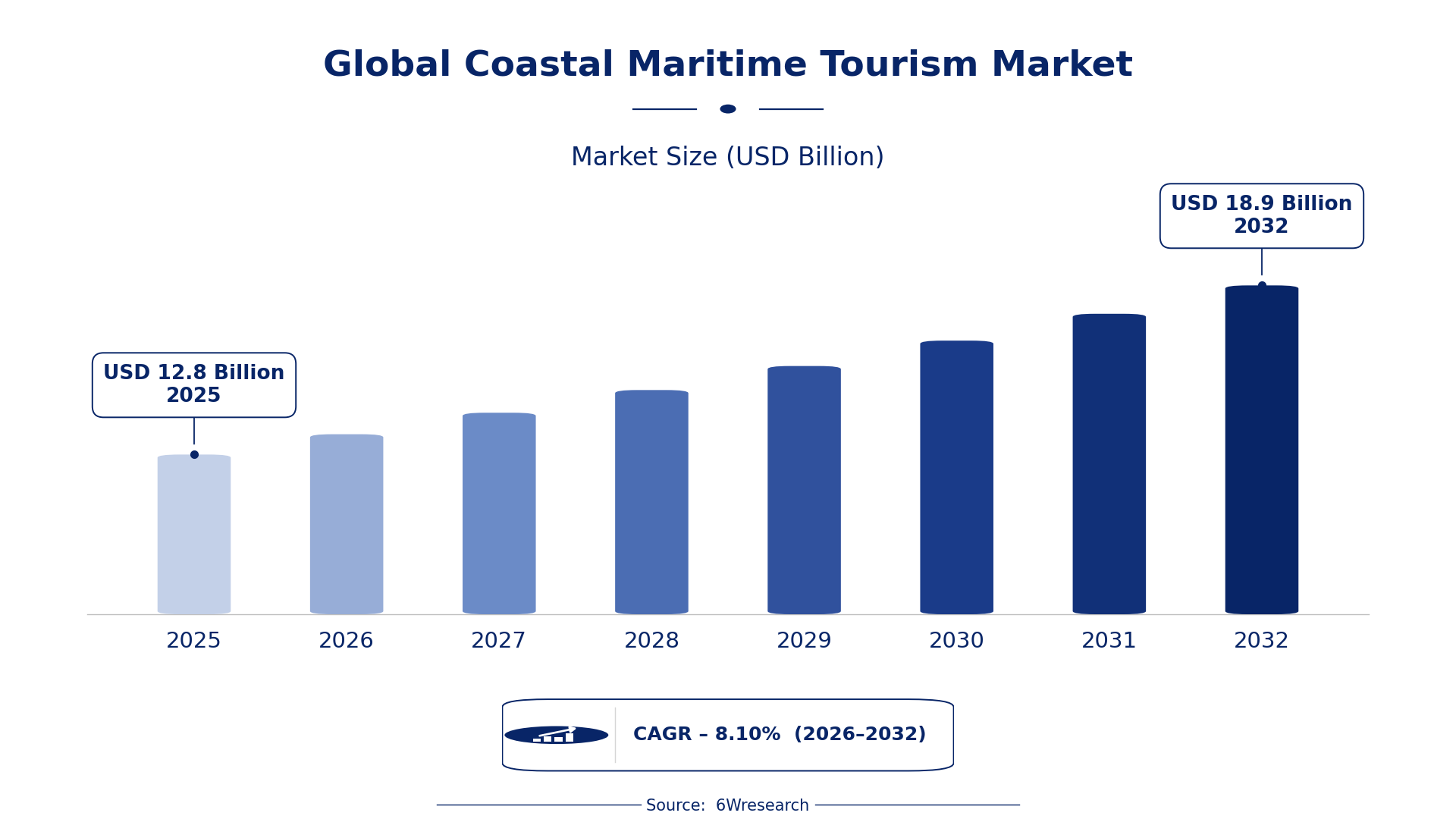
The Global Coastal Maritime Tourism Market was estimated at USD 12.8 Billion in 2025 and is projected to reach USD 18.9 Billion by 2032, growing at a CAGR of 8.10% from 2026 to 2032.
Global Coastal Maritime Tourism Market Synopsis
The Global Coastal Maritime Tourism Market is experiencing a notable shift towards sustainable practices, appealing to environmentally-conscious travelers. The push for eco-friendly tourism options has compelled cruise lines to innovate, creating itineraries that emphasize minimal environmental impact while providing rich experiences. Increasing availability of new technologies enhances operational efficiency and guest satisfaction, supporting the industry's growth.
The post-pandemic recovery phase has sparked a resurgence in interest for coastal tourism, with many travelers eager to explore pristine environments. Key players are responding by diversifying offerings that cater to niche markets, including adventure tourism and cultural experiences, thus reshaping demand dynamics. As the market evolves, its focus is increasingly on creating memorable, immersive travel experiences that align with changing consumer preferences.
Global Coastal Maritime Tourism Market Year-wise Growth Rate and Key Drivers
This graph illustrates the annual growth rates of the Global Coastal Maritime Tourism Market from 2022 to 2032, highlighting a steady upward trajectory and projected expansion over the forecast period.
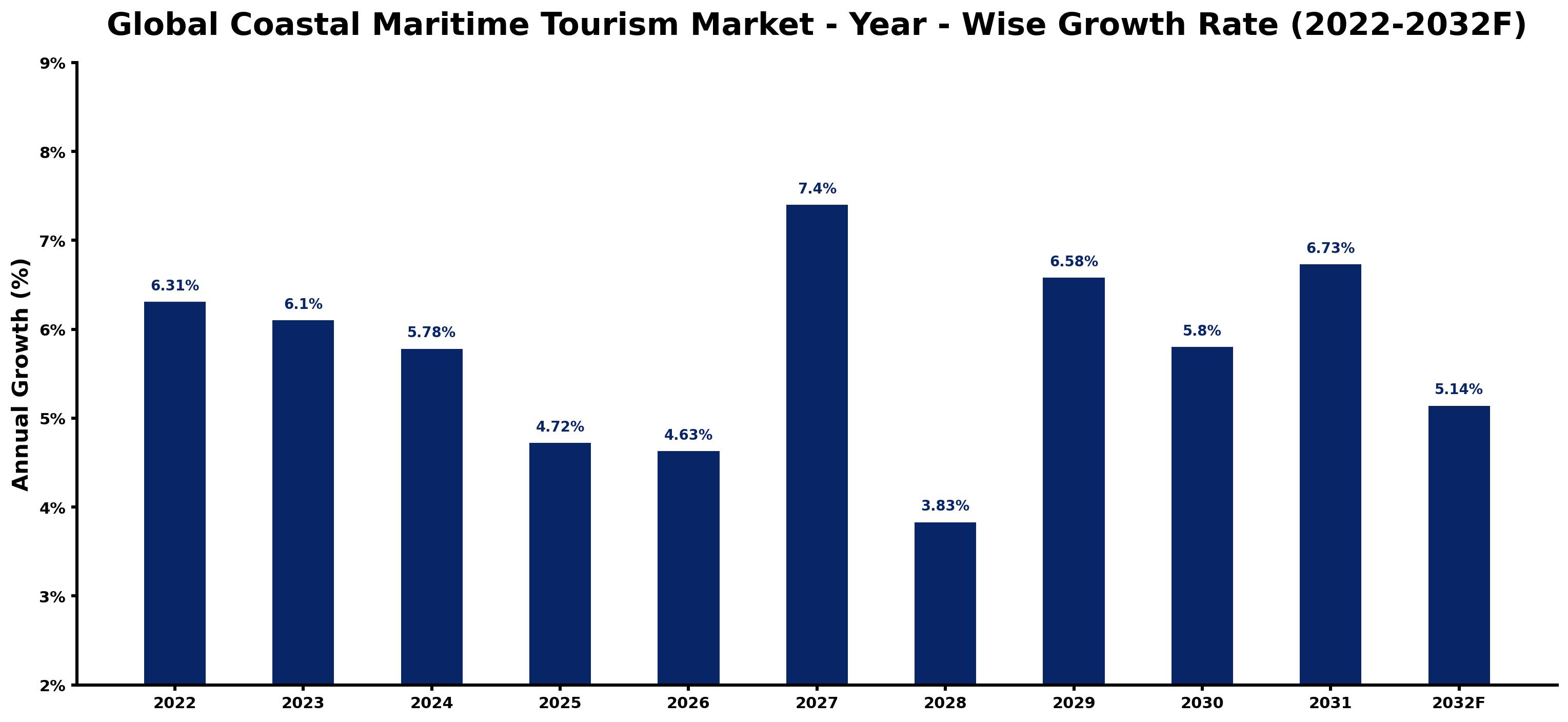
The table below presents the year‑wise growth rates along with the key drivers influencing the market
| Year | Growth Rate (%) | Major Drivers |
| 2022 | 6.31 | A shift toward skilled labor availability enhances service quality in coastal tourism. |
| 2023 | 6.1 | Regional expansion of coastal maritime tourism attracts diverse traveler demographics and spending. |
| 2024 | 5.78 | Amid rising material costs, coastal maritime tourism businesses reassess pricing strategies and offerings. |
| 2025 | 4.72 | Tourism operators are increasing investments in coastal maritime experiences to enhance customer engagement. |
| 2026 | 4.63 | While customer preferences shift, coastal maritime tourism adapts offerings to meet evolving expectations. |
| 2027 | 7.4 | Advancements in maritime technology are transforming the operational efficiency of coastal tourism operators. |
| 2028 | 3.83 | Hotels and resorts along coastal regions are responding to increasing demand for experiential tourism. |
| 2029 | 6.58 | Maritime eco-tourism solutions are reshaping supply chain dynamics in coastal tourism services. |
| 2030 | 5.8 | Regulators are pushing for sustainable practices within the coastal maritime tourism sector. |
| 2031 | 6.73 | Implementing stricter environmental standards encourages compliance within the coastal tourism industry. |
| 2032 | 5.14 | Continuous investment in eco-friendly vessels is redefining competitive strategies in coastal maritime tourism. |
Note - Market size estimations and growth projections presented in this report are based on 6Wresearch's proprietary research methodology, combining internal industry data, secondary research, and primary validation, updated periodically to reflect current market conditions. As markets evolve rapidly, figures for certain industries may vary slightly and are intended as informed estimates rather than absolute figures. For the most current market sizing, we recommend validating figures with a 6Wresearch analyst.
Global Coastal Maritime Tourism Market Key Takeaways
Below are some of the specific key takeaways from the market, including:
- Royal Caribbean Group reported a 50% increase in bookings for eco-friendly cruise options in 2023.
- In 2022, Carnival Corporation launched a program aimed at reducing single-use plastics across its fleet.
- Passenger Ticket Services account for approximately 60% share in 2025, making them the leading segment in revenue generation.
- Onboard & Other Services is expected to see a CAGR of 10.5% from 2026 to 2032, indicating a strong consumer trend towards luxury experiences aboard.
Evaluation of Restraints in Global Coastal Maritime Tourism Market
The Global Coastal Maritime Tourism Market faces challenges related to stringent environmental regulations and operational costs. Specifically, compliance with new international maritime environmental regulations is projected to add up to 15% to operational expenditures for relevant companies. For example, the International Maritime Organization's decision to enforce the reduction of carbon emissions by at least 50% by 2030 has pressured cruise lines to adapt quickly, often incurring significant investments in either retrofit technologies or fleet renewal. Such regulatory shifts can hinder smaller operators who may struggle with the financial burden while larger companies invest in compliance and innovation.
Global Coastal Maritime Tourism Market Trends
The market is currently witnessing several transformative trends. One prominent change is the rise of expedition cruising, which focuses on remote and less-explored destinations. Companies like Hurtigruten have reported a tripling of demand for such trips, reflecting consumer interest in unique travel experiences. Additionally, technology integration is enhancing guest experiences; for instance, Royal Caribbean has introduced smart ships equipped with AI that personalize onboard services, thus improving customer satisfaction rates significantly.
Another key trend is the adoption of sustainable practices. In 2023, MSC Cruises pledged to achieve net-zero emissions by 2050, reinforcing the push for environmentally responsible travel options. As more cruise lines engage in sustainable initiatives, consumer preferences are gradually shifting towards companies that prioritize ecological integrity, marking a significant turn in the maritime tourism sector.
Global Coastal Maritime Tourism Market Opportunities
The Global Coastal Maritime Tourism Market presents several future revenue opportunities. One of the most promising avenues is the expansion of luxury cruise offerings aimed at affluent travelers. For example, in 2024, Norwegian Cruise Line intends to expand its fleet with a new ultra-luxury liner catering specifically to high-end clientele, projected to generate an additional USD 1 billion in revenue annually.
Furthermore, partnerships with local communities to develop authentic cultural tourism experiences are gaining traction. This approach not only fosters community engagement but also enhances the travel experience for tourists, diversifying revenue streams. These initiatives are essential in emerging markets, particularly in regions like Southeast Asia, contributing to a more sustainable growth model.
Global Coastal Maritime Tourism Market by Product
In the Global Coastal Maritime Tourism Market, Passenger Ticket Services lead in market share, accounting for approximately 60% share in 2025. This dominance is attributed to the increasing consumer preference for cruise experiences, offering a blend of comfort and exploration. Conversely, Onboard & Other Services is the fastest-growing segment, projected to experience a CAGR of 10.5% from 2026 to 2032, driven by rising demand for premium services and luxury amenities aboard cruise ships. Enhancing the travel experience through innovative onboard services is becoming essential in a competitive marketplace.
Global Coastal Maritime Tourism Market by Application
Cruise Tourism is the largest application segment in the Global Coastal Maritime Tourism Market, commanding a significant share of around 70% in 2025. This sector's growth can be attributed to the appeal of all-inclusive travel experiences that cruise lines offer. Water Sports & Water Activities represent the fastest-growing segment, with a projected CAGR of 9.0% from 2026 to 2032, as more travelers seek active, engaging experiences during their coastal trips, allowing destination exploration beyond traditional cruising.
Global Coastal Maritime Tourism Market by Region
North America is the largest region in the Global Coastal Maritime Tourism Market, holding about 48% share in 2025, supported by established cruise lines and high consumer spending power. However, Asia stands out as the fastest-growing region, expected to achieve a CAGR of 10.2% from 2026 to 2032, primarily due to the expanding middle class and increasing interest in local tourism experiences. The interplay of favorable regulatory frameworks and heightened tourism demand in Asian countries positions this region as a compelling market.
Government Initiatives in the Global Coastal Maritime Tourism Market
The regulatory landscape for the Global Coastal Maritime Tourism Market is evolving, with various government initiatives aimed at enhancing safety and promoting sustainable tourism practices. Governments are increasingly recognizing the economic potential of coastal tourism, instituting policies that support infrastructure development, environmental protection, and community engagement.
- U.S. Department of Transportation, Cruise Ship Modernization Program, 2021.
- European Commission, Blue Growth Strategy, promoting sustainable maritime economies, 2020.
- Government of Canada, Ocean Protection Plan, aimed at enhancing marine safety and environmental stewardship, 2017.
- Australia Government, Coastal Management Program, funding for sustainable tourism projects, 2023.
Future Insights of the Global Coastal Maritime Tourism Market
The Global Coastal Maritime Tourism Market is on the brink of transformative changes driven by technology integration and evolving consumer preferences. For instance, the growing emphasis on personalized experiences, represented by initiatives like Royal Caribbean's smart ships, is projected to redefine service standards. By 2032, advancements in sustainable technologies and fleet optimization will likely shape competitive strategies, with an increasing focus on reducing environmental impact and enhancing onboard amenities. This will establish a new benchmark for operational excellence and customer satisfaction.
Global Coastal Maritime Tourism Market Latest Developments
Recent developments within the industry showcase a proactive response from key players to meet changing consumer demands and regulatory challenges. These initiatives not only enhance operational capability but also significantly impact market positioning.
- In early 2023, Carnival Corporation launched a new eco-friendly cruise itinerary aimed at reducing carbon emissions, reflecting its commitment to sustainability.
- Royal Caribbean Group recently announced plans to deploy a fleet of zero-emission vessels by 2030, reinforcing its leadership in sustainable maritime tourism.
- In mid-2023, Norwegian Cruise Line introduced a luxury wellness-themed cruise category, catering to health-conscious travelers seeking unique experiences.
- MSC Cruises is set to unveil its largest ship to date in late 2024, featuring expanded onboard service offerings, thus enhancing guest experience and capacity.
Global Coastal Maritime Tourism Market Key Players and Industry Positioning
The competitive landscape of the Global Coastal Maritime Tourism Market is characterized by a mix of industry giants and agile innovators. This fragmented structure allows for diverse service offerings, with companies focusing on niche markets and unique travel experiences. Leaders in the sector are actively investing in sustainability and advanced technologies to maintain a competitive edge and attract eco-conscious consumers.
| Leading Company | Core Strength | Strategic Focus |
|---|---|---|
| Carnival Corporation | Strong global presence with diverse fleet | Sustainability initiatives and market diversification |
| Royal Caribbean Group | Innovative onboard technology | Expansion of eco-friendly cruise options |
| Norwegian Cruise Line Holdings | Customization of passenger experiences | Luxury and wellness-oriented offerings |
| MSC Cruises | Fleet modernization and new ship launches | Commitment to environmental stewardship |
| Genting Hong Kong | Diverse portfolio of luxury cruise brands | Targeted development in Asian markets |
As the industry continues to evolve, companies that effectively blend sustainability with innovative offerings will likely thrive in this dynamic market environment.
Key Attractiveness of the Report
- 10 Years of Market Numbers
- Historical Data Starting from 2022 to 2025
- Base Year: 2025
- Forecast Data until 2032
- Key Performance Indicators Impacting the Market
- Major Upcoming Developments and Projects
Key Highlights of the Report:
- Global Coastal Maritime Tourism Market Outlook
- Market Size of Global Coastal Maritime Tourism Market, 2025
- Forecast of Global Coastal Maritime Tourism Market, 2032
- Historical Data and Forecast of Global Coastal Maritime Tourism Revenues & Volume for the Period 2022-2032
- Global Coastal Maritime Tourism Market Trend Evolution
- Global Coastal Maritime Tourism Market Drivers and Challenges
- Global Coastal Maritime Tourism Price Trends
- Global Coastal Maritime Tourism Porter's Five Forces
- Global Coastal Maritime Tourism Industry Life Cycle
- Historical Data and Forecast of Global Coastal Maritime Tourism Market Revenues & Volume
- Historical Data and Forecast of Global Coastal Maritime Tourism Market Revenues & Volume By Product for the Period 2022-2032
- Historical Data and Forecast of Global Coastal Maritime Tourism Market Revenues & Volume By Passenger Ticket Services for the Period 2022-2032
- Historical Data and Forecast of Global Coastal Maritime Tourism Market Revenues & Volume By Onboard & Other Services for the Period 2022-2032
- Historical Data and Forecast of Global Coastal Maritime Tourism Market Revenues & Volume By Application for the Period 2022-2032
- Historical Data and Forecast of Global Coastal Maritime Tourism Market Revenues & Volume By Cruise Tourism for the Period 2022-2032
- Historical Data and Forecast of Global Coastal Maritime Tourism Market Revenues & Volume By Yacht & Sailing Tourism for the Period 2022-2032
- Historical Data and Forecast of Global Coastal Maritime Tourism Market Revenues & Volume By Water Sports & Water Activities for the Period 2022-2032
- Historical Data and Forecast of Global Coastal Maritime Tourism Market Revenues & Volume By Others for the Period 2022-2032
- Historical Data and Forecast of North America Coastal Maritime Tourism Market Revenues & Volume By Product for the Period 2022-2032
- Historical Data and Forecast of North America Coastal Maritime Tourism Market Revenues & Volume By Passenger Ticket Services for the Period 2022-2032
- Historical Data and Forecast of North America Coastal Maritime Tourism Market Revenues & Volume By Onboard & Other Services for the Period 2022-2032
- Historical Data and Forecast of North America Coastal Maritime Tourism Market Revenues & Volume By Application for the Period 2022-2032
- Historical Data and Forecast of North America Coastal Maritime Tourism Market Revenues & Volume By Cruise Tourism for the Period 2022-2032
- Historical Data and Forecast of North America Coastal Maritime Tourism Market Revenues & Volume By Yacht & Sailing Tourism for the Period 2022-2032
- Historical Data and Forecast of North America Coastal Maritime Tourism Market Revenues & Volume By Water Sports & Water Activities for the Period 2022-2032
- Historical Data and Forecast of North America Coastal Maritime Tourism Market Revenues & Volume By Others for the Period 2022-2032
- Historical Data and Forecast of United States of America Coastal Maritime Tourism Market Revenues & Volume for the Period 2022-2032
- Historical Data and Forecast of Canada Coastal Maritime Tourism Market Revenues & Volume for the Period 2022-2032
- Historical Data and Forecast of Rest of North America Coastal Maritime Tourism Market Revenues & Volume for the Period 2022-2032
- Historical Data and Forecast of Latin America (LATAM) Coastal Maritime Tourism Market Revenues & Volume By Product for the Period 2022-2032
- Historical Data and Forecast of Latin America (LATAM) Coastal Maritime Tourism Market Revenues & Volume By Passenger Ticket Services for the Period 2022-2032
- Historical Data and Forecast of Latin America (LATAM) Coastal Maritime Tourism Market Revenues & Volume By Onboard & Other Services for the Period 2022-2032
- Historical Data and Forecast of Latin America (LATAM) Coastal Maritime Tourism Market Revenues & Volume By Application for the Period 2022-2032
- Historical Data and Forecast of Latin America (LATAM) Coastal Maritime Tourism Market Revenues & Volume By Cruise Tourism for the Period 2022-2032
- Historical Data and Forecast of Latin America (LATAM) Coastal Maritime Tourism Market Revenues & Volume By Yacht & Sailing Tourism for the Period 2022-2032
- Historical Data and Forecast of Latin America (LATAM) Coastal Maritime Tourism Market Revenues & Volume By Water Sports & Water Activities for the Period 2022-2032
- Historical Data and Forecast of Latin America (LATAM) Coastal Maritime Tourism Market Revenues & Volume By Others for the Period 2022-2032
- Historical Data and Forecast of Brazil Coastal Maritime Tourism Market Revenues & Volume for the Period 2022-2032
- Historical Data and Forecast of Mexico Coastal Maritime Tourism Market Revenues & Volume for the Period 2022-2032
- Historical Data and Forecast of Argentina Coastal Maritime Tourism Market Revenues & Volume for the Period 2022-2032
- Historical Data and Forecast of Rest of LATAM Coastal Maritime Tourism Market Revenues & Volume for the Period 2022-2032
- Historical Data and Forecast of Asia Coastal Maritime Tourism Market Revenues & Volume By Product for the Period 2022-2032
- Historical Data and Forecast of Asia Coastal Maritime Tourism Market Revenues & Volume By Passenger Ticket Services for the Period 2022-2032
- Historical Data and Forecast of Asia Coastal Maritime Tourism Market Revenues & Volume By Onboard & Other Services for the Period 2022-2032
- Historical Data and Forecast of Asia Coastal Maritime Tourism Market Revenues & Volume By Application for the Period 2022-2032
- Historical Data and Forecast of Asia Coastal Maritime Tourism Market Revenues & Volume By Cruise Tourism for the Period 2022-2032
- Historical Data and Forecast of Asia Coastal Maritime Tourism Market Revenues & Volume By Yacht & Sailing Tourism for the Period 2022-2032
- Historical Data and Forecast of Asia Coastal Maritime Tourism Market Revenues & Volume By Water Sports & Water Activities for the Period 2022-2032
- Historical Data and Forecast of Asia Coastal Maritime Tourism Market Revenues & Volume By Others for the Period 2022-2032
- Historical Data and Forecast of China Coastal Maritime Tourism Market Revenues & Volume for the Period 2022-2032
- Historical Data and Forecast of India Coastal Maritime Tourism Market Revenues & Volume for the Period 2022-2032
- Historical Data and Forecast of Japan Coastal Maritime Tourism Market Revenues & Volume for the Period 2022-2032
- Historical Data and Forecast of Rest of Asia Coastal Maritime Tourism Market Revenues & Volume for the Period 2022-2032
- Historical Data and Forecast of Africa Coastal Maritime Tourism Market Revenues & Volume By Product for the Period 2022-2032
- Historical Data and Forecast of Africa Coastal Maritime Tourism Market Revenues & Volume By Passenger Ticket Services for the Period 2022-2032
- Historical Data and Forecast of Africa Coastal Maritime Tourism Market Revenues & Volume By Onboard & Other Services for the Period 2022-2032
- Historical Data and Forecast of Africa Coastal Maritime Tourism Market Revenues & Volume By Application for the Period 2022-2032
- Historical Data and Forecast of Africa Coastal Maritime Tourism Market Revenues & Volume By Cruise Tourism for the Period 2022-2032
- Historical Data and Forecast of Africa Coastal Maritime Tourism Market Revenues & Volume By Yacht & Sailing Tourism for the Period 2022-2032
- Historical Data and Forecast of Africa Coastal Maritime Tourism Market Revenues & Volume By Water Sports & Water Activities for the Period 2022-2032
- Historical Data and Forecast of Africa Coastal Maritime Tourism Market Revenues & Volume By Others for the Period 2022-2032
- Historical Data and Forecast of South Africa Coastal Maritime Tourism Market Revenues & Volume for the Period 2022-2032
- Historical Data and Forecast of Nigeria Coastal Maritime Tourism Market Revenues & Volume for the Period 2022-2032
- Historical Data and Forecast of Egypt Coastal Maritime Tourism Market Revenues & Volume for the Period 2022-2032
- Historical Data and Forecast of Rest of Africa Coastal Maritime Tourism Market Revenues & Volume for the Period 2022-2032
- Historical Data and Forecast of Europe Coastal Maritime Tourism Market Revenues & Volume By Product for the Period 2022-2032
- Historical Data and Forecast of Europe Coastal Maritime Tourism Market Revenues & Volume By Passenger Ticket Services for the Period 2022-2032
- Historical Data and Forecast of Europe Coastal Maritime Tourism Market Revenues & Volume By Onboard & Other Services for the Period 2022-2032
- Historical Data and Forecast of Europe Coastal Maritime Tourism Market Revenues & Volume By Application for the Period 2022-2032
- Historical Data and Forecast of Europe Coastal Maritime Tourism Market Revenues & Volume By Cruise Tourism for the Period 2022-2032
- Historical Data and Forecast of Europe Coastal Maritime Tourism Market Revenues & Volume By Yacht & Sailing Tourism for the Period 2022-2032
- Historical Data and Forecast of Europe Coastal Maritime Tourism Market Revenues & Volume By Water Sports & Water Activities for the Period 2022-2032
- Historical Data and Forecast of Europe Coastal Maritime Tourism Market Revenues & Volume By Others for the Period 2022-2032
- Historical Data and Forecast of United Kingdom Coastal Maritime Tourism Market Revenues & Volume for the Period 2022-2032
- Historical Data and Forecast of France Coastal Maritime Tourism Market Revenues & Volume for the Period 2022-2032
- Historical Data and Forecast of Germany Coastal Maritime Tourism Market Revenues & Volume for the Period 2022-2032
- Historical Data and Forecast of Rest of Europe Coastal Maritime Tourism Market Revenues & Volume for the Period 2022-2032
- Historical Data and Forecast of Middle East Coastal Maritime Tourism Market Revenues & Volume By Product for the Period 2022-2032
- Historical Data and Forecast of Middle East Coastal Maritime Tourism Market Revenues & Volume By Passenger Ticket Services for the Period 2022-2032
- Historical Data and Forecast of Middle East Coastal Maritime Tourism Market Revenues & Volume By Onboard & Other Services for the Period 2022-2032
- Historical Data and Forecast of Middle East Coastal Maritime Tourism Market Revenues & Volume By Application for the Period 2022-2032
- Historical Data and Forecast of Middle East Coastal Maritime Tourism Market Revenues & Volume By Cruise Tourism for the Period 2022-2032
- Historical Data and Forecast of Middle East Coastal Maritime Tourism Market Revenues & Volume By Yacht & Sailing Tourism for the Period 2022-2032
- Historical Data and Forecast of Middle East Coastal Maritime Tourism Market Revenues & Volume By Water Sports & Water Activities for the Period 2022-2032
- Historical Data and Forecast of Middle East Coastal Maritime Tourism Market Revenues & Volume By Others for the Period 2022-2032
- Historical Data and Forecast of Saudi Arabia Coastal Maritime Tourism Market Revenues & Volume for the Period 2022-2032
- Historical Data and Forecast of UAE Coastal Maritime Tourism Market Revenues & Volume for the Period 2022-2032
- Historical Data and Forecast of Turkey Coastal Maritime Tourism Market Revenues & Volume for the Period 2022-2032
- Historical Data and Forecast of Rest of Middle East Coastal Maritime Tourism Market Revenues & Volume for the Period 2022-2032
- Global Coastal Maritime Tourism Market - Key Performance Indicators
- Global Coastal Maritime Tourism Market - Import Export Trade Statistics
- Global Coastal Maritime Tourism Market - Opportunity Assessment By Countries
- Global Coastal Maritime Tourism Market - Opportunity Assessment By Product
- Global Coastal Maritime Tourism Market - Opportunity Assessment By Application
- Global Coastal Maritime Tourism Market - Top Companies Market Share
- Global Coastal Maritime Tourism Market - Top Companies Profiles
- Global Coastal Maritime Tourism Market - Comparison of Players in Technical and Operating Parameters
- Global Coastal Maritime Tourism Market - Strategic Recommendations
Markets Covered
The Global Coastal Maritime Tourism Market report provides a detailed analysis of the following market segments:
By Regions and Countries:
- North America
- Europe
- LATAM
- Middle East
- Asia
- Africa
By Product:
- Passenger Ticket Services
- Onboard & Other Services
By Application:
- Cruise Tourism
- Yacht & Sailing Tourism
- Water Sports & Water Activities
- Others






































