Global Commercial Aircraft Market Highlights
| Market Size (2025) | USD 300 Billion |
| Forecast Size (2032) | USD 440 Billion |
| CAGR | 5.50% |
| Base Year | 2025 |
| Forecast Period | 2026-2032 |
| Largest Region | North America |
| Fastest Growing Region | Asia |
| Largest Segment | Narrow Body Aircrafts |
| Fastest Growing Segment | Wide Body Aircrafts |
| Leading Companies | Boeing, Airbus, Embraer, Bombardier, Lockheed Martin |
Global Commercial Aircraft Market Size & Growth Rate (2026-2032)
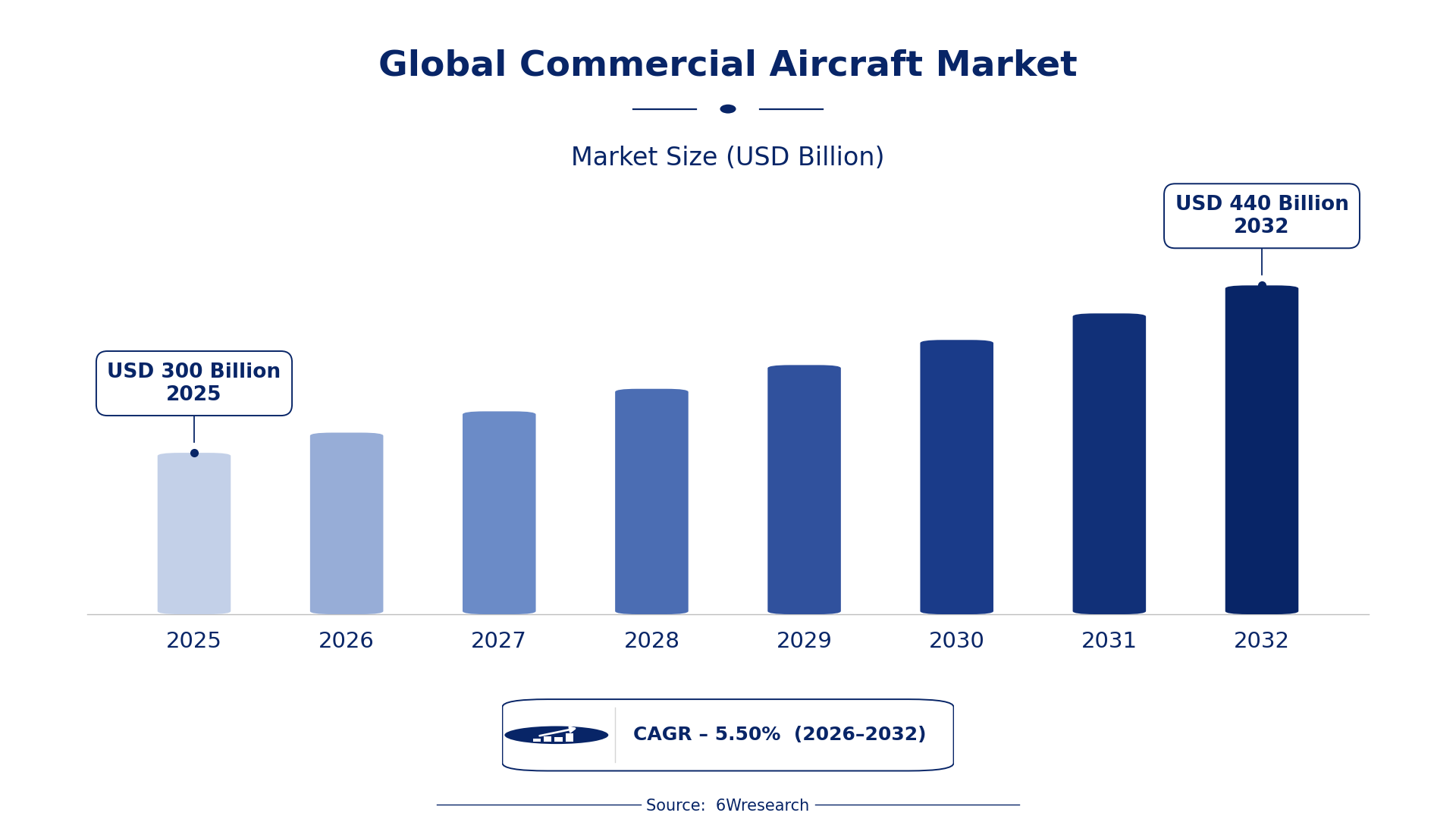
The Global Commercial Aircraft Market was estimated at USD 300 Billion in 2025 and is projected to reach USD 440 Billion by 2032, growing at a CAGR of 5.50% from 2026 to 2032.
Global Commercial Aircraft Market Synopsis
The Global Commercial Aircraft Market is undergoing substantial transformation, resulting from an uptick in air travel demand and enhanced focus on fuel efficiency. Airlines are modernizing fleets to appeal to changing passenger preferences and comply with stricter environmental regulations, propelling innovation in aircraft design and technology.
This market plays an essential role in the broader aviation ecosystem. Factors like geopolitical stability, economic growth in emerging markets, and competitive positioning of manufacturers are shaping its future. The shift towards sustainable aviation fuels and eco-friendly aircraft models signifies a notable pivot from traditional practices, further distinguishing this market from others.
Global Commercial Aircraft Market Year-wise Growth Rate and Key Drivers
This graph illustrates the annual growth rates of the Global Commercial Aircraft Market from 2022 to 2032, highlighting a steady upward trajectory and projected expansion over the forecast period.
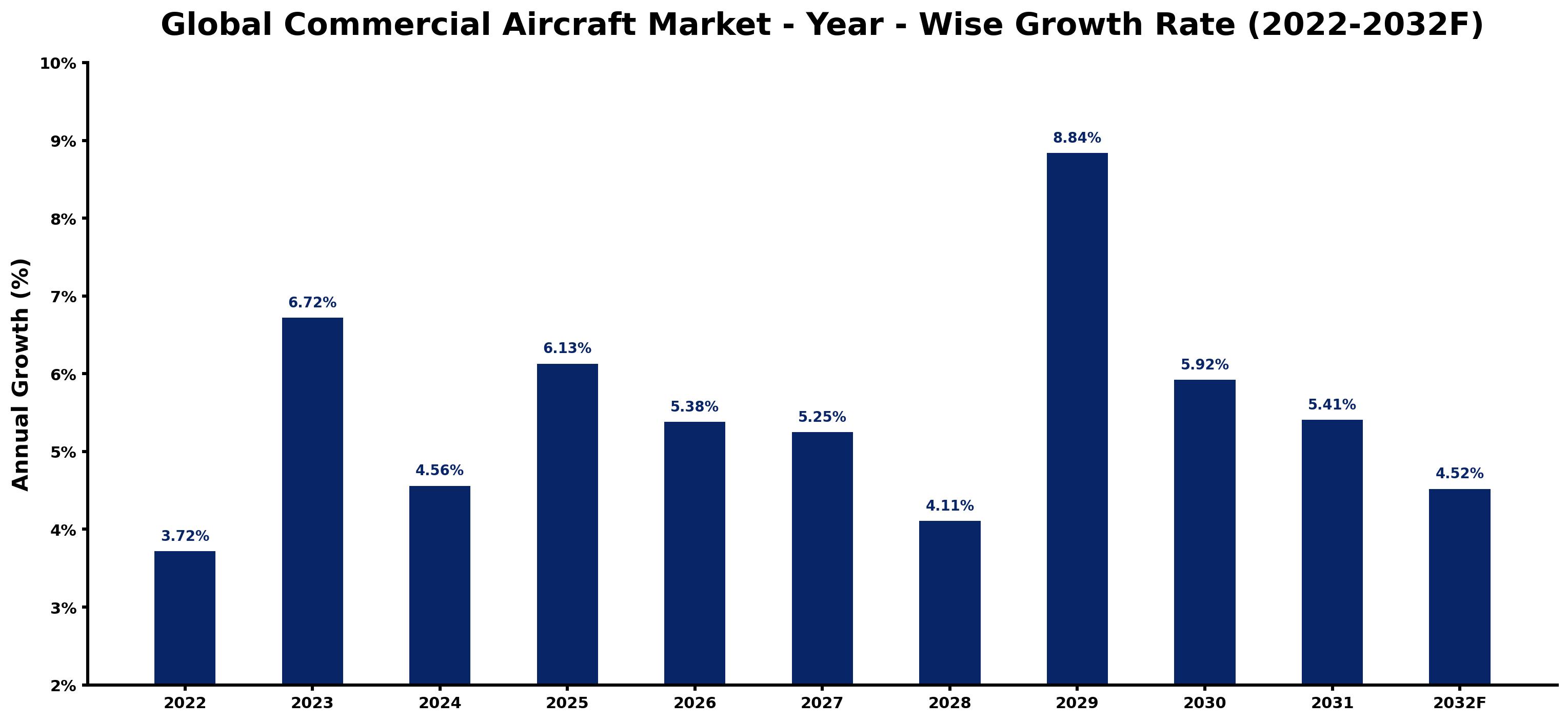
The table below presents the year‑wise growth rates along with the key drivers influencing the market
| Year | Growth Rate (%) | Major Drivers |
| 2022 | 3.72 | Aircraft manufacturers are responding to rising demand for efficient commercial aircraft. |
| 2023 | 6.72 | A surge in raw material costs affects production rates of commercial aircraft components. |
| 2024 | 4.56 | Commercial airlines are reshaping their strategies to compete in a demanding market. |
| 2025 | 6.13 | Expanding training programs improve the skill set of commercial aircraft technicians. |
| 2026 | 5.38 | As sustainability standards become stricter, manufacturers innovate with eco-friendly aircraft technologies. |
| 2027 | 5.25 | In the Asia-Pacific region, consumer preferences shift towards fuel-efficient commercial aircraft. |
| 2028 | 4.11 | A shift toward just-in-time supply chains enhances the availability of aircraft components. |
| 2029 | 8.84 | Major defense contractors are increasing M&A activities to enhance commercial aircraft capabilities. |
| 2030 | 5.92 | Emerging radar systems are becoming essential for next-generation commercial aircraft functionality. |
| 2031 | 5.41 | Increased demand for regional air travel drives geographic expansion of commercial aircraft production. |
| 2032 | 4.52 | Advanced composite materials enhance the performance and efficiency of new aircraft designs. |
Note - Market size estimations and growth projections presented in this report are based on 6Wresearch's proprietary research methodology, combining internal industry data, secondary research, and primary validation, updated periodically to reflect current market conditions. As markets evolve rapidly, figures for certain industries may vary slightly and are intended as informed estimates rather than absolute figures. For the most current market sizing, we recommend validating figures with a 6Wresearch analyst.
Global Commercial Aircraft Market Key Takeaways
Below are some of the specific key takeaways from the market, including:
- North America holds approximately 41% share in the Global Commercial Aircraft Market as of 2025.
- Boeing's 737 MAX series is projected to account for 29% of new aircraft deliveries through 2030.
- Wide Body Aircrafts are expected to grow at a CAGR of 6.3% from 2026 to 2032, reflecting a shift towards long-haul travel.
- In 2024, Airbus is targeting a production rate of 75 A320 family aircraft per month to meet increasing demand.
- Emerging markets are displaying a 7.2% CAGR in air travel demand, significantly influencing fleet expansion strategies across the globe.
Evaluation of Restraints in Global Commercial Aircraft Market
The Global Commercial Aircraft Market contends with several operational challenges, including fluctuating fuel costs and increasing regulatory pressures. For instance, average jet fuel prices have risen by approximately 42% in the past year, significantly impacting airlines' operating budgets. Furthermore, evolving environmental regulations, such as the European Union's stringent CO2 reduction targets, necessitate costly upgrades or new aircraft investment. Meeting these targets will involve substantial capital allocations that could restrain short-term profitability for aircraft manufacturers.
Global Commercial Aircraft Market Trends
Currently, the market is witnessing a decisive shift towards fuel efficiency as airlines increasingly prioritize environmental considerations. For instance, Boeing's latest 787 Dreamliner reduces fuel consumption by 20% compared to previous models, enabling airlines to mitigate costs while increasing their sustainability efforts. Additionally, the integration of artificial intelligence in operational processes is gaining traction; Delta Airlines has begun implementing AI-driven predictive maintenance, expected to enhance aircraft availability by up to 15% by 2025. Another significant trend is the rising preference for lightweight materials, with Airbus leading initiatives to incorporate composites that result in both performance and economic advantages.
Global Commercial Aircraft Market Opportunities
The future promises significant revenue opportunities within the Global Commercial Aircraft Market, particularly in sectors such as urban air mobility and sustainable aviation fuels. Vertical Aerospace, expanding electric vertical take-off and landing (eVTOL) aircraft development, aims for initial commercial services by 2025, capturing urban transport markets. Additionally, the cargo segment, expecting revenues to grow by 8% annually, demonstrates potential as e-commerce continues to drive demand. Aircraft modernization efforts by airlines globally to meet comfort and technological standards are also presenting opportunities for manufacturers to offer cutting-edge interior solutions.
Global Commercial Aircraft Market by Aircraft Type
Narrow Body Aircrafts dominate the Global Commercial Aircraft Market, commanding a share of approximately 52% in 2025. This segment's extensive use in short to medium-haul flights meets growing passenger preferences effectively. Conversely, Wide Body Aircrafts are emerging as the fastest-growing segment, projected to achieve a CAGR of 6.5% from 2026 to 2032 as airlines invest in long-haul capabilities to cater to international travel recovery.
Global Commercial Aircraft Market by Region
North America holds the largest share of approximately 41% in the Global Commercial Aircraft Market as of 2025, bolstered by a robust manufacturing ecosystem and the presence of major players like Boeing and Lockheed Martin. Meanwhile, Asia is anticipated to be the fastest-growing region, achieving a CAGR of 7.2% from 2026 to 2032, driven by increasing air travel demand and a burgeoning middle class further intensifying investment in the aviation sector.
Government Initiatives in the Global Commercial Aircraft Market
The regulatory landscape for the Global Commercial Aircraft Market is currently evolving, with numerous initiatives aimed at bolstering industry growth and sustainability. Governments are investing in future-oriented policies that enhance both domestic manufacturing and environmental standards, framing a dynamic interplay between policy and market operations.
- United States Department of Transportation, "Aviation Climate Action Plan," 2022 – Aiming to promote sustainable aviation, the initiative encourages the development of technologies that reduce emissions, incentivizing manufacturer investment.
- European Union Aviation Safety Agency, "Regulation on the Environmental Performance of Aircraft," 2023 – This regulation seeks to implement ecologically sound practices among manufacturers, which could lead to increased compliance costs.
- Civil Aviation Administration of China, "China's National Civil Aviation Development Plan," 2021-2025 – This ongoing initiative promotes increased domestic production capacities and technological advancement in aircraft manufacturing.
- Rio de Janeiro State Government, "Aviation Modernization Fund," 2024 – Planned to launch in 2024, this fund will support local airlines and manufacturers in modernizing their fleets to enhance their operational efficiency.
Future Insights of the Global Commercial Aircraft Market
The trajectory of the Global Commercial Aircraft Market reveals a marked shift towards sustainability and technological advancement. Given that emerging markets are projected to display a 7.2% CAGR in air travel demand, manufacturers are likely to explore innovative aircraft technologies, emphasizing fuel efficiency and reduced emissions. Companies like Airbus are investing substantially in sustainable aviation fuels and electric propulsion systems, reflecting an industry-wide pivot that aligns with heightened global environmental consciousness and regulatory frameworks aimed at cutting carbon emissions by 2030.
Global Commercial Aircraft Market Latest Developments
Several significant developments are shaping the Global Commercial Aircraft Market, indicating a competitive drive toward modernization and sustainability.
- In June 2023, Boeing finalized a multi-billion-dollar deal with a major Asian airline to supply the latest 737 MAX aircraft, strengthening its market position in the region.
- Ongoing since early 2023, Airbus is ramping up production of A320 neo family aircraft to meet robust demand, aiming for a production rate increase to 75 units per month by mid-2024.
- Upcoming in 2024, Embraer's new E-Jet fleet is projected to receive FAA certification, enhancing its competitiveness by offering superior fuel efficiency and passenger comfort.
- Recently, Lockheed Martin announced a collaboration with a consortium to explore urban air mobility solutions, aiming to capitalize on the growing eVTOL market for future revenue streams.
Global Commercial Aircraft Market Key Players and Industry Positioning
The Global Commercial Aircraft Market exhibits a consolidated structure, dominated by a handful of key players who dictate competitive dynamics. Each company leverages unique strengths and strategies to secure and enhance their market positions, pushing for technological advancements and market responsiveness.
| Leading Company | Core Strength | Strategic Focus |
|---|---|---|
| Boeing | Extensive product range | Enhancing operational efficiency through modernization |
| Airbus | Advanced composite materials utilization | Pioneering sustainable aircraft design |
| Embraer | Expertise in regional jets | Expanding market share in emerging markets |
| Bombardier | Strong foothold in business aviation | Focusing on niche markets and specialized products |
| Lockheed Martin | Defense and aerospace integration | Investing in next-gen urban air mobility technologies |
The competitive dynamics in the Global Commercial Aircraft Market are increasingly influenced by technological advancements and sustainability initiatives, pushing companies to adapt and innovate in response to both consumer demand and regulatory pressures.
Key Attractiveness of the Report
- 10 Years of Market Numbers
- Historical Data Starting from 2022 to 2025
- Base Year: 2025
- Forecast Data until 2032
- Key Performance Indicators Impacting the Market
- Major Upcoming Developments and Projects
Key Highlights of the Report:
- Global Commercial Aircraft Market Outlook
- Market Size of Global Commercial Aircraft Market, 2025
- Forecast of Global Commercial Aircraft Market, 2032
- Historical Data and Forecast of Global Commercial Aircraft Revenues & Volume for the Period 2022-2032
- Global Commercial Aircraft Market Trend Evolution
- Global Commercial Aircraft Market Drivers and Challenges
- Global Commercial Aircraft Price Trends
- Global Commercial Aircraft Porter's Five Forces
- Global Commercial Aircraft Industry Life Cycle
- Historical Data and Forecast of Global Commercial Aircraft Market Revenues & Volume
- Historical Data and Forecast of Global Commercial Aircraft Market Revenues & Volume By Aircraft Type for the Period 2022-2032
- Historical Data and Forecast of Global Commercial Aircraft Market Revenues & Volume By Narrow Body Aircrafts for the Period 2022-2032
- Historical Data and Forecast of Global Commercial Aircraft Market Revenues & Volume By Wide Body Aircrafts for the Period 2022-2032
- Historical Data and Forecast of Global Commercial Aircraft Market Revenues & Volume By Regional Jets for the Period 2022-2032
- Historical Data and Forecast of Global Commercial Aircraft Market Revenues & Volume By Turboprop Aircrafts for the Period 2022-2032
- Historical Data and Forecast of North America Commercial Aircraft Market Revenues & Volume By Aircraft Type for the Period 2022-2032
- Historical Data and Forecast of North America Commercial Aircraft Market Revenues & Volume By Narrow Body Aircrafts for the Period 2022-2032
- Historical Data and Forecast of North America Commercial Aircraft Market Revenues & Volume By Wide Body Aircrafts for the Period 2022-2032
- Historical Data and Forecast of North America Commercial Aircraft Market Revenues & Volume By Regional Jets for the Period 2022-2032
- Historical Data and Forecast of North America Commercial Aircraft Market Revenues & Volume By Turboprop Aircrafts for the Period 2022-2032
- Historical Data and Forecast of United States of America Commercial Aircraft Market Revenues & Volume for the Period 2022-2032
- Historical Data and Forecast of Canada Commercial Aircraft Market Revenues & Volume for the Period 2022-2032
- Historical Data and Forecast of Rest of North America Commercial Aircraft Market Revenues & Volume for the Period 2022-2032
- Historical Data and Forecast of Latin America (LATAM) Commercial Aircraft Market Revenues & Volume By Aircraft Type for the Period 2022-2032
- Historical Data and Forecast of Latin America (LATAM) Commercial Aircraft Market Revenues & Volume By Narrow Body Aircrafts for the Period 2022-2032
- Historical Data and Forecast of Latin America (LATAM) Commercial Aircraft Market Revenues & Volume By Wide Body Aircrafts for the Period 2022-2032
- Historical Data and Forecast of Latin America (LATAM) Commercial Aircraft Market Revenues & Volume By Regional Jets for the Period 2022-2032
- Historical Data and Forecast of Latin America (LATAM) Commercial Aircraft Market Revenues & Volume By Turboprop Aircrafts for the Period 2022-2032
- Historical Data and Forecast of Brazil Commercial Aircraft Market Revenues & Volume for the Period 2022-2032
- Historical Data and Forecast of Mexico Commercial Aircraft Market Revenues & Volume for the Period 2022-2032
- Historical Data and Forecast of Argentina Commercial Aircraft Market Revenues & Volume for the Period 2022-2032
- Historical Data and Forecast of Rest of LATAM Commercial Aircraft Market Revenues & Volume for the Period 2022-2032
- Historical Data and Forecast of Asia Commercial Aircraft Market Revenues & Volume By Aircraft Type for the Period 2022-2032
- Historical Data and Forecast of Asia Commercial Aircraft Market Revenues & Volume By Narrow Body Aircrafts for the Period 2022-2032
- Historical Data and Forecast of Asia Commercial Aircraft Market Revenues & Volume By Wide Body Aircrafts for the Period 2022-2032
- Historical Data and Forecast of Asia Commercial Aircraft Market Revenues & Volume By Regional Jets for the Period 2022-2032
- Historical Data and Forecast of Asia Commercial Aircraft Market Revenues & Volume By Turboprop Aircrafts for the Period 2022-2032
- Historical Data and Forecast of China Commercial Aircraft Market Revenues & Volume for the Period 2022-2032
- Historical Data and Forecast of India Commercial Aircraft Market Revenues & Volume for the Period 2022-2032
- Historical Data and Forecast of Japan Commercial Aircraft Market Revenues & Volume for the Period 2022-2032
- Historical Data and Forecast of Rest of Asia Commercial Aircraft Market Revenues & Volume for the Period 2022-2032
- Historical Data and Forecast of Africa Commercial Aircraft Market Revenues & Volume By Aircraft Type for the Period 2022-2032
- Historical Data and Forecast of Africa Commercial Aircraft Market Revenues & Volume By Narrow Body Aircrafts for the Period 2022-2032
- Historical Data and Forecast of Africa Commercial Aircraft Market Revenues & Volume By Wide Body Aircrafts for the Period 2022-2032
- Historical Data and Forecast of Africa Commercial Aircraft Market Revenues & Volume By Regional Jets for the Period 2022-2032
- Historical Data and Forecast of Africa Commercial Aircraft Market Revenues & Volume By Turboprop Aircrafts for the Period 2022-2032
- Historical Data and Forecast of South Africa Commercial Aircraft Market Revenues & Volume for the Period 2022-2032
- Historical Data and Forecast of Nigeria Commercial Aircraft Market Revenues & Volume for the Period 2022-2032
- Historical Data and Forecast of Egypt Commercial Aircraft Market Revenues & Volume for the Period 2022-2032
- Historical Data and Forecast of Rest of Africa Commercial Aircraft Market Revenues & Volume for the Period 2022-2032
- Historical Data and Forecast of Europe Commercial Aircraft Market Revenues & Volume By Aircraft Type for the Period 2022-2032
- Historical Data and Forecast of Europe Commercial Aircraft Market Revenues & Volume By Narrow Body Aircrafts for the Period 2022-2032
- Historical Data and Forecast of Europe Commercial Aircraft Market Revenues & Volume By Wide Body Aircrafts for the Period 2022-2032
- Historical Data and Forecast of Europe Commercial Aircraft Market Revenues & Volume By Regional Jets for the Period 2022-2032
- Historical Data and Forecast of Europe Commercial Aircraft Market Revenues & Volume By Turboprop Aircrafts for the Period 2022-2032
- Historical Data and Forecast of United Kingdom Commercial Aircraft Market Revenues & Volume for the Period 2022-2032
- Historical Data and Forecast of France Commercial Aircraft Market Revenues & Volume for the Period 2022-2032
- Historical Data and Forecast of Germany Commercial Aircraft Market Revenues & Volume for the Period 2022-2032
- Historical Data and Forecast of Rest of Europe Commercial Aircraft Market Revenues & Volume for the Period 2022-2032
- Historical Data and Forecast of Middle East Commercial Aircraft Market Revenues & Volume By Aircraft Type for the Period 2022-2032
- Historical Data and Forecast of Middle East Commercial Aircraft Market Revenues & Volume By Narrow Body Aircrafts for the Period 2022-2032
- Historical Data and Forecast of Middle East Commercial Aircraft Market Revenues & Volume By Wide Body Aircrafts for the Period 2022-2032
- Historical Data and Forecast of Middle East Commercial Aircraft Market Revenues & Volume By Regional Jets for the Period 2022-2032
- Historical Data and Forecast of Middle East Commercial Aircraft Market Revenues & Volume By Turboprop Aircrafts for the Period 2022-2032
- Historical Data and Forecast of Saudi Arabia Commercial Aircraft Market Revenues & Volume for the Period 2022-2032
- Historical Data and Forecast of UAE Commercial Aircraft Market Revenues & Volume for the Period 2022-2032
- Historical Data and Forecast of Turkey Commercial Aircraft Market Revenues & Volume for the Period 2022-2032
- Historical Data and Forecast of Rest of Middle East Commercial Aircraft Market Revenues & Volume for the Period 2022-2032
- Global Commercial Aircraft Market - Key Performance Indicators
- Global Commercial Aircraft Market - Import Export Trade Statistics
- Global Commercial Aircraft Market - Opportunity Assessment By Countries
- Global Commercial Aircraft Market - Opportunity Assessment By Aircraft Type
- 0
- Global Commercial Aircraft Market - Top Companies Market Share
- Global Commercial Aircraft Market - Top Companies Profiles
- Global Commercial Aircraft Market - Comparison of Players in Technical and Operating Parameters
- Global Commercial Aircraft Market - Strategic Recommendations
Markets Covered
The Global Commercial Aircraft Market report provides a detailed analysis of the following market segments:
By Regions and Countries:
- North America
- Europe
- LATAM
- Middle East
- Asia
- Africa
By Aircraft Type:
- Narrow Body Aircrafts
- Wide Body Aircrafts
- Regional Jets
- Turboprop Aircrafts






































