Global Connected Motorcycle Market Highlights
| Market Size (2025) | USD 0.5 Billion |
| Forecast Size (2032) | USD 2.2 Billion |
| CAGR | 13.10% |
| Base Year | 2025 |
| Forecast Period | 2026-2032 |
| Largest Region | North America |
| Fastest Growing Region | Asia |
| Largest Segment | Embedded |
| Fastest Growing Segment | Tethered |
| Leading Companies | BMW, Honda, KTM, Harley-Davidson, Yamaha |
Global Connected Motorcycle Market Size & Growth Rate (2026-2032)
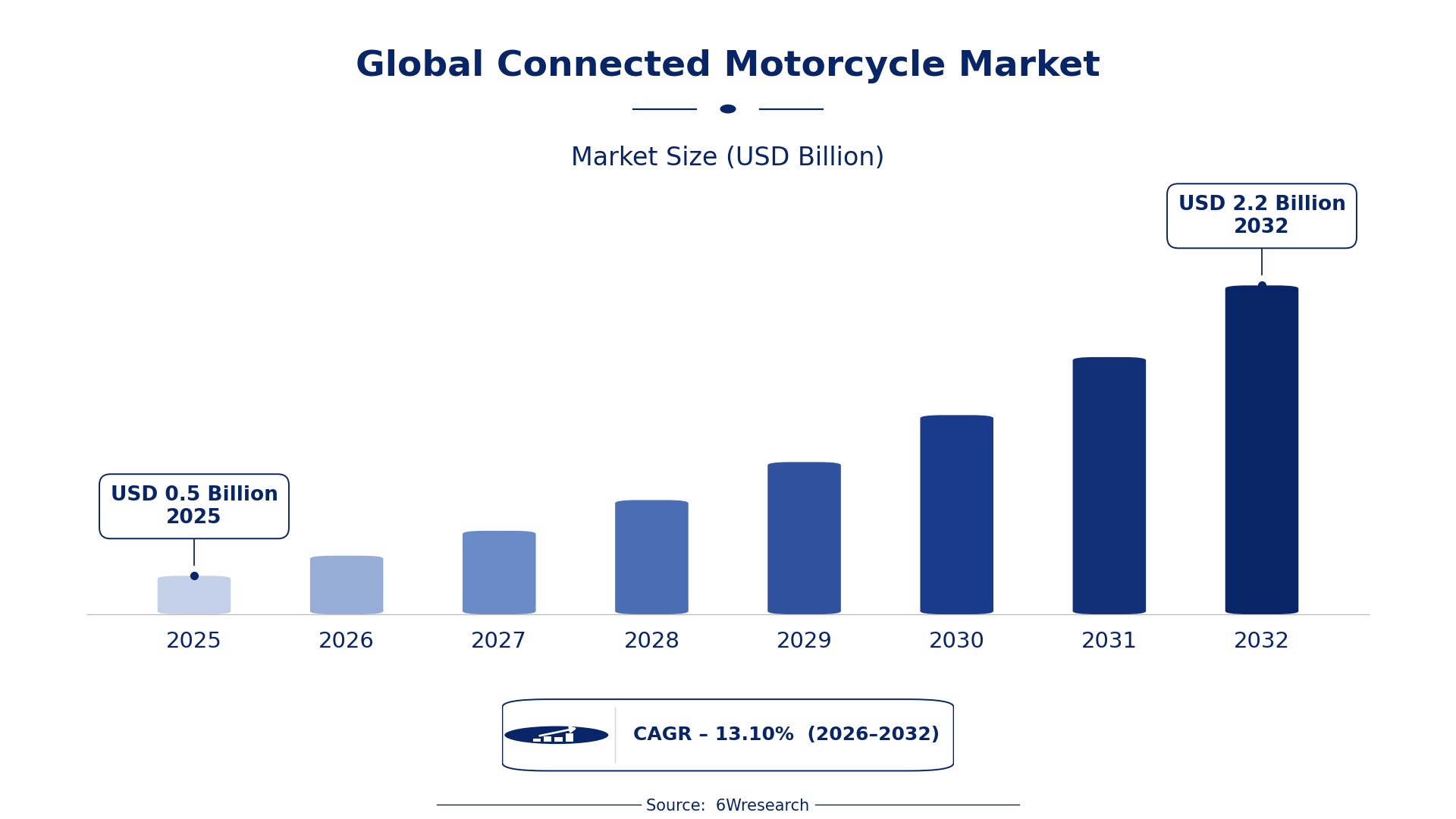
The Global Connected Motorcycle Market was estimated at USD 0.5 Billion in 2025 and is projected to reach USD 2.2 Billion by 2032, growing at a CAGR of 13.10% from 2026 to 2032.
Global Connected Motorcycle Market Synopsis
The Global Connected Motorcycle Market is evolving notably, influenced by an uptick in smart transportation and connectivity solutions. With motorcycles increasingly integrated with IoT capabilities, manufacturers are innovating in safety features, diagnostics, and navigation systems. This transformation is critical for urban mobility, given the increasing reliance on two-wheelers for commuting.
Key factors, such as urbanization and the growing popularity of riding adventures, are restructuring market dynamics. Connected motorcycles not only appeal to traditional bikers but also attract new segments, including urban commuters focused on efficiency and technology. This market differentiates itself from traditional motorcycle markets through its enhanced safety and connectivity applications.
Global Connected Motorcycle Market Year-wise Growth Rate and Key Drivers
This graph illustrates the annual growth rates of the Global Connected Motorcycle Market from 2022 to 2032, highlighting a steady upward trajectory and projected expansion over the forecast period.
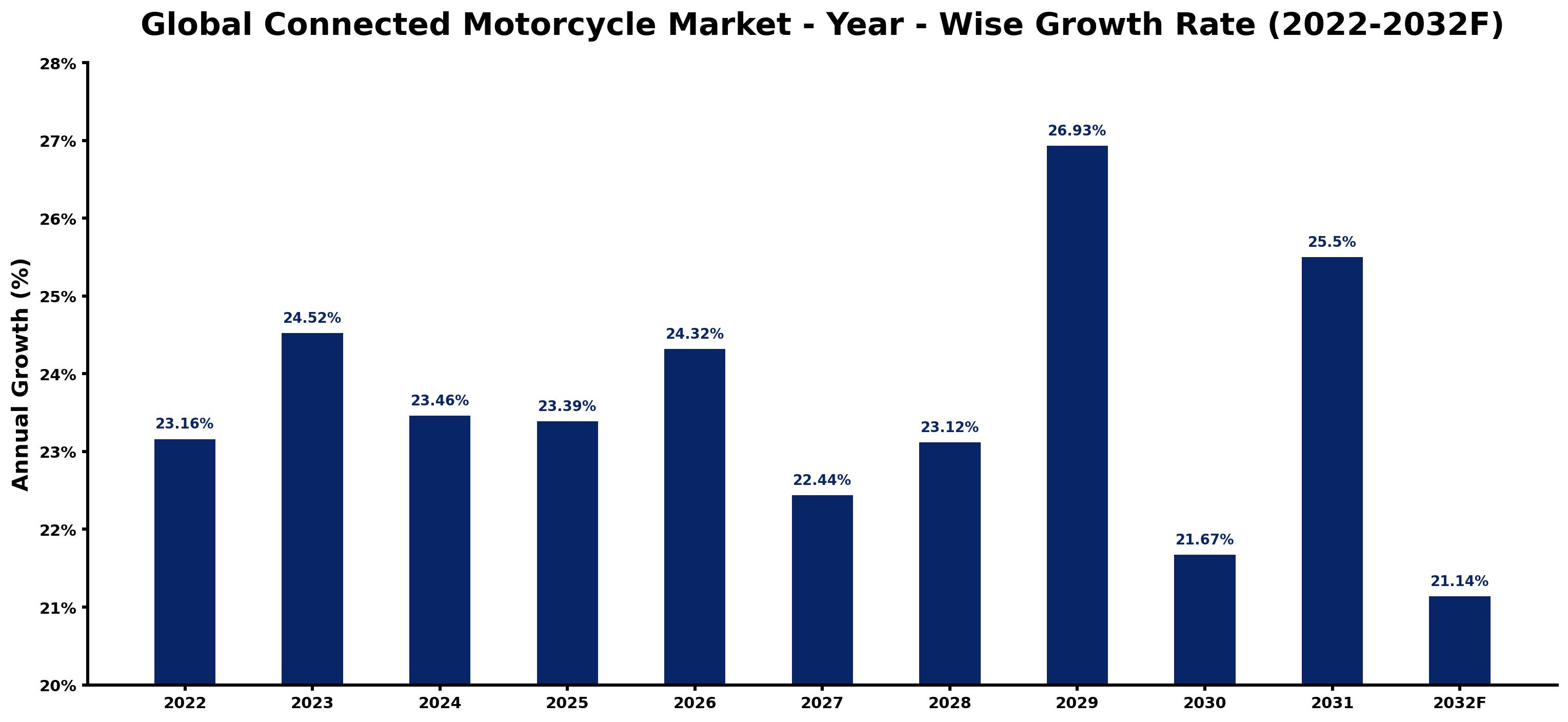
The table below presents the year‑wise growth rates along with the key drivers influencing the market
| Year | Growth Rate (%) | Major Drivers |
| 2022 | 23.16 | Consumers increasingly prioritize connectivity features in their motorcycle purchasing decisions. |
| 2023 | 24.52 | Advancements in ADAS systems enhance safety and appeal of connected motorcycles. |
| 2024 | 23.46 | Electric vehicle battery technology impacts the overall cost of connected motorcycle production. |
| 2025 | 23.39 | As investments in connected motorcycle startups surge, innovation accelerates across the sector. |
| 2026 | 24.32 | A growing interest in connected motorcycles is evident among environmentally conscious riders. |
| 2027 | 22.44 | In North America, a skilled workforce enhances OEM capabilities for connected motorcycle production. |
| 2028 | 23.12 | Millennials drive a shift toward connected motorcycles, emphasizing sustainable and smart technology. |
| 2029 | 26.93 | Optimizing supply chain logistics improves the delivery of connected motorcycle components significantly. |
| 2030 | 21.67 | Expanding distribution networks facilitates wider availability of connected motorcycles in emerging markets. |
| 2031 | 25.5 | A shift toward environmentally friendly products alters the competitive dynamics within the connected motorcycle sector. |
| 2032 | 21.14 | OEM regulations are evolving, pushing connected motorcycle manufacturers to enhance compliance measures. |
Note - Market size estimations and growth projections presented in this report are based on 6Wresearch's proprietary research methodology, combining internal industry data, secondary research, and primary validation, updated periodically to reflect current market conditions. As markets evolve rapidly, figures for certain industries may vary slightly and are intended as informed estimates rather than absolute figures. For the most current market sizing, we recommend validating figures with a 6Wresearch analyst.
Global Connected Motorcycle Market Key Takeaways
Below are some of the specific key takeaways from the market, including:
- North America commands a market share of approximately 40% in 2025, driven by high consumer appetite for technology and premium features.
- The tethered segment is forecasted to grow at a CAGR of 16.5% from 2026 to 2032, thanks to the surge in smartphone applications related to motorcycle connectivity.
- KTM launched its new connected motorcycle platform in early 2023, focusing on real-time diagnostics and user-engagement features, showcasing the immediate industry shift.
- Government incentives in several regions aim to encourage the adoption of connected motorcycles as part of broader smart city initiatives.
Evaluation of Restraints in Global Connected Motorcycle Market
Challenges persist in the Global Connected Motorcycle Market, particularly around data privacy. Manufacturers must comply with regulations governing the handling of sensitive user data, which can incur higher operational costs. For example, non-compliance fines can reach upwards of $10,000, significantly impacting small manufacturers. Additionally, technological integration issues complicate the emergence of features like V2V communication, delaying innovation cycles.
Global Connected Motorcycle Market Trends
Current trends in the Global Connected Motorcycle Market reflect a shift toward advanced connectivity solutions driven by consumer preference for safety and efficiency. The integration of IoT technology is manifesting through real-time GPS tracking and emergency response systems becoming standard. For example, major players like Honda are actively incorporating collision avoidance systems in their upcoming models, aligning with regulations and consumer expectations.
This operational change corresponds not only with customer demands but also with regulatory pressure to improve road safety. Furthermore, the rise of connected motorcycle apps for navigation and user engagement is fostering a new ecosystem, allowing manufacturers to foster relationships with consumers while gathering data for future innovations.
Global Connected Motorcycle Market Opportunities
The Global Connected Motorcycle Market presents several promising avenues for future revenue streams. The advent of electric vehicles (EVs) is one such opportunity, where manufacturers can incorporate connected features into their designs, capitalizing on the burgeoning EV segment. For instance, industry leaders like BMW are investing heavily in battery management systems that harness connectivity to enhance performance.
Collaboration between motorcycle manufacturers and tech companies signifies another avenue, as partnerships evolve to create comprehensive digital solutions. A notable project is the collaboration between Yamaha and a leading tech firm to enhance connectivity in their motorcycles, aiming for a more integrated and intuitive user experience.
Global Connected Motorcycle Market by Hardware
The Global Connected Motorcycle Market is primarily led by embedded hardware, which accounted for approximately 55% share in 2025. This segment benefits from extensive integration capabilities and manufacturing efficiencies. On the other hand, the tethered hardware segment is the fastest-growing, projected to achieve a CAGR of 16.5% from 2026 to 2032, as it offers flexibility and ease of updates for consumers dependent on mobile technology.
Global Connected Motorcycle Market by Communication Type
In the communication type category, Vehicle-to-Vehicle (V2V) communication leads the market, expected to capture around 47% of the share in 2025 due to its crucial role in enhancing safety and traffic management. Conversely, Vehicle-to-Infrastructure (V2I) communication is poised to emerge as the fastest-growing segment, anticipated to achieve a CAGR of 15.8% from 2026 to 2032. This growth stems from increasing smart city implementations around the globe, thereby improving commuter safety and efficiency.
Global Connected Motorcycle Market by Network Type
C-V2X (Cellular Vehicle-to-Everything) technology leads the network type segment, projected to comprise roughly 54% of the market share in 2025 due to its robust capabilities in real-time communication. Meanwhile, Dedicated Short-Range Communications (DSRC) is the fastest-growing segment, with an anticipated CAGR of 14.2% from 2026 to 2032. This growth is attributed to increasing investments in intelligent transportation systems globally.
Global Connected Motorcycle Market by Region
North America is currently the largest region in the Global Connected Motorcycle Market, holding approximately 40% of the share as of 2025, driven by technological advancements and a mature consumer base. Asia, on the other hand, is the fastest-growing region, expected to achieve a CAGR of 15.5% from 2026 to 2032, as rising urbanization and increasing disposable incomes fuel motorcycle adoption, particularly in countries like India and China.
Government Initiatives in the Global Connected Motorcycle Market
The regulatory landscape for the Global Connected Motorcycle Market is increasingly shaped by government initiatives aimed at fostering innovation and enhancing safety. These initiatives not only provide financial incentives but also create standards that manufacturers must adhere to, significantly impacting the market dynamics.
- U.S. Department of Transportation, "Connected Vehicle Pilot Program," 2021 - Aimed at integrating connected vehicle technology into urban environments to improve traffic safety and efficiency.
- European Commission, "EU Connected Mobility Project," 2022 - This initiative focuses on enhancing connectivity and safety in transportation through significant funding and resources for connected vehicles.
- Government of India, "FAME II Scheme," 2022 - Incentivizes electric and connected vehicles, crucial for advancing connected motorcycle technologies in emerging markets.
- Department for Transport (UK), "Connected and Automated Mobility Strategy," 2021 - Sets forth regulations and guidelines to promote the development of connected motorcycle technologies within the UK.
Future Insights of the Global Connected Motorcycle Market
As consumer preferences shift towards sustainable transportation solutions, the demand for connected motorcycles is anticipated to evolve significantly. By 2032, collaborative initiatives between manufacturers and technology firms will enhance functionalities, particularly as connected features become integral in electric models. For instance, BMW's focus on integrating battery management systems highlights an essential trend toward connectivity in electric vehicles, driving market Dynamics. The ongoing shift towards enhanced safety protocols and smart technology will also reshape competitive strategies and growth trajectories for existing players.
Global Connected Motorcycle Market Latest Developments
The landscape of the Global Connected Motorcycle Market is witnessing transformative developments driven by innovations in technology and strategic partnerships. Below are key recent activities:
- In April 2023, Honda announced plans for an upcoming model featuring an advanced collision-avoidance system, which is expected to significantly enhance rider safety.
- Recently, Harley-Davidson introduced a new connected motorcycle app aimed at improving rider experience through navigation and vehicle diagnostics.
- In early 2023, KTM completed the launch of its connected motorcycle platform, focusing on user engagement and real-time diagnostics, thereby positioning itself uniquely in the market.
- Throughout 2023, Yamaha partnered with a leading tech company to develop integrated connectivity solutions, aiming to deliver seamless user experiences and bolster its competitive edge.
Global Connected Motorcycle Market Key Players and Industry Positioning
The Global Connected Motorcycle Market features a fragmented competitive landscape, with key players leveraging unique strengths to differentiate themselves. As manufacturers vie for market share, innovation in connectivity and advanced safety features is increasingly central to their strategies.
| Leading Company | Core Strength | Strategic Focus |
|---|---|---|
| BMW | Strong emphasis on integrating connectivity with advanced safety features | Developing innovative battery management for EVs |
| Honda | Established reputation for reliability and cutting-edge technology | Focusing on enhanced safety systems, including collision avoidance |
| KTM | Agility in launching new connected platforms | Real-time diagnostics and user engagement features |
| Harley-Davidson | Iconic brand with loyal customer base | Enhancing rider experience through connectivity apps |
| Yamaha | Robust R&D investment for tech integration | Partnerships to develop comprehensive digital solutions |
As the competitive dynamics evolve, companies are expected to sharpen their focus on innovative connectivity solutions, presenting both challenges and opportunities across the market.
Key Attractiveness of the Report
- 10 Years of Market Numbers
- Historical Data Starting from 2022 to 2025
- Base Year: 2025
- Forecast Data until 2032
- Key Performance Indicators Impacting the Market
- Major Upcoming Developments and Projects
Key Highlights of the Report:
- Global Connected Motorcycle Market Outlook
- Market Size of Global Connected Motorcycle Market, 2025
- Forecast of Global Connected Motorcycle Market, 2032
- Historical Data and Forecast of Global Connected Motorcycle Revenues & Volume for the Period 2022-2032
- Global Connected Motorcycle Market Trend Evolution
- Global Connected Motorcycle Market Drivers and Challenges
- Global Connected Motorcycle Price Trends
- Global Connected Motorcycle Porter's Five Forces
- Global Connected Motorcycle Industry Life Cycle
- Historical Data and Forecast of Global Connected Motorcycle Market Revenues & Volume
- Historical Data and Forecast of Global Connected Motorcycle Market Revenues & Volume By Hardware for the Period 2022-2032
- Historical Data and Forecast of Global Connected Motorcycle Market Revenues & Volume By Embedded for the Period 2022-2032
- Historical Data and Forecast of Global Connected Motorcycle Market Revenues & Volume By Tethered for the Period 2022-2032
- Historical Data and Forecast of Global Connected Motorcycle Market Revenues & Volume By Communication Type for the Period 2022-2032
- Historical Data and Forecast of Global Connected Motorcycle Market Revenues & Volume By V2V for the Period 2022-2032
- Historical Data and Forecast of Global Connected Motorcycle Market Revenues & Volume By V2I for the Period 2022-2032
- Historical Data and Forecast of Global Connected Motorcycle Market Revenues & Volume By Network Type for the Period 2022-2032
- Historical Data and Forecast of Global Connected Motorcycle Market Revenues & Volume By C-V2X for the Period 2022-2032
- Historical Data and Forecast of Global Connected Motorcycle Market Revenues & Volume By DSRC for the Period 2022-2032
- Historical Data and Forecast of North America Connected Motorcycle Market Revenues & Volume By Hardware for the Period 2022-2032
- Historical Data and Forecast of North America Connected Motorcycle Market Revenues & Volume By Embedded for the Period 2022-2032
- Historical Data and Forecast of North America Connected Motorcycle Market Revenues & Volume By Tethered for the Period 2022-2032
- Historical Data and Forecast of North America Connected Motorcycle Market Revenues & Volume By Communication Type for the Period 2022-2032
- Historical Data and Forecast of North America Connected Motorcycle Market Revenues & Volume By V2V for the Period 2022-2032
- Historical Data and Forecast of North America Connected Motorcycle Market Revenues & Volume By V2I for the Period 2022-2032
- Historical Data and Forecast of North America Connected Motorcycle Market Revenues & Volume By Network Type for the Period 2022-2032
- Historical Data and Forecast of North America Connected Motorcycle Market Revenues & Volume By C-V2X for the Period 2022-2032
- Historical Data and Forecast of North America Connected Motorcycle Market Revenues & Volume By DSRC for the Period 2022-2032
- Historical Data and Forecast of United States of America Connected Motorcycle Market Revenues & Volume for the Period 2022-2032
- Historical Data and Forecast of Canada Connected Motorcycle Market Revenues & Volume for the Period 2022-2032
- Historical Data and Forecast of Rest of North America Connected Motorcycle Market Revenues & Volume for the Period 2022-2032
- Historical Data and Forecast of Latin America (LATAM) Connected Motorcycle Market Revenues & Volume By Hardware for the Period 2022-2032
- Historical Data and Forecast of Latin America (LATAM) Connected Motorcycle Market Revenues & Volume By Embedded for the Period 2022-2032
- Historical Data and Forecast of Latin America (LATAM) Connected Motorcycle Market Revenues & Volume By Tethered for the Period 2022-2032
- Historical Data and Forecast of Latin America (LATAM) Connected Motorcycle Market Revenues & Volume By Communication Type for the Period 2022-2032
- Historical Data and Forecast of Latin America (LATAM) Connected Motorcycle Market Revenues & Volume By V2V for the Period 2022-2032
- Historical Data and Forecast of Latin America (LATAM) Connected Motorcycle Market Revenues & Volume By V2I for the Period 2022-2032
- Historical Data and Forecast of Latin America (LATAM) Connected Motorcycle Market Revenues & Volume By Network Type for the Period 2022-2032
- Historical Data and Forecast of Latin America (LATAM) Connected Motorcycle Market Revenues & Volume By C-V2X for the Period 2022-2032
- Historical Data and Forecast of Latin America (LATAM) Connected Motorcycle Market Revenues & Volume By DSRC for the Period 2022-2032
- Historical Data and Forecast of Brazil Connected Motorcycle Market Revenues & Volume for the Period 2022-2032
- Historical Data and Forecast of Mexico Connected Motorcycle Market Revenues & Volume for the Period 2022-2032
- Historical Data and Forecast of Argentina Connected Motorcycle Market Revenues & Volume for the Period 2022-2032
- Historical Data and Forecast of Rest of LATAM Connected Motorcycle Market Revenues & Volume for the Period 2022-2032
- Historical Data and Forecast of Asia Connected Motorcycle Market Revenues & Volume By Hardware for the Period 2022-2032
- Historical Data and Forecast of Asia Connected Motorcycle Market Revenues & Volume By Embedded for the Period 2022-2032
- Historical Data and Forecast of Asia Connected Motorcycle Market Revenues & Volume By Tethered for the Period 2022-2032
- Historical Data and Forecast of Asia Connected Motorcycle Market Revenues & Volume By Communication Type for the Period 2022-2032
- Historical Data and Forecast of Asia Connected Motorcycle Market Revenues & Volume By V2V for the Period 2022-2032
- Historical Data and Forecast of Asia Connected Motorcycle Market Revenues & Volume By V2I for the Period 2022-2032
- Historical Data and Forecast of Asia Connected Motorcycle Market Revenues & Volume By Network Type for the Period 2022-2032
- Historical Data and Forecast of Asia Connected Motorcycle Market Revenues & Volume By C-V2X for the Period 2022-2032
- Historical Data and Forecast of Asia Connected Motorcycle Market Revenues & Volume By DSRC for the Period 2022-2032
- Historical Data and Forecast of China Connected Motorcycle Market Revenues & Volume for the Period 2022-2032
- Historical Data and Forecast of India Connected Motorcycle Market Revenues & Volume for the Period 2022-2032
- Historical Data and Forecast of Japan Connected Motorcycle Market Revenues & Volume for the Period 2022-2032
- Historical Data and Forecast of Rest of Asia Connected Motorcycle Market Revenues & Volume for the Period 2022-2032
- Historical Data and Forecast of Africa Connected Motorcycle Market Revenues & Volume By Hardware for the Period 2022-2032
- Historical Data and Forecast of Africa Connected Motorcycle Market Revenues & Volume By Embedded for the Period 2022-2032
- Historical Data and Forecast of Africa Connected Motorcycle Market Revenues & Volume By Tethered for the Period 2022-2032
- Historical Data and Forecast of Africa Connected Motorcycle Market Revenues & Volume By Communication Type for the Period 2022-2032
- Historical Data and Forecast of Africa Connected Motorcycle Market Revenues & Volume By V2V for the Period 2022-2032
- Historical Data and Forecast of Africa Connected Motorcycle Market Revenues & Volume By V2I for the Period 2022-2032
- Historical Data and Forecast of Africa Connected Motorcycle Market Revenues & Volume By Network Type for the Period 2022-2032
- Historical Data and Forecast of Africa Connected Motorcycle Market Revenues & Volume By C-V2X for the Period 2022-2032
- Historical Data and Forecast of Africa Connected Motorcycle Market Revenues & Volume By DSRC for the Period 2022-2032
- Historical Data and Forecast of South Africa Connected Motorcycle Market Revenues & Volume for the Period 2022-2032
- Historical Data and Forecast of Nigeria Connected Motorcycle Market Revenues & Volume for the Period 2022-2032
- Historical Data and Forecast of Egypt Connected Motorcycle Market Revenues & Volume for the Period 2022-2032
- Historical Data and Forecast of Rest of Africa Connected Motorcycle Market Revenues & Volume for the Period 2022-2032
- Historical Data and Forecast of Europe Connected Motorcycle Market Revenues & Volume By Hardware for the Period 2022-2032
- Historical Data and Forecast of Europe Connected Motorcycle Market Revenues & Volume By Embedded for the Period 2022-2032
- Historical Data and Forecast of Europe Connected Motorcycle Market Revenues & Volume By Tethered for the Period 2022-2032
- Historical Data and Forecast of Europe Connected Motorcycle Market Revenues & Volume By Communication Type for the Period 2022-2032
- Historical Data and Forecast of Europe Connected Motorcycle Market Revenues & Volume By V2V for the Period 2022-2032
- Historical Data and Forecast of Europe Connected Motorcycle Market Revenues & Volume By V2I for the Period 2022-2032
- Historical Data and Forecast of Europe Connected Motorcycle Market Revenues & Volume By Network Type for the Period 2022-2032
- Historical Data and Forecast of Europe Connected Motorcycle Market Revenues & Volume By C-V2X for the Period 2022-2032
- Historical Data and Forecast of Europe Connected Motorcycle Market Revenues & Volume By DSRC for the Period 2022-2032
- Historical Data and Forecast of United Kingdom Connected Motorcycle Market Revenues & Volume for the Period 2022-2032
- Historical Data and Forecast of France Connected Motorcycle Market Revenues & Volume for the Period 2022-2032
- Historical Data and Forecast of Germany Connected Motorcycle Market Revenues & Volume for the Period 2022-2032
- Historical Data and Forecast of Rest of Europe Connected Motorcycle Market Revenues & Volume for the Period 2022-2032
- Historical Data and Forecast of Middle East Connected Motorcycle Market Revenues & Volume By Hardware for the Period 2022-2032
- Historical Data and Forecast of Middle East Connected Motorcycle Market Revenues & Volume By Embedded for the Period 2022-2032
- Historical Data and Forecast of Middle East Connected Motorcycle Market Revenues & Volume By Tethered for the Period 2022-2032
- Historical Data and Forecast of Middle East Connected Motorcycle Market Revenues & Volume By Communication Type for the Period 2022-2032
- Historical Data and Forecast of Middle East Connected Motorcycle Market Revenues & Volume By V2V for the Period 2022-2032
- Historical Data and Forecast of Middle East Connected Motorcycle Market Revenues & Volume By V2I for the Period 2022-2032
- Historical Data and Forecast of Middle East Connected Motorcycle Market Revenues & Volume By Network Type for the Period 2022-2032
- Historical Data and Forecast of Middle East Connected Motorcycle Market Revenues & Volume By C-V2X for the Period 2022-2032
- Historical Data and Forecast of Middle East Connected Motorcycle Market Revenues & Volume By DSRC for the Period 2022-2032
- Historical Data and Forecast of Saudi Arabia Connected Motorcycle Market Revenues & Volume for the Period 2022-2032
- Historical Data and Forecast of UAE Connected Motorcycle Market Revenues & Volume for the Period 2022-2032
- Historical Data and Forecast of Turkey Connected Motorcycle Market Revenues & Volume for the Period 2022-2032
- Historical Data and Forecast of Rest of Middle East Connected Motorcycle Market Revenues & Volume for the Period 2022-2032
- Global Connected Motorcycle Market - Key Performance Indicators
- Global Connected Motorcycle Market - Import Export Trade Statistics
- Global Connected Motorcycle Market - Opportunity Assessment By Countries
- Global Connected Motorcycle Market - Opportunity Assessment By Hardware
- Global Connected Motorcycle Market - Opportunity Assessment By Communication Type
- Global Connected Motorcycle Market - Opportunity Assessment By Network Type
- Global Connected Motorcycle Market - Top Companies Market Share
- Global Connected Motorcycle Market - Top Companies Profiles
- Global Connected Motorcycle Market - Comparison of Players in Technical and Operating Parameters
- Global Connected Motorcycle Market - Strategic Recommendations
Markets Covered
The Global Connected Motorcycle Market report provides a detailed analysis of the following market segments:
By Regions and Countries:
- North America
- Europe
- LATAM
- Middle East
- Asia
- Africa
By Hardware:
- Embedded
- Tethered
By Communication Type:
- V2V
- V2I
By Network Type:
- C-V2X
- DSRC






































