Global Connected Solutions for Oil & Gas Market Highlights
| Market Size (2025) | USD 4.8 Billion |
| Forecast Size (2032) | USD 7.2 Billion |
| CAGR | 7.50% |
| Base Year | 2025 |
| Forecast Period | 2026-2032 |
| Largest Region | North America |
| Fastest Growing Region | Middle East |
| Largest Segment | Hardware |
| Fastest Growing Segment | Services |
| Leading Companies | Schlumberger, Halliburton, ABB, IBM, Honeywell |
Global Connected Solutions for Oil & Gas Market Size & Growth Rate (2026-2032)
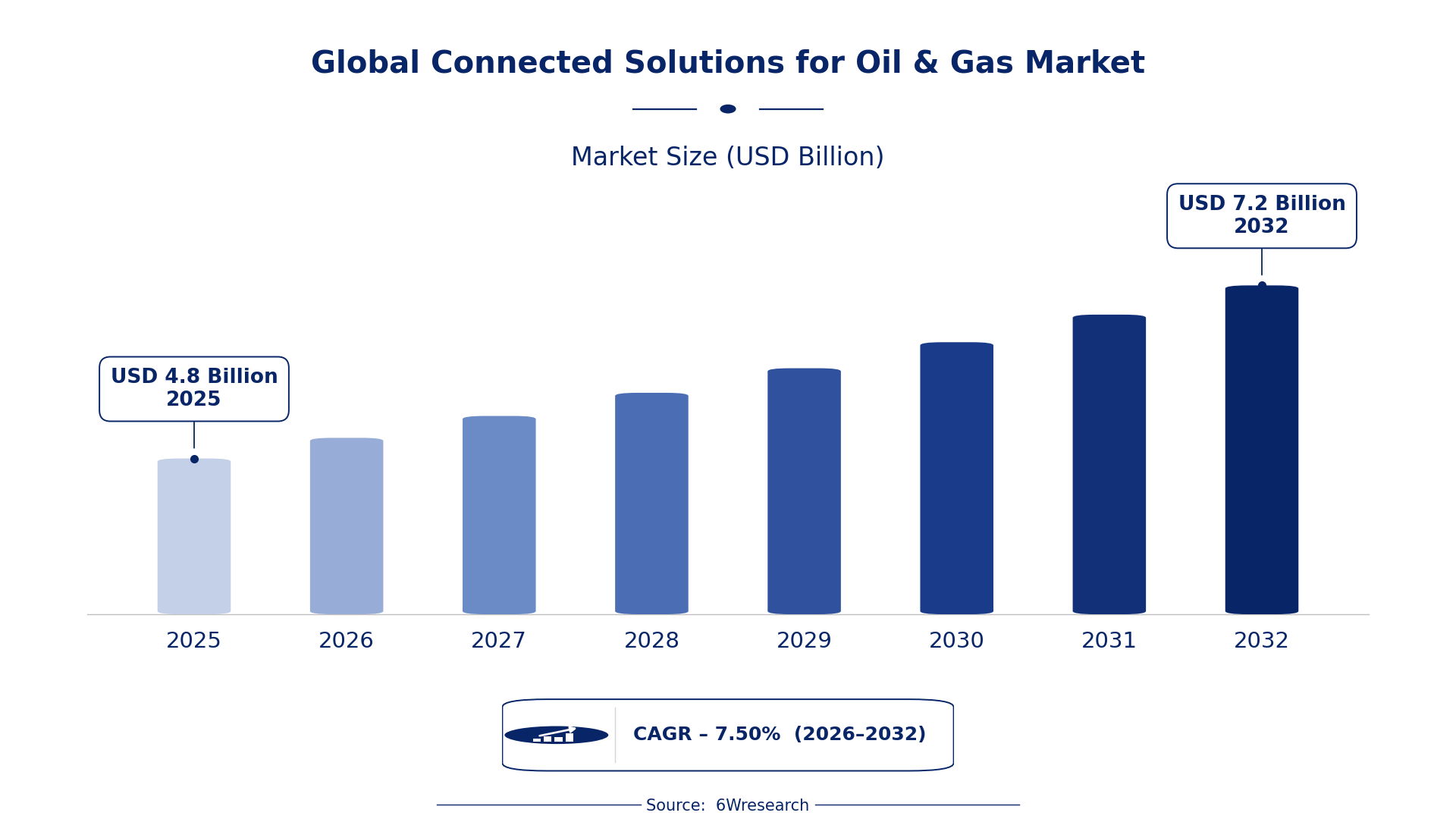
The Global Connected Solutions for Oil & Gas Market was estimated at USD 4.8 Billion in 2025 and is projected to reach USD 7.2 Billion by 2032, growing at a CAGR of 7.50% from 2026 to 2032.
Global Connected Solutions for Oil & Gas Market Synopsis
The Global Connected Solutions for Oil & Gas Market is fundamentally transforming as companies increasingly leverage digital technologies to enhance operational efficiency and ensure safety. The shift toward remote monitoring and data analytics is not merely a trend; it represents a seismic change in how oil and gas companies operate, reducing time and costs associated with traditional methods.
As operational processes adopt interconnected technologies, significant improvements in asset management and performance optimization are expected. This is not just an opportunity for cost savings but is critical for maintaining competitiveness in a market increasingly pressured by sustainability and environmental considerations.
Global Connected Solutions for Oil & Gas Market Year-wise Growth Rate and Key Drivers
This graph illustrates the annual growth rates of the Global Connected Solutions for Oil & Gas Market from 2022 to 2032, highlighting a steady upward trajectory and projected expansion over the forecast period.
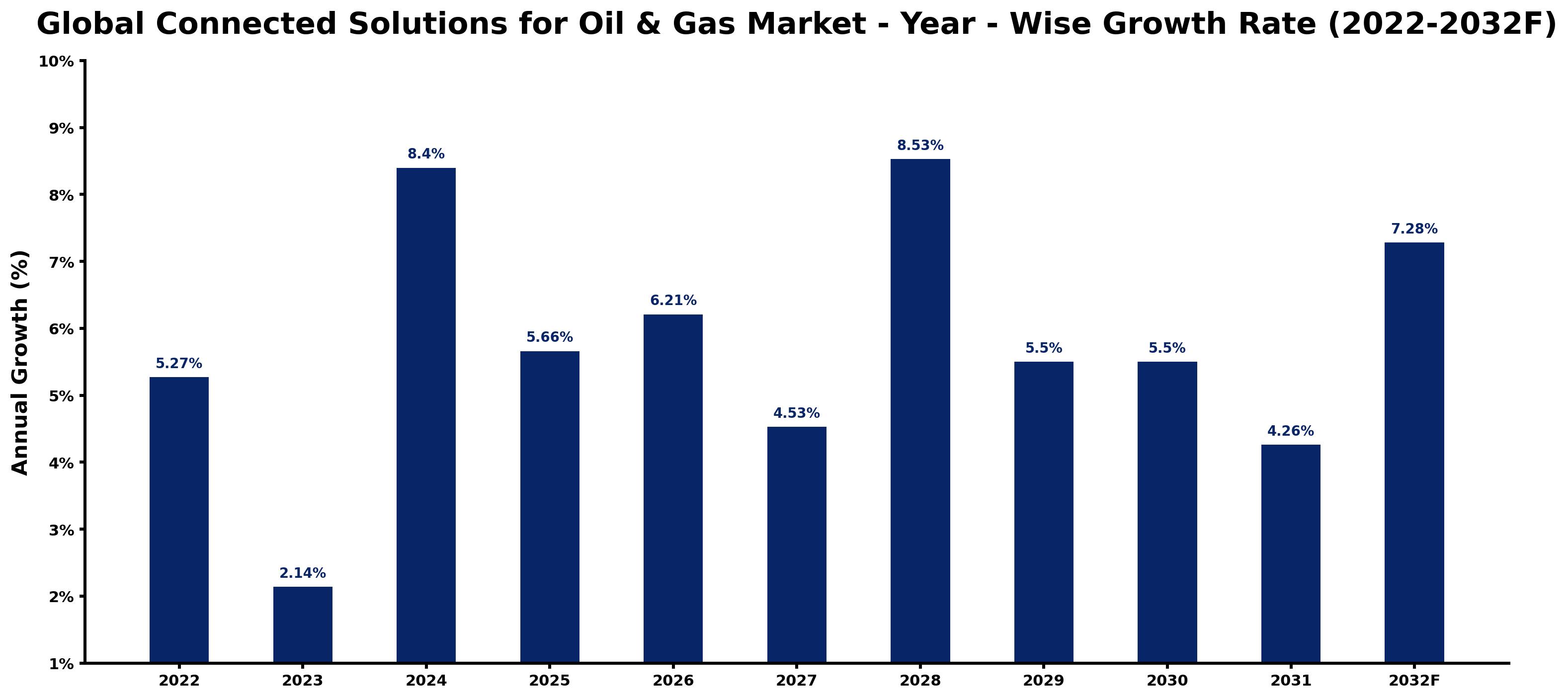
The table below presents the year‑wise growth rates along with the key drivers influencing the market
| Year | Growth Rate (%) | Major Drivers |
| 2022 | 5.27 | Strong collaboration among skilled workers enhances efficiency in connected oil solutions. |
| 2023 | 2.14 | Rising costs of raw materials strain profitability in gas production operations. |
| 2024 | 8.4 | Smart metering technologies enable compliance with new decarbonization mandates across regions. |
| 2025 | 5.66 | Oil and gas companies increasingly adopt connected solutions to enhance operational efficiency. |
| 2026 | 6.21 | While upstream exploration pressures drive investments in advanced gas management technologies. |
| 2027 | 4.53 | Growing demand for connected solutions results from expanding pipeline infrastructure across markets. |
| 2028 | 8.53 | A shift toward strategic investment in connected technologies promotes M&A activity in oil. |
| 2029 | 5.5 | Rising competition in connected oil solutions accelerates the pace of technology innovations. |
| 2030 | 5.5 | Manufacturers prioritize sustainability goals, influencing demand for connected gas solutions significantly. |
| 2031 | 4.26 | In North America, supply chain adjustments lead to greater adoption of connected solutions. |
| 2032 | 7.28 | Increasing awareness of efficiency drives end-users toward advanced connected oil technologies. |
Note - Market size estimations and growth projections presented in this report are based on 6Wresearch's proprietary research methodology, combining internal industry data, secondary research, and primary validation, updated periodically to reflect current market conditions. As markets evolve rapidly, figures for certain industries may vary slightly and are intended as informed estimates rather than absolute figures. For the most current market sizing, we recommend validating figures with a 6Wresearch analyst.
Global Connected Solutions for Oil & Gas Market Key Takeaways
Below are some of the specific key takeaways from the market, including:
- North America is set to hold approximately 45% share in 2025, driven by major oil production and technological investment.
- The Services segment is projected to grow at a CAGR of 9.2% from 2026 to 2032, reflecting growing demand for operational support and management.
- Schlumberger reported an investment of over $1 billion in digital transformation initiatives in 2024.
- Increased government funding in connected technologies is estimated to reach USD 500 million by the end of 2025, enhancing infrastructure capabilities.
Evaluation of Restraints in Global Connected Solutions for Oil & Gas Market
The Global Connected Solutions for Oil & Gas Market faces notable challenges predominantly tied to the technological integration of various platforms. For instance, projected cybersecurity costs for safeguarding connected systems are expected to exceed USD 300 million by 2025. Compliance with stringent regulations, such as those imposed by the Environmental Protection Agency (EPA) on emissions monitoring, adds another layer of complexity. For example, companies failing to adhere to these regulations can face fines upwards of USD 50,000 per day, compelling them to allocate significant resources to compliance efforts and thereby limiting their budget for innovation and expansion.
Global Connected Solutions for Oil & Gas Market Trends
Digitalization and automation are stirring profound changes within the Global Connected Solutions for Oil & Gas Market. Companies are increasingly turning to IoT devices for real-time data acquisition that inform critical business decisions. A pertinent example is Halliburton’s investment in AI-driven predictive maintenance solutions, which is expected to cut maintenance costs by up to 20% by 2026. Furthermore, the implementation of cloud computing solutions facilitates collaborative data analytics, enabling different stakeholders to derive insights collectively, making operations leaner and more efficient. These technological adoptions are not merely reactive to competition but are proactive strategies to embrace a future defined by data-driven operational paradigms.
Global Connected Solutions for Oil & Gas Market Opportunities
The future presents a tapestry of lucrative revenue streams for the Global Connected Solutions for Oil & Gas Market, particularly in advanced technologies. For instance, the integration of blockchain technology for secure data transactions is projected to capture market interest, with expected market involvement of over USD 200 million by 2030. Additionally, companies like IBM are pioneering the use of drones for remote inspections, enhancing operational safety and efficiency. This technology not only delivers a return on investment but also mitigates risks associated with conventional inspection methods. Moreover, the evolving landscape of renewable energy integration offers a significant avenue for revenue, especially as oil and gas firms expand their portfolios beyond hydrocarbons.
Global Connected Solutions for Oil & Gas Market by Component
In the Global Connected Solutions for Oil & Gas Market, Hardware is anticipated to lead with a substantial market share of approximately 50% in 2025. This is primarily due to the extensive reliance on physical devices like sensors and monitoring equipment. On the other hand, Services is expected to emerge as the fastest-growing component, boasting a CAGR of 9.0% from 2026 to 2032. Companies are increasingly outsourcing operational management to service providers to enhance focus on core competencies.
Global Connected Solutions for Oil & Gas Market by Value Chain
Within the Global Connected Solutions for Oil & Gas Market, the Upstream segment is projected to dominate, commanding a market share of approximately 55% in 2025. The focus on exploration and production efficiency drives investments in connected technologies for real-time data access. Conversely, the Midstream segment is expected to showcase the fastest growth, with a CAGR of 8.5% from 2026 to 2032. This is largely attributed to the increasing demand for pipeline monitoring solutions that ensure secure and efficient transportation of hydrocarbons.
Global Connected Solutions for Oil & Gas Market by Application
Asset Tracking and Monitoring leads the applications within the Global Connected Solutions for Oil & Gas Market, anticipated to hold around 40% of the market share in 2025. This is fueled by a high demand for improved tracking technologies to optimize resource allocation. Meanwhile, Predictive and Preventive Maintenance is expected to grow at a robust CAGR of 10.2% from 2026 to 2032, indicating a strong shift toward proactive maintenance strategies to reduce downtime and costs.
Global Connected Solutions for Oil & Gas Market by Region
North America is set to retain its status as the largest region in the Global Connected Solutions for Oil & Gas Market, comprising approximately 48% share in 2025. The region benefits from advanced technological infrastructure and significant capital investment. Meanwhile, the Middle East is projected to be the fastest-growing region, with a CAGR of 9.0% from 2026 to 2032. Continued investments in oil production coupled with government initiatives aimed at modernizing the sector will bolster this growth trajectory.
Government Initiatives in the Global Connected Solutions for Oil & Gas Market
The regulatory landscape is increasingly crucial in shaping the Global Connected Solutions for Oil & Gas Market. Governments are recognizing the need for modernized infrastructure and are enacting policies to facilitate technological integration and sustainability. Such initiatives not only foster innovation but also ensure compliance with environmental standards.
- U.S. Department of Energy, "Oil & Gas Innovation Grant Program," enacted in 2022, supports projects aimed at improving efficiency in oil and gas extraction.
- European Commission, "EU’s Green Deal," launched in 2019, mandates reductions in carbon emissions, thereby encouraging the adoption of connected solutions.
- Saudi Ministry of Energy, "National Industrial Development and Logistics Program," announced in 2021, focusing on enhancing technological capabilities in the oil and gas sector.
- Canadian Ministry of Natural Resources, "Clean Growth Program," introduced in 2024, aims to fund research into innovative technologies for resource extraction and management.
Future Insights of the Global Connected Solutions for Oil & Gas Market
As the Global Connected Solutions for Oil & Gas Market evolves, companies are expected to prioritize investments in AI and machine learning technologies for predictive maintenance and optimization. For instance, Halliburton's ongoing development of advanced analytics tools aims to enhance decision-making capabilities, which could lead to improved operational efficiency. The anticipated shift towards integrating renewable energy sources into existing frameworks will also redefine operational standards, necessitating industry-wide adaptations in technology and methodologies by 2032.
Global Connected Solutions for Oil & Gas Market Latest Developments
Recent advancements in the Global Connected Solutions for Oil & Gas Market underscore the dynamic nature of this sector as companies make strategic moves to boost their market positions.
- In early 2024, Schlumberger launched a new cloud-based platform to support remote monitoring efforts, enhancing data accessibility and security across operations.
- Recently completed in late 2023, ABB expanded its IoT capabilities by acquiring a leading remote sensing technology firm, strengthening its portfolio in asset management and monitoring.
- Upcoming in Q2 2025, Honeywell is set to release a suite of integrated safety solutions aimed at improving compliance with environmental regulations for oil and gas operations.
- In mid-2024, IBM initiated a collaboration with several oil companies to pilot a blockchain-based supply chain management tool, which promises enhanced transparency and security in transactions.
Global Connected Solutions for Oil & Gas Market Key Players and Industry Positioning
The competitive structure of the Global Connected Solutions for Oil & Gas Market is characterized by a mix of established leaders and emerging players. Large corporations dominate through extensive resources and technological expertise, while nimble startups are often at the forefront of innovative solutions tailored to niche markets.
| Leading Company | Core Strength | Strategic Focus |
|---|---|---|
| Schlumberger | Leadership in digital solutions and oilfield services | Investment in AI and cloud technologies |
| Halliburton | Strong expertise in well construction and optimization | Focus on predictive analytics and automation |
| ABB | Integrated solutions for industrial automation | Enhancement of safety and efficiency in operations |
| IBM | Expertise in blockchain and data management | Development of digital tools for supply chain transparency |
| Honeywell | Innovator in connected safety and HVAC technologies | Investment in smart solutions for environmental compliance |
The diverse competencies of these key players position them strategically to influence the future direction of the Global Connected Solutions for Oil & Gas Market, particularly in areas such as digital transformation and compliance with regulatory frameworks.
Key Attractiveness of the Report
- 10 Years of Market Numbers
- Historical Data Starting from 2022 to 2025
- Base Year: 2025
- Forecast Data until 2032
- Key Performance Indicators Impacting the Market
- Major Upcoming Developments and Projects
Key Highlights of the Report:
- Global Connected Solutions for Oil & Gas Market Outlook
- Market Size of Global Connected Solutions for Oil & Gas Market, 2025
- Forecast of Global Connected Solutions for Oil & Gas Market, 2032
- Historical Data and Forecast of Global Connected Solutions for Oil & Gas Revenues & Volume for the Period 2022-2032
- Global Connected Solutions for Oil & Gas Market Trend Evolution
- Global Connected Solutions for Oil & Gas Market Drivers and Challenges
- Global Connected Solutions for Oil & Gas Price Trends
- Global Connected Solutions for Oil & Gas Porter's Five Forces
- Global Connected Solutions for Oil & Gas Industry Life Cycle
- Historical Data and Forecast of Global Connected Solutions for Oil & Gas Market Revenues & Volume
- Historical Data and Forecast of Global Connected Solutions for Oil & Gas Market Revenues & Volume By Component for the Period 2022-2032
- Historical Data and Forecast of Global Connected Solutions for Oil & Gas Market Revenues & Volume By Hardware for the Period 2022-2032
- Historical Data and Forecast of Global Connected Solutions for Oil & Gas Market Revenues & Volume By Software for the Period 2022-2032
- Historical Data and Forecast of Global Connected Solutions for Oil & Gas Market Revenues & Volume By Services for the Period 2022-2032
- Historical Data and Forecast of Global Connected Solutions for Oil & Gas Market Revenues & Volume By Value Chain for the Period 2022-2032
- Historical Data and Forecast of Global Connected Solutions for Oil & Gas Market Revenues & Volume By Upstream for the Period 2022-2032
- Historical Data and Forecast of Global Connected Solutions for Oil & Gas Market Revenues & Volume By Midstream for the Period 2022-2032
- Historical Data and Forecast of Global Connected Solutions for Oil & Gas Market Revenues & Volume By Downstream for the Period 2022-2032
- Historical Data and Forecast of Global Connected Solutions for Oil & Gas Market Revenues & Volume By Application for the Period 2022-2032
- Historical Data and Forecast of Global Connected Solutions for Oil & Gas Market Revenues & Volume By Asset Tracking and Monitoring for the Period 2022-2032
- Historical Data and Forecast of Global Connected Solutions for Oil & Gas Market Revenues & Volume By Predictive and Preventive Maintenance for the Period 2022-2032
- Historical Data and Forecast of Global Connected Solutions for Oil & Gas Market Revenues & Volume By Supply Chain Management for the Period 2022-2032
- Historical Data and Forecast of Global Connected Solutions for Oil & Gas Market Revenues & Volume By Leak Detection for the Period 2022-2032
- Historical Data and Forecast of Global Connected Solutions for Oil & Gas Market Revenues & Volume By Fleet Management for the Period 2022-2032
- Historical Data and Forecast of Global Connected Solutions for Oil & Gas Market Revenues & Volume By Others for the Period 2022-2032
- Historical Data and Forecast of North America Connected Solutions for Oil & Gas Market Revenues & Volume By Component for the Period 2022-2032
- Historical Data and Forecast of North America Connected Solutions for Oil & Gas Market Revenues & Volume By Hardware for the Period 2022-2032
- Historical Data and Forecast of North America Connected Solutions for Oil & Gas Market Revenues & Volume By Software for the Period 2022-2032
- Historical Data and Forecast of North America Connected Solutions for Oil & Gas Market Revenues & Volume By Services for the Period 2022-2032
- Historical Data and Forecast of North America Connected Solutions for Oil & Gas Market Revenues & Volume By Value Chain for the Period 2022-2032
- Historical Data and Forecast of North America Connected Solutions for Oil & Gas Market Revenues & Volume By Upstream for the Period 2022-2032
- Historical Data and Forecast of North America Connected Solutions for Oil & Gas Market Revenues & Volume By Midstream for the Period 2022-2032
- Historical Data and Forecast of North America Connected Solutions for Oil & Gas Market Revenues & Volume By Downstream for the Period 2022-2032
- Historical Data and Forecast of North America Connected Solutions for Oil & Gas Market Revenues & Volume By Application for the Period 2022-2032
- Historical Data and Forecast of North America Connected Solutions for Oil & Gas Market Revenues & Volume By Asset Tracking and Monitoring for the Period 2022-2032
- Historical Data and Forecast of North America Connected Solutions for Oil & Gas Market Revenues & Volume By Predictive and Preventive Maintenance for the Period 2022-2032
- Historical Data and Forecast of North America Connected Solutions for Oil & Gas Market Revenues & Volume By Supply Chain Management for the Period 2022-2032
- Historical Data and Forecast of North America Connected Solutions for Oil & Gas Market Revenues & Volume By Leak Detection for the Period 2022-2032
- Historical Data and Forecast of North America Connected Solutions for Oil & Gas Market Revenues & Volume By Fleet Management for the Period 2022-2032
- Historical Data and Forecast of North America Connected Solutions for Oil & Gas Market Revenues & Volume By Others for the Period 2022-2032
- Historical Data and Forecast of United States of America Connected Solutions for Oil & Gas Market Revenues & Volume for the Period 2022-2032
- Historical Data and Forecast of Canada Connected Solutions for Oil & Gas Market Revenues & Volume for the Period 2022-2032
- Historical Data and Forecast of Rest of North America Connected Solutions for Oil & Gas Market Revenues & Volume for the Period 2022-2032
- Historical Data and Forecast of Latin America (LATAM) Connected Solutions for Oil & Gas Market Revenues & Volume By Component for the Period 2022-2032
- Historical Data and Forecast of Latin America (LATAM) Connected Solutions for Oil & Gas Market Revenues & Volume By Hardware for the Period 2022-2032
- Historical Data and Forecast of Latin America (LATAM) Connected Solutions for Oil & Gas Market Revenues & Volume By Software for the Period 2022-2032
- Historical Data and Forecast of Latin America (LATAM) Connected Solutions for Oil & Gas Market Revenues & Volume By Services for the Period 2022-2032
- Historical Data and Forecast of Latin America (LATAM) Connected Solutions for Oil & Gas Market Revenues & Volume By Value Chain for the Period 2022-2032
- Historical Data and Forecast of Latin America (LATAM) Connected Solutions for Oil & Gas Market Revenues & Volume By Upstream for the Period 2022-2032
- Historical Data and Forecast of Latin America (LATAM) Connected Solutions for Oil & Gas Market Revenues & Volume By Midstream for the Period 2022-2032
- Historical Data and Forecast of Latin America (LATAM) Connected Solutions for Oil & Gas Market Revenues & Volume By Downstream for the Period 2022-2032
- Historical Data and Forecast of Latin America (LATAM) Connected Solutions for Oil & Gas Market Revenues & Volume By Application for the Period 2022-2032
- Historical Data and Forecast of Latin America (LATAM) Connected Solutions for Oil & Gas Market Revenues & Volume By Asset Tracking and Monitoring for the Period 2022-2032
- Historical Data and Forecast of Latin America (LATAM) Connected Solutions for Oil & Gas Market Revenues & Volume By Predictive and Preventive Maintenance for the Period 2022-2032
- Historical Data and Forecast of Latin America (LATAM) Connected Solutions for Oil & Gas Market Revenues & Volume By Supply Chain Management for the Period 2022-2032
- Historical Data and Forecast of Latin America (LATAM) Connected Solutions for Oil & Gas Market Revenues & Volume By Leak Detection for the Period 2022-2032
- Historical Data and Forecast of Latin America (LATAM) Connected Solutions for Oil & Gas Market Revenues & Volume By Fleet Management for the Period 2022-2032
- Historical Data and Forecast of Latin America (LATAM) Connected Solutions for Oil & Gas Market Revenues & Volume By Others for the Period 2022-2032
- Historical Data and Forecast of Brazil Connected Solutions for Oil & Gas Market Revenues & Volume for the Period 2022-2032
- Historical Data and Forecast of Mexico Connected Solutions for Oil & Gas Market Revenues & Volume for the Period 2022-2032
- Historical Data and Forecast of Argentina Connected Solutions for Oil & Gas Market Revenues & Volume for the Period 2022-2032
- Historical Data and Forecast of Rest of LATAM Connected Solutions for Oil & Gas Market Revenues & Volume for the Period 2022-2032
- Historical Data and Forecast of Asia Connected Solutions for Oil & Gas Market Revenues & Volume By Component for the Period 2022-2032
- Historical Data and Forecast of Asia Connected Solutions for Oil & Gas Market Revenues & Volume By Hardware for the Period 2022-2032
- Historical Data and Forecast of Asia Connected Solutions for Oil & Gas Market Revenues & Volume By Software for the Period 2022-2032
- Historical Data and Forecast of Asia Connected Solutions for Oil & Gas Market Revenues & Volume By Services for the Period 2022-2032
- Historical Data and Forecast of Asia Connected Solutions for Oil & Gas Market Revenues & Volume By Value Chain for the Period 2022-2032
- Historical Data and Forecast of Asia Connected Solutions for Oil & Gas Market Revenues & Volume By Upstream for the Period 2022-2032
- Historical Data and Forecast of Asia Connected Solutions for Oil & Gas Market Revenues & Volume By Midstream for the Period 2022-2032
- Historical Data and Forecast of Asia Connected Solutions for Oil & Gas Market Revenues & Volume By Downstream for the Period 2022-2032
- Historical Data and Forecast of Asia Connected Solutions for Oil & Gas Market Revenues & Volume By Application for the Period 2022-2032
- Historical Data and Forecast of Asia Connected Solutions for Oil & Gas Market Revenues & Volume By Asset Tracking and Monitoring for the Period 2022-2032
- Historical Data and Forecast of Asia Connected Solutions for Oil & Gas Market Revenues & Volume By Predictive and Preventive Maintenance for the Period 2022-2032
- Historical Data and Forecast of Asia Connected Solutions for Oil & Gas Market Revenues & Volume By Supply Chain Management for the Period 2022-2032
- Historical Data and Forecast of Asia Connected Solutions for Oil & Gas Market Revenues & Volume By Leak Detection for the Period 2022-2032
- Historical Data and Forecast of Asia Connected Solutions for Oil & Gas Market Revenues & Volume By Fleet Management for the Period 2022-2032
- Historical Data and Forecast of Asia Connected Solutions for Oil & Gas Market Revenues & Volume By Others for the Period 2022-2032
- Historical Data and Forecast of China Connected Solutions for Oil & Gas Market Revenues & Volume for the Period 2022-2032
- Historical Data and Forecast of India Connected Solutions for Oil & Gas Market Revenues & Volume for the Period 2022-2032
- Historical Data and Forecast of Japan Connected Solutions for Oil & Gas Market Revenues & Volume for the Period 2022-2032
- Historical Data and Forecast of Rest of Asia Connected Solutions for Oil & Gas Market Revenues & Volume for the Period 2022-2032
- Historical Data and Forecast of Africa Connected Solutions for Oil & Gas Market Revenues & Volume By Component for the Period 2022-2032
- Historical Data and Forecast of Africa Connected Solutions for Oil & Gas Market Revenues & Volume By Hardware for the Period 2022-2032
- Historical Data and Forecast of Africa Connected Solutions for Oil & Gas Market Revenues & Volume By Software for the Period 2022-2032
- Historical Data and Forecast of Africa Connected Solutions for Oil & Gas Market Revenues & Volume By Services for the Period 2022-2032
- Historical Data and Forecast of Africa Connected Solutions for Oil & Gas Market Revenues & Volume By Value Chain for the Period 2022-2032
- Historical Data and Forecast of Africa Connected Solutions for Oil & Gas Market Revenues & Volume By Upstream for the Period 2022-2032
- Historical Data and Forecast of Africa Connected Solutions for Oil & Gas Market Revenues & Volume By Midstream for the Period 2022-2032
- Historical Data and Forecast of Africa Connected Solutions for Oil & Gas Market Revenues & Volume By Downstream for the Period 2022-2032
- Historical Data and Forecast of Africa Connected Solutions for Oil & Gas Market Revenues & Volume By Application for the Period 2022-2032
- Historical Data and Forecast of Africa Connected Solutions for Oil & Gas Market Revenues & Volume By Asset Tracking and Monitoring for the Period 2022-2032
- Historical Data and Forecast of Africa Connected Solutions for Oil & Gas Market Revenues & Volume By Predictive and Preventive Maintenance for the Period 2022-2032
- Historical Data and Forecast of Africa Connected Solutions for Oil & Gas Market Revenues & Volume By Supply Chain Management for the Period 2022-2032
- Historical Data and Forecast of Africa Connected Solutions for Oil & Gas Market Revenues & Volume By Leak Detection for the Period 2022-2032
- Historical Data and Forecast of Africa Connected Solutions for Oil & Gas Market Revenues & Volume By Fleet Management for the Period 2022-2032
- Historical Data and Forecast of Africa Connected Solutions for Oil & Gas Market Revenues & Volume By Others for the Period 2022-2032
- Historical Data and Forecast of South Africa Connected Solutions for Oil & Gas Market Revenues & Volume for the Period 2022-2032
- Historical Data and Forecast of Nigeria Connected Solutions for Oil & Gas Market Revenues & Volume for the Period 2022-2032
- Historical Data and Forecast of Egypt Connected Solutions for Oil & Gas Market Revenues & Volume for the Period 2022-2032
- Historical Data and Forecast of Rest of Africa Connected Solutions for Oil & Gas Market Revenues & Volume for the Period 2022-2032
- Historical Data and Forecast of Europe Connected Solutions for Oil & Gas Market Revenues & Volume By Component for the Period 2022-2032
- Historical Data and Forecast of Europe Connected Solutions for Oil & Gas Market Revenues & Volume By Hardware for the Period 2022-2032
- Historical Data and Forecast of Europe Connected Solutions for Oil & Gas Market Revenues & Volume By Software for the Period 2022-2032
- Historical Data and Forecast of Europe Connected Solutions for Oil & Gas Market Revenues & Volume By Services for the Period 2022-2032
- Historical Data and Forecast of Europe Connected Solutions for Oil & Gas Market Revenues & Volume By Value Chain for the Period 2022-2032
- Historical Data and Forecast of Europe Connected Solutions for Oil & Gas Market Revenues & Volume By Upstream for the Period 2022-2032
- Historical Data and Forecast of Europe Connected Solutions for Oil & Gas Market Revenues & Volume By Midstream for the Period 2022-2032
- Historical Data and Forecast of Europe Connected Solutions for Oil & Gas Market Revenues & Volume By Downstream for the Period 2022-2032
- Historical Data and Forecast of Europe Connected Solutions for Oil & Gas Market Revenues & Volume By Application for the Period 2022-2032
- Historical Data and Forecast of Europe Connected Solutions for Oil & Gas Market Revenues & Volume By Asset Tracking and Monitoring for the Period 2022-2032
- Historical Data and Forecast of Europe Connected Solutions for Oil & Gas Market Revenues & Volume By Predictive and Preventive Maintenance for the Period 2022-2032
- Historical Data and Forecast of Europe Connected Solutions for Oil & Gas Market Revenues & Volume By Supply Chain Management for the Period 2022-2032
- Historical Data and Forecast of Europe Connected Solutions for Oil & Gas Market Revenues & Volume By Leak Detection for the Period 2022-2032
- Historical Data and Forecast of Europe Connected Solutions for Oil & Gas Market Revenues & Volume By Fleet Management for the Period 2022-2032
- Historical Data and Forecast of Europe Connected Solutions for Oil & Gas Market Revenues & Volume By Others for the Period 2022-2032
- Historical Data and Forecast of United Kingdom Connected Solutions for Oil & Gas Market Revenues & Volume for the Period 2022-2032
- Historical Data and Forecast of France Connected Solutions for Oil & Gas Market Revenues & Volume for the Period 2022-2032
- Historical Data and Forecast of Germany Connected Solutions for Oil & Gas Market Revenues & Volume for the Period 2022-2032
- Historical Data and Forecast of Rest of Europe Connected Solutions for Oil & Gas Market Revenues & Volume for the Period 2022-2032
- Historical Data and Forecast of Middle East Connected Solutions for Oil & Gas Market Revenues & Volume By Component for the Period 2022-2032
- Historical Data and Forecast of Middle East Connected Solutions for Oil & Gas Market Revenues & Volume By Hardware for the Period 2022-2032
- Historical Data and Forecast of Middle East Connected Solutions for Oil & Gas Market Revenues & Volume By Software for the Period 2022-2032
- Historical Data and Forecast of Middle East Connected Solutions for Oil & Gas Market Revenues & Volume By Services for the Period 2022-2032
- Historical Data and Forecast of Middle East Connected Solutions for Oil & Gas Market Revenues & Volume By Value Chain for the Period 2022-2032
- Historical Data and Forecast of Middle East Connected Solutions for Oil & Gas Market Revenues & Volume By Upstream for the Period 2022-2032
- Historical Data and Forecast of Middle East Connected Solutions for Oil & Gas Market Revenues & Volume By Midstream for the Period 2022-2032
- Historical Data and Forecast of Middle East Connected Solutions for Oil & Gas Market Revenues & Volume By Downstream for the Period 2022-2032
- Historical Data and Forecast of Middle East Connected Solutions for Oil & Gas Market Revenues & Volume By Application for the Period 2022-2032
- Historical Data and Forecast of Middle East Connected Solutions for Oil & Gas Market Revenues & Volume By Asset Tracking and Monitoring for the Period 2022-2032
- Historical Data and Forecast of Middle East Connected Solutions for Oil & Gas Market Revenues & Volume By Predictive and Preventive Maintenance for the Period 2022-2032
- Historical Data and Forecast of Middle East Connected Solutions for Oil & Gas Market Revenues & Volume By Supply Chain Management for the Period 2022-2032
- Historical Data and Forecast of Middle East Connected Solutions for Oil & Gas Market Revenues & Volume By Leak Detection for the Period 2022-2032
- Historical Data and Forecast of Middle East Connected Solutions for Oil & Gas Market Revenues & Volume By Fleet Management for the Period 2022-2032
- Historical Data and Forecast of Middle East Connected Solutions for Oil & Gas Market Revenues & Volume By Others for the Period 2022-2032
- Historical Data and Forecast of Saudi Arabia Connected Solutions for Oil & Gas Market Revenues & Volume for the Period 2022-2032
- Historical Data and Forecast of UAE Connected Solutions for Oil & Gas Market Revenues & Volume for the Period 2022-2032
- Historical Data and Forecast of Turkey Connected Solutions for Oil & Gas Market Revenues & Volume for the Period 2022-2032
- Historical Data and Forecast of Rest of Middle East Connected Solutions for Oil & Gas Market Revenues & Volume for the Period 2022-2032
- Global Connected Solutions for Oil & Gas Market - Key Performance Indicators
- Global Connected Solutions for Oil & Gas Market - Import Export Trade Statistics
- Global Connected Solutions for Oil & Gas Market - Opportunity Assessment By Countries
- Global Connected Solutions for Oil & Gas Market - Opportunity Assessment By Component
- Global Connected Solutions for Oil & Gas Market - Opportunity Assessment By Value Chain
- Global Connected Solutions for Oil & Gas Market - Opportunity Assessment By Application
- Global Connected Solutions for Oil & Gas Market - Top Companies Market Share
- Global Connected Solutions for Oil & Gas Market - Top Companies Profiles
- Global Connected Solutions for Oil & Gas Market - Comparison of Players in Technical and Operating Parameters
- Global Connected Solutions for Oil & Gas Market - Strategic Recommendations
Markets Covered
The Global Connected Solutions for Oil & Gas Market report provides a detailed analysis of the following market segments:
By Regions and Countries:
- North America
- Europe
- LATAM
- Middle East
- Asia
- Africa
By Component:
- Hardware
- Software
- Services
By Value Chain:
- Upstream
- Midstream
- Downstream
By Application:
- Asset Tracking
- Monitoring
- Predictive
- Preventive Maintenance
- Supply Chain Management
- Leak Detection
- Fleet Management
- Others






































