Global Construction Management Solution Market Highlights
| Market Size (2025) | USD 9.2 Billion |
| Forecast Size (2032) | USD 17.6 Billion |
| CAGR | 9.40% |
| Base Year | 2025 |
| Forecast Period | 2026-2032 |
| Largest Region | North America |
| Fastest Growing Region | Asia |
| Largest Segment | Cloud |
| Fastest Growing Segment | On-premises |
| Leading Companies | Procore, Autodesk, Oracle, Trimble, PlanGrid |
Global Construction Management Solution Market Size & Growth Rate (2026-2032)
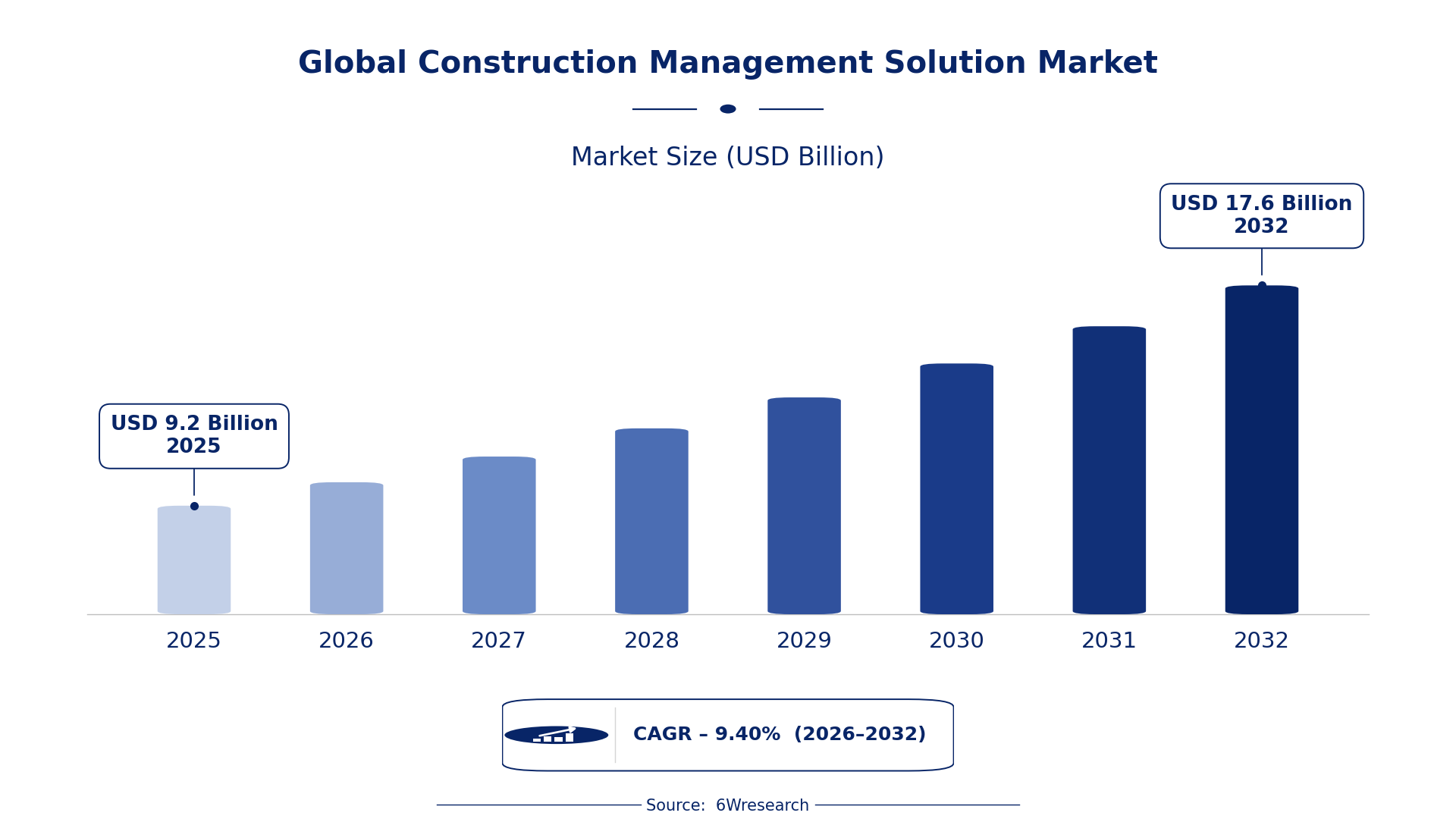
The Global Construction Management Solution Market was estimated at USD 9.2 Billion in 2025 and is projected to reach USD 17.6 Billion by 2032, growing at a CAGR of 9.40% from 2026 to 2032.
Global Construction Management Solution Market Synopsis
The Global Construction Management Solution Market is undergoing transformative changes, driven by the integration of advanced technologies into project management processes. This transformation is characterized by heightened operational efficiencies, resulting in significant cost reductions and enhanced productivity within the sector. As construction companies increasingly prioritize effective project delivery, the solutions that streamline workflows, such as cloud-based platforms and BIM technologies, are gaining traction.
Moreover, the competitive landscape is intensifying, with major players innovating rapidly to maintain their edge. Companies that successfully harness real-time collaboration tools and data analytics are expected to significantly improve decision-making processes. These advancements not only enhance project outcomes but also position participants in the Global Construction Management Solution Market as leaders capable of responding to evolving industry demands.
Global Construction Management Solution Market Year-wise Growth Rate and Key Drivers
This graph illustrates the annual growth rates of the Global Construction Management Solution Market from 2022 to 2032, highlighting a steady upward trajectory and projected expansion over the forecast period.
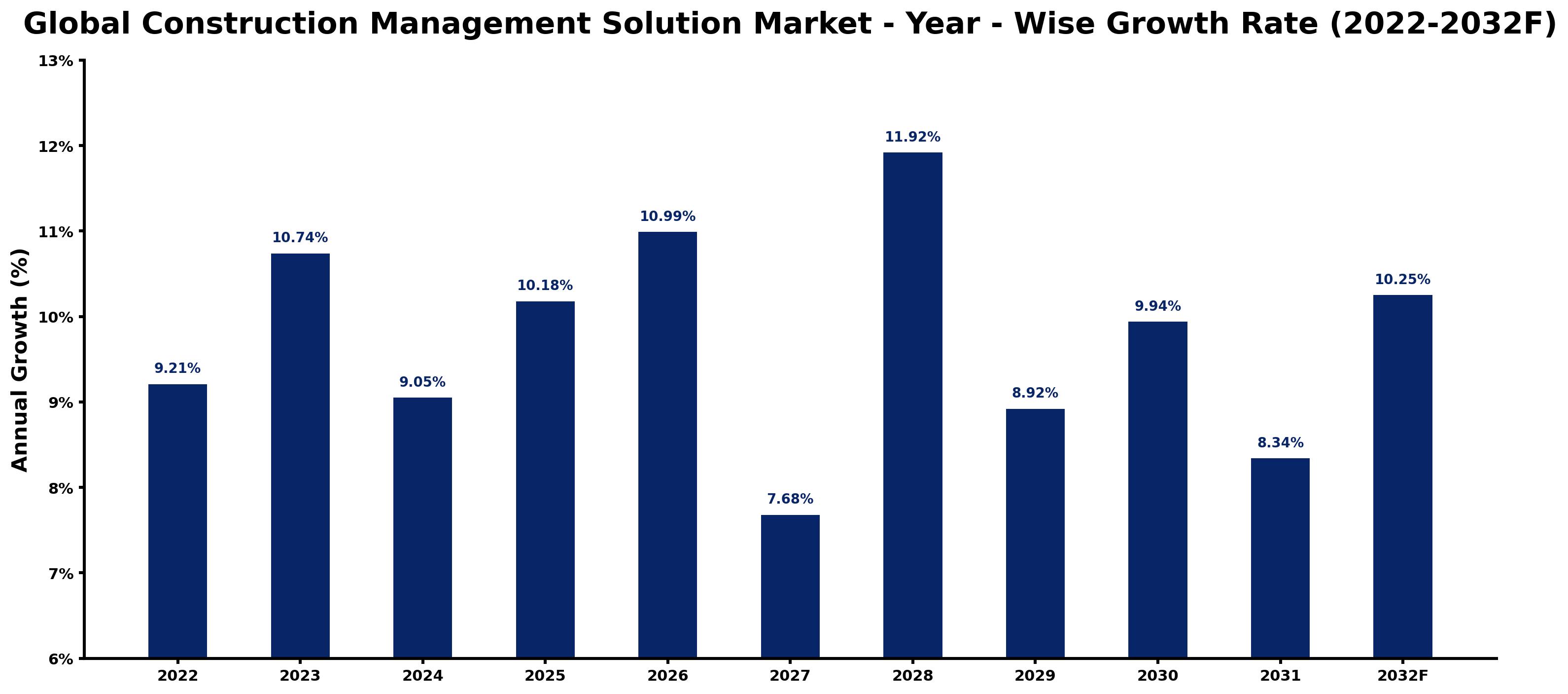
The table below presents the year‑wise growth rates along with the key drivers influencing the market
| Year | Growth Rate (%) | Major Drivers |
| 2022 | 9.21 | As new regulations emerge, construction management solutions gain necessary compliance capabilities. |
| 2023 | 10.74 | Contractors increasingly adopt technology to enhance competitiveness in project management solutions. |
| 2024 | 9.05 | Fluctuating material costs challenge profit margins, driving demand for efficient construction management solutions. |
| 2025 | 10.18 | In North America, sustainability initiatives accelerate the integration of green construction management solutions. |
| 2026 | 10.99 | Adopting industrial automation technologies enhances the efficiency of construction management solutions. |
| 2027 | 7.68 | A shift toward strategic mergers and acquisitions strengthens the construction management solutions sector. |
| 2028 | 11.92 | General contractors expand their service offerings, increasing demand for advanced construction management solutions. |
| 2029 | 8.92 | The rise of modular construction influences end-users to prioritize comprehensive management solutions. |
| 2030 | 9.94 | Building information modeling technology advances, improving the efficacy of construction management solutions. |
| 2031 | 8.34 | Growing environmental awareness prompts end-users to seek sustainable construction management solutions. |
| 2032 | 10.25 | Builders increasingly utilize data analytics to optimize supply chain dynamics for construction management. |
Note - Market size estimations and growth projections presented in this report are based on 6Wresearch's proprietary research methodology, combining internal industry data, secondary research, and primary validation, updated periodically to reflect current market conditions. As markets evolve rapidly, figures for certain industries may vary slightly and are intended as informed estimates rather than absolute figures. For the most current market sizing, we recommend validating figures with a 6Wresearch analyst.
Global Construction Management Solution Market Key Takeaways
Below are some of the specific key takeaways from the market, including:
- Procore, a leader in construction management software, reported a 30% increase in annual subscriptions in 2023.
- The cloud segment is anticipated to dominate the market with an approximately 55% share in 2025.
- A recent survey indicated that 45% of construction firms prioritize digital tools for improved efficiency.
- The integration of AI in construction management solutions is projected to enhance analytics capabilities, with a CAGR of over 15% during the same period.
Evaluation of Restraints in Global Construction Management Solution Market
Despite its promising outlook, the Global Construction Management Solution Market faces notable hurdles. One significant constraint is the high upfront investment required for implementation, often exceeding $250,000 for small to mid-sized firms. This financial barrier can deter adoption, particularly in a traditionally cost-conscious industry. For example, many construction companies report hesitancy in transitioning to new technologies due to these initial costs, opting instead to rely on legacy systems that hinder efficiency.
Global Construction Management Solution Market Trends
A trend toward cloud-based solutions is reshaping the Global Construction Management Solution Market. Companies such as Autodesk are leading this shift by offering comprehensive platforms that facilitate collaboration and streamline project management tasks. The increasing demand for Building Information Modeling (BIM) technology further supports this trend, allowing stakeholders to visualize project details effectively, thus reducing costly errors. For example, in 2022, Autodesk reported a 28% rise in users adopting their BIM solutions.
Another notable trend is the growing integration of AI within these solutions to enhance productivity metrics. Major firms are leveraging predictive analytics to optimize resource management. Trimble's recent deployment of AI-enabled tools has demonstrated a reduction in project delays by 22%, showcasing the efficiency gains these technologies can bring.
Global Construction Management Solution Market Opportunities
The Global Construction Management Solution Market is poised for lucrative opportunities, particularly as the focus on sustainability intensifies. Companies like Oracle are developing tools to facilitate green building practices, targeting a market segment projected to exceed $1 billion in services dedicated to environmental impacts tracking. Another significant opportunity lies in the infrastructure sector, with the U.S. government planning a $1.2 trillion infrastructure boost, driving demand for sophisticated management solutions capable of handling complex projects.
Furthermore, advances in IoT technology present avenues for real-time resource optimization, where IoT-enabled equipment can directly feed data into management platforms, improving efficiency. The estimated value of IoT integrations in construction management solutions is expected to reach $500 million by 2026.
Global Construction Management Solution Market by Deployment
In the Global Construction Management Solution Market, the leading deployment model is the Cloud, commanding roughly a 55% share in 2025, primarily due to its scalability and accessibility. Conversely, the On-premises segment is forecasted to exhibit a robust CAGR of 12.5% from 2026 to 2032, largely driven by organizations seeking enhanced control over their data and security. As construction firms navigate the complexities of project management, the preference for Cloud solutions reflects broader industry trends towards streamlined operations and real-time collaboration.
Global Construction Management Solution Market by End users
Among end users, the segment comprising Builders & Contractors holds the largest share, approximated at 48% in 2025. This dominance is attributable to their pivotal role in project execution and the growing need for effective project management solutions to mitigate risks. Engineers & Architects are anticipated to be the fastest-growing segment, projected to achieve a CAGR of 11% from 2026 to 2032, driven by the increasing complexity of design requirements and the necessity for collaborative tools.
Global Construction Management Solution Market by Region
North America stands as the largest region in the Global Construction Management Solution Market, accounting for approximately 45% share in 2025. This dominance is supported by a robust construction sector and a strong emphasis on digital solutions. Asia is expected to be the fastest-growing region, with a projected CAGR of 10.5% from 2026 to 2032, spurred by rapid urbanization and significant investments in infrastructure development across countries like India and China.
Government Initiatives in the Global Construction Management Solution Market
The regulatory environment surrounding the Global Construction Management Solution Market is evolving, influenced by government initiatives aimed at improving efficiency and sustainability in the construction industry. Several schemes are being implemented to bolster technology adoption, enhance project management practices, and support investment in innovative construction solutions.
- The U.S. Department of Energy launched the Building Technologies Office's initiative, "Smart Building Systems," in 2023, aimed at integrating advanced construction management technologies to improve energy efficiency and overall building performance.
- The European Commission initiated the "Green Deal" in 2020, which includes funding for digitalization in construction practices, encouraging firms to adopt management solutions that align with sustainability goals.
- In 2021, the UK Government's "Construction Innovation Strategy" introduced funding of £40 million to promote advanced technologies, including construction management solutions, to enhance productivity in the construction sector.
- The Australian Building Codes Board announced plans in 2022 for a new regulatory framework promoting digital construction practices, aimed at market accountability and technology integration in project management.
Future Insights of the Global Construction Management Solution Market
As the Global Construction Management Solution Market evolves, a critical shift is anticipated towards increased automation and integration of AI. Recent projects, such as Oracle's implementation of automated project tracking in large-scale developments, demonstrate how firms are enhancing operational efficiency. Such technological advancements are expected to redefine resource management and project oversight by 2032, enabling organizations to respond swiftly to changes and minimize errors in project execution.
Global Construction Management Solution Market Latest Developments
The competitive realm is marked by significant developments that reflect the rapid maturation of construction solutions. Key activities include:
- Trimble unveiled a new cloud-based collaboration platform in March 2023, aimed at enhancing project communication, thereby strengthening its position in real-time project management.
- Autodesk has recently expanded its BIM collaboration tools to include AI-driven project prediction features, with a rollout expected by late 2024, optimizing construction workflows.
- Procore introduced advanced analytics capabilities to its software suite in January 2023, improving decision-making through data-driven insights, which positions it favorably among competitors.
- PlanGrid initiated a partnership with several construction firms in June 2023 to pilot a mobile-first project documentation tool, slated for full market availability in early 2025, fostering user engagement.
Global Construction Management Solution Market Key Players and Industry Positioning
The competitive landscape of the Global Construction Management Solution Market is moderately fragmented, characterized by numerous players striving to differentiate themselves through innovative offerings and specialized services. Companies that effectively harness emerging technologies often have a strategic advantage in securing larger client bases and expanding geographical reach.
| Leading Company | Core Strength | Strategic Focus |
|---|---|---|
| Procore | Robust user engagement with a cloud-based platform | Expanding analytics capabilities for real-time data |
| Autodesk | Leadership in BIM technology and integration | Enhancing AI functionalities in project design |
| Oracle | Strong enterprise resource planning solutions | Focus on sustainability and green building practices |
| Trimble | Advanced geolocation technology and data integration | Investing in IoT capabilities for construction |
| PlanGrid | User-friendly mobile access for on-site documentation | Fostering collaborative tools among project teams |
As the market moves forward, these players will likely continue to leverage technological advancements, fostering competitive differentiation and specialized services.
Key Attractiveness of the Report
- 10 Years of Market Numbers
- Historical Data Starting from 2022 to 2025
- Base Year: 2025
- Forecast Data until 2032
- Key Performance Indicators Impacting the Market
- Major Upcoming Developments and Projects
Key Highlights of the Report:
- Global Construction Management Solution Market Outlook
- Market Size of Global Construction Management Solution Market, 2025
- Forecast of Global Construction Management Solution Market, 2032
- Historical Data and Forecast of Global Construction Management Solution Revenues & Volume for the Period 2022-2032
- Global Construction Management Solution Market Trend Evolution
- Global Construction Management Solution Market Drivers and Challenges
- Global Construction Management Solution Price Trends
- Global Construction Management Solution Porter's Five Forces
- Global Construction Management Solution Industry Life Cycle
- Historical Data and Forecast of Global Construction Management Solution Market Revenues & Volume
- Historical Data and Forecast of Global Construction Management Solution Market Revenues & Volume By Deployment for the Period 2022-2032
- Historical Data and Forecast of Global Construction Management Solution Market Revenues & Volume By On-premises for the Period 2022-2032
- Historical Data and Forecast of Global Construction Management Solution Market Revenues & Volume By Cloud for the Period 2022-2032
- Historical Data and Forecast of Global Construction Management Solution Market Revenues & Volume By End users for the Period 2022-2032
- Historical Data and Forecast of Global Construction Management Solution Market Revenues & Volume By Construction Managers for the Period 2022-2032
- Historical Data and Forecast of Global Construction Management Solution Market Revenues & Volume By Builders & Contractors for the Period 2022-2032
- Historical Data and Forecast of Global Construction Management Solution Market Revenues & Volume By Engineers & Architects for the Period 2022-2032
- Historical Data and Forecast of North America Construction Management Solution Market Revenues & Volume By Deployment for the Period 2022-2032
- Historical Data and Forecast of North America Construction Management Solution Market Revenues & Volume By On-premises for the Period 2022-2032
- Historical Data and Forecast of North America Construction Management Solution Market Revenues & Volume By Cloud for the Period 2022-2032
- Historical Data and Forecast of North America Construction Management Solution Market Revenues & Volume By End users for the Period 2022-2032
- Historical Data and Forecast of North America Construction Management Solution Market Revenues & Volume By Construction Managers for the Period 2022-2032
- Historical Data and Forecast of North America Construction Management Solution Market Revenues & Volume By Builders & Contractors for the Period 2022-2032
- Historical Data and Forecast of North America Construction Management Solution Market Revenues & Volume By Engineers & Architects for the Period 2022-2032
- Historical Data and Forecast of United States of America Construction Management Solution Market Revenues & Volume for the Period 2022-2032
- Historical Data and Forecast of Canada Construction Management Solution Market Revenues & Volume for the Period 2022-2032
- Historical Data and Forecast of Rest of North America Construction Management Solution Market Revenues & Volume for the Period 2022-2032
- Historical Data and Forecast of Latin America (LATAM) Construction Management Solution Market Revenues & Volume By Deployment for the Period 2022-2032
- Historical Data and Forecast of Latin America (LATAM) Construction Management Solution Market Revenues & Volume By On-premises for the Period 2022-2032
- Historical Data and Forecast of Latin America (LATAM) Construction Management Solution Market Revenues & Volume By Cloud for the Period 2022-2032
- Historical Data and Forecast of Latin America (LATAM) Construction Management Solution Market Revenues & Volume By End users for the Period 2022-2032
- Historical Data and Forecast of Latin America (LATAM) Construction Management Solution Market Revenues & Volume By Construction Managers for the Period 2022-2032
- Historical Data and Forecast of Latin America (LATAM) Construction Management Solution Market Revenues & Volume By Builders & Contractors for the Period 2022-2032
- Historical Data and Forecast of Latin America (LATAM) Construction Management Solution Market Revenues & Volume By Engineers & Architects for the Period 2022-2032
- Historical Data and Forecast of Brazil Construction Management Solution Market Revenues & Volume for the Period 2022-2032
- Historical Data and Forecast of Mexico Construction Management Solution Market Revenues & Volume for the Period 2022-2032
- Historical Data and Forecast of Argentina Construction Management Solution Market Revenues & Volume for the Period 2022-2032
- Historical Data and Forecast of Rest of LATAM Construction Management Solution Market Revenues & Volume for the Period 2022-2032
- Historical Data and Forecast of Asia Construction Management Solution Market Revenues & Volume By Deployment for the Period 2022-2032
- Historical Data and Forecast of Asia Construction Management Solution Market Revenues & Volume By On-premises for the Period 2022-2032
- Historical Data and Forecast of Asia Construction Management Solution Market Revenues & Volume By Cloud for the Period 2022-2032
- Historical Data and Forecast of Asia Construction Management Solution Market Revenues & Volume By End users for the Period 2022-2032
- Historical Data and Forecast of Asia Construction Management Solution Market Revenues & Volume By Construction Managers for the Period 2022-2032
- Historical Data and Forecast of Asia Construction Management Solution Market Revenues & Volume By Builders & Contractors for the Period 2022-2032
- Historical Data and Forecast of Asia Construction Management Solution Market Revenues & Volume By Engineers & Architects for the Period 2022-2032
- Historical Data and Forecast of China Construction Management Solution Market Revenues & Volume for the Period 2022-2032
- Historical Data and Forecast of India Construction Management Solution Market Revenues & Volume for the Period 2022-2032
- Historical Data and Forecast of Japan Construction Management Solution Market Revenues & Volume for the Period 2022-2032
- Historical Data and Forecast of Rest of Asia Construction Management Solution Market Revenues & Volume for the Period 2022-2032
- Historical Data and Forecast of Africa Construction Management Solution Market Revenues & Volume By Deployment for the Period 2022-2032
- Historical Data and Forecast of Africa Construction Management Solution Market Revenues & Volume By On-premises for the Period 2022-2032
- Historical Data and Forecast of Africa Construction Management Solution Market Revenues & Volume By Cloud for the Period 2022-2032
- Historical Data and Forecast of Africa Construction Management Solution Market Revenues & Volume By End users for the Period 2022-2032
- Historical Data and Forecast of Africa Construction Management Solution Market Revenues & Volume By Construction Managers for the Period 2022-2032
- Historical Data and Forecast of Africa Construction Management Solution Market Revenues & Volume By Builders & Contractors for the Period 2022-2032
- Historical Data and Forecast of Africa Construction Management Solution Market Revenues & Volume By Engineers & Architects for the Period 2022-2032
- Historical Data and Forecast of South Africa Construction Management Solution Market Revenues & Volume for the Period 2022-2032
- Historical Data and Forecast of Nigeria Construction Management Solution Market Revenues & Volume for the Period 2022-2032
- Historical Data and Forecast of Egypt Construction Management Solution Market Revenues & Volume for the Period 2022-2032
- Historical Data and Forecast of Rest of Africa Construction Management Solution Market Revenues & Volume for the Period 2022-2032
- Historical Data and Forecast of Europe Construction Management Solution Market Revenues & Volume By Deployment for the Period 2022-2032
- Historical Data and Forecast of Europe Construction Management Solution Market Revenues & Volume By On-premises for the Period 2022-2032
- Historical Data and Forecast of Europe Construction Management Solution Market Revenues & Volume By Cloud for the Period 2022-2032
- Historical Data and Forecast of Europe Construction Management Solution Market Revenues & Volume By End users for the Period 2022-2032
- Historical Data and Forecast of Europe Construction Management Solution Market Revenues & Volume By Construction Managers for the Period 2022-2032
- Historical Data and Forecast of Europe Construction Management Solution Market Revenues & Volume By Builders & Contractors for the Period 2022-2032
- Historical Data and Forecast of Europe Construction Management Solution Market Revenues & Volume By Engineers & Architects for the Period 2022-2032
- Historical Data and Forecast of United Kingdom Construction Management Solution Market Revenues & Volume for the Period 2022-2032
- Historical Data and Forecast of France Construction Management Solution Market Revenues & Volume for the Period 2022-2032
- Historical Data and Forecast of Germany Construction Management Solution Market Revenues & Volume for the Period 2022-2032
- Historical Data and Forecast of Rest of Europe Construction Management Solution Market Revenues & Volume for the Period 2022-2032
- Historical Data and Forecast of Middle East Construction Management Solution Market Revenues & Volume By Deployment for the Period 2022-2032
- Historical Data and Forecast of Middle East Construction Management Solution Market Revenues & Volume By On-premises for the Period 2022-2032
- Historical Data and Forecast of Middle East Construction Management Solution Market Revenues & Volume By Cloud for the Period 2022-2032
- Historical Data and Forecast of Middle East Construction Management Solution Market Revenues & Volume By End users for the Period 2022-2032
- Historical Data and Forecast of Middle East Construction Management Solution Market Revenues & Volume By Construction Managers for the Period 2022-2032
- Historical Data and Forecast of Middle East Construction Management Solution Market Revenues & Volume By Builders & Contractors for the Period 2022-2032
- Historical Data and Forecast of Middle East Construction Management Solution Market Revenues & Volume By Engineers & Architects for the Period 2022-2032
- Historical Data and Forecast of Saudi Arabia Construction Management Solution Market Revenues & Volume for the Period 2022-2032
- Historical Data and Forecast of UAE Construction Management Solution Market Revenues & Volume for the Period 2022-2032
- Historical Data and Forecast of Turkey Construction Management Solution Market Revenues & Volume for the Period 2022-2032
- Historical Data and Forecast of Rest of Middle East Construction Management Solution Market Revenues & Volume for the Period 2022-2032
- Global Construction Management Solution Market - Key Performance Indicators
- Global Construction Management Solution Market - Import Export Trade Statistics
- Global Construction Management Solution Market - Opportunity Assessment By Countries
- Global Construction Management Solution Market - Opportunity Assessment By Deployment
- Global Construction Management Solution Market - Opportunity Assessment By End users
- Global Construction Management Solution Market - Top Companies Market Share
- Global Construction Management Solution Market - Top Companies Profiles
- Global Construction Management Solution Market - Comparison of Players in Technical and Operating Parameters
- Global Construction Management Solution Market - Strategic Recommendations
Markets Covered
The Global Construction Management Solution Market report provides a detailed analysis of the following market segments:
By Regions and Countries:
- North America
- Europe
- LATAM
- Middle East
- Asia
- Africa
By Deployment:
- On-premises
- Cloud
By End users:
- Construction Managers
- Builders & Contractors
- Engineers & Architects






































