Global Curcumin Market Highlights
| Market Size (2025) | USD 0.69 Billion |
| Forecast Size (2032) | USD 1.4 Billion |
| CAGR | 8.89% |
| Base Year | 2025 |
| Forecast Period | 2026-2032 |
| Largest Region | Asia-Pacific |
| Fastest Growing Region | North America |
| Largest Segment | Pharmaceutical |
| Fastest Growing Segment | Cosmetics |
| Leading Companies | Arjuna Natural Extracts, Sabinsa Corporation, Synthite Industries, Kerry Group, Indena S.p.A. |
Global Curcumin Market Size & Growth Rate (2026-2032)
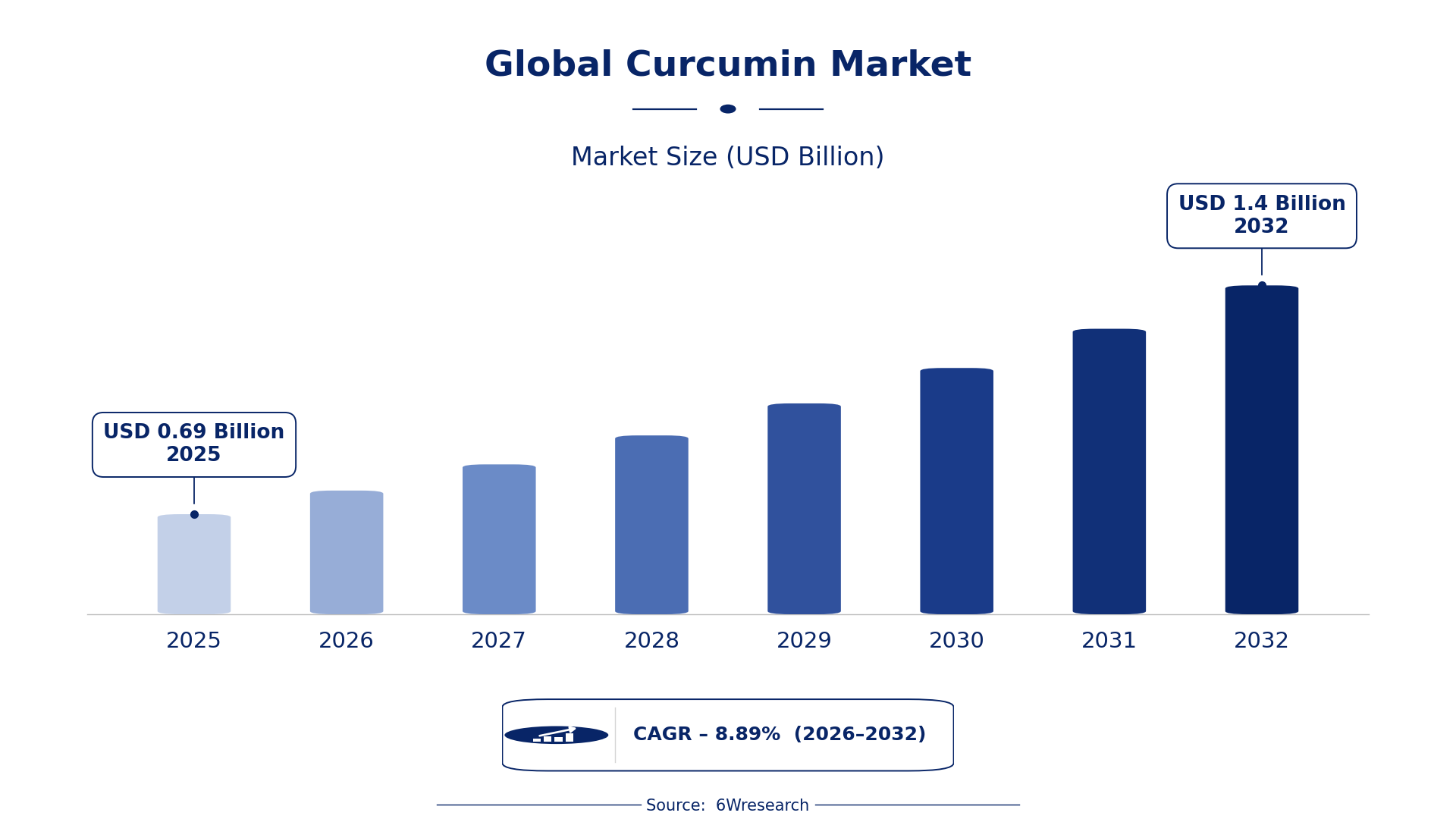
The Global Curcumin Market was estimated at USD 0.69 Billion in 2025 and is projected to reach USD 1.4 Billion by 2032, growing at a CAGR of 8.89% from 2026 to 2032.
Global Curcumin Market Synopsis
The Global Curcumin Market is undergoing a transformation, driven by a shift towards natural health products across diverse sectors. As consumer preferences increasingly align with organic and plant-based ingredients, the market witnesses substantial growth from various applications such as dietary supplements, food additives, and cosmetic products. This alignment is resulting in a robust manufacturing ecosystem focused on ensuring high purity and bioavailability of curcumin.
Key industrial players are investing in research and development to enhance the product offerings, thereby influencing market dynamics. Countries like India, being major producers of turmeric, play an essential role in the supply chain, leading to competitive advantages through lower transportation costs and established agricultural practices. Additionally, the rise of e-commerce channels is further facilitating product reach and consumer access, subsequently affecting market structure.
Global Curcumin Market Year-wise Growth Rate and Key Drivers
This graph illustrates the annual growth rates of the Global Curcumin Market from 2022 to 2032, highlighting a steady upward trajectory and projected expansion over the forecast period.
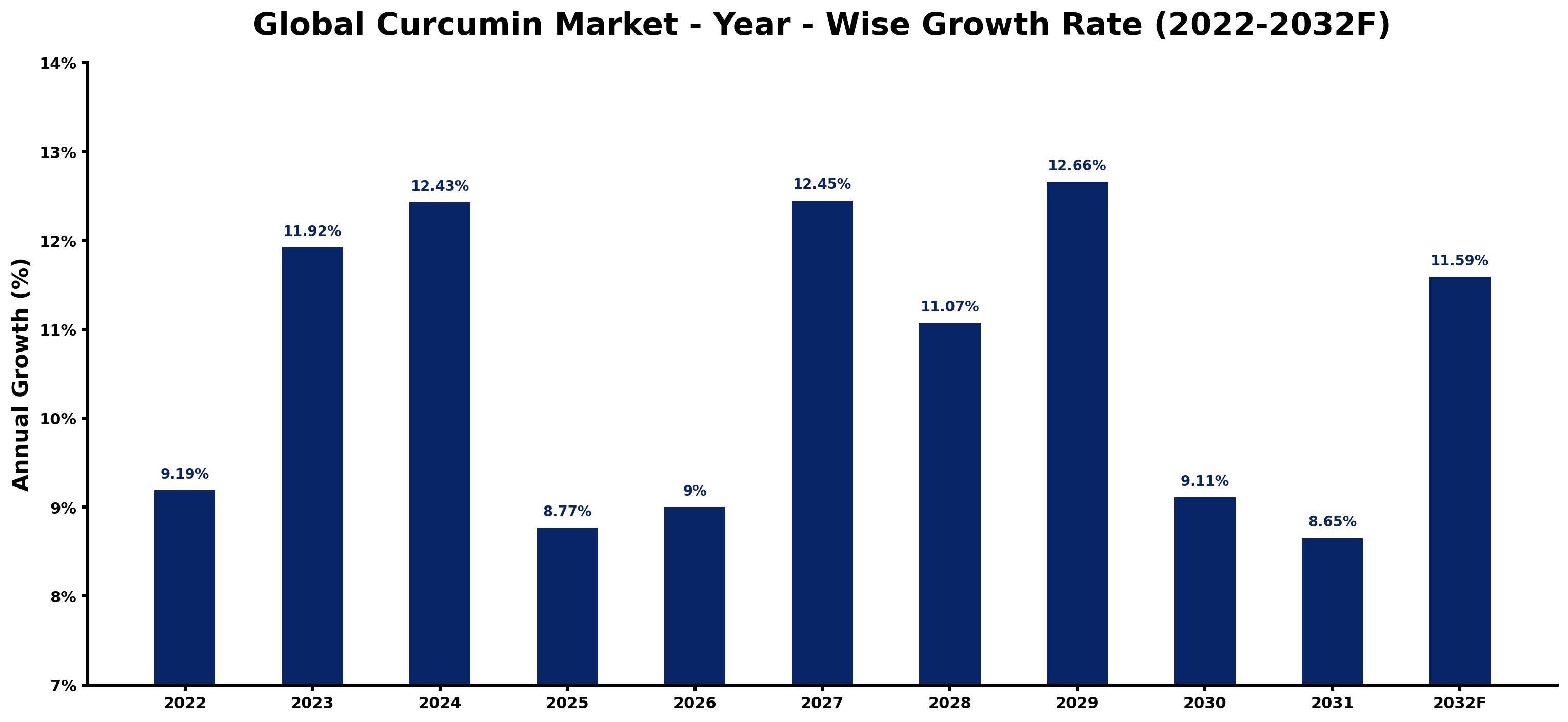
The table below presents the year‑wise growth rates along with the key drivers influencing the market
| Year | Growth Rate (%) | Major Drivers |
| 2022 | 9.19 | Implementing precision farming techniques enhances labor efficiency for curcumin cultivation. |
| 2023 | 11.92 | A shift toward higher raw material costs is reshaping curcumin pricing strategies. |
| 2024 | 12.43 | Optimizing supply chain traceability supports better curcumin distribution and reduces waste. |
| 2025 | 8.77 | Investment in soil health management technologies is driving the curcumin sector's growth. |
| 2026 | 9 | Farmers increasingly adopt irrigation infrastructure to enhance curcumin crop yields. |
| 2027 | 12.45 | As new regulatory policies emerge, curcumin producers adjust to compliance demands. |
| 2028 | 11.07 | Advancements in seed technology are stimulating improved curcumin product quality and yields. |
| 2029 | 12.66 | Farmers are increasingly focusing on sustainability practices to enhance curcumin cultivation. |
| 2030 | 9.11 | In North America, changing consumer preferences are influencing curcumin product development. |
| 2031 | 8.65 | Increasing market accessibility conditions are expanding the geographic reach of curcumin sales. |
| 2032 | 11.59 | AgriTech companies are prioritizing sustainable practices in curcumin production processes. |
Note - Market size estimations and growth projections presented in this report are based on 6Wresearch's proprietary research methodology, combining internal industry data, secondary research, and primary validation, updated periodically to reflect current market conditions. As markets evolve rapidly, figures for certain industries may vary slightly and are intended as informed estimates rather than absolute figures. For the most current market sizing, we recommend validating figures with a 6Wresearch analyst.
Global Curcumin Market Key Takeaways
Below are some of the specific key takeaways from the market, including:
- The pharmaceutical segment commands approximately ~45% market share in 2025, reflecting its importance in health-related applications.
- Asia-Pacific is the largest market, contributing about 60% of global production due to its robust turmeric agriculture, particularly in India.
- The cosmetics sector is projected to see a CAGR of 10.5% from 2026 to 2032, higher than the overall market growth.
- Arjuna Natural Extracts has been a pioneer in launching innovative curcumin formulations recently, illustrating the competitive landscape.
- Sustainability initiatives in production practices are increasingly prioritized by major stakeholders, addressing environmental concerns.
Evaluation of Restraints in Global Curcumin Market
The Global Curcumin Market faces notable restraints that hinder its full potential. Fluctuating raw material prices present significant challenges for manufacturers; for example, turmeric prices can vary between $2 to $4 per kilogram based on seasonality and crop yield variations. Additionally, there exists a saturation of lower-cost synthetic curcumin alternatives that appeal to price-sensitive consumers. Regulatory hurdles, particularly concerning purity standards enforced by FDA regulations, can further complicate market entry for new players, especially in nations with stringent food safety guidelines. The need for further consumer education remains vital, as many still underestimate the health benefits associated with high-quality curcumin products.
Global Curcumin Market Trends
The Global Curcumin Market is currently witnessing several pivotal trends that reflect changing operational frameworks. A significant shift is occurring towards innovative formulations aimed at enhancing the bioavailability of curcumin, addressing inherent absorption challenges. For instance, Sabinsa Corporation recently introduced a patented Microencapsulation technology in 2023 to augment curcumin's effectiveness in dietary supplements, thus enhancing its market appeal.
Furthermore, a burgeoning demand for clean-label products is steering companies towards transparency in sourcing and ingredient lists, which is becoming a competitive differentiator. Industry players are actively pursuing partnerships to bolster research efforts; for example, Synthite Industries formed a collaboration in 2022 with a leading university to explore the health benefits of curcumin in chronic disease management. Lastly, e-commerce platforms are increasingly being leveraged for marketing curcumin-based products, facilitating broader consumer outreach and driving growth.
Global Curcumin Market Opportunities
The future landscape of the Global Curcumin Market offers promising revenue opportunities that companies are keen to harness. The rise of personalized nutrition is unlocking new avenues for curcumin-based products tailored to specific health concerns, like inflammation and joint health. For example, a new startup, NutraCurcumin, launched in 2023 features customized supplement blends that incorporate high-potency curcumin to address these needs more effectively.
Moreover, the cosmetics industry is expanding significantly, particularly in clean beauty segments where natural ingredients are preferred. With a projected worth of about $55 billion by 2027, companies dominating this space can leverage curcumin for its dermatological benefits. There is ample room for investment in R&D to create personalized skin care solutions, amplifying product offerings and enhancing competitive edge within the industry.
Global Curcumin Market by Application
The analysis of the Global Curcumin Market by application indicates that the pharmaceutical segment holds the largest market share, approximately ~45% share in 2025. This dominance is due to the widespread recognition of curcumin's anti-inflammatory and antioxidant properties, making it a staple in the health supplement and pharmaceutical sectors. On the other hand, the cosmetics segment is projected to be the fastest-growing, with a CAGR of 10.5% from 2026 to 2032, driven by increasing consumer preference for natural and organic beauty products. Brands are prioritizing curcumin for its complexion-enhancing properties, positioning it as an essential ingredient in skin care formulations.
Global Curcumin Market by Region
Regionally, the Asia-Pacific area stands out as the largest market for curcumin, accounting for approximately ~60% share in 2025 due to its robust agricultural framework and extensive turmeric cultivation in countries like India. Conversely, North America is on track to be the fastest-growing region, with a projected CAGR of 9.2% from 2026 to 2032. This growth can be attributed to rising consumer awareness about the health benefits of natural ingredients and increasing demand from dietary supplements and food sectors in the United States. The region's strong regulatory framework also ensures product safety, further promoting consumer trust and driving market dynamics.
Government Initiatives in the Global Curcumin Market
Government initiatives play a critical role in shaping the regulatory landscape and fostering growth in the Global Curcumin Market. Recent policies aimed at enhancing agricultural practices and promoting research into natural ingredients have the potential to significantly impact production and market access.
- Ministry of Agriculture, India – "National Mission on Agri-Tech Startups" – Launched in 2022. This initiative seeks to support agro-tech innovations, benefiting curcumin producers through enhanced farming techniques and access to modern technology.
- Food and Drug Administration (FDA), USA – "New Dietary Ingredient Notification" (NDIN) Guidelines – Updated in 2021. These modifications streamline regulatory processes for curcumin-based products, making it easier for companies to bring safe and efficacious supplements to the market.
- European Commission – "Green Deal for Nutraceuticals" – Proposed in 2023. This initiative is designed to promote the use of plant-based ingredients in nutraceuticals, directly supporting the inclusion of curcumin in health products across Europe.
- Council of Scientific & Industrial Research (CSIR), India – "Integrated Research Program for Turmeric and Curcumin" – Initiated in 2020. This program aims to bridge research gaps and improve extraction techniques, ultimately boosting curcumin quality and availability.
Future Insights of the Global Curcumin Market
The Global Curcumin Market is anticipated to witness transformative shifts through 2032, fueled by advancements in extraction technologies and a surge in clinical research backing curcumin's health benefits. For instance, Arjuna Natural Extracts is investing in biotech enhancements to extract curcumin more efficiently, aiming to increase purity levels while reducing costs. This strategic move could enable companies to offer high-quality products accessible to a broader consumer base, reinforcing curcumin's position in dietary supplements and integrated health solutions.
Global Curcumin Market Latest Developments
Several notable developments are shaping the Global Curcumin Market, reflecting ongoing efforts to enhance product offerings and leverage technology for competitive advantage.
- In mid-2023, Sabinsa Corporation unveiled a new range of curcumin formulations specifically designed for immune health, indicating a strategic focus on tapping into growing consumer interest in wellness.
- Recently, Synthite Industries completed the expansion of its manufacturing facility to enhance curcumin production capacity, aiming to meet increased demand across both food and pharmaceutical sectors.
- In late 2022, Arjuna Natural Extracts collaborated with a leading European health institute to research curcumin's efficacy against chronic inflammation, potentially elevating its standing in therapeutic markets.
- Kerry Group is working on an innovative encapsulation technology for curcumin as of early 2023, which could significantly improve the bioavailability of this potent ingredient in various applications.
Global Curcumin Market Key Players and Industry Positioning
The Global Curcumin Market currently exhibits a fragmented competitive structure, characterized by both established players and agile startups. Larger companies leverage their supply chain efficiencies and extensive R&D capabilities, while smaller firms focus on specialized product offerings and niche segments to carve out competitive space.
| Leading Company | Core Strength | Strategic Focus |
|---|---|---|
| Arjuna Natural Extracts | Expertise in innovative formulations and extraction | Expanding R&D for therapeutic applications |
| Sabinsa Corporation | Strong global distribution network | Focusing on immune health and natural compounds |
| Synthite Industries | Vertical integration in production processes | Enhancing manufacturing capacity for scaled production |
| Kerry Group | Extensive expertise in food and beverage sectors | Developing innovative applications in food products |
| Indena S.p.A. | Focus on botanical extraction and quality control | Pursuing collaborations for product advancement in supplements |
As industry trends continue to evolve, competition is expected to intensify, particularly in developing effective formulations and sustainable practices, setting the stage for dynamic market interactions.
Key Attractiveness of the Report
- 10 Years of Market Numbers
- Historical Data Starting from 2022 to 2025
- Base Year: 2025
- Forecast Data until 2032
- Key Performance Indicators Impacting the Market
- Major Upcoming Developments and Projects
Key Highlights of the Report:
- Global Curcumin Market Outlook
- Market Size of Global Curcumin Market, 2025
- Forecast of Global Curcumin Market, 2032
- Historical Data and Forecast of Global Curcumin Revenues & Volume for the Period 2022-2032
- Global Curcumin Market Trend Evolution
- Global Curcumin Market Drivers and Challenges
- Global Curcumin Price Trends
- Global Curcumin Porter's Five Forces
- Global Curcumin Industry Life Cycle
- Historical Data and Forecast of Global Curcumin Market Revenues & Volume
- Historical Data and Forecast of Global Curcumin Market Revenues & Volume By Application for the Period 2022-2032
- Historical Data and Forecast of Global Curcumin Market Revenues & Volume By Pharmaceutical for the Period 2022-2032
- Historical Data and Forecast of Global Curcumin Market Revenues & Volume By Food for the Period 2022-2032
- Historical Data and Forecast of Global Curcumin Market Revenues & Volume By Cosmetics for the Period 2022-2032
- Historical Data and Forecast of North America Curcumin Market Revenues & Volume By Application for the Period 2022-2032
- Historical Data and Forecast of North America Curcumin Market Revenues & Volume By Pharmaceutical for the Period 2022-2032
- Historical Data and Forecast of North America Curcumin Market Revenues & Volume By Food for the Period 2022-2032
- Historical Data and Forecast of North America Curcumin Market Revenues & Volume By Cosmetics for the Period 2022-2032
- Historical Data and Forecast of United States of America Curcumin Market Revenues & Volume for the Period 2022-2032
- Historical Data and Forecast of Canada Curcumin Market Revenues & Volume for the Period 2022-2032
- Historical Data and Forecast of Rest of North America Curcumin Market Revenues & Volume for the Period 2022-2032
- Historical Data and Forecast of Latin America (LATAM) Curcumin Market Revenues & Volume By Application for the Period 2022-2032
- Historical Data and Forecast of Latin America (LATAM) Curcumin Market Revenues & Volume By Pharmaceutical for the Period 2022-2032
- Historical Data and Forecast of Latin America (LATAM) Curcumin Market Revenues & Volume By Food for the Period 2022-2032
- Historical Data and Forecast of Latin America (LATAM) Curcumin Market Revenues & Volume By Cosmetics for the Period 2022-2032
- Historical Data and Forecast of Brazil Curcumin Market Revenues & Volume for the Period 2022-2032
- Historical Data and Forecast of Mexico Curcumin Market Revenues & Volume for the Period 2022-2032
- Historical Data and Forecast of Argentina Curcumin Market Revenues & Volume for the Period 2022-2032
- Historical Data and Forecast of Rest of LATAM Curcumin Market Revenues & Volume for the Period 2022-2032
- Historical Data and Forecast of Asia Curcumin Market Revenues & Volume By Application for the Period 2022-2032
- Historical Data and Forecast of Asia Curcumin Market Revenues & Volume By Pharmaceutical for the Period 2022-2032
- Historical Data and Forecast of Asia Curcumin Market Revenues & Volume By Food for the Period 2022-2032
- Historical Data and Forecast of Asia Curcumin Market Revenues & Volume By Cosmetics for the Period 2022-2032
- Historical Data and Forecast of China Curcumin Market Revenues & Volume for the Period 2022-2032
- Historical Data and Forecast of India Curcumin Market Revenues & Volume for the Period 2022-2032
- Historical Data and Forecast of Japan Curcumin Market Revenues & Volume for the Period 2022-2032
- Historical Data and Forecast of Rest of Asia Curcumin Market Revenues & Volume for the Period 2022-2032
- Historical Data and Forecast of Africa Curcumin Market Revenues & Volume By Application for the Period 2022-2032
- Historical Data and Forecast of Africa Curcumin Market Revenues & Volume By Pharmaceutical for the Period 2022-2032
- Historical Data and Forecast of Africa Curcumin Market Revenues & Volume By Food for the Period 2022-2032
- Historical Data and Forecast of Africa Curcumin Market Revenues & Volume By Cosmetics for the Period 2022-2032
- Historical Data and Forecast of South Africa Curcumin Market Revenues & Volume for the Period 2022-2032
- Historical Data and Forecast of Nigeria Curcumin Market Revenues & Volume for the Period 2022-2032
- Historical Data and Forecast of Egypt Curcumin Market Revenues & Volume for the Period 2022-2032
- Historical Data and Forecast of Rest of Africa Curcumin Market Revenues & Volume for the Period 2022-2032
- Historical Data and Forecast of Europe Curcumin Market Revenues & Volume By Application for the Period 2022-2032
- Historical Data and Forecast of Europe Curcumin Market Revenues & Volume By Pharmaceutical for the Period 2022-2032
- Historical Data and Forecast of Europe Curcumin Market Revenues & Volume By Food for the Period 2022-2032
- Historical Data and Forecast of Europe Curcumin Market Revenues & Volume By Cosmetics for the Period 2022-2032
- Historical Data and Forecast of United Kingdom Curcumin Market Revenues & Volume for the Period 2022-2032
- Historical Data and Forecast of France Curcumin Market Revenues & Volume for the Period 2022-2032
- Historical Data and Forecast of Germany Curcumin Market Revenues & Volume for the Period 2022-2032
- Historical Data and Forecast of Rest of Europe Curcumin Market Revenues & Volume for the Period 2022-2032
- Historical Data and Forecast of Middle East Curcumin Market Revenues & Volume By Application for the Period 2022-2032
- Historical Data and Forecast of Middle East Curcumin Market Revenues & Volume By Pharmaceutical for the Period 2022-2032
- Historical Data and Forecast of Middle East Curcumin Market Revenues & Volume By Food for the Period 2022-2032
- Historical Data and Forecast of Middle East Curcumin Market Revenues & Volume By Cosmetics for the Period 2022-2032
- Historical Data and Forecast of Saudi Arabia Curcumin Market Revenues & Volume for the Period 2022-2032
- Historical Data and Forecast of UAE Curcumin Market Revenues & Volume for the Period 2022-2032
- Historical Data and Forecast of Turkey Curcumin Market Revenues & Volume for the Period 2022-2032
- Historical Data and Forecast of Rest of Middle East Curcumin Market Revenues & Volume for the Period 2022-2032
- Global Curcumin Market - Key Performance Indicators
- Global Curcumin Market - Import Export Trade Statistics
- Global Curcumin Market - Opportunity Assessment By Countries
- Global Curcumin Market - Opportunity Assessment By Application
- 0
- Global Curcumin Market - Top Companies Market Share
- Global Curcumin Market - Top Companies Profiles
- Global Curcumin Market - Comparison of Players in Technical and Operating Parameters
- Global Curcumin Market - Strategic Recommendations
Markets Covered
The Global Curcumin Market report provides a detailed analysis of the following market segments:
By Regions and Countries:
- North America
- Europe
- LATAM
- Middle East
- Asia
- Africa
By Application:
- Pharmaceutical
- Food
- Cosmetics






































