Global Database Market Highlights
| Market Size (2025) | USD 40 Billion |
| Forecast Size (2032) | USD 95 Billion |
| CAGR | 8.60% |
| Base Year | 2025 |
| Forecast Period | 2026-2032 |
| Largest Region | North America |
| Fastest Growing Region | Asia |
| Largest Segment | Operational |
| Fastest Growing Segment | Analytical |
| Leading Companies | Oracle, Microsoft, IBM, Amazon Web Services, Google |
Global Database Market Size & Growth Rate (2026-2032)
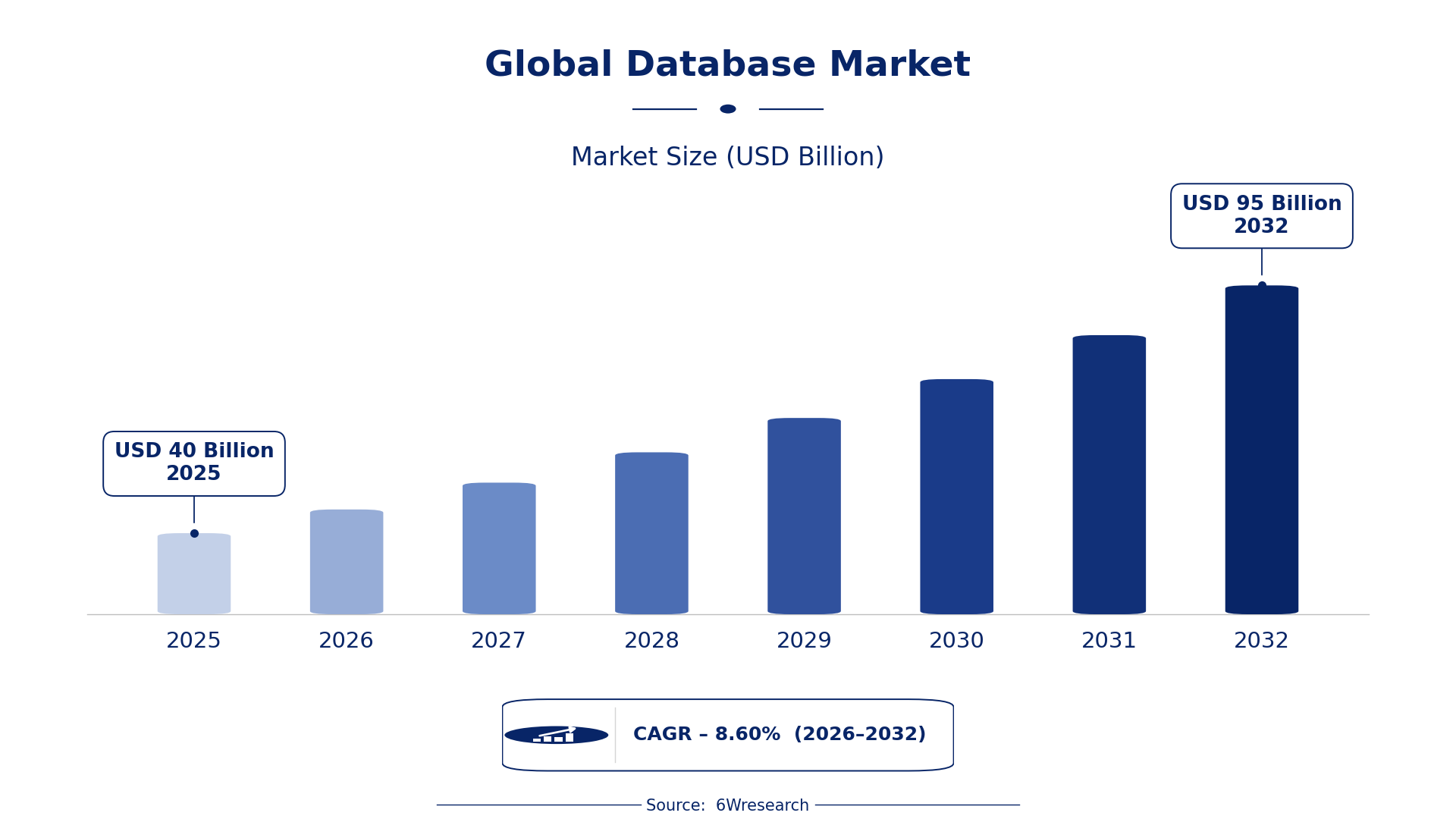
The Global Database Market was estimated at USD 40 Billion in 2025 and is projected to reach USD 95 Billion by 2032, growing at a CAGR of 8.60% from 2026 to 2032.
Global Database Market Synopsis
The dynamics of the Global Database Market are fundamentally transforming as organizations increasingly shift towards cloud-based solutions for data management. This inclination is not merely market-driven but largely necessitated by the emerging need for real-time data analytics and accessibility, which traditional databases struggle to offer. Companies are prioritizing data-centric strategies, compelling vendors to innovate and adapt their offerings to meet evolving requirements.
As businesses accumulate vast amounts of data from varied sources, the demand for sophisticated database solutions capable of managing both structured and unstructured data has surged. This is particularly evident in sectors like healthcare and finance, where decision-making accuracy is paramount. The differentiation of the Global Database Market lies in its ability to evolve alongside technological advancements and regulatory changes, setting it apart from adjacent data management sectors.
Global Database Market Year-wise Growth Rate and Key Drivers
This graph illustrates the annual growth rates of the Global Database Market from 2022 to 2032, highlighting a steady upward trajectory and projected expansion over the forecast period.
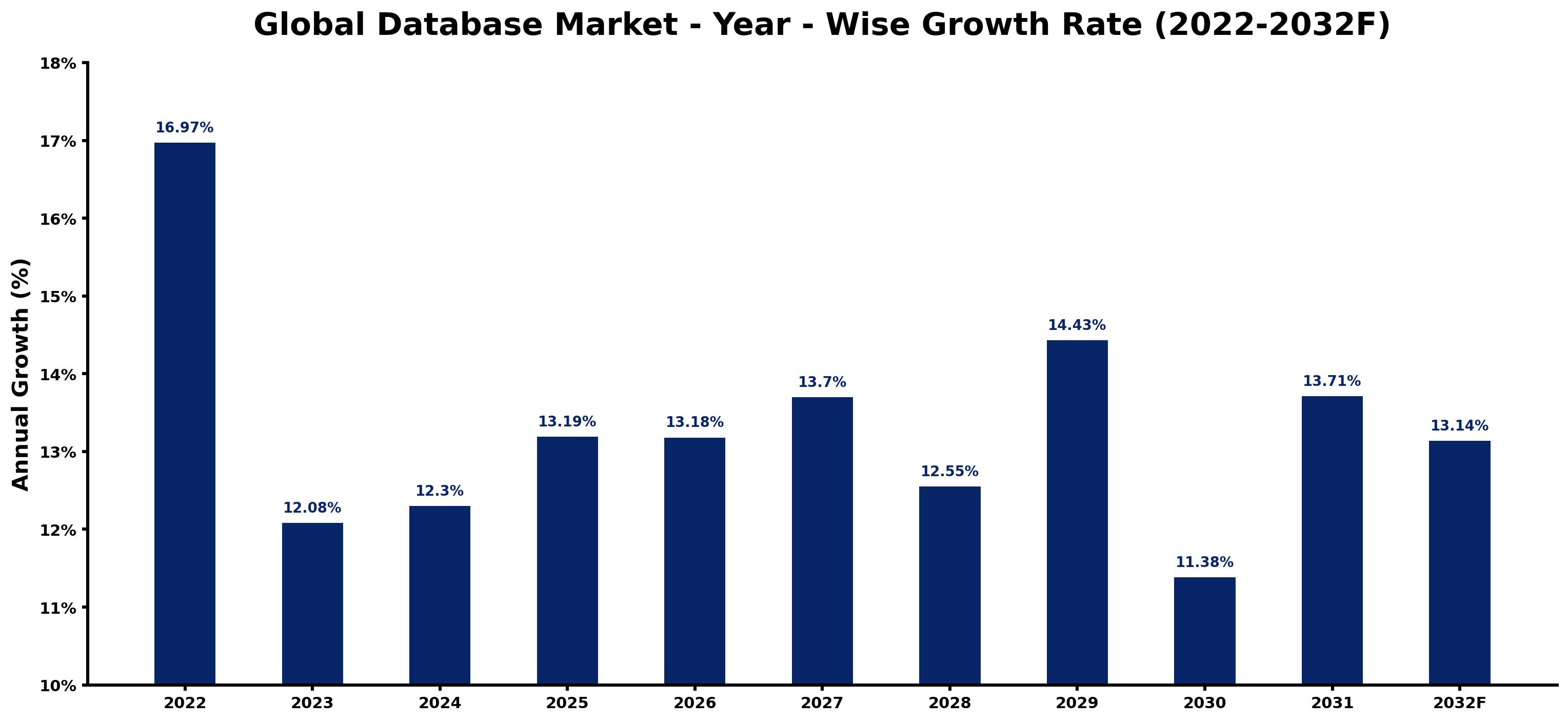
The table below presents the year‑wise growth rates along with the key drivers influencing the market
| Year | Growth Rate (%) | Major Drivers |
| 2022 | 16.97 | Telecom infrastructure investments are advancing the capabilities of the global database market. |
| 2023 | 12.08 | Businesses are enhancing their supply chain management through improved database solutions. |
| 2024 | 12.3 | Expanding cloud migration strategies enables broader access to database technologies. |
| 2025 | 13.19 | Hyperscale computing technologies are reducing costs and accelerating database deployment. |
| 2026 | 13.18 | Increased merger and acquisition activity is reshaping the competitive dynamics of the database sector. |
| 2027 | 13.7 | A growing emphasis on data science skills enhances workforce capabilities for database management. |
| 2028 | 12.55 | Tech companies are increasingly adopting advanced database solutions to improve operational efficiency. |
| 2029 | 14.43 | While North America leads, emerging markets are driving significant global database expansion. |
| 2030 | 11.38 | In the Asia-Pacific region, changing consumer behavior is influencing database usage patterns. |
| 2031 | 13.71 | Sustainable practices in data centers are transforming the approach to database resource management. |
| 2032 | 13.14 | A shift toward stricter data privacy regulations changes compliance requirements for database providers. |
Note - Market size estimations and growth projections presented in this report are based on 6Wresearch's proprietary research methodology, combining internal industry data, secondary research, and primary validation, updated periodically to reflect current market conditions. As markets evolve rapidly, figures for certain industries may vary slightly and are intended as informed estimates rather than absolute figures. For the most current market sizing, we recommend validating figures with a 6Wresearch analyst.
Global Database Market Key Takeaways
Below are some of the specific key takeaways from the market, including:
- North America holds approximately 48% share in 2025, driven by a high concentration of advanced technology firms.
- Oracle maintains a significant market presence, with revenue exceeding $40 billion in 2021 from its cloud services.
- The cloud deployment segment is projected to experience a CAGR of 9.5% from 2026 to 2032, outperforming other deployment models.
- The analytical segment is set to register robust growth, with a CAGR of 9.1%, as businesses increasingly leverage predictive analytics for decision-making.
- Data privacy regulations, including GDPR, are influencing database management practices significantly, driving the need for compliant solutions.
Evaluation of Restraints in Global Database Market
The Global Database Market faces substantial challenges primarily related to data privacy and compliance. Regulations such as the GDPR impose strict penalties for non-compliance, which can reach up to €20 million or 4% of a company's global turnover, whichever is higher. For example, database providers must invest heavily in compliance measures, increasing operational costs and necessitating constant updates to their systems to align with shifting regulatory requirements. Additionally, the escalating complexity and volume of data captured from numerous sources present an ongoing challenge, demanding innovative adaptation from market players.
Global Database Market Trends
Several key trends are shaping the Global Database Market. Firstly, the integration of artificial intelligence within database management solutions is becoming increasingly critical. Companies like Microsoft are focusing on implementing AI-driven analytics features that enhance data retrieval and analysis, allowing organizations to derive actionable insights rapidly. In 2022, the company reported achieving a 25% increase in efficiency through AI enhancements in its database platforms.
Secondly, the trend toward “Database as a Service” (DBaaS) is gaining traction, driven largely by the demand for scalable, cost-effective solutions. Providers such as Amazon Web Services have successfully positioned themselves in this space, illustrating a shift towards usage-based models. As organizations increasingly prioritize flexibility, we can expect DBaaS offerings to represent a larger share of the market in coming years.
Global Database Market Opportunities
The Global Database Market presents several lucrative opportunities for growth. A notable area includes the healthcare sector, where data management solutions can streamline patient records and enhance data security. For instance, IBM has launched Watson Health, aimed at providing optimized data handling capabilities for healthcare providers, a market projected to reach USD 24 billion by 2025. This segmentation presents a ripe opportunity for database service providers that can deliver tailored solutions.
Moreover, the ongoing digital transformation across industries provides fertile ground for innovative database solutions. The increasing emphasis on cybersecurity also represents a growing revenue avenue; companies focusing on secure database offerings can expect significant profitability. Notably, investing in blockchain technology for data integrity verification can discern providers in this competitive marketplace.
Global Database Market by Type
The Global Database Market is notably segmented into Operational and Analytical databases. The Operational type leads the market, holding nearly 62% share in 2025. This is primarily due to the essential role operational databases play in daily business functions and transaction processing. Conversely, the Analytical segment is expected to experience a robust growth trajectory with a CAGR of 10.5% from 2026 to 2032, as demand for advanced analytics capabilities rises across various sectors, particularly in finance and retail, where data-driven decision-making is critical.
Global Database Market by Deployment
In terms of deployment, the Global Database Market is categorized into On-Premises and Cloud solutions. The Cloud deployment segment is set to emerge as the largest, capturing approximately 55% share in 2025, as organizations increasingly migrate to cloud-based models for heightened scalability and cost efficiency. Moreover, the Cloud segment is projected to grow at a CAGR of 9.8% from 2026 to 2032, driven by the escalating need for real-time access to data and flexible infrastructure that supports remote operations across numerous industries.
Global Database Market by End User
The Global Database Market comprises various end users, with IT leading this segment, accounting for around 45% share in 2025. The industry's reliance on databases for application development, system operations, and customer data management solidifies its dominant position. On the other hand, the healthcare segment is anticipated to be the fastest-growing, showcasing a CAGR of 10.2% from 2026 to 2032. This acceleration stems from the urgent need for effective data management systems capable of improving patient care and operational efficiency within healthcare institutions.
Global Database Market by Organization
The Global Database Market can be segmented by organization size into Small and Medium Enterprises (SMEs) and Large Enterprises. Large Enterprises currently lead, possessing approximately 70% share in 2025, largely due to their extensive data management needs and higher capital allocation to advanced database technologies. However, the SME segment is set to grow at a CAGR of 9.2% from 2026 to 2032, as increasing numbers of small businesses recognize the importance of data-driven strategies and invest in affordable, scalable database solutions to enhance their operations.
Global Database Market by Region
The Global Database Market is geographically diverse, with North America leading, holding a significant share of around 48% in 2025. This dominance stems from the concentration of major technology firms and substantial investments in data infrastructure within the region. Meanwhile, the Asia region is emerging as the fastest-growing, projected to register a CAGR of 10.3% from 2026 to 2032, owing to rapid digitalization initiatives and increasing functionalities of databases in various sectors, including e-commerce and finance, catalyzed by government reforms and investments in IT infrastructure.
Government Initiatives in the Global Database Market
The regulatory environment surrounding the Global Database Market is marked by various government initiatives aimed at fostering innovation and compliance. These efforts are crucial for enabling organizations to navigate the complexities of data management while ensuring data privacy and security.
- The General Data Protection Regulation (GDPR), enforced by the European Union, was implemented in May 2018 to protect data privacy and increase user control over personal data.
- The U.S. Federal Trade Commission, under the Privacy Shield Framework, works to regulate data transfer between the US and EU, continuously updating guidelines since its establishment in July 2016.
- The Digital Personal Data Protection Bill, proposed by the Government of India in November 2021, aims to establish a comprehensive legal framework for data protection and privacy in the country.
- The United Nations, through the International Telecommunication Union (ITU), launched a project in 2020 focused on data interoperability standards to facilitate better data management practices across member states.
Future Insights of the Global Database Market
The trajectory of the Global Database Market is likely to be shaped by transformative shifts towards automated data management systems and increased reliance on artificial intelligence for analytics. For instance, IBM's focus on integrating AI-driven functionalities into its existing database offerings is expected to refine operational efficiencies within enterprises, paving the way for more responsive data handling. As organizations evolve their data architectures, investment in secure yet flexible database solutions will become a critical priority, particularly in regulated industries like healthcare, underscoring a heightened emphasis on compliance and adaptability.
Global Database Market Latest Developments
Recently, several key players have made significant advancements that highlight their strategic intent and market positioning.
- In March 2023, Microsoft launched Azure SQL Database serverless, enhancing scalability and cost-effectiveness for businesses by allowing automatic scaling and pausing during inactivity, reflecting market responsiveness to user demands.
- In April 2023, Amazon Web Services expanded its database services in Asia by introducing a new data center in Singapore, solidifying its competitive edge in a rapidly growing region.
- IBM announced its intention to invest heavily in quantum computing technology for databases in June 2023, aiming to pioneer new capabilities that could revolutionize data processing speeds.
- Oracle recently unveiled advanced security features in its cloud database offerings in February 2023, addressing growing concerns over data privacy and compliance in an increasingly regulated environment.
Global Database Market Key Players and Industry Positioning
The competitive landscape of the Global Database Market remains largely consolidated, with a few key players dominating the space and offering diverse product portfolios. Each leader leverages unique strengths, allowing them to maintain a competitive edge in various segments.
| Leading Company | Core Strength | Strategic Focus |
|---|---|---|
| Oracle | High-performance relational database management. | Enhancing cloud capabilities and security. |
| Microsoft | Integrated cloud and on-premises functionalities. | AI and machine learning integration in data solutions. |
| IBM | Strong focus on enterprise-level database architecture. | Investing in AI and quantum computing technology. |
| Amazon Web Services | Extensive infrastructure for scalable database solutions. | Expanding global data center footprint and DBaaS offerings. |
| Innovative cloud-based database services. | Focusing on big data analytics and machine learning. |
As the market evolves, these key players are likely to deepen their technology investments and partnerships, accelerating the adoption of specialized database solutions tailored to industry-specific needs.
Key Attractiveness of the Report
- 10 Years of Market Numbers
- Historical Data Starting from 2022 to 2025
- Base Year: 2025
- Forecast Data until 2032
- Key Performance Indicators Impacting the Market
- Major Upcoming Developments and Projects
Key Highlights of the Report:
- Global Database Market Outlook
- Market Size of Global Database Market, 2025
- Forecast of Global Database Market, 2032
- Historical Data and Forecast of Global Database Revenues & Volume for the Period 2022-2032
- Global Database Market Trend Evolution
- Global Database Market Drivers and Challenges
- Global Database Price Trends
- Global Database Porter's Five Forces
- Global Database Industry Life Cycle
- Historical Data and Forecast of Global Database Market Revenues & Volume
- Historical Data and Forecast of Global Database Market Revenues & Volume By Type for the Period 2022-2032
- Historical Data and Forecast of Global Database Market Revenues & Volume By Operational for the Period 2022-2032
- Historical Data and Forecast of Global Database Market Revenues & Volume By Analytical for the Period 2022-2032
- Historical Data and Forecast of Global Database Market Revenues & Volume By Deployment for the Period 2022-2032
- Historical Data and Forecast of Global Database Market Revenues & Volume By On-Premises for the Period 2022-2032
- Historical Data and Forecast of Global Database Market Revenues & Volume By Cloud for the Period 2022-2032
- Historical Data and Forecast of Global Database Market Revenues & Volume By End User for the Period 2022-2032
- Historical Data and Forecast of Global Database Market Revenues & Volume By IT for the Period 2022-2032
- Historical Data and Forecast of Global Database Market Revenues & Volume By Healthcare for the Period 2022-2032
- Historical Data and Forecast of Global Database Market Revenues & Volume By Manufacturing for the Period 2022-2032
- Historical Data and Forecast of Global Database Market Revenues & Volume By Organization for the Period 2022-2032
- Historical Data and Forecast of Global Database Market Revenues & Volume By SME for the Period 2022-2032
- Historical Data and Forecast of Global Database Market Revenues & Volume By Large Enterprise for the Period 2022-2032
- Historical Data and Forecast of North America Database Market Revenues & Volume By Type for the Period 2022-2032
- Historical Data and Forecast of North America Database Market Revenues & Volume By Operational for the Period 2022-2032
- Historical Data and Forecast of North America Database Market Revenues & Volume By Analytical for the Period 2022-2032
- Historical Data and Forecast of North America Database Market Revenues & Volume By Deployment for the Period 2022-2032
- Historical Data and Forecast of North America Database Market Revenues & Volume By On-Premises for the Period 2022-2032
- Historical Data and Forecast of North America Database Market Revenues & Volume By Cloud for the Period 2022-2032
- Historical Data and Forecast of North America Database Market Revenues & Volume By End User for the Period 2022-2032
- Historical Data and Forecast of North America Database Market Revenues & Volume By IT for the Period 2022-2032
- Historical Data and Forecast of North America Database Market Revenues & Volume By Healthcare for the Period 2022-2032
- Historical Data and Forecast of North America Database Market Revenues & Volume By Manufacturing for the Period 2022-2032
- Historical Data and Forecast of North America Database Market Revenues & Volume By Organization for the Period 2022-2032
- Historical Data and Forecast of North America Database Market Revenues & Volume By SME for the Period 2022-2032
- Historical Data and Forecast of North America Database Market Revenues & Volume By Large Enterprise for the Period 2022-2032
- Historical Data and Forecast of United States of America Database Market Revenues & Volume for the Period 2022-2032
- Historical Data and Forecast of Canada Database Market Revenues & Volume for the Period 2022-2032
- Historical Data and Forecast of Rest of North America Database Market Revenues & Volume for the Period 2022-2032
- Historical Data and Forecast of Latin America (LATAM) Database Market Revenues & Volume By Type for the Period 2022-2032
- Historical Data and Forecast of Latin America (LATAM) Database Market Revenues & Volume By Operational for the Period 2022-2032
- Historical Data and Forecast of Latin America (LATAM) Database Market Revenues & Volume By Analytical for the Period 2022-2032
- Historical Data and Forecast of Latin America (LATAM) Database Market Revenues & Volume By Deployment for the Period 2022-2032
- Historical Data and Forecast of Latin America (LATAM) Database Market Revenues & Volume By On-Premises for the Period 2022-2032
- Historical Data and Forecast of Latin America (LATAM) Database Market Revenues & Volume By Cloud for the Period 2022-2032
- Historical Data and Forecast of Latin America (LATAM) Database Market Revenues & Volume By End User for the Period 2022-2032
- Historical Data and Forecast of Latin America (LATAM) Database Market Revenues & Volume By IT for the Period 2022-2032
- Historical Data and Forecast of Latin America (LATAM) Database Market Revenues & Volume By Healthcare for the Period 2022-2032
- Historical Data and Forecast of Latin America (LATAM) Database Market Revenues & Volume By Manufacturing for the Period 2022-2032
- Historical Data and Forecast of Latin America (LATAM) Database Market Revenues & Volume By Organization for the Period 2022-2032
- Historical Data and Forecast of Latin America (LATAM) Database Market Revenues & Volume By SME for the Period 2022-2032
- Historical Data and Forecast of Latin America (LATAM) Database Market Revenues & Volume By Large Enterprise for the Period 2022-2032
- Historical Data and Forecast of Brazil Database Market Revenues & Volume for the Period 2022-2032
- Historical Data and Forecast of Mexico Database Market Revenues & Volume for the Period 2022-2032
- Historical Data and Forecast of Argentina Database Market Revenues & Volume for the Period 2022-2032
- Historical Data and Forecast of Rest of LATAM Database Market Revenues & Volume for the Period 2022-2032
- Historical Data and Forecast of Asia Database Market Revenues & Volume By Type for the Period 2022-2032
- Historical Data and Forecast of Asia Database Market Revenues & Volume By Operational for the Period 2022-2032
- Historical Data and Forecast of Asia Database Market Revenues & Volume By Analytical for the Period 2022-2032
- Historical Data and Forecast of Asia Database Market Revenues & Volume By Deployment for the Period 2022-2032
- Historical Data and Forecast of Asia Database Market Revenues & Volume By On-Premises for the Period 2022-2032
- Historical Data and Forecast of Asia Database Market Revenues & Volume By Cloud for the Period 2022-2032
- Historical Data and Forecast of Asia Database Market Revenues & Volume By End User for the Period 2022-2032
- Historical Data and Forecast of Asia Database Market Revenues & Volume By IT for the Period 2022-2032
- Historical Data and Forecast of Asia Database Market Revenues & Volume By Healthcare for the Period 2022-2032
- Historical Data and Forecast of Asia Database Market Revenues & Volume By Manufacturing for the Period 2022-2032
- Historical Data and Forecast of Asia Database Market Revenues & Volume By Organization for the Period 2022-2032
- Historical Data and Forecast of Asia Database Market Revenues & Volume By SME for the Period 2022-2032
- Historical Data and Forecast of Asia Database Market Revenues & Volume By Large Enterprise for the Period 2022-2032
- Historical Data and Forecast of China Database Market Revenues & Volume for the Period 2022-2032
- Historical Data and Forecast of India Database Market Revenues & Volume for the Period 2022-2032
- Historical Data and Forecast of Japan Database Market Revenues & Volume for the Period 2022-2032
- Historical Data and Forecast of Rest of Asia Database Market Revenues & Volume for the Period 2022-2032
- Historical Data and Forecast of Africa Database Market Revenues & Volume By Type for the Period 2022-2032
- Historical Data and Forecast of Africa Database Market Revenues & Volume By Operational for the Period 2022-2032
- Historical Data and Forecast of Africa Database Market Revenues & Volume By Analytical for the Period 2022-2032
- Historical Data and Forecast of Africa Database Market Revenues & Volume By Deployment for the Period 2022-2032
- Historical Data and Forecast of Africa Database Market Revenues & Volume By On-Premises for the Period 2022-2032
- Historical Data and Forecast of Africa Database Market Revenues & Volume By Cloud for the Period 2022-2032
- Historical Data and Forecast of Africa Database Market Revenues & Volume By End User for the Period 2022-2032
- Historical Data and Forecast of Africa Database Market Revenues & Volume By IT for the Period 2022-2032
- Historical Data and Forecast of Africa Database Market Revenues & Volume By Healthcare for the Period 2022-2032
- Historical Data and Forecast of Africa Database Market Revenues & Volume By Manufacturing for the Period 2022-2032
- Historical Data and Forecast of Africa Database Market Revenues & Volume By Organization for the Period 2022-2032
- Historical Data and Forecast of Africa Database Market Revenues & Volume By SME for the Period 2022-2032
- Historical Data and Forecast of Africa Database Market Revenues & Volume By Large Enterprise for the Period 2022-2032
- Historical Data and Forecast of South Africa Database Market Revenues & Volume for the Period 2022-2032
- Historical Data and Forecast of Nigeria Database Market Revenues & Volume for the Period 2022-2032
- Historical Data and Forecast of Egypt Database Market Revenues & Volume for the Period 2022-2032
- Historical Data and Forecast of Rest of Africa Database Market Revenues & Volume for the Period 2022-2032
- Historical Data and Forecast of Europe Database Market Revenues & Volume By Type for the Period 2022-2032
- Historical Data and Forecast of Europe Database Market Revenues & Volume By Operational for the Period 2022-2032
- Historical Data and Forecast of Europe Database Market Revenues & Volume By Analytical for the Period 2022-2032
- Historical Data and Forecast of Europe Database Market Revenues & Volume By Deployment for the Period 2022-2032
- Historical Data and Forecast of Europe Database Market Revenues & Volume By On-Premises for the Period 2022-2032
- Historical Data and Forecast of Europe Database Market Revenues & Volume By Cloud for the Period 2022-2032
- Historical Data and Forecast of Europe Database Market Revenues & Volume By End User for the Period 2022-2032
- Historical Data and Forecast of Europe Database Market Revenues & Volume By IT for the Period 2022-2032
- Historical Data and Forecast of Europe Database Market Revenues & Volume By Healthcare for the Period 2022-2032
- Historical Data and Forecast of Europe Database Market Revenues & Volume By Manufacturing for the Period 2022-2032
- Historical Data and Forecast of Europe Database Market Revenues & Volume By Organization for the Period 2022-2032
- Historical Data and Forecast of Europe Database Market Revenues & Volume By SME for the Period 2022-2032
- Historical Data and Forecast of Europe Database Market Revenues & Volume By Large Enterprise for the Period 2022-2032
- Historical Data and Forecast of United Kingdom Database Market Revenues & Volume for the Period 2022-2032
- Historical Data and Forecast of France Database Market Revenues & Volume for the Period 2022-2032
- Historical Data and Forecast of Germany Database Market Revenues & Volume for the Period 2022-2032
- Historical Data and Forecast of Rest of Europe Database Market Revenues & Volume for the Period 2022-2032
- Historical Data and Forecast of Middle East Database Market Revenues & Volume By Type for the Period 2022-2032
- Historical Data and Forecast of Middle East Database Market Revenues & Volume By Operational for the Period 2022-2032
- Historical Data and Forecast of Middle East Database Market Revenues & Volume By Analytical for the Period 2022-2032
- Historical Data and Forecast of Middle East Database Market Revenues & Volume By Deployment for the Period 2022-2032
- Historical Data and Forecast of Middle East Database Market Revenues & Volume By On-Premises for the Period 2022-2032
- Historical Data and Forecast of Middle East Database Market Revenues & Volume By Cloud for the Period 2022-2032
- Historical Data and Forecast of Middle East Database Market Revenues & Volume By End User for the Period 2022-2032
- Historical Data and Forecast of Middle East Database Market Revenues & Volume By IT for the Period 2022-2032
- Historical Data and Forecast of Middle East Database Market Revenues & Volume By Healthcare for the Period 2022-2032
- Historical Data and Forecast of Middle East Database Market Revenues & Volume By Manufacturing for the Period 2022-2032
- Historical Data and Forecast of Middle East Database Market Revenues & Volume By Organization for the Period 2022-2032
- Historical Data and Forecast of Middle East Database Market Revenues & Volume By SME for the Period 2022-2032
- Historical Data and Forecast of Middle East Database Market Revenues & Volume By Large Enterprise for the Period 2022-2032
- Historical Data and Forecast of Saudi Arabia Database Market Revenues & Volume for the Period 2022-2032
- Historical Data and Forecast of UAE Database Market Revenues & Volume for the Period 2022-2032
- Historical Data and Forecast of Turkey Database Market Revenues & Volume for the Period 2022-2032
- Historical Data and Forecast of Rest of Middle East Database Market Revenues & Volume for the Period 2022-2032
- Global Database Market - Key Performance Indicators
- Global Database Market - Import Export Trade Statistics
- Global Database Market - Opportunity Assessment By Countries
- Global Database Market - Opportunity Assessment By Type
- Global Database Market - Opportunity Assessment By Deployment
- Global Database Market - Opportunity Assessment By End User
- Global Database Market - Opportunity Assessment By Organization
- Global Database Market - Top Companies Market Share
- Global Database Market - Top Companies Profiles
- Global Database Market - Comparison of Players in Technical and Operating Parameters
- Global Database Market - Strategic Recommendations
Markets Covered
The Global Database Market report provides a detailed analysis of the following market segments:
By Regions and Countries:
- North America
- Europe
- LATAM
- Middle East
- Asia
- Africa
By Type:
- Operational
- Analytical
By Deployment:
- On-Premises
- Cloud
By End User:
- IT
- Healthcare
- Manufacturing
By Organization:
- SME
- Large Enterprise






































