Global Defense Cyber Security Market Highlights
| Market Size (2025) | USD 25.8 Billion |
| Forecast Size (2032) | USD 48.5 Billion |
| CAGR | 5.00% |
| Base Year | 2025 |
| Forecast Period | 2026-2032 |
| Largest Region | North America |
| Fastest Growing Region | Asia |
| Largest Segment | Defense Solutions |
| Fastest Growing Segment | Threat Assessment |
| Leading Companies | Lockheed Martin, Northrop Grumman, Raytheon Technologies, BAE Systems, Thales Group |
Global Defense Cyber Security Market Size & Growth Rate (2026-2032)
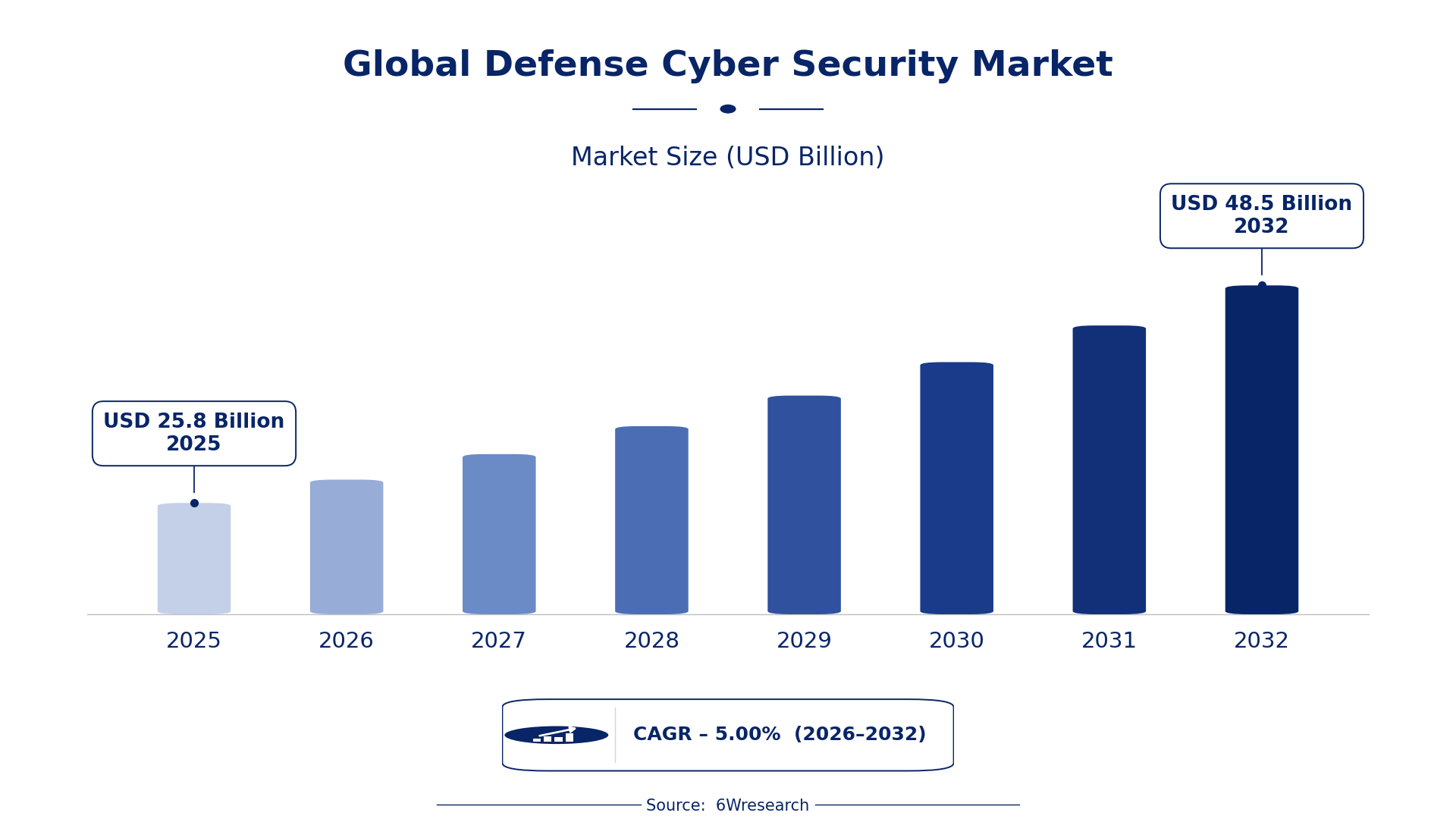
The Global Defense Cyber Security Market was estimated at USD 25.8 Billion in 2025 and is projected to reach USD 48.5 Billion by 2032, growing at a CAGR of 5.00% from 2026 to 2032.
Global Defense Cyber Security Market Synopsis
The dynamics of the Global Defense Cyber Security Market are shifting dramatically, influenced by the escalation of cyber threats targeted at national defense mechanisms. This market is integral to safeguarding sensitive data and operational capabilities, particularly as defense systems become increasingly digitized and interconnected. The imperative for enhanced cyber resilience is reshaping the strategic frameworks of defense agencies globally.
As countries recognize the critical nature of cyber warfare, investments in cybersecurity solutions are surging. This trend is not merely reactive; it actively transforms procurement processes, emphasizing innovation in technologies like machine learning and AI. Such shifts ensure that defense organizations can not only manage existing vulnerabilities but anticipate emerging threats with adaptability.
Global Defense Cyber Security Market Year-wise Growth Rate and Key Drivers
This graph illustrates the annual growth rates of the Global Defense Cyber Security Market from 2022 to 2032, highlighting a steady upward trajectory and projected expansion over the forecast period.
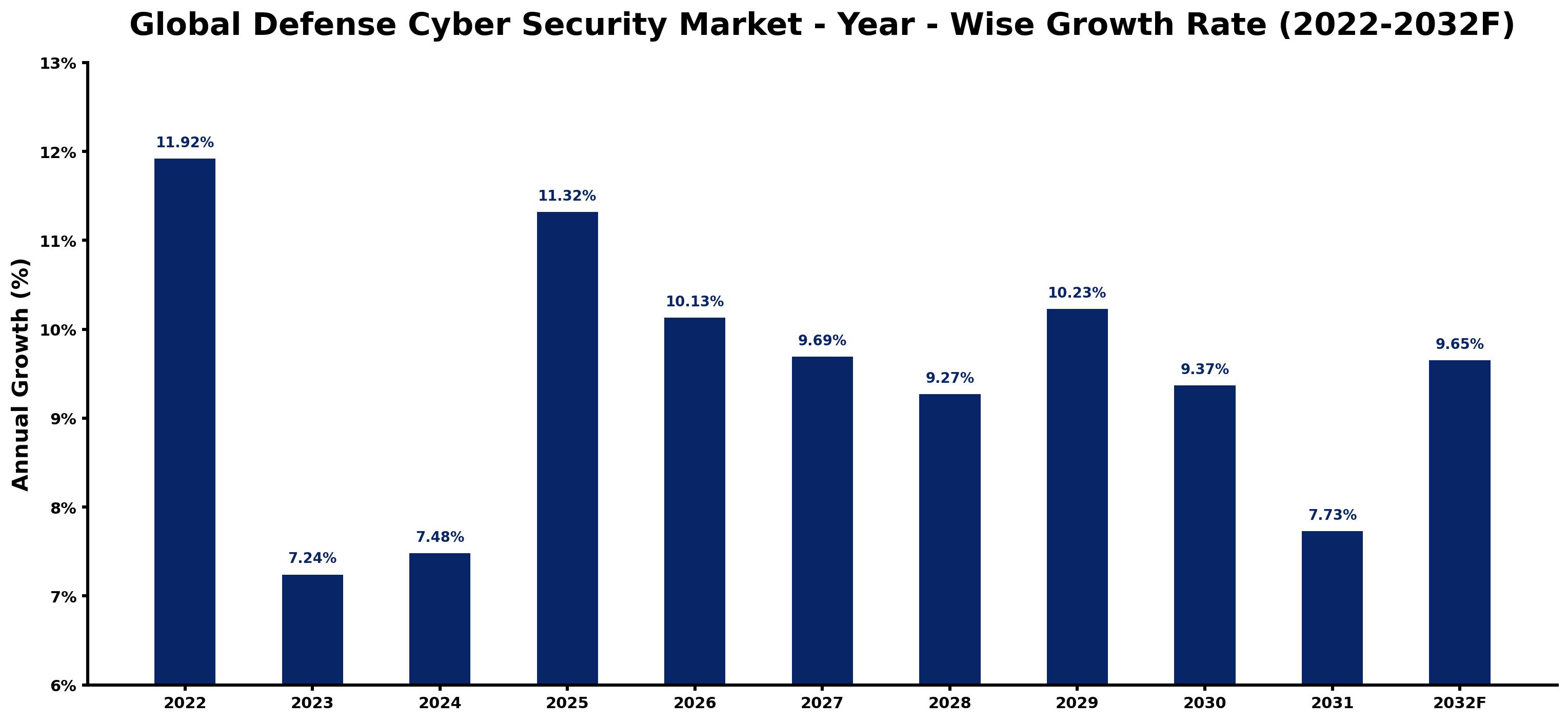
The table below presents the year‑wise growth rates along with the key drivers influencing the market
| Year | Growth Rate (%) | Major Drivers |
| 2022 | 11.92 | A surge in military cyber awareness catalyzes demand for defense cyber security solutions. |
| 2023 | 7.24 | Shifts in federal procurement policies enhance demand for advanced defense cyber frameworks. |
| 2024 | 7.48 | Manufacturers of satellite constellations encounter rising costs that affect defense cyber security investments. |
| 2025 | 11.32 | A shift toward integrating UAV systems with upgraded cyber security changes defense strategies. |
| 2026 | 10.13 | End-user adoption of secure radar systems accelerates, reflecting increasing cyber threat awareness. |
| 2027 | 9.69 | Defense contractors prioritize ESG compliance in deploying new cyber security technologies. |
| 2028 | 9.27 | While workforce skills evolve, the need for defense cyber security experts intensifies significantly. |
| 2029 | 10.23 | Increasing regulatory scrutiny on data protection mandates stronger defense cyber security measures. |
| 2030 | 9.37 | In North America, geographic expansion of cyber security services strengthens competitive positioning. |
| 2031 | 7.73 | Merging capabilities in software engineering enhances defense cyber security across various applications. |
| 2032 | 9.65 | Artificial intelligence systems for defense cyber security improve threat detection and response times. |
Note - Market size estimations and growth projections presented in this report are based on 6Wresearch's proprietary research methodology, combining internal industry data, secondary research, and primary validation, updated periodically to reflect current market conditions. As markets evolve rapidly, figures for certain industries may vary slightly and are intended as informed estimates rather than absolute figures. For the most current market sizing, we recommend validating figures with a 6Wresearch analyst.
Global Defense Cyber Security Market Key Takeaways
Below are some of the specific key takeaways from the market, including:
- Lockheed Martin allocated USD 2.5 Billion towards cybersecurity research and development in 2023, illustrating commitment to defense innovations.
- The Asia-Pacific region is expected to witness a CAGR of 6.5% from 2026 to 2032, reflecting increased defense spending among nations.
- Threat Assessment services are projected to command a ~30% market share in 2025, identifying it as a core area of cybersecurity demand.
- In 2023, Northrop Grumman won a $1.4 billion contract to enhance U.S. military cyber defense capabilities.
- BAE Systems is set to increase its cybersecurity workforce by 15% by the end of 2025 to meet rising demand for skilled professionals.
Evaluation of Restraints in Global Defense Cyber Security Market
The Global Defense Cyber Security Market contends with notable challenges, particularly in the realm of skilled workforce shortages. The cybersecurity sector is experiencing an estimated global talent shortage of 3.4 million professionals, complicating effective security implementation across defense organizations. For example, the European Union has cited stringent hiring regulations as a barrier to entering the cybersecurity labor market, further exacerbating this issue. Additionally, continuously evolving cyber threats demand persistent updates to security protocols, necessitating sustained investment, which can strain budgets.
Global Defense Cyber Security Market Trends
Three key trends are reshaping the Global Defense Cyber Security Market landscape. First, the integration of AI in cybersecurity protocols is becoming essential. Companies like Raytheon Technologies have developed AI-based solutions that enhance threat detection capabilities, with analysts noting a 25% reduction in response times to incidents. Second, cloud-based deployments are gaining traction; the Department of Defense's Cloud Strategy outlines a move towards securing cloud environments to facilitate agility and scalability. Third, the adoption of Zero Trust frameworks is revolutionizing security architecture. For instance, Thales Group has reported that 67% of its defense clients are shifting to this model to tighten internal access controls and streamline security operations.
Global Defense Cyber Security Market Opportunities
Future revenue opportunities lie primarily in smart defense applications and the integration of advanced threat intelligence. For example, a projected USD 1.8 billion funding towards IoT security initiatives by the U.S. government by 2025 is indicative of the rising focus on safeguarding connected devices within military operations. Additionally, as defense agencies increasingly rely on cloud services, companies providing cloud-native cybersecurity solutions stand to benefit greatly. A report indicates that over 55% of defense organizations plan to enhance their cloud security investments by 2026, highlighting the market’s readiness for innovative solutions.
Global Defense Cyber Security Market by Solution
Within the Global Defense Cyber Security Market, Defense Solutions currently hold the largest share, estimated at ~40% in 2025. However, the fastest-growing segment is Threat Assessment, anticipated to achieve a CAGR of 6.2% from 2026 to 2032 due to rising cyber intelligence requirements in military settings. The emphasis on predictive analytics and real-time response capabilities enhances the attractiveness of Threat Assessment, particularly as defense organizations aim to stay ahead of adversaries through proactive strategies.
Global Defense Cyber Security Market by Region
North America dominates the Global Defense Cyber Security Market, holding a ~46% share in 2025, largely owing to significant defense budgets and technological advancements. However, the Asia-Pacific region is on a fast trajectory, expected to grow at a CAGR of 6.8% from 2026 to 2032. This growth is driven by rising military modernization efforts and increasing cyber threats emanating from geopolitical tensions within the region.
Government Initiatives in the Global Defense Cyber Security Market
The regulatory environment surrounding the Global Defense Cyber Security Market is characterized by proactive government initiatives aimed at strengthening national cyber capabilities. These efforts include funding, policy frameworks, and collaborative engagements with private sector firms to enhance defense resilience against cyber threats.
- U.S. Department of Defense Cyber Strategy, released in 2022, allocates over USD 9 billion annually to strengthen cybersecurity measures across armed services.
- European Union Cybersecurity Act, effective January 2021, establishes an EU-wide cybersecurity certification framework, enhancing regulatory standards for cybersecurity solutions.
- India's National Cybersecurity Strategy, announced in 2023, aims to bolster defense against cyber threats with a proposed investment of USD 5 billion over the next five years.
- Canada’s National Cyber Security Strategy updated in 2021 emphasizes real-time data sharing between government agencies and defense contractors, promoting collaboration to tackle cyber threats.
Future Insights of the Global Defense Cyber Security Market
As the Global Defense Cyber Security Market evolves, the increasing convergence of operational technology (OT) and information technology (IT) within military systems will necessitate advanced cybersecurity protocols. Projected increases in cybersecurity funding, such as the U.S. Department of Defense's 2022 allocation of over USD 9 billion annually, are likely to drive significant infrastructure upgrades. This may include an emphasis on machine learning-driven automation and enhanced threat intelligence solutions, as organizations seek to not only protect assets but also anticipate and neutralize emerging threats to national security.
Global Defense Cyber Security Market Latest Developments
Recent activities in the Global Defense Cyber Security Market illustrate an active push toward strengthening capabilities and technology advancements among leading players. The following developments highlight this momentum:
- In August 2023, Lockheed Martin announced a significant upgrade to its cybersecurity infrastructure, enhancing its network protection capabilities through advanced AI algorithms, thereby solidifying its competitive edge.
- Northrop Grumman is undergoing ongoing enhancements to its cyber resilience program, investing resources to integrate next-gen technologies, such as quantum encryption, planned for implementation by late 2024.
- Raytheon Technologies is preparing to launch a new suite of autonomous cybersecurity solutions by early 2025, aimed at reducing incident response times across defense agencies.
- In July 2023, BAE Systems secured a partnership with a major tech firm to develop real-time threat analysis capabilities, expected to bolster its position in the European defense market ahead of critical contract renewals.
Global Defense Cyber Security Market Key Players and Industry Positioning
The Global Defense Cyber Security Market is characterized by a consolidated structure, with key players dominating due to their substantial technological investments and established client relationships. Strategic collaborations and innovations are common as firms seek to differentiate themselves in an increasingly competitive landscape.
| Leading Company | Core Strength | Strategic Focus |
|---|---|---|
| Lockheed Martin | Advanced cyber capabilities and robust R&D investment. | Expansion in AI applications for cybersecurity. |
| Northrop Grumman | Industry-leading defense technology integration. | Focus on quantum encryption solutions. |
| Raytheon Technologies | Innovative threat detection technologies. | Development of autonomous cybersecurity systems. |
| BAE Systems | Strong position in European defense contracts. | Investment in real-time threat analysis. |
| Thales Group | Expertise in integrated security systems. | Adoption of Zero Trust frameworks. |
With the competitive landscape continuously evolving, players are strategizing to leverage cutting-edge technologies and partnerships, enhancing their market positioning significantly.
Key Attractiveness of the Report
- 10 Years of Market Numbers
- Historical Data Starting from 2022 to 2025
- Base Year: 2025
- Forecast Data until 2032
- Key Performance Indicators Impacting the Market
- Major Upcoming Developments and Projects
Key Highlights of the Report:
- Global Defense Cyber Security Market Outlook
- Market Size of Global Defense Cyber Security Market, 2025
- Forecast of Global Defense Cyber Security Market, 2032
- Historical Data and Forecast of Global Defense Cyber Security Revenues & Volume for the Period 2022-2032
- Global Defense Cyber Security Market Trend Evolution
- Global Defense Cyber Security Market Drivers and Challenges
- Global Defense Cyber Security Price Trends
- Global Defense Cyber Security Porter's Five Forces
- Global Defense Cyber Security Industry Life Cycle
- Historical Data and Forecast of Global Defense Cyber Security Market Revenues & Volume
- Historical Data and Forecast of Global Defense Cyber Security Market Revenues & Volume By Solution for the Period 2022-2032
- Historical Data and Forecast of Global Defense Cyber Security Market Revenues & Volume By Defense Solutions for the Period 2022-2032
- Historical Data and Forecast of Global Defense Cyber Security Market Revenues & Volume By Threat Assessment for the Period 2022-2032
- Historical Data and Forecast of Global Defense Cyber Security Market Revenues & Volume By Network Fortification for the Period 2022-2032
- Historical Data and Forecast of Global Defense Cyber Security Market Revenues & Volume By Training Services for the Period 2022-2032
- Historical Data and Forecast of North America Defense Cyber Security Market Revenues & Volume By Solution for the Period 2022-2032
- Historical Data and Forecast of North America Defense Cyber Security Market Revenues & Volume By Defense Solutions for the Period 2022-2032
- Historical Data and Forecast of North America Defense Cyber Security Market Revenues & Volume By Threat Assessment for the Period 2022-2032
- Historical Data and Forecast of North America Defense Cyber Security Market Revenues & Volume By Network Fortification for the Period 2022-2032
- Historical Data and Forecast of North America Defense Cyber Security Market Revenues & Volume By Training Services for the Period 2022-2032
- Historical Data and Forecast of United States of America Defense Cyber Security Market Revenues & Volume for the Period 2022-2032
- Historical Data and Forecast of Canada Defense Cyber Security Market Revenues & Volume for the Period 2022-2032
- Historical Data and Forecast of Rest of North America Defense Cyber Security Market Revenues & Volume for the Period 2022-2032
- Historical Data and Forecast of Latin America (LATAM) Defense Cyber Security Market Revenues & Volume By Solution for the Period 2022-2032
- Historical Data and Forecast of Latin America (LATAM) Defense Cyber Security Market Revenues & Volume By Defense Solutions for the Period 2022-2032
- Historical Data and Forecast of Latin America (LATAM) Defense Cyber Security Market Revenues & Volume By Threat Assessment for the Period 2022-2032
- Historical Data and Forecast of Latin America (LATAM) Defense Cyber Security Market Revenues & Volume By Network Fortification for the Period 2022-2032
- Historical Data and Forecast of Latin America (LATAM) Defense Cyber Security Market Revenues & Volume By Training Services for the Period 2022-2032
- Historical Data and Forecast of Brazil Defense Cyber Security Market Revenues & Volume for the Period 2022-2032
- Historical Data and Forecast of Mexico Defense Cyber Security Market Revenues & Volume for the Period 2022-2032
- Historical Data and Forecast of Argentina Defense Cyber Security Market Revenues & Volume for the Period 2022-2032
- Historical Data and Forecast of Rest of LATAM Defense Cyber Security Market Revenues & Volume for the Period 2022-2032
- Historical Data and Forecast of Asia Defense Cyber Security Market Revenues & Volume By Solution for the Period 2022-2032
- Historical Data and Forecast of Asia Defense Cyber Security Market Revenues & Volume By Defense Solutions for the Period 2022-2032
- Historical Data and Forecast of Asia Defense Cyber Security Market Revenues & Volume By Threat Assessment for the Period 2022-2032
- Historical Data and Forecast of Asia Defense Cyber Security Market Revenues & Volume By Network Fortification for the Period 2022-2032
- Historical Data and Forecast of Asia Defense Cyber Security Market Revenues & Volume By Training Services for the Period 2022-2032
- Historical Data and Forecast of China Defense Cyber Security Market Revenues & Volume for the Period 2022-2032
- Historical Data and Forecast of India Defense Cyber Security Market Revenues & Volume for the Period 2022-2032
- Historical Data and Forecast of Japan Defense Cyber Security Market Revenues & Volume for the Period 2022-2032
- Historical Data and Forecast of Rest of Asia Defense Cyber Security Market Revenues & Volume for the Period 2022-2032
- Historical Data and Forecast of Africa Defense Cyber Security Market Revenues & Volume By Solution for the Period 2022-2032
- Historical Data and Forecast of Africa Defense Cyber Security Market Revenues & Volume By Defense Solutions for the Period 2022-2032
- Historical Data and Forecast of Africa Defense Cyber Security Market Revenues & Volume By Threat Assessment for the Period 2022-2032
- Historical Data and Forecast of Africa Defense Cyber Security Market Revenues & Volume By Network Fortification for the Period 2022-2032
- Historical Data and Forecast of Africa Defense Cyber Security Market Revenues & Volume By Training Services for the Period 2022-2032
- Historical Data and Forecast of South Africa Defense Cyber Security Market Revenues & Volume for the Period 2022-2032
- Historical Data and Forecast of Nigeria Defense Cyber Security Market Revenues & Volume for the Period 2022-2032
- Historical Data and Forecast of Egypt Defense Cyber Security Market Revenues & Volume for the Period 2022-2032
- Historical Data and Forecast of Rest of Africa Defense Cyber Security Market Revenues & Volume for the Period 2022-2032
- Historical Data and Forecast of Europe Defense Cyber Security Market Revenues & Volume By Solution for the Period 2022-2032
- Historical Data and Forecast of Europe Defense Cyber Security Market Revenues & Volume By Defense Solutions for the Period 2022-2032
- Historical Data and Forecast of Europe Defense Cyber Security Market Revenues & Volume By Threat Assessment for the Period 2022-2032
- Historical Data and Forecast of Europe Defense Cyber Security Market Revenues & Volume By Network Fortification for the Period 2022-2032
- Historical Data and Forecast of Europe Defense Cyber Security Market Revenues & Volume By Training Services for the Period 2022-2032
- Historical Data and Forecast of United Kingdom Defense Cyber Security Market Revenues & Volume for the Period 2022-2032
- Historical Data and Forecast of France Defense Cyber Security Market Revenues & Volume for the Period 2022-2032
- Historical Data and Forecast of Germany Defense Cyber Security Market Revenues & Volume for the Period 2022-2032
- Historical Data and Forecast of Rest of Europe Defense Cyber Security Market Revenues & Volume for the Period 2022-2032
- Historical Data and Forecast of Middle East Defense Cyber Security Market Revenues & Volume By Solution for the Period 2022-2032
- Historical Data and Forecast of Middle East Defense Cyber Security Market Revenues & Volume By Defense Solutions for the Period 2022-2032
- Historical Data and Forecast of Middle East Defense Cyber Security Market Revenues & Volume By Threat Assessment for the Period 2022-2032
- Historical Data and Forecast of Middle East Defense Cyber Security Market Revenues & Volume By Network Fortification for the Period 2022-2032
- Historical Data and Forecast of Middle East Defense Cyber Security Market Revenues & Volume By Training Services for the Period 2022-2032
- Historical Data and Forecast of Saudi Arabia Defense Cyber Security Market Revenues & Volume for the Period 2022-2032
- Historical Data and Forecast of UAE Defense Cyber Security Market Revenues & Volume for the Period 2022-2032
- Historical Data and Forecast of Turkey Defense Cyber Security Market Revenues & Volume for the Period 2022-2032
- Historical Data and Forecast of Rest of Middle East Defense Cyber Security Market Revenues & Volume for the Period 2022-2032
- Global Defense Cyber Security Market - Key Performance Indicators
- Global Defense Cyber Security Market - Import Export Trade Statistics
- Global Defense Cyber Security Market - Opportunity Assessment By Countries
- Global Defense Cyber Security Market - Opportunity Assessment By Solution
- 0
- Global Defense Cyber Security Market - Top Companies Market Share
- Global Defense Cyber Security Market - Top Companies Profiles
- Global Defense Cyber Security Market - Comparison of Players in Technical and Operating Parameters
- Global Defense Cyber Security Market - Strategic Recommendations
Markets Covered
The Global Defense Cyber Security Market report provides a detailed analysis of the following market segments:
By Regions and Countries:
- North America
- Europe
- LATAM
- Middle East
- Asia
- Africa
By Solution:
- Defense Solutions
- Threat Assessment
- Network Fortification
- Training Services






































