Global Electronic Dictionary Market Highlights
| Market Size (2025) | USD 0.7 Billion |
| Forecast Size (2032) | USD 1.03 Billion |
| CAGR | 7.20% |
| Base Year | 2025 |
| Forecast Period | 2026-2032 |
| Largest Region | Asia Pacific |
| Fastest Growing Region | LATAM |
| Largest Segment | Educational Institutions |
| Fastest Growing Segment | Government |
| Leading Companies | Casio Computer Co., Ltd., Canon, Sharp Corporation, Ectaco, Inc., Franklin Electronic Publishers |
Global Electronic Dictionary Market Size & Growth Rate (2026-2032)
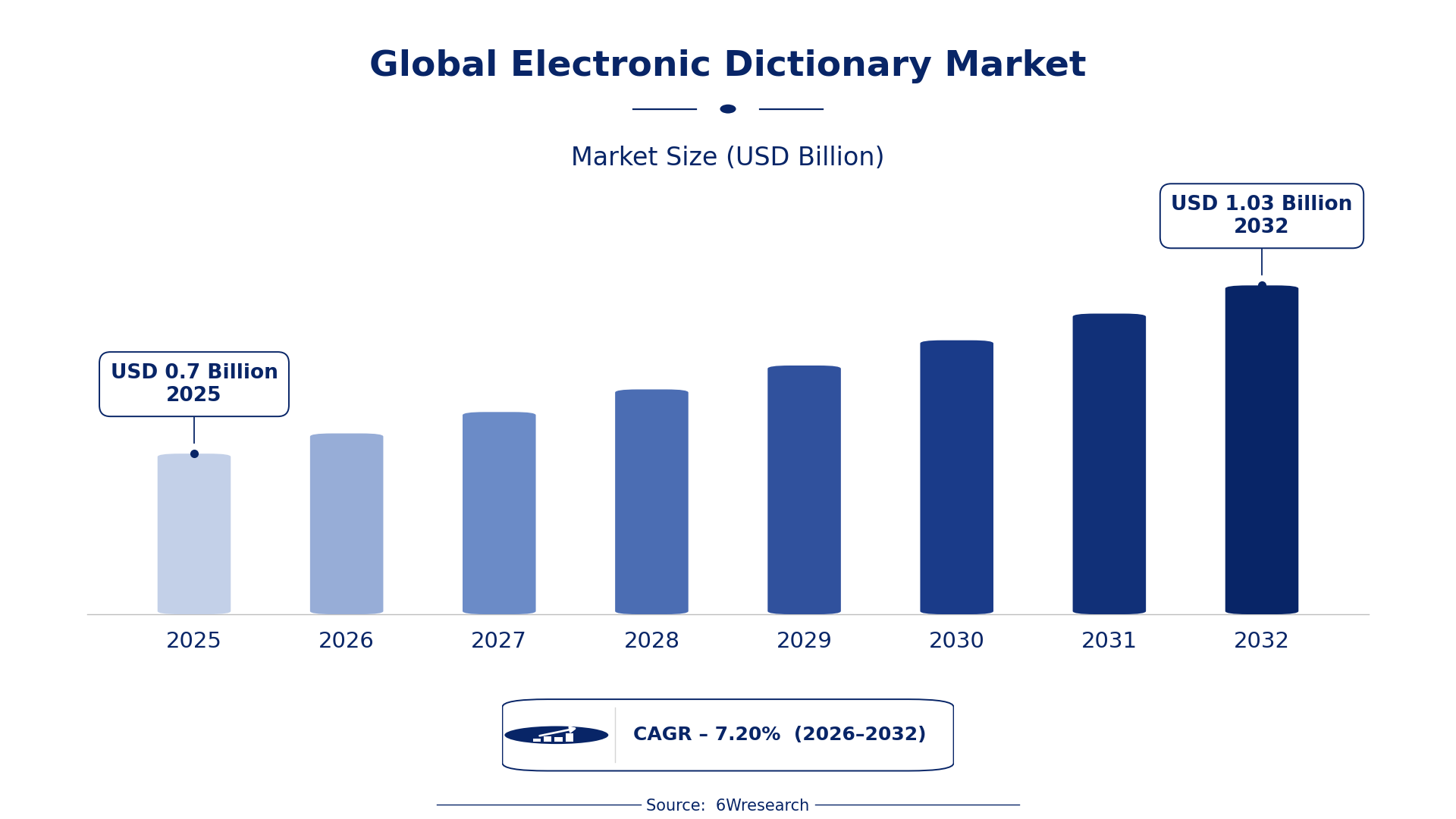
The Global Electronic Dictionary Market was estimated at USD 0.7 Billion in 2025 and is projected to reach USD 1.03 Billion by 2032, growing at a CAGR of 7.20% from 2026 to 2032.
Global Electronic Dictionary Market Synopsis
The Global Electronic Dictionary Market is undergoing transformative changes largely due to the demand for portable language translation solutions. As digital learning becomes more mainstream, stakeholders across educational and corporate sectors are embracing electronic dictionaries. This trend is fostering shifts in product offerings, with a notable emphasis on user-friendly features.
A noteworthy aspect driving the market is the proliferation of mobile and online platforms offering language resources. With significant growth in remote education and globalization, electronic dictionaries are increasingly viewed as essential tools. This results in differentiated offerings that cater to tech-savvy environments and various demographic groups.
Global Electronic Dictionary Market Year-wise Growth Rate and Key Drivers
This graph illustrates the annual growth rates of the Global Electronic Dictionary Market from 2022 to 2032, highlighting a steady upward trajectory and projected expansion over the forecast period.
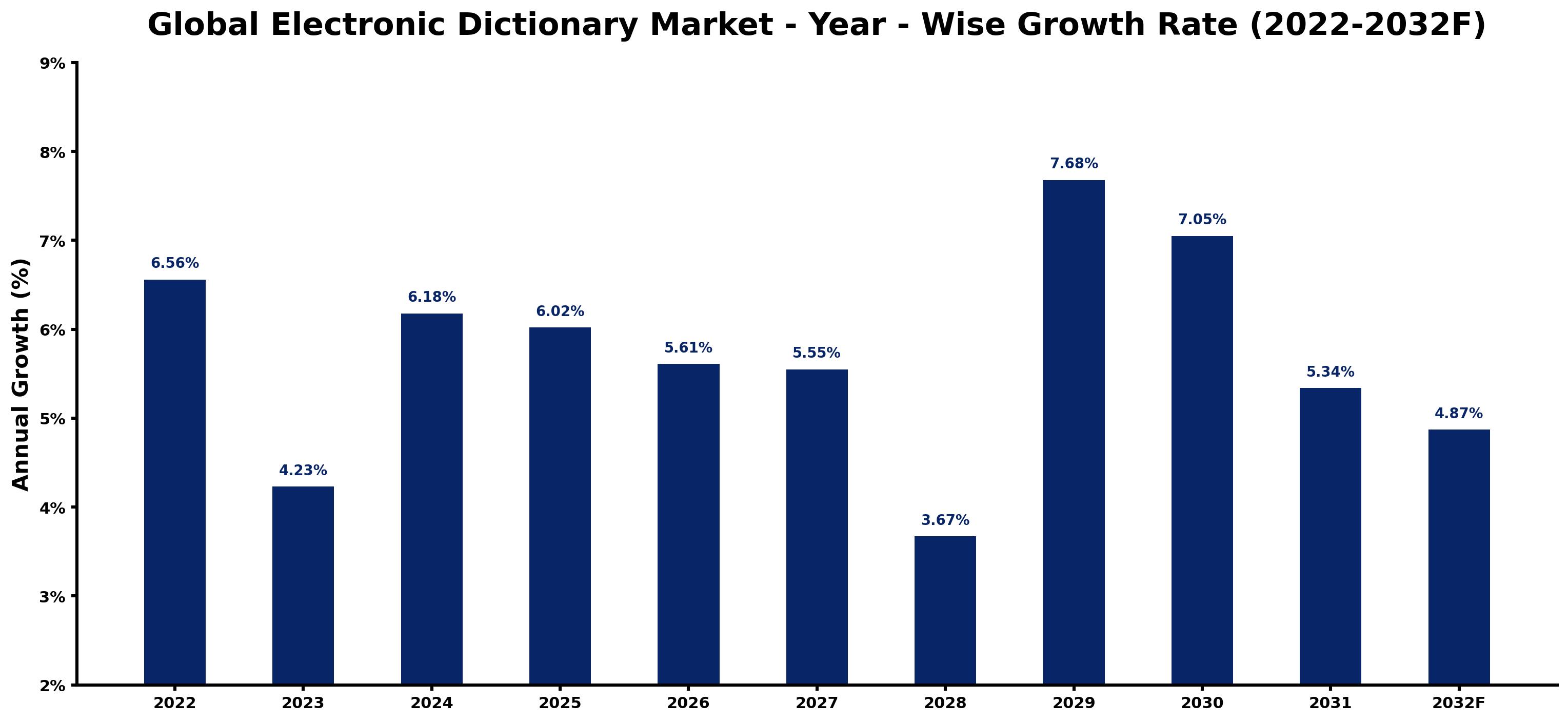
The table below presents the year‑wise growth rates along with the key drivers influencing the market
| Year | Growth Rate (%) | Major Drivers |
| 2022 | 6.56 | As the competitive landscape shifts, electronic dictionary adoption begins to rise among users. |
| 2023 | 4.23 | Sustainability trends drive interest in electronic dictionaries with eco-friendly features and functionalities. |
| 2024 | 6.18 | In North America, supply chain dynamics enhance the availability of electronic dictionaries. |
| 2025 | 6.02 | Investing in advanced electronic dictionary technologies increases production capacity and market presence. |
| 2026 | 5.61 | Expanding cloud migration initiatives enable integrated features in electronic dictionaries for enhanced user experience. |
| 2027 | 5.55 | Educators increasingly adopt electronic dictionaries as raw material costs for production stabilize. |
| 2028 | 3.67 | A shift toward stricter data privacy regulations changes the operational framework for electronic dictionaries. |
| 2029 | 7.68 | Growing demand for electronic dictionaries in Asia-Pacific drives significant regional market expansion. |
| 2030 | 7.05 | Students increasingly prefer electronic dictionary applications due to behavioral changes in learning methodologies. |
| 2031 | 5.34 | Innovations in search algorithms for electronic dictionaries reflect shifting user preferences among students. |
| 2032 | 4.87 | Schools integrating electronic dictionaries into curricula face challenges with evolving skill requirements for educators. |
Note - Market size estimations and growth projections presented in this report are based on 6Wresearch's proprietary research methodology, combining internal industry data, secondary research, and primary validation, updated periodically to reflect current market conditions. As markets evolve rapidly, figures for certain industries may vary slightly and are intended as informed estimates rather than absolute figures. For the most current market sizing, we recommend validating figures with a 6Wresearch analyst.
Global Electronic Dictionary Market Key Takeaways
Below are some of the specific key takeaways from the market, including:
- Asia Pacific accounts for approximately 50% of the market share as of 2025, driven by high usage rates in countries like Japan and South Korea.
- Government budgets specifically earmarked for linguistic technology integration across educational institutions are expected to increase by 15% in 2026.
- Ectaco, Inc. has announced a 20% increase in research and development funding in 2023 to enhance voice recognition capabilities.
- The Government segment is anticipated to have a CAGR of 9.5% from 2026 to 2032, reflecting strong anticipated growth in public sector applications.
- Canon's recent product line has integrated AI-driven translation tools, emphasizing the ongoing trend toward advanced features.
Evaluation of Restraints in Global Electronic Dictionary Market
The Global Electronic Dictionary Market faces significant restraints stemming from fierce competition, particularly from free mobile applications. Standalone electronic dictionaries must contend with platforms offering cost-free alternatives, affecting their market penetration. For example, popular language translation applications saw combined downloads exceed 1 billion in 2022, compelling manufacturers to rethink pricing strategies. Regulatory hurdles regarding data privacy could also impose additional compliance costs, further complicating the market's operational landscape.
Global Electronic Dictionary Market Trends
A key trend in the Global Electronic Dictionary Market is the integration of artificial intelligence into dictionary functions, enhancing real-time translation capabilities. Companies like Sharp Corporation have initiated developments in AI-assisted dictionaries, creating products that can learn user preferences over time, thus improving usability. Another trend involves increasing user reliance on mobile formats. Data from 2023 indicates that over 60% of users prefer mobile applications for accessing language resources, spurring developers to optimize for mobile platforms. This trend signifies a shift toward greater customer flexibility and accessibility.
Global Electronic Dictionary Market Opportunities
The Global Electronic Dictionary Market is poised for opportunities rooted in the growing demand for specialized language resources. For instance, the rise of online learning platforms indicates a market opening for dictionaries tailored for specific educational content. Companies like Franklin Electronic Publishers are already crafting dictionaries aimed at specific fields, such as medical and technical jargon. With the online education sector projected to grow by 18% by 2032, the opportunity for niche products becomes increasingly pronounced. Additionally, governmental investments into multilingual education initiatives present further avenues for revenue growth, targeting diverse linguistic populations.
Global Electronic Dictionary Market by Application
Among various applications, the Educational Institutions segment leads the Global Electronic Dictionary Market, representing a ~45% share in 2025. This dominance owes itself to the continued integration of these tools into modern academic settings, enhancing vocabulary and comprehension. Meanwhile, the Government segment emerges as the fastest-growing application, projected to experience a CAGR of 9.5% from 2026 to 2032. This growth reflects an increasing focus on multilingual communication within public sectors, as various government programs seek to engage with diverse populations effectively.
Global Electronic Dictionary Market by Region
Asia Pacific is the largest region in the Global Electronic Dictionary Market, holding a share of approximately ~50% as of 2025. The region benefits from advanced educational infrastructures and high adoption rates of technology in language learning. Conversely, LATAM is projected to be the fastest-growing region, with an anticipated CAGR of 8.5% from 2026 to 2032. This growth can be attributed to the increasing educational reforms aimed at enhancing English proficiency across Latin America, pushing demand for electronic dictionaries.
Government Initiatives in the Global Electronic Dictionary Market
Various governmental actions are shaping the landscape of the Global Electronic Dictionary Market. Policies aimed at improving language literacy and supporting educational equity indicate a proactive approach in enhancing the use and development of electronic dictionaries. Initiatives span different countries and contexts, influencing market dynamics substantially.
- Ministry of Education, Japan - "Digital Learning Enhancement Program," launched in 2022, focuses on integrating electronic dictionaries in schools to foster language skills.
- U.S. Department of Education - "Language Resources for All," ongoing since 2021, aims to provide funding for modern language learning tools, including electronic dictionaries, across public schools.
- European Commission - "Multilingualism Initiative," planned for 2025, aims to allocate €200 million towards resources that include electronic dictionaries for diverse language groups.
- Brazilian Ministry of Culture - "Cultural Heritage Language Program," initiated in 2023, aims to develop bilingual dictionaries in underrepresented languages, enhancing local engagement.
Future Insights of the Global Electronic Dictionary Market
The Global Electronic Dictionary Market is set to witness transformative changes as educational institutions increasingly incorporate digital tools into their curricula. A pivotal recent development is the U.S. Department of Education's "Language Resources for All" initiative, aiming to enhance language learning tools across public schools. This focus on integrating advanced technology in educational frameworks is expected to drive investment in electronic dictionaries, thereby fostering unique product offerings that address specific linguistic and academic needs through 2032.
Global Electronic Dictionary Market Latest Developments
The following recent developments highlight key initiatives from major companies within the Global Electronic Dictionary Market:
- Ectaco, Inc. has recently completed an upgrade to its dictionaries, improving voice recognition capabilities, which is projected to enhance user engagement through 2026.
- Casio Computer Co., Ltd. is preparing to launch a new model in mid-2024 that integrates advanced AI-assisted language training features, positioning it competitively in the educational sector.
- Canon is currently testing a platform that combines translation and pronunciation tools, expected to debut within the year, addressing multilingual needs in educational settings.
- Franklin Electronic Publishers has announced plans for a collaboration with educational technology firms to create specialized dictionaries for STEM fields, anticipated to commence by early 2025.
Global Electronic Dictionary Market Key Players and Industry Positioning
The Global Electronic Dictionary Market is moderately fragmented, with several key players competing for market share through product differentiation and technological advancements. Companies focus on tailored offerings to specific sectors, particularly in education and government applications.
| Leading Company | Core Strength | Strategic Focus |
|---|---|---|
| Casio Computer Co., Ltd. | Expertise in user-friendly design and educational products. | Targeting academic institutions with innovative dictionary features. |
| Canon | Strong background in imaging technology. | Integrating AI features to enhance translation accuracy. |
| Sharp Corporation | Leadership in consumer electronics and portable devices. | Developing AI-assisted dictionaries for contextual learning. |
| Ectaco, Inc. | Innovative language solutions with voice recognition capabilities. | Focusing on enhancing interactive and immersive user experiences. |
| Franklin Electronic Publishers | Specialization in niche dictionaries for specific sectors. | Expansion into technical and medical terminology dictionaries. |
As competitive dynamics intensify, companies are likely to leverage advanced technologies and partnerships to maintain their market positions and develop unique offerings tailored to a diverse user base.
Key Attractiveness of the Report
- 10 Years of Market Numbers
- Historical Data Starting from 2022 to 2025
- Base Year: 2025
- Forecast Data until 2032
- Key Performance Indicators Impacting the Market
- Major Upcoming Developments and Projects
Key Highlights of the Report:
- Global Electronic Dictionary Market Outlook
- Market Size of Global Electronic Dictionary Market, 2025
- Forecast of Global Electronic Dictionary Market, 2032
- Historical Data and Forecast of Global Electronic Dictionary Revenues & Volume for the Period 2022-2032
- Global Electronic Dictionary Market Trend Evolution
- Global Electronic Dictionary Market Drivers and Challenges
- Global Electronic Dictionary Price Trends
- Global Electronic Dictionary Porter's Five Forces
- Global Electronic Dictionary Industry Life Cycle
- Historical Data and Forecast of Global Electronic Dictionary Market Revenues & Volume
- Historical Data and Forecast of Global Electronic Dictionary Market Revenues & Volume By Application for the Period 2022-2032
- Historical Data and Forecast of Global Electronic Dictionary Market Revenues & Volume By Educational Institutions for the Period 2022-2032
- Historical Data and Forecast of Global Electronic Dictionary Market Revenues & Volume By Corporate for the Period 2022-2032
- Historical Data and Forecast of Global Electronic Dictionary Market Revenues & Volume By Government for the Period 2022-2032
- Historical Data and Forecast of Global Electronic Dictionary Market Revenues & Volume By Household for the Period 2022-2032
- Historical Data and Forecast of Global Electronic Dictionary Market Revenues & Volume By Others for the Period 2022-2032
- Historical Data and Forecast of North America Electronic Dictionary Market Revenues & Volume By Application for the Period 2022-2032
- Historical Data and Forecast of North America Electronic Dictionary Market Revenues & Volume By Educational Institutions for the Period 2022-2032
- Historical Data and Forecast of North America Electronic Dictionary Market Revenues & Volume By Corporate for the Period 2022-2032
- Historical Data and Forecast of North America Electronic Dictionary Market Revenues & Volume By Government for the Period 2022-2032
- Historical Data and Forecast of North America Electronic Dictionary Market Revenues & Volume By Household for the Period 2022-2032
- Historical Data and Forecast of North America Electronic Dictionary Market Revenues & Volume By Others for the Period 2022-2032
- Historical Data and Forecast of United States of America Electronic Dictionary Market Revenues & Volume for the Period 2022-2032
- Historical Data and Forecast of Canada Electronic Dictionary Market Revenues & Volume for the Period 2022-2032
- Historical Data and Forecast of Rest of North America Electronic Dictionary Market Revenues & Volume for the Period 2022-2032
- Historical Data and Forecast of Latin America (LATAM) Electronic Dictionary Market Revenues & Volume By Application for the Period 2022-2032
- Historical Data and Forecast of Latin America (LATAM) Electronic Dictionary Market Revenues & Volume By Educational Institutions for the Period 2022-2032
- Historical Data and Forecast of Latin America (LATAM) Electronic Dictionary Market Revenues & Volume By Corporate for the Period 2022-2032
- Historical Data and Forecast of Latin America (LATAM) Electronic Dictionary Market Revenues & Volume By Government for the Period 2022-2032
- Historical Data and Forecast of Latin America (LATAM) Electronic Dictionary Market Revenues & Volume By Household for the Period 2022-2032
- Historical Data and Forecast of Latin America (LATAM) Electronic Dictionary Market Revenues & Volume By Others for the Period 2022-2032
- Historical Data and Forecast of Brazil Electronic Dictionary Market Revenues & Volume for the Period 2022-2032
- Historical Data and Forecast of Mexico Electronic Dictionary Market Revenues & Volume for the Period 2022-2032
- Historical Data and Forecast of Argentina Electronic Dictionary Market Revenues & Volume for the Period 2022-2032
- Historical Data and Forecast of Rest of LATAM Electronic Dictionary Market Revenues & Volume for the Period 2022-2032
- Historical Data and Forecast of Asia Electronic Dictionary Market Revenues & Volume By Application for the Period 2022-2032
- Historical Data and Forecast of Asia Electronic Dictionary Market Revenues & Volume By Educational Institutions for the Period 2022-2032
- Historical Data and Forecast of Asia Electronic Dictionary Market Revenues & Volume By Corporate for the Period 2022-2032
- Historical Data and Forecast of Asia Electronic Dictionary Market Revenues & Volume By Government for the Period 2022-2032
- Historical Data and Forecast of Asia Electronic Dictionary Market Revenues & Volume By Household for the Period 2022-2032
- Historical Data and Forecast of Asia Electronic Dictionary Market Revenues & Volume By Others for the Period 2022-2032
- Historical Data and Forecast of China Electronic Dictionary Market Revenues & Volume for the Period 2022-2032
- Historical Data and Forecast of India Electronic Dictionary Market Revenues & Volume for the Period 2022-2032
- Historical Data and Forecast of Japan Electronic Dictionary Market Revenues & Volume for the Period 2022-2032
- Historical Data and Forecast of Rest of Asia Electronic Dictionary Market Revenues & Volume for the Period 2022-2032
- Historical Data and Forecast of Africa Electronic Dictionary Market Revenues & Volume By Application for the Period 2022-2032
- Historical Data and Forecast of Africa Electronic Dictionary Market Revenues & Volume By Educational Institutions for the Period 2022-2032
- Historical Data and Forecast of Africa Electronic Dictionary Market Revenues & Volume By Corporate for the Period 2022-2032
- Historical Data and Forecast of Africa Electronic Dictionary Market Revenues & Volume By Government for the Period 2022-2032
- Historical Data and Forecast of Africa Electronic Dictionary Market Revenues & Volume By Household for the Period 2022-2032
- Historical Data and Forecast of Africa Electronic Dictionary Market Revenues & Volume By Others for the Period 2022-2032
- Historical Data and Forecast of South Africa Electronic Dictionary Market Revenues & Volume for the Period 2022-2032
- Historical Data and Forecast of Nigeria Electronic Dictionary Market Revenues & Volume for the Period 2022-2032
- Historical Data and Forecast of Egypt Electronic Dictionary Market Revenues & Volume for the Period 2022-2032
- Historical Data and Forecast of Rest of Africa Electronic Dictionary Market Revenues & Volume for the Period 2022-2032
- Historical Data and Forecast of Europe Electronic Dictionary Market Revenues & Volume By Application for the Period 2022-2032
- Historical Data and Forecast of Europe Electronic Dictionary Market Revenues & Volume By Educational Institutions for the Period 2022-2032
- Historical Data and Forecast of Europe Electronic Dictionary Market Revenues & Volume By Corporate for the Period 2022-2032
- Historical Data and Forecast of Europe Electronic Dictionary Market Revenues & Volume By Government for the Period 2022-2032
- Historical Data and Forecast of Europe Electronic Dictionary Market Revenues & Volume By Household for the Period 2022-2032
- Historical Data and Forecast of Europe Electronic Dictionary Market Revenues & Volume By Others for the Period 2022-2032
- Historical Data and Forecast of United Kingdom Electronic Dictionary Market Revenues & Volume for the Period 2022-2032
- Historical Data and Forecast of France Electronic Dictionary Market Revenues & Volume for the Period 2022-2032
- Historical Data and Forecast of Germany Electronic Dictionary Market Revenues & Volume for the Period 2022-2032
- Historical Data and Forecast of Rest of Europe Electronic Dictionary Market Revenues & Volume for the Period 2022-2032
- Historical Data and Forecast of Middle East Electronic Dictionary Market Revenues & Volume By Application for the Period 2022-2032
- Historical Data and Forecast of Middle East Electronic Dictionary Market Revenues & Volume By Educational Institutions for the Period 2022-2032
- Historical Data and Forecast of Middle East Electronic Dictionary Market Revenues & Volume By Corporate for the Period 2022-2032
- Historical Data and Forecast of Middle East Electronic Dictionary Market Revenues & Volume By Government for the Period 2022-2032
- Historical Data and Forecast of Middle East Electronic Dictionary Market Revenues & Volume By Household for the Period 2022-2032
- Historical Data and Forecast of Middle East Electronic Dictionary Market Revenues & Volume By Others for the Period 2022-2032
- Historical Data and Forecast of Saudi Arabia Electronic Dictionary Market Revenues & Volume for the Period 2022-2032
- Historical Data and Forecast of UAE Electronic Dictionary Market Revenues & Volume for the Period 2022-2032
- Historical Data and Forecast of Turkey Electronic Dictionary Market Revenues & Volume for the Period 2022-2032
- Historical Data and Forecast of Rest of Middle East Electronic Dictionary Market Revenues & Volume for the Period 2022-2032
- Global Electronic Dictionary Market - Key Performance Indicators
- Global Electronic Dictionary Market - Import Export Trade Statistics
- Global Electronic Dictionary Market - Opportunity Assessment By Countries
- Global Electronic Dictionary Market - Opportunity Assessment By Application
- 0
- Global Electronic Dictionary Market - Top Companies Market Share
- Global Electronic Dictionary Market - Top Companies Profiles
- Global Electronic Dictionary Market - Comparison of Players in Technical and Operating Parameters
- Global Electronic Dictionary Market - Strategic Recommendations
Markets Covered
The Global Electronic Dictionary Market report provides a detailed analysis of the following market segments:
By Regions and Countries:
- North America
- Europe
- LATAM
- Middle East
- Asia
- Africa
By Application:
- Educational Institutions
- Corporate
- Government
- Household
- Others






































