Global Esports Market Highlights
| Market Size (2025) | USD 2.2 Billion |
| Forecast Size (2032) | USD 8 Billion |
| CAGR | 24.70% |
| Base Year | 2025 |
| Forecast Period | 2026-2032 |
| Largest Region | North America |
| Fastest Growing Region | Asia |
| Largest Segment | Sponsorships and Direct Advertisements |
| Fastest Growing Segment | Media Rights |
| Leading Companies | Activision Blizzard, Riot Games, ESL Gaming, Electronic Arts, Tencent |
Global Esports Market Size & Growth Rate (2026-2032)
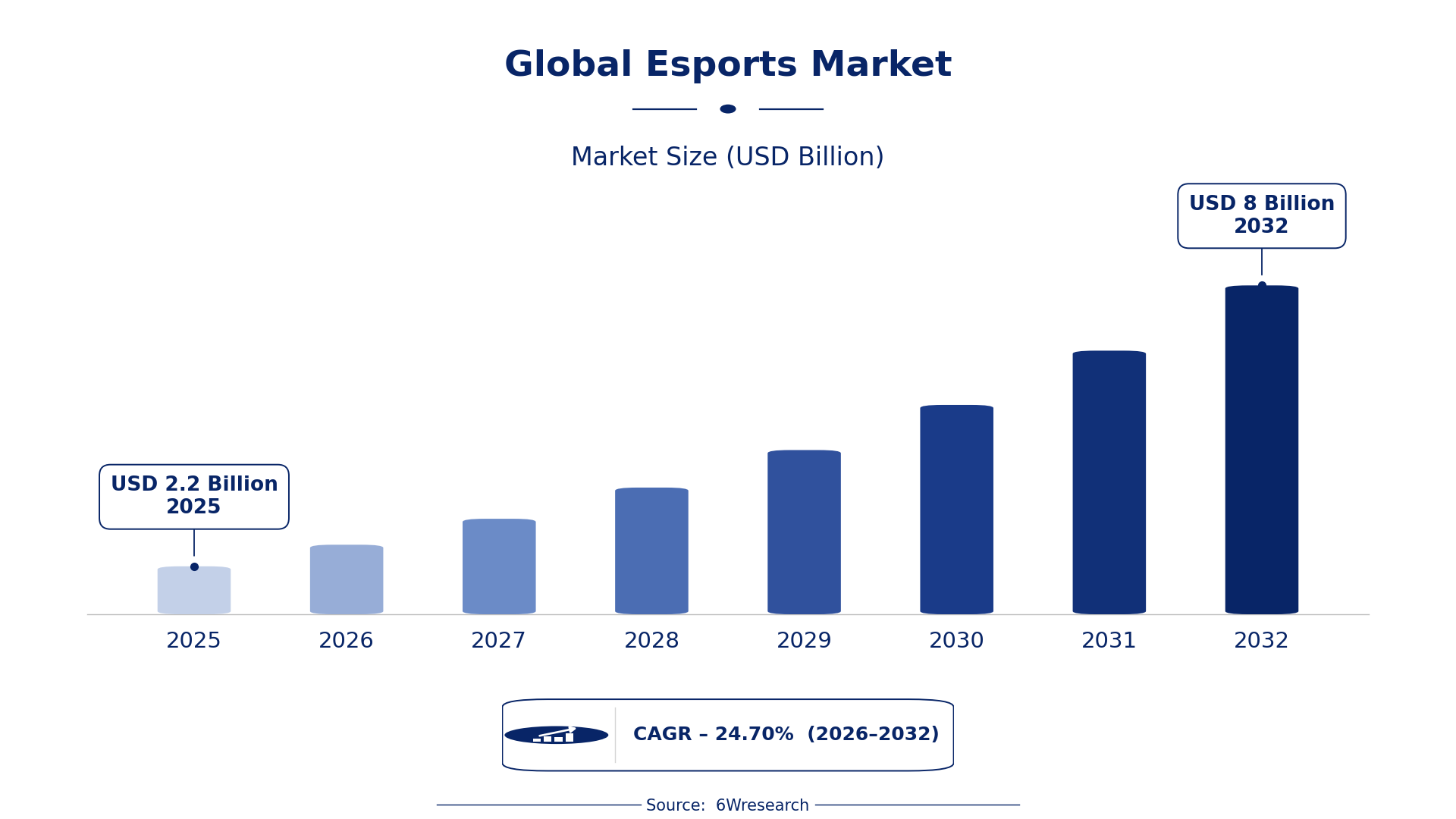
The Global Esports Market was estimated at USD 2.2 Billion in 2025 and is projected to reach USD 8 Billion by 2032, growing at a CAGR of 24.70% from 2026 to 2032.
Global Esports Market Synopsis
The Global Esports Market is transitioning into a multifaceted ecosystem where competitive gaming evolves beyond mere entertainment into a commercial powerhouse. Factors such as the surge in internet accessibility and the rise of digital platforms like Twitch are reshaping how audiences engage with esports content, effectively transforming it into a mainstream cultural phenomenon.
Traditional sports organizations, including the NBA, are now embracing esports, forging a critical link between established sports and new gaming communities. This intersection is driving investments from a range of sectors, facilitating growth across sponsorship, media rights, and direct advertisements, which differentiate esports from adjacent markets like conventional gaming.
Global Esports Market Year-wise Growth Rate and Key Drivers
This graph illustrates the annual growth rates of the Global Esports Market from 2022 to 2032, highlighting a steady upward trajectory and projected expansion over the forecast period.
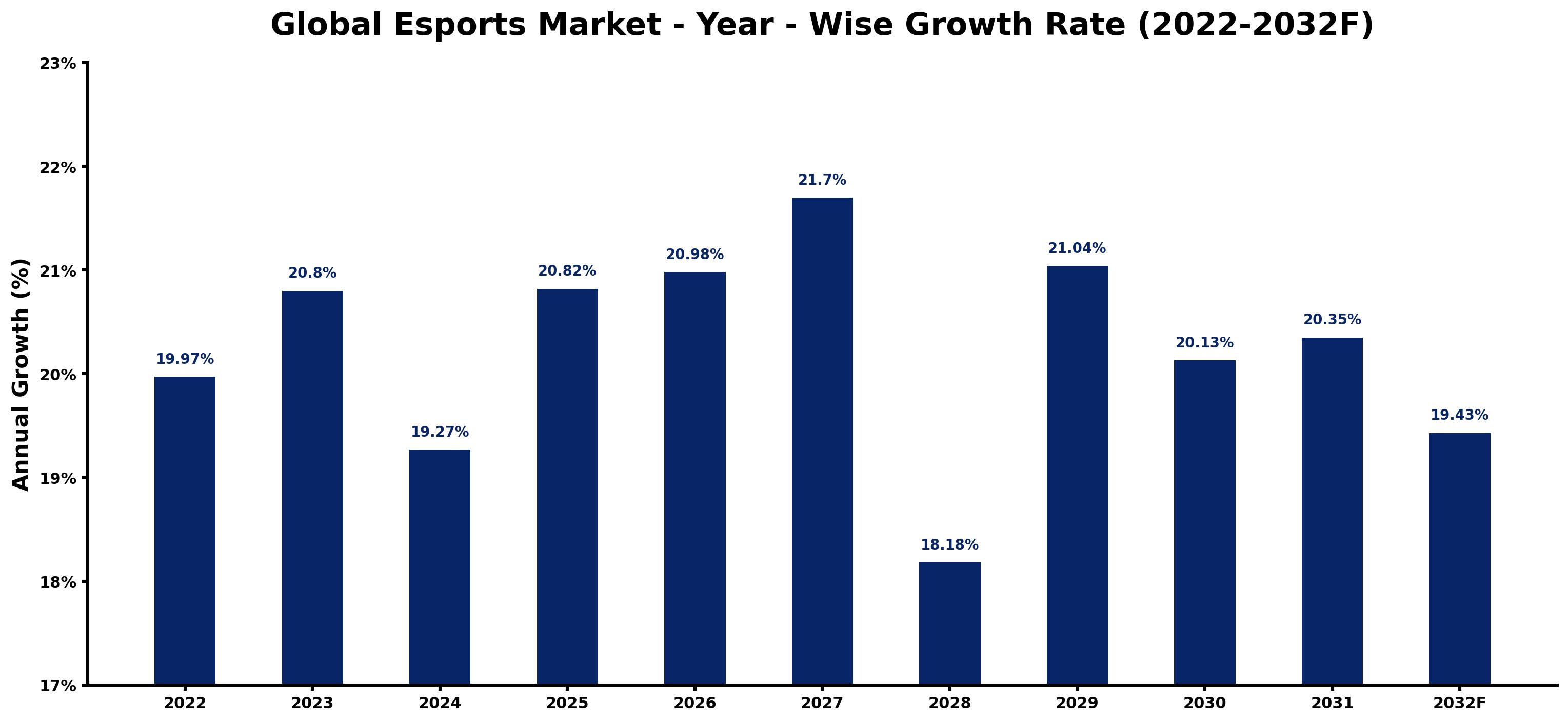
The table below presents the year‑wise growth rates along with the key drivers influencing the market
| Year | Growth Rate (%) | Major Drivers |
| 2022 | 19.97 | Expanding Esports platforms drives a significant surge in viewership engagement metrics. |
| 2023 | 20.8 | As regulations evolve, Esports content licensing deals gain broader industry acceptance. |
| 2024 | 19.27 | Increased investment activity highlights the importance of IP monetization in Esports. |
| 2025 | 20.82 | In the Asia-Pacific region, ad-supported revenue models enhance Esports profitability. |
| 2026 | 20.98 | Esports streaming technologies attract skilled labor, improving production budgets and content quality. |
| 2027 | 21.7 | Gamers are increasingly prioritizing sustainable practices, influencing Esports event planning. |
| 2028 | 18.18 | Media companies are expanding their reach, pushing Esports into new geographic territories. |
| 2029 | 21.04 | Streaming platforms are innovating with improved user interfaces to enhance Esports consumption. |
| 2030 | 20.13 | A shift toward mobile gaming changes audience demographics within the Esports ecosystem. |
| 2031 | 20.35 | Supply chain disruptions in merchandise manufacturing affect Esports event logistics and planning. |
| 2032 | 19.43 | The emergence of new gameplay mechanics reshapes competition dynamics in the Esports arena. |
Note - Market size estimations and growth projections presented in this report are based on 6Wresearch's proprietary research methodology, combining internal industry data, secondary research, and primary validation, updated periodically to reflect current market conditions. As markets evolve rapidly, figures for certain industries may vary slightly and are intended as informed estimates rather than absolute figures. For the most current market sizing, we recommend validating figures with a 6Wresearch analyst.
Global Esports Market Key Takeaways
Below are some of the specific key takeaways from the market, including:
- North America holds the largest market share, with an estimated ~40% in 2025, driven by a robust infrastructure and high consumer spending on esports.
- The Media Rights segment is expanding rapidly, with a projected CAGR of 30% from 2026 to 2032, given the increasing number of broadcasting deals.
- As of 2025, sponsorships and direct advertisements account for about 55% of the overall revenue, highlighting their significance in monetization strategies.
- Major events like The International by Valve typically feature prize pools exceeding $40 million, enhancing the appeal of esports tournaments.
- The growth of mobile gaming in regions like Asia is contributing significantly to audience increase, with mobile esports titles expected to reach one billion downloads by 2025.
Evaluation of Restraints in Global Esports Market
The Global Esports Market faces regulatory challenges that threaten competitive integrity and monetization efforts. A notable barrier is the varying legal frameworks across countries; for example, some nations require esports competitions to obtain specific gaming licenses, which can cost thousands of dollars and slow down event organization. Furthermore, disputes related to player eligibility and game rules due to the absence of a central governing body often hinder smoother operations. This fragmented landscape can diminish investor confidence and slow market growth.
Global Esports Market Trends
The industry is witnessing a marked shift towards mobile esports, largely fueled by the proliferation of smartphones across developing regions. Companies like Tencent are leading this trend with popular titles such as PUBG Mobile, which attracted 40 million daily players by early 2023. Additionally, partnerships between esports organizations and traditional sports teams are becoming more prevalent; for instance, the Atlanta Hawks have established an esports team, leveraging their brand to enhance engagement with younger demographics.
Moreover, the rise of blockchain technology is beginning to impact monetization strategies within esports. NFT-based collectibles are gaining traction; for example, Dapper Labs has partnered with major game developers to create unique digital assets, which are expected to reach over $500 million in sales within the next two years. This technological integration is not only providing new revenue streams but also fostering deeper fan relationships through ownership of in-game assets.
Global Esports Market Opportunities
Future revenue opportunities lie in the expansion into emerging markets such as India and Brazil, where gaming culture is rapidly gaining traction. For instance, the Indian esports market is projected to exceed $1 billion by 2025, driven by increased internet penetration and a youthful population eager for gaming experiences. Additionally, the continued integration of esports into education systems offers significant potential; institutions are beginning to recognize competitive gaming as a legitimate skill set, leading to programs that could attract sponsorships and funding in the realm of youth engagement.
Furthermore, the development of esports tournaments within corporate settings is becoming increasingly common. Companies are investing millions in organizing internal competitions to boost employee engagement and foster team-building, viewing esports as a modern solution to corporate challenges.
Global Esports Market by Revenue Streams
Sponsorships and Direct Advertisements lead revenue streams in the Global Esports Market, accounting for approximately 55% share in 2025. The fastest-growing segment is Media Rights, projected to grow at a CAGR of 30% from 2026 to 2032. The commanding share of sponsorships arises from the growing investment by brands looking to tap into the expansive reach of gaming enthusiasts, while the Media Rights segment capitalizes on increasing broadcast deals as esports gains mainstream visibility.
Global Esports Market by Region
North America is the largest region in the Global Esports Market, estimated to represent around 40% share in 2025, primarily due to its developed gaming infrastructure and high advertising spend. Meanwhile, Asia is showing the fastest growth, expected to have a CAGR of 35% from 2026 to 2032, as countries like China and India increasingly embrace competitive gaming and enhance their digital entertainment ecosystems. The concentration of major game publishers and competitive gaming events in these regions contributes significantly to their market positions.
Government Initiatives in the Global Esports Market
The regulatory landscape for the Global Esports Market is evolving, influencing growth prospects and operational parameters. Governments are beginning to recognize the economic potential of esports, leading to targeted initiatives aimed at fostering development. These measures range from funding for infrastructure to regulatory support for competitions, which collectively enhance the region's competitive gaming environment.
- Federal Ministry of Youth and Sports Development, National Esports Development Framework, 2021: This initiative aims to create an organized structure for esports competitions while promoting local talent and enhancing global interaction.
- European Commission, Digital Europe Programme 2021-2027: A strategic plan allocating €7.5 billion for digital transition projects, including esports, to foster competitive gaming and innovation in the EU.
- Korean Ministry of Culture, Sports and Tourism, Support for Digital Sports Policy, announced in mid-2023: This policy emphasizes funding esports events and nurturing talent to strengthen South Korea's position in the global esports industry.
- UK Department for Digital, Culture, Media and Sport, Esports Strategy Consultation, upcoming in 2024: Aimed at establishing guidelines and regulations to ensure fair play and ethical standards in competitive gaming.
Future Insights of the Global Esports Market
As the Global Esports Market evolves, key shifts will redefine audience engagement and competitive structures. The integration of advanced technologies, such as augmented reality (AR) and virtual reality (VR), is anticipated to enhance spectator experiences and elevate tournament formats. For instance, Riot Games is exploring immersive viewing options for its League of Legends Championships, aiming to bring fans closer to the action. Such innovations are likely to create new revenue streams, attract diverse audiences, and deepen brand partnerships, thereby positioning genuine competitive gaming as a sustainable part of the entertainment industry.
Global Esports Market Latest Developments
The Global Esports Market is experiencing notable advancements that underscore its dynamic nature. These developments reflect the industry's growth trajectory and the competitive strategies of leading companies.
- Recently completed, Activision Blizzard enhanced its esports tournament format for Call of Duty, aiming to attract mainstream audiences with increased prize pools and multi-platform accessibility.
- Upcoming in late 2023, Riot Games plans to launch regional leagues in Latin America, aiming to enhance local talent engagement and scale viewership.
- Ongoing, ESL Gaming has entered partnerships with major brands to develop integrated advertising solutions, bridging traditional marketing and esports content.
- Recently announced, Tencent's expansion into mobile esports in Southeast Asia is focused on creating competitive ecosystems for titles like Honor of Kings, targeting regional growth.
Global Esports Market Key Players and Industry Positioning
The competitive structure of the Global Esports Market is highly fragmented, with various players navigating their unique paths to success. Each company brings distinct expertise, leveraging synergies within the ecosystem to capture market share and enhance their positioning.
| Leading Company | Core Strength | Strategic Focus |
|---|---|---|
| Activision Blizzard | Strong IP portfolio including franchises like Call of Duty | Enhancing engagement through immersive tournament experiences |
| Riot Games | Expertise in community-driven game development | Expanding competitive ecosystems in emerging markets |
| ESL Gaming | Robust event management and broadcasting expertise | Innovative advertising models to connect brands with gamers |
| Electronic Arts | Diverse game titles with established esports scene | Integrating esports into mainstream sporting events |
| Tencent | Dominant mobile gaming presence | Fostering competitive opportunities in Southeast Asia |
The competitive dynamics in the Global Esports Market showcase a blend of traditional gaming prowess with innovative strategies aimed at diverse audiences. As companies adapt to market needs, their individual strengths become vital assets in shaping the future trajectory of esports.
Key Attractiveness of the Report
- 10 Years of Market Numbers
- Historical Data Starting from 2022 to 2025
- Base Year: 2025
- Forecast Data until 2032
- Key Performance Indicators Impacting the Market
- Major Upcoming Developments and Projects
Key Highlights of the Report:
- Global Esports Market Outlook
- Market Size of Global Esports Market, 2025
- Forecast of Global Esports Market, 2032
- Historical Data and Forecast of Global Esports Revenues & Volume for the Period 2022-2032
- Global Esports Market Trend Evolution
- Global Esports Market Drivers and Challenges
- Global Esports Price Trends
- Global Esports Porter's Five Forces
- Global Esports Industry Life Cycle
- Historical Data and Forecast of Global Esports Market Revenues & Volume
- Historical Data and Forecast of Global Esports Market Revenues & Volume By Revenue Streams for the Period 2022-2032
- Historical Data and Forecast of Global Esports Market Revenues & Volume By Media Rights for the Period 2022-2032
- Historical Data and Forecast of Global Esports Market Revenues & Volume By Tickets and Merchandise for the Period 2022-2032
- Historical Data and Forecast of Global Esports Market Revenues & Volume By Sponsorships and Direct Advertisements for the Period 2022-2032
- Historical Data and Forecast of Global Esports Market Revenues & Volume By Publisher Fees for the Period 2022-2032
- Historical Data and Forecast of North America Esports Market Revenues & Volume By Revenue Streams for the Period 2022-2032
- Historical Data and Forecast of North America Esports Market Revenues & Volume By Media Rights for the Period 2022-2032
- Historical Data and Forecast of North America Esports Market Revenues & Volume By Tickets and Merchandise for the Period 2022-2032
- Historical Data and Forecast of North America Esports Market Revenues & Volume By Sponsorships and Direct Advertisements for the Period 2022-2032
- Historical Data and Forecast of North America Esports Market Revenues & Volume By Publisher Fees for the Period 2022-2032
- Historical Data and Forecast of United States of America Esports Market Revenues & Volume for the Period 2022-2032
- Historical Data and Forecast of Canada Esports Market Revenues & Volume for the Period 2022-2032
- Historical Data and Forecast of Rest of North America Esports Market Revenues & Volume for the Period 2022-2032
- Historical Data and Forecast of Latin America (LATAM) Esports Market Revenues & Volume By Revenue Streams for the Period 2022-2032
- Historical Data and Forecast of Latin America (LATAM) Esports Market Revenues & Volume By Media Rights for the Period 2022-2032
- Historical Data and Forecast of Latin America (LATAM) Esports Market Revenues & Volume By Tickets and Merchandise for the Period 2022-2032
- Historical Data and Forecast of Latin America (LATAM) Esports Market Revenues & Volume By Sponsorships and Direct Advertisements for the Period 2022-2032
- Historical Data and Forecast of Latin America (LATAM) Esports Market Revenues & Volume By Publisher Fees for the Period 2022-2032
- Historical Data and Forecast of Brazil Esports Market Revenues & Volume for the Period 2022-2032
- Historical Data and Forecast of Mexico Esports Market Revenues & Volume for the Period 2022-2032
- Historical Data and Forecast of Argentina Esports Market Revenues & Volume for the Period 2022-2032
- Historical Data and Forecast of Rest of LATAM Esports Market Revenues & Volume for the Period 2022-2032
- Historical Data and Forecast of Asia Esports Market Revenues & Volume By Revenue Streams for the Period 2022-2032
- Historical Data and Forecast of Asia Esports Market Revenues & Volume By Media Rights for the Period 2022-2032
- Historical Data and Forecast of Asia Esports Market Revenues & Volume By Tickets and Merchandise for the Period 2022-2032
- Historical Data and Forecast of Asia Esports Market Revenues & Volume By Sponsorships and Direct Advertisements for the Period 2022-2032
- Historical Data and Forecast of Asia Esports Market Revenues & Volume By Publisher Fees for the Period 2022-2032
- Historical Data and Forecast of China Esports Market Revenues & Volume for the Period 2022-2032
- Historical Data and Forecast of India Esports Market Revenues & Volume for the Period 2022-2032
- Historical Data and Forecast of Japan Esports Market Revenues & Volume for the Period 2022-2032
- Historical Data and Forecast of Rest of Asia Esports Market Revenues & Volume for the Period 2022-2032
- Historical Data and Forecast of Africa Esports Market Revenues & Volume By Revenue Streams for the Period 2022-2032
- Historical Data and Forecast of Africa Esports Market Revenues & Volume By Media Rights for the Period 2022-2032
- Historical Data and Forecast of Africa Esports Market Revenues & Volume By Tickets and Merchandise for the Period 2022-2032
- Historical Data and Forecast of Africa Esports Market Revenues & Volume By Sponsorships and Direct Advertisements for the Period 2022-2032
- Historical Data and Forecast of Africa Esports Market Revenues & Volume By Publisher Fees for the Period 2022-2032
- Historical Data and Forecast of South Africa Esports Market Revenues & Volume for the Period 2022-2032
- Historical Data and Forecast of Nigeria Esports Market Revenues & Volume for the Period 2022-2032
- Historical Data and Forecast of Egypt Esports Market Revenues & Volume for the Period 2022-2032
- Historical Data and Forecast of Rest of Africa Esports Market Revenues & Volume for the Period 2022-2032
- Historical Data and Forecast of Europe Esports Market Revenues & Volume By Revenue Streams for the Period 2022-2032
- Historical Data and Forecast of Europe Esports Market Revenues & Volume By Media Rights for the Period 2022-2032
- Historical Data and Forecast of Europe Esports Market Revenues & Volume By Tickets and Merchandise for the Period 2022-2032
- Historical Data and Forecast of Europe Esports Market Revenues & Volume By Sponsorships and Direct Advertisements for the Period 2022-2032
- Historical Data and Forecast of Europe Esports Market Revenues & Volume By Publisher Fees for the Period 2022-2032
- Historical Data and Forecast of United Kingdom Esports Market Revenues & Volume for the Period 2022-2032
- Historical Data and Forecast of France Esports Market Revenues & Volume for the Period 2022-2032
- Historical Data and Forecast of Germany Esports Market Revenues & Volume for the Period 2022-2032
- Historical Data and Forecast of Rest of Europe Esports Market Revenues & Volume for the Period 2022-2032
- Historical Data and Forecast of Middle East Esports Market Revenues & Volume By Revenue Streams for the Period 2022-2032
- Historical Data and Forecast of Middle East Esports Market Revenues & Volume By Media Rights for the Period 2022-2032
- Historical Data and Forecast of Middle East Esports Market Revenues & Volume By Tickets and Merchandise for the Period 2022-2032
- Historical Data and Forecast of Middle East Esports Market Revenues & Volume By Sponsorships and Direct Advertisements for the Period 2022-2032
- Historical Data and Forecast of Middle East Esports Market Revenues & Volume By Publisher Fees for the Period 2022-2032
- Historical Data and Forecast of Saudi Arabia Esports Market Revenues & Volume for the Period 2022-2032
- Historical Data and Forecast of UAE Esports Market Revenues & Volume for the Period 2022-2032
- Historical Data and Forecast of Turkey Esports Market Revenues & Volume for the Period 2022-2032
- Historical Data and Forecast of Rest of Middle East Esports Market Revenues & Volume for the Period 2022-2032
- Global Esports Market - Key Performance Indicators
- Global Esports Market - Import Export Trade Statistics
- Global Esports Market - Opportunity Assessment By Countries
- Global Esports Market - Opportunity Assessment By Revenue Streams
- 0
- Global Esports Market - Top Companies Market Share
- Global Esports Market - Top Companies Profiles
- Global Esports Market - Comparison of Players in Technical and Operating Parameters
- Global Esports Market - Strategic Recommendations
Markets Covered
The Global Esports Market report provides a detailed analysis of the following market segments:
By Regions and Countries:
- North America
- Europe
- LATAM
- Middle East
- Asia
- Africa
By Revenue Streams:
- Media Rights
- Tickets
- Merchandise
- Sponsorships
- Direct Advertisements
- Publisher Fees






































