Global EV High Power Charger Market Highlights
| Market Size (2025) | USD 7 Billion |
| Forecast Size (2032) | USD 11.2 Billion |
| CAGR | 7.00% |
| Base Year | 2025 |
| Forecast Period | 2026-2032 |
| Largest Region | Asia Pacific |
| Fastest Growing Region | Asia Pacific |
| Largest Segment | Above 350 KW |
| Fastest Growing Segment | Above 350 KW |
| Leading Companies | ABB, Siemens, Tesla, ChargePoint, Schneider Electric |
Global EV High Power Charger Market Size & Growth Rate (2026-2032)
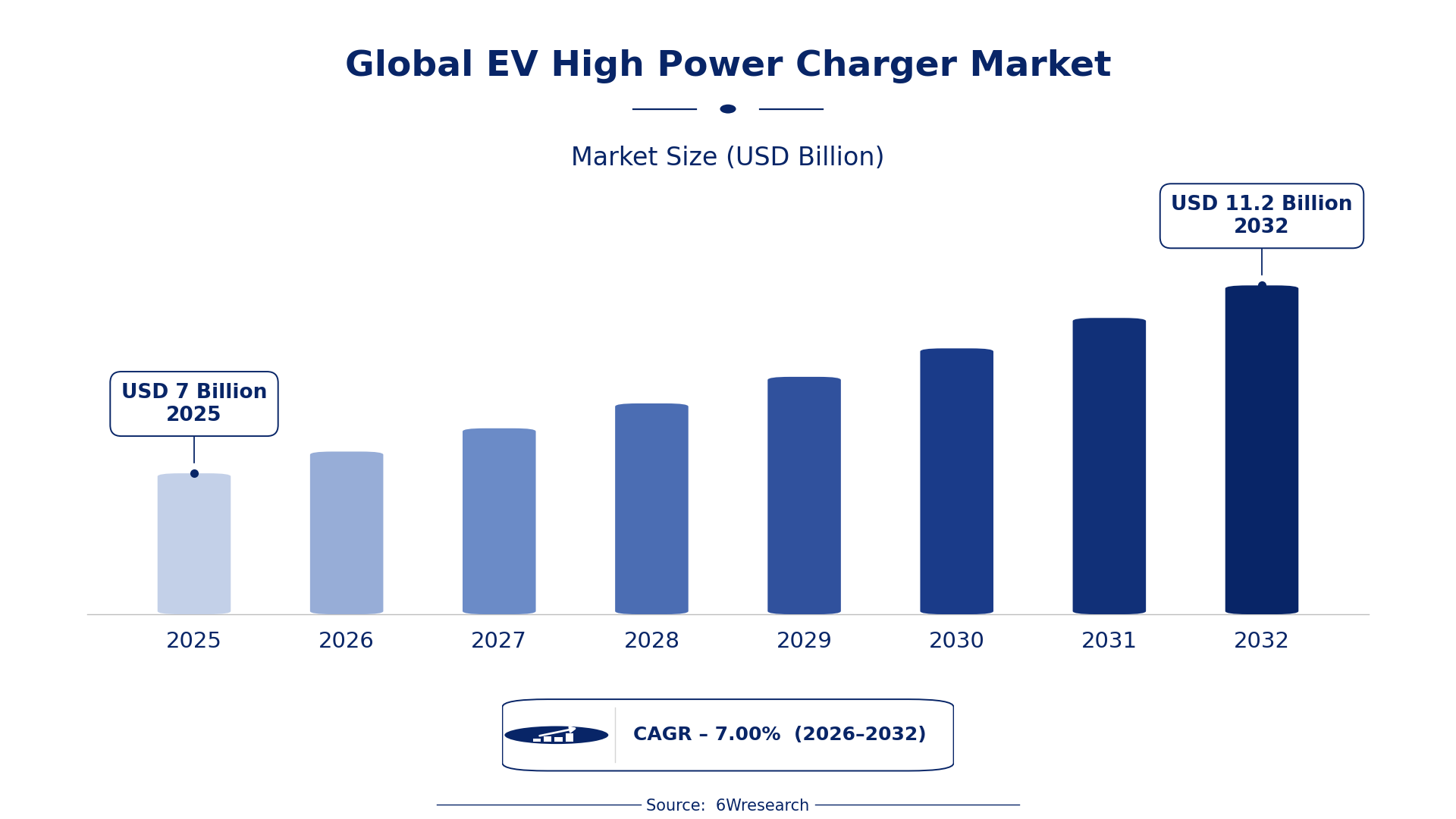
The Global EV High Power Charger Market was estimated at USD 7 Billion in 2025 and is projected to reach USD 11.2 Billion by 2032, growing at a CAGR of 7.00% from 2026 to 2032.
Global EV High Power Charger Market Synopsis
The global EV High Power Charger Market is undergoing a transformative phase, characterized by rapid technological advancements and substantial investments. This evolution is primarily driven by the escalating demand for efficient and rapid charging solutions, essential for the widespread adoption of electric vehicles (EVs). The market's growth trajectory is further bolstered by strategic collaborations among key industry players, aiming to standardize charging infrastructure and enhance interoperability. These developments are not only reshaping the competitive landscape but also setting the stage for a more integrated and user-friendly EV charging ecosystem.
As the market matures, there is a discernible shift towards the deployment of ultra-fast chargers capable of delivering power outputs exceeding 350 kW. This trend is indicative of the industry's commitment to reducing charging times and improving the overall EV ownership experience. The emphasis on high-power charging solutions is also a response to the increasing range capabilities of modern EVs, necessitating charging infrastructure that can keep pace with vehicle performance enhancements.
Global EV High Power Charger Market Year-wise Growth Rate and Key Drivers
This graph illustrates the annual growth rates of the Global EV High Power Charger Market from 2022 to 2032, highlighting a steady upward trajectory and projected expansion over the forecast period.
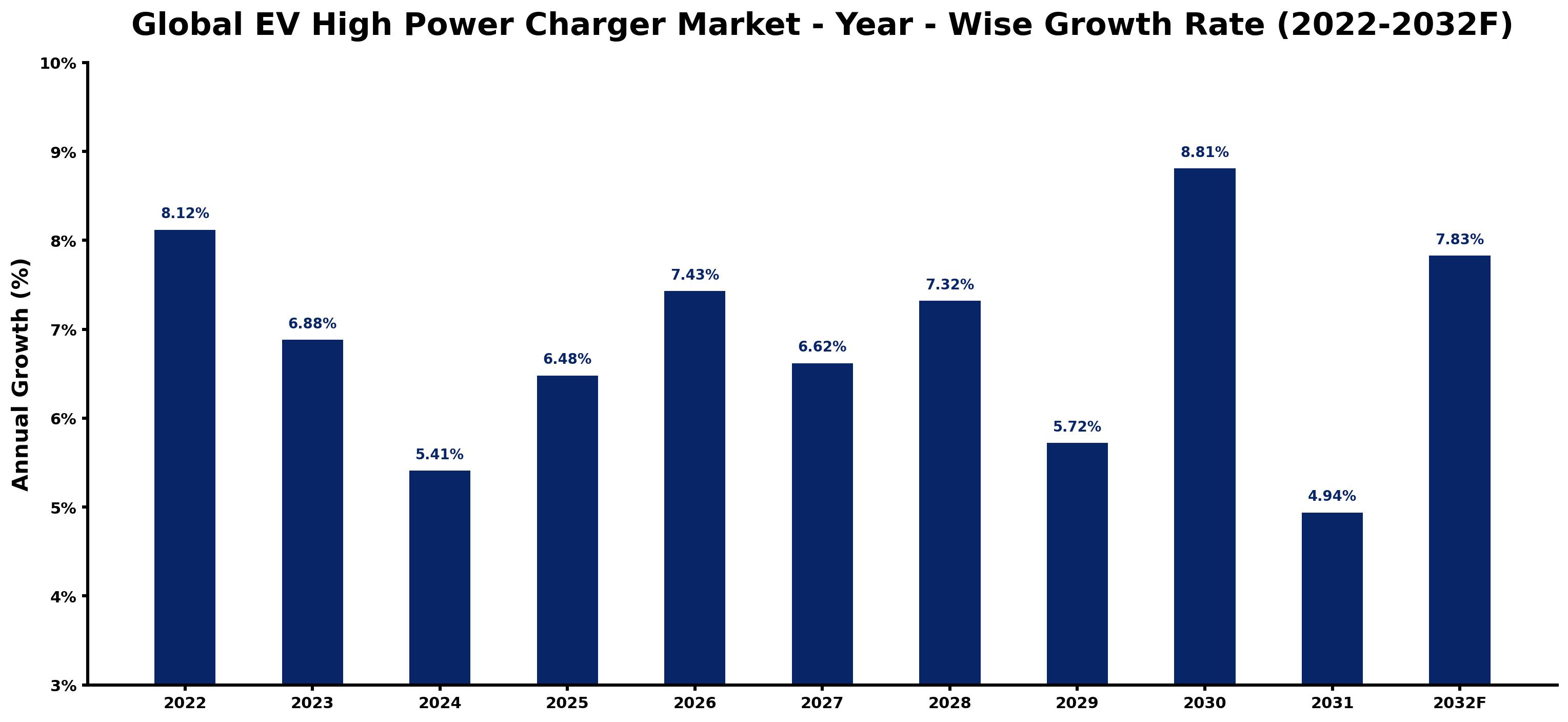
The table below presents the year‑wise growth rates along with the key drivers influencing the market
| Year | Growth Rate (%) | Major Drivers |
| 2022 | 8.12 | Growing consumer interest in EVs drives investment in high power charger infrastructure. |
| 2023 | 6.88 | Regional manufacturers expand their operations to accommodate rising EV charging needs. |
| 2024 | 5.41 | EV service centers enhance high power charger availability to meet consumer preferences. |
| 2025 | 6.48 | A shift toward stricter emissions regulations changes demand for high power chargers. |
| 2026 | 7.43 | Increasing focus on sustainability accelerates adoption of high power charging solutions. |
| 2027 | 6.62 | Fleet operators face rising raw material costs impacting high power charger production. |
| 2028 | 7.32 | While new entrants emerge, competition strengthens within the high power charger sector. |
| 2029 | 5.72 | Advancements in vehicle-to-grid integration enhance high power charger functionalities and capabilities. |
| 2030 | 8.81 | Growing mergers and acquisitions among companies consolidate the high power charger market. |
| 2031 | 4.94 | In North America, supply chain dynamics create challenges in high power charger deployment. |
| 2032 | 7.83 | Expanding workforce skills in EV technology enhances high power charger installation efficiency. |
Note - Market size estimations and growth projections presented in this report are based on 6Wresearch's proprietary research methodology, combining internal industry data, secondary research, and primary validation, updated periodically to reflect current market conditions. As markets evolve rapidly, figures for certain industries may vary slightly and are intended as informed estimates rather than absolute figures. For the most current market sizing, we recommend validating figures with a 6Wresearch analyst.
Global EV High Power Charger Market Key Takeaways
Below are some of the specific key takeaways from the market, including:
- The Asia Pacific region accounted for approximately 45.29% of the global EV High Power Charger Market in 2025, reflecting its dominant position in the market.
- The 'Above 350 KW' segment is projected to experience a CAGR of 8.5% from 2026 to 2032, indicating its rapid growth compared to other power output categories.
- Tesla's Supercharger network, which comprises a significant portion of the fast-charging infrastructure in the United States, is set to open its stations to non-Tesla EVs by the end of 2024, enhancing accessibility and interoperability.
- The U.S. Department of Transportation has allocated $100 million to improve the reliability of existing EV charging infrastructure, aiming to repair and replace non-operational chargers and ensure a more dependable charging network.
Evaluation of Restraints in Global EV High Power Charger Market
Despite the promising growth prospects, the Global EV High Power Charger Market faces several challenges that could impede its expansion. One significant restraint is the substantial capital investment required for the deployment of high-power charging stations. For instance, the installation of a single ultra-fast charger can cost upwards of $150,000, excluding operational expenses. This high upfront cost poses a barrier for many potential investors and operators, particularly in regions with limited financial incentives. Additionally, the variability in regulatory standards across different jurisdictions complicates the standardization of charging infrastructure, leading to interoperability issues and increased operational complexities. For example, the U.S. Department of Transportation's final standards for federally funded EV charging stations, effective March 30, 2023, impose specific requirements on charger types, payment processing, and data privacy, which may not align with standards in other regions.
Global EV High Power Charger Market Trends
The Global EV High Power Charger Market is witnessing several notable trends that are shaping its future direction. A prominent trend is the increasing emphasis on standardization and interoperability among charging networks. The recent confirmation of Tesla's North American Charging Standard (NACS) by SAE International as a new standard is a significant step towards unifying charging protocols, thereby enhancing user convenience and accelerating EV adoption. Another trend is the growing integration of smart charging technologies, which enable dynamic load management and integration with renewable energy sources. This approach not only optimizes energy consumption but also contributes to grid stability. For example, the UK's Electric Vehicle Smart Charging Action Plan outlines steps to deliver energy flexibility from EV charging, providing affordable, green power. Additionally, there is a shift towards public-private partnerships aimed at expanding charging infrastructure. The U.S. government's allocation of $2.5 billion in grants for EV chargers, particularly targeting underserved areas, exemplifies this collaborative approach to building a comprehensive charging network.
Global EV High Power Charger Market Opportunities
The Global EV High Power Charger Market presents several lucrative opportunities for stakeholders. One such opportunity lies in the development of ultra-rapid charging stations along major highways, catering to long-distance EV travelers. The UK's £70 million pilot scheme announced in December 2023 aims to boost the number of ultra-rapid chargepoints at motorway service areas, signaling a significant investment in this area. Another opportunity is the expansion of charging infrastructure in underserved and rural regions, supported by government grants and incentives. The U.S. Department of Transportation's initiative to allocate $100 million for improving EV charger reliability and accessibility is a case in point. Furthermore, the integration of renewable energy sources with charging stations offers a dual benefit of promoting clean energy and reducing operational costs. For instance, the UK's Electric Vehicle Smart Charging Action Plan emphasizes the importance of energy flexibility from EV charging, providing affordable, green power.
Global EV High Power Charger Market by Power Output Type
In 2025, the 'Above 350 KW' power output segment led the Global EV High Power Charger Market, capturing approximately 45.29% of the market share. This dominance is attributed to the growing demand for ultra-fast charging solutions that significantly reduce charging times, enhancing the convenience of EV ownership. The 'Above 350 KW' segment is also the fastest-growing, with a projected CAGR of 8.5% from 2026 to 2032. This rapid growth is driven by technological advancements in charging technology and substantial investments from both public and private sectors. The increasing adoption of high-performance EVs with larger battery capacities further propels the need for higher power charging infrastructure.
Global EV High Power Charger Market by Vehicle Type
In 2025, the Plug-In Hybrid Electric Vehicle (PHEV) segment led the Global EV High Power Charger Market, accounting for approximately 60% of the market share. This dominance is due to the widespread adoption of PHEVs, which offer a combination of electric and internal combustion engine capabilities, appealing to a broad consumer base. The PHEV segment is also the fastest-growing, with a projected CAGR of 9.2% from 2026 to 2032. This growth is fueled by advancements in battery technology, extending electric-only driving ranges, and supportive government policies promoting cleaner transportation options. The increasing availability of charging infrastructure further supports the adoption of PHEVs.
Global EV High Power Charger Market by Region
In 2025, the Asia Pacific region dominated the Global EV High Power Charger Market, holding approximately 45.29% of the market share. This dominance is driven by rapid EV adoption in countries like China and Japan, coupled with substantial investments in charging infrastructure. The Asia Pacific region is also the fastest-growing, with a projected CAGR of 8.5% from 2026 to 2032. This growth is attributed to supportive government policies, increasing consumer demand for EVs, and ongoing technological advancements in charging solutions. The region's manufacturing capabilities and export capacity further bolster its position in the global market.
Government Initiatives in the Global EV High Power Charger Market
Governments worldwide are implementing various initiatives to accelerate the deployment of EV charging infrastructure, recognizing its critical role in supporting the transition to electric mobility. These initiatives encompass funding programs, regulatory frameworks, and strategic partnerships aimed at enhancing the availability, reliability, and accessibility of charging stations. Such efforts are pivotal in addressing the existing infrastructure gaps and fostering consumer confidence in EV adoption.
- In December 2023, the U.S. Department of Transportation announced the availability of up to $100 million through the Electric Vehicle Charger Reliability and Accessibility Accelerator. This program aims to repair and replace non-operational EV charging infrastructure, enhancing the reliability of the existing charging network.
- In December 2023, the UK's Department for Transport launched a £70 million pilot scheme to increase the number of ultra-rapid EV chargepoints at motorway service areas. This initiative is designed to support the transition to electric vehicles by improving charging infrastructure along major highways.
- In December 2023, Singapore's Land Transport Authority commenced the Electric Vehicles Charging Act 2022, regulating the safe charging of EVs and ensuring the provision of reliable charging services. The act mandates that all EV chargers be type-approved and registered, with penalties for non-compliance, thereby enhancing the safety and reliability of the charging infrastructure.
- In February 2023, the U.S. Department of Transportation released final standards for federally funded EV charging stations, effective March 30, 2023. These standards regulate charger types, payment processing, and data privacy, aiming to ensure consistency and reliability across the national charging network.
Future Insights of the Global EV High Power Charger Market
As the landscape of the Global EV High Power Charger Market evolves, significant structural changes are anticipated. The integration of artificial intelligence in load management systems is projected to enhance operational efficiency. Companies like ABB are investing in smart charging technologies, thereby advancing their positions. Furthermore, initiatives focused on renewable energy integration into charging stations are expected to promote sustainability while addressing peak demand issues. By 2032, manufacturing processes may also transition towards more modular and scalable solutions to accommodate the increasing global demand for charging infrastructure.
Global EV High Power Charger Market Latest Developments
Recent initiatives undertaken by leading companies in the Global EV High Power Charger Market highlight their strategic efforts to enhance performance and capacity. Below are some notable developments:
- In August 2023, Tesla announced plans for a significant expansion of its Supercharger network, focusing on locations in underserved areas to improve accessibility.
- In September 2023, ChargePoint introduced a new high-efficiency charging solution designed to minimize downtime, reflecting a shift towards more resilient technology.
- In July 2023, Siemens partnered with local municipalities in Europe to launch a series of ultra-fast charging stations, increasing regional coverage and enhancing customer convenience.
- In October 2023, Schneider Electric revealed its innovative energy management system for EV charging stations, aimed at optimizing electricity costs and energy use.
Global EV High Power Charger Market Key Players and Industry Positioning
The Global EV High Power Charger Market is characterized by a fragmented competitive structure, with significant players vying for market share through technological advancements and strategic partnerships. Companies are investing extensively in R&D to enhance performance and address evolving consumer needs.
| Leading Company | Core Strength | Strategic Focus |
|---|---|---|
| ABB | Leadership in energy-efficient technology | R&D for smart charging solutions |
| Siemens | Strong integration capabilities with grid systems | Expansion in public charging infrastructure |
| Tesla | Robust Supercharger network | Enhancing accessibility for all EV models |
| ChargePoint | Extensive customer reach | Innovation in high-efficiency charging solutions |
| Schneider Electric | Expertise in energy management | Sustainability through smart technology |
The competitive dynamics of the Global EV High Power Charger Market indicate that firms are not only focusing on current technology but also anticipating future trends and demands. This proactive approach is likely to define their long-term success.
Key Attractiveness of the Report
- 10 Years of Market Numbers
- Historical Data Starting from 2022 to 2025
- Base Year: 2025
- Forecast Data until 2032
- Key Performance Indicators Impacting the Market
- Major Upcoming Developments and Projects
Key Highlights of the Report:
- Global EV High Power Charger Market Outlook
- Market Size of Global EV High Power Charger Market, 2025
- Forecast of Global EV High Power Charger Market, 2032
- Historical Data and Forecast of Global EV High Power Charger Revenues & Volume for the Period 2022-2032
- Global EV High Power Charger Market Trend Evolution
- Global EV High Power Charger Market Drivers and Challenges
- Global EV High Power Charger Price Trends
- Global EV High Power Charger Porter's Five Forces
- Global EV High Power Charger Industry Life Cycle
- Historical Data and Forecast of Global EV High Power Charger Market Revenues & Volume
- Historical Data and Forecast of Global EV High Power Charger Market Revenues & Volume By Power Output Type for the Period 2022-2032
- Historical Data and Forecast of Global EV High Power Charger Market Revenues & Volume By 50 KW - 150 KW for the Period 2022-2032
- Historical Data and Forecast of Global EV High Power Charger Market Revenues & Volume By 150 KW - 350 KW for the Period 2022-2032
- Historical Data and Forecast of Global EV High Power Charger Market Revenues & Volume By Above 350 KW for the Period 2022-2032
- Historical Data and Forecast of Global EV High Power Charger Market Revenues & Volume By Vehicle Type for the Period 2022-2032
- Historical Data and Forecast of Global EV High Power Charger Market Revenues & Volume By Plug-In Hybrid Electric Vehicle (PHEV) for the Period 2022-2032
- Historical Data and Forecast of Global EV High Power Charger Market Revenues & Volume By Battery Electric Vehicle (BEV) for the Period 2022-2032
- Historical Data and Forecast of North America EV High Power Charger Market Revenues & Volume By Power Output Type for the Period 2022-2032
- Historical Data and Forecast of North America EV High Power Charger Market Revenues & Volume By 50 KW - 150 KW for the Period 2022-2032
- Historical Data and Forecast of North America EV High Power Charger Market Revenues & Volume By 150 KW - 350 KW for the Period 2022-2032
- Historical Data and Forecast of North America EV High Power Charger Market Revenues & Volume By Above 350 KW for the Period 2022-2032
- Historical Data and Forecast of North America EV High Power Charger Market Revenues & Volume By Vehicle Type for the Period 2022-2032
- Historical Data and Forecast of North America EV High Power Charger Market Revenues & Volume By Plug-In Hybrid Electric Vehicle (PHEV) for the Period 2022-2032
- Historical Data and Forecast of North America EV High Power Charger Market Revenues & Volume By Battery Electric Vehicle (BEV) for the Period 2022-2032
- Historical Data and Forecast of United States of America EV High Power Charger Market Revenues & Volume for the Period 2022-2032
- Historical Data and Forecast of Canada EV High Power Charger Market Revenues & Volume for the Period 2022-2032
- Historical Data and Forecast of Rest of North America EV High Power Charger Market Revenues & Volume for the Period 2022-2032
- Historical Data and Forecast of Latin America (LATAM) EV High Power Charger Market Revenues & Volume By Power Output Type for the Period 2022-2032
- Historical Data and Forecast of Latin America (LATAM) EV High Power Charger Market Revenues & Volume By 50 KW - 150 KW for the Period 2022-2032
- Historical Data and Forecast of Latin America (LATAM) EV High Power Charger Market Revenues & Volume By 150 KW - 350 KW for the Period 2022-2032
- Historical Data and Forecast of Latin America (LATAM) EV High Power Charger Market Revenues & Volume By Above 350 KW for the Period 2022-2032
- Historical Data and Forecast of Latin America (LATAM) EV High Power Charger Market Revenues & Volume By Vehicle Type for the Period 2022-2032
- Historical Data and Forecast of Latin America (LATAM) EV High Power Charger Market Revenues & Volume By Plug-In Hybrid Electric Vehicle (PHEV) for the Period 2022-2032
- Historical Data and Forecast of Latin America (LATAM) EV High Power Charger Market Revenues & Volume By Battery Electric Vehicle (BEV) for the Period 2022-2032
- Historical Data and Forecast of Brazil EV High Power Charger Market Revenues & Volume for the Period 2022-2032
- Historical Data and Forecast of Mexico EV High Power Charger Market Revenues & Volume for the Period 2022-2032
- Historical Data and Forecast of Argentina EV High Power Charger Market Revenues & Volume for the Period 2022-2032
- Historical Data and Forecast of Rest of LATAM EV High Power Charger Market Revenues & Volume for the Period 2022-2032
- Historical Data and Forecast of Asia EV High Power Charger Market Revenues & Volume By Power Output Type for the Period 2022-2032
- Historical Data and Forecast of Asia EV High Power Charger Market Revenues & Volume By 50 KW - 150 KW for the Period 2022-2032
- Historical Data and Forecast of Asia EV High Power Charger Market Revenues & Volume By 150 KW - 350 KW for the Period 2022-2032
- Historical Data and Forecast of Asia EV High Power Charger Market Revenues & Volume By Above 350 KW for the Period 2022-2032
- Historical Data and Forecast of Asia EV High Power Charger Market Revenues & Volume By Vehicle Type for the Period 2022-2032
- Historical Data and Forecast of Asia EV High Power Charger Market Revenues & Volume By Plug-In Hybrid Electric Vehicle (PHEV) for the Period 2022-2032
- Historical Data and Forecast of Asia EV High Power Charger Market Revenues & Volume By Battery Electric Vehicle (BEV) for the Period 2022-2032
- Historical Data and Forecast of China EV High Power Charger Market Revenues & Volume for the Period 2022-2032
- Historical Data and Forecast of India EV High Power Charger Market Revenues & Volume for the Period 2022-2032
- Historical Data and Forecast of Japan EV High Power Charger Market Revenues & Volume for the Period 2022-2032
- Historical Data and Forecast of Rest of Asia EV High Power Charger Market Revenues & Volume for the Period 2022-2032
- Historical Data and Forecast of Africa EV High Power Charger Market Revenues & Volume By Power Output Type for the Period 2022-2032
- Historical Data and Forecast of Africa EV High Power Charger Market Revenues & Volume By 50 KW - 150 KW for the Period 2022-2032
- Historical Data and Forecast of Africa EV High Power Charger Market Revenues & Volume By 150 KW - 350 KW for the Period 2022-2032
- Historical Data and Forecast of Africa EV High Power Charger Market Revenues & Volume By Above 350 KW for the Period 2022-2032
- Historical Data and Forecast of Africa EV High Power Charger Market Revenues & Volume By Vehicle Type for the Period 2022-2032
- Historical Data and Forecast of Africa EV High Power Charger Market Revenues & Volume By Plug-In Hybrid Electric Vehicle (PHEV) for the Period 2022-2032
- Historical Data and Forecast of Africa EV High Power Charger Market Revenues & Volume By Battery Electric Vehicle (BEV) for the Period 2022-2032
- Historical Data and Forecast of South Africa EV High Power Charger Market Revenues & Volume for the Period 2022-2032
- Historical Data and Forecast of Nigeria EV High Power Charger Market Revenues & Volume for the Period 2022-2032
- Historical Data and Forecast of Egypt EV High Power Charger Market Revenues & Volume for the Period 2022-2032
- Historical Data and Forecast of Rest of Africa EV High Power Charger Market Revenues & Volume for the Period 2022-2032
- Historical Data and Forecast of Europe EV High Power Charger Market Revenues & Volume By Power Output Type for the Period 2022-2032
- Historical Data and Forecast of Europe EV High Power Charger Market Revenues & Volume By 50 KW - 150 KW for the Period 2022-2032
- Historical Data and Forecast of Europe EV High Power Charger Market Revenues & Volume By 150 KW - 350 KW for the Period 2022-2032
- Historical Data and Forecast of Europe EV High Power Charger Market Revenues & Volume By Above 350 KW for the Period 2022-2032
- Historical Data and Forecast of Europe EV High Power Charger Market Revenues & Volume By Vehicle Type for the Period 2022-2032
- Historical Data and Forecast of Europe EV High Power Charger Market Revenues & Volume By Plug-In Hybrid Electric Vehicle (PHEV) for the Period 2022-2032
- Historical Data and Forecast of Europe EV High Power Charger Market Revenues & Volume By Battery Electric Vehicle (BEV) for the Period 2022-2032
- Historical Data and Forecast of United Kingdom EV High Power Charger Market Revenues & Volume for the Period 2022-2032
- Historical Data and Forecast of France EV High Power Charger Market Revenues & Volume for the Period 2022-2032
- Historical Data and Forecast of Germany EV High Power Charger Market Revenues & Volume for the Period 2022-2032
- Historical Data and Forecast of Rest of Europe EV High Power Charger Market Revenues & Volume for the Period 2022-2032
- Historical Data and Forecast of Middle East EV High Power Charger Market Revenues & Volume By Power Output Type for the Period 2022-2032
- Historical Data and Forecast of Middle East EV High Power Charger Market Revenues & Volume By 50 KW - 150 KW for the Period 2022-2032
- Historical Data and Forecast of Middle East EV High Power Charger Market Revenues & Volume By 150 KW - 350 KW for the Period 2022-2032
- Historical Data and Forecast of Middle East EV High Power Charger Market Revenues & Volume By Above 350 KW for the Period 2022-2032
- Historical Data and Forecast of Middle East EV High Power Charger Market Revenues & Volume By Vehicle Type for the Period 2022-2032
- Historical Data and Forecast of Middle East EV High Power Charger Market Revenues & Volume By Plug-In Hybrid Electric Vehicle (PHEV) for the Period 2022-2032
- Historical Data and Forecast of Middle East EV High Power Charger Market Revenues & Volume By Battery Electric Vehicle (BEV) for the Period 2022-2032
- Historical Data and Forecast of Saudi Arabia EV High Power Charger Market Revenues & Volume for the Period 2022-2032
- Historical Data and Forecast of UAE EV High Power Charger Market Revenues & Volume for the Period 2022-2032
- Historical Data and Forecast of Turkey EV High Power Charger Market Revenues & Volume for the Period 2022-2032
- Historical Data and Forecast of Rest of Middle East EV High Power Charger Market Revenues & Volume for the Period 2022-2032
- Global EV High Power Charger Market - Key Performance Indicators
- Global EV High Power Charger Market - Import Export Trade Statistics
- Global EV High Power Charger Market - Opportunity Assessment By Countries
- Global EV High Power Charger Market - Opportunity Assessment By Power Output Type
- Global EV High Power Charger Market - Opportunity Assessment By Vehicle Type
- Global EV High Power Charger Market - Top Companies Market Share
- Global EV High Power Charger Market - Top Companies Profiles
- Global EV High Power Charger Market - Comparison of Players in Technical and Operating Parameters
- Global EV High Power Charger Market - Strategic Recommendations
Markets Covered
The Global EV High Power Charger Market report provides a detailed analysis of the following market segments:
By Regions and Countries:
- North America
- Europe
- LATAM
- Middle East
- Asia
- Africa
By Power Output Type:
- 50 KW - 150 KW
- 150 KW - 350 KW
- Above 350 KW
By Vehicle Type:
- Plug-In Hybrid Electric Vehicle (PHEV)
- Battery Electric Vehicle (BEV)






































