Global Fatty Alcohol Market Highlights
| Market Size (2025) | USD 3000 Billion |
| Forecast Size (2032) | USD 4900 Billion |
| CAGR | 4.60% |
| Base Year | 2025 |
| Forecast Period | 2026-2032 |
| Largest Region | Asia-Pacific |
| Fastest Growing Region | Latin America |
| Largest Segment | C12-C14 |
| Fastest Growing Segment | C15-C22 |
| Leading Companies | BASF SE, VVF LLC, Wilmar International, KLK OLEO, Kao Corporation |
Global Fatty Alcohol Market Size & Growth Rate (2026-2032)
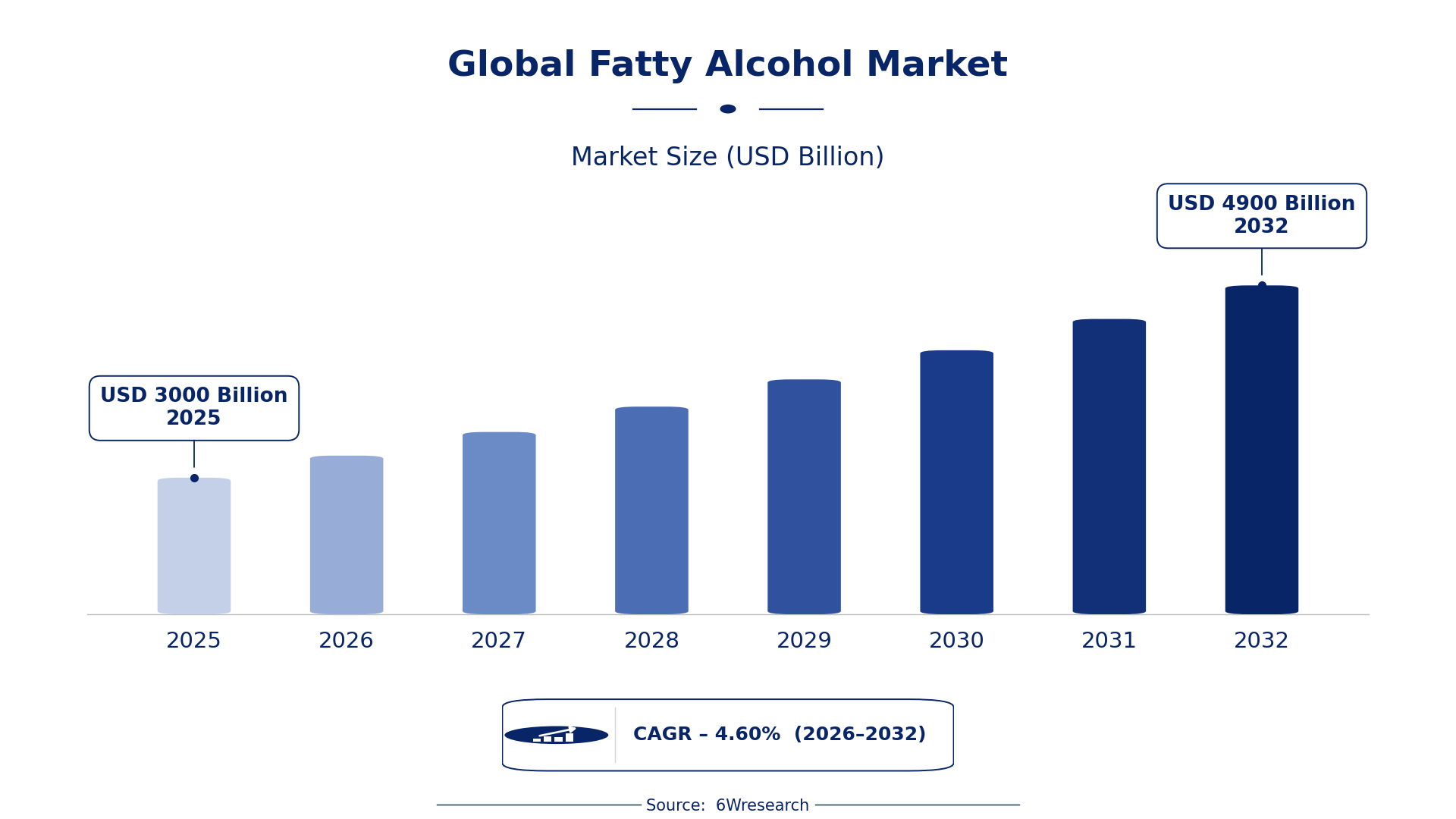
The Global Fatty Alcohol Market was estimated at USD 3000 Billion in 2025 and is projected to reach USD 4900 Billion by 2032, growing at a CAGR of 4.60% from 2026 to 2032.
Global Fatty Alcohol Market Synopsis
The Global Fatty Alcohol Market is undergoing notable shifts, primarily influenced by the increasing preference for bio-based products across multiple sectors. Industries such as personal care, which rigorously adhere to evolving consumer preferences for natural ingredients, are intensifying the demand for fatty alcohols derived from renewable resources.
Furthermore, the market dynamics are being reshaped by regulatory frameworks advocating for environmentally sustainable practices. The focus on biodegradable surfactants in cleaning and cosmetic products is driving manufacturers to prioritize fatty alcohols over synthetic alternatives, which are increasingly scrutinized for their ecological impacts.
Global Fatty Alcohol Market Year-wise Growth Rate and Key Drivers
This graph illustrates the annual growth rates of the Global Fatty Alcohol Market from 2022 to 2032, highlighting a steady upward trajectory and projected expansion over the forecast period.
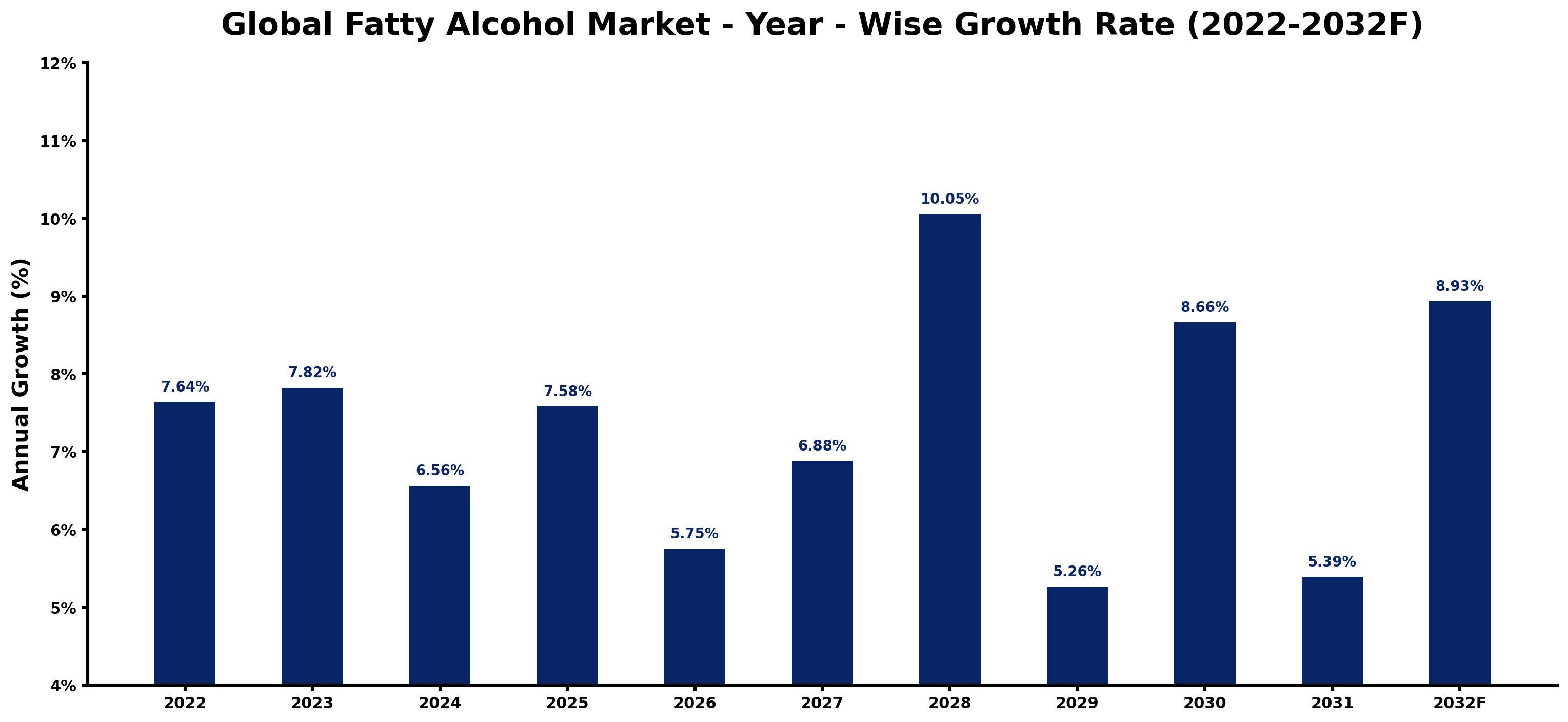
The table below presents the year‑wise growth rates along with the key drivers influencing the market
| Year | Growth Rate (%) | Major Drivers |
| 2022 | 7.64 | Manufacturers increasingly prioritize bio-based fatty alcohols to enhance sustainability efforts. |
| 2023 | 7.82 | Petrochemical cracking efficiencies improve supply chain dynamics for fatty alcohol production. |
| 2024 | 6.56 | Expanding competitive strategies compel fatty alcohol firms to innovate product formulations. |
| 2025 | 7.58 | Strengthening regional demand accelerates capacity expansion of the global fatty alcohol market. |
| 2026 | 5.75 | Growing environmental awareness drives consumer preferences towards green chemistry in fatty alcohols. |
| 2027 | 6.88 | A shift toward skilled labor in chemical processes advances fatty alcohol production capabilities. |
| 2028 | 10.05 | In North America, technology breakthroughs elevate the production efficiency of fatty alcohols. |
| 2029 | 5.26 | Regulatory compliance pressures drive major fatty alcohol companies to adopt sustainable practices. |
| 2030 | 8.66 | End-users increasingly seek cost-effective fatty alcohols to mitigate raw material price fluctuations. |
| 2031 | 5.39 | The incorporation of performance coatings in formulations influences fatty alcohol demand patterns. |
| 2032 | 8.93 | As investment in sustainable technologies rises, the fatty alcohol market is expected to thrive. |
Note - Market size estimations and growth projections presented in this report are based on 6Wresearch's proprietary research methodology, combining internal industry data, secondary research, and primary validation, updated periodically to reflect current market conditions. As markets evolve rapidly, figures for certain industries may vary slightly and are intended as informed estimates rather than absolute figures. For the most current market sizing, we recommend validating figures with a 6Wresearch analyst.
Global Fatty Alcohol Market Key Takeaways
Below are some of the specific key takeaways from the market, including:
- Asia-Pacific contributes approximately ~53% of the overall market share as of 2025, owing to robust demand from the personal care sector.
- The market for C12-C14 fatty alcohols is projected to grow at a CAGR of 5.2% from 2026 to 2032, primarily driven by their extensive use in cosmetic formulations.
- In 2022, BASF SE invested USD 300 million in expanding its fatty alcohol production capacity in Asia, highlighting the region's significance.
- The shift towards clean label products has contributed significantly to a 17% year-on-year increase in organic fatty alcohol consumption.
Evaluation of Restraints in Global Fatty Alcohol Market
Despite the expected growth, the Global Fatty Alcohol Market faces substantial challenges including fluctuating raw material prices, especially palm oil, which can rise up to 30% annually due to climatic factors. For example, the World Bank recently forecasted that the price of palm oil could reach USD 900 per ton in 2026, potentially squeezing margins for manufacturers who rely on palm oil as a primary feedstock. Moreover, regulatory environments demanding higher sustainability standards pose operational hurdles that can inhibit market entry for smaller producers.
Global Fatty Alcohol Market Trends
The landscape of the Global Fatty Alcohol Market is currently marked by three significant trends: the shift towards sustainable production methodologies, increasing application in innovative personal care products, and the escalation of bio-based product adoption. A notable case is the partnership between Kao Corporation and the Japanese government to develop bio-based surfactants, with an investment of USD 50 million announced in 2023. This collaboration aims to enhance product offerings while reducing environmental impacts.
In addition, the integration of automated technologies in production lines is streamlining operations, thereby reducing costs and increasing efficiency. Noteworthy, in 2023, Wilmar International unveiled a new technology that cuts production time by 20%, enhancing competitiveness in pricing.
Global Fatty Alcohol Market Opportunities
Several promising revenue opportunities are emerging within the Global Fatty Alcohol Market. Companies such as VVF LLC are actively exploring applications in bioplastics, with projected revenue growth driving a dedicated investment of USD 100 million over the next five years. This expansion aligns with the increasing regulatory pressures for sustainable alternatives to conventional plastics.
Furthermore, there's a growing trend toward fatty alcohol-based emulsifiers in the food industry, driven by a projected 12% CAGR increase in natural food product demand by 2030. This offers lucrative avenues for market players to diversify their product lines and secure a competitive foothold.
Global Fatty Alcohol Market by Product
In the Global Fatty Alcohol Market, the C12-C14 segment currently leads with a substantial market share of ~45% in 2025. This segment enjoys favor due to its versatile applications in personal care formulations, making it an industry staple. Conversely, the C15-C22 segment is the fastest-growing, with a projected CAGR of 6.8% from 2026 to 2032. Its increasing use in specialized industrial applications marks its rapid ascent and reflects a shift in consumer preference toward higher-purity fatty alcohols for niche markets.
Global Fatty Alcohol Market by Application
Among various applications, Personal Care emerges as the leading sector, commanding a market share of ~60% in 2025. The segment's popularity is largely attributed to the rising demand for natural and organic skincare products. In contrast, Soaps & Detergents is the fastest-growing application, expected to achieve a CAGR of 5.5% from 2026 to 2032, spurred by increasing consumer awareness regarding the efficacy and environmental impact of biodegradable cleaning products.
Global Fatty Alcohol Market by Region
The Asia-Pacific region dominates the Global Fatty Alcohol Market, holding a significant share of ~53% in 2025. This leadership stems from a robust manufacturing sector, coupled with high consumer demand in cosmetics and personal care. Notably, Latin America is anticipated to be the fastest-growing region, poised for a CAGR of 6.0% from 2026 to 2032, driven by expanding market access and investment in sustainable sourcing practices within the region.
Government Initiatives in the Global Fatty Alcohol Market
The regulatory environment surrounding the Global Fatty Alcohol Market is increasingly influenced by government attempts to promote sustainable practices. Numerous initiatives demonstrate a growing commitment to environmental stewardship, aiming to bolster the market competitiveness of bio-based fatty alcohols.
- Ministry of Environment, Japan: "Bio-Based Products Promotion Program," announced in April 2023, encourages local manufacturers to switch to sustainable raw materials.
- U.S. Environmental Protection Agency: "Sustainable Sourcing Initiative," launched in January 2023, aims to support companies that adopt eco-friendly fatty alcohols to reduce environmental footprints.
- European Commission: "Green Chemistry Action Plan," announced in July 2022, provides funding of EUR 50 million for research in sustainable fatty alcohol production.
- Government of India: "Palm Oil Sustainability Certification Program," established in March 2021, incentivizes producers utilizing palm oil sustainably, thereby impacting the fatty alcohol market's raw material sourcing.
Future Insights of the Global Fatty Alcohol Market
The Global Fatty Alcohol Market is expected to witness substantial structural shifts, especially with the rising focus on sustainable manufacturing practices. Investments such as BASF SE's USD 300 million expansion in Asia demonstrate a strategic pivot towards enhancing production capacity of renewable fatty alcohols. By 2032, we anticipate a notable transformation in supplier dynamics as firms increasingly pivot towards bio-based alternatives, driven by rising regulatory demands and consumer preferences for ecological products.
Global Fatty Alcohol Market Latest Developments
The competitive landscape of the Global Fatty Alcohol Market is evolving rapidly, marked by significant advancements aimed at sustainability and innovation. Below are recent noteworthy developments:
- In August 2023, KLK OLEO announced a new eco-friendly production process capable of reducing carbon emissions by 30%, positioning itself as a leader in sustainable practices.
- Recently, VVF LLC launched an extension of its product line with a bio-based fatty alcohol series aimed at personal care applications, expected to gain traction through 2024.
- In September 2023, Kao Corporation initiated a partnership with a renewable energy firm to achieve carbon neutrality in its fatty alcohol production by 2025.
- Ongoing in early 2024, Wilmar International is ramping up capacity at its manufacturing facilities in Southeast Asia, anticipating increased demand from the cleaning products sector.
Global Fatty Alcohol Market Key Players and Industry Positioning
The Global Fatty Alcohol Market is characterized by a fragmented competitive structure, with key players strategically positioning themselves through innovation and sustainability initiatives. This competitive model allows for a diverse array of products and applications, catering to varying industry needs.
| Leading Company | Core Strength | Strategic Focus |
|---|---|---|
| BASF SE | Robust R&D capabilities | Sustainable product development |
| VVF LLC | Diverse application scope | Expansion into bioplastics |
| Wilmar International | Strong regional manufacturing | Investment in automation |
| KLK OLEO | Focus on eco-friendly processes | Carbon reduction initiatives |
| Kao Corporation | Strong sustainability commitment | Bio-based product innovations |
As manufacturers continue to leverage their unique strengths, the competition will intensify, driving advancements in sustainable practices and product offerings across the market.
Key Attractiveness of the Report
- 10 Years of Market Numbers
- Historical Data Starting from 2022 to 2025
- Base Year: 2025
- Forecast Data until 2032
- Key Performance Indicators Impacting the Market
- Major Upcoming Developments and Projects
Key Highlights of the Report:
- Global Fatty Alcohol Market Outlook
- Market Size of Global Fatty Alcohol Market, 2025
- Forecast of Global Fatty Alcohol Market, 2032
- Historical Data and Forecast of Global Fatty Alcohol Revenues & Volume for the Period 2022-2032
- Global Fatty Alcohol Market Trend Evolution
- Global Fatty Alcohol Market Drivers and Challenges
- Global Fatty Alcohol Price Trends
- Global Fatty Alcohol Porter's Five Forces
- Global Fatty Alcohol Industry Life Cycle
- Historical Data and Forecast of Global Fatty Alcohol Market Revenues & Volume
- Historical Data and Forecast of Global Fatty Alcohol Market Revenues & Volume By Product for the Period 2022-2032
- Historical Data and Forecast of Global Fatty Alcohol Market Revenues & Volume By C6-C10 for the Period 2022-2032
- Historical Data and Forecast of Global Fatty Alcohol Market Revenues & Volume By C11-C14 for the Period 2022-2032
- Historical Data and Forecast of Global Fatty Alcohol Market Revenues & Volume By C15-C22 for the Period 2022-2032
- Historical Data and Forecast of Global Fatty Alcohol Market Revenues & Volume By Application for the Period 2022-2032
- Historical Data and Forecast of Global Fatty Alcohol Market Revenues & Volume By Soaps & Detergents for the Period 2022-2032
- Historical Data and Forecast of Global Fatty Alcohol Market Revenues & Volume By Personal Care for the Period 2022-2032
- Historical Data and Forecast of Global Fatty Alcohol Market Revenues & Volume By Lubricants for the Period 2022-2032
- Historical Data and Forecast of Global Fatty Alcohol Market Revenues & Volume By Amines for the Period 2022-2032
- Historical Data and Forecast of Global Fatty Alcohol Market Revenues & Volume By Others for the Period 2022-2032
- Historical Data and Forecast of North America Fatty Alcohol Market Revenues & Volume By Product for the Period 2022-2032
- Historical Data and Forecast of North America Fatty Alcohol Market Revenues & Volume By C6-C10 for the Period 2022-2032
- Historical Data and Forecast of North America Fatty Alcohol Market Revenues & Volume By C11-C14 for the Period 2022-2032
- Historical Data and Forecast of North America Fatty Alcohol Market Revenues & Volume By C15-C22 for the Period 2022-2032
- Historical Data and Forecast of North America Fatty Alcohol Market Revenues & Volume By Application for the Period 2022-2032
- Historical Data and Forecast of North America Fatty Alcohol Market Revenues & Volume By Soaps & Detergents for the Period 2022-2032
- Historical Data and Forecast of North America Fatty Alcohol Market Revenues & Volume By Personal Care for the Period 2022-2032
- Historical Data and Forecast of North America Fatty Alcohol Market Revenues & Volume By Lubricants for the Period 2022-2032
- Historical Data and Forecast of North America Fatty Alcohol Market Revenues & Volume By Amines for the Period 2022-2032
- Historical Data and Forecast of North America Fatty Alcohol Market Revenues & Volume By Others for the Period 2022-2032
- Historical Data and Forecast of United States of America Fatty Alcohol Market Revenues & Volume for the Period 2022-2032
- Historical Data and Forecast of Canada Fatty Alcohol Market Revenues & Volume for the Period 2022-2032
- Historical Data and Forecast of Rest of North America Fatty Alcohol Market Revenues & Volume for the Period 2022-2032
- Historical Data and Forecast of Latin America (LATAM) Fatty Alcohol Market Revenues & Volume By Product for the Period 2022-2032
- Historical Data and Forecast of Latin America (LATAM) Fatty Alcohol Market Revenues & Volume By C6-C10 for the Period 2022-2032
- Historical Data and Forecast of Latin America (LATAM) Fatty Alcohol Market Revenues & Volume By C11-C14 for the Period 2022-2032
- Historical Data and Forecast of Latin America (LATAM) Fatty Alcohol Market Revenues & Volume By C15-C22 for the Period 2022-2032
- Historical Data and Forecast of Latin America (LATAM) Fatty Alcohol Market Revenues & Volume By Application for the Period 2022-2032
- Historical Data and Forecast of Latin America (LATAM) Fatty Alcohol Market Revenues & Volume By Soaps & Detergents for the Period 2022-2032
- Historical Data and Forecast of Latin America (LATAM) Fatty Alcohol Market Revenues & Volume By Personal Care for the Period 2022-2032
- Historical Data and Forecast of Latin America (LATAM) Fatty Alcohol Market Revenues & Volume By Lubricants for the Period 2022-2032
- Historical Data and Forecast of Latin America (LATAM) Fatty Alcohol Market Revenues & Volume By Amines for the Period 2022-2032
- Historical Data and Forecast of Latin America (LATAM) Fatty Alcohol Market Revenues & Volume By Others for the Period 2022-2032
- Historical Data and Forecast of Brazil Fatty Alcohol Market Revenues & Volume for the Period 2022-2032
- Historical Data and Forecast of Mexico Fatty Alcohol Market Revenues & Volume for the Period 2022-2032
- Historical Data and Forecast of Argentina Fatty Alcohol Market Revenues & Volume for the Period 2022-2032
- Historical Data and Forecast of Rest of LATAM Fatty Alcohol Market Revenues & Volume for the Period 2022-2032
- Historical Data and Forecast of Asia Fatty Alcohol Market Revenues & Volume By Product for the Period 2022-2032
- Historical Data and Forecast of Asia Fatty Alcohol Market Revenues & Volume By C6-C10 for the Period 2022-2032
- Historical Data and Forecast of Asia Fatty Alcohol Market Revenues & Volume By C11-C14 for the Period 2022-2032
- Historical Data and Forecast of Asia Fatty Alcohol Market Revenues & Volume By C15-C22 for the Period 2022-2032
- Historical Data and Forecast of Asia Fatty Alcohol Market Revenues & Volume By Application for the Period 2022-2032
- Historical Data and Forecast of Asia Fatty Alcohol Market Revenues & Volume By Soaps & Detergents for the Period 2022-2032
- Historical Data and Forecast of Asia Fatty Alcohol Market Revenues & Volume By Personal Care for the Period 2022-2032
- Historical Data and Forecast of Asia Fatty Alcohol Market Revenues & Volume By Lubricants for the Period 2022-2032
- Historical Data and Forecast of Asia Fatty Alcohol Market Revenues & Volume By Amines for the Period 2022-2032
- Historical Data and Forecast of Asia Fatty Alcohol Market Revenues & Volume By Others for the Period 2022-2032
- Historical Data and Forecast of China Fatty Alcohol Market Revenues & Volume for the Period 2022-2032
- Historical Data and Forecast of India Fatty Alcohol Market Revenues & Volume for the Period 2022-2032
- Historical Data and Forecast of Japan Fatty Alcohol Market Revenues & Volume for the Period 2022-2032
- Historical Data and Forecast of Rest of Asia Fatty Alcohol Market Revenues & Volume for the Period 2022-2032
- Historical Data and Forecast of Africa Fatty Alcohol Market Revenues & Volume By Product for the Period 2022-2032
- Historical Data and Forecast of Africa Fatty Alcohol Market Revenues & Volume By C6-C10 for the Period 2022-2032
- Historical Data and Forecast of Africa Fatty Alcohol Market Revenues & Volume By C11-C14 for the Period 2022-2032
- Historical Data and Forecast of Africa Fatty Alcohol Market Revenues & Volume By C15-C22 for the Period 2022-2032
- Historical Data and Forecast of Africa Fatty Alcohol Market Revenues & Volume By Application for the Period 2022-2032
- Historical Data and Forecast of Africa Fatty Alcohol Market Revenues & Volume By Soaps & Detergents for the Period 2022-2032
- Historical Data and Forecast of Africa Fatty Alcohol Market Revenues & Volume By Personal Care for the Period 2022-2032
- Historical Data and Forecast of Africa Fatty Alcohol Market Revenues & Volume By Lubricants for the Period 2022-2032
- Historical Data and Forecast of Africa Fatty Alcohol Market Revenues & Volume By Amines for the Period 2022-2032
- Historical Data and Forecast of Africa Fatty Alcohol Market Revenues & Volume By Others for the Period 2022-2032
- Historical Data and Forecast of South Africa Fatty Alcohol Market Revenues & Volume for the Period 2022-2032
- Historical Data and Forecast of Nigeria Fatty Alcohol Market Revenues & Volume for the Period 2022-2032
- Historical Data and Forecast of Egypt Fatty Alcohol Market Revenues & Volume for the Period 2022-2032
- Historical Data and Forecast of Rest of Africa Fatty Alcohol Market Revenues & Volume for the Period 2022-2032
- Historical Data and Forecast of Europe Fatty Alcohol Market Revenues & Volume By Product for the Period 2022-2032
- Historical Data and Forecast of Europe Fatty Alcohol Market Revenues & Volume By C6-C10 for the Period 2022-2032
- Historical Data and Forecast of Europe Fatty Alcohol Market Revenues & Volume By C11-C14 for the Period 2022-2032
- Historical Data and Forecast of Europe Fatty Alcohol Market Revenues & Volume By C15-C22 for the Period 2022-2032
- Historical Data and Forecast of Europe Fatty Alcohol Market Revenues & Volume By Application for the Period 2022-2032
- Historical Data and Forecast of Europe Fatty Alcohol Market Revenues & Volume By Soaps & Detergents for the Period 2022-2032
- Historical Data and Forecast of Europe Fatty Alcohol Market Revenues & Volume By Personal Care for the Period 2022-2032
- Historical Data and Forecast of Europe Fatty Alcohol Market Revenues & Volume By Lubricants for the Period 2022-2032
- Historical Data and Forecast of Europe Fatty Alcohol Market Revenues & Volume By Amines for the Period 2022-2032
- Historical Data and Forecast of Europe Fatty Alcohol Market Revenues & Volume By Others for the Period 2022-2032
- Historical Data and Forecast of United Kingdom Fatty Alcohol Market Revenues & Volume for the Period 2022-2032
- Historical Data and Forecast of France Fatty Alcohol Market Revenues & Volume for the Period 2022-2032
- Historical Data and Forecast of Germany Fatty Alcohol Market Revenues & Volume for the Period 2022-2032
- Historical Data and Forecast of Rest of Europe Fatty Alcohol Market Revenues & Volume for the Period 2022-2032
- Historical Data and Forecast of Middle East Fatty Alcohol Market Revenues & Volume By Product for the Period 2022-2032
- Historical Data and Forecast of Middle East Fatty Alcohol Market Revenues & Volume By C6-C10 for the Period 2022-2032
- Historical Data and Forecast of Middle East Fatty Alcohol Market Revenues & Volume By C11-C14 for the Period 2022-2032
- Historical Data and Forecast of Middle East Fatty Alcohol Market Revenues & Volume By C15-C22 for the Period 2022-2032
- Historical Data and Forecast of Middle East Fatty Alcohol Market Revenues & Volume By Application for the Period 2022-2032
- Historical Data and Forecast of Middle East Fatty Alcohol Market Revenues & Volume By Soaps & Detergents for the Period 2022-2032
- Historical Data and Forecast of Middle East Fatty Alcohol Market Revenues & Volume By Personal Care for the Period 2022-2032
- Historical Data and Forecast of Middle East Fatty Alcohol Market Revenues & Volume By Lubricants for the Period 2022-2032
- Historical Data and Forecast of Middle East Fatty Alcohol Market Revenues & Volume By Amines for the Period 2022-2032
- Historical Data and Forecast of Middle East Fatty Alcohol Market Revenues & Volume By Others for the Period 2022-2032
- Historical Data and Forecast of Saudi Arabia Fatty Alcohol Market Revenues & Volume for the Period 2022-2032
- Historical Data and Forecast of UAE Fatty Alcohol Market Revenues & Volume for the Period 2022-2032
- Historical Data and Forecast of Turkey Fatty Alcohol Market Revenues & Volume for the Period 2022-2032
- Historical Data and Forecast of Rest of Middle East Fatty Alcohol Market Revenues & Volume for the Period 2022-2032
- Global Fatty Alcohol Market - Key Performance Indicators
- Global Fatty Alcohol Market - Import Export Trade Statistics
- Global Fatty Alcohol Market - Opportunity Assessment By Countries
- Global Fatty Alcohol Market - Opportunity Assessment By Product
- Global Fatty Alcohol Market - Opportunity Assessment By Application
- Global Fatty Alcohol Market - Top Companies Market Share
- Global Fatty Alcohol Market - Top Companies Profiles
- Global Fatty Alcohol Market - Comparison of Players in Technical and Operating Parameters
- Global Fatty Alcohol Market - Strategic Recommendations
Markets Covered
The Global Fatty Alcohol Market report provides a detailed analysis of the following market segments:
By Regions and Countries:
- North America
- Europe
- LATAM
- Middle East
- Asia
- Africa
By Product:
- C6-C10
- C11-C14
- C15-C22
By Application:
- Soaps & Detergents
- Personal Care
- Lubricants
- Amines
- Others






































