Global Flavor and Fragrance Market Highlights
| Market Size (2025) | USD 30.5 Billion |
| Forecast Size (2032) | USD 44.8 Billion |
| CAGR | 6.90% |
| Base Year | 2025 |
| Forecast Period | 2026-2032 |
| Largest Region | North America |
| Fastest Growing Region | Asia |
| Largest Segment | Natural |
| Fastest Growing Segment | Synthetic |
| Leading Companies | Givaudan, Firmenich, IFF, Symrise, Takasago |
Global Flavor and Fragrance Market Size & Growth Rate (2026-2032)
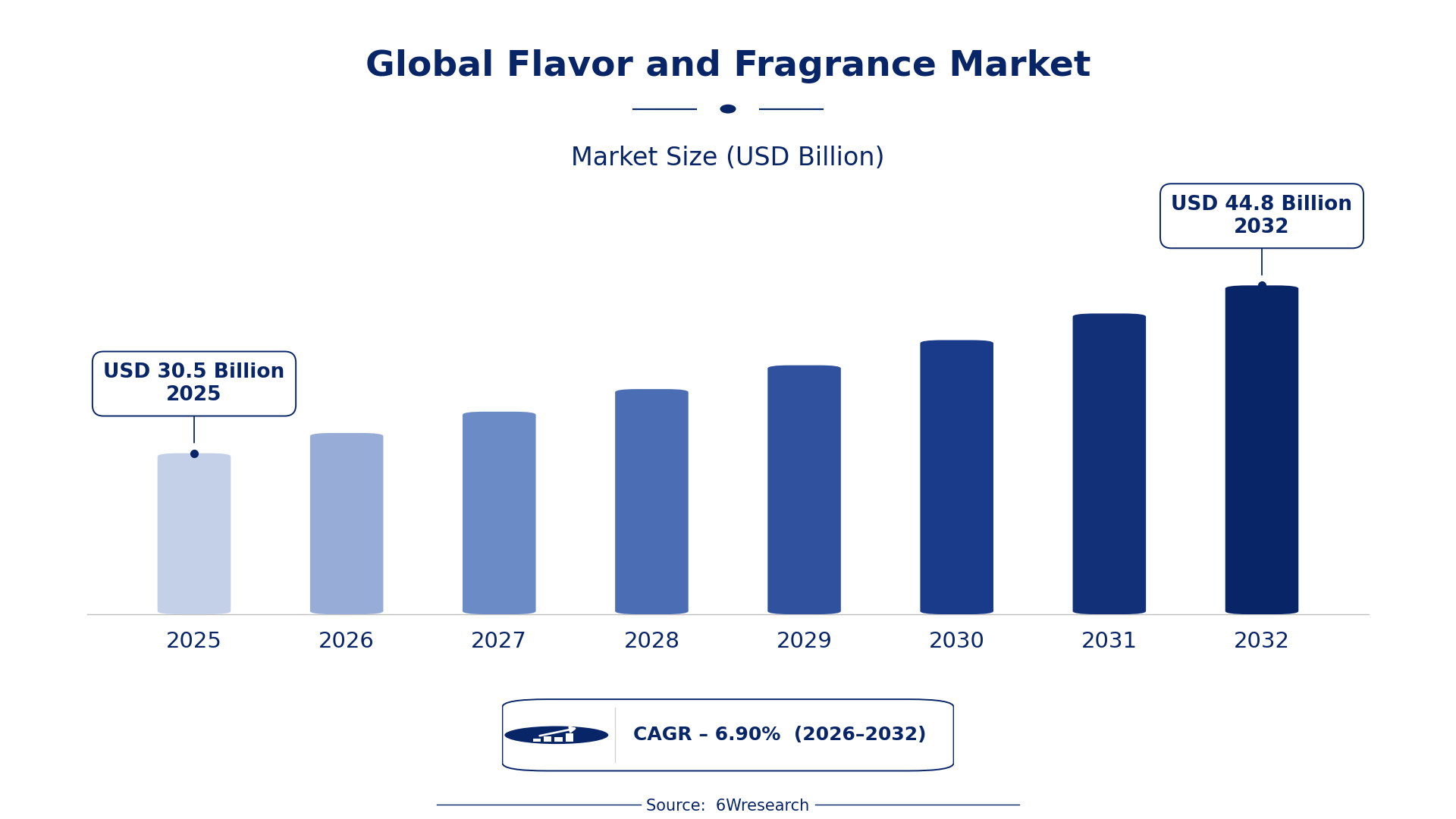
The Global Flavor and Fragrance Market was estimated at USD 30.5 Billion in 2025 and is projected to reach USD 44.8 Billion by 2032, growing at a CAGR of 6.90% from 2026 to 2032.
Global Flavor and Fragrance Market Synopsis
The dynamics of the Global Flavor and Fragrance Market are shifting rapidly, influenced by increased consumer interest in natural ingredients and clean-label products. Industries such as food and beverage are re-evaluating their sourcing strategies to incorporate more sustainable practices. This modernization signals a fundamental change in how flavors and fragrances are perceived and consumed, pushing companies to innovate continually.
Amidst these shifts, companies are also focusing on digital platforms for distribution, particularly in regions where traditional retail is losing ground. The demand for novel sensory experiences is more pronounced, leading to an uptick in unique flavor offerings aimed at niche markets. As established players and newcomers alike navigate these trends, strategic partnerships and investments in research and development are becoming essential for maintaining a competitive edge.
Global Flavor and Fragrance Market Year-wise Growth Rate and Key Drivers
This graph illustrates the annual growth rates of the Global Flavor and Fragrance Market from 2022 to 2032, highlighting a steady upward trajectory and projected expansion over the forecast period.
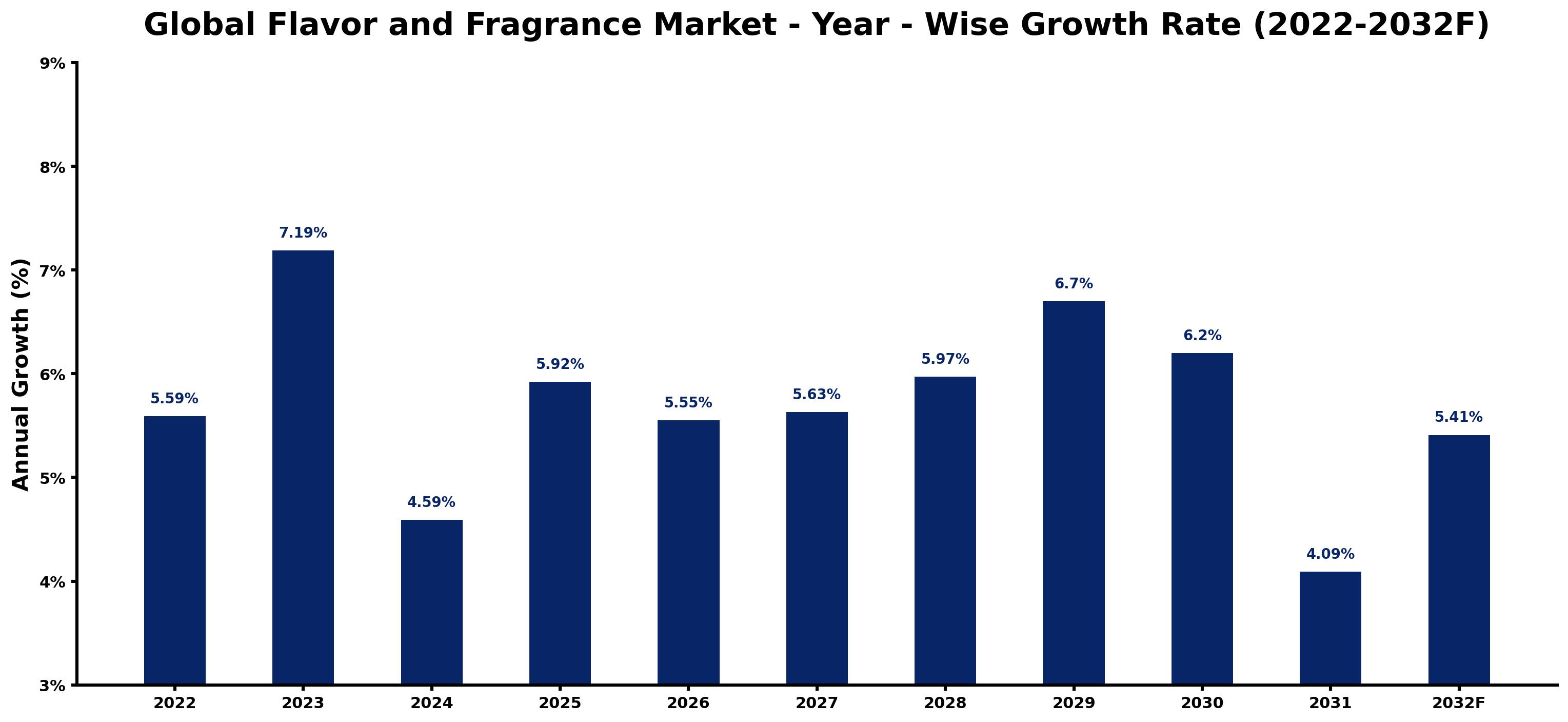
The table below presents the year‑wise growth rates along with the key drivers influencing the market
| Year | Growth Rate (%) | Major Drivers |
| 2022 | 5.59 | A skilled workforce in flavor and fragrance production enhances operational efficiency. |
| 2023 | 7.19 | While global mergers and acquisitions increase, flavor and fragrance investments rise steadily. |
| 2024 | 4.59 | Petrochemical cracking technologies reveal supply chain vulnerabilities affecting fragrance availability. |
| 2025 | 5.92 | Sustainability initiatives among manufacturers enhance bio-based flavor and fragrance offerings. |
| 2026 | 5.55 | An increase in consumer awareness leads to greater demand for eco-friendly fragrances. |
| 2027 | 5.63 | In North America, fragrance firms expand product lines to meet evolving consumer preferences. |
| 2028 | 5.97 | Increasing feedstock pricing pressures the profitability of flavor and fragrance production methods. |
| 2029 | 6.7 | Manufacturers innovate new resin formulations to improve fragrance longevity and market appeal. |
| 2030 | 6.2 | A shift toward natural flavors and fragrances transforms consumer purchasing behavior significantly. |
| 2031 | 4.09 | Consolidating product offerings strengthens competitive positions among leading fragrance manufacturers. |
| 2032 | 5.41 | Customers in the food and beverage sector adapt to new REACH regulations for flavors. |
Note - Market size estimations and growth projections presented in this report are based on 6Wresearch's proprietary research methodology, combining internal industry data, secondary research, and primary validation, updated periodically to reflect current market conditions. As markets evolve rapidly, figures for certain industries may vary slightly and are intended as informed estimates rather than absolute figures. For the most current market sizing, we recommend validating figures with a 6Wresearch analyst.
Global Flavor and Fragrance Market Key Takeaways
Below are some of the specific key takeaways from the market, including:
- Natural flavors hold nearly 55% share of the total market as of 2025, reflecting consumer preference for healthier options.
- The synthetic segment is anticipated to grow at a CAGR of 7.5% from 2026 to 2032, driven by demand for versatility in applications.
- North America is the largest market, accounting for around 40% of total revenues, owing to high consumption rates in food and beverages.
- Companies like Givaudan have increased R&D spend, which reached USD 350 million in 2022, to develop sustainable product lines.
- In Asia, emerging markets are poised for growth, with a projected CAGR of 8.2% from 2026 to 2032, fueled by urbanization and rising disposable incomes.
Evaluation of Restraints in Global Flavor and Fragrance Market
The Global Flavor and Fragrance Market faces several critical restraints, primarily from regulatory challenges and raw material costs. For example, the recent EC Regulation 2019/1381 on food additives has imposed stringent labeling requirements that can hinder producers' operational flexibility and increase compliance costs. These challenges are compounded by raw material fluctuations; prices for essential oils have increased by as much as 20% in the past year due to supply chain disruptions and climate change impacts. This scenario necessitates that companies adopt agile strategies to manage costs and adhere to regulations simultaneously.
Global Flavor and Fragrance Market Trends
One distinct trend in the Global Flavor and Fragrance Market is the increasing emphasis on transparency and ethical sourcing. Companies are adopting blockchain technology to trace ingredient origins, significantly enhancing consumer trust. For instance, in 2022, Firmenich began integrating blockchain in its sourcing processes to ensure ingredient authenticity. Furthermore, automation in production processes is becoming more prevalent, streamlining operations and reducing labor costs. Leading firms like IFF have implemented advanced robotic systems, realizing an increase in efficiency of about 25% in their production lines compared to traditional methods. Such shifts not only improve productivity but also align with environmentally friendly manufacturing standards.
Global Flavor and Fragrance Market Opportunities
The evolving regulatory landscape presents unique revenue opportunities for the Global Flavor and Fragrance Market, particularly in the natural and organic segments. For example, as demand for organic products climbs, Takasago is investing USD 50 million into developing a new line of organic flavors, which is expected to generate significant revenue by 2028. Beyond organic growth, technological advancements like AI in flavor formulation also present opportunities; companies can reduce time-to-market by leveraging AI algorithms that predict consumer preferences more accurately. This competitive advantage enables manufacturers to tailor their products to market needs swiftly.
Global Flavor and Fragrance Market by Type
Natural flavors dominate the Global Flavor and Fragrance Market, holding around 55% share in 2025, largely due to consumer demand for health-conscious options. Meanwhile, synthetic flavors represent the fastest-growing segment, with a CAGR of 7.5% from 2026 to 2032. This growth can be attributed to their adaptability and cost-effectiveness in a variety of applications, ranging from food products to personal care items, making them highly appealing to manufacturers.
Global Flavor and Fragrance Market by Application
The largest application segment in the Global Flavor and Fragrance Market is Food, accounting for approximately 50% share in 2025. This segment is driven by persistent consumer interest in unique flavors and culinary experimentation. On the other hand, the fastest-growing application is Beauty and Personal Care, projected to experience a CAGR of 8.3% from 2026 to 2032. The rising demand for personalized beauty products has led companies to innovate fragrance offerings that align with individual consumer preferences and emerging wellness trends.
Global Flavor and Fragrance Market by Region
North America remains the largest region in the Global Flavor and Fragrance Market, capturing about 40% share as of 2025, largely driven by robust demand across food and beverage sectors. Conversely, the fastest-growing region is Asia, expected to grow at a CAGR of 8.2% from 2026 to 2032. This growth trajectory is propelled by rapid urbanization, changing dietary preferences, and increasing disposable incomes in countries like China and India, creating ripe conditions for flavor and fragrance innovations.
Government Initiatives in the Global Flavor and Fragrance Market
In the Global Flavor and Fragrance Market, government initiatives play a crucial role in shaping operational practices and encouraging sustainable development. Regulatory bodies around the world are increasingly focusing on food safety and environmental impact, which directly influence market dynamics. Understanding these initiatives can provide companies with insights that enhance compliance and align strategies for future growth.
- The European Food Safety Authority (EFSA) enacted the Food Information Regulation in December 2020, which mandates clear labeling for flavoring substances, benefitting companies that prioritize transparency.
- The United States Department of Agriculture (USDA) launched the Organic Integrity Initiative in 2021, providing funding and support to companies involved in organic food flavoring, thus stimulating growth in the organic segment.
- In India, the Food Safety and Standards Authority (FSSAI) issued guidelines in March 2023 to standardize labeling practices for flavor additives, enhancing consumer protection and trust.
- The Australian government has committed USD 10 million towards the Sustainable Food Flavors Initiative, expected to commence in late 2024, aimed at promoting sustainable sourcing practices in flavor production.
Future Insights of the Global Flavor and Fragrance Market
As the Global Flavor and Fragrance Market progresses towards 2032, a notable shift towards synthetic biology is expected. Companies like Givaudan are investing in biotechnological solutions to create flavors that accurately mimic natural profiles while reducing environmental impact. This trend may facilitate a more sustainable sourcing approach, helping to mitigate supply chain vulnerabilities due to climate change and resource scarcity. Furthermore, emerging markets in Asia are likely to increasingly adopt digital technologies for personalized consumer experiences, indicating a transformative phase ahead.
Global Flavor and Fragrance Market Latest Developments
Recent advancements in the Global Flavor and Fragrance Market are indicative of robust strategies employed by key players to strengthen their market positions. The following developments highlight this momentum:
- In mid-2023, Symrise launched a new line of flavor compounds designed specifically for plant-based foods, aligning with rising consumer preferences for vegan options.
- Givaudan is currently collaborating with biotechnology firms to develop sustainable ingredients, aiming to reduce reliance on traditional farming methods by 2025.
- Recently, IFF announced the acquisition of a flavor company specializing in natural extracts, enhancing its product diversification and technological capabilities.
- Upcoming in late 2024, Takasago plans to introduce an AI-driven platform for flavor development, which is expected to shorten the product development cycle significantly.
Global Flavor and Fragrance Market Key Players and Industry Positioning
The Global Flavor and Fragrance Market is relatively consolidated, with a few leading companies commanding significant market share. These firms leverage advanced technologies and extensive global networks to establish competitive advantages, while also focusing on sustainability and innovation to drive future growth.
| Leading Company | Core Strength | Strategic Focus |
|---|---|---|
| Givaudan | Biotechnological innovations and R&D capabilities | Expanding sustainable product lines |
| Firmenich | Extensive portfolio of natural ingredients | Enhancing ingredient transparency through blockchain |
| IFF | Diverse applications across fragrances and flavors | Acquisitions to broaden natural flavor offerings |
| Symrise | Strong global distribution and market reach | Investing in innovative plant-based solutions |
| Takasago | Expertise in flavor formulation and consumer insights | AI integration in product development processes |
The competitive landscape is marked by these companies' focus on sustainability and technological advancements, signaling a dynamic shift in the industry's future.
Key Attractiveness of the Report
- 10 Years of Market Numbers
- Historical Data Starting from 2022 to 2025
- Base Year: 2025
- Forecast Data until 2032
- Key Performance Indicators Impacting the Market
- Major Upcoming Developments and Projects
Key Highlights of the Report:
- Global Flavor and Fragrance Market Outlook
- Market Size of Global Flavor and Fragrance Market, 2025
- Forecast of Global Flavor and Fragrance Market, 2032
- Historical Data and Forecast of Global Flavor and Fragrance Revenues & Volume for the Period 2022-2032
- Global Flavor and Fragrance Market Trend Evolution
- Global Flavor and Fragrance Market Drivers and Challenges
- Global Flavor and Fragrance Price Trends
- Global Flavor and Fragrance Porter's Five Forces
- Global Flavor and Fragrance Industry Life Cycle
- Historical Data and Forecast of Global Flavor and Fragrance Market Revenues & Volume
- Historical Data and Forecast of Global Flavor and Fragrance Market Revenues & Volume By Type for the Period 2022-2032
- Historical Data and Forecast of Global Flavor and Fragrance Market Revenues & Volume By Synthetic for the Period 2022-2032
- Historical Data and Forecast of Global Flavor and Fragrance Market Revenues & Volume By Natural for the Period 2022-2032
- Historical Data and Forecast of Global Flavor and Fragrance Market Revenues & Volume By Application for the Period 2022-2032
- Historical Data and Forecast of Global Flavor and Fragrance Market Revenues & Volume By Food for the Period 2022-2032
- Historical Data and Forecast of Global Flavor and Fragrance Market Revenues & Volume By Beverage for the Period 2022-2032
- Historical Data and Forecast of Global Flavor and Fragrance Market Revenues & Volume By Beauty and Personal Care for the Period 2022-2032
- Historical Data and Forecast of Global Flavor and Fragrance Market Revenues & Volume By Perfumes for the Period 2022-2032
- Historical Data and Forecast of Global Flavor and Fragrance Market Revenues & Volume By Others for the Period 2022-2032
- Historical Data and Forecast of North America Flavor and Fragrance Market Revenues & Volume By Type for the Period 2022-2032
- Historical Data and Forecast of North America Flavor and Fragrance Market Revenues & Volume By Synthetic for the Period 2022-2032
- Historical Data and Forecast of North America Flavor and Fragrance Market Revenues & Volume By Natural for the Period 2022-2032
- Historical Data and Forecast of North America Flavor and Fragrance Market Revenues & Volume By Application for the Period 2022-2032
- Historical Data and Forecast of North America Flavor and Fragrance Market Revenues & Volume By Food for the Period 2022-2032
- Historical Data and Forecast of North America Flavor and Fragrance Market Revenues & Volume By Beverage for the Period 2022-2032
- Historical Data and Forecast of North America Flavor and Fragrance Market Revenues & Volume By Beauty and Personal Care for the Period 2022-2032
- Historical Data and Forecast of North America Flavor and Fragrance Market Revenues & Volume By Perfumes for the Period 2022-2032
- Historical Data and Forecast of North America Flavor and Fragrance Market Revenues & Volume By Others for the Period 2022-2032
- Historical Data and Forecast of United States of America Flavor and Fragrance Market Revenues & Volume for the Period 2022-2032
- Historical Data and Forecast of Canada Flavor and Fragrance Market Revenues & Volume for the Period 2022-2032
- Historical Data and Forecast of Rest of North America Flavor and Fragrance Market Revenues & Volume for the Period 2022-2032
- Historical Data and Forecast of Latin America (LATAM) Flavor and Fragrance Market Revenues & Volume By Type for the Period 2022-2032
- Historical Data and Forecast of Latin America (LATAM) Flavor and Fragrance Market Revenues & Volume By Synthetic for the Period 2022-2032
- Historical Data and Forecast of Latin America (LATAM) Flavor and Fragrance Market Revenues & Volume By Natural for the Period 2022-2032
- Historical Data and Forecast of Latin America (LATAM) Flavor and Fragrance Market Revenues & Volume By Application for the Period 2022-2032
- Historical Data and Forecast of Latin America (LATAM) Flavor and Fragrance Market Revenues & Volume By Food for the Period 2022-2032
- Historical Data and Forecast of Latin America (LATAM) Flavor and Fragrance Market Revenues & Volume By Beverage for the Period 2022-2032
- Historical Data and Forecast of Latin America (LATAM) Flavor and Fragrance Market Revenues & Volume By Beauty and Personal Care for the Period 2022-2032
- Historical Data and Forecast of Latin America (LATAM) Flavor and Fragrance Market Revenues & Volume By Perfumes for the Period 2022-2032
- Historical Data and Forecast of Latin America (LATAM) Flavor and Fragrance Market Revenues & Volume By Others for the Period 2022-2032
- Historical Data and Forecast of Brazil Flavor and Fragrance Market Revenues & Volume for the Period 2022-2032
- Historical Data and Forecast of Mexico Flavor and Fragrance Market Revenues & Volume for the Period 2022-2032
- Historical Data and Forecast of Argentina Flavor and Fragrance Market Revenues & Volume for the Period 2022-2032
- Historical Data and Forecast of Rest of LATAM Flavor and Fragrance Market Revenues & Volume for the Period 2022-2032
- Historical Data and Forecast of Asia Flavor and Fragrance Market Revenues & Volume By Type for the Period 2022-2032
- Historical Data and Forecast of Asia Flavor and Fragrance Market Revenues & Volume By Synthetic for the Period 2022-2032
- Historical Data and Forecast of Asia Flavor and Fragrance Market Revenues & Volume By Natural for the Period 2022-2032
- Historical Data and Forecast of Asia Flavor and Fragrance Market Revenues & Volume By Application for the Period 2022-2032
- Historical Data and Forecast of Asia Flavor and Fragrance Market Revenues & Volume By Food for the Period 2022-2032
- Historical Data and Forecast of Asia Flavor and Fragrance Market Revenues & Volume By Beverage for the Period 2022-2032
- Historical Data and Forecast of Asia Flavor and Fragrance Market Revenues & Volume By Beauty and Personal Care for the Period 2022-2032
- Historical Data and Forecast of Asia Flavor and Fragrance Market Revenues & Volume By Perfumes for the Period 2022-2032
- Historical Data and Forecast of Asia Flavor and Fragrance Market Revenues & Volume By Others for the Period 2022-2032
- Historical Data and Forecast of China Flavor and Fragrance Market Revenues & Volume for the Period 2022-2032
- Historical Data and Forecast of India Flavor and Fragrance Market Revenues & Volume for the Period 2022-2032
- Historical Data and Forecast of Japan Flavor and Fragrance Market Revenues & Volume for the Period 2022-2032
- Historical Data and Forecast of Rest of Asia Flavor and Fragrance Market Revenues & Volume for the Period 2022-2032
- Historical Data and Forecast of Africa Flavor and Fragrance Market Revenues & Volume By Type for the Period 2022-2032
- Historical Data and Forecast of Africa Flavor and Fragrance Market Revenues & Volume By Synthetic for the Period 2022-2032
- Historical Data and Forecast of Africa Flavor and Fragrance Market Revenues & Volume By Natural for the Period 2022-2032
- Historical Data and Forecast of Africa Flavor and Fragrance Market Revenues & Volume By Application for the Period 2022-2032
- Historical Data and Forecast of Africa Flavor and Fragrance Market Revenues & Volume By Food for the Period 2022-2032
- Historical Data and Forecast of Africa Flavor and Fragrance Market Revenues & Volume By Beverage for the Period 2022-2032
- Historical Data and Forecast of Africa Flavor and Fragrance Market Revenues & Volume By Beauty and Personal Care for the Period 2022-2032
- Historical Data and Forecast of Africa Flavor and Fragrance Market Revenues & Volume By Perfumes for the Period 2022-2032
- Historical Data and Forecast of Africa Flavor and Fragrance Market Revenues & Volume By Others for the Period 2022-2032
- Historical Data and Forecast of South Africa Flavor and Fragrance Market Revenues & Volume for the Period 2022-2032
- Historical Data and Forecast of Nigeria Flavor and Fragrance Market Revenues & Volume for the Period 2022-2032
- Historical Data and Forecast of Egypt Flavor and Fragrance Market Revenues & Volume for the Period 2022-2032
- Historical Data and Forecast of Rest of Africa Flavor and Fragrance Market Revenues & Volume for the Period 2022-2032
- Historical Data and Forecast of Europe Flavor and Fragrance Market Revenues & Volume By Type for the Period 2022-2032
- Historical Data and Forecast of Europe Flavor and Fragrance Market Revenues & Volume By Synthetic for the Period 2022-2032
- Historical Data and Forecast of Europe Flavor and Fragrance Market Revenues & Volume By Natural for the Period 2022-2032
- Historical Data and Forecast of Europe Flavor and Fragrance Market Revenues & Volume By Application for the Period 2022-2032
- Historical Data and Forecast of Europe Flavor and Fragrance Market Revenues & Volume By Food for the Period 2022-2032
- Historical Data and Forecast of Europe Flavor and Fragrance Market Revenues & Volume By Beverage for the Period 2022-2032
- Historical Data and Forecast of Europe Flavor and Fragrance Market Revenues & Volume By Beauty and Personal Care for the Period 2022-2032
- Historical Data and Forecast of Europe Flavor and Fragrance Market Revenues & Volume By Perfumes for the Period 2022-2032
- Historical Data and Forecast of Europe Flavor and Fragrance Market Revenues & Volume By Others for the Period 2022-2032
- Historical Data and Forecast of United Kingdom Flavor and Fragrance Market Revenues & Volume for the Period 2022-2032
- Historical Data and Forecast of France Flavor and Fragrance Market Revenues & Volume for the Period 2022-2032
- Historical Data and Forecast of Germany Flavor and Fragrance Market Revenues & Volume for the Period 2022-2032
- Historical Data and Forecast of Rest of Europe Flavor and Fragrance Market Revenues & Volume for the Period 2022-2032
- Historical Data and Forecast of Middle East Flavor and Fragrance Market Revenues & Volume By Type for the Period 2022-2032
- Historical Data and Forecast of Middle East Flavor and Fragrance Market Revenues & Volume By Synthetic for the Period 2022-2032
- Historical Data and Forecast of Middle East Flavor and Fragrance Market Revenues & Volume By Natural for the Period 2022-2032
- Historical Data and Forecast of Middle East Flavor and Fragrance Market Revenues & Volume By Application for the Period 2022-2032
- Historical Data and Forecast of Middle East Flavor and Fragrance Market Revenues & Volume By Food for the Period 2022-2032
- Historical Data and Forecast of Middle East Flavor and Fragrance Market Revenues & Volume By Beverage for the Period 2022-2032
- Historical Data and Forecast of Middle East Flavor and Fragrance Market Revenues & Volume By Beauty and Personal Care for the Period 2022-2032
- Historical Data and Forecast of Middle East Flavor and Fragrance Market Revenues & Volume By Perfumes for the Period 2022-2032
- Historical Data and Forecast of Middle East Flavor and Fragrance Market Revenues & Volume By Others for the Period 2022-2032
- Historical Data and Forecast of Saudi Arabia Flavor and Fragrance Market Revenues & Volume for the Period 2022-2032
- Historical Data and Forecast of UAE Flavor and Fragrance Market Revenues & Volume for the Period 2022-2032
- Historical Data and Forecast of Turkey Flavor and Fragrance Market Revenues & Volume for the Period 2022-2032
- Historical Data and Forecast of Rest of Middle East Flavor and Fragrance Market Revenues & Volume for the Period 2022-2032
- Global Flavor and Fragrance Market - Key Performance Indicators
- Global Flavor and Fragrance Market - Import Export Trade Statistics
- Global Flavor and Fragrance Market - Opportunity Assessment By Countries
- Global Flavor and Fragrance Market - Opportunity Assessment By Type
- Global Flavor and Fragrance Market - Opportunity Assessment By Application
- Global Flavor and Fragrance Market - Top Companies Market Share
- Global Flavor and Fragrance Market - Top Companies Profiles
- Global Flavor and Fragrance Market - Comparison of Players in Technical and Operating Parameters
- Global Flavor and Fragrance Market - Strategic Recommendations
Markets Covered
The Global Flavor and Fragrance Market report provides a detailed analysis of the following market segments:
By Regions and Countries:
- North America
- Europe
- LATAM
- Middle East
- Asia
- Africa
By Type:
- Synthetic
- Natural
By Application:
- Food
- Beverage
- Beauty
- Personal Care
- Perfumes
- Others






































