Global FLAVOR & FRAGRANCES Market (2026-2032) | Investment Trends, Consumer Insights, Share, Segmentation, Demand, Segments, Supply, Trends, Opportunities, Forecast, Strategic Insights, Competitive, Growth, Strategy, Companies, Size, Outlook, Analysis, Restraints, Industry, Challenges, Revenue, Drivers, Value, Pricing Analysis, Competition
Market Forecast by Regions and Countries (North America, Europe, LATAM, Middle East, Asia and Africa), By Type (Synthetic, Natural), By Application (Food, Beverage, Beauty and Personal Care, Perfumes) And Competitive Landscape
| Product Code: ETC13195115 | Publication Date: Apr 2025 | Updated Date: Sep 2026 | Product Type: Market Research Report | |
| Publisher: 6Wresearch | Author: Sumit Sagar | No. of Pages: 190 | No. of Figures: 80 | No. of Tables: 40 |
Global FLAVOR & FRAGRANCES Market Highlights
| Market Size (2025) | USD 34 Billion |
| Forecast Size (2032) | USD 46 Billion |
| CAGR | 5.00% |
| Base Year | 2025 |
| Forecast Period | 2026-2032 |
| Largest Region | North America |
| Fastest Growing Region | Asia |
| Largest Segment | Synthetic |
| Fastest Growing Segment | Natural |
| Leading Companies | Givaudan, Firmenich, International Flavors & Fragrances, Symrise, Takasago |
Global FLAVOR & FRAGRANCES Market Size & Growth Rate (2026-2032)
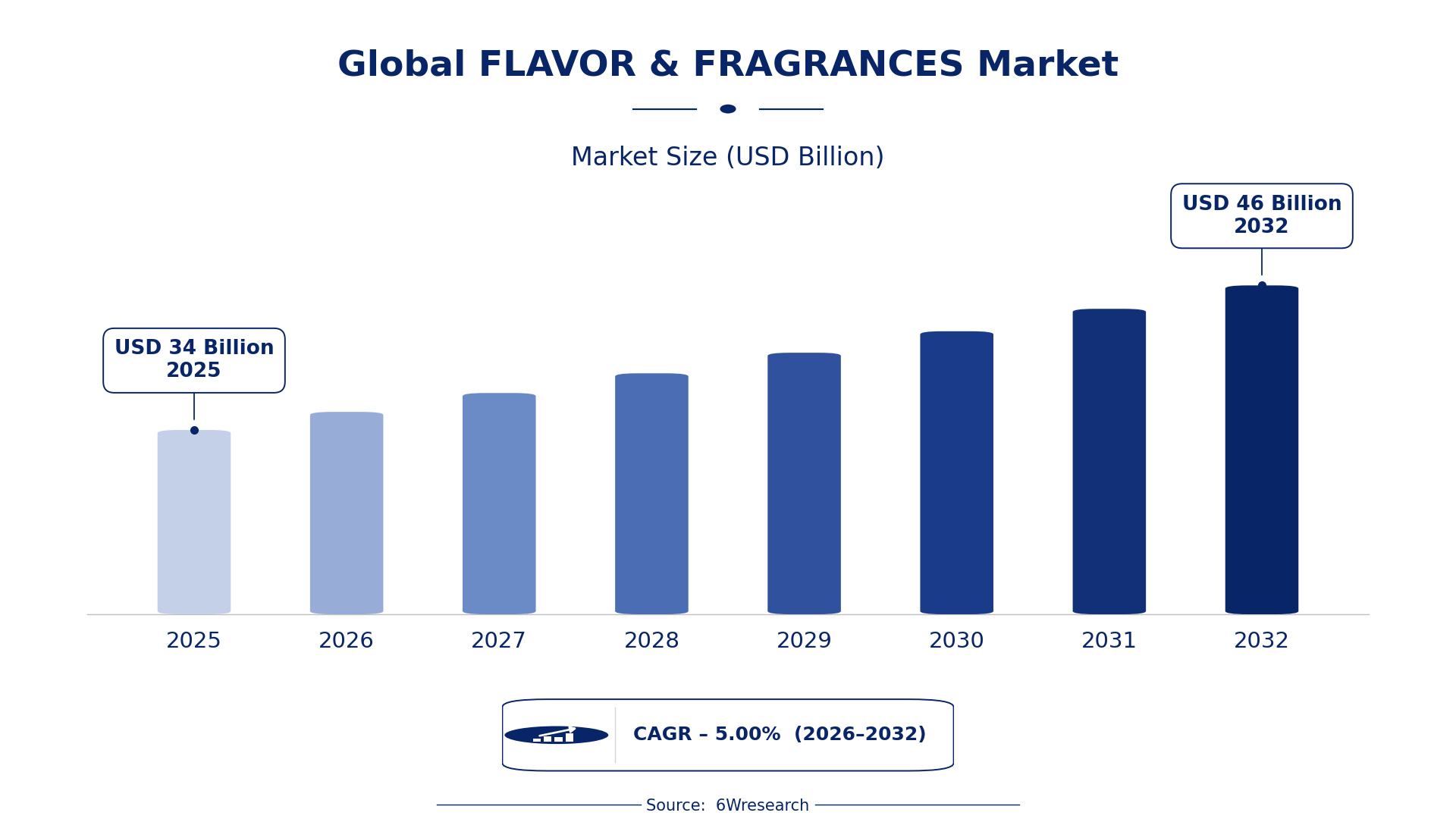
The Global FLAVOR & FRAGRANCES Market was estimated at USD 34 Billion in 2025 and is projected to reach USD 46 Billion by 2032, growing at a CAGR of 5.00% from 2026 to 2032.
Global FLAVOR & FRAGRANCES Market Synopsis
The flavor and fragrances sector has become increasingly vital for industries seeking to enhance product appeal through sensory experiences. Key growth engines include rising interest in natural ingredients and unique scent profiles, which cater to more discerning consumers. This market is not only an essential component for food and beverage manufacturers but also plays a substantial role in cosmetics and personal care.
The shift towards organic and sustainably sourced materials reflects changing consumer preferences, prompting manufacturers to adapt rapidly. As brands seek differentiation in a competitive landscape, innovations in extraction and formulation technology become crucial. The ability to create diverse offerings positions this market distinctly from adjacent sectors such as chemicals or agri-products.
Global FLAVOR & FRAGRANCES Market Year-wise Growth Rate and Key Drivers
This graph illustrates the annual growth rates of the Global FLAVOR & FRAGRANCES Market from 2022 to 2032, highlighting a steady upward trajectory and projected expansion over the forecast period.
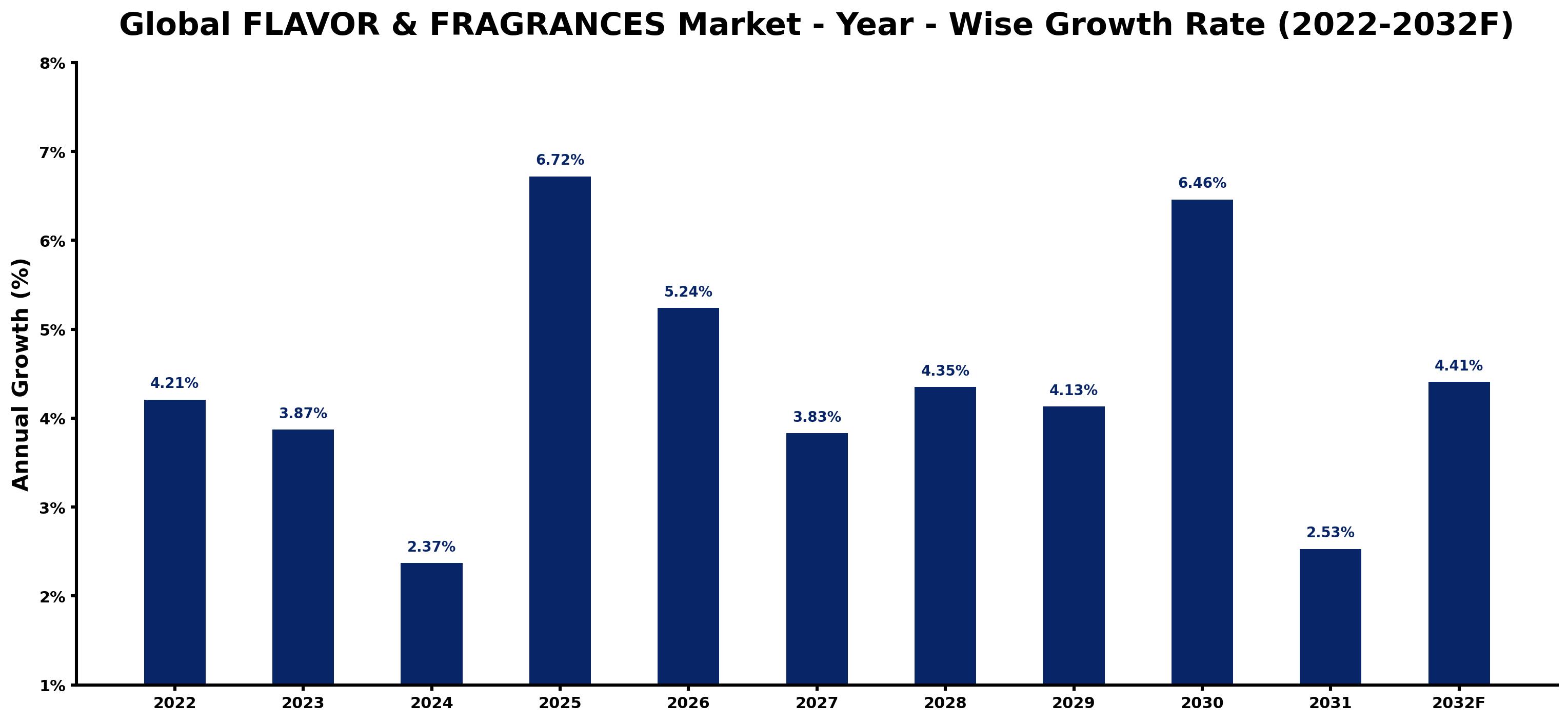
The table below presents the year‑wise growth rates along with the key drivers influencing the market
| Year | Growth Rate (%) | Major Drivers |
| 2022 | 4.21 | In North America, geographic expansion drives growth in flavor and fragrance applications. |
| 2023 | 3.87 | Manufacturers are adapting to an evolving competitive landscape in flavor innovations. |
| 2024 | 2.37 | A shortage of skilled labor affects production capabilities for fragrances and flavors. |
| 2025 | 6.72 | Investment in bio-based chemistry enhances product offerings in flavor and fragrance sectors. |
| 2026 | 5.24 | A shift toward sustainable sourcing of feedstock pricing influences fragrance market dynamics. |
| 2027 | 3.83 | Expanding resin formulation techniques enable more diverse applications for flavors and fragrances. |
| 2028 | 4.35 | As consumer preferences shift, the demand for natural flavors and fragrances is increasing. |
| 2029 | 4.13 | Sustainability initiatives lead major companies to prioritize eco-friendly fragrance production. |
| 2030 | 6.46 | Petrochemical cracking technologies significantly lower input costs for fragrance manufacturing. |
| 2031 | 2.53 | Regulatory compliance pressures impact flavor manufacturers' production and formulation strategies. |
| 2032 | 4.41 | Customers are increasingly favoring personalized flavor experiences in various consumer products. |
Note - Market size estimations and growth projections presented in this report are based on 6Wresearch's proprietary research methodology, combining internal industry data, secondary research, and primary validation, updated periodically to reflect current market conditions. As markets evolve rapidly, figures for certain industries may vary slightly and are intended as informed estimates rather than absolute figures. For the most current market sizing, we recommend validating figures with a 6Wresearch analyst.
Global FLAVOR & FRAGRANCES Market Key Takeaways
Below are some of the specific key takeaways from the market, including:
- North America held approximately 45% of the global share in 2025, backed by its robust production facilities and strong brand loyalty.
- Natural flavors are projected to grow at a rate of 7.2% from 2026 to 2032, reflecting market shifts toward health-conscious consumption.
- In 2022, Givaudan invested USD 200 million in new facilities in Asia to enhance its regional production and development capabilities.
- Synthetic flavor segments garnered significant attention, accounting for a major portion of sales due to cost-effectiveness.
- The emergence of e-commerce has created a 15% increase in consumer engagement for fragrance products since 2020.
Evaluation of Restraints in Global FLAVOR & FRAGRANCES Market
One prominent restraint affecting the Global FLAVOR & FRAGRANCES Market is the increasing regulatory scrutiny over certain synthetic ingredients. For example, the European Union's REACH (Registration, Evaluation, Authorisation, and Restriction of Chemicals) regulation mandates comprehensive safety assessments for numerous chemicals, adding complexity to compliance and formulation processes. This compliance can incur costs ranging from USD 50,000 to over USD 200,000 per ingredient, particularly for smaller enterprises that may lack the resources for extensive reformulation efforts. As such challenges proliferate, companies must innovate quickly to adapt to changing regulations.
Global FLAVOR & FRAGRANCES Market Trends
A notable trend in the Global FLAVOR & FRAGRANCES Market is the accelerating demand for natural flavors driven by consumer preferences for organic products. Firms like Symrise have introduced innovative extraction methods that allow for the preservation of volatile compounds in natural sources, yielding flavors that closely resemble their fresh counterparts. Additionally, there is a significant shift toward personalized products, with small batch producers leveraging technology to customize scents and flavors for niche markets. The demand for such tailored offerings is expected to surge, creating a gap that larger manufacturers can exploit.
Global FLAVOR & FRAGRANCES Market Opportunities
The growth of e-commerce presents a substantial revenue opportunity in the Global FLAVOR & FRAGRANCES Market. Brands are increasingly exploring direct-to-consumer channels to offer custom scents and flavors, with estimates showing that companies like IFF expect e-commerce sales to represent up to 25% of their total revenue by 2025. Furthermore, the rise of the health and wellness trend has opened avenues for flavor solutions tailored for food and beverage industries, as more consumers seek functional products that do not compromise on taste. The market for functional beverages alone is projected to reach USD 60 billion by 2026, highlighting the potential for targeted flavor innovations.
Global FLAVOR & FRAGRANCES Market by Type
As of 2025, the leading segment in the Global FLAVOR & FRAGRANCES Market is Synthetic flavors, commanding approximately ~57% share. Natural flavors, while currently smaller, are expected to experience a robust growth trajectory with a CAGR of 7.2% from 2026 to 2032 as consumer preferences shift further towards organic products. The competitive edge of synthetic flavors stems from their cost-effectiveness and consistency, allowing manufacturers to scale production efficiently while meeting diverse consumer demands.
Global FLAVOR & FRAGRANCES Market by Application
In the Global FLAVOR & FRAGRANCES Market, the Food application leads the segment with around ~42% share in 2025, as food manufacturers continuously integrate new flavors to enhance product appeal. The Beverage segment is positioned as the fastest-growing category, projected to achieve a CAGR of 6.5% from 2026 to 2032, driven by a surge in demand for craft and artisan beverages. The burgeoning preference for unique and artisanal flavors in drinks offers a substantial avenue for growth, urging major players to innovate continually.
Global FLAVOR & FRAGRANCES Market by Region
In terms of geography, North America is the largest region, expected to hold nearly ~48% of the market share in 2025, driven by its established flavor production hubs and significant consumer spending power. Asia, on the other hand, is anticipated to be the fastest-growing region with a CAGR of 8.2% from 2026 to 2032, fueled by a burgeoning middle class keen on premium products. This shifting demand landscape compels companies to expand operations and invest in region-specific innovations to capture emerging opportunities.
Government Initiatives in the Global FLAVOR & FRAGRANCES Market
The regulatory framework surrounding the Global FLAVOR & FRAGRANCES Market is increasingly dynamic, with several initiatives aimed at ensuring product safety and encouraging innovation. Government bodies are introducing regulations to support sustainable practices while simultaneously addressing consumer health concerns.
- U.S. Food and Drug Administration (FDA) - Food Safety Modernization Act, 2011: Enhances safety standards in flavoring agents to protect public health.
- European Commission - REACH Regulation, 2007: Mandates safety assessments for chemical ingredients, impacting formulation processes across producers.
- U.S. Department of Agriculture (USDA) - Organic Food Regulations, 2020: Encourages producers to utilize organic flavors, thereby expanding the natural flavor segment.
- Ministry of Agriculture, India - National Organic Farming Policy, 2021: Aims to enhance organic flavor production through investment grants for farmers.
Future Insights of the Global FLAVOR & FRAGRANCES Market
The trajectory of the Global FLAVOR & FRAGRANCES Market is set to evolve significantly by 2032 due to the integration of advanced technologies like AI in product formulation. Companies are focusing on developing customized flavor profiles that resonate with health trends and environmental sustainability. For example, recent initiatives by Takasago aim to expand their natural product lines, reflecting consumer demand for organic alternatives. This shift indicates an impending transformation in how flavors and fragrances are sourced, created, and marketed, pushing traditional boundaries to explore more efficient manufacturing processes.
Global FLAVOR & FRAGRANCES Market Latest Developments
Several recent developments have shaped the competitive landscape of the Global FLAVOR & FRAGRANCES Market, underscoring strategic moves by leading companies:
- In July 2023, Givaudan launched a new extraction technology that enhances the purity of natural flavors, allowing for cleaner profiles that meet increasing consumer preferences for organic products.
- Symrise recently completed its acquisition of a local player in Asia in June 2023, aimed at strengthening its regional supply chain capabilities and augmenting its natural fragrance offerings.
- International Flavors & Fragrances (IFF) is set to open a new research center in Europe by early 2024, focusing on sustainable fragrance development that aligns with evolving market demands.
- Takasago is in the process of scaling up its production capacity for natural extracts as of August 2023, anticipating the rising trend toward vegan and plant-based products.
Global FLAVOR & FRAGRANCES Market Key Players and Industry Positioning
The Global FLAVOR & FRAGRANCES Market exhibits a fragmented structure with several key players vying for dominance. Companies differentiate themselves through unique production capabilities and strategic regional focuses, allowing them to capture distinct market segments effectively.
| Leading Company | Core Strength | Strategic Focus |
|---|---|---|
| Givaudan | Leading in research and innovation for flavor development. | Focus on sustainable and natural product lines. |
| Firmenich | Expertise in sensory science and consumer engagement. | Targeting health-conscious and premium markets. |
| International Flavors & Fragrances | Robust global presence with diversified product portfolio. | Investing in R&D for sustainable sourcing. |
| Symrise | Strong capability in natural ingredient sourcing. | Expansion through strategic acquisitions in key regions. |
| Takasago | Advanced technology in flavor extraction processes. | Enhancing production efficiency for natural extracts. |
Amidst rising competitive pressures, these companies must continue to adapt their strategies, ensuring alignment with consumer preferences and regulatory requirements while harnessing technological advancements for growth.
Key Attractiveness of the Report
- 10 Years of Market Numbers
- Historical Data Starting from 2022 to 2025
- Base Year: 2025
- Forecast Data until 2032
- Key Performance Indicators Impacting the Market
- Major Upcoming Developments and Projects
Key Highlights of the Report:
- Global FLAVOR & FRAGRANCES Market Outlook
- Market Size of Global FLAVOR & FRAGRANCES Market, 2025
- Forecast of Global FLAVOR & FRAGRANCES Market, 2032
- Historical Data and Forecast of Global FLAVOR & FRAGRANCES Revenues & Volume for the Period 2022-2032
- Global FLAVOR & FRAGRANCES Market Trend Evolution
- Global FLAVOR & FRAGRANCES Market Drivers and Challenges
- Global FLAVOR & FRAGRANCES Price Trends
- Global FLAVOR & FRAGRANCES Porter's Five Forces
- Global FLAVOR & FRAGRANCES Industry Life Cycle
- Historical Data and Forecast of Global FLAVOR & FRAGRANCES Market Revenues & Volume
- Historical Data and Forecast of Global FLAVOR & FRAGRANCES Market Revenues & Volume By Type for the Period 2022-2032
- Historical Data and Forecast of Global FLAVOR & FRAGRANCES Market Revenues & Volume By Synthetic for the Period 2022-2032
- Historical Data and Forecast of Global FLAVOR & FRAGRANCES Market Revenues & Volume By Natural for the Period 2022-2032
- Historical Data and Forecast of Global FLAVOR & FRAGRANCES Market Revenues & Volume By Application for the Period 2022-2032
- Historical Data and Forecast of Global FLAVOR & FRAGRANCES Market Revenues & Volume By Food for the Period 2022-2032
- Historical Data and Forecast of Global FLAVOR & FRAGRANCES Market Revenues & Volume By Beverage for the Period 2022-2032
- Historical Data and Forecast of Global FLAVOR & FRAGRANCES Market Revenues & Volume By Beauty and Personal Care for the Period 2022-2032
- Historical Data and Forecast of Global FLAVOR & FRAGRANCES Market Revenues & Volume By Perfumes for the Period 2022-2032
- Historical Data and Forecast of North America FLAVOR & FRAGRANCES Market Revenues & Volume By Type for the Period 2022-2032
- Historical Data and Forecast of North America FLAVOR & FRAGRANCES Market Revenues & Volume By Synthetic for the Period 2022-2032
- Historical Data and Forecast of North America FLAVOR & FRAGRANCES Market Revenues & Volume By Natural for the Period 2022-2032
- Historical Data and Forecast of North America FLAVOR & FRAGRANCES Market Revenues & Volume By Application for the Period 2022-2032
- Historical Data and Forecast of North America FLAVOR & FRAGRANCES Market Revenues & Volume By Food for the Period 2022-2032
- Historical Data and Forecast of North America FLAVOR & FRAGRANCES Market Revenues & Volume By Beverage for the Period 2022-2032
- Historical Data and Forecast of North America FLAVOR & FRAGRANCES Market Revenues & Volume By Beauty and Personal Care for the Period 2022-2032
- Historical Data and Forecast of North America FLAVOR & FRAGRANCES Market Revenues & Volume By Perfumes for the Period 2022-2032
- Historical Data and Forecast of United States of America FLAVOR & FRAGRANCES Market Revenues & Volume for the Period 2022-2032
- Historical Data and Forecast of Canada FLAVOR & FRAGRANCES Market Revenues & Volume for the Period 2022-2032
- Historical Data and Forecast of Rest of North America FLAVOR & FRAGRANCES Market Revenues & Volume for the Period 2022-2032
- Historical Data and Forecast of Latin America (LATAM) FLAVOR & FRAGRANCES Market Revenues & Volume By Type for the Period 2022-2032
- Historical Data and Forecast of Latin America (LATAM) FLAVOR & FRAGRANCES Market Revenues & Volume By Synthetic for the Period 2022-2032
- Historical Data and Forecast of Latin America (LATAM) FLAVOR & FRAGRANCES Market Revenues & Volume By Natural for the Period 2022-2032
- Historical Data and Forecast of Latin America (LATAM) FLAVOR & FRAGRANCES Market Revenues & Volume By Application for the Period 2022-2032
- Historical Data and Forecast of Latin America (LATAM) FLAVOR & FRAGRANCES Market Revenues & Volume By Food for the Period 2022-2032
- Historical Data and Forecast of Latin America (LATAM) FLAVOR & FRAGRANCES Market Revenues & Volume By Beverage for the Period 2022-2032
- Historical Data and Forecast of Latin America (LATAM) FLAVOR & FRAGRANCES Market Revenues & Volume By Beauty and Personal Care for the Period 2022-2032
- Historical Data and Forecast of Latin America (LATAM) FLAVOR & FRAGRANCES Market Revenues & Volume By Perfumes for the Period 2022-2032
- Historical Data and Forecast of Brazil FLAVOR & FRAGRANCES Market Revenues & Volume for the Period 2022-2032
- Historical Data and Forecast of Mexico FLAVOR & FRAGRANCES Market Revenues & Volume for the Period 2022-2032
- Historical Data and Forecast of Argentina FLAVOR & FRAGRANCES Market Revenues & Volume for the Period 2022-2032
- Historical Data and Forecast of Rest of LATAM FLAVOR & FRAGRANCES Market Revenues & Volume for the Period 2022-2032
- Historical Data and Forecast of Asia FLAVOR & FRAGRANCES Market Revenues & Volume By Type for the Period 2022-2032
- Historical Data and Forecast of Asia FLAVOR & FRAGRANCES Market Revenues & Volume By Synthetic for the Period 2022-2032
- Historical Data and Forecast of Asia FLAVOR & FRAGRANCES Market Revenues & Volume By Natural for the Period 2022-2032
- Historical Data and Forecast of Asia FLAVOR & FRAGRANCES Market Revenues & Volume By Application for the Period 2022-2032
- Historical Data and Forecast of Asia FLAVOR & FRAGRANCES Market Revenues & Volume By Food for the Period 2022-2032
- Historical Data and Forecast of Asia FLAVOR & FRAGRANCES Market Revenues & Volume By Beverage for the Period 2022-2032
- Historical Data and Forecast of Asia FLAVOR & FRAGRANCES Market Revenues & Volume By Beauty and Personal Care for the Period 2022-2032
- Historical Data and Forecast of Asia FLAVOR & FRAGRANCES Market Revenues & Volume By Perfumes for the Period 2022-2032
- Historical Data and Forecast of China FLAVOR & FRAGRANCES Market Revenues & Volume for the Period 2022-2032
- Historical Data and Forecast of India FLAVOR & FRAGRANCES Market Revenues & Volume for the Period 2022-2032
- Historical Data and Forecast of Japan FLAVOR & FRAGRANCES Market Revenues & Volume for the Period 2022-2032
- Historical Data and Forecast of Rest of Asia FLAVOR & FRAGRANCES Market Revenues & Volume for the Period 2022-2032
- Historical Data and Forecast of Africa FLAVOR & FRAGRANCES Market Revenues & Volume By Type for the Period 2022-2032
- Historical Data and Forecast of Africa FLAVOR & FRAGRANCES Market Revenues & Volume By Synthetic for the Period 2022-2032
- Historical Data and Forecast of Africa FLAVOR & FRAGRANCES Market Revenues & Volume By Natural for the Period 2022-2032
- Historical Data and Forecast of Africa FLAVOR & FRAGRANCES Market Revenues & Volume By Application for the Period 2022-2032
- Historical Data and Forecast of Africa FLAVOR & FRAGRANCES Market Revenues & Volume By Food for the Period 2022-2032
- Historical Data and Forecast of Africa FLAVOR & FRAGRANCES Market Revenues & Volume By Beverage for the Period 2022-2032
- Historical Data and Forecast of Africa FLAVOR & FRAGRANCES Market Revenues & Volume By Beauty and Personal Care for the Period 2022-2032
- Historical Data and Forecast of Africa FLAVOR & FRAGRANCES Market Revenues & Volume By Perfumes for the Period 2022-2032
- Historical Data and Forecast of South Africa FLAVOR & FRAGRANCES Market Revenues & Volume for the Period 2022-2032
- Historical Data and Forecast of Nigeria FLAVOR & FRAGRANCES Market Revenues & Volume for the Period 2022-2032
- Historical Data and Forecast of Egypt FLAVOR & FRAGRANCES Market Revenues & Volume for the Period 2022-2032
- Historical Data and Forecast of Rest of Africa FLAVOR & FRAGRANCES Market Revenues & Volume for the Period 2022-2032
- Historical Data and Forecast of Europe FLAVOR & FRAGRANCES Market Revenues & Volume By Type for the Period 2022-2032
- Historical Data and Forecast of Europe FLAVOR & FRAGRANCES Market Revenues & Volume By Synthetic for the Period 2022-2032
- Historical Data and Forecast of Europe FLAVOR & FRAGRANCES Market Revenues & Volume By Natural for the Period 2022-2032
- Historical Data and Forecast of Europe FLAVOR & FRAGRANCES Market Revenues & Volume By Application for the Period 2022-2032
- Historical Data and Forecast of Europe FLAVOR & FRAGRANCES Market Revenues & Volume By Food for the Period 2022-2032
- Historical Data and Forecast of Europe FLAVOR & FRAGRANCES Market Revenues & Volume By Beverage for the Period 2022-2032
- Historical Data and Forecast of Europe FLAVOR & FRAGRANCES Market Revenues & Volume By Beauty and Personal Care for the Period 2022-2032
- Historical Data and Forecast of Europe FLAVOR & FRAGRANCES Market Revenues & Volume By Perfumes for the Period 2022-2032
- Historical Data and Forecast of United Kingdom FLAVOR & FRAGRANCES Market Revenues & Volume for the Period 2022-2032
- Historical Data and Forecast of France FLAVOR & FRAGRANCES Market Revenues & Volume for the Period 2022-2032
- Historical Data and Forecast of Germany FLAVOR & FRAGRANCES Market Revenues & Volume for the Period 2022-2032
- Historical Data and Forecast of Rest of Europe FLAVOR & FRAGRANCES Market Revenues & Volume for the Period 2022-2032
- Historical Data and Forecast of Middle East FLAVOR & FRAGRANCES Market Revenues & Volume By Type for the Period 2022-2032
- Historical Data and Forecast of Middle East FLAVOR & FRAGRANCES Market Revenues & Volume By Synthetic for the Period 2022-2032
- Historical Data and Forecast of Middle East FLAVOR & FRAGRANCES Market Revenues & Volume By Natural for the Period 2022-2032
- Historical Data and Forecast of Middle East FLAVOR & FRAGRANCES Market Revenues & Volume By Application for the Period 2022-2032
- Historical Data and Forecast of Middle East FLAVOR & FRAGRANCES Market Revenues & Volume By Food for the Period 2022-2032
- Historical Data and Forecast of Middle East FLAVOR & FRAGRANCES Market Revenues & Volume By Beverage for the Period 2022-2032
- Historical Data and Forecast of Middle East FLAVOR & FRAGRANCES Market Revenues & Volume By Beauty and Personal Care for the Period 2022-2032
- Historical Data and Forecast of Middle East FLAVOR & FRAGRANCES Market Revenues & Volume By Perfumes for the Period 2022-2032
- Historical Data and Forecast of Saudi Arabia FLAVOR & FRAGRANCES Market Revenues & Volume for the Period 2022-2032
- Historical Data and Forecast of UAE FLAVOR & FRAGRANCES Market Revenues & Volume for the Period 2022-2032
- Historical Data and Forecast of Turkey FLAVOR & FRAGRANCES Market Revenues & Volume for the Period 2022-2032
- Historical Data and Forecast of Rest of Middle East FLAVOR & FRAGRANCES Market Revenues & Volume for the Period 2022-2032
- Global FLAVOR & FRAGRANCES Market - Key Performance Indicators
- Global FLAVOR & FRAGRANCES Market - Import Export Trade Statistics
- Global FLAVOR & FRAGRANCES Market - Opportunity Assessment By Countries
- Global FLAVOR & FRAGRANCES Market - Opportunity Assessment By Type
- Global FLAVOR & FRAGRANCES Market - Opportunity Assessment By Application
- Global FLAVOR & FRAGRANCES Market - Top Companies Market Share
- Global FLAVOR & FRAGRANCES Market - Top Companies Profiles
- Global FLAVOR & FRAGRANCES Market - Comparison of Players in Technical and Operating Parameters
- Global FLAVOR & FRAGRANCES Market - Strategic Recommendations
Markets Covered
The Global FLAVOR & FRAGRANCES Market report provides a detailed analysis of the following market segments:
By Regions and Countries:
- North America
- Europe
- LATAM
- Middle East
- Asia
- Africa
By Type:
- Synthetic
- Natural
By Application:
- Food
- Beverage
- Beauty
- Personal Care
- Perfumes
Global FLAVOR & FRAGRANCES Market - Frequently Asked Questions
The Global FLAVOR & FRAGRANCES Market is projected to reach USD 46 Billion by 2032.
The expected CAGR for the Global FLAVOR & FRAGRANCES Market from 2026 to 2032 is 5.00%.
Key drivers include escalating demand for natural ingredients, rising awareness regarding health and wellness, and advancements in extraction and formulation technologies.
The synthetic flavor segment currently leads, but the natural flavor segment is anticipated to show substantial growth, reflecting consumer preference shifts.
Main challenges include stringent regulatory standards for synthetic ingredients and the rising costs associated with compliance and reformulation efforts.
The landscape is characterized by several key players with varying strategies focused on sustainability, innovation, and regional expansion to capitalize on market opportunities.
6Wresearch actively monitors the Global FLAVOR & FRAGRANCES Market and publishes its comprehensive annual report, highlighting emerging trends, growth drivers, revenue analysis, and forecast outlook. Our insights help businesses to make data-backed strategic decisions with ongoing market dynamics. Our analysts track relevent industries related to the Global FLAVOR & FRAGRANCES Market, allowing our clients with actionable intelligence and reliable forecasts tailored to emerging regional needs.
Yes, we provide customisation as per your requirements. To learn more, feel free to contact us on sales@6wresearch.com
Global FLAVOR & FRAGRANCES Market |
1 Executive Summary |
2 Introduction |
2.1 Key Highlights of the Report |
2.2 Report Description |
2.3 Market Scope & Segmentation |
2.4 Research Methodology |
2.5 Assumptions |
3 Global FLAVOR & FRAGRANCES Market Overview |
3.1 Global Regional Macro Economic Indicators |
3.2 Global FLAVOR & FRAGRANCES Market Revenues & Volume, 2022 & 2032F |
3.3 Global FLAVOR & FRAGRANCES Market - Industry Life Cycle |
3.4 Global FLAVOR & FRAGRANCES Market - Porter's Five Forces |
3.5 Global FLAVOR & FRAGRANCES Market Revenues & Volume Share, By Regions, 2022 & 2032F |
3.6 Global FLAVOR & FRAGRANCES Market Revenues & Volume Share, By Type, 2022 & 2032F |
3.7 Global FLAVOR & FRAGRANCES Market Revenues & Volume Share, By Application, 2022 & 2032F |
4 Global FLAVOR & FRAGRANCES Market Dynamics |
4.1 Impact Analysis |
4.2 Market Drivers |
4.3 Market Restraints |
5 Global FLAVOR & FRAGRANCES Market Trends |
6 Global FLAVOR & FRAGRANCES Market, 2022-2032 |
6.1 Global FLAVOR & FRAGRANCES Market, Revenues & Volume, By Type, 2022-2032 |
6.1.1 Overview & Analysis |
6.1.2 Global FLAVOR & FRAGRANCES Market, Revenues & Volume, By Synthetic, 2022-2032 |
6.1.3 Global FLAVOR & FRAGRANCES Market, Revenues & Volume, By Natural, 2022-2032 |
6.2 Global FLAVOR & FRAGRANCES Market, Revenues & Volume, By Application, 2022-2032 |
6.2.1 Overview & Analysis |
6.2.2 Global FLAVOR & FRAGRANCES Market, Revenues & Volume, By Food, 2022-2032 |
6.2.3 Global FLAVOR & FRAGRANCES Market, Revenues & Volume, By Beverage, 2022-2032 |
6.2.4 Global FLAVOR & FRAGRANCES Market, Revenues & Volume, By Beauty and Personal Care, 2022-2032 |
6.2.5 Global FLAVOR & FRAGRANCES Market, Revenues & Volume, By Perfumes, 2022-2032 |
6.3.1 Overview & Analysis |
7 North America FLAVOR & FRAGRANCES Market, Overview & Analysis |
7.1 North America FLAVOR & FRAGRANCES Market Revenues & Volume, 2022-2032 |
7.2 North America FLAVOR & FRAGRANCES Market, Revenues & Volume, By Countries, 2022-2032 |
7.2.1 United States (US) FLAVOR & FRAGRANCES Market, Revenues & Volume, 2022-2032 |
7.2.2 Canada FLAVOR & FRAGRANCES Market, Revenues & Volume, 2022-2032 |
7.2.3 Rest of North America FLAVOR & FRAGRANCES Market, Revenues & Volume, 2022-2032 |
7.3 North America FLAVOR & FRAGRANCES Market, Revenues & Volume, By Type, 2022-2032 |
7.4 North America FLAVOR & FRAGRANCES Market, Revenues & Volume, By Application, 2022-2032 |
8 Latin America (LATAM) FLAVOR & FRAGRANCES Market, Overview & Analysis |
8.1 Latin America (LATAM) FLAVOR & FRAGRANCES Market Revenues & Volume, 2022-2032 |
8.2 Latin America (LATAM) FLAVOR & FRAGRANCES Market, Revenues & Volume, By Countries, 2022-2032 |
8.2.1 Brazil FLAVOR & FRAGRANCES Market, Revenues & Volume, 2022-2032 |
8.2.2 Mexico FLAVOR & FRAGRANCES Market, Revenues & Volume, 2022-2032 |
8.2.3 Argentina FLAVOR & FRAGRANCES Market, Revenues & Volume, 2022-2032 |
8.2.4 Rest of LATAM FLAVOR & FRAGRANCES Market, Revenues & Volume, 2022-2032 |
8.3 Latin America (LATAM) FLAVOR & FRAGRANCES Market, Revenues & Volume, By Type, 2022-2032 |
8.4 Latin America (LATAM) FLAVOR & FRAGRANCES Market, Revenues & Volume, By Application, 2022-2032 |
9 Asia FLAVOR & FRAGRANCES Market, Overview & Analysis |
9.1 Asia FLAVOR & FRAGRANCES Market Revenues & Volume, 2022-2032 |
9.2 Asia FLAVOR & FRAGRANCES Market, Revenues & Volume, By Countries, 2022-2032 |
9.2.1 India FLAVOR & FRAGRANCES Market, Revenues & Volume, 2022-2032 |
9.2.2 China FLAVOR & FRAGRANCES Market, Revenues & Volume, 2022-2032 |
9.2.3 Japan FLAVOR & FRAGRANCES Market, Revenues & Volume, 2022-2032 |
9.2.4 Rest of Asia FLAVOR & FRAGRANCES Market, Revenues & Volume, 2022-2032 |
9.3 Asia FLAVOR & FRAGRANCES Market, Revenues & Volume, By Type, 2022-2032 |
9.4 Asia FLAVOR & FRAGRANCES Market, Revenues & Volume, By Application, 2022-2032 |
10 Africa FLAVOR & FRAGRANCES Market, Overview & Analysis |
10.1 Africa FLAVOR & FRAGRANCES Market Revenues & Volume, 2022-2032 |
10.2 Africa FLAVOR & FRAGRANCES Market, Revenues & Volume, By Countries, 2022-2032 |
10.2.1 South Africa FLAVOR & FRAGRANCES Market, Revenues & Volume, 2022-2032 |
10.2.2 Egypt FLAVOR & FRAGRANCES Market, Revenues & Volume, 2022-2032 |
10.2.3 Nigeria FLAVOR & FRAGRANCES Market, Revenues & Volume, 2022-2032 |
10.2.4 Rest of Africa FLAVOR & FRAGRANCES Market, Revenues & Volume, 2022-2032 |
10.3 Africa FLAVOR & FRAGRANCES Market, Revenues & Volume, By Type, 2022-2032 |
10.4 Africa FLAVOR & FRAGRANCES Market, Revenues & Volume, By Application, 2022-2032 |
11 Europe FLAVOR & FRAGRANCES Market, Overview & Analysis |
11.1 Europe FLAVOR & FRAGRANCES Market Revenues & Volume, 2022-2032 |
11.2 Europe FLAVOR & FRAGRANCES Market, Revenues & Volume, By Countries, 2022-2032 |
11.2.1 United Kingdom FLAVOR & FRAGRANCES Market, Revenues & Volume, 2022-2032 |
11.2.2 Germany FLAVOR & FRAGRANCES Market, Revenues & Volume, 2022-2032 |
11.2.3 France FLAVOR & FRAGRANCES Market, Revenues & Volume, 2022-2032 |
11.2.4 Rest of Europe FLAVOR & FRAGRANCES Market, Revenues & Volume, 2022-2032 |
11.3 Europe FLAVOR & FRAGRANCES Market, Revenues & Volume, By Type, 2022-2032 |
11.4 Europe FLAVOR & FRAGRANCES Market, Revenues & Volume, By Application, 2022-2032 |
12 Middle East FLAVOR & FRAGRANCES Market, Overview & Analysis |
12.1 Middle East FLAVOR & FRAGRANCES Market Revenues & Volume, 2022-2032 |
12.2 Middle East FLAVOR & FRAGRANCES Market, Revenues & Volume, By Countries, 2022-2032 |
12.2.1 Saudi Arabia FLAVOR & FRAGRANCES Market, Revenues & Volume, 2022-2032 |
12.2.2 UAE FLAVOR & FRAGRANCES Market, Revenues & Volume, 2022-2032 |
12.2.3 Turkey FLAVOR & FRAGRANCES Market, Revenues & Volume, 2022-2032 |
12.3 Middle East FLAVOR & FRAGRANCES Market, Revenues & Volume, By Type, 2022-2032 |
12.4 Middle East FLAVOR & FRAGRANCES Market, Revenues & Volume, By Application, 2022-2032 |
13 Global FLAVOR & FRAGRANCES Market Key Performance Indicators |
14 Global FLAVOR & FRAGRANCES Market - Export/Import By Countries Assessment |
15 Global FLAVOR & FRAGRANCES Market - Opportunity Assessment |
15.1 Global FLAVOR & FRAGRANCES Market Opportunity Assessment, By Countries, 2022 & 2032F |
15.2 Global FLAVOR & FRAGRANCES Market Opportunity Assessment, By Type, 2022 & 2032F |
15.3 Global FLAVOR & FRAGRANCES Market Opportunity Assessment, By Application, 2022 & 2032F |
16 Global FLAVOR & FRAGRANCES Market - Competitive Landscape |
16.1 Global FLAVOR & FRAGRANCES Market Revenue Share, By Companies, 2025 |
16.2 Global FLAVOR & FRAGRANCES Market Competitive Benchmarking, By Operating and Technical Parameters |
17 Top 10 Company Profiles |
18 Recommendations |
19 Disclaimer |
Global Go To Market Strategy - 2030
Export potential enables firms to identify high-growth global markets with greater confidence by combining advanced trade intelligence with a structured quantitative methodology. The framework analyzes emerging demand trends and country-level import patterns while integrating macroeconomic and trade datasets such as GDP and population forecasts, bilateral import–export flows, tariff structures, elasticity differentials between developed and developing economies, geographic distance, and import demand projections. Using weighted trade values from 2020–2024 as the base period to project country-to-country export potential for 2030, these inputs are operationalized through calculated drivers such as gravity model parameters, tariff impact factors, and projected GDP per-capita growth. Through an analysis of hidden potentials, demand hotspots, and market conditions that are most favorable to success, this method enables firms to focus on target countries, maximize returns, and global expansion with data, backed by accuracy.
By factoring in the projected importer demand gap that is currently unmet and could be potential opportunity, it identifies the potential for the Exporter (Country) among 190 countries, against the general trade analysis, which identifies the biggest importer or exporter.
To discover high-growth global markets and optimize your business strategy:
Click Here
Request Primary Research & Report
- Single User License$ 4,560
- Department License$ 5,055
- Site License$ 5,595
- Global License$ 6,000

Leadership Perspectives from Industry Events
Search
6Wresearch in the News
 Forbes
Citing 6Wresearch analytics to map global infrastructure and pharmaceutical industry trajectories.
 Bloomberg Law
Direct syndication of 6Wresearch's macro data points, capturing complex supply chain shifts.
 Reuters
Tracking industrial manufacturing adjustments and electronic security ecosystem scaling.
 Mint
Mint
Utilizing deep-tech sector market sizing to analyze global automation and robotics.
 The Economic Times
Anchoring features on industrial IoT growth metrics and connected smart-grid devices.
 Business Standard
Featuring strategic evaluations of Advanced Driver Assistance Systems (ADAS) and AI road safety.
 The Hindu
Spotlighting core commercial metrics ranging from unmanned aerial vehicles (UAVs) to consumer durables.
 Financial Express
Anchoring quarterly reviews on cross-border real estate tech and structural hardware manufacturing.
 Yahoo Finance
Syndicating the tracker's $30.1 billion untapped-market findings, spotlighting Japan, the US and China as India's top new-potential importers.
 India Today
Carrying the release on smartphones leading India's export potential to $94 billion by 2031, per 6WExportGTM data.
 Dailyhunt
Distributing the tracker findings to its regional readership, framing India's export diversification into Japan and Mexico.
 PR Newswire Original release
Publishing the full India Export Attractiveness Tracker 2026, detailing new trade corridors across iron ore, LCVs and pharmaceuticals.
 The Industrial
Highlighting the tracker's read on India's semiconductor ambitions and long-term chip-assembly export potential.
 PTI News
Reporting on the $66.81 billion pharmaceuticals export opportunity flagged in the tracker, amid looming US generic-drug tariffs.
 Tribune India
Covering the tracker's tariff-versus-regulation analysis across India's mature export markets in the US, China and UAE.
 ANI News
Amplifying the report's findings on polished diamonds, refined petroleum and medicines as India's core export engines.
 International Business Magazine
Covering the report's insight into how AEB, blind spot detection, and driver monitoring are reshaping India's ADAS market.
 Focus Gaming News
Highlighting the research forecast for Egypt's gambling market, projecting steady growth through 2032.
Thought Leadership and Analyst Meet





Our Clients








Latest Reports
- Austria X-ray Imaging Devices Market (2026-2032)
- Armenia X-ray Imaging Devices Market (2026-2032)
- Antigua and Barbuda X-ray Imaging Devices Market (2026-2032)
- Angola X-ray Imaging Devices Market (2026-2032)
- Andorra X-ray Imaging Devices Market (2026-2032)
- Albania X-ray Imaging Devices Market (2026-2032)
- Afghanistan X-ray Imaging Devices Market (2026-2032)
- United States (US) X-ray Imaging Devices Market (2026-2032)
- United Kingdom (UK) X-ray Imaging Devices Market (2026-2032)
- United Arab Emirates (UAE) X-ray Imaging Devices Market (2026-2032)
Industry Events and Analyst Meet

EV India Expo 2026

HIMTEX 2026

India Refining Summit 2026

India EV Show 2026

EV tech India Expo 2026
Whitepaper
- Middle East & Africa Commercial Security Market Click here to view more.
- Middle East & Africa Fire Safety Systems & Equipment Market Click here to view more.
- GCC Drone Market Click here to view more.
- Middle East Lighting Fixture Market Click here to view more.
- GCC Physical & Perimeter Security Market Click here to view more.


