Global Flexible Office Market Highlights
| Market Size (2025) | USD 52 Billion |
| Forecast Size (2032) | USD 75 Billion |
| CAGR | 5.40% |
| Base Year | 2025 |
| Forecast Period | 2026-2032 |
| Largest Region | North America |
| Fastest Growing Region | Asia |
| Largest Segment | Co-Working Spaces |
| Fastest Growing Segment | Virtual Offices |
| Leading Companies | WeWork, IWG, Spaces, Regus, Knotel |
Global Flexible Office Market Size & Growth Rate (2026-2032)
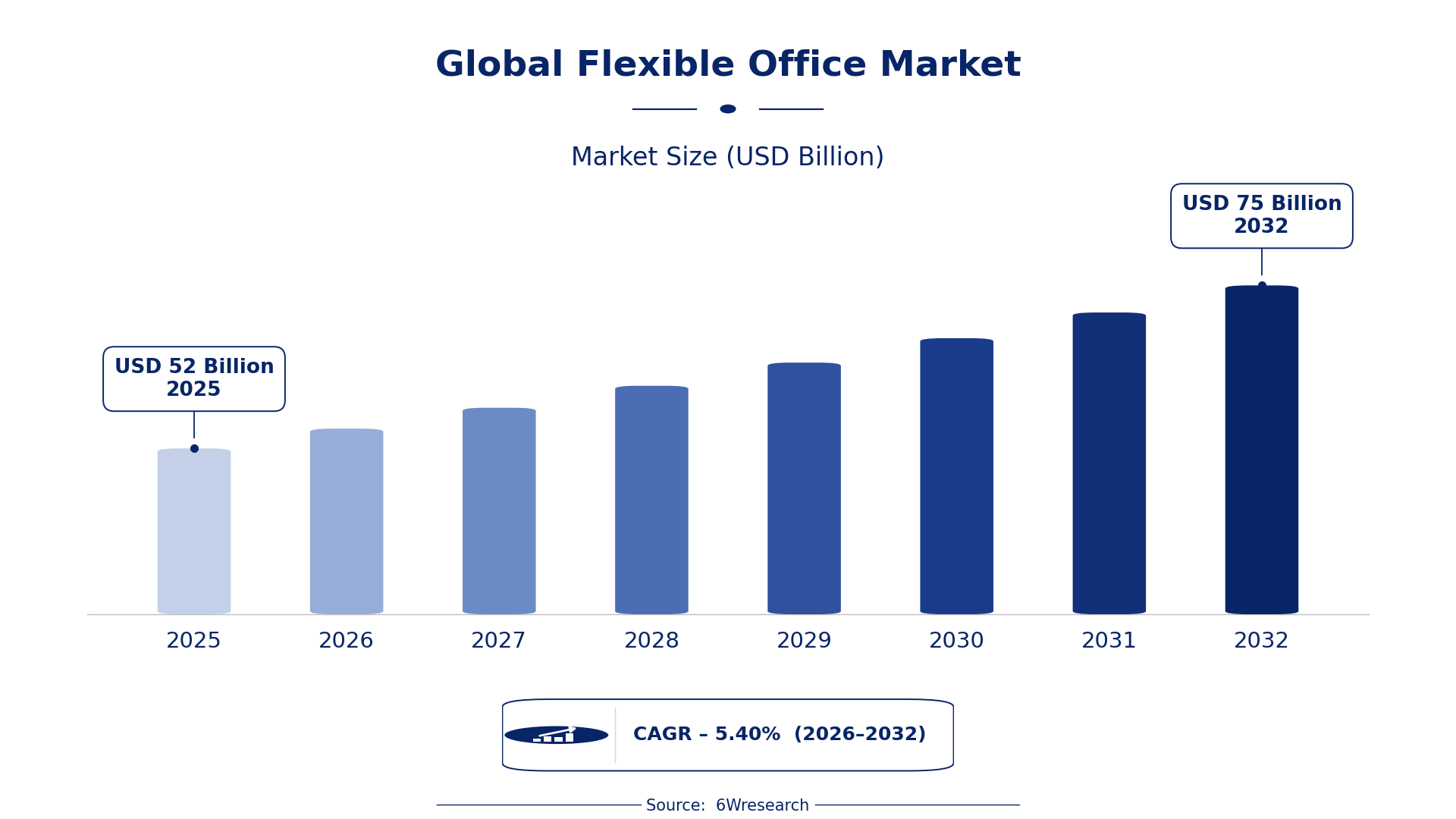
The Global Flexible Office Market was estimated at USD 52 Billion in 2025 and is projected to reach USD 75 Billion by 2032, growing at a CAGR of 5.40% from 2026 to 2032.
Global Flexible Office Market Synopsis
The recent shift toward flexible work arrangements has fundamentally transformed the landscape of the Global Flexible Office Market. Businesses are increasingly seeking adaptable office solutions to meet the changing needs of their workforce amidst evolving economic conditions. This trend reflects a larger movement toward efficiency and cost-effectiveness in urban workspace management.
As organizations pivot from traditional office setups to flexible work environments, the market's relevance extends beyond mere workspace availability. Companies across various sectors, from technology to finance, are leveraging co-working and virtual office solutions to enhance employee productivity and collaboration. This strategic pivot not only reduces overhead costs but also aligns workforce management with contemporary organizational practices.
Global Flexible Office Market Year-wise Growth Rate and Key Drivers
This graph illustrates the annual growth rates of the Global Flexible Office Market from 2022 to 2032, highlighting a steady upward trajectory and projected expansion over the forecast period.
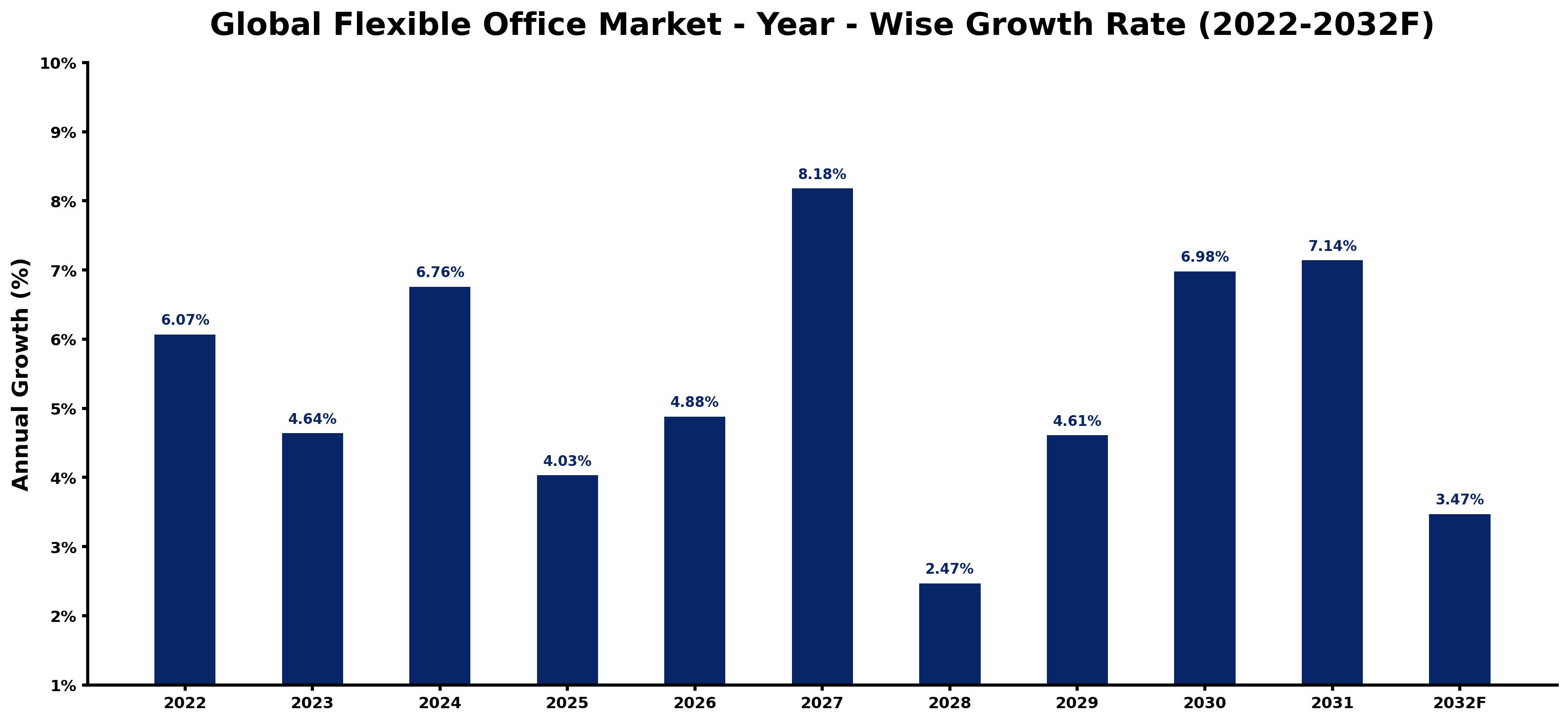
The table below presents the year‑wise growth rates along with the key drivers influencing the market
| Year | Growth Rate (%) | Major Drivers |
| 2022 | 6.07 | Flexible office operators see rising demand due to evolving workspace preferences among companies. |
| 2023 | 4.64 | In Asia-Pacific, the expanding footprint of flexible office spaces attracts diverse clientele and boosts availability. |
| 2024 | 6.76 | Innovative workspace technologies enhance the appeal of flexible office setups for remote and hybrid workers. |
| 2025 | 4.03 | End-users are increasingly favoring flexible office solutions to adapt to changing work patterns and needs. |
| 2026 | 4.88 | Expanding labor flexibility trends lead to higher adoption rates of flexible office arrangements by businesses. |
| 2027 | 8.18 | Coworking spaces gain traction as significant competitors within the flexible office sector, redefining workspace choices. |
| 2028 | 2.47 | Landlords' rising management costs are impacting operational strategies for flexible office providers. |
| 2029 | 4.61 | A shift toward sustainable office designs influences tenant choices and boosts flexible office demand. |
| 2030 | 6.98 | Logistics in flexible office space distribution improve through advanced inventory management and on-demand services. |
| 2031 | 7.14 | As workplace regulations adapt to remote work trends, flexible office solutions become more favorable for firms. |
| 2032 | 3.47 | Increased merger and acquisition activities among flexible office companies indicate ongoing market consolidation and growth. |
Note - Market size estimations and growth projections presented in this report are based on 6Wresearch's proprietary research methodology, combining internal industry data, secondary research, and primary validation, updated periodically to reflect current market conditions. As markets evolve rapidly, figures for certain industries may vary slightly and are intended as informed estimates rather than absolute figures. For the most current market sizing, we recommend validating figures with a 6Wresearch analyst.
Global Flexible Office Market Key Takeaways
Below are some of the specific key takeaways from the market, including:
- As of 2025, co-working spaces dominate the market with a share of approximately 48%.
- Notably, virtual offices are projected to grow at a CAGR of 8.5% from 2026 to 2032, indicating strong demand.
- Major players like IWG have reported a doubling in demand for flexible office space since the COVID-19 pandemic.
- Investment in technology-enhanced office solutions is increasing, with many firms allocating more than 30% of their budgets to workspace technology in 2025.
Evaluation of Restraints in Global Flexible Office Market
Despite the optimistic outlook, the Global Flexible Office Market faces specific challenges affecting growth. Rising real estate costs in urban centers are putting pressure on profit margins. For instance, prime office rents in cities like New York and London can exceed USD 80 per square foot, complicating the financial feasibility for flexible office providers. Additionally, regulatory hurdles related to zoning and corporate leases present obstacles. For example, recent regulatory restrictions on short-term rentals in several major cities can complicate operational strategies for co-working providers.
Global Flexible Office Market Trends
Current trends in the Global Flexible Office Market reveal a noticeable shift toward sustainability and user experience. Operators are now prioritizing environmentally conscious design and energy-efficient practices. An example is WeWork, which recently announced a commitment to certifying its spaces in alignment with LEED standards by 2026. Concurrently, the integration of technology is reshaping office functionalities, as providers are increasingly utilizing IoT devices for smart office management. This shift enhances workspace utilization and supports remote collaboration.
Global Flexible Office Market Opportunities
Future growth avenues for the Global Flexible Office Market are clear, particularly in the sphere of specialized sector services. Companies like Spaces are actively targeting tech startups and creative industries through tailored offerings that cater to their unique requirements. For example, the introduction of flexible office configurations that enable rapid scalability in response to project demands is set to attract more businesses entering the gig economy. Additionally, leveraging data analytics tools to maximize space efficiency represents an untapped potential, as businesses become more focused on cost-effectiveness and productivity enhancements.
Global Flexible Office Market by Offering
The leading segment within the Global Flexible Office Market is Co-Working Spaces, which commands a share of approximately 48% in 2025. This model appeals to various professionals seeking cost-effective office solutions. Conversely, Virtual Offices are the fastest-growing segment, expected to achieve a CAGR of 8.5% from 2026 to 2032, as businesses increasingly favor remote work capabilities and digital presence without the need for physical office space.
Global Flexible Office Market by Vertical
In terms of verticals, the IT and Telecommunications sector dominates the Global Flexible Office Market, holding around 35% of the market share in 2025. This reflects the industry's need for dynamic workspace solutions capable of supporting tech-driven operations. On the other hand, the Media and Entertainment vertical is the fastest-growing, with a projected CAGR of 7.2% from 2026 to 2032, driven by the requirement for collaborative environments that stimulate creativity and innovation.
Global Flexible Office Market by Region
North America remains the largest region in the Global Flexible Office Market, holding a share of approximately 40% in 2025. The region benefits from a robust entrepreneurial ecosystem and widespread acceptance of flexible workspace solutions. In contrast, Asia is projected to be the fastest-growing region, with an impressive CAGR of 6.8% from 2026 to 2032, fueled by rapid urbanization and a burgeoning startup culture, particularly in tech hubs such as Singapore and Bangalore.
Government Initiatives in the Global Flexible Office Market
The regulatory landscape surrounding the Global Flexible Office Market is evolving to support diverse work arrangements. Governments are implementing policies aimed at stimulating economic growth through flexible workplace solutions. Recent initiatives emphasize sustainability, smart city development, and support for SMEs, critically affecting market dynamics.
- U.S. Small Business Administration, "Small Business Innovation Research Program," 2022: This initiative provides funding to small businesses that utilize flexible office spaces, promoting entrepreneurship.
- UK Department for Business, Energy & Industrial Strategy, "Flexible Workspace Grant," 2023: This ongoing funding program aims to support businesses transitioning to flexible workspaces by providing financial assistance for renovation and adaptation.
- European Commission, "Workspace Modernization Proposal," slated for 2025: Aiming to create standards and incentives for innovative workspace solutions, this initiative is anticipated to ease regulatory burdens for flexible office providers.
- Singapore Ministry of Finance, "Entrepreneurship Development Programme," launched in 2021: This program encourages startups to utilize co-working spaces, enhancing collaboration across industries.
Future Insights of the Global Flexible Office Market
By 2032, the Global Flexible Office Market is expected to undergo profound transformations as technological advancements, such as AI-driven workspace management systems, gain traction. Companies like Regus are already integrating smart technologies to optimize space utilization, achieving operational efficiencies. Furthermore, the ongoing rise of hybrid work models is likely to enhance innovation within flexible office solutions, encouraging providers to develop bespoke offerings that respond to industry-specific needs.
Global Flexible Office Market Latest Developments
Leading players in the Global Flexible Office Market are making strategic moves to reinforce their positions and enhance service offerings. Recent developments include:
- In September 2023, WeWork announced a partnership with local businesses to create hybrid spaces tailored for startups, expanding their customer base and fostering community engagement.
- Recently, IWG finalized an agreement to acquire a significant competitor in Europe, positioning itself to streamline operations and improve overall market share.
- In early 2024, Spaces plans to launch a comprehensive online platform that will integrate booking and management functionalities, enhancing user experience and operational efficiency.
- Knotel is currently expanding its portfolio in Asia-Pacific, focusing on flexible solutions for tech companies that prioritize scalability, thereby capitalizing on regional growth prospects.
Global Flexible Office Market Key Players and Industry Positioning
The competitive structure of the Global Flexible Office Market is moderately fragmented, featuring both large-scale operators and numerous local providers. This diversity allows for a range of service offerings tailored to various customer needs, thereby fostering innovation and competitive pricing.
| Leading Company | Core Strength | Strategic Focus |
|---|---|---|
| WeWork | Extensive global reach with a robust brand recognition. | Focusing on creating community-driven hybrid workspaces. |
| IWG | Diverse portfolio of brands catering to various market segments. | Pursuing vertical integration through strategic acquisitions. |
| Spaces | Unique design aesthetics appealing to creative professionals. | Targeting collaboration-focused environments for startups. |
| Regus | Established reputation in traditional and flexible office markets. | Leveraging technology for enhanced customer experiences. |
| Knotel | Customizable workspace solutions tailored for enterprises. | Expanding in emerging markets with a focus on tech companies. |
With each player carving out a distinct niche, the Global Flexible Office Market is expected to thrive, fostering diversification and adaptability as it evolves.
Key Attractiveness of the Report
- 10 Years of Market Numbers
- Historical Data Starting from 2022 to 2025
- Base Year: 2025
- Forecast Data until 2032
- Key Performance Indicators Impacting the Market
- Major Upcoming Developments and Projects
Key Highlights of the Report:
- Global Flexible Office Market Outlook
- Market Size of Global Flexible Office Market, 2025
- Forecast of Global Flexible Office Market, 2032
- Historical Data and Forecast of Global Flexible Office Revenues & Volume for the Period 2022-2032
- Global Flexible Office Market Trend Evolution
- Global Flexible Office Market Drivers and Challenges
- Global Flexible Office Price Trends
- Global Flexible Office Porter's Five Forces
- Global Flexible Office Industry Life Cycle
- Historical Data and Forecast of Global Flexible Office Market Revenues & Volume
- Historical Data and Forecast of Global Flexible Office Market Revenues & Volume By Offering for the Period 2022-2032
- Historical Data and Forecast of Global Flexible Office Market Revenues & Volume By Private Offices for the Period 2022-2032
- Historical Data and Forecast of Global Flexible Office Market Revenues & Volume By Co-Working Spaces for the Period 2022-2032
- Historical Data and Forecast of Global Flexible Office Market Revenues & Volume By Virtual Offices for the Period 2022-2032
- Historical Data and Forecast of Global Flexible Office Market Revenues & Volume By Vertical for the Period 2022-2032
- Historical Data and Forecast of Global Flexible Office Market Revenues & Volume By IT and Telecommunications for the Period 2022-2032
- Historical Data and Forecast of Global Flexible Office Market Revenues & Volume By Media and Entertainment for the Period 2022-2032
- Historical Data and Forecast of Global Flexible Office Market Revenues & Volume By Retail and Consumer Goods for the Period 2022-2032
- Historical Data and Forecast of North America Flexible Office Market Revenues & Volume By Offering for the Period 2022-2032
- Historical Data and Forecast of North America Flexible Office Market Revenues & Volume By Private Offices for the Period 2022-2032
- Historical Data and Forecast of North America Flexible Office Market Revenues & Volume By Co-Working Spaces for the Period 2022-2032
- Historical Data and Forecast of North America Flexible Office Market Revenues & Volume By Virtual Offices for the Period 2022-2032
- Historical Data and Forecast of North America Flexible Office Market Revenues & Volume By Vertical for the Period 2022-2032
- Historical Data and Forecast of North America Flexible Office Market Revenues & Volume By IT and Telecommunications for the Period 2022-2032
- Historical Data and Forecast of North America Flexible Office Market Revenues & Volume By Media and Entertainment for the Period 2022-2032
- Historical Data and Forecast of North America Flexible Office Market Revenues & Volume By Retail and Consumer Goods for the Period 2022-2032
- Historical Data and Forecast of United States of America Flexible Office Market Revenues & Volume for the Period 2022-2032
- Historical Data and Forecast of Canada Flexible Office Market Revenues & Volume for the Period 2022-2032
- Historical Data and Forecast of Rest of North America Flexible Office Market Revenues & Volume for the Period 2022-2032
- Historical Data and Forecast of Latin America (LATAM) Flexible Office Market Revenues & Volume By Offering for the Period 2022-2032
- Historical Data and Forecast of Latin America (LATAM) Flexible Office Market Revenues & Volume By Private Offices for the Period 2022-2032
- Historical Data and Forecast of Latin America (LATAM) Flexible Office Market Revenues & Volume By Co-Working Spaces for the Period 2022-2032
- Historical Data and Forecast of Latin America (LATAM) Flexible Office Market Revenues & Volume By Virtual Offices for the Period 2022-2032
- Historical Data and Forecast of Latin America (LATAM) Flexible Office Market Revenues & Volume By Vertical for the Period 2022-2032
- Historical Data and Forecast of Latin America (LATAM) Flexible Office Market Revenues & Volume By IT and Telecommunications for the Period 2022-2032
- Historical Data and Forecast of Latin America (LATAM) Flexible Office Market Revenues & Volume By Media and Entertainment for the Period 2022-2032
- Historical Data and Forecast of Latin America (LATAM) Flexible Office Market Revenues & Volume By Retail and Consumer Goods for the Period 2022-2032
- Historical Data and Forecast of Brazil Flexible Office Market Revenues & Volume for the Period 2022-2032
- Historical Data and Forecast of Mexico Flexible Office Market Revenues & Volume for the Period 2022-2032
- Historical Data and Forecast of Argentina Flexible Office Market Revenues & Volume for the Period 2022-2032
- Historical Data and Forecast of Rest of LATAM Flexible Office Market Revenues & Volume for the Period 2022-2032
- Historical Data and Forecast of Asia Flexible Office Market Revenues & Volume By Offering for the Period 2022-2032
- Historical Data and Forecast of Asia Flexible Office Market Revenues & Volume By Private Offices for the Period 2022-2032
- Historical Data and Forecast of Asia Flexible Office Market Revenues & Volume By Co-Working Spaces for the Period 2022-2032
- Historical Data and Forecast of Asia Flexible Office Market Revenues & Volume By Virtual Offices for the Period 2022-2032
- Historical Data and Forecast of Asia Flexible Office Market Revenues & Volume By Vertical for the Period 2022-2032
- Historical Data and Forecast of Asia Flexible Office Market Revenues & Volume By IT and Telecommunications for the Period 2022-2032
- Historical Data and Forecast of Asia Flexible Office Market Revenues & Volume By Media and Entertainment for the Period 2022-2032
- Historical Data and Forecast of Asia Flexible Office Market Revenues & Volume By Retail and Consumer Goods for the Period 2022-2032
- Historical Data and Forecast of China Flexible Office Market Revenues & Volume for the Period 2022-2032
- Historical Data and Forecast of India Flexible Office Market Revenues & Volume for the Period 2022-2032
- Historical Data and Forecast of Japan Flexible Office Market Revenues & Volume for the Period 2022-2032
- Historical Data and Forecast of Rest of Asia Flexible Office Market Revenues & Volume for the Period 2022-2032
- Historical Data and Forecast of Africa Flexible Office Market Revenues & Volume By Offering for the Period 2022-2032
- Historical Data and Forecast of Africa Flexible Office Market Revenues & Volume By Private Offices for the Period 2022-2032
- Historical Data and Forecast of Africa Flexible Office Market Revenues & Volume By Co-Working Spaces for the Period 2022-2032
- Historical Data and Forecast of Africa Flexible Office Market Revenues & Volume By Virtual Offices for the Period 2022-2032
- Historical Data and Forecast of Africa Flexible Office Market Revenues & Volume By Vertical for the Period 2022-2032
- Historical Data and Forecast of Africa Flexible Office Market Revenues & Volume By IT and Telecommunications for the Period 2022-2032
- Historical Data and Forecast of Africa Flexible Office Market Revenues & Volume By Media and Entertainment for the Period 2022-2032
- Historical Data and Forecast of Africa Flexible Office Market Revenues & Volume By Retail and Consumer Goods for the Period 2022-2032
- Historical Data and Forecast of South Africa Flexible Office Market Revenues & Volume for the Period 2022-2032
- Historical Data and Forecast of Nigeria Flexible Office Market Revenues & Volume for the Period 2022-2032
- Historical Data and Forecast of Egypt Flexible Office Market Revenues & Volume for the Period 2022-2032
- Historical Data and Forecast of Rest of Africa Flexible Office Market Revenues & Volume for the Period 2022-2032
- Historical Data and Forecast of Europe Flexible Office Market Revenues & Volume By Offering for the Period 2022-2032
- Historical Data and Forecast of Europe Flexible Office Market Revenues & Volume By Private Offices for the Period 2022-2032
- Historical Data and Forecast of Europe Flexible Office Market Revenues & Volume By Co-Working Spaces for the Period 2022-2032
- Historical Data and Forecast of Europe Flexible Office Market Revenues & Volume By Virtual Offices for the Period 2022-2032
- Historical Data and Forecast of Europe Flexible Office Market Revenues & Volume By Vertical for the Period 2022-2032
- Historical Data and Forecast of Europe Flexible Office Market Revenues & Volume By IT and Telecommunications for the Period 2022-2032
- Historical Data and Forecast of Europe Flexible Office Market Revenues & Volume By Media and Entertainment for the Period 2022-2032
- Historical Data and Forecast of Europe Flexible Office Market Revenues & Volume By Retail and Consumer Goods for the Period 2022-2032
- Historical Data and Forecast of United Kingdom Flexible Office Market Revenues & Volume for the Period 2022-2032
- Historical Data and Forecast of France Flexible Office Market Revenues & Volume for the Period 2022-2032
- Historical Data and Forecast of Germany Flexible Office Market Revenues & Volume for the Period 2022-2032
- Historical Data and Forecast of Rest of Europe Flexible Office Market Revenues & Volume for the Period 2022-2032
- Historical Data and Forecast of Middle East Flexible Office Market Revenues & Volume By Offering for the Period 2022-2032
- Historical Data and Forecast of Middle East Flexible Office Market Revenues & Volume By Private Offices for the Period 2022-2032
- Historical Data and Forecast of Middle East Flexible Office Market Revenues & Volume By Co-Working Spaces for the Period 2022-2032
- Historical Data and Forecast of Middle East Flexible Office Market Revenues & Volume By Virtual Offices for the Period 2022-2032
- Historical Data and Forecast of Middle East Flexible Office Market Revenues & Volume By Vertical for the Period 2022-2032
- Historical Data and Forecast of Middle East Flexible Office Market Revenues & Volume By IT and Telecommunications for the Period 2022-2032
- Historical Data and Forecast of Middle East Flexible Office Market Revenues & Volume By Media and Entertainment for the Period 2022-2032
- Historical Data and Forecast of Middle East Flexible Office Market Revenues & Volume By Retail and Consumer Goods for the Period 2022-2032
- Historical Data and Forecast of Saudi Arabia Flexible Office Market Revenues & Volume for the Period 2022-2032
- Historical Data and Forecast of UAE Flexible Office Market Revenues & Volume for the Period 2022-2032
- Historical Data and Forecast of Turkey Flexible Office Market Revenues & Volume for the Period 2022-2032
- Historical Data and Forecast of Rest of Middle East Flexible Office Market Revenues & Volume for the Period 2022-2032
- Global Flexible Office Market - Key Performance Indicators
- Global Flexible Office Market - Import Export Trade Statistics
- Global Flexible Office Market - Opportunity Assessment By Countries
- Global Flexible Office Market - Opportunity Assessment By Offering
- Global Flexible Office Market - Opportunity Assessment By Vertical
- Global Flexible Office Market - Top Companies Market Share
- Global Flexible Office Market - Top Companies Profiles
- Global Flexible Office Market - Comparison of Players in Technical and Operating Parameters
- Global Flexible Office Market - Strategic Recommendations
Markets Covered
The Global Flexible Office Market report provides a detailed analysis of the following market segments:
By Regions and Countries:
- North America
- Europe
- LATAM
- Middle East
- Asia
- Africa
By Offering:
- Private Offices
- Co-Working Spaces
- Virtual Offices
By Vertical:
- IT
- Telecommunications
- Media
- Entertainment
- Retail
- Consumer Goods






































