Global Folic Acid Market Highlights
| Market Size (2025) | USD 0.82 Billion |
| Forecast Size (2032) | USD 1.2 Billion |
| CAGR | 4.30% |
| Base Year | 2025 |
| Forecast Period | 2026-2032 |
| Largest Region | North America |
| Fastest Growing Region | Asia-Pacific |
| Largest Segment | Pharmaceuticals |
| Fastest Growing Segment | Nutraceuticals |
| Leading Companies | BASF, Merck KGaA, Alvogen, Northstar, Solgar |
Global Folic Acid Market Size & Growth Rate (2026-2032)
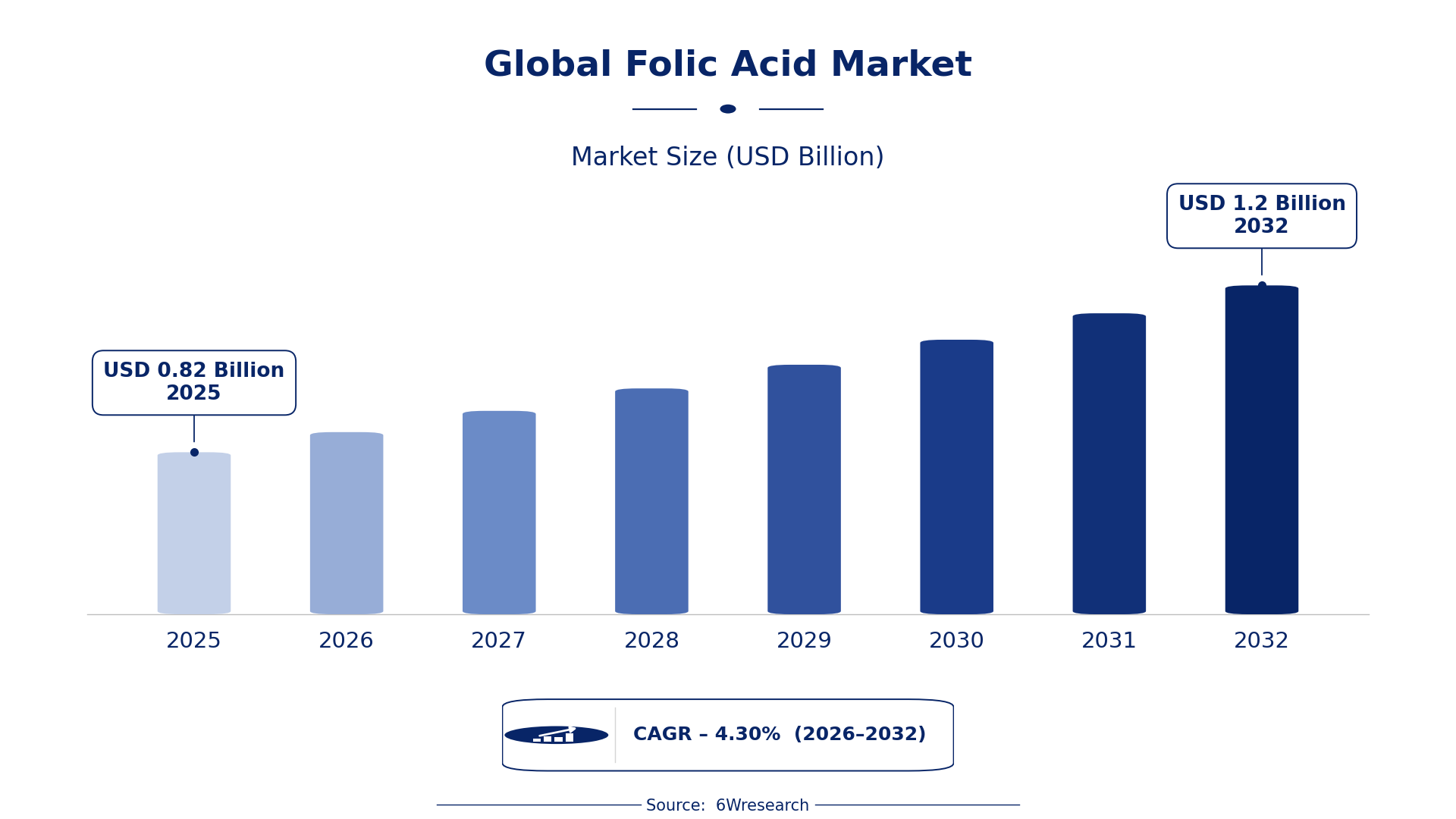
The Global Folic Acid Market was estimated at USD 0.82 Billion in 2025 and is projected to reach USD 1.2 Billion by 2032, growing at a CAGR of 4.30% from 2026 to 2032.
Global Folic Acid Market Synopsis
The increasing focus on maternal and child health, driven by higher incidences of neural tube defects, is reshaping the Global Folic Acid Market. Public health initiatives and educational campaigns emphasize the critical role of folic acid in prenatal nutrition, which directly impacts demand across various applications.
Moreover, the burgeoning pharmaceuticals sector leverages folic acid in various therapeutic formulations, positioning it as a crucial ingredient amidst rising health consciousness. The nutritional enhancement of foods and beverages aims to address community-wide deficiencies, creating fresh avenues for product innovation and market expansion.
Global Folic Acid Market Year-wise Growth Rate and Key Drivers
This graph illustrates the annual growth rates of the Global Folic Acid Market from 2022 to 2032, highlighting a steady upward trajectory and projected expansion over the forecast period.
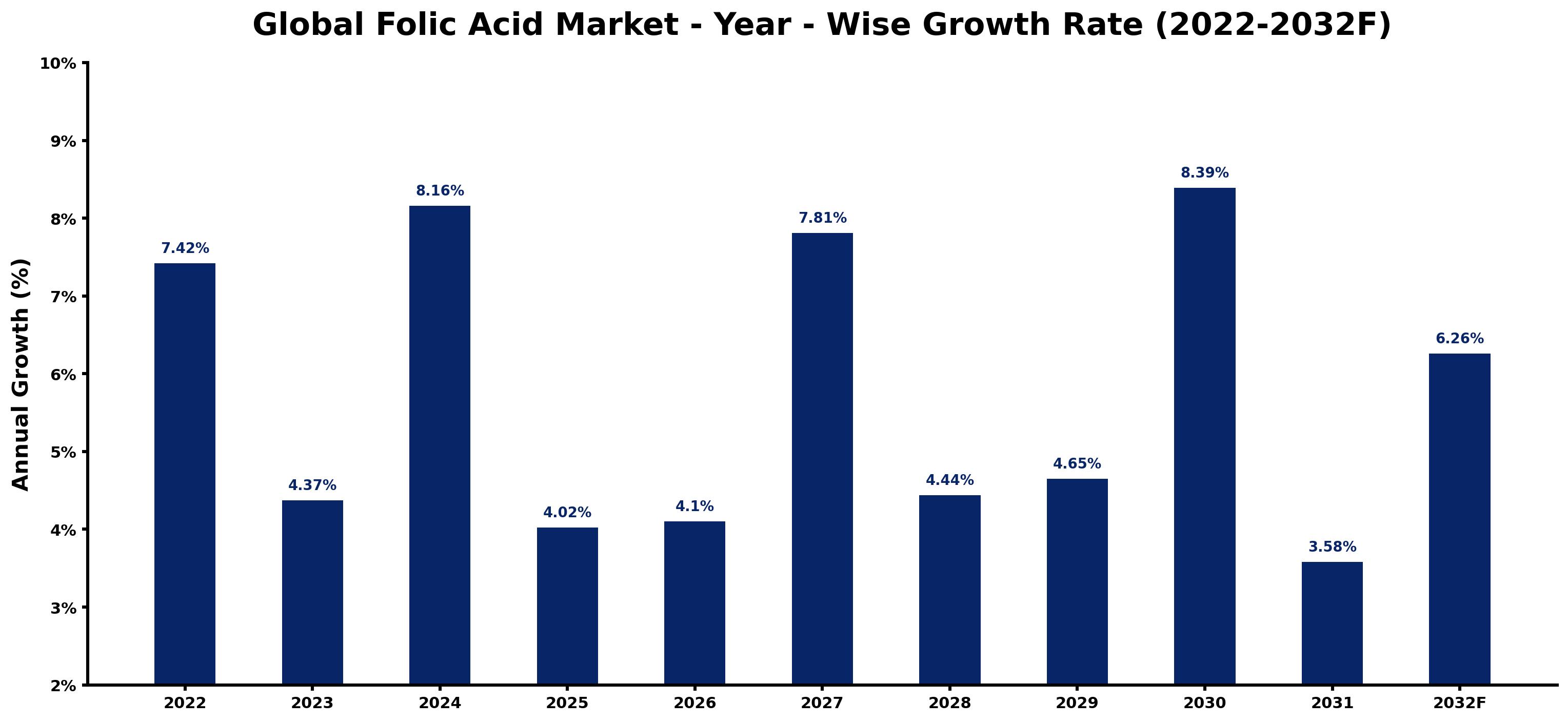
The table below presents the year‑wise growth rates along with the key drivers influencing the market
| Year | Growth Rate (%) | Major Drivers |
| 2022 | 7.42 | Investing in clinical trial pipelines enhances Folic Acid market development and recovery. |
| 2023 | 4.37 | Rising raw material costs for pharmaceutical ingredients challenge Folic Acid production efficiency. |
| 2024 | 8.16 | Utilizing sustainable sourcing practices advances Folic Acid production's environmental benefits. |
| 2025 | 4.02 | A shift toward digital therapeutics accelerates the adoption of Folic Acid supplements. |
| 2026 | 4.1 | While the competitive landscape stabilizes, collaboration among Folic Acid manufacturers intensifies. |
| 2027 | 7.81 | In the Asia-Pacific region, a skilled workforce boosts Folic Acid production capabilities. |
| 2028 | 4.44 | Continued global demand for prenatal vitamins stimulates Folic Acid industry growth opportunities. |
| 2029 | 4.65 | Healthcare providers increasingly emphasize Folic Acid for improved patient outcomes among expectant mothers. |
| 2030 | 8.39 | Supply chain efficiencies are enhancing accessibility of Folic Acid in diverse markets. |
| 2031 | 3.58 | Regulators are implementing updated guidelines that affect the Folic Acid manufacturing process. |
| 2032 | 6.26 | Wearable monitoring devices encourage consumers to engage more with Folic Acid intake. |
Note - Market size estimations and growth projections presented in this report are based on 6Wresearch's proprietary research methodology, combining internal industry data, secondary research, and primary validation, updated periodically to reflect current market conditions. As markets evolve rapidly, figures for certain industries may vary slightly and are intended as informed estimates rather than absolute figures. For the most current market sizing, we recommend validating figures with a 6Wresearch analyst.
Global Folic Acid Market Key Takeaways
Below are some of the specific key takeaways from the market, including:
- The pharmaceuticals segment is projected to command a ~56% share in 2025, underlining its pivotal role in health management and preventive care.
- Asia-Pacific is anticipated to record a CAGR of 6.2% from 2026 to 2032, reflecting improving healthcare standards and increasing maternal health awareness.
- Merck KGaA invested €12 million in expanding its manufacturing capacity for high-purity folic acid in 2023, responding to surging global demand.
- North America dominates the folic acid market due to stringent fortification regulations and high per capita health spending.
- Nutraceuticals is identified as the fastest-growing segment, with a projected CAGR of 5.5% from 2026 to 2032, driven by rising consumer preference for preventive healthcare solutions.
Evaluation of Restraints in Global Folic Acid Market
The Global Folic Acid Market is constrained by fluctuating raw material costs, which can lead to unpredictable price volatility. For instance, the price for raw materials has historically varied by over 20% annually, complicating budgeting and financial forecasting for manufacturers. Additionally, stringent regulatory requirements, such as those defined by the FDA, mandate rigorous testing and labeling, prolonging the approval process and potentially delaying product launches. For example, the FDA's regulations require that any folic acid product intended for human consumption must meet specific quality and safety standards, adding another layer of complexity for firms entering the market.
Global Folic Acid Market Trends
The Global Folic Acid Market is witnessing notable advancements in product formulations, particularly as consumer preferences shift towards convenient delivery methods. Companies like BASF are innovating with gummy and chewable forms, enhancing consumer appeal. According to a 2023 market study, these formulations are seeing demand spikes of up to 15% year-on-year.
Moreover, the integration of digital platforms for health management showcases a technological transformation in consumer engagement. Companies such as Solgar are employing mobile health applications to provide personalized dosage recommendations, creating a competitive edge. This trend not only meets consumer expectations but is also set to drive market revenue by enhancing accessibility and education.
Global Folic Acid Market Opportunities
Future opportunities in the Global Folic Acid Market hinge on expanding into fortified food applications, which are increasingly adopted amid growing health awareness. Notably, Northstar is developing a line of organic folic acid-enhanced snack foods aimed at health-conscious consumers, targeting market entry by 2025. This diversification presents a lucrative avenue for companies willing to innovate beyond traditional supplement formats.
Additionally, an increasing global focus on prenatal healthcare provides fertile ground for strategic alliances between pharmaceutical and nutraceutical companies. For example, collaborations between companies like Alvogen and healthcare institutions are projected to enhance research in folic acid efficacy, potentially unlocking new revenue streams in maternal health products.
Global Folic Acid Market by Application
The pharmaceuticals segment currently leads the Global Folic Acid Market, commanding a ~56% share in 2025 due to its critical use in medical formulations and treatments. On the other hand, the nutraceuticals segment reveals itself as the fastest-growing, with an expected CAGR of 5.5% from 2026 to 2032. This growth is primarily driven by the increasing consumer shift towards preventive health products that may enhance overall well-being and nutritional adequacy.
Global Folic Acid Market by Region
North America remains the largest region in the Global Folic Acid Market, capturing approximately ~48% share in 2025, bolstered by strong regulatory frameworks promoting folic acid consumption. Alternatively, the Asia-Pacific region is anticipated to be the fastest-growing market, boasting a CAGR of 6.2% from 2026 to 2032, driven by improving healthcare access and increasing awareness about maternal health. The concentration of economic growth in this region creates significant opportunities for market players to establish manufacturing and distribution capabilities, thereby enhancing access to folic acid products.
Government Initiatives in the Global Folic Acid Market
The regulatory landscape around folic acid is continuously evolving, aimed at enhancing public health standards and nutritional outcomes. Governments worldwide are increasingly implementing policies designed to boost folic acid awareness and accessibility, thereby affecting demand and supply dynamics in the market. Such initiatives facilitate growth in the pharmaceutical and nutraceutical sectors focused on maternal health.
- U.S. Department of Health and Human Services: "Folic Acid Campaign," launched in 2021, aims to educate women of childbearing age on the importance of folic acid, thereby influencing consumption rates across the nation.
- European Food Safety Authority: Regulation No. 432/2012, established in 2012, mandates specific health claims related to folic acid, creating a clearer information landscape that benefits consumers and businesses alike.
- Indian Ministry of Health and Family Welfare: Initiated the "National Folic Acid Supplementation Program" in 2020 to prevent neural tube defects in newborns, demonstrating government commitment to improving maternal and child health.
- World Health Organization: The "Global Strategy for Women’s, Children’s and Adolescent’s Health" in 2016 emphasizes the integration of folic acid into reproductive health programs, affecting international funding and support for folic acid initiatives.
- Australian Department of Health: Planned review of the National Folic Acid Fortification Program in 2024 to assess its impact on public health and to recommend strategies to enhance effectiveness.
Future Insights of the Global Folic Acid Market
The industry landscape of the Global Folic Acid Market is expected to undergo structural changes due to advancements in biotechnology and increasing demand for personalized nutrition. For instance, BASF's commitment to integrating high-purity folic acid in tailored health solutions positions them strongly for competitive advantage. Moreover, as consumer awareness surrounding prenatal health continues to rise, anticipated government initiatives targeting nutritional fortification are likely to encourage broader applications of folic acid, from pharmaceuticals to food systems, preparing the market for a transformative shift by 2032.
Global Folic Acid Market Latest Developments
Recent developments in the Global Folic Acid Market highlight significant strategic moves by key players aimed at bolstering their market positions:
- In June 2023, Merck KGaA completed an investment in a state-of-the-art production facility to enhance its folic acid production capacity, enabling faster response to market requirements and strengthening its supply chain reliability.
- Recently, Alvogen launched a new line of innovative folic acid formulations targeting expectant mothers, aiming to capture growing interest in maternal health solutions.
- In Q1 2024, Solgar plans to unveil a novel brand of organic folic acid supplements, reflecting a commitment to natural health products that meet consumer demand for organic certifications.
- In August 2023, Northstar expanded its distribution network across Asia-Pacific, capitalizing on the region's robust growth potential and increasing access to folic acid-based nutritional products.
Global Folic Acid Market Key Players and Industry Positioning
The Global Folic Acid Market exhibits a fragmented structure, with several key players competing on various fronts, including product specialization, technological advancements, and market penetration strategies. This fragmentation enables niche players to thrive alongside established companies by catering to specific consumer preferences.
| Leading Company | Core Strength | Strategic Focus |
|---|---|---|
| BASF | World leader in chemical production with advanced R&D capabilities. | Prioritizing innovation in high-purity folic acid applications. |
| Merck KGaA | Strong global footprint in pharmaceuticals with a focus on quality assurance. | Expanding manufacturing capabilities to support product demand. |
| Alvogen | Specialization in generic pharmaceuticals with unique product offerings. | Emphasizing maternal health and tailored formulations. |
| Northstar | Robust presence in nutraceuticals and food industries. | Focusing on organic and health-centric product lines. |
| Solgar | Reputation for premium quality dietary supplements. | Targeting growth through innovative product introductions. |
The dynamic nature of the market encourages healthy competition, compelling key players to innovate and adapt their strategies to meet emerging consumer needs and preferences.
Key Attractiveness of the Report
- 10 Years of Market Numbers
- Historical Data Starting from 2022 to 2025
- Base Year: 2025
- Forecast Data until 2032
- Key Performance Indicators Impacting the Market
- Major Upcoming Developments and Projects
Key Highlights of the Report:
- Global Folic Acid Market Outlook
- Market Size of Global Folic Acid Market, 2025
- Forecast of Global Folic Acid Market, 2032
- Historical Data and Forecast of Global Folic Acid Revenues & Volume for the Period 2022-2032
- Global Folic Acid Market Trend Evolution
- Global Folic Acid Market Drivers and Challenges
- Global Folic Acid Price Trends
- Global Folic Acid Porter's Five Forces
- Global Folic Acid Industry Life Cycle
- Historical Data and Forecast of Global Folic Acid Market Revenues & Volume
- Historical Data and Forecast of Global Folic Acid Market Revenues & Volume By Application for the Period 2022-2032
- Historical Data and Forecast of Global Folic Acid Market Revenues & Volume By Food & Beverages for the Period 2022-2032
- Historical Data and Forecast of Global Folic Acid Market Revenues & Volume By Pharmaceuticals for the Period 2022-2032
- Historical Data and Forecast of Global Folic Acid Market Revenues & Volume By Nutraceuticals for the Period 2022-2032
- Historical Data and Forecast of Global Folic Acid Market Revenues & Volume By Others for the Period 2022-2032
- Historical Data and Forecast of North America Folic Acid Market Revenues & Volume By Application for the Period 2022-2032
- Historical Data and Forecast of North America Folic Acid Market Revenues & Volume By Food & Beverages for the Period 2022-2032
- Historical Data and Forecast of North America Folic Acid Market Revenues & Volume By Pharmaceuticals for the Period 2022-2032
- Historical Data and Forecast of North America Folic Acid Market Revenues & Volume By Nutraceuticals for the Period 2022-2032
- Historical Data and Forecast of North America Folic Acid Market Revenues & Volume By Others for the Period 2022-2032
- Historical Data and Forecast of United States of America Folic Acid Market Revenues & Volume for the Period 2022-2032
- Historical Data and Forecast of Canada Folic Acid Market Revenues & Volume for the Period 2022-2032
- Historical Data and Forecast of Rest of North America Folic Acid Market Revenues & Volume for the Period 2022-2032
- Historical Data and Forecast of Latin America (LATAM) Folic Acid Market Revenues & Volume By Application for the Period 2022-2032
- Historical Data and Forecast of Latin America (LATAM) Folic Acid Market Revenues & Volume By Food & Beverages for the Period 2022-2032
- Historical Data and Forecast of Latin America (LATAM) Folic Acid Market Revenues & Volume By Pharmaceuticals for the Period 2022-2032
- Historical Data and Forecast of Latin America (LATAM) Folic Acid Market Revenues & Volume By Nutraceuticals for the Period 2022-2032
- Historical Data and Forecast of Latin America (LATAM) Folic Acid Market Revenues & Volume By Others for the Period 2022-2032
- Historical Data and Forecast of Brazil Folic Acid Market Revenues & Volume for the Period 2022-2032
- Historical Data and Forecast of Mexico Folic Acid Market Revenues & Volume for the Period 2022-2032
- Historical Data and Forecast of Argentina Folic Acid Market Revenues & Volume for the Period 2022-2032
- Historical Data and Forecast of Rest of LATAM Folic Acid Market Revenues & Volume for the Period 2022-2032
- Historical Data and Forecast of Asia Folic Acid Market Revenues & Volume By Application for the Period 2022-2032
- Historical Data and Forecast of Asia Folic Acid Market Revenues & Volume By Food & Beverages for the Period 2022-2032
- Historical Data and Forecast of Asia Folic Acid Market Revenues & Volume By Pharmaceuticals for the Period 2022-2032
- Historical Data and Forecast of Asia Folic Acid Market Revenues & Volume By Nutraceuticals for the Period 2022-2032
- Historical Data and Forecast of Asia Folic Acid Market Revenues & Volume By Others for the Period 2022-2032
- Historical Data and Forecast of China Folic Acid Market Revenues & Volume for the Period 2022-2032
- Historical Data and Forecast of India Folic Acid Market Revenues & Volume for the Period 2022-2032
- Historical Data and Forecast of Japan Folic Acid Market Revenues & Volume for the Period 2022-2032
- Historical Data and Forecast of Rest of Asia Folic Acid Market Revenues & Volume for the Period 2022-2032
- Historical Data and Forecast of Africa Folic Acid Market Revenues & Volume By Application for the Period 2022-2032
- Historical Data and Forecast of Africa Folic Acid Market Revenues & Volume By Food & Beverages for the Period 2022-2032
- Historical Data and Forecast of Africa Folic Acid Market Revenues & Volume By Pharmaceuticals for the Period 2022-2032
- Historical Data and Forecast of Africa Folic Acid Market Revenues & Volume By Nutraceuticals for the Period 2022-2032
- Historical Data and Forecast of Africa Folic Acid Market Revenues & Volume By Others for the Period 2022-2032
- Historical Data and Forecast of South Africa Folic Acid Market Revenues & Volume for the Period 2022-2032
- Historical Data and Forecast of Nigeria Folic Acid Market Revenues & Volume for the Period 2022-2032
- Historical Data and Forecast of Egypt Folic Acid Market Revenues & Volume for the Period 2022-2032
- Historical Data and Forecast of Rest of Africa Folic Acid Market Revenues & Volume for the Period 2022-2032
- Historical Data and Forecast of Europe Folic Acid Market Revenues & Volume By Application for the Period 2022-2032
- Historical Data and Forecast of Europe Folic Acid Market Revenues & Volume By Food & Beverages for the Period 2022-2032
- Historical Data and Forecast of Europe Folic Acid Market Revenues & Volume By Pharmaceuticals for the Period 2022-2032
- Historical Data and Forecast of Europe Folic Acid Market Revenues & Volume By Nutraceuticals for the Period 2022-2032
- Historical Data and Forecast of Europe Folic Acid Market Revenues & Volume By Others for the Period 2022-2032
- Historical Data and Forecast of United Kingdom Folic Acid Market Revenues & Volume for the Period 2022-2032
- Historical Data and Forecast of France Folic Acid Market Revenues & Volume for the Period 2022-2032
- Historical Data and Forecast of Germany Folic Acid Market Revenues & Volume for the Period 2022-2032
- Historical Data and Forecast of Rest of Europe Folic Acid Market Revenues & Volume for the Period 2022-2032
- Historical Data and Forecast of Middle East Folic Acid Market Revenues & Volume By Application for the Period 2022-2032
- Historical Data and Forecast of Middle East Folic Acid Market Revenues & Volume By Food & Beverages for the Period 2022-2032
- Historical Data and Forecast of Middle East Folic Acid Market Revenues & Volume By Pharmaceuticals for the Period 2022-2032
- Historical Data and Forecast of Middle East Folic Acid Market Revenues & Volume By Nutraceuticals for the Period 2022-2032
- Historical Data and Forecast of Middle East Folic Acid Market Revenues & Volume By Others for the Period 2022-2032
- Historical Data and Forecast of Saudi Arabia Folic Acid Market Revenues & Volume for the Period 2022-2032
- Historical Data and Forecast of UAE Folic Acid Market Revenues & Volume for the Period 2022-2032
- Historical Data and Forecast of Turkey Folic Acid Market Revenues & Volume for the Period 2022-2032
- Historical Data and Forecast of Rest of Middle East Folic Acid Market Revenues & Volume for the Period 2022-2032
- Global Folic Acid Market - Key Performance Indicators
- Global Folic Acid Market - Import Export Trade Statistics
- Global Folic Acid Market - Opportunity Assessment By Countries
- Global Folic Acid Market - Opportunity Assessment By Application
- 0
- Global Folic Acid Market - Top Companies Market Share
- Global Folic Acid Market - Top Companies Profiles
- Global Folic Acid Market - Comparison of Players in Technical and Operating Parameters
- Global Folic Acid Market - Strategic Recommendations
Markets Covered
The Global Folic Acid Market report provides a detailed analysis of the following market segments:
By Regions and Countries:
- North America
- Europe
- LATAM
- Middle East
- Asia
- Africa
By Application:
- Food & Beverages
- Pharmaceuticals
- Nutraceuticals
- Others






































