Global Forklift Market Highlights
| Market Size (2025) | USD 58.4 Billion |
| Forecast Size (2032) | USD 85.7 Billion |
| CAGR | 4.52% |
| Base Year | 2025 |
| Forecast Period | 2026-2032 |
| Largest Region | Asia Pacific |
| Fastest Growing Region | Asia Pacific |
| Largest Segment | Class 2 |
| Fastest Growing Segment | Class 3 |
| Leading Companies | Toyota Industries Corporation, KION Group, Hyster-Yale Materials Handling, Mitsubishi Logisnext, Crown Equipment Corporation |
Global Forklift Market Size & Growth Rate (2026-2032)
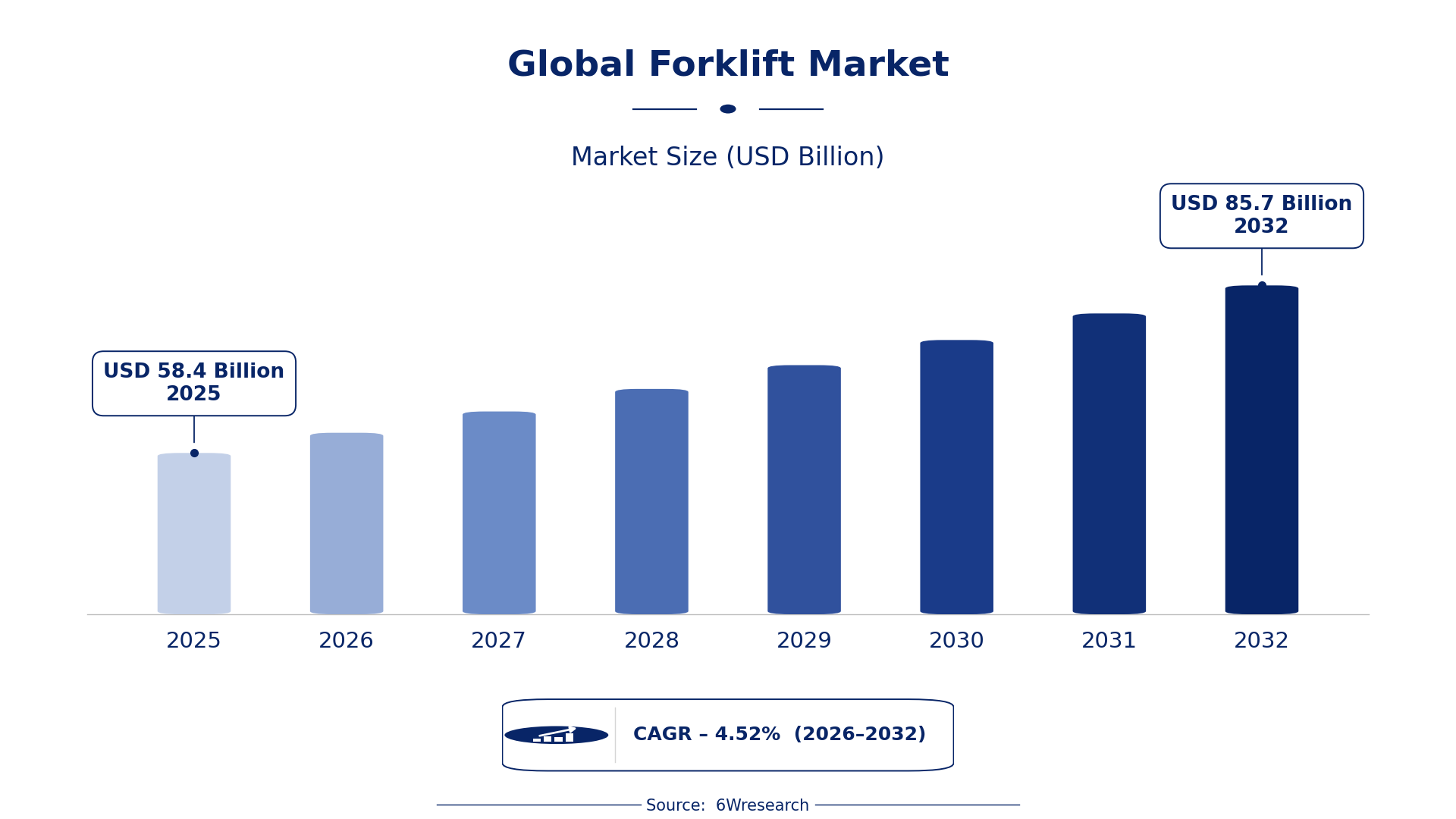
The Global Forklift Market was estimated at USD 58.4 Billion in 2025 and is projected to reach USD 85.7 Billion by 2032, growing at a CAGR of 4.52% from 2026 to 2032.
Global Forklift Market Synopsis
Presently, the Global Forklift Market is undergoing a transformative phase, operationally energizing sectors ranging from logistics to construction. The integration of automation and electric technology is reshaping the landscape, presenting new efficiency benchmarks in material handling. Furthermore, the impending surge in e-commerce continues to escalate the demand pressures on warehousing applications.
Challenges related to sustainability and labor shortages have spurred companies to innovate. As a result, market players are increasingly focusing on electric and autonomous forklift solutions to align with regulatory shifts and consumer expectations. With robust industrial activity and infrastructure development, the future growth trajectory looks promising, distinguishing this market from adjacent sectors.
Global Forklift Market Year-wise Growth Rate and Key Drivers
This graph illustrates the annual growth rates of the Global Forklift Market from 2022 to 2032, highlighting a steady upward trajectory and projected expansion over the forecast period.
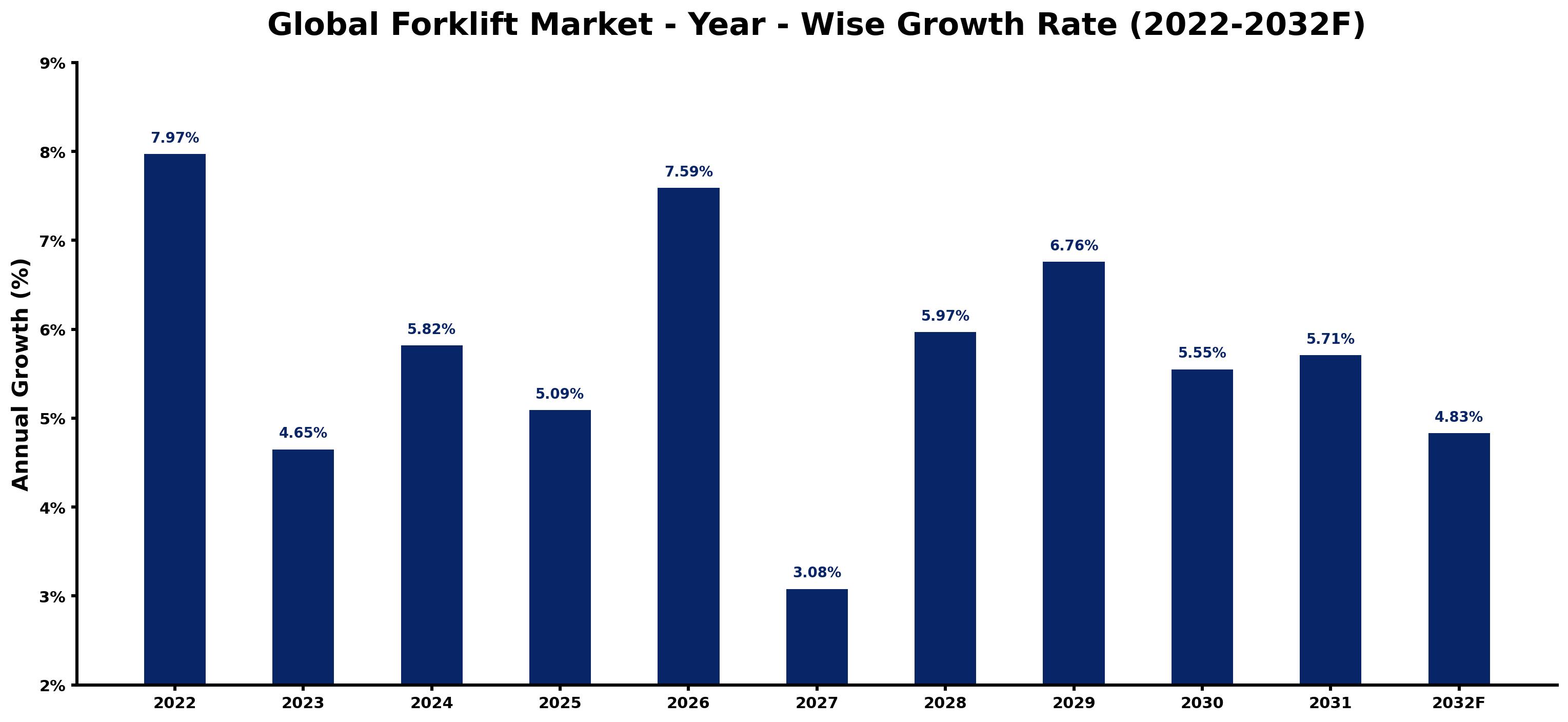
The table below presents the year‑wise growth rates along with the key drivers influencing the market
| Year | Growth Rate (%) | Major Drivers |
| 2022 | 7.97 | Rapid geographic expansion drives the upward trajectory of the global forklift market. |
| 2023 | 4.65 | Increasing skilled labor availability enhances operational efficiency within forklift operations. |
| 2024 | 5.82 | Rising costs of raw materials such as steel influence forklift pricing strategies. |
| 2025 | 5.09 | Manufacturers adopting sustainable practices are transforming forklift production methods. |
| 2026 | 7.59 | A shift toward strategic M&A is reshaping the heavy machinery fleets within the industry. |
| 2027 | 3.08 | In North America, evolving supply chain dynamics are impacting forklift demand rates. |
| 2028 | 5.97 | Electric forklifts are gaining traction as competitors focus on lower emissions technologies. |
| 2029 | 6.76 | While end-users prioritize cost efficiency, forklift adoption is adapting to changing needs. |
| 2030 | 5.55 | Regulators are mandating stricter safety standards, prompting upgrades in forklift technologies. |
| 2031 | 5.71 | Logistics companies increasingly prefer advanced forklifts to optimize material handling systems. |
| 2032 | 4.83 | Integrating automation technologies enhances the efficiency of modern forklift operations. |
Note - Market size estimations and growth projections presented in this report are based on 6Wresearch's proprietary research methodology, combining internal industry data, secondary research, and primary validation, updated periodically to reflect current market conditions. As markets evolve rapidly, figures for certain industries may vary slightly and are intended as informed estimates rather than absolute figures. For the most current market sizing, we recommend validating figures with a 6Wresearch analyst.
Global Forklift Market Key Takeaways
Below are some of the specific key takeaways from the market, including:
- Class 2 forklifts are projected to account for approximately 40% share in 2025, attributed to their versatility in various applications.
- Asia Pacific is anticipated to continue its dominance with nearly 50% market share in 2025, supported by vigorous industrialization in China and India.
- The estimated CAGR for Class 3 forklifts is around 6.5% from 2026 to 2032, driven by advancements in automation and robotics integration.
- The rental and leasing segment's market share is expected to grow significantly, accounting for around 20% by 2032 as businesses seek flexibility amid economic volatility.
Evaluation of Restraints in Global Forklift Market
The Global Forklift Market faces a series of constraints that could impact its growth trajectory. One significant challenge is the increasing production costs due to raw material price volatility, which can reach up to 7-10% in fluctuating markets. This change can deter investments in new fleet expansions. For example, rising steel prices often compromise manufacturers' ability to maintain competitive pricing, affecting their margins and ultimately resulting in higher costs for end-users.
Global Forklift Market Trends
The landscape of the Global Forklift Market is shifting dramatically due to several key trends. Firstly, the surge in electric forklifts can be traced back to heightened environmental regulations. For instance, ProMat 2023 showcased numerous companies pointing to electric models that feature lower lifetime costs—an essential consideration in today's carbon-conscious market. Secondly, the integration of IoT technology into forklifts has revolutionized operational efficiency. Notably, companies like Toyota Industries are implementing telematics systems that provide real-time performance data, enabling predictive maintenance and reducing downtime.
Thirdly, the rise in autonomous forklift models is gaining traction. Firms like KION Group are pioneering developments in this area, with autonomous solutions offering labor cost savings. The global push toward warehouse automation serves to further enhance the appeal of such technologies while responding to labor shortages.
Global Forklift Market Opportunities
There are remarkable revenue opportunities on the horizon for players in the Global Forklift Market. One standout is the growing demand for electric forklifts, projected to surpass traditional internal combustion models due to their operational cost efficiency and reduced environmental footprint. For instance, the global electric forklift market is expected to be valued at over USD 20 Billion by 2028, underlining the shift towards sustainability. Additionally, as autonomous solutions gain traction, companies like Hyster-Yale are strategizing to introduce models optimizing workflow automation in warehouses.
Rising e-commerce activity is translating to greater demand for specialized forklifts, positioning manufacturers to cater to this essential growth. The rental market segment also presents a significant opportunity, particularly for small and medium enterprises that require flexible ways to manage costs while ensuring efficiency.
Global Forklift Market by Class
Class 2 forklifts dominate the Global Forklift Market, holding approximately 40% share in 2025, a reflection of their adaptability for a range of material handling tasks across various sectors. Meanwhile, Class 3 forklifts are poised to be the fastest-growing segment, with a projected CAGR of 6.5% from 2026 to 2032, driven by their suitability for warehouse applications where space is a premium. This class is becoming increasingly attractive to businesses focused on efficiency and labor savings, amplified by advancements in robotic and automation technologies.
Global Forklift Market by Propulsion
Electric forklifts lead the Global Forklift Market with around 34% share in 2025, owing to their cost-effectiveness and minimal environmental impact. The fastest-growing segment, however, is the internal combustion engine (ICE) category, expected to show a CAGR of 5.8% from 2026 to 2032. This growth can be attributed to their performance reliability in rugged environments, a crucial factor for industries such as construction and heavy manufacturing.
Global Forklift Market by Battery Type
Lead acid batteries currently dominate the Global Forklift Market, capturing roughly 70% share in 2025, primarily due to their lower initial cost and reliability. In contrast, lithium-ion batteries are anticipated to be the fastest-growing segment, with a CAGR of 9.1% from 2026 to 2032. The long lifespan and quick charging features of lithium-ion technology are compelling factors driving this trend, making it increasingly favorable for electric forklift applications.
Global Forklift Market by Region
Asia Pacific is the largest region in the Global Forklift Market, expected to hold nearly 50% market share in 2025, driven by robust industrialization and logistics demands in China and India. Furthermore, this region is also projected to be the fastest-growing, with a CAGR of 5.2% from 2026 to 2032. The concentration of manufacturing activities and ongoing investments in infrastructure significantly bolster this growth, enhancing the appeal of efficient material handling solutions.
Government Initiatives in the Global Forklift Market
The regulatory environment surrounding the Global Forklift Market is seeing increased governmental attention, particularly concerning safety standards and environmental regulations. This framework serves not only to protect workers but also to advance sustainable practices within the industry.
- U.S. Occupational Safety and Health Administration (OSHA) standards, updated in 2021, enforce stricter safety measures for material handling equipment, ensuring a safer working environment for forklift operators.
- The European Union's Fit for 55 package, introduced in 2021, aims to reduce carbon emissions across various sectors, promoting electric forklift adoption to meet sustainability targets.
- The Indian government's Production-Linked Incentive (PLI) Scheme, announced in 2020, allocates INR 1,500 crores to boost domestic manufacturing of electric vehicles and related equipment, benefitting electric forklift manufacturers.
- The 2023 National Electric Vehicle Infrastructure (NEVI) program by the U.S. Department of Transportation aims to fund charging infrastructure, enabling wider adoption of electric forklifts in the logistics sector.
Future Insights of the Global Forklift Market
The Global Forklift Market is set to undergo transformative shifts as the push for sustainability intensifies. A notable reference point is the increased electrification, with electric forklifts projected to dominate, supported by regulatory frameworks like the EU’s Fit for 55 initiative. This movement not only aligns with environmental goals but also enhances operational efficiency through lower lifecycle costs. Concurrently, the incorporation of automation technologies is expected to reshape material handling processes, steering the competitive dynamics toward companies that excel in integrating smart solutions into their forklift offerings.
Global Forklift Market Latest Developments
Several significant advancements have marked the Global Forklift Market recently, impacting operational efficiency and competitive positioning across the sector:
- In 2023, Toyota Industries Corporation announced the development of next-generation electric forklifts with advanced AI capabilities for enhanced performance tracking and predictive maintenance, aiming to elevate operational uptime.
- Recently, KION Group unveiled a strategic partnership focusing on autonomous forklift technology, with pilot projects anticipated to launch in late 2024, geared towards revolutionizing warehouse operations.
- Ongoing collaborations between Hyster-Yale Materials Handling and leading battery manufacturers are set to yield lithium-ion-powered forklifts by 2025, emphasizing operational efficiency and longer run times.
- Mitsubishi Logisnext recently expanded its manufacturing capacity in Asia, targeting increased output of electric models, projected to meet rising regional demand by 2026.
Global Forklift Market Key Players and Industry Positioning
The competitive structure of the Global Forklift Market is relatively consolidated with key players controlling substantial market shares. Each company leverages unique strengths, such as technological advancements, regional manufacturing capabilities, and strategic collaborations to fortify their positions. The focus on enhancing product portfolios, especially in electric and automated solutions, reflects a proactive approach to address evolving customer needs and regulatory frameworks.
| Leading Company | Core Strength | Strategic Focus |
|---|---|---|
| Toyota Industries Corporation | Leader in electric forklifts with advanced automation. | Focusing on AI integration for predictive maintenance. |
| KION Group | Expertise in warehouse automation and autonomy. | Strategic partnerships for autonomous technology development. |
| Hyster-Yale Materials Handling | Strong portfolio in diverse forklift models. | Emphasis on lithium-ion battery technology for efficiency. |
| Mitsubishi Logisnext | Robust manufacturing capabilities in Asia. | Expanding electric model production to capture local demand. |
| Crown Equipment Corporation | Focus on ergonomic design and user experience. | Investment in electronic systems for enhanced performance. |
This competitive diversity provides a unique landscape for the Global Forklift Market, pushing players to enhance their operational efficiencies and adapt to new technologies to capture market shares effectively.
Key Attractiveness of the Report
- 10 Years of Market Numbers
- Historical Data Starting from 2022 to 2025
- Base Year: 2025
- Forecast Data until 2032
- Key Performance Indicators Impacting the Market
- Major Upcoming Developments and Projects
Key Highlights of the Report:
- Global Forklift Market Outlook
- Market Size of Global Forklift Market, 2025
- Forecast of Global Forklift Market, 2032
- Historical Data and Forecast of Global Forklift Revenues & Volume for the Period 2022-2032
- Global Forklift Market Trend Evolution
- Global Forklift Market Drivers and Challenges
- Global Forklift Price Trends
- Global Forklift Porter's Five Forces
- Global Forklift Industry Life Cycle
- Historical Data and Forecast of Global Forklift Market Revenues & Volume
- Historical Data and Forecast of Global Forklift Market Revenues & Volume By Class for the Period 2022-2032
- Historical Data and Forecast of Global Forklift Market Revenues & Volume By Class 1 for the Period 2022-2032
- Historical Data and Forecast of Global Forklift Market Revenues & Volume By 2 for the Period 2022-2032
- Historical Data and Forecast of Global Forklift Market Revenues & Volume By 3 for the Period 2022-2032
- Historical Data and Forecast of Global Forklift Market Revenues & Volume By 4/5 for the Period 2022-2032
- Historical Data and Forecast of Global Forklift Market Revenues & Volume By Propulsion for the Period 2022-2032
- Historical Data and Forecast of Global Forklift Market Revenues & Volume By Electric for the Period 2022-2032
- Historical Data and Forecast of Global Forklift Market Revenues & Volume By ICE for the Period 2022-2032
- Historical Data and Forecast of Global Forklift Market Revenues & Volume By Battery Type for the Period 2022-2032
- Historical Data and Forecast of Global Forklift Market Revenues & Volume By Li-Ion for the Period 2022-2032
- Historical Data and Forecast of Global Forklift Market Revenues & Volume By Lead Acid for the Period 2022-2032
- Historical Data and Forecast of North America Forklift Market Revenues & Volume By Class for the Period 2022-2032
- Historical Data and Forecast of North America Forklift Market Revenues & Volume By Class 1 for the Period 2022-2032
- Historical Data and Forecast of North America Forklift Market Revenues & Volume By 2 for the Period 2022-2032
- Historical Data and Forecast of North America Forklift Market Revenues & Volume By 3 for the Period 2022-2032
- Historical Data and Forecast of North America Forklift Market Revenues & Volume By 4/5 for the Period 2022-2032
- Historical Data and Forecast of North America Forklift Market Revenues & Volume By Propulsion for the Period 2022-2032
- Historical Data and Forecast of North America Forklift Market Revenues & Volume By Electric for the Period 2022-2032
- Historical Data and Forecast of North America Forklift Market Revenues & Volume By ICE for the Period 2022-2032
- Historical Data and Forecast of North America Forklift Market Revenues & Volume By Battery Type for the Period 2022-2032
- Historical Data and Forecast of North America Forklift Market Revenues & Volume By Li-Ion for the Period 2022-2032
- Historical Data and Forecast of North America Forklift Market Revenues & Volume By Lead Acid for the Period 2022-2032
- Historical Data and Forecast of United States of America Forklift Market Revenues & Volume for the Period 2022-2032
- Historical Data and Forecast of Canada Forklift Market Revenues & Volume for the Period 2022-2032
- Historical Data and Forecast of Rest of North America Forklift Market Revenues & Volume for the Period 2022-2032
- Historical Data and Forecast of Latin America (LATAM) Forklift Market Revenues & Volume By Class for the Period 2022-2032
- Historical Data and Forecast of Latin America (LATAM) Forklift Market Revenues & Volume By Class 1 for the Period 2022-2032
- Historical Data and Forecast of Latin America (LATAM) Forklift Market Revenues & Volume By 2 for the Period 2022-2032
- Historical Data and Forecast of Latin America (LATAM) Forklift Market Revenues & Volume By 3 for the Period 2022-2032
- Historical Data and Forecast of Latin America (LATAM) Forklift Market Revenues & Volume By 4/5 for the Period 2022-2032
- Historical Data and Forecast of Latin America (LATAM) Forklift Market Revenues & Volume By Propulsion for the Period 2022-2032
- Historical Data and Forecast of Latin America (LATAM) Forklift Market Revenues & Volume By Electric for the Period 2022-2032
- Historical Data and Forecast of Latin America (LATAM) Forklift Market Revenues & Volume By ICE for the Period 2022-2032
- Historical Data and Forecast of Latin America (LATAM) Forklift Market Revenues & Volume By Battery Type for the Period 2022-2032
- Historical Data and Forecast of Latin America (LATAM) Forklift Market Revenues & Volume By Li-Ion for the Period 2022-2032
- Historical Data and Forecast of Latin America (LATAM) Forklift Market Revenues & Volume By Lead Acid for the Period 2022-2032
- Historical Data and Forecast of Brazil Forklift Market Revenues & Volume for the Period 2022-2032
- Historical Data and Forecast of Mexico Forklift Market Revenues & Volume for the Period 2022-2032
- Historical Data and Forecast of Argentina Forklift Market Revenues & Volume for the Period 2022-2032
- Historical Data and Forecast of Rest of LATAM Forklift Market Revenues & Volume for the Period 2022-2032
- Historical Data and Forecast of Asia Forklift Market Revenues & Volume By Class for the Period 2022-2032
- Historical Data and Forecast of Asia Forklift Market Revenues & Volume By Class 1 for the Period 2022-2032
- Historical Data and Forecast of Asia Forklift Market Revenues & Volume By 2 for the Period 2022-2032
- Historical Data and Forecast of Asia Forklift Market Revenues & Volume By 3 for the Period 2022-2032
- Historical Data and Forecast of Asia Forklift Market Revenues & Volume By 4/5 for the Period 2022-2032
- Historical Data and Forecast of Asia Forklift Market Revenues & Volume By Propulsion for the Period 2022-2032
- Historical Data and Forecast of Asia Forklift Market Revenues & Volume By Electric for the Period 2022-2032
- Historical Data and Forecast of Asia Forklift Market Revenues & Volume By ICE for the Period 2022-2032
- Historical Data and Forecast of Asia Forklift Market Revenues & Volume By Battery Type for the Period 2022-2032
- Historical Data and Forecast of Asia Forklift Market Revenues & Volume By Li-Ion for the Period 2022-2032
- Historical Data and Forecast of Asia Forklift Market Revenues & Volume By Lead Acid for the Period 2022-2032
- Historical Data and Forecast of China Forklift Market Revenues & Volume for the Period 2022-2032
- Historical Data and Forecast of India Forklift Market Revenues & Volume for the Period 2022-2032
- Historical Data and Forecast of Japan Forklift Market Revenues & Volume for the Period 2022-2032
- Historical Data and Forecast of Rest of Asia Forklift Market Revenues & Volume for the Period 2022-2032
- Historical Data and Forecast of Africa Forklift Market Revenues & Volume By Class for the Period 2022-2032
- Historical Data and Forecast of Africa Forklift Market Revenues & Volume By Class 1 for the Period 2022-2032
- Historical Data and Forecast of Africa Forklift Market Revenues & Volume By 2 for the Period 2022-2032
- Historical Data and Forecast of Africa Forklift Market Revenues & Volume By 3 for the Period 2022-2032
- Historical Data and Forecast of Africa Forklift Market Revenues & Volume By 4/5 for the Period 2022-2032
- Historical Data and Forecast of Africa Forklift Market Revenues & Volume By Propulsion for the Period 2022-2032
- Historical Data and Forecast of Africa Forklift Market Revenues & Volume By Electric for the Period 2022-2032
- Historical Data and Forecast of Africa Forklift Market Revenues & Volume By ICE for the Period 2022-2032
- Historical Data and Forecast of Africa Forklift Market Revenues & Volume By Battery Type for the Period 2022-2032
- Historical Data and Forecast of Africa Forklift Market Revenues & Volume By Li-Ion for the Period 2022-2032
- Historical Data and Forecast of Africa Forklift Market Revenues & Volume By Lead Acid for the Period 2022-2032
- Historical Data and Forecast of South Africa Forklift Market Revenues & Volume for the Period 2022-2032
- Historical Data and Forecast of Nigeria Forklift Market Revenues & Volume for the Period 2022-2032
- Historical Data and Forecast of Egypt Forklift Market Revenues & Volume for the Period 2022-2032
- Historical Data and Forecast of Rest of Africa Forklift Market Revenues & Volume for the Period 2022-2032
- Historical Data and Forecast of Europe Forklift Market Revenues & Volume By Class for the Period 2022-2032
- Historical Data and Forecast of Europe Forklift Market Revenues & Volume By Class 1 for the Period 2022-2032
- Historical Data and Forecast of Europe Forklift Market Revenues & Volume By 2 for the Period 2022-2032
- Historical Data and Forecast of Europe Forklift Market Revenues & Volume By 3 for the Period 2022-2032
- Historical Data and Forecast of Europe Forklift Market Revenues & Volume By 4/5 for the Period 2022-2032
- Historical Data and Forecast of Europe Forklift Market Revenues & Volume By Propulsion for the Period 2022-2032
- Historical Data and Forecast of Europe Forklift Market Revenues & Volume By Electric for the Period 2022-2032
- Historical Data and Forecast of Europe Forklift Market Revenues & Volume By ICE for the Period 2022-2032
- Historical Data and Forecast of Europe Forklift Market Revenues & Volume By Battery Type for the Period 2022-2032
- Historical Data and Forecast of Europe Forklift Market Revenues & Volume By Li-Ion for the Period 2022-2032
- Historical Data and Forecast of Europe Forklift Market Revenues & Volume By Lead Acid for the Period 2022-2032
- Historical Data and Forecast of United Kingdom Forklift Market Revenues & Volume for the Period 2022-2032
- Historical Data and Forecast of France Forklift Market Revenues & Volume for the Period 2022-2032
- Historical Data and Forecast of Germany Forklift Market Revenues & Volume for the Period 2022-2032
- Historical Data and Forecast of Rest of Europe Forklift Market Revenues & Volume for the Period 2022-2032
- Historical Data and Forecast of Middle East Forklift Market Revenues & Volume By Class for the Period 2022-2032
- Historical Data and Forecast of Middle East Forklift Market Revenues & Volume By Class 1 for the Period 2022-2032
- Historical Data and Forecast of Middle East Forklift Market Revenues & Volume By 2 for the Period 2022-2032
- Historical Data and Forecast of Middle East Forklift Market Revenues & Volume By 3 for the Period 2022-2032
- Historical Data and Forecast of Middle East Forklift Market Revenues & Volume By 4/5 for the Period 2022-2032
- Historical Data and Forecast of Middle East Forklift Market Revenues & Volume By Propulsion for the Period 2022-2032
- Historical Data and Forecast of Middle East Forklift Market Revenues & Volume By Electric for the Period 2022-2032
- Historical Data and Forecast of Middle East Forklift Market Revenues & Volume By ICE for the Period 2022-2032
- Historical Data and Forecast of Middle East Forklift Market Revenues & Volume By Battery Type for the Period 2022-2032
- Historical Data and Forecast of Middle East Forklift Market Revenues & Volume By Li-Ion for the Period 2022-2032
- Historical Data and Forecast of Middle East Forklift Market Revenues & Volume By Lead Acid for the Period 2022-2032
- Historical Data and Forecast of Saudi Arabia Forklift Market Revenues & Volume for the Period 2022-2032
- Historical Data and Forecast of UAE Forklift Market Revenues & Volume for the Period 2022-2032
- Historical Data and Forecast of Turkey Forklift Market Revenues & Volume for the Period 2022-2032
- Historical Data and Forecast of Rest of Middle East Forklift Market Revenues & Volume for the Period 2022-2032
- Global Forklift Market - Key Performance Indicators
- Global Forklift Market - Import Export Trade Statistics
- Global Forklift Market - Opportunity Assessment By Countries
- Global Forklift Market - Opportunity Assessment By Class
- Global Forklift Market - Opportunity Assessment By Propulsion
- Global Forklift Market - Opportunity Assessment By Battery Type
- Global Forklift Market - Top Companies Market Share
- Global Forklift Market - Top Companies Profiles
- Global Forklift Market - Comparison of Players in Technical and Operating Parameters
- Global Forklift Market - Strategic Recommendations
Markets Covered
The Global Forklift Market report provides a detailed analysis of the following market segments:
By Regions and Countries:
- North America
- Europe
- LATAM
- Middle East
- Asia
- Africa
By Class:
- Class 1
- 2
- 3
- 4/5
By Propulsion:
- Electric
- ICE
By Battery Type:
- Li-Ion
- Lead Acid






































