Global Frozencooked Ready Meals Market Highlights
| Market Size (2025) | USD 13.7 Billion |
| Forecast Size (2032) | USD 21.6 Billion |
| CAGR | 5.80% |
| Base Year | 2025 |
| Forecast Period | 2026-2032 |
| Largest Region | North America |
| Fastest Growing Region | Asia-Pacific |
| Largest Segment | Non-Vegetarian Meals |
| Fastest Growing Segment | Vegetarian Meals |
| Leading Companies | Nestlé S.A., Unilever Group, Conagra Brands, Inc., Tyson Foods, Inc., General Mills, Inc. |
Global Frozencooked Ready Meals Market Size & Growth Rate (2026-2032)
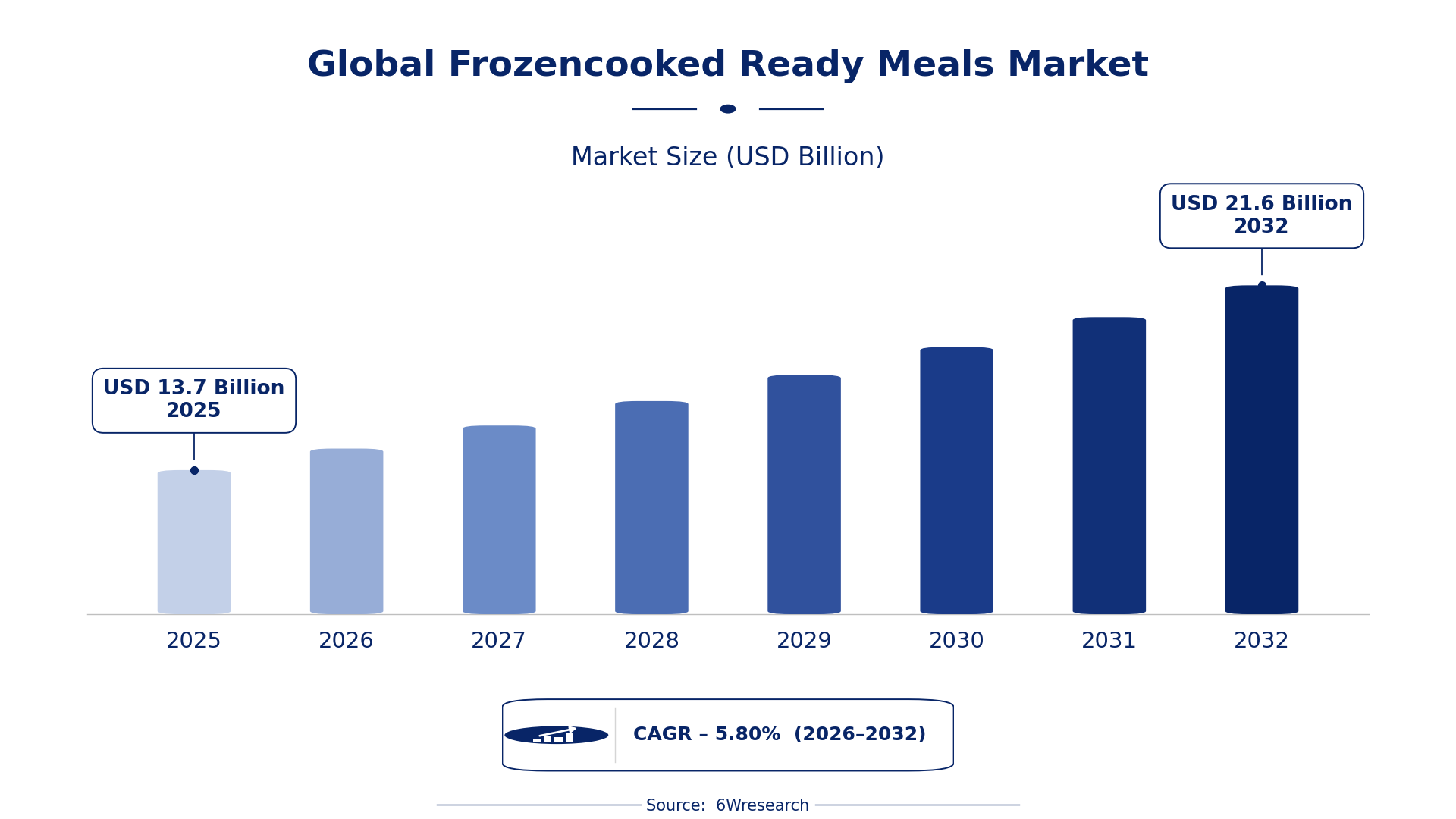
The Global Frozencooked Ready Meals Market was estimated at USD 13.7 Billion in 2025 and is projected to reach USD 21.6 Billion by 2032, growing at a CAGR of 5.80% from 2026 to 2032.
Global Frozencooked Ready Meals Market Synopsis
The frozen-cooked ready meals market is undergoing a significant transformation, driven by evolving consumer preferences and technological advancements. As consumers increasingly seek convenience without compromising on quality, the demand for frozen-cooked ready meals has surged. This shift is particularly evident in urban areas, where busy lifestyles necessitate quick and easy meal solutions. Manufacturers are responding by diversifying their product offerings, introducing a variety of cuisines and dietary options to cater to a broad spectrum of tastes and nutritional needs. The market's growth is also supported by improvements in freezing and packaging technologies, which have enhanced product shelf-life and quality, making frozen meals a more attractive option for consumers.
The market's expansion is not just a reflection of changing consumer habits but also a response to broader economic and social trends. The rise of single-person households and dual-income families has increased the need for convenient meal solutions. Additionally, the global focus on reducing food waste has led to innovations in packaging and preservation, further bolstering the appeal of frozen-cooked ready meals. As the market continues to evolve, it presents opportunities for both established players and new entrants to capitalize on these trends by offering products that align with consumer demands for convenience, variety, and quality.
Global Frozencooked Ready Meals Market Year-wise Growth Rate and Key Drivers
This graph illustrates the annual growth rates of the Global Frozencooked Ready Meals Market from 2022 to 2032, highlighting a steady upward trajectory and projected expansion over the forecast period.
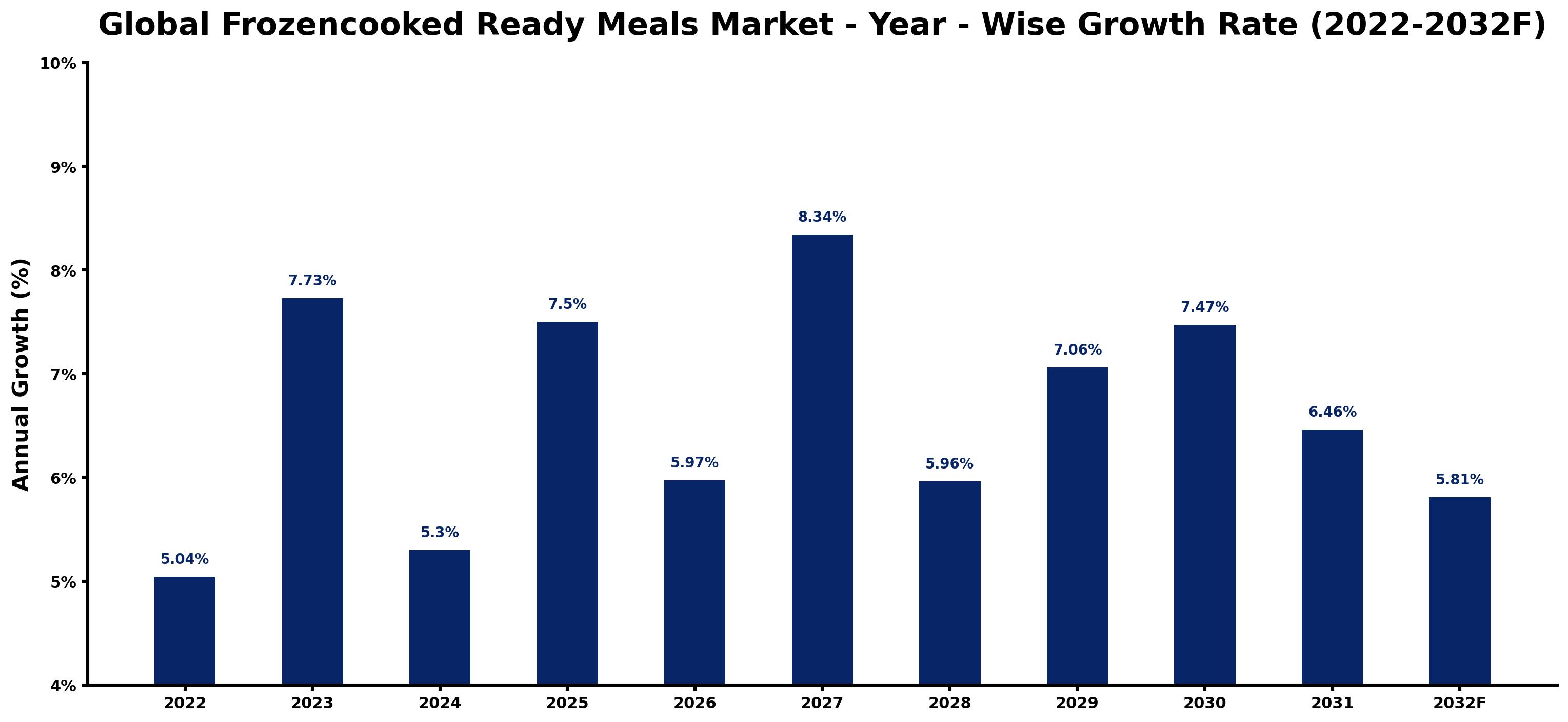
The table below presents the year‑wise growth rates along with the key drivers influencing the market
| Year | Growth Rate (%) | Major Drivers |
| 2022 | 5.04 | Regulatory changes around food safety promote interest in frozen cooked ready meals. |
| 2023 | 7.73 | In North America, a surge in brand loyalty programs enhances frozen meal sales. |
| 2024 | 5.3 | A shift toward clean-label formulations is changing consumer perceptions of frozen meals. |
| 2025 | 7.5 | Expanding sustainable packaging initiatives for frozen cooked meals encourages eco-conscious purchasing. |
| 2026 | 5.97 | Increased retail shelf penetration of frozen cooked meals supports broader consumer access. |
| 2027 | 8.34 | Food manufacturers are experiencing rising raw material costs for frozen meal production. |
| 2028 | 5.96 | Growing investment from private-label brands drives competitive pricing in frozen meals. |
| 2029 | 7.06 | Health-conscious consumers increasingly prioritize ready meals with clean label attributes. |
| 2030 | 7.47 | Retailers are enhancing e-commerce channels to meet demand for convenient frozen meals. |
| 2031 | 6.46 | As labor shortages affect production, frozen cooked meals face availability challenges. |
| 2032 | 5.81 | Plant-based frozen cooked meal options respond to shifting consumer dietary preferences. |
Note - Market size estimations and growth projections presented in this report are based on 6Wresearch's proprietary research methodology, combining internal industry data, secondary research, and primary validation, updated periodically to reflect current market conditions. As markets evolve rapidly, figures for certain industries may vary slightly and are intended as informed estimates rather than absolute figures. For the most current market sizing, we recommend validating figures with a 6Wresearch analyst.
Global Frozencooked Ready Meals Market Key Takeaways
Below are some of the specific key takeaways from the market, including:
- The market is projected to reach USD 21.6 Billion by 2032, growing at a CAGR of 5.80% from 2026 to 2032.
- North America is the largest regional market, holding a significant share in 2025.
- Non-Vegetarian Meals dominate the market, accounting for a substantial portion of the market share in 2025.
- Vegetarian Meals are the fastest-growing segment, with a projected CAGR of 6.19% from 2025 to 2030.
- Supermarkets and Hypermarkets are the leading distribution channels, representing a significant share in 2025.
Evaluation of Restraints in Global Frozencooked Ready Meals Market
Despite the market's robust growth, several challenges persist. One notable restraint is the perception of frozen meals as less healthy compared to fresh options. This perception can deter health-conscious consumers from choosing frozen-cooked ready meals. For example, the U.S. Food and Drug Administration (FDA) has stringent regulations regarding the labeling of "healthy" claims on food products, which can impact how frozen meal manufacturers market their products. Additionally, the need for continuous innovation to meet changing consumer preferences and dietary trends poses a challenge. Manufacturers must invest in research and development to create products that align with evolving consumer demands, which can be resource-intensive. Moreover, logistical challenges, such as maintaining the quality of frozen products during storage and transportation, require significant investment in cold chain infrastructure. These factors collectively influence the market dynamics and require strategic planning by industry stakeholders.
Global Frozencooked Ready Meals Market Trends
The frozen-cooked ready meals market is witnessing several distinct trends that are reshaping its landscape. One prominent trend is the increasing incorporation of plant-based ingredients into frozen meals. Manufacturers are introducing plant-based options to cater to the growing demand for vegetarian and vegan diets. For instance, in 2025, Nestlé S.A. launched a new line of plant-based frozen meals under its Garden Gourmet brand, aiming to tap into the expanding vegetarian market. Another trend is the focus on clean label products, where manufacturers are emphasizing natural ingredients and transparency in labeling to appeal to health-conscious consumers. This shift is evident in the rise of frozen meals with no artificial additives or preservatives. Additionally, there is a growing emphasis on sustainable packaging solutions. Companies are investing in eco-friendly packaging materials to reduce environmental impact and meet consumer expectations for sustainability. These trends reflect the industry's responsiveness to consumer demands and its commitment to innovation and sustainability.
Global Frozencooked Ready Meals Market Opportunities
The market presents several promising opportunities for growth. One significant opportunity lies in the expansion of e-commerce platforms for frozen meals. The convenience of online shopping, coupled with improved cold chain logistics, is making it easier for consumers to purchase frozen meals online. For example, in 2025, Unilever Group partnered with major online retailers to offer its frozen meal products through e-commerce channels, resulting in a 15% increase in online sales. Another opportunity is the development of region-specific frozen meal offerings. Manufacturers can create products that cater to local tastes and dietary preferences, tapping into emerging markets with tailored offerings. Additionally, there is potential in the premium frozen meal segment, where consumers are willing to pay a premium for high-quality, gourmet frozen meals. This segment is expected to grow at a CAGR of 6.5% from 2026 to 2032, driven by increasing disposable incomes and a desire for convenience without compromising on quality.
Global Frozencooked Ready Meals Market by Product Type
In 2025, Non-Vegetarian Meals led the product type segment, accounting for approximately 76.44% of the market share. This dominance is attributed to the widespread consumer preference for meat-based dishes and the established supply chains for such products. However, the Vegetarian Meals segment is the fastest-growing, with a projected CAGR of 6.19% from 2025 to 2030. This growth is driven by the increasing adoption of plant-based diets and the introduction of innovative vegetarian frozen meal options by manufacturers. The shift towards vegetarian meals reflects changing consumer attitudes towards health and sustainability, presenting a significant opportunity for market expansion in this segment.
Global Frozencooked Ready Meals Market by Distribution Channel
Supermarkets and Hypermarkets are the leading distribution channels for frozen-cooked ready meals, holding a significant share in 2025. This dominance is due to the extensive reach and established consumer trust in these retail formats. However, Online Retail is the fastest-growing distribution channel, with a projected CAGR of 6.36% from 2025 to 2030. The growth of online retail is facilitated by the increasing penetration of e-commerce platforms and the convenience they offer to consumers. Manufacturers are increasingly focusing on enhancing their online presence to tap into this growing channel, offering direct-to-consumer sales and subscription services to meet the evolving shopping habits of consumers.
Global Frozencooked Ready Meals Market by Region
North America is the largest regional market for frozen-cooked ready meals, holding a significant share in 2025. This dominance is driven by high disposable incomes, a fast-paced lifestyle, and a well-established retail infrastructure. In contrast, the Asia-Pacific region is the fastest-growing, with a projected CAGR of 6.28% from 2026 to 2030. This growth is attributed to rapid urbanization, changing dietary habits, and the expansion of modern retail channels in countries like China and India. The increasing adoption of frozen meals in these regions presents a substantial opportunity for market players to expand their footprint and cater to a burgeoning consumer base seeking convenient meal solutions.
Government Initiatives in the Global Frozencooked Ready Meals Market
The regulatory landscape for frozen-cooked ready meals is shaped by various government initiatives aimed at ensuring food safety, promoting healthy eating, and supporting industry growth. These initiatives influence product development, labeling, and distribution practices within the market.
- The U.S. Food and Drug Administration (FDA) has implemented the "Nutrition Labeling and Education Act" (NLEA) of 1990, which mandates that most prepared foods, including frozen meals, display nutrition labeling. This regulation ensures that consumers have access to accurate nutritional information, influencing manufacturers to reformulate products to meet health standards.
- The European Union's "Regulation (EU) No 1169/2011 on the provision of food information to consumers," effective from December 13, 2014, requires clear labeling of frozen food products, including frozen-cooked ready meals. This regulation aims to provide consumers with comprehensive information on ingredients, allergens, and nutritional content, thereby enhancing transparency and consumer trust.
- In Australia, the "Food Standards Australia New Zealand (FSANZ) Food Standards Code" sets out requirements for the labeling of frozen foods, including ready meals. These standards ensure that frozen-cooked ready meals meet specific criteria for safety, quality, and nutritional content, supporting consumer confidence in these products.
- The Canadian Food Inspection Agency (CFIA) enforces the "Food and Drug Regulations" under the "Food and Drugs Act," which includes provisions for the labeling of frozen foods. These regulations require that frozen-cooked ready meals provide accurate and truthful information regarding ingredients, nutritional content, and storage instructions, ensuring consumer safety and informed choices.
- In Japan, the "Food Sanitation Act" and associated regulations govern the safety and labeling of food products, including frozen-cooked ready meals. These regulations set standards for hygiene, additives, and labeling, ensuring that frozen meals are safe for consumption and meet consumer expectations for quality and transparency.
Future Insights of the Global Frozencooked Ready Meals Market
As the Global Frozencooked Ready Meals Market evolves, significant structural changes are anticipated. A notable shift towards automation in manufacturing processes is underway, driven by advancements in artificial intelligence and robotics, which could enhance production efficiency and reduce costs. Additionally, consumer behavior is shifting towards personalized meals, prompting companies to explore customizable frozen meal options. For instance, advancements by companies like Tyson Foods in utilizing AI for predictive analytics may revolutionize inventory management and product offerings, aligning closely with emerging dietary trends through 2032.
Global Frozencooked Ready Meals Market Latest Developments
The competitive landscape of the Global Frozencooked Ready Meals Market is marked by several key developments that highlight the industry's commitment to innovation and consumer trends.
- Recently, Nestlé S.A. expanded its product line with the introduction of a new range of frozen meals tailored for health-conscious consumers, emphasizing low-sodium and organic ingredients to respond to rising demand for nutritious options.
- In early 2023, Unilever Group launched a sustainability initiative aimed at reducing plastic packaging in its frozen meal products, potentially improving its ecological footprint and appealing to environmentally conscious consumers.
- Tyson Foods has partnered with technology providers to implement AI-driven cold chain logistics, enhancing the efficiency of transportation and maintaining product quality, with full deployment expected by late 2023.
- In mid-2023, General Mills, Inc. initiated a regional expansion strategy by introducing culturally inspired frozen meal options in the Asia-Pacific market, aiming to capture new consumer segments in line with local culinary preferences.
Global Frozencooked Ready Meals Market Key Players and Industry Positioning
The Global Frozencooked Ready Meals Market is fragmented, with several companies competing for market share through product differentiation and regional expansion. Major players leverage their brand strength and distribution networks to capture diverse consumer bases, while also investing in technology and sustainability initiatives to enhance their competitive positioning.
| Leading Company | Core Strength | Strategic Focus |
|---|---|---|
| Nestlé S.A. | Strong R&D capabilities, focusing on health and dietary trends | Expansion of nutritious product lines and sustainable practices |
| Unilever Group | Robust sustainability initiatives in packaging | Investment in eco-friendly products and reducing carbon footprint |
| Conagra Brands, Inc. | Diverse product portfolio with strong brand recognition | Innovative marketing strategies targeting millennials and Gen Z |
| Tyson Foods, Inc. | Strong supply chain management and cold chain logistics | Utilization of technology to enhance efficiency and product quality |
| General Mills, Inc. | A wide range of frozen meal options catering to various dietary needs | Regional expansion and introduction of culturally relevant products |
As competition intensifies, companies are likely to differentiate through innovation, focusing on health-conscious, sustainable, and regionally tailored offerings while leveraging technology for operational improvements.
Key Attractiveness of the Report
- 10 Years of Market Numbers
- Historical Data Starting from 2022 to 2025
- Base Year: 2025
- Forecast Data until 2032
- Key Performance Indicators Impacting the Market
- Major Upcoming Developments and Projects
Key Highlights of the Report:
- Global Frozen-cooked Ready Meals Market Outlook
- Market Size of Global Frozen-cooked Ready Meals Market, 2025
- Forecast of Global Frozen-cooked Ready Meals Market, 2032
- Historical Data and Forecast of Global Frozen-cooked Ready Meals Revenues & Volume for the Period 2022-2032
- Global Frozen-cooked Ready Meals Market Trend Evolution
- Global Frozen-cooked Ready Meals Market Drivers and Challenges
- Global Frozen-cooked Ready Meals Price Trends
- Global Frozen-cooked Ready Meals Porter's Five Forces
- Global Frozen-cooked Ready Meals Industry Life Cycle
- Historical Data and Forecast of Global Frozen-cooked Ready Meals Market Revenues & Volume
- Historical Data and Forecast of Global Frozen-cooked Ready Meals Market Revenues & Volume By Product Type for the Period 2022-2032
- Historical Data and Forecast of Global Frozen-cooked Ready Meals Market Revenues & Volume By Vegetarian Meals for the Period 2022-2032
- Historical Data and Forecast of Global Frozen-cooked Ready Meals Market Revenues & Volume By Non- Vegetarian Meals for the Period 2022-2032
- Historical Data and Forecast of Global Frozen-cooked Ready Meals Market Revenues & Volume By Distribution Channel for the Period 2022-2032
- Historical Data and Forecast of Global Frozen-cooked Ready Meals Market Revenues & Volume By Supermarkets/ Hypermarkets for the Period 2022-2032
- Historical Data and Forecast of Global Frozen-cooked Ready Meals Market Revenues & Volume By Convenience Stores for the Period 2022-2032
- Historical Data and Forecast of Global Frozen-cooked Ready Meals Market Revenues & Volume By Online Retailers for the Period 2022-2032
- Historical Data and Forecast of Global Frozen-cooked Ready Meals Market Revenues & Volume By Other Distribution Channels for the Period 2022-2032
- Historical Data and Forecast of North America Frozen-cooked Ready Meals Market Revenues & Volume By Product Type for the Period 2022-2032
- Historical Data and Forecast of North America Frozen-cooked Ready Meals Market Revenues & Volume By Vegetarian Meals for the Period 2022-2032
- Historical Data and Forecast of North America Frozen-cooked Ready Meals Market Revenues & Volume By Non- Vegetarian Meals for the Period 2022-2032
- Historical Data and Forecast of North America Frozen-cooked Ready Meals Market Revenues & Volume By Distribution Channel for the Period 2022-2032
- Historical Data and Forecast of North America Frozen-cooked Ready Meals Market Revenues & Volume By Supermarkets/ Hypermarkets for the Period 2022-2032
- Historical Data and Forecast of North America Frozen-cooked Ready Meals Market Revenues & Volume By Convenience Stores for the Period 2022-2032
- Historical Data and Forecast of North America Frozen-cooked Ready Meals Market Revenues & Volume By Online Retailers for the Period 2022-2032
- Historical Data and Forecast of North America Frozen-cooked Ready Meals Market Revenues & Volume By Other Distribution Channels for the Period 2022-2032
- Historical Data and Forecast of United States of America Frozen-cooked Ready Meals Market Revenues & Volume for the Period 2022-2032
- Historical Data and Forecast of Canada Frozen-cooked Ready Meals Market Revenues & Volume for the Period 2022-2032
- Historical Data and Forecast of Rest of North America Frozen-cooked Ready Meals Market Revenues & Volume for the Period 2022-2032
- Historical Data and Forecast of Latin America (LATAM) Frozen-cooked Ready Meals Market Revenues & Volume By Product Type for the Period 2022-2032
- Historical Data and Forecast of Latin America (LATAM) Frozen-cooked Ready Meals Market Revenues & Volume By Vegetarian Meals for the Period 2022-2032
- Historical Data and Forecast of Latin America (LATAM) Frozen-cooked Ready Meals Market Revenues & Volume By Non- Vegetarian Meals for the Period 2022-2032
- Historical Data and Forecast of Latin America (LATAM) Frozen-cooked Ready Meals Market Revenues & Volume By Distribution Channel for the Period 2022-2032
- Historical Data and Forecast of Latin America (LATAM) Frozen-cooked Ready Meals Market Revenues & Volume By Supermarkets/ Hypermarkets for the Period 2022-2032
- Historical Data and Forecast of Latin America (LATAM) Frozen-cooked Ready Meals Market Revenues & Volume By Convenience Stores for the Period 2022-2032
- Historical Data and Forecast of Latin America (LATAM) Frozen-cooked Ready Meals Market Revenues & Volume By Online Retailers for the Period 2022-2032
- Historical Data and Forecast of Latin America (LATAM) Frozen-cooked Ready Meals Market Revenues & Volume By Other Distribution Channels for the Period 2022-2032
- Historical Data and Forecast of Brazil Frozen-cooked Ready Meals Market Revenues & Volume for the Period 2022-2032
- Historical Data and Forecast of Mexico Frozen-cooked Ready Meals Market Revenues & Volume for the Period 2022-2032
- Historical Data and Forecast of Argentina Frozen-cooked Ready Meals Market Revenues & Volume for the Period 2022-2032
- Historical Data and Forecast of Rest of LATAM Frozen-cooked Ready Meals Market Revenues & Volume for the Period 2022-2032
- Historical Data and Forecast of Asia Frozen-cooked Ready Meals Market Revenues & Volume By Product Type for the Period 2022-2032
- Historical Data and Forecast of Asia Frozen-cooked Ready Meals Market Revenues & Volume By Vegetarian Meals for the Period 2022-2032
- Historical Data and Forecast of Asia Frozen-cooked Ready Meals Market Revenues & Volume By Non- Vegetarian Meals for the Period 2022-2032
- Historical Data and Forecast of Asia Frozen-cooked Ready Meals Market Revenues & Volume By Distribution Channel for the Period 2022-2032
- Historical Data and Forecast of Asia Frozen-cooked Ready Meals Market Revenues & Volume By Supermarkets/ Hypermarkets for the Period 2022-2032
- Historical Data and Forecast of Asia Frozen-cooked Ready Meals Market Revenues & Volume By Convenience Stores for the Period 2022-2032
- Historical Data and Forecast of Asia Frozen-cooked Ready Meals Market Revenues & Volume By Online Retailers for the Period 2022-2032
- Historical Data and Forecast of Asia Frozen-cooked Ready Meals Market Revenues & Volume By Other Distribution Channels for the Period 2022-2032
- Historical Data and Forecast of China Frozen-cooked Ready Meals Market Revenues & Volume for the Period 2022-2032
- Historical Data and Forecast of India Frozen-cooked Ready Meals Market Revenues & Volume for the Period 2022-2032
- Historical Data and Forecast of Japan Frozen-cooked Ready Meals Market Revenues & Volume for the Period 2022-2032
- Historical Data and Forecast of Rest of Asia Frozen-cooked Ready Meals Market Revenues & Volume for the Period 2022-2032
- Historical Data and Forecast of Africa Frozen-cooked Ready Meals Market Revenues & Volume By Product Type for the Period 2022-2032
- Historical Data and Forecast of Africa Frozen-cooked Ready Meals Market Revenues & Volume By Vegetarian Meals for the Period 2022-2032
- Historical Data and Forecast of Africa Frozen-cooked Ready Meals Market Revenues & Volume By Non- Vegetarian Meals for the Period 2022-2032
- Historical Data and Forecast of Africa Frozen-cooked Ready Meals Market Revenues & Volume By Distribution Channel for the Period 2022-2032
- Historical Data and Forecast of Africa Frozen-cooked Ready Meals Market Revenues & Volume By Supermarkets/ Hypermarkets for the Period 2022-2032
- Historical Data and Forecast of Africa Frozen-cooked Ready Meals Market Revenues & Volume By Convenience Stores for the Period 2022-2032
- Historical Data and Forecast of Africa Frozen-cooked Ready Meals Market Revenues & Volume By Online Retailers for the Period 2022-2032
- Historical Data and Forecast of Africa Frozen-cooked Ready Meals Market Revenues & Volume By Other Distribution Channels for the Period 2022-2032
- Historical Data and Forecast of South Africa Frozen-cooked Ready Meals Market Revenues & Volume for the Period 2022-2032
- Historical Data and Forecast of Nigeria Frozen-cooked Ready Meals Market Revenues & Volume for the Period 2022-2032
- Historical Data and Forecast of Egypt Frozen-cooked Ready Meals Market Revenues & Volume for the Period 2022-2032
- Historical Data and Forecast of Rest of Africa Frozen-cooked Ready Meals Market Revenues & Volume for the Period 2022-2032
- Historical Data and Forecast of Europe Frozen-cooked Ready Meals Market Revenues & Volume By Product Type for the Period 2022-2032
- Historical Data and Forecast of Europe Frozen-cooked Ready Meals Market Revenues & Volume By Vegetarian Meals for the Period 2022-2032
- Historical Data and Forecast of Europe Frozen-cooked Ready Meals Market Revenues & Volume By Non- Vegetarian Meals for the Period 2022-2032
- Historical Data and Forecast of Europe Frozen-cooked Ready Meals Market Revenues & Volume By Distribution Channel for the Period 2022-2032
- Historical Data and Forecast of Europe Frozen-cooked Ready Meals Market Revenues & Volume By Supermarkets/ Hypermarkets for the Period 2022-2032
- Historical Data and Forecast of Europe Frozen-cooked Ready Meals Market Revenues & Volume By Convenience Stores for the Period 2022-2032
- Historical Data and Forecast of Europe Frozen-cooked Ready Meals Market Revenues & Volume By Online Retailers for the Period 2022-2032
- Historical Data and Forecast of Europe Frozen-cooked Ready Meals Market Revenues & Volume By Other Distribution Channels for the Period 2022-2032
- Historical Data and Forecast of United Kingdom Frozen-cooked Ready Meals Market Revenues & Volume for the Period 2022-2032
- Historical Data and Forecast of France Frozen-cooked Ready Meals Market Revenues & Volume for the Period 2022-2032
- Historical Data and Forecast of Germany Frozen-cooked Ready Meals Market Revenues & Volume for the Period 2022-2032
- Historical Data and Forecast of Rest of Europe Frozen-cooked Ready Meals Market Revenues & Volume for the Period 2022-2032
- Historical Data and Forecast of Middle East Frozen-cooked Ready Meals Market Revenues & Volume By Product Type for the Period 2022-2032
- Historical Data and Forecast of Middle East Frozen-cooked Ready Meals Market Revenues & Volume By Vegetarian Meals for the Period 2022-2032
- Historical Data and Forecast of Middle East Frozen-cooked Ready Meals Market Revenues & Volume By Non- Vegetarian Meals for the Period 2022-2032
- Historical Data and Forecast of Middle East Frozen-cooked Ready Meals Market Revenues & Volume By Distribution Channel for the Period 2022-2032
- Historical Data and Forecast of Middle East Frozen-cooked Ready Meals Market Revenues & Volume By Supermarkets/ Hypermarkets for the Period 2022-2032
- Historical Data and Forecast of Middle East Frozen-cooked Ready Meals Market Revenues & Volume By Convenience Stores for the Period 2022-2032
- Historical Data and Forecast of Middle East Frozen-cooked Ready Meals Market Revenues & Volume By Online Retailers for the Period 2022-2032
- Historical Data and Forecast of Middle East Frozen-cooked Ready Meals Market Revenues & Volume By Other Distribution Channels for the Period 2022-2032
- Historical Data and Forecast of Saudi Arabia Frozen-cooked Ready Meals Market Revenues & Volume for the Period 2022-2032
- Historical Data and Forecast of UAE Frozen-cooked Ready Meals Market Revenues & Volume for the Period 2022-2032
- Historical Data and Forecast of Turkey Frozen-cooked Ready Meals Market Revenues & Volume for the Period 2022-2032
- Historical Data and Forecast of Rest of Middle East Frozen-cooked Ready Meals Market Revenues & Volume for the Period 2022-2032
- Global Frozen-cooked Ready Meals Market - Key Performance Indicators
- Global Frozen-cooked Ready Meals Market - Import Export Trade Statistics
- Global Frozen-cooked Ready Meals Market - Opportunity Assessment By Countries
- Global Frozen-cooked Ready Meals Market - Opportunity Assessment By Product Type
- Global Frozen-cooked Ready Meals Market - Opportunity Assessment By Distribution Channel
- Global Frozen-cooked Ready Meals Market - Top Companies Market Share
- Global Frozen-cooked Ready Meals Market - Top Companies Profiles
- Global Frozen-cooked Ready Meals Market - Comparison of Players in Technical and Operating Parameters
- Global Frozen-cooked Ready Meals Market - Strategic Recommendations
Markets Covered
The Global Frozen-cooked Ready Meals Market report provides a detailed analysis of the following market segments:
By Regions and Countries:
- North America
- Europe
- LATAM
- Middle East
- Asia
- Africa
By Product Type:
- Vegetarian Meals
- Non- Vegetarian Meals
By Distribution Channel:
- Supermarkets/ Hypermarkets
- Convenience Stores
- Online Retailers
- Other Distribution Channels






































