Global Islamic Clothing Market Highlights
| Market Size (2025) | USD 96 Billion |
| Forecast Size (2032) | USD 150 Billion |
| CAGR | 6.60% |
| Base Year | 2025 |
| Forecast Period | 2026-2032 |
| Largest Region | Middle East |
| Fastest Growing Region | Africa |
| Largest Segment | Ethnic wear |
| Fastest Growing Segment | Sustainable Fashion |
| Leading Companies | Modanisa, ASOS, Namshi, Hijab House, Abu Dhabi Fashion |
Global Islamic Clothing Market Size & Growth Rate (2026-2032)
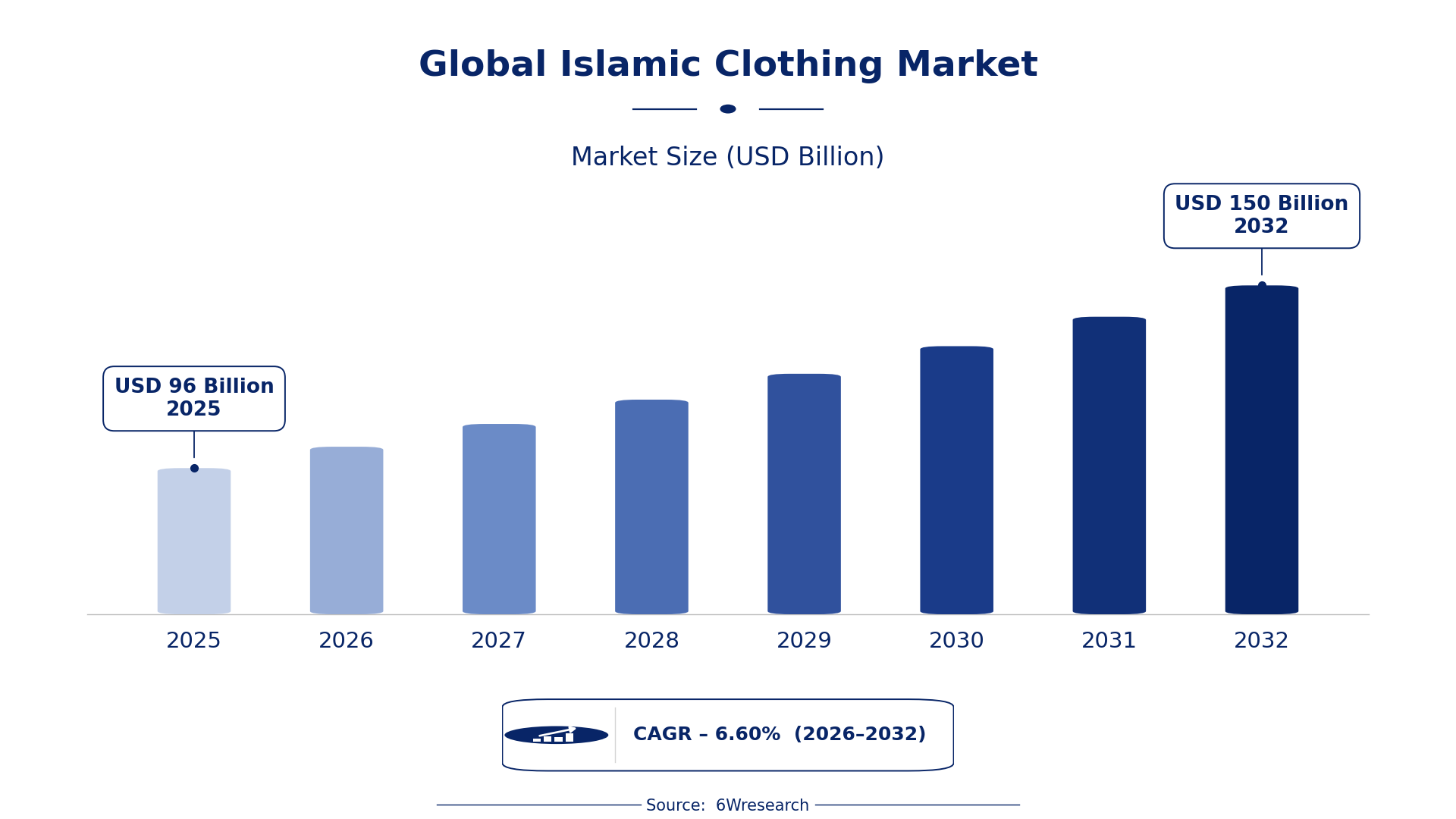
The Global Islamic Clothing Market was estimated at USD 96 Billion in 2025 and is projected to reach USD 150 Billion by 2032, growing at a CAGR of 6.60% from 2026 to 2032.
Global Islamic Clothing Market Synopsis
The Global Islamic Clothing Market is undergoing a transformative phase, being increasingly recognized for its unique intersection of culture and modern fashion. With the rise of the Muslim population and shifting perceptions about modest fashion, brands are seizing opportunities to innovate their product offerings and reach diverse consumers. This evolution is fostering a more inclusive environment in the fashion industry, bridging gaps across conventional boundaries.
Integration of technology and social media has notably increased visibility for modest clothing brands. Younger generations are engaging with Islamic fashion through online platforms, thereby boosting e-commerce growth. Moreover, collaborations between mainstream fashion labels and modest clothing designers are reshaping market dynamics, contributing to a burgeoning demand for diverse, trendy offerings.
Global Islamic Clothing Market Year-wise Growth Rate and Key Drivers
This graph illustrates the annual growth rates of the Global Islamic Clothing Market from 2022 to 2032, highlighting a steady upward trajectory and projected expansion over the forecast period.
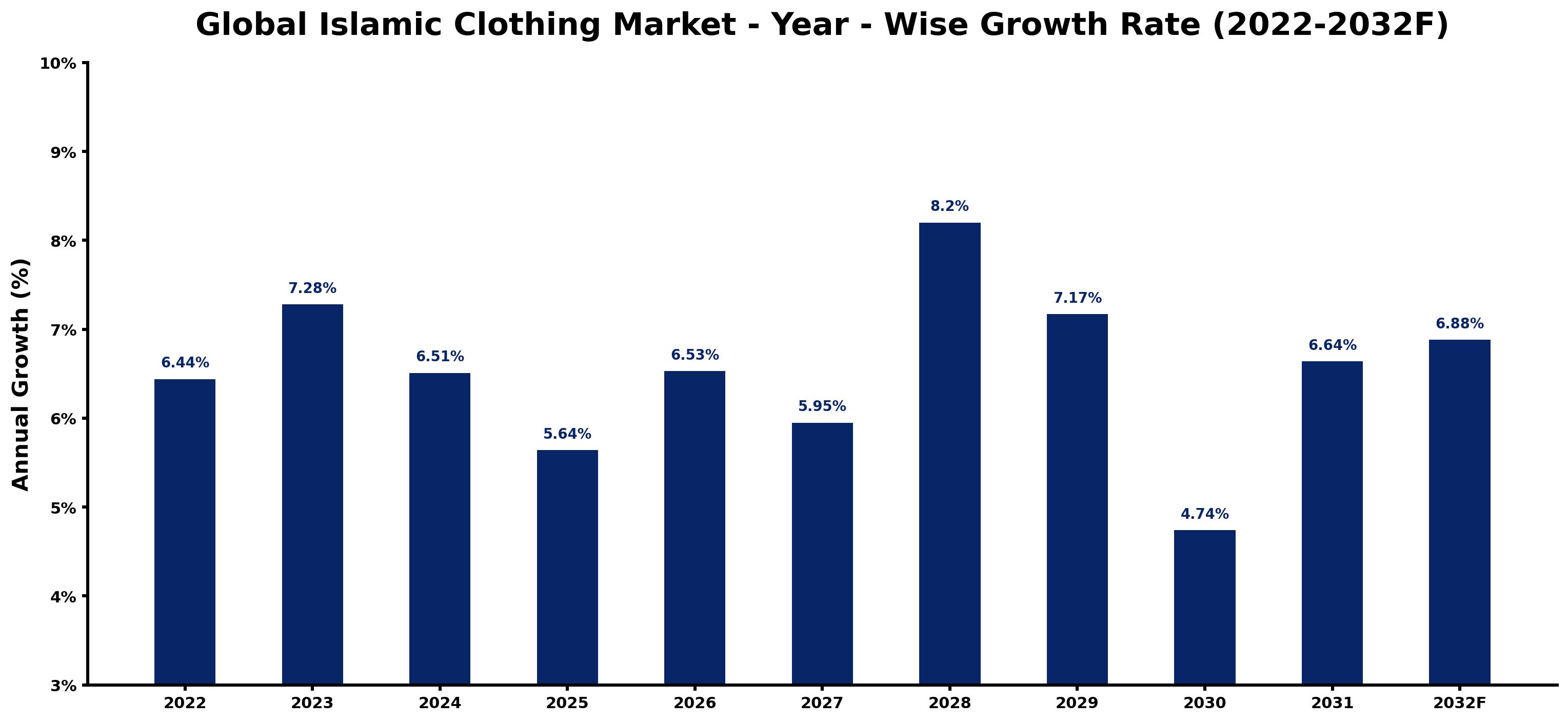
The table below presents the year‑wise growth rates along with the key drivers influencing the market
| Year | Growth Rate (%) | Major Drivers |
| 2022 | 6.44 | Navigating supply chain dynamics enhances the flow of Islamic clothing distribution. |
| 2023 | 7.28 | As skilled labor improves, the craftsmanship of Islamic apparel rises in quality. |
| 2024 | 6.51 | A shift toward inclusive regulations facilitates greater access to Islamic clothing markets. |
| 2025 | 5.64 | Manufacturers increasingly prioritize sustainability in sourcing materials for Islamic garments. |
| 2026 | 6.53 | E-commerce platforms are reshaping the competitive space for Islamic clothing retailers. |
| 2027 | 5.95 | Consumers in emerging markets expand their preferences for diverse Islamic clothing styles. |
| 2028 | 8.2 | Increased investment activity stimulates innovation within the Islamic clothing sector. |
| 2029 | 7.17 | The growing trend of personalization drives innovation in Islamic clothing offerings. |
| 2030 | 4.74 | In Asia, technological advancements in production enhance the efficiency of Islamic clothing. |
| 2031 | 6.64 | Retailers facing rising raw material costs for Islamic garments adapt pricing strategies. |
| 2032 | 6.88 | Changing consumer preferences lead Islamic clothing brands to embrace more sustainable practices. |
Note - Market size estimations and growth projections presented in this report are based on 6Wresearch's proprietary research methodology, combining internal industry data, secondary research, and primary validation, updated periodically to reflect current market conditions. As markets evolve rapidly, figures for certain industries may vary slightly and are intended as informed estimates rather than absolute figures. For the most current market sizing, we recommend validating figures with a 6Wresearch analyst.
Global Islamic Clothing Market Key Takeaways
Below are some of the specific key takeaways from the market, including:
- As of 2025, ethnic wear is projected to account for around 48% market share, reflecting its dominant position in the Global Islamic Clothing Market.
- The sustainable fashion segment is anticipated to grow at a CAGR of 8.5% from 2026 to 2032, driven by a shift toward ethical consumption.
- Modanisa, a major player, reported sales swelling by nearly 23% in 2022, further iterating the potential of online platforms in this sphere.
- Collaboration with mainstream fashion brands has surged, with over 15 notable partnerships launched between 2020-2023 aimed at democratizing modest fashion.
Evaluation of Restraints in Global Islamic Clothing Market
The Global Islamic Clothing Market grapples with specific restraints that can hinder growth, notably the challenge of varying definitions of modesty across different cultures. This cultural differentiation complicates design standardization, impacting product acceptance. For instance, a survey published in 2022 highlighted that around 38% of Muslim consumers felt current offerings inadequately addressed their unique modesty preferences, evidencing a clear gap in market alignment and demand fulfillment. Furthermore, high-quality fabric costs pose a financial strain on brands, sometimes exceeding production budgets by as much as 20%.
Global Islamic Clothing Market Trends
Several definitive trends are reshaping the Global Islamic Clothing Market, particularly through technology integration and evolving customer behavior. Notably, online shopping for modest clothing surged to account for about 45% of total sales in 2022, underscored by platforms like ASOS that effectively cater to modest fashion. Additionally, the rise of sustainable materials is gaining traction, with companies like Abu Dhabi Fashion investing in organic cotton and recycled fabrics, expected to make up 30% of their collections by 2025. Collaborations with influencers are also transforming marketing strategies, where brands leverage social media reach to highlight their products, an approach proven to yield an impressive 40% increase in engagement rates among targeted demographics.
Global Islamic Clothing Market Opportunities
The Global Islamic Clothing Market presents notable opportunities for businesses to capture emerging revenue streams. A key prospect lies in the growth of sportswear specifically designed for Muslim women, with the market expected to expand by 15% by 2026, driven by demand for active, modest apparel. For example, Nike's move to launch a hijab specifically for athletes reflects a targeted strategy to accommodate the needs of Muslim consumers in sports. Furthermore, leveraging advanced digital marketing strategies can propel brand visibility; projections indicate that effective social media campaigns could enhance sales by 25% within 12 months.
Global Islamic Clothing Market by Product
As of 2025, ethnic wear holds the largest share in the Global Islamic Clothing Market, representing approximately 48%. The fastest-growing segment is sustainable fashion, expected to achieve a CAGR of 8.5% from 2026 to 2032. The dominance of ethnic wear can be attributed to its cultural significance and adaptability in various contexts, appealing strongly to a diverse range of consumers. Contrarily, sustainable fashion is gaining traction as awareness regarding environmental impacts intensifies, driving the adoption of eco-friendly materials in production.
Global Islamic Clothing Market by Region
The Middle East is projected to dominate the Global Islamic Clothing Market, with an impressive share of around 50% in 2025. Conversely, the African region stands out as the fastest-growing, anticipated to achieve a CAGR of 9% from 2026 to 2032. The Middle East's large Muslim demographics and robust retail infrastructure contribute to its significant market concentration. In contrast, Africa's growth trajectory is fueled by increasing urbanization and a rising middle class, showcasing a burgeoning appetite for modest fashion.
Government Initiatives in the Global Islamic Clothing Market
The regulatory landscape surrounding the Global Islamic Clothing Market is evolving, with multiple initiatives aimed at supporting industry growth and enhancing consumer engagement. Governments are proactively introducing frameworks to bolster Islamic economic sectors, encouraging local manufacturing and reducing reliance on imports.
- Ministry of Trade and Industry, Indonesia: The "Support for Modest Fashion Industry" initiative was launched in 2021, providing IDR 200 billion in funding to local manufacturers to advance competitive capabilities.
- Ministry of Economy, UAE: The "UAE Islamic Fashion Initiative," established in 2020, focuses on promoting local brands through exhibitions, networking events, and investment support to boost exports.
- Ministry of Culture, Malaysia: Announced in 2023, the "Modest Fashion Global Summit" aims to create an international platform for modest apparel exchange, enhancing visibility and market reach.
- Singapore Economic Development Board: The "Modular Manufacturing Scheme," initiated in 2022, offers financial incentives to firms adapting to sustainable practices in clothing production.
Future Insights of the Global Islamic Clothing Market
The Global Islamic Clothing Market is witnessing a shift towards digitalization, heavily influenced by the rise of e-commerce. Companies are expected to invest significantly in technology to enhance online shopping experiences, as evidenced by ASOS's recent initiatives in personalized shopping features. Collaboration between brands and tech firms is likely to evolve, promoting innovations in supply chain management and customer engagement. Furthermore, a demand for more inclusive designs tailored to specific cultural representations may reshape product offerings, signalling an adaptive approach to consumer preferences.
Global Islamic Clothing Market Latest Developments
Recent breakthroughs in the Global Islamic Clothing Market showcase adaptations to consumer expectations and technological advancements. Below are notable developments:
- Modanisa recently launched a new line of activewear tailored for modest fashion enthusiasts, set to roll out in late 2023, thereby positioning itself better in the growing athleisure segment.
- ASOS is currently expanding its online catalog to include more sustainable fabric options, expected to reach half of its product range by early 2024, reinforcing its commitment to ethical fashion.
- Namshi has partnered with local influencers to enhance brand visibility, with campaigns scheduled for 2023, which is anticipated to drive higher engagement among younger audiences.
- Hijab House is in the process of opening three new physical stores across Australia by the end of 2024, aiming to tap into the in-person shopping experience and strengthen community ties.
Global Islamic Clothing Market Key Players and Industry Positioning
The competitive landscape of the Global Islamic Clothing Market is fragmented, with several key players establishing distinct niches. Brands are increasingly differentiating themselves through targeted marketing strategies, which cater to various cultural backgrounds and fashion preferences.
| Leading Company | Core Strength | Strategic Focus |
|---|---|---|
| Modanisa | Strong e-commerce platform and wide product variety | Expansion into athleisure and sportswear |
| ASOS | Innovative digital shopping features and fashion-forward offerings | Sustainability and inclusivity in product lines |
| Namshi | Local market expertise with a strong online presence | Enhancing brand engagement through influencer partnerships |
| Hijab House | Community-driven marketing and local fashion sense | Growth through physical retail presence in addition to online |
| Abu Dhabi Fashion | Focus on sustainable fashion and high-quality materials | Investment in eco-friendly production techniques |
In this dynamic market, companies are continuously adapting to societal trends and consumer expectations, which underscores the need for innovative approaches to remain competitive.
Key Attractiveness of the Report
- 10 Years of Market Numbers
- Historical Data Starting from 2022 to 2025
- Base Year: 2025
- Forecast Data until 2032
- Key Performance Indicators Impacting the Market
- Major Upcoming Developments and Projects
Key Highlights of the Report:
- Global Islamic Clothing Market Outlook
- Market Size of Global Islamic Clothing Market, 2025
- Forecast of Global Islamic Clothing Market, 2032
- Historical Data and Forecast of Global Islamic Clothing Revenues & Volume for the Period 2022-2032
- Global Islamic Clothing Market Trend Evolution
- Global Islamic Clothing Market Drivers and Challenges
- Global Islamic Clothing Price Trends
- Global Islamic Clothing Porter's Five Forces
- Global Islamic Clothing Industry Life Cycle
- Historical Data and Forecast of Global Islamic Clothing Market Revenues & Volume
- Historical Data and Forecast of Global Islamic Clothing Market Revenues & Volume By Product for the Period 2022-2032
- Historical Data and Forecast of Global Islamic Clothing Market Revenues & Volume By Ethnic wear for the Period 2022-2032
- Historical Data and Forecast of Global Islamic Clothing Market Revenues & Volume By Sustainable Fashion for the Period 2022-2032
- Historical Data and Forecast of Global Islamic Clothing Market Revenues & Volume By Sportswear for the Period 2022-2032
- Historical Data and Forecast of North America Islamic Clothing Market Revenues & Volume By Product for the Period 2022-2032
- Historical Data and Forecast of North America Islamic Clothing Market Revenues & Volume By Ethnic wear for the Period 2022-2032
- Historical Data and Forecast of North America Islamic Clothing Market Revenues & Volume By Sustainable Fashion for the Period 2022-2032
- Historical Data and Forecast of North America Islamic Clothing Market Revenues & Volume By Sportswear for the Period 2022-2032
- Historical Data and Forecast of United States of America Islamic Clothing Market Revenues & Volume for the Period 2022-2032
- Historical Data and Forecast of Canada Islamic Clothing Market Revenues & Volume for the Period 2022-2032
- Historical Data and Forecast of Rest of North America Islamic Clothing Market Revenues & Volume for the Period 2022-2032
- Historical Data and Forecast of Latin America (LATAM) Islamic Clothing Market Revenues & Volume By Product for the Period 2022-2032
- Historical Data and Forecast of Latin America (LATAM) Islamic Clothing Market Revenues & Volume By Ethnic wear for the Period 2022-2032
- Historical Data and Forecast of Latin America (LATAM) Islamic Clothing Market Revenues & Volume By Sustainable Fashion for the Period 2022-2032
- Historical Data and Forecast of Latin America (LATAM) Islamic Clothing Market Revenues & Volume By Sportswear for the Period 2022-2032
- Historical Data and Forecast of Brazil Islamic Clothing Market Revenues & Volume for the Period 2022-2032
- Historical Data and Forecast of Mexico Islamic Clothing Market Revenues & Volume for the Period 2022-2032
- Historical Data and Forecast of Argentina Islamic Clothing Market Revenues & Volume for the Period 2022-2032
- Historical Data and Forecast of Rest of LATAM Islamic Clothing Market Revenues & Volume for the Period 2022-2032
- Historical Data and Forecast of Asia Islamic Clothing Market Revenues & Volume By Product for the Period 2022-2032
- Historical Data and Forecast of Asia Islamic Clothing Market Revenues & Volume By Ethnic wear for the Period 2022-2032
- Historical Data and Forecast of Asia Islamic Clothing Market Revenues & Volume By Sustainable Fashion for the Period 2022-2032
- Historical Data and Forecast of Asia Islamic Clothing Market Revenues & Volume By Sportswear for the Period 2022-2032
- Historical Data and Forecast of China Islamic Clothing Market Revenues & Volume for the Period 2022-2032
- Historical Data and Forecast of India Islamic Clothing Market Revenues & Volume for the Period 2022-2032
- Historical Data and Forecast of Japan Islamic Clothing Market Revenues & Volume for the Period 2022-2032
- Historical Data and Forecast of Rest of Asia Islamic Clothing Market Revenues & Volume for the Period 2022-2032
- Historical Data and Forecast of Africa Islamic Clothing Market Revenues & Volume By Product for the Period 2022-2032
- Historical Data and Forecast of Africa Islamic Clothing Market Revenues & Volume By Ethnic wear for the Period 2022-2032
- Historical Data and Forecast of Africa Islamic Clothing Market Revenues & Volume By Sustainable Fashion for the Period 2022-2032
- Historical Data and Forecast of Africa Islamic Clothing Market Revenues & Volume By Sportswear for the Period 2022-2032
- Historical Data and Forecast of South Africa Islamic Clothing Market Revenues & Volume for the Period 2022-2032
- Historical Data and Forecast of Nigeria Islamic Clothing Market Revenues & Volume for the Period 2022-2032
- Historical Data and Forecast of Egypt Islamic Clothing Market Revenues & Volume for the Period 2022-2032
- Historical Data and Forecast of Rest of Africa Islamic Clothing Market Revenues & Volume for the Period 2022-2032
- Historical Data and Forecast of Europe Islamic Clothing Market Revenues & Volume By Product for the Period 2022-2032
- Historical Data and Forecast of Europe Islamic Clothing Market Revenues & Volume By Ethnic wear for the Period 2022-2032
- Historical Data and Forecast of Europe Islamic Clothing Market Revenues & Volume By Sustainable Fashion for the Period 2022-2032
- Historical Data and Forecast of Europe Islamic Clothing Market Revenues & Volume By Sportswear for the Period 2022-2032
- Historical Data and Forecast of United Kingdom Islamic Clothing Market Revenues & Volume for the Period 2022-2032
- Historical Data and Forecast of France Islamic Clothing Market Revenues & Volume for the Period 2022-2032
- Historical Data and Forecast of Germany Islamic Clothing Market Revenues & Volume for the Period 2022-2032
- Historical Data and Forecast of Rest of Europe Islamic Clothing Market Revenues & Volume for the Period 2022-2032
- Historical Data and Forecast of Middle East Islamic Clothing Market Revenues & Volume By Product for the Period 2022-2032
- Historical Data and Forecast of Middle East Islamic Clothing Market Revenues & Volume By Ethnic wear for the Period 2022-2032
- Historical Data and Forecast of Middle East Islamic Clothing Market Revenues & Volume By Sustainable Fashion for the Period 2022-2032
- Historical Data and Forecast of Middle East Islamic Clothing Market Revenues & Volume By Sportswear for the Period 2022-2032
- Historical Data and Forecast of Saudi Arabia Islamic Clothing Market Revenues & Volume for the Period 2022-2032
- Historical Data and Forecast of UAE Islamic Clothing Market Revenues & Volume for the Period 2022-2032
- Historical Data and Forecast of Turkey Islamic Clothing Market Revenues & Volume for the Period 2022-2032
- Historical Data and Forecast of Rest of Middle East Islamic Clothing Market Revenues & Volume for the Period 2022-2032
- Global Islamic Clothing Market - Key Performance Indicators
- Global Islamic Clothing Market - Import Export Trade Statistics
- Global Islamic Clothing Market - Opportunity Assessment By Countries
- Global Islamic Clothing Market - Opportunity Assessment By Product
- 0
- Global Islamic Clothing Market - Top Companies Market Share
- Global Islamic Clothing Market - Top Companies Profiles
- Global Islamic Clothing Market - Comparison of Players in Technical and Operating Parameters
- Global Islamic Clothing Market - Strategic Recommendations
Markets Covered
The Global Islamic Clothing Market report provides a detailed analysis of the following market segments:
By Regions and Countries:
- North America
- Europe
- LATAM
- Middle East
- Asia
- Africa
By Product:
- Ethnic wear
- Sustainable Fashion
- Sportswear






































