Global Islamic Finance Market Highlights
| Market Size (2025) | USD 3300 Billion |
| Forecast Size (2032) | USD 5500 Billion |
| CAGR | 7.60% |
| Base Year | 2025 |
| Forecast Period | 2026-2032 |
| Largest Region | Middle East |
| Fastest Growing Region | Africa |
| Largest Segment | Islamic Banking |
| Fastest Growing Segment | Islamic Bonds 'Sukuk' |
| Leading Companies | Al Baraka Banking Group, Dubai Islamic Bank, Qatar Islamic Bank, Bank Muamalat, Abu Dhabi Islamic Bank |
Global Islamic Finance Market Size & Growth Rate (2026-2032)
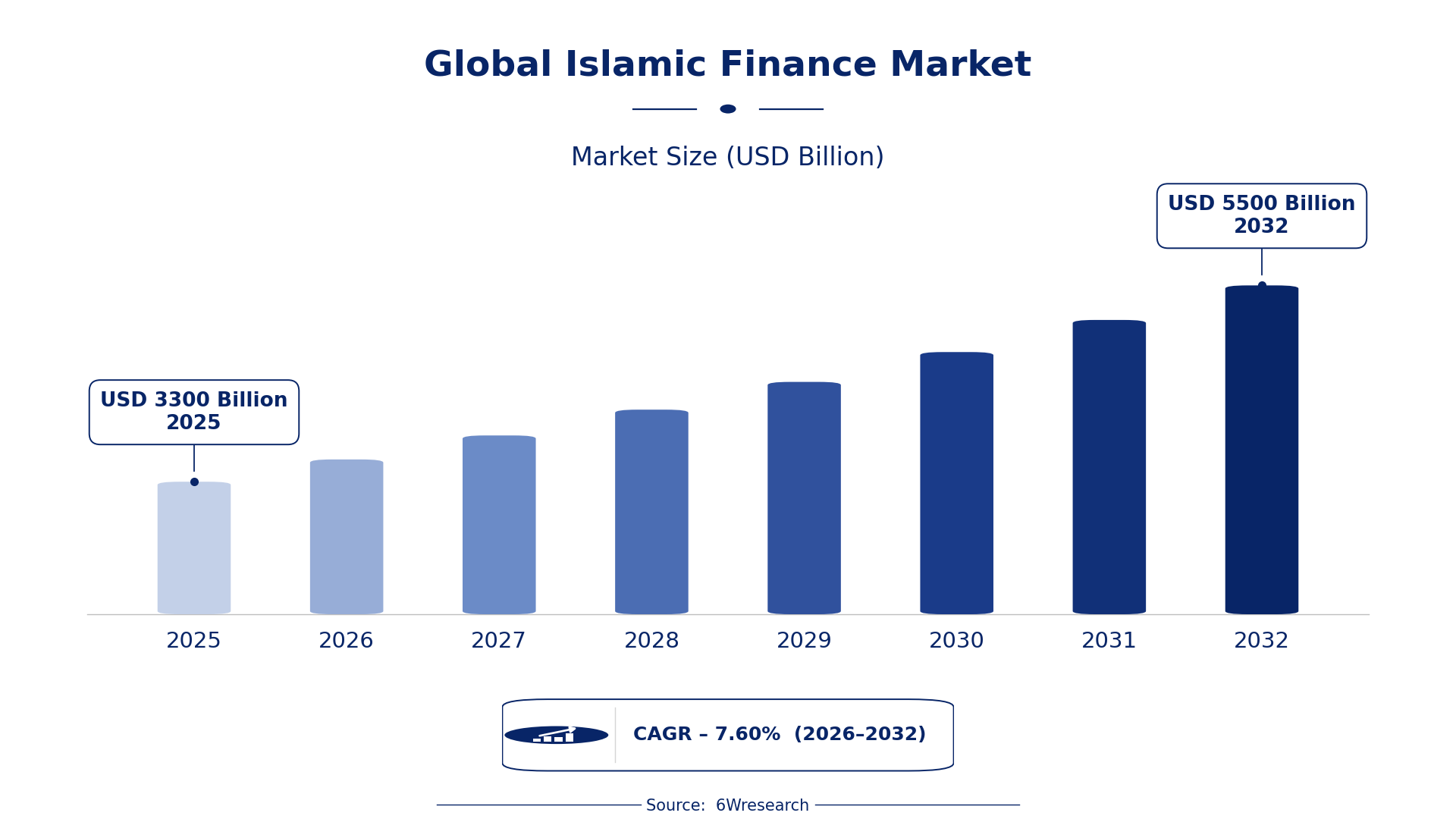
The Global Islamic Finance Market was estimated at USD 3300 Billion in 2025 and is projected to reach USD 5500 Billion by 2032, growing at a CAGR of 7.60% from 2026 to 2032.
Global Islamic Finance Market Synopsis
The Global Islamic Finance Market is currently undergoing transformational changes fueled by a heightened demand for Sharia-compliant financial services. This demand stems from an increased awareness of ethical financing options, particularly in emerging markets where Islamic finances are not just an alternative but increasingly a preferred choice. The diversification of investment products and growing consumer confidence in Islamic banking are also critical elements shaping this landscape.
As the market evolves, traditional financial entities are adapting by introducing innovative offerings, thus competing more effectively with conventional finance structures. Regions such as the Middle East and Southeast Asia are leading this transformation, demonstrating how Islamic finance appeals to a broader demographic seeking ethical alignment with investment choices. This market is distinct from conventional finance not just in compliance, but in the values that guide financial practices.
Global Islamic Finance Market Year-wise Growth Rate and Key Drivers
This graph illustrates the annual growth rates of the Global Islamic Finance Market from 2022 to 2032, highlighting a steady upward trajectory and projected expansion over the forecast period.
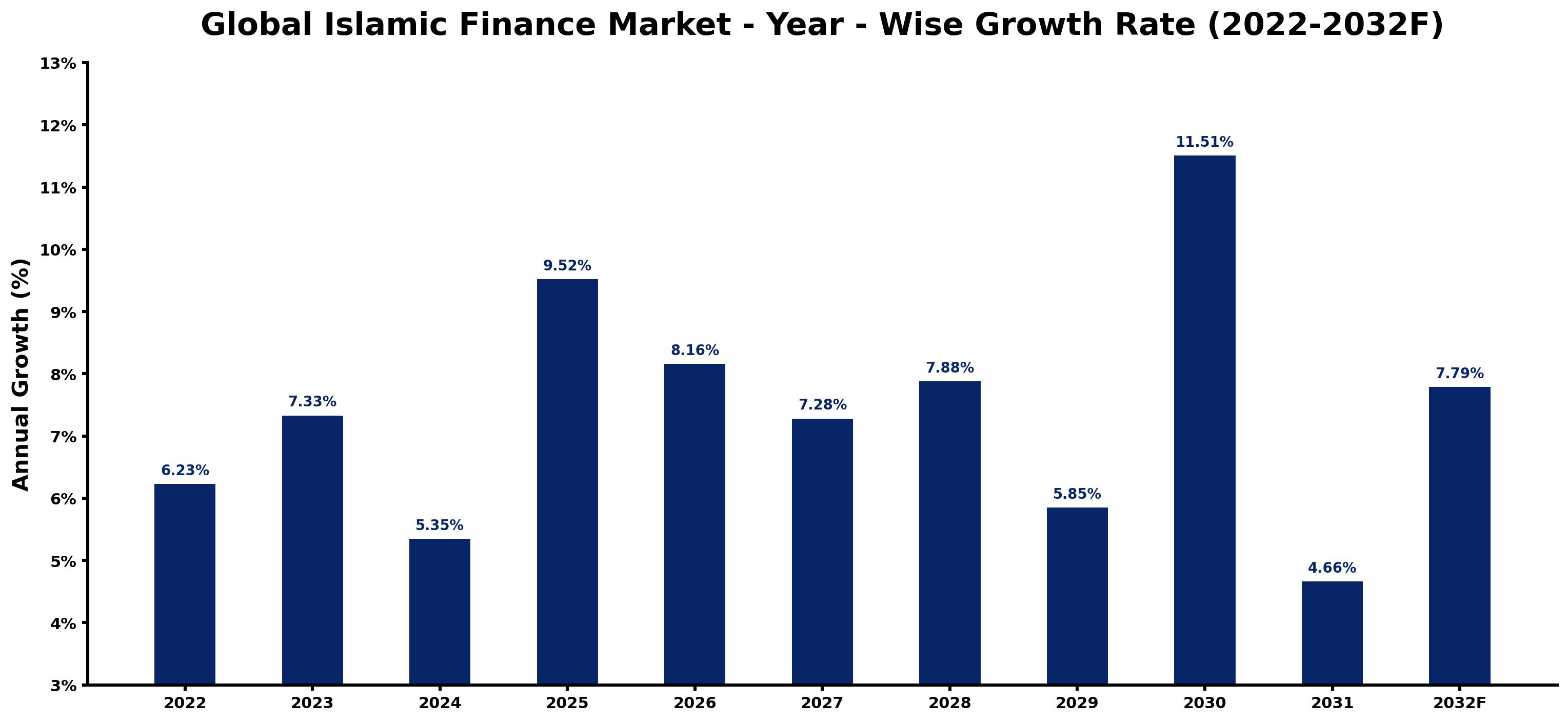
The table below presents the year‑wise growth rates along with the key drivers influencing the market
| Year | Growth Rate (%) | Major Drivers |
| 2022 | 6.23 | Islamic finance technologies are reshaping competitive dynamics within traditional banking sectors. |
| 2023 | 7.33 | Supply chain optimization in Islamic finance enhances transaction efficiency and accountability. |
| 2024 | 5.35 | Increasing costs of Sharia-compliant investment vehicles hinder proactive capital allocation. |
| 2025 | 9.52 | Fintech companies are accelerating innovation in Islamic finance solutions to attract younger clients. |
| 2026 | 8.16 | Islamic banking institutions are expanding their geographic reach into emerging Asian markets. |
| 2027 | 7.28 | Retail investors are fueling M&A activity among prominent Islamic finance service providers. |
| 2028 | 7.88 | Adopting digital platforms is enhancing Islamic finance accessibility for diverse customer bases. |
| 2029 | 5.85 | In the Middle East, end-user preferences are shifting toward ethical investment options. |
| 2030 | 11.51 | A skilled workforce within Islamic finance institutions drives innovation and customer engagement. |
| 2031 | 4.66 | While sustainability initiatives are growing, they reshape investment strategies in Islamic finance. |
| 2032 | 7.79 | A shift toward stricter regulatory compliance alters operational frameworks in Islamic finance. |
Note - Market size estimations and growth projections presented in this report are based on 6Wresearch's proprietary research methodology, combining internal industry data, secondary research, and primary validation, updated periodically to reflect current market conditions. As markets evolve rapidly, figures for certain industries may vary slightly and are intended as informed estimates rather than absolute figures. For the most current market sizing, we recommend validating figures with a 6Wresearch analyst.
Global Islamic Finance Market Key Takeaways
Below are some of the specific key takeaways from the market, including:
- Islamic banking commands approximately 70% of the total Islamic finance market share as of 2025, illustrating its dominant position.
- The sukuk segment is expected to grow at a CAGR of 8.5% from 2026 to 2032, reflecting a steady rise in appetite for Sharia-compliant bonds.
- Diverse product offerings within Islamic finance are increasing, with a specific focus on green sukuk launches,, which saw an issuance of approximately USD 5 billion in 2021.
- According to the Islamic Finance Development Report, the index for global Islamic finance grew by 12% in 2022, further indicating market resilience and expansion potential.
Evaluation of Restraints in Global Islamic Finance Market
Despite the promising outlook for the Global Islamic Finance Market, several constraints hinder its growth. A critical issue is the lack of standardized regulatory frameworks across jurisdictions, which has resulted in varied interpretations of Sharia compliance. For example, it is estimated that up to 40% of Islamic banks struggle with compliance due to these discrepancies. Moreover, a significant skills gap exists, with an estimated shortfall of over 30,000 trained professionals fluent in both conventional and Islamic finance principles expected by 2025, presenting a barrier to expansion.
Global Islamic Finance Market Trends
One of the notable trends in the Global Islamic Finance Market is the increasing integration of fintech solutions tailored for Sharia-compliant offerings. Companies like Wahed Invest, which secured USD 25 million in funding in 2022, are enhancing access to Islamic investment products through digital platforms. The trend for sustainable finance is also on the rise; the issuance of green sukuk in 2021 reached USD 5.2 billion, reflecting a merging of ethical investment strategies with environmental consciousness.
Additionally, the implementation of blockchain technology is reshaping processes related to transparency and efficiency in Islamic finance. Institutions such as the Dubai Islamic Bank have initiated pilot projects utilizing blockchain for transaction settlements, aiming to reduce operational costs while ensuring compliance with Sharia principles.
Global Islamic Finance Market Opportunities
Future revenue opportunities within the Global Islamic Finance Market are robust, particularly in green financing initiatives. For instance, Saudi Arabia's Vision 2030 promotes the need for green finance, aiming to issue up to USD 50 billion in green sukuk by 2030. This creates a significant market opportunity for Islamic financial institutions to engage with environmentally-focused investors.
Furthermore, the untapped markets in Africa offer compelling prospects; the growth rate of Islamic finance in countries like Nigeria is anticipated to surge at a CAGR of 10% from 2026 to 2032 as institutions begin to offer diverse financial products tailored to local needs and preferences. Companies such as Access Bank are already exploring Islamic banking products to capture this market segment.
Global Islamic Finance Market by Financial Sector
Islamic Banking holds the largest market share in the Global Islamic Finance Market, commanding approximately 70% share in 2025. This dominance stems from its pivotal role in providing Sharia-compliant services that cater to a wide demographic of consumers. In contrast, Islamic Bonds 'Sukuk' represents the fastest-growing segment, expected to grow at a CAGR of 8.5% from 2026 to 2032. The increasing demand for sukuk can be attributed to the desire for socially responsible investment options, along with greater awareness of their utility in funding large infrastructure projects.
Global Islamic Finance Market by Region
The Middle East stands out as the largest region in the Global Islamic Finance Market, accounting for approximately 58% share in 2025, largely due to its established banking frameworks and high demand for Sharia-compliant products. Conversely, Africa is the fastest-growing region, projected to exhibit a CAGR of 10% from 2026 to 2032. The rising Islamic population and growing interest in ethical finance across countries like Nigeria and Kenya contribute to this robust growth, enabling new financial products that appeal to emerging investor demographics.
Government Initiatives in the Global Islamic Finance Market
The regulatory landscape for the Global Islamic Finance Market is evolving rapidly, driven by various government initiatives aimed at promoting compliance and growth. Numerous regulatory bodies are working to enhance the framework surrounding Islamic financial services, facilitating greater market access and investment potential.
- The Shariah Governance Framework launched by the Central Bank of Malaysia in 2019 empowers institutions to adhere strictly to Islamic law in offering financial products.
- The Financial Services Authority of Indonesia introduced the Islamic Banking Strengthening Program in 2021, aimed at boosting local Islamic financial institutions, with an estimated funding of USD 200 million.
- In 2023, the Government of the United Kingdom announced an initiative to support the issuance of green sukuk, targeting a USD 15 billion market, enhancing support for sustainable investments.
- The Saudi Arabian Ministry of Finance is set to implement the Vision 2030 initiative, aimed at increasing the market share of Islamic finance in total banking assets to 50% by 2030, with ongoing regulatory support.
Future Insights of the Global Islamic Finance Market
The trajectory of the Global Islamic Finance Market indicates a shift towards digital transformation, with fintech solutions reshaping traditional banking models. Companies like Al Baraka Banking Group are investing in AI and blockchain technologies to enhance customer experience and streamline operations. This technological adoption is expected to lead to more personalized financial products and services, catering to a diverse array of investor needs, particularly among millennials who prioritize ethical investments. By 2032, we anticipate a notable rise in partnerships between traditional institutions and fintech startups, facilitating deeper market penetration.
Global Islamic Finance Market Latest Developments
Recent advancements in the Global Islamic Finance Market illustrate the sector's dynamic response to evolving demands and technological innovations. These developments are not just significant for the companies involved but also indicate a broader shift in market practices.
- In August 2023, Dubai Islamic Bank launched a new digital platform to enhance customer access to Sharia-compliant financing solutions, reflecting its commitment to expanding digital offerings.
- Al Baraka Banking Group recently completed the acquisition of a fintech startup in July 2023, positioning itself to leverage technology in delivering tailored financial products.
- In April 2023, Qatar Islamic Bank announced plans to issue a new sukuk, aiming to raise USD 500 million, demonstrating a proactive approach to meet investor interest in Sharia-compliant bonds.
- Bank Muamalat initiated a sustainability strategy in June 2023, focusing on green investments, which aligns with the growing emphasis on environmentally responsible financing.
Global Islamic Finance Market Key Players and Industry Positioning
The Global Islamic Finance Market is characterized by a blend of established institutions and emerging fintech players, resulting in a competitive yet fragmented landscape. This diversity allows for unique positioning strategies as companies seek to differentiate themselves through innovative products, customer engagement, and regional expansion.
| Leading Company | Core Strength | Strategic Focus |
|---|---|---|
| Al Baraka Banking Group | Strong regional presence in multiple countries | Digital transformation and fintech integration |
| Dubai Islamic Bank | Extensive suite of Sharia-compliant products | Expansion in digital banking solutions |
| Qatar Islamic Bank | Solid credit ratings and financial stability | Innovative sukuk offerings |
| Bank Muamalat | Customer-centric strategies with a focus on service | Investment in sustainability initiatives |
| Abu Dhabi Islamic Bank | Diverse product innovation | Targeting affluent customer segments |
Fostering competitive differentiation will be crucial as the market continues to expand. The adaptation strategies deployed by key players are essential not only for driving growth but also for ensuring long-term sustainability in a rapidly evolving financial landscape.
Key Attractiveness of the Report
- 10 Years of Market Numbers
- Historical Data Starting from 2022 to 2025
- Base Year: 2025
- Forecast Data until 2032
- Key Performance Indicators Impacting the Market
- Major Upcoming Developments and Projects
Key Highlights of the Report:
- Global Islamic Finance Market Outlook
- Market Size of Global Islamic Finance Market, 2025
- Forecast of Global Islamic Finance Market, 2032
- Historical Data and Forecast of Global Islamic Finance Revenues & Volume for the Period 2022-2032
- Global Islamic Finance Market Trend Evolution
- Global Islamic Finance Market Drivers and Challenges
- Global Islamic Finance Price Trends
- Global Islamic Finance Porter's Five Forces
- Global Islamic Finance Industry Life Cycle
- Historical Data and Forecast of Global Islamic Finance Market Revenues & Volume
- Historical Data and Forecast of Global Islamic Finance Market Revenues & Volume By Financial Sector for the Period 2022-2032
- Historical Data and Forecast of Global Islamic Finance Market Revenues & Volume By Islamic Banking for the Period 2022-2032
- Historical Data and Forecast of Global Islamic Finance Market Revenues & Volume By Islamic Insurance 'Takaful' for the Period 2022-2032
- Historical Data and Forecast of Global Islamic Finance Market Revenues & Volume By Islamic Bonds 'Sukuk' for the Period 2022-2032
- Historical Data and Forecast of Global Islamic Finance Market Revenues & Volume By Other Financial Institutions (OIFL's) and Islamic Funds for the Period 2022-2032
- Historical Data and Forecast of North America Islamic Finance Market Revenues & Volume By Financial Sector for the Period 2022-2032
- Historical Data and Forecast of North America Islamic Finance Market Revenues & Volume By Islamic Banking for the Period 2022-2032
- Historical Data and Forecast of North America Islamic Finance Market Revenues & Volume By Islamic Insurance 'Takaful' for the Period 2022-2032
- Historical Data and Forecast of North America Islamic Finance Market Revenues & Volume By Islamic Bonds 'Sukuk' for the Period 2022-2032
- Historical Data and Forecast of North America Islamic Finance Market Revenues & Volume By Other Financial Institutions (OIFL's) and Islamic Funds for the Period 2022-2032
- Historical Data and Forecast of United States of America Islamic Finance Market Revenues & Volume for the Period 2022-2032
- Historical Data and Forecast of Canada Islamic Finance Market Revenues & Volume for the Period 2022-2032
- Historical Data and Forecast of Rest of North America Islamic Finance Market Revenues & Volume for the Period 2022-2032
- Historical Data and Forecast of Latin America (LATAM) Islamic Finance Market Revenues & Volume By Financial Sector for the Period 2022-2032
- Historical Data and Forecast of Latin America (LATAM) Islamic Finance Market Revenues & Volume By Islamic Banking for the Period 2022-2032
- Historical Data and Forecast of Latin America (LATAM) Islamic Finance Market Revenues & Volume By Islamic Insurance 'Takaful' for the Period 2022-2032
- Historical Data and Forecast of Latin America (LATAM) Islamic Finance Market Revenues & Volume By Islamic Bonds 'Sukuk' for the Period 2022-2032
- Historical Data and Forecast of Latin America (LATAM) Islamic Finance Market Revenues & Volume By Other Financial Institutions (OIFL's) and Islamic Funds for the Period 2022-2032
- Historical Data and Forecast of Brazil Islamic Finance Market Revenues & Volume for the Period 2022-2032
- Historical Data and Forecast of Mexico Islamic Finance Market Revenues & Volume for the Period 2022-2032
- Historical Data and Forecast of Argentina Islamic Finance Market Revenues & Volume for the Period 2022-2032
- Historical Data and Forecast of Rest of LATAM Islamic Finance Market Revenues & Volume for the Period 2022-2032
- Historical Data and Forecast of Asia Islamic Finance Market Revenues & Volume By Financial Sector for the Period 2022-2032
- Historical Data and Forecast of Asia Islamic Finance Market Revenues & Volume By Islamic Banking for the Period 2022-2032
- Historical Data and Forecast of Asia Islamic Finance Market Revenues & Volume By Islamic Insurance 'Takaful' for the Period 2022-2032
- Historical Data and Forecast of Asia Islamic Finance Market Revenues & Volume By Islamic Bonds 'Sukuk' for the Period 2022-2032
- Historical Data and Forecast of Asia Islamic Finance Market Revenues & Volume By Other Financial Institutions (OIFL's) and Islamic Funds for the Period 2022-2032
- Historical Data and Forecast of China Islamic Finance Market Revenues & Volume for the Period 2022-2032
- Historical Data and Forecast of India Islamic Finance Market Revenues & Volume for the Period 2022-2032
- Historical Data and Forecast of Japan Islamic Finance Market Revenues & Volume for the Period 2022-2032
- Historical Data and Forecast of Rest of Asia Islamic Finance Market Revenues & Volume for the Period 2022-2032
- Historical Data and Forecast of Africa Islamic Finance Market Revenues & Volume By Financial Sector for the Period 2022-2032
- Historical Data and Forecast of Africa Islamic Finance Market Revenues & Volume By Islamic Banking for the Period 2022-2032
- Historical Data and Forecast of Africa Islamic Finance Market Revenues & Volume By Islamic Insurance 'Takaful' for the Period 2022-2032
- Historical Data and Forecast of Africa Islamic Finance Market Revenues & Volume By Islamic Bonds 'Sukuk' for the Period 2022-2032
- Historical Data and Forecast of Africa Islamic Finance Market Revenues & Volume By Other Financial Institutions (OIFL's) and Islamic Funds for the Period 2022-2032
- Historical Data and Forecast of South Africa Islamic Finance Market Revenues & Volume for the Period 2022-2032
- Historical Data and Forecast of Nigeria Islamic Finance Market Revenues & Volume for the Period 2022-2032
- Historical Data and Forecast of Egypt Islamic Finance Market Revenues & Volume for the Period 2022-2032
- Historical Data and Forecast of Rest of Africa Islamic Finance Market Revenues & Volume for the Period 2022-2032
- Historical Data and Forecast of Europe Islamic Finance Market Revenues & Volume By Financial Sector for the Period 2022-2032
- Historical Data and Forecast of Europe Islamic Finance Market Revenues & Volume By Islamic Banking for the Period 2022-2032
- Historical Data and Forecast of Europe Islamic Finance Market Revenues & Volume By Islamic Insurance 'Takaful' for the Period 2022-2032
- Historical Data and Forecast of Europe Islamic Finance Market Revenues & Volume By Islamic Bonds 'Sukuk' for the Period 2022-2032
- Historical Data and Forecast of Europe Islamic Finance Market Revenues & Volume By Other Financial Institutions (OIFL's) and Islamic Funds for the Period 2022-2032
- Historical Data and Forecast of United Kingdom Islamic Finance Market Revenues & Volume for the Period 2022-2032
- Historical Data and Forecast of France Islamic Finance Market Revenues & Volume for the Period 2022-2032
- Historical Data and Forecast of Germany Islamic Finance Market Revenues & Volume for the Period 2022-2032
- Historical Data and Forecast of Rest of Europe Islamic Finance Market Revenues & Volume for the Period 2022-2032
- Historical Data and Forecast of Middle East Islamic Finance Market Revenues & Volume By Financial Sector for the Period 2022-2032
- Historical Data and Forecast of Middle East Islamic Finance Market Revenues & Volume By Islamic Banking for the Period 2022-2032
- Historical Data and Forecast of Middle East Islamic Finance Market Revenues & Volume By Islamic Insurance 'Takaful' for the Period 2022-2032
- Historical Data and Forecast of Middle East Islamic Finance Market Revenues & Volume By Islamic Bonds 'Sukuk' for the Period 2022-2032
- Historical Data and Forecast of Middle East Islamic Finance Market Revenues & Volume By Other Financial Institutions (OIFL's) and Islamic Funds for the Period 2022-2032
- Historical Data and Forecast of Saudi Arabia Islamic Finance Market Revenues & Volume for the Period 2022-2032
- Historical Data and Forecast of UAE Islamic Finance Market Revenues & Volume for the Period 2022-2032
- Historical Data and Forecast of Turkey Islamic Finance Market Revenues & Volume for the Period 2022-2032
- Historical Data and Forecast of Rest of Middle East Islamic Finance Market Revenues & Volume for the Period 2022-2032
- Global Islamic Finance Market - Key Performance Indicators
- Global Islamic Finance Market - Import Export Trade Statistics
- Global Islamic Finance Market - Opportunity Assessment By Countries
- Global Islamic Finance Market - Opportunity Assessment By Financial Sector
- 0
- Global Islamic Finance Market - Top Companies Market Share
- Global Islamic Finance Market - Top Companies Profiles
- Global Islamic Finance Market - Comparison of Players in Technical and Operating Parameters
- Global Islamic Finance Market - Strategic Recommendations
Markets Covered
The Global Islamic Finance Market report provides a detailed analysis of the following market segments:
By Regions and Countries:
- North America
- Europe
- LATAM
- Middle East
- Asia
- Africa
By Financial Sector:
- Islamic Banking
- Islamic Insurance 'Takaful'
- Islamic Bonds 'Sukuk'
- Other Financial Institutions (OIFL's)
- Islamic Funds






































