Global Language Services Market Highlights
| Market Size (2025) | USD 56.4 Billion |
| Forecast Size (2032) | USD 91.2 Billion |
| CAGR | 6.50% |
| Base Year | 2025 |
| Forecast Period | 2026-2032 |
| Largest Region | North America |
| Fastest Growing Region | Asia |
| Largest Segment | Translation Services |
| Fastest Growing Segment | Interpretation Services |
| Leading Companies | Lionbridge, TransPerfect, SDL, LanguageLine Solutions, RWS |
Global Language Services Market Size & Growth Rate (2026-2032)
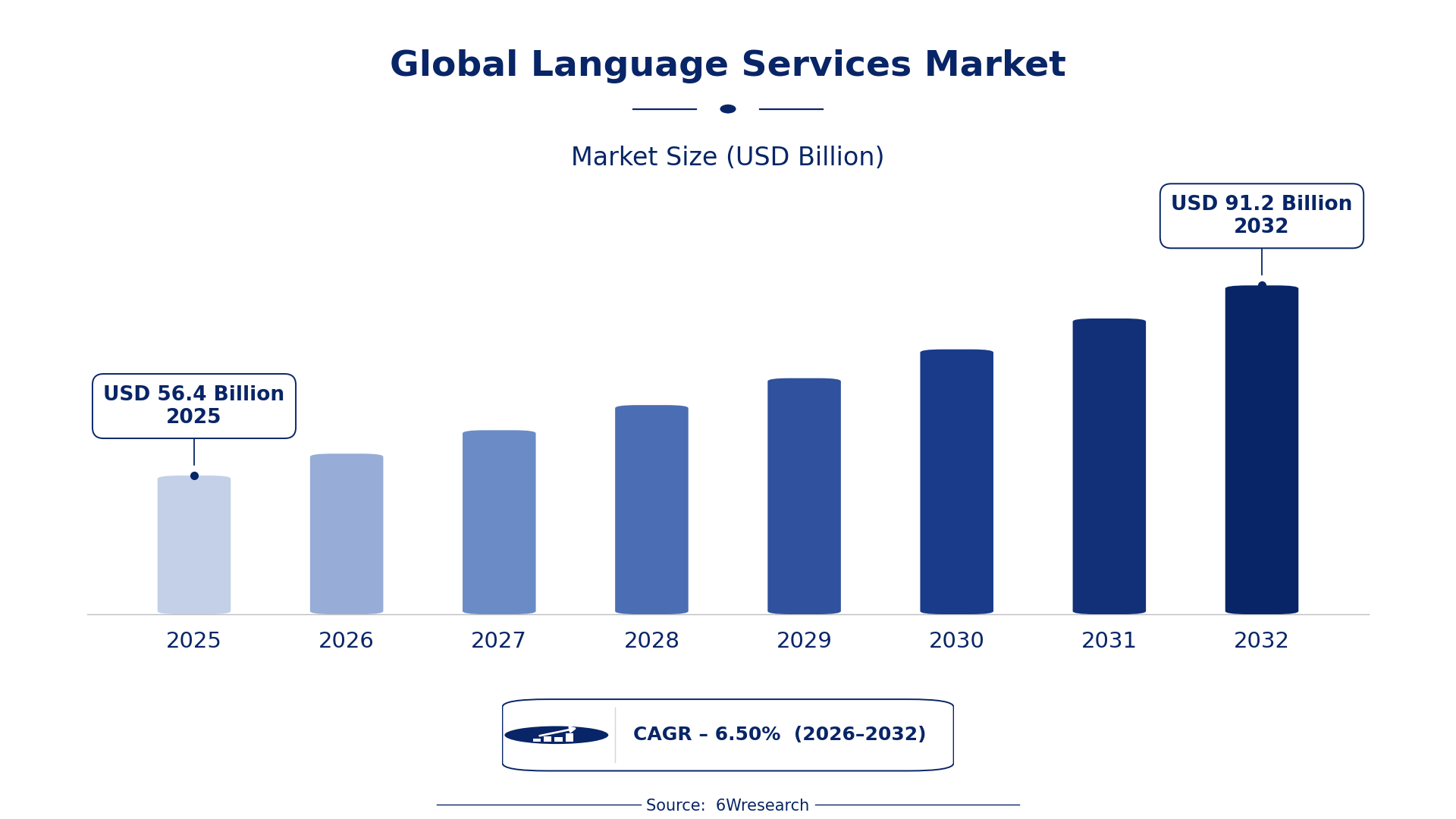
The Global Language Services Market was estimated at USD 56.4 Billion in 2025 and is projected to reach USD 91.2 Billion by 2032, growing at a CAGR of 6.50% from 2026 to 2032.
Global Language Services Market Synopsis
The Global Language Services Market is in a transformative phase driven by globalization and digital communication needs. Companies across various sectors, such as e-commerce and technology, are prioritizing localization strategies to effectively penetrate international markets. This shift underscores the importance of language services as a critical tool for corporate growth.
As organizations strive to connect with diverse audiences, language service providers are evolving their offerings. The integration of advanced technologies, like AI-driven machine translation, is redefining service delivery. Such advancements not only increase efficiency but also create strategic partnerships, expanding the functionalities that language service providers can offer to their clients.
Global Language Services Market Year-wise Growth Rate and Key Drivers
This graph illustrates the annual growth rates of the Global Language Services Market from 2022 to 2032, highlighting a steady upward trajectory and projected expansion over the forecast period.
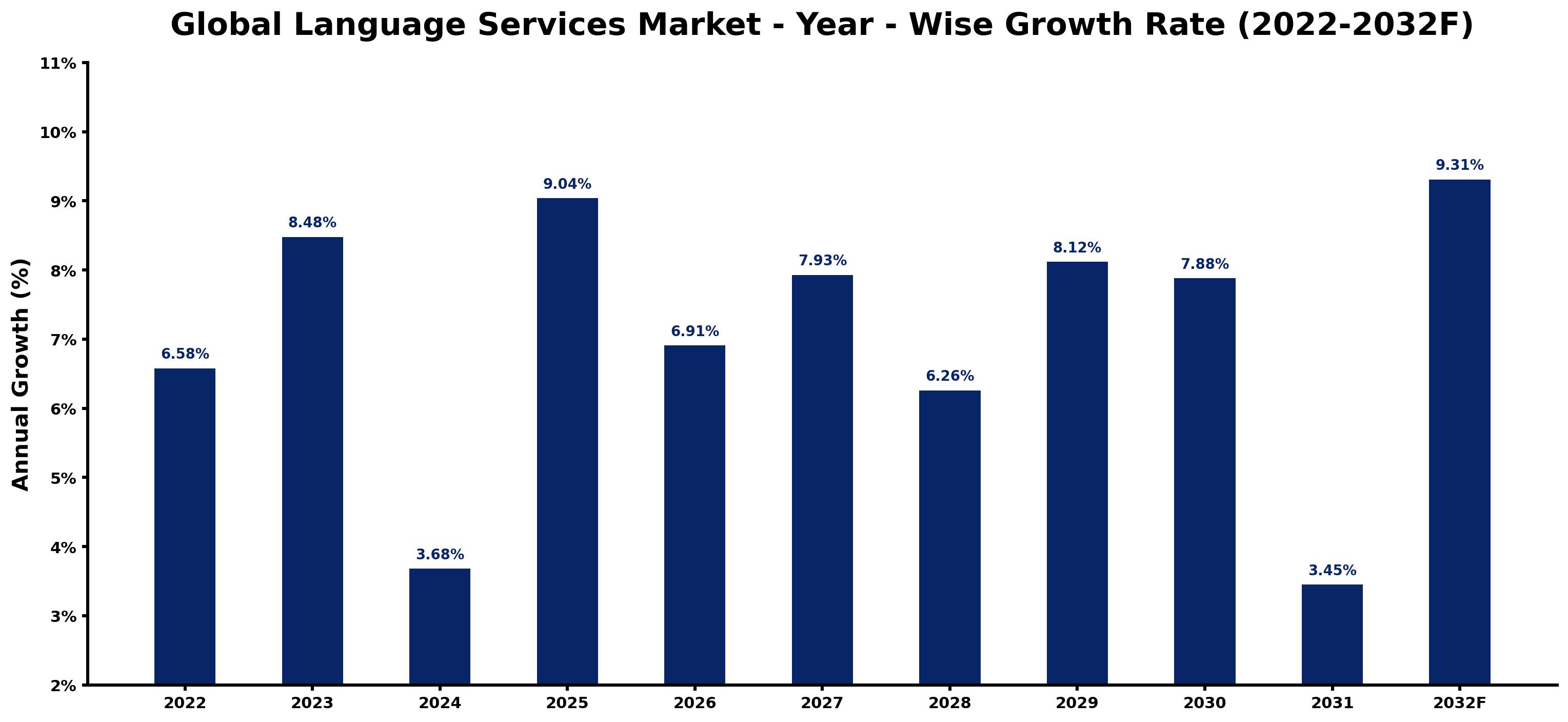
The table below presents the year‑wise growth rates along with the key drivers influencing the market
| Year | Growth Rate (%) | Major Drivers |
| 2022 | 6.58 | Language services expanded as businesses shifted to remote communication and global engagement. |
| 2023 | 8.48 | Implementing new translation policies heightened regulatory compliance for language services. |
| 2024 | 3.68 | In North America, the rising demand for multilingual content increased language service engagement. |
| 2025 | 9.04 | A shift toward AI-driven translation technology enhances operational efficiency in language services. |
| 2026 | 6.91 | Growing skill shortages in linguistic professionals challenge capacity in language service providers. |
| 2027 | 7.93 | Translation firms are navigating regional expansions to enhance global language service access. |
| 2028 | 6.26 | Investors are driving acquisitions in language service companies to consolidate market share. |
| 2029 | 8.12 | Market consolidation leads to stricter price competition among leading language service providers. |
| 2030 | 7.88 | Enhancing digital platforms for language services promotes sustainability through reduced paper usage. |
| 2031 | 3.45 | As global supply chain disruptions continue, language service demand stabilizes across industries. |
| 2032 | 9.31 | Enterprises investing in language services benefit from decreasing localization costs, enhancing competitiveness. |
Note - Market size estimations and growth projections presented in this report are based on 6Wresearch's proprietary research methodology, combining internal industry data, secondary research, and primary validation, updated periodically to reflect current market conditions. As markets evolve rapidly, figures for certain industries may vary slightly and are intended as informed estimates rather than absolute figures. For the most current market sizing, we recommend validating figures with a 6Wresearch analyst.
Global Language Services Market Key Takeaways
Below are some of the specific key takeaways from the market, including:
- North America accounts for approximately 48% share in 2025, making it the largest region.
- Interpretation Services are expected to grow at a CAGR of 8.2% from 2026 to 2032, surpassing other segments.
- AI translation technology is projected to see a 30% increase in adoption within the next four years, enhancing service efficiency.
- Major players like TransPerfect reported revenues of over $1 billion in 2022, indicating robust market health.
Evaluation of Restraints in Global Language Services Market
The Global Language Services Market faces significant challenges, particularly related to quality control and pricing pressures. Freelance language providers often undercut larger firms, creating a race to the bottom in pricing. Companies may find their profit margins squeezed to as low as 10% due to this intense competition. For example, regulatory compliance can also impose additional costs; the GDPR in Europe has mandated strict guidelines on data handling, necessitating language services to adapt quickly, which can be financially burdensome.
Global Language Services Market Trends
Three prevailing trends are shaping the Global Language Services Market. Firstly, there is a clear shift towards AI-enhanced translations, with companies like Lionbridge investing in deep learning algorithms to streamline processes. This has resulted in a 50% faster turnaround time for translation projects compared to traditional methods. Secondly, the healthcare sector is increasingly reliant on specialized language services; the demand for medical translations surged to over $2 billion in 2022 due to the expansion of telehealth services. Lastly, a growing trend in e-learning has fueled the need for localized educational content, driving companies to offer translation services tailored specifically for academic contexts, thus expanding their service portfolios.
Global Language Services Market Opportunities
Distinct revenue opportunities are emerging in the Global Language Services Market, particularly in tech-driven applications. For instance, businesses targeting the electric vehicle ecosystem are increasingly seeking translation services for technical manuals and consumer communication. A projected market growth of $1.8 billion by 2030 in this segment emphasizes the opportunity. Moreover, companies providing language services for the gaming industry could see substantial returns, as localization plays a vital role in user engagement, which has increased user retention rates by 15% across various platforms.
Global Language Services Market by Service
Translation Services hold the largest market share, accounting for approximately 58% in 2025. Conversely, Interpretation Services are anticipated to grow the fastest, with a CAGR of 8.2% from 2026 to 2032. The preference for Translation Services stems from the continual need for written localization and documentation across diverse sectors, while the growing demand for real-time communication in business and events drives the rapid growth of Interpretation Services.
Global Language Services Market by Component
Software is the largest component segment, comprising about 70% share in 2025, driven by the increasing reliance on translation automation tools. Meanwhile, Hardware components are projected to grow at a CAGR of 7.5% from 2026 to 2032, reflecting the need for sophisticated audio-visual equipment used in interpretation services.
Global Language Services Market by Application
The IT and Telecommunications sector leads the Global Language Services Market, holding a market share of approximately 40% in 2025. The sector’s reliance on accurate localization to enhance communication and maintain a competitive edge is evident. Meanwhile, the Healthcare sector is identified as the fastest-growing, with a projected CAGR of 9.0% from 2026 to 2032, spurred by increasing regulatory requirements for accurate medical translations and patient care communications.
Global Language Services Market by Region
North America is the largest region for the Global Language Services Market, commanding around 48% of the market share in 2025, primarily due to a vast consumer base and high technology adoption rates. Meanwhile, Asia is anticipated to be the fastest-growing region, with a CAGR of 7.8% from 2026 to 2032, influenced by burgeoning tech markets and significant investments in localization by established multinationals.
Government Initiatives in the Global Language Services Market
Government agencies are increasingly recognizing the importance of language services in enhancing communication and fostering international relations. Various initiatives are being undertaken to support this market, promoting growth and investment. Here are some notable examples:
- Department of Commerce, "Language Access Plan," initiated in 2021, aims to enhance communication with non-English speaking populations, benefitting language service providers focused on community services.
- European Commission, "Trans-European Networks for Language Services," launched in 2023, encourages cross-border cooperation and standardization to support language service growth across EU nations.
- Ministry of Education, "Localization for Educational Materials Initiative," planned for 2024, aims to allocate funding to enhance language access in education, particularly in multilingual regions.
- Federal Ministry of Health, "Health Communication Multilingual Initiative," enacted in 2022, focuses on improving health communication and outreach to diverse communities, increasing demand for healthcare translation services.
Future Insights of the Global Language Services Market
As the Global Language Services Market continues to evolve, a notable trend is the strategic adoption of AI technologies by leading companies such as Lionbridge, which has invested significantly in machine learning algorithms. This shift is expected to improve service delivery and efficiency, ultimately reshaping client engagement. By 2032, tailored solutions for specific industries, such as legal and medical sectors, are projected to gain prominence, prompting providers to specialize in niche markets. As technology integration deepens, a segmentation focused on personalized services will likely emerge, driving competitive advantages.
Global Language Services Market Latest Developments
Recent developments in the Global Language Services Market highlight the strategic movements of key players aimed at enhancing service capabilities and market position. The following are notable examples:
- TransPerfect recently launched a new cloud-based platform (October 2023) aimed at simplifying client access to translation services, which is expected to enhance usability and scalability.
- RWS is in the process of acquiring a specialized AI-driven localization company (upcoming, early 2024) to bolster its technological edge in automation, enhancing service efficiency and quality.
- LanguageLine Solutions has been expanding its team of interpreters (recently completed, September 2023) to meet the rising demands in the healthcare sector, reflecting its commitment to accurately serve diverse populations.
- SDL introduced a suite of enhanced translation memory tools (upcoming, Q1 2024) aimed at reducing translation costs for clients, thereby improving market competitiveness.
Global Language Services Market Key Players and Industry Positioning
The competitive structure of the Global Language Services Market is moderately consolidated, with a mix of large multinational corporations and niche players specializing in specific applications, creating a diverse landscape. Major companies focus on leveraging technology and market needs to enhance their service offerings.
| Leading Company | Core Strength | Strategic Focus |
|---|---|---|
| Lionbridge | Strong AI integration in translation processes | Expanding services in tech-driven industries |
| TransPerfect | Extensive global network with localized insights | Focusing on healthcare and e-commerce sectors |
| SDL | Robust machine translation and automation tools | Enhancing productivity through technology investment |
| LanguageLine Solutions | Specialized in healthcare communication | Increasing interpreter availability for diverse communities |
| RWS | Expertise in intellectual property translations | Acquisitions to strengthen technological capabilities |
As companies continue to refine their strategic approaches, the focus on technological advancements and specialized services is likely to reshape the competitive dynamics of the market.
Key Attractiveness of the Report
- 10 Years of Market Numbers
- Historical Data Starting from 2022 to 2025
- Base Year: 2025
- Forecast Data until 2032
- Key Performance Indicators Impacting the Market
- Major Upcoming Developments and Projects
Key Highlights of the Report:
- Global Language Services Market Outlook
- Market Size of Global Language Services Market, 2025
- Forecast of Global Language Services Market, 2032
- Historical Data and Forecast of Global Language Services Revenues & Volume for the Period 2022-2032
- Global Language Services Market Trend Evolution
- Global Language Services Market Drivers and Challenges
- Global Language Services Price Trends
- Global Language Services Porter's Five Forces
- Global Language Services Industry Life Cycle
- Historical Data and Forecast of Global Language Services Market Revenues & Volume
- Historical Data and Forecast of Global Language Services Market Revenues & Volume By Service for the Period 2022-2032
- Historical Data and Forecast of Global Language Services Market Revenues & Volume By Translation Services for the Period 2022-2032
- Historical Data and Forecast of Global Language Services Market Revenues & Volume By Interpretation Services for the Period 2022-2032
- Historical Data and Forecast of Global Language Services Market Revenues & Volume By Others for the Period 2022-2032
- Historical Data and Forecast of Global Language Services Market Revenues & Volume By Component for the Period 2022-2032
- Historical Data and Forecast of Global Language Services Market Revenues & Volume By Software for the Period 2022-2032
- Historical Data and Forecast of Global Language Services Market Revenues & Volume By Hardware for the Period 2022-2032
- Historical Data and Forecast of Global Language Services Market Revenues & Volume By Application for the Period 2022-2032
- Historical Data and Forecast of Global Language Services Market Revenues & Volume By IT and Telecommunications for the Period 2022-2032
- Historical Data and Forecast of Global Language Services Market Revenues & Volume By Commercial for the Period 2022-2032
- Historical Data and Forecast of Global Language Services Market Revenues & Volume By Government for the Period 2022-2032
- Historical Data and Forecast of Global Language Services Market Revenues & Volume By Automotive for the Period 2022-2032
- Historical Data and Forecast of Global Language Services Market Revenues & Volume By Healthcare for the Period 2022-2032
- Historical Data and Forecast of Global Language Services Market Revenues & Volume By Others for the Period 2022-2032
- Historical Data and Forecast of North America Language Services Market Revenues & Volume By Service for the Period 2022-2032
- Historical Data and Forecast of North America Language Services Market Revenues & Volume By Translation Services for the Period 2022-2032
- Historical Data and Forecast of North America Language Services Market Revenues & Volume By Interpretation Services for the Period 2022-2032
- Historical Data and Forecast of North America Language Services Market Revenues & Volume By Others for the Period 2022-2032
- Historical Data and Forecast of North America Language Services Market Revenues & Volume By Component for the Period 2022-2032
- Historical Data and Forecast of North America Language Services Market Revenues & Volume By Software for the Period 2022-2032
- Historical Data and Forecast of North America Language Services Market Revenues & Volume By Hardware for the Period 2022-2032
- Historical Data and Forecast of North America Language Services Market Revenues & Volume By Application for the Period 2022-2032
- Historical Data and Forecast of North America Language Services Market Revenues & Volume By IT and Telecommunications for the Period 2022-2032
- Historical Data and Forecast of North America Language Services Market Revenues & Volume By Commercial for the Period 2022-2032
- Historical Data and Forecast of North America Language Services Market Revenues & Volume By Government for the Period 2022-2032
- Historical Data and Forecast of North America Language Services Market Revenues & Volume By Automotive for the Period 2022-2032
- Historical Data and Forecast of North America Language Services Market Revenues & Volume By Healthcare for the Period 2022-2032
- Historical Data and Forecast of North America Language Services Market Revenues & Volume By Others for the Period 2022-2032
- Historical Data and Forecast of United States of America Language Services Market Revenues & Volume for the Period 2022-2032
- Historical Data and Forecast of Canada Language Services Market Revenues & Volume for the Period 2022-2032
- Historical Data and Forecast of Rest of North America Language Services Market Revenues & Volume for the Period 2022-2032
- Historical Data and Forecast of Latin America (LATAM) Language Services Market Revenues & Volume By Service for the Period 2022-2032
- Historical Data and Forecast of Latin America (LATAM) Language Services Market Revenues & Volume By Translation Services for the Period 2022-2032
- Historical Data and Forecast of Latin America (LATAM) Language Services Market Revenues & Volume By Interpretation Services for the Period 2022-2032
- Historical Data and Forecast of Latin America (LATAM) Language Services Market Revenues & Volume By Others for the Period 2022-2032
- Historical Data and Forecast of Latin America (LATAM) Language Services Market Revenues & Volume By Component for the Period 2022-2032
- Historical Data and Forecast of Latin America (LATAM) Language Services Market Revenues & Volume By Software for the Period 2022-2032
- Historical Data and Forecast of Latin America (LATAM) Language Services Market Revenues & Volume By Hardware for the Period 2022-2032
- Historical Data and Forecast of Latin America (LATAM) Language Services Market Revenues & Volume By Application for the Period 2022-2032
- Historical Data and Forecast of Latin America (LATAM) Language Services Market Revenues & Volume By IT and Telecommunications for the Period 2022-2032
- Historical Data and Forecast of Latin America (LATAM) Language Services Market Revenues & Volume By Commercial for the Period 2022-2032
- Historical Data and Forecast of Latin America (LATAM) Language Services Market Revenues & Volume By Government for the Period 2022-2032
- Historical Data and Forecast of Latin America (LATAM) Language Services Market Revenues & Volume By Automotive for the Period 2022-2032
- Historical Data and Forecast of Latin America (LATAM) Language Services Market Revenues & Volume By Healthcare for the Period 2022-2032
- Historical Data and Forecast of Latin America (LATAM) Language Services Market Revenues & Volume By Others for the Period 2022-2032
- Historical Data and Forecast of Brazil Language Services Market Revenues & Volume for the Period 2022-2032
- Historical Data and Forecast of Mexico Language Services Market Revenues & Volume for the Period 2022-2032
- Historical Data and Forecast of Argentina Language Services Market Revenues & Volume for the Period 2022-2032
- Historical Data and Forecast of Rest of LATAM Language Services Market Revenues & Volume for the Period 2022-2032
- Historical Data and Forecast of Asia Language Services Market Revenues & Volume By Service for the Period 2022-2032
- Historical Data and Forecast of Asia Language Services Market Revenues & Volume By Translation Services for the Period 2022-2032
- Historical Data and Forecast of Asia Language Services Market Revenues & Volume By Interpretation Services for the Period 2022-2032
- Historical Data and Forecast of Asia Language Services Market Revenues & Volume By Others for the Period 2022-2032
- Historical Data and Forecast of Asia Language Services Market Revenues & Volume By Component for the Period 2022-2032
- Historical Data and Forecast of Asia Language Services Market Revenues & Volume By Software for the Period 2022-2032
- Historical Data and Forecast of Asia Language Services Market Revenues & Volume By Hardware for the Period 2022-2032
- Historical Data and Forecast of Asia Language Services Market Revenues & Volume By Application for the Period 2022-2032
- Historical Data and Forecast of Asia Language Services Market Revenues & Volume By IT and Telecommunications for the Period 2022-2032
- Historical Data and Forecast of Asia Language Services Market Revenues & Volume By Commercial for the Period 2022-2032
- Historical Data and Forecast of Asia Language Services Market Revenues & Volume By Government for the Period 2022-2032
- Historical Data and Forecast of Asia Language Services Market Revenues & Volume By Automotive for the Period 2022-2032
- Historical Data and Forecast of Asia Language Services Market Revenues & Volume By Healthcare for the Period 2022-2032
- Historical Data and Forecast of Asia Language Services Market Revenues & Volume By Others for the Period 2022-2032
- Historical Data and Forecast of China Language Services Market Revenues & Volume for the Period 2022-2032
- Historical Data and Forecast of India Language Services Market Revenues & Volume for the Period 2022-2032
- Historical Data and Forecast of Japan Language Services Market Revenues & Volume for the Period 2022-2032
- Historical Data and Forecast of Rest of Asia Language Services Market Revenues & Volume for the Period 2022-2032
- Historical Data and Forecast of Africa Language Services Market Revenues & Volume By Service for the Period 2022-2032
- Historical Data and Forecast of Africa Language Services Market Revenues & Volume By Translation Services for the Period 2022-2032
- Historical Data and Forecast of Africa Language Services Market Revenues & Volume By Interpretation Services for the Period 2022-2032
- Historical Data and Forecast of Africa Language Services Market Revenues & Volume By Others for the Period 2022-2032
- Historical Data and Forecast of Africa Language Services Market Revenues & Volume By Component for the Period 2022-2032
- Historical Data and Forecast of Africa Language Services Market Revenues & Volume By Software for the Period 2022-2032
- Historical Data and Forecast of Africa Language Services Market Revenues & Volume By Hardware for the Period 2022-2032
- Historical Data and Forecast of Africa Language Services Market Revenues & Volume By Application for the Period 2022-2032
- Historical Data and Forecast of Africa Language Services Market Revenues & Volume By IT and Telecommunications for the Period 2022-2032
- Historical Data and Forecast of Africa Language Services Market Revenues & Volume By Commercial for the Period 2022-2032
- Historical Data and Forecast of Africa Language Services Market Revenues & Volume By Government for the Period 2022-2032
- Historical Data and Forecast of Africa Language Services Market Revenues & Volume By Automotive for the Period 2022-2032
- Historical Data and Forecast of Africa Language Services Market Revenues & Volume By Healthcare for the Period 2022-2032
- Historical Data and Forecast of Africa Language Services Market Revenues & Volume By Others for the Period 2022-2032
- Historical Data and Forecast of South Africa Language Services Market Revenues & Volume for the Period 2022-2032
- Historical Data and Forecast of Nigeria Language Services Market Revenues & Volume for the Period 2022-2032
- Historical Data and Forecast of Egypt Language Services Market Revenues & Volume for the Period 2022-2032
- Historical Data and Forecast of Rest of Africa Language Services Market Revenues & Volume for the Period 2022-2032
- Historical Data and Forecast of Europe Language Services Market Revenues & Volume By Service for the Period 2022-2032
- Historical Data and Forecast of Europe Language Services Market Revenues & Volume By Translation Services for the Period 2022-2032
- Historical Data and Forecast of Europe Language Services Market Revenues & Volume By Interpretation Services for the Period 2022-2032
- Historical Data and Forecast of Europe Language Services Market Revenues & Volume By Others for the Period 2022-2032
- Historical Data and Forecast of Europe Language Services Market Revenues & Volume By Component for the Period 2022-2032
- Historical Data and Forecast of Europe Language Services Market Revenues & Volume By Software for the Period 2022-2032
- Historical Data and Forecast of Europe Language Services Market Revenues & Volume By Hardware for the Period 2022-2032
- Historical Data and Forecast of Europe Language Services Market Revenues & Volume By Application for the Period 2022-2032
- Historical Data and Forecast of Europe Language Services Market Revenues & Volume By IT and Telecommunications for the Period 2022-2032
- Historical Data and Forecast of Europe Language Services Market Revenues & Volume By Commercial for the Period 2022-2032
- Historical Data and Forecast of Europe Language Services Market Revenues & Volume By Government for the Period 2022-2032
- Historical Data and Forecast of Europe Language Services Market Revenues & Volume By Automotive for the Period 2022-2032
- Historical Data and Forecast of Europe Language Services Market Revenues & Volume By Healthcare for the Period 2022-2032
- Historical Data and Forecast of Europe Language Services Market Revenues & Volume By Others for the Period 2022-2032
- Historical Data and Forecast of United Kingdom Language Services Market Revenues & Volume for the Period 2022-2032
- Historical Data and Forecast of France Language Services Market Revenues & Volume for the Period 2022-2032
- Historical Data and Forecast of Germany Language Services Market Revenues & Volume for the Period 2022-2032
- Historical Data and Forecast of Rest of Europe Language Services Market Revenues & Volume for the Period 2022-2032
- Historical Data and Forecast of Middle East Language Services Market Revenues & Volume By Service for the Period 2022-2032
- Historical Data and Forecast of Middle East Language Services Market Revenues & Volume By Translation Services for the Period 2022-2032
- Historical Data and Forecast of Middle East Language Services Market Revenues & Volume By Interpretation Services for the Period 2022-2032
- Historical Data and Forecast of Middle East Language Services Market Revenues & Volume By Others for the Period 2022-2032
- Historical Data and Forecast of Middle East Language Services Market Revenues & Volume By Component for the Period 2022-2032
- Historical Data and Forecast of Middle East Language Services Market Revenues & Volume By Software for the Period 2022-2032
- Historical Data and Forecast of Middle East Language Services Market Revenues & Volume By Hardware for the Period 2022-2032
- Historical Data and Forecast of Middle East Language Services Market Revenues & Volume By Application for the Period 2022-2032
- Historical Data and Forecast of Middle East Language Services Market Revenues & Volume By IT and Telecommunications for the Period 2022-2032
- Historical Data and Forecast of Middle East Language Services Market Revenues & Volume By Commercial for the Period 2022-2032
- Historical Data and Forecast of Middle East Language Services Market Revenues & Volume By Government for the Period 2022-2032
- Historical Data and Forecast of Middle East Language Services Market Revenues & Volume By Automotive for the Period 2022-2032
- Historical Data and Forecast of Middle East Language Services Market Revenues & Volume By Healthcare for the Period 2022-2032
- Historical Data and Forecast of Middle East Language Services Market Revenues & Volume By Others for the Period 2022-2032
- Historical Data and Forecast of Saudi Arabia Language Services Market Revenues & Volume for the Period 2022-2032
- Historical Data and Forecast of UAE Language Services Market Revenues & Volume for the Period 2022-2032
- Historical Data and Forecast of Turkey Language Services Market Revenues & Volume for the Period 2022-2032
- Historical Data and Forecast of Rest of Middle East Language Services Market Revenues & Volume for the Period 2022-2032
- Global Language Services Market - Key Performance Indicators
- Global Language Services Market - Import Export Trade Statistics
- Global Language Services Market - Opportunity Assessment By Countries
- Global Language Services Market - Opportunity Assessment By Service
- Global Language Services Market - Opportunity Assessment By Component
- Global Language Services Market - Opportunity Assessment By Application
- Global Language Services Market - Top Companies Market Share
- Global Language Services Market - Top Companies Profiles
- Global Language Services Market - Comparison of Players in Technical and Operating Parameters
- Global Language Services Market - Strategic Recommendations
Markets Covered
The Global Language Services Market report provides a detailed analysis of the following market segments:
By Regions and Countries:
- North America
- Europe
- LATAM
- Middle East
- Asia
- Africa
By Service:
- Translation Services
- Interpretation Services
- Others
By Component:
- Software
- Hardware
By Application:
- IT
- Telecommunications
- Commercial
- Government
- Automotive
- Healthcare
- Others






































