Global Locomotive Market Highlights
| Market Size (2025) | USD 28 Billion |
| Forecast Size (2032) | USD 40.77 Billion |
| CAGR | 5.60% |
| Base Year | 2025 |
| Forecast Period | 2026-2032 |
| Largest Region | North America |
| Fastest Growing Region | Asia-Pacific |
| Largest Segment | Diesel |
| Fastest Growing Segment | Electric |
| Leading Companies | GE Transportation, Siemens Mobility, Bombardier, Alstom, Hitachi Rail |
Global Locomotive Market Size & Growth Rate (2026-2032)
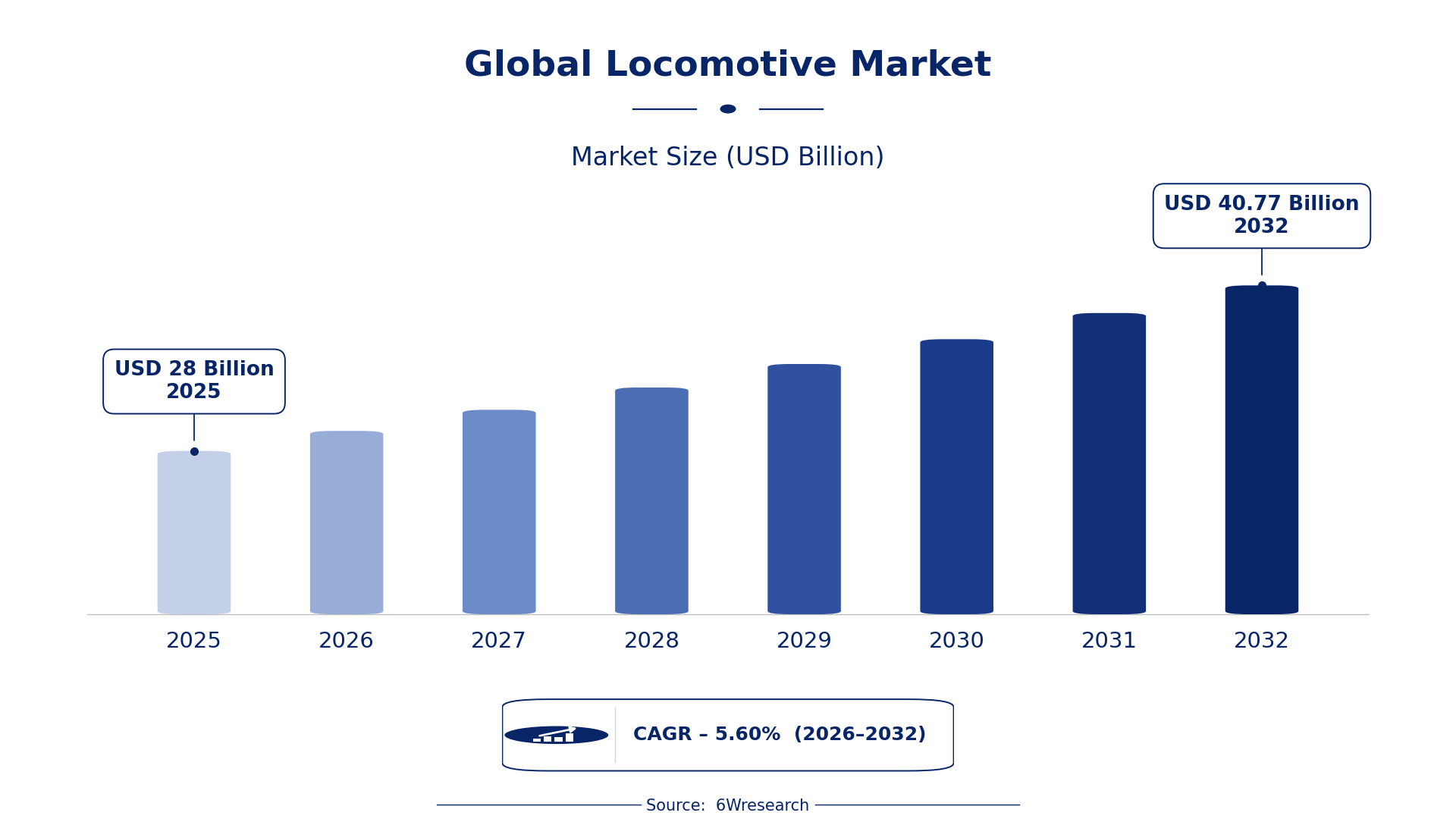
The Global Locomotive Market was estimated at USD 28 Billion in 2025 and is projected to reach USD 40.77 Billion by 2032, growing at a CAGR of 5.60% from 2026 to 2032.
Global Locomotive Market Synopsis
Structural shifts in transportation priorities are redefining the Global Locomotive Market. Rail networks are expanding not only for passenger transit but also to meet freight demands, heralding a pivotal alignment towards sustainable logistics.
Competitive pressures and evolving compliance standards are driving manufacturers to innovate, particularly in the realms of fuel efficiency and technology integration. This market's relevance is underpinned by its interconnectivity with broader sectors such as logistics, urbanization, and economic development.
Global Locomotive Market Year-wise Growth Rate and Key Drivers
This graph illustrates the annual growth rates of the Global Locomotive Market from 2022 to 2032, highlighting a steady upward trajectory and projected expansion over the forecast period.
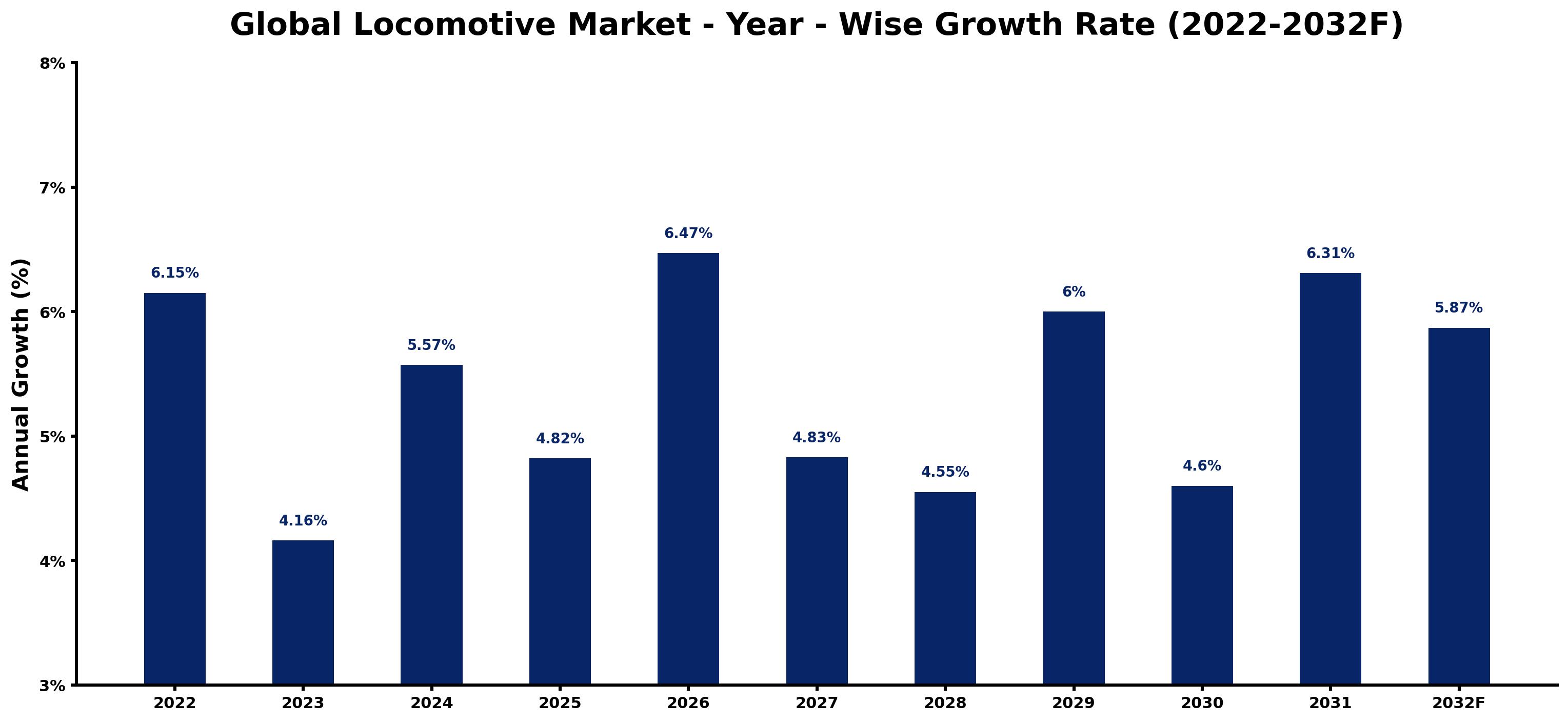
The table below presents the year‑wise growth rates along with the key drivers influencing the market
| Year | Growth Rate (%) | Major Drivers |
| 2022 | 6.15 | Investment in advanced EV battery technology spurs growth in the locomotive market. |
| 2023 | 4.16 | Supply chain disruptions during production hinder timely availability of locomotive parts. |
| 2024 | 5.57 | Manufacturers introduce innovative powertrain electrification systems, enhancing locomotive efficiency. |
| 2025 | 4.82 | Rail operators increasingly adopt locomotives to enhance regional transport capabilities. |
| 2026 | 6.47 | Innovative aftermarket parts demand shifts competitive dynamics in the locomotive sector. |
| 2027 | 4.83 | As consumer preferences evolve, there's greater emphasis on low-emission locomotives. |
| 2028 | 4.55 | Growing demand for autonomous driving software contributes to locomotive market expansion. |
| 2029 | 6 | A shift toward sustainable raw material sourcing changes the locomotive production process. |
| 2030 | 4.6 | Integrating ESG practices into logistics enhances efficiency for locomotive manufacturers. |
| 2031 | 6.31 | In North America, a skilled workforce supports advanced locomotive technology development. |
| 2032 | 5.87 | OEM production cycles adapt as emissions regulations tighten in the locomotive industry. |
Note - Market size estimations and growth projections presented in this report are based on 6Wresearch's proprietary research methodology, combining internal industry data, secondary research, and primary validation, updated periodically to reflect current market conditions. As markets evolve rapidly, figures for certain industries may vary slightly and are intended as informed estimates rather than absolute figures. For the most current market sizing, we recommend validating figures with a 6Wresearch analyst.
Global Locomotive Market Key Takeaways
Below are some of the specific key takeaways from the market, including:
- North America holds a dominant position with approximately 48% market share in 2025, driven by ongoing investments in rail infrastructure.
- Electric locomotives are expected to exhibit a CAGR of 7.2% from 2026 to 2032, reflecting strong government mandates for emission reductions.
- GE Transportation recently unveiled its latest freight locomotive model, designed for enhanced fuel efficiency, aiming for a 20% reduction in operational costs.
- China is rapidly expanding its railway network, adding an expected 3,000 kilometers of track by 2030, significantly impacting locomotive demand.
Evaluation of Restraints in Global Locomotive Market
High capital costs remain a prominent restraint in the Global Locomotive Market, with initial investment figures estimated at over USD 15 million for a single freight locomotive. This upfront expense often discourages new market entrants. For example, regulatory compliance with stringent environmental standards adds to manufacturer costs, prompting companies to increase their operational budgets substantially. This combination of high initial costs and regulatory burdens limits broader market participation and affects overall growth potential.
Global Locomotive Market Trends
The shift towards automation and predictive maintenance technologies is transforming locomotive operations. Companies such as Siemens Mobility are at the forefront, implementing systems that enhance efficiency through real-time data monitoring. This development is marked by a 15% reduction in maintenance costs due to improved operational visibility. Concurrently, the transition to battery-electric locomotives is accelerating, with manufacturers like Alstom reporting a projected increase in production capacity by 30% by 2028. The industry is also witnessing a paradigm shift as focus intensifies on sustainability, spurred by government regulations emphasizing emissions reductions.
Global Locomotive Market Opportunities
Future revenue opportunities in the Global Locomotive Market are promising, particularly in the realm of hybrid and electric locomotives. Major players like Bombardier are exploring additive manufacturing for locomotive components, potentially reducing production costs by 25%. Additionally, investments in green hydrogen infrastructure are anticipated, with projects targeting to develop hydrogen-powered locomotives by 2025, positioning companies to significantly capitalize on this emerging sector. The growing need for urban mass transit solutions further opens new avenues for revenue generation in rapidly urbanizing regions.
Global Locomotive Market by Technology Type
The Global Locomotive Market is predominantly led by IGBT Modules, commanding a share of approximately 53% in 2025. GTO Thyristors are currently the fastest-growing segment with a projected CAGR of 6.8% from 2026 to 2032. This growth is fueled by their superior performance in high-power applications, garnering preferences in both freight and passenger sectors. Manufacturers favor IGBT technology for its efficiency, but the rising demand for GTO Thyristors underscores a strategic shift towards improving energy utilization in rail transport.
Global Locomotive Market by Propulsion Type
In terms of propulsion type, Diesel locomotives dominate the market landscape, holding an estimated share of 65% in 2025. However, Electric locomotives present a compelling growth trajectory, boasting a CAGR of 8.1% from 2026 to 2032. The increasing push for sustainability and reduced carbon emissions is a primary driver behind the growing preference for electric propulsion systems. This shift is also facilitated by ongoing investments in electrification of rail networks, providing long-term operational cost advantages over traditional diesel systems.
Global Locomotive Market by Region
North America remains the largest region in the Global Locomotive Market, commanding around 48% of the overall share in 2025. This market strength is underpinned by well-established railroad networks and ongoing infrastructure investments. Conversely, the Asia-Pacific region is poised to be the fastest-growing area, anticipated to achieve a CAGR of 7.5% from 2026 to 2032. Rapid urbanization and significant government support for rail transport infrastructure are key factors driving this expansion. Countries like India and China are heavily investing in rail projects, enhancing connectivity and logistics capabilities.
Government Initiatives in the Global Locomotive Market
The regulatory landscape for the Global Locomotive Market is increasingly shaped by government initiatives aimed at enhancing rail transportation efficiency and sustainability. Various ministries across different regions are launching schemes and policies that not only foster technological advancement but also stimulate investments in railway infrastructure.
- U.S. Department of Transportation, Consolidated Rail Infrastructure and Safety Improvements (CRISI) program, 2021.
- European Commission, Shift2Rail Initiative, launched in 2014, ongoing.
- Indian Ministry of Railways, National Rail Plan 2030, announced in 2020, aims to enhance rail infrastructure.
- Transport Canada, Rail Safety Improvement Program, 2018, promoting safety and sustainability in rail operations.
Future Insights of the Global Locomotive Market
The future trajectory of the Global Locomotive Market is indicative of a profound shift towards electrification and automation. Companies like Siemens Mobility are focusing on integrating advanced predictive maintenance technologies, projected to lower operational downtime significantly. Investment in environmentally friendly solutions, such as green hydrogen and battery-electric locomotives, is anticipated to reshape production lines, as highlighted by Bombardier's plans to optimize costs through innovative manufacturing techniques by 2025. These developments promise to enhance operational efficiency while aligning with regulatory pressures for sustainability.
Global Locomotive Market Latest Developments
Recent advancements within the Global Locomotive Market underscore the competitive drive among leading companies to innovate and expand. Below are notable developments:
- In September 2023, Alstom completed the successful testing of its new battery-operated locomotive, aiming to reduce emissions in urban environments.
- In August 2023, GE Transportation announced plans to enhance the efficiency of its freight locomotives, targeting a 25% improvement in fuel usage by 2030.
- In July 2023, Siemens Mobility launched its next-generation signalling system, which is designed to optimize train scheduling and significantly reduce delays.
- In June 2023, Hitachi Rail expanded its manufacturing facility in the U.S., projecting a 40% increase in production capacity aimed at meeting rising demand for electric locomotives.
Global Locomotive Market Key Players and Industry Positioning
The Global Locomotive Market is characterized by a mix of consolidated and fragmented elements, with several key players holding significant market shares. Industry leaders are competing vigorously, focusing on technological advancements and customer-specific solutions to secure their positions in a dynamic environment.
| Leading Company | Core Strength | Strategic Focus |
|---|---|---|
| GE Transportation | Expertise in freight locomotive design | Emphasis on fuel efficiency innovations |
| Siemens Mobility | Leader in railway automation | Development of advanced signalling systems |
| Bombardier | Strength in hybrid technologies | Exploring additive manufacturing for parts |
| Alstom | Innovator in sustainable locomotives | Focus on battery-powered solutions |
| Hitachi Rail | Robust manufacturing capabilities | Expansion into electric locomotive production |
As the Global Locomotive Market evolves, understanding the strategic positioning and operational strengths of these companies will be crucial for stakeholders aiming to thrive in this competitive landscape.
Key Attractiveness of the Report
- 10 Years of Market Numbers
- Historical Data Starting from 2022 to 2025
- Base Year: 2025
- Forecast Data until 2032
- Key Performance Indicators Impacting the Market
- Major Upcoming Developments and Projects
Key Highlights of the Report:
- Global Locomotive Market Outlook
- Market Size of Global Locomotive Market, 2025
- Forecast of Global Locomotive Market, 2032
- Historical Data and Forecast of Global Locomotive Revenues & Volume for the Period 2022-2032
- Global Locomotive Market Trend Evolution
- Global Locomotive Market Drivers and Challenges
- Global Locomotive Price Trends
- Global Locomotive Porter's Five Forces
- Global Locomotive Industry Life Cycle
- Historical Data and Forecast of Global Locomotive Market Revenues & Volume
- Historical Data and Forecast of Global Locomotive Market Revenues & Volume By Technology Type for the Period 2022-2032
- Historical Data and Forecast of Global Locomotive Market Revenues & Volume By IGBT Module for the Period 2022-2032
- Historical Data and Forecast of Global Locomotive Market Revenues & Volume By GTO Thyristor for the Period 2022-2032
- Historical Data and Forecast of Global Locomotive Market Revenues & Volume By SiC Module for the Period 2022-2032
- Historical Data and Forecast of Global Locomotive Market Revenues & Volume By Propulsion Type for the Period 2022-2032
- Historical Data and Forecast of Global Locomotive Market Revenues & Volume By Diesel for the Period 2022-2032
- Historical Data and Forecast of Global Locomotive Market Revenues & Volume By Electric for the Period 2022-2032
- Historical Data and Forecast of North America Locomotive Market Revenues & Volume By Technology Type for the Period 2022-2032
- Historical Data and Forecast of North America Locomotive Market Revenues & Volume By IGBT Module for the Period 2022-2032
- Historical Data and Forecast of North America Locomotive Market Revenues & Volume By GTO Thyristor for the Period 2022-2032
- Historical Data and Forecast of North America Locomotive Market Revenues & Volume By SiC Module for the Period 2022-2032
- Historical Data and Forecast of North America Locomotive Market Revenues & Volume By Propulsion Type for the Period 2022-2032
- Historical Data and Forecast of North America Locomotive Market Revenues & Volume By Diesel for the Period 2022-2032
- Historical Data and Forecast of North America Locomotive Market Revenues & Volume By Electric for the Period 2022-2032
- Historical Data and Forecast of United States of America Locomotive Market Revenues & Volume for the Period 2022-2032
- Historical Data and Forecast of Canada Locomotive Market Revenues & Volume for the Period 2022-2032
- Historical Data and Forecast of Rest of North America Locomotive Market Revenues & Volume for the Period 2022-2032
- Historical Data and Forecast of Latin America (LATAM) Locomotive Market Revenues & Volume By Technology Type for the Period 2022-2032
- Historical Data and Forecast of Latin America (LATAM) Locomotive Market Revenues & Volume By IGBT Module for the Period 2022-2032
- Historical Data and Forecast of Latin America (LATAM) Locomotive Market Revenues & Volume By GTO Thyristor for the Period 2022-2032
- Historical Data and Forecast of Latin America (LATAM) Locomotive Market Revenues & Volume By SiC Module for the Period 2022-2032
- Historical Data and Forecast of Latin America (LATAM) Locomotive Market Revenues & Volume By Propulsion Type for the Period 2022-2032
- Historical Data and Forecast of Latin America (LATAM) Locomotive Market Revenues & Volume By Diesel for the Period 2022-2032
- Historical Data and Forecast of Latin America (LATAM) Locomotive Market Revenues & Volume By Electric for the Period 2022-2032
- Historical Data and Forecast of Brazil Locomotive Market Revenues & Volume for the Period 2022-2032
- Historical Data and Forecast of Mexico Locomotive Market Revenues & Volume for the Period 2022-2032
- Historical Data and Forecast of Argentina Locomotive Market Revenues & Volume for the Period 2022-2032
- Historical Data and Forecast of Rest of LATAM Locomotive Market Revenues & Volume for the Period 2022-2032
- Historical Data and Forecast of Asia Locomotive Market Revenues & Volume By Technology Type for the Period 2022-2032
- Historical Data and Forecast of Asia Locomotive Market Revenues & Volume By IGBT Module for the Period 2022-2032
- Historical Data and Forecast of Asia Locomotive Market Revenues & Volume By GTO Thyristor for the Period 2022-2032
- Historical Data and Forecast of Asia Locomotive Market Revenues & Volume By SiC Module for the Period 2022-2032
- Historical Data and Forecast of Asia Locomotive Market Revenues & Volume By Propulsion Type for the Period 2022-2032
- Historical Data and Forecast of Asia Locomotive Market Revenues & Volume By Diesel for the Period 2022-2032
- Historical Data and Forecast of Asia Locomotive Market Revenues & Volume By Electric for the Period 2022-2032
- Historical Data and Forecast of China Locomotive Market Revenues & Volume for the Period 2022-2032
- Historical Data and Forecast of India Locomotive Market Revenues & Volume for the Period 2022-2032
- Historical Data and Forecast of Japan Locomotive Market Revenues & Volume for the Period 2022-2032
- Historical Data and Forecast of Rest of Asia Locomotive Market Revenues & Volume for the Period 2022-2032
- Historical Data and Forecast of Africa Locomotive Market Revenues & Volume By Technology Type for the Period 2022-2032
- Historical Data and Forecast of Africa Locomotive Market Revenues & Volume By IGBT Module for the Period 2022-2032
- Historical Data and Forecast of Africa Locomotive Market Revenues & Volume By GTO Thyristor for the Period 2022-2032
- Historical Data and Forecast of Africa Locomotive Market Revenues & Volume By SiC Module for the Period 2022-2032
- Historical Data and Forecast of Africa Locomotive Market Revenues & Volume By Propulsion Type for the Period 2022-2032
- Historical Data and Forecast of Africa Locomotive Market Revenues & Volume By Diesel for the Period 2022-2032
- Historical Data and Forecast of Africa Locomotive Market Revenues & Volume By Electric for the Period 2022-2032
- Historical Data and Forecast of South Africa Locomotive Market Revenues & Volume for the Period 2022-2032
- Historical Data and Forecast of Nigeria Locomotive Market Revenues & Volume for the Period 2022-2032
- Historical Data and Forecast of Egypt Locomotive Market Revenues & Volume for the Period 2022-2032
- Historical Data and Forecast of Rest of Africa Locomotive Market Revenues & Volume for the Period 2022-2032
- Historical Data and Forecast of Europe Locomotive Market Revenues & Volume By Technology Type for the Period 2022-2032
- Historical Data and Forecast of Europe Locomotive Market Revenues & Volume By IGBT Module for the Period 2022-2032
- Historical Data and Forecast of Europe Locomotive Market Revenues & Volume By GTO Thyristor for the Period 2022-2032
- Historical Data and Forecast of Europe Locomotive Market Revenues & Volume By SiC Module for the Period 2022-2032
- Historical Data and Forecast of Europe Locomotive Market Revenues & Volume By Propulsion Type for the Period 2022-2032
- Historical Data and Forecast of Europe Locomotive Market Revenues & Volume By Diesel for the Period 2022-2032
- Historical Data and Forecast of Europe Locomotive Market Revenues & Volume By Electric for the Period 2022-2032
- Historical Data and Forecast of United Kingdom Locomotive Market Revenues & Volume for the Period 2022-2032
- Historical Data and Forecast of France Locomotive Market Revenues & Volume for the Period 2022-2032
- Historical Data and Forecast of Germany Locomotive Market Revenues & Volume for the Period 2022-2032
- Historical Data and Forecast of Rest of Europe Locomotive Market Revenues & Volume for the Period 2022-2032
- Historical Data and Forecast of Middle East Locomotive Market Revenues & Volume By Technology Type for the Period 2022-2032
- Historical Data and Forecast of Middle East Locomotive Market Revenues & Volume By IGBT Module for the Period 2022-2032
- Historical Data and Forecast of Middle East Locomotive Market Revenues & Volume By GTO Thyristor for the Period 2022-2032
- Historical Data and Forecast of Middle East Locomotive Market Revenues & Volume By SiC Module for the Period 2022-2032
- Historical Data and Forecast of Middle East Locomotive Market Revenues & Volume By Propulsion Type for the Period 2022-2032
- Historical Data and Forecast of Middle East Locomotive Market Revenues & Volume By Diesel for the Period 2022-2032
- Historical Data and Forecast of Middle East Locomotive Market Revenues & Volume By Electric for the Period 2022-2032
- Historical Data and Forecast of Saudi Arabia Locomotive Market Revenues & Volume for the Period 2022-2032
- Historical Data and Forecast of UAE Locomotive Market Revenues & Volume for the Period 2022-2032
- Historical Data and Forecast of Turkey Locomotive Market Revenues & Volume for the Period 2022-2032
- Historical Data and Forecast of Rest of Middle East Locomotive Market Revenues & Volume for the Period 2022-2032
- Global Locomotive Market - Key Performance Indicators
- Global Locomotive Market - Import Export Trade Statistics
- Global Locomotive Market - Opportunity Assessment By Countries
- Global Locomotive Market - Opportunity Assessment By Technology Type
- Global Locomotive Market - Opportunity Assessment By Propulsion Type
- Global Locomotive Market - Top Companies Market Share
- Global Locomotive Market - Top Companies Profiles
- Global Locomotive Market - Comparison of Players in Technical and Operating Parameters
- Global Locomotive Market - Strategic Recommendations
Markets Covered
The Global Locomotive Market report provides a detailed analysis of the following market segments:
By Regions and Countries:
- North America
- Europe
- LATAM
- Middle East
- Asia
- Africa
By Technology Type:
- IGBT Module
- GTO Thyristor
- SiC Module
By Propulsion Type:
- Diesel
- Electric






































