Global Luxury Perfume Market Highlights
| Market Size (2025) | USD 40 Billion |
| Forecast Size (2032) | USD 63.5 Billion |
| CAGR | 5.00% |
| Base Year | 2025 |
| Forecast Period | 2026-2032 |
| Largest Region | Europe |
| Fastest Growing Region | Asia |
| Largest Segment | Women |
| Fastest Growing Segment | Unisex |
| Leading Companies | Chanel, Dior, Gucci, Louis Vuitton, Estée Lauder |
Global Luxury Perfume Market Size & Growth Rate (2026-2032)
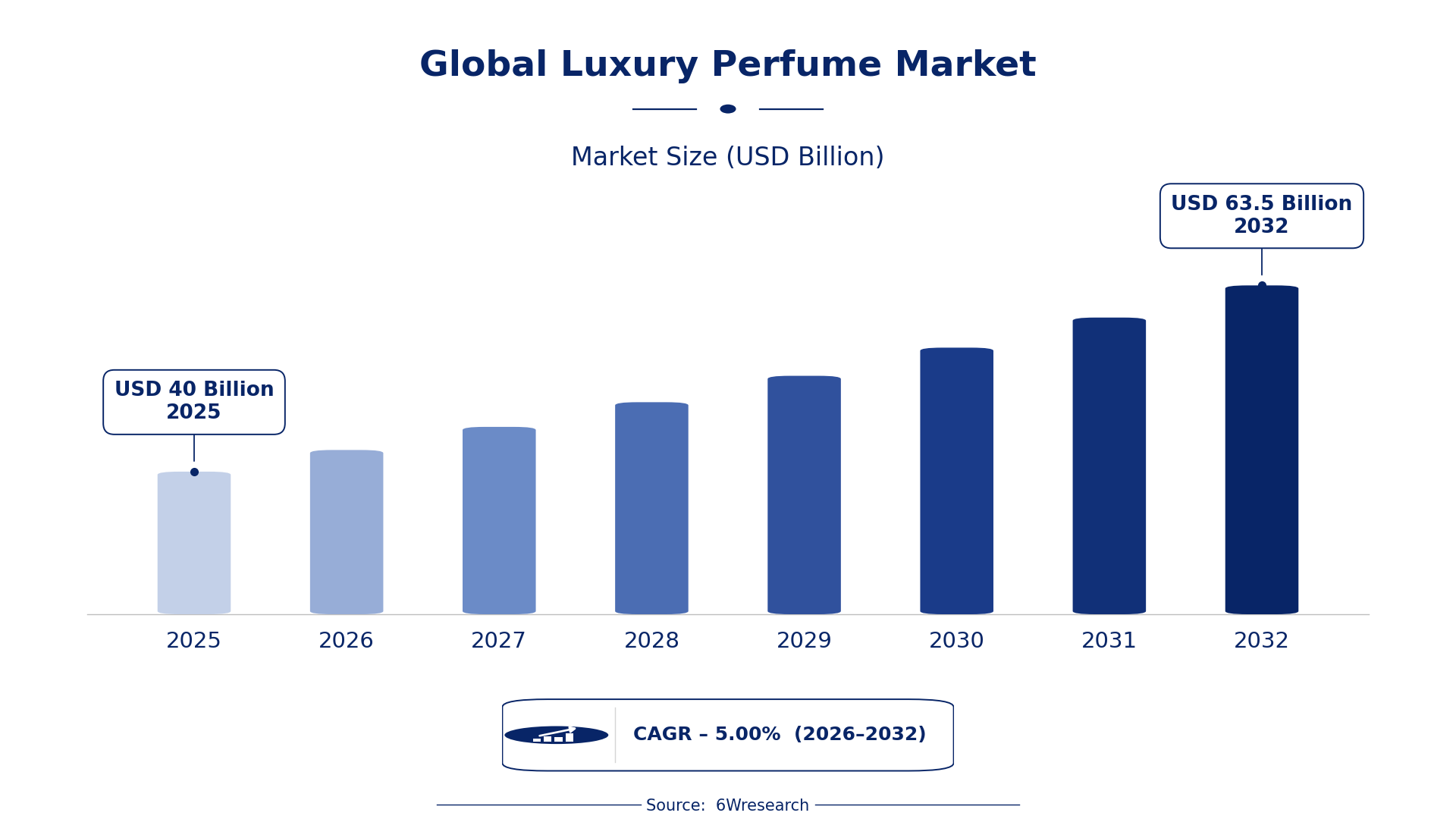
The Global Luxury Perfume Market was estimated at USD 40 Billion in 2025 and is projected to reach USD 63.5 Billion by 2032, growing at a CAGR of 5.00% from 2026 to 2032.
Global Luxury Perfume Market Synopsis
The landscape of the Global Luxury Perfume Market is undergoing a remarkable transformation, driven largely by a burgeoning affluent demographic that values uniqueness and personalization in fragrance. The rise of e-commerce platforms is reshaping how luxury perfumes are marketed and sold, further emphasizing direct-to-consumer strategies that capitalize on digital engagement.
Moreover, the market is increasingly characterized by the demand for niche and artisanal brands that offer bespoke services, reflecting a broader shift towards personalized luxury. This evolution not only signifies changing consumer preferences but also highlights the necessity for established brands to innovate, lest they fall behind in this competitive arena.
Global Luxury Perfume Market Year-wise Growth Rate and Key Drivers
This graph illustrates the annual growth rates of the Global Luxury Perfume Market from 2022 to 2032, highlighting a steady upward trajectory and projected expansion over the forecast period.
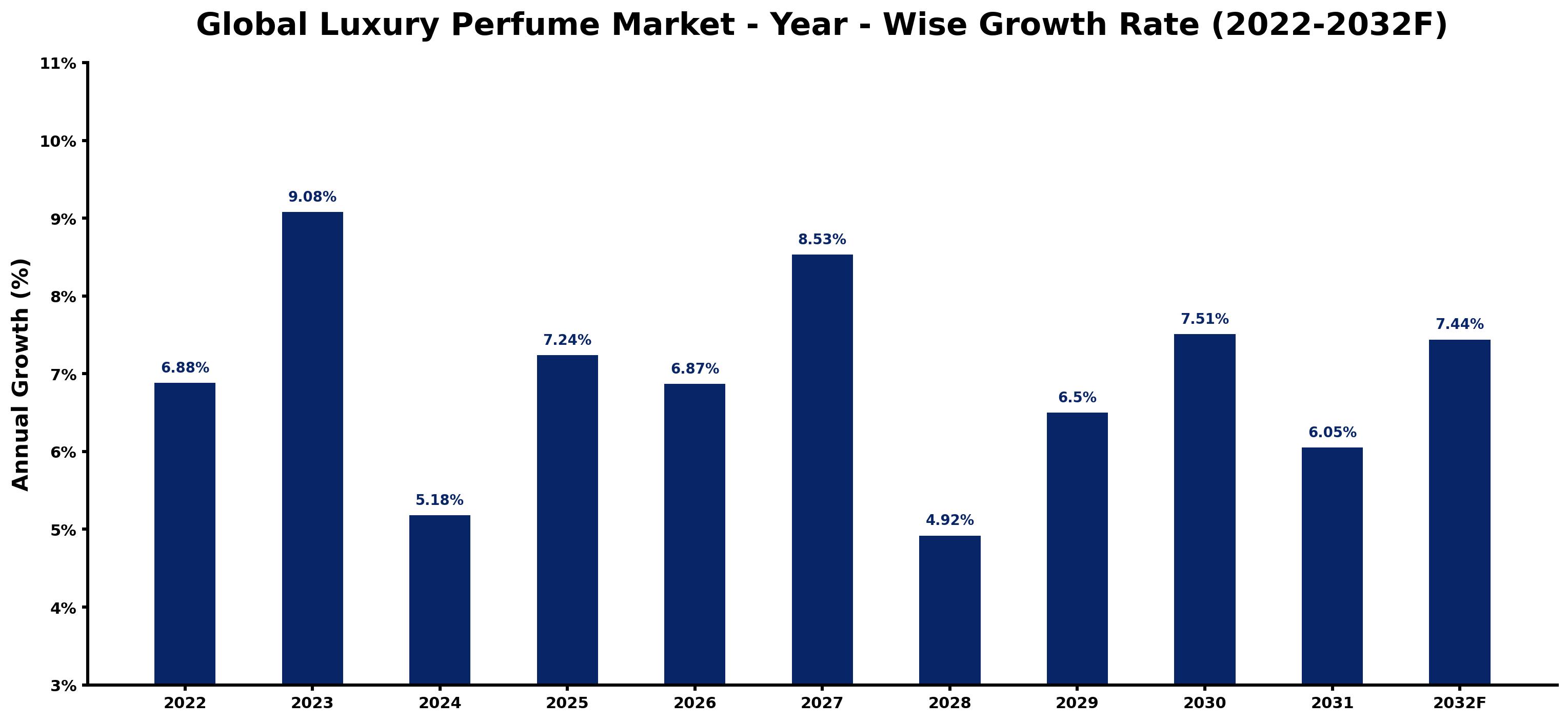
The table below presents the year‑wise growth rates along with the key drivers influencing the market
| Year | Growth Rate (%) | Major Drivers |
| 2022 | 6.88 | In North America, advancements in clean-label formulations enhance luxury perfume offerings. |
| 2023 | 9.08 | Retailers are adjusting to surging raw material costs affecting luxury perfume pricing. |
| 2024 | 5.18 | Expanding private-label competition increases pressure on luxury perfume brand positioning. |
| 2025 | 7.24 | Consumers seeking indulgent experiences are driving demand for premium luxury perfumes. |
| 2026 | 6.87 | A shift toward sustainable packaging changes consumer expectations for luxury perfume brands. |
| 2027 | 8.53 | Current supply chain dynamics enable luxury perfume companies to improve distribution efficiency. |
| 2028 | 4.92 | Recycling initiatives in packaging materials enhance the sustainability profile of luxury perfumes. |
| 2029 | 6.5 | As consumers prioritize experiential purchases, luxury perfume becomes essential for personal expression. |
| 2030 | 7.51 | Rising investment in skilled artisanship leads to the emergence of niche luxury perfume brands. |
| 2031 | 6.05 | Manufacturers expanding operations into Asia capitalize on growing luxury perfume demand. |
| 2032 | 7.44 | The introduction of personalized luxury perfumes propels investment activity in the sector. |
Note - Market size estimations and growth projections presented in this report are based on 6Wresearch's proprietary research methodology, combining internal industry data, secondary research, and primary validation, updated periodically to reflect current market conditions. As markets evolve rapidly, figures for certain industries may vary slightly and are intended as informed estimates rather than absolute figures. For the most current market sizing, we recommend validating figures with a 6Wresearch analyst.
Global Luxury Perfume Market Key Takeaways
Below are some of the specific key takeaways from the market, including:
- Over 55% of the luxury perfume revenue is generated from women’s fragrances in 2025.
- A surge of 12% in online sales of luxury perfumes is expected within the next two years.
- The unisex segment is forecasted to grow at a CAGR of 7.5% from 2026 to 2032.
- In Europe, the luxury perfume market accounts for approximately 48% of the overall sales as of 2025.
- Chanel and Dior continue to dominate market share, comprising nearly 20% collectively.
Evaluation of Restraints in Global Luxury Perfume Market
The Global Luxury Perfume Market faces significant hurdles, including rising raw material costs that can impact the final retail price of fragrances. For instance, the cost of natural ingredients has surged by approximately 15% over the past two years due to increased global demand. Furthermore, a growing emphasis on sustainability has compelled brands to rethink their sourcing practices, which can lead to higher operational costs. For example, brands like Estée Lauder have committed to sustainable sourcing, requiring investment in certified suppliers, which complicates price competitiveness in the market.
Global Luxury Perfume Market Trends
Several distinct trends are shaping the Global Luxury Perfume Market. Firstly, the integration of digital tools is revolutionizing customer engagement; brands like Jo Malone are leveraging augmented reality (AR) experiences to allow consumers to virtually explore fragrances. This trend aligns with the significant uptick in e-commerce, where online sales are projected to account for 30-35% of total revenues by 2032. Secondly, a shift towards eco-friendly and sustainable practices is prominent, as evidenced by luxury brands increasingly using recyclable packaging and ethically sourced ingredients. For instance, L’Oreal announced its commitment to achieving 100% eco-designed packaging by 2030, highlighting a concerted effort towards sustainability.
Global Luxury Perfume Market Opportunities
The future of the Global Luxury Perfume Market is rife with opportunities, especially in sustainable product lines and personalized experiences. Brands such as Atelier Cologne are already capitalizing on the growing consumer preference for eco-conscious products by introducing fragrances made from organic ingredients. Additionally, the digital realm is a major frontier; for instance, L’Occitane has reported a 25% increase in sales directly attributable to its robust online strategy, exemplifying how e-commerce can support brand growth. Finally, the rise of customization represents a lucrative segment; companies offering bespoke fragrance experiences stand to tap into a market eager for individual expression.
Global Luxury Perfume Market by End User
The Global Luxury Perfume Market is dominated by women's fragrances, which accounted for approximately 55% share in 2025. This segment continues to thrive due to its established consumer base and varied offerings tailored to women's preferences. Conversely, the unisex segment is gaining momentum with a CAGR of 7.5% from 2026 to 2032, attracting a diverse audience seeking shared experiences in fragrance. This growth reflects a broader societal shift towards inclusivity and personalization in luxury products.
Global Luxury Perfume Market by Distribution Channel
The leading distribution channel for the Global Luxury Perfume Market is specialty stores, commanding nearly 40% of market share as of 2025. Specialty stores not only provide a curated shopping experience but also allow consumers to engage with the product more intimately. However, online retail is experiencing rapid growth, projected to achieve a CAGR of 9.5% from 2026 to 2032, as consumers increasingly prefer the convenience and variety available online. This shift will compel traditional retailers to adapt their strategies to maintain relevance and competitive edge.
Global Luxury Perfume Market by Region
Europe stands out as the largest region in the Global Luxury Perfume Market, accounting for nearly 48% of the global share in 2025. The region benefits from a rich heritage of fragrance craftsmanship and a high concentration of established luxury brands. Meanwhile, Asia is projected to be the fastest-growing region, with an anticipated CAGR of 8.2% from 2026 to 2032, driven by rapidly growing middle-class spending and shifting consumer preferences towards premium luxury products, leading to increased brand investments in localized marketing and distribution.
Government Initiatives in the Global Luxury Perfume Market
As the regulatory framework around luxury goods becomes increasingly stringent, several government initiatives are influencing the Global Luxury Perfume Market landscape. Policymakers are focusing on sustainability, ethical sourcing, and consumer protection, creating both challenges and opportunities for brands operating in this space.
- European Commission, EU Regulation on Cosmetic Products, 2022 - This regulation focuses on sustainability practices within the beauty sector, ensuring brands comply with environmental standards, thereby encouraging investment in eco-friendly practices.
- U.S. Food & Drug Administration, Fragrance Ingredient Safety Initiative, 2023 - This initiative examines the safety of fragrance ingredients, fostering consumer confidence and ensuring product safety in the luxury segment.
- Ministry of Industry and Trade (Germany), COVID-19 Recovery Fund for the Beauty Sector, 2021 - This fund aims to support local luxury perfume manufacturers in overcoming pandemic-induced challenges, enabling expansion and innovation.
- Government of France, Luxury Goods Export Promotion Program, 2024 - This upcoming initiative incentivizes luxury perfume exports, enhancing the competitiveness of French brands on a global scale.
Future Insights of the Global Luxury Perfume Market
Over the next several years, the Global Luxury Perfume Market is expected to undergo significant transformation, particularly in the areas of personalization and sustainability. By 2032, brands such as Jo Malone are anticipated to leverage advanced technologies like machine learning to enhance customer experience through tailor-made fragrance offerings. Furthermore, as eco-consumerism gains traction, investments in sustainable sourcing will likely rise, contributing to a more responsible supply chain. This focus not only reflects consumer sentiments but also compels established brands to innovate in formulation and packaging.
Global Luxury Perfume Market Latest Developments
The following recent developments have marked noteworthy progress in the Global Luxury Perfume Market:
- In June 2023, Estée Lauder launched a new eco-friendly fragrance line featuring recyclable packaging, responding to the growing demand for sustainability.
- Recently, Gucci announced a collaboration with digital artists to create limited-edition online fragrances, targeting younger demographics engaged in social media.
- In Q4 2023, Chanel is set to open a flagship store in New York focused on immersive experience, enhancing consumer interaction with its products.
- Dior is expected to implement augmented reality features in its e-commerce platforms by early 2024, allowing consumers to virtually explore fragrance notes.
Global Luxury Perfume Market Key Players and Industry Positioning
The competitive structure of the Global Luxury Perfume Market is characterized by a significant presence of established brands, while niche players are also making strides. Leading companies leverage their storied heritage to consolidate market share while smaller brands focus on innovation and personalization.
| Leading Company | Core Strength | Strategic Focus |
|---|---|---|
| Chanel | Strong brand heritage and iconic fragrances | Luxury market positioning with ongoing product innovation |
| Dior | Cutting-edge marketing strategies and celebrity partnerships | Expansion in e-commerce and immersive digital experiences |
| Gucci | Innovative design philosophy and trendsetting capabilities | Collaboration with digital art and fashion to engage younger consumers |
| Louis Vuitton | Exceptional craftsmanship and premium branding | Investments in luxury retail experiences and personalized services |
| Estée Lauder | Diversified product range and global reach | Commitment to sustainability and digital marketing strategies |
As the market evolves, differentiation through unique offerings and consumer engagement will prove essential for maintaining competitive advantage.
Key Attractiveness of the Report
- 10 Years of Market Numbers
- Historical Data Starting from 2022 to 2025
- Base Year: 2025
- Forecast Data until 2032
- Key Performance Indicators Impacting the Market
- Major Upcoming Developments and Projects
Key Highlights of the Report:
- Global Luxury Perfume Market Outlook
- Market Size of Global Luxury Perfume Market, 2025
- Forecast of Global Luxury Perfume Market, 2032
- Historical Data and Forecast of Global Luxury Perfume Revenues & Volume for the Period 2022-2032
- Global Luxury Perfume Market Trend Evolution
- Global Luxury Perfume Market Drivers and Challenges
- Global Luxury Perfume Price Trends
- Global Luxury Perfume Porter's Five Forces
- Global Luxury Perfume Industry Life Cycle
- Historical Data and Forecast of Global Luxury Perfume Market Revenues & Volume
- Historical Data and Forecast of Global Luxury Perfume Market Revenues & Volume By End User for the Period 2022-2032
- Historical Data and Forecast of Global Luxury Perfume Market Revenues & Volume By Men for the Period 2022-2032
- Historical Data and Forecast of Global Luxury Perfume Market Revenues & Volume By Women for the Period 2022-2032
- Historical Data and Forecast of Global Luxury Perfume Market Revenues & Volume By Unisex for the Period 2022-2032
- Historical Data and Forecast of Global Luxury Perfume Market Revenues & Volume By Distribution Channel for the Period 2022-2032
- Historical Data and Forecast of Global Luxury Perfume Market Revenues & Volume By Supermarkets for the Period 2022-2032
- Historical Data and Forecast of Global Luxury Perfume Market Revenues & Volume By Hypermarkets for the Period 2022-2032
- Historical Data and Forecast of Global Luxury Perfume Market Revenues & Volume By Specialty Stores for the Period 2022-2032
- Historical Data and Forecast of Global Luxury Perfume Market Revenues & Volume By Online retail for the Period 2022-2032
- Historical Data and Forecast of North America Luxury Perfume Market Revenues & Volume By End User for the Period 2022-2032
- Historical Data and Forecast of North America Luxury Perfume Market Revenues & Volume By Men for the Period 2022-2032
- Historical Data and Forecast of North America Luxury Perfume Market Revenues & Volume By Women for the Period 2022-2032
- Historical Data and Forecast of North America Luxury Perfume Market Revenues & Volume By Unisex for the Period 2022-2032
- Historical Data and Forecast of North America Luxury Perfume Market Revenues & Volume By Distribution Channel for the Period 2022-2032
- Historical Data and Forecast of North America Luxury Perfume Market Revenues & Volume By Supermarkets for the Period 2022-2032
- Historical Data and Forecast of North America Luxury Perfume Market Revenues & Volume By Hypermarkets for the Period 2022-2032
- Historical Data and Forecast of North America Luxury Perfume Market Revenues & Volume By Specialty Stores for the Period 2022-2032
- Historical Data and Forecast of North America Luxury Perfume Market Revenues & Volume By Online retail for the Period 2022-2032
- Historical Data and Forecast of United States of America Luxury Perfume Market Revenues & Volume for the Period 2022-2032
- Historical Data and Forecast of Canada Luxury Perfume Market Revenues & Volume for the Period 2022-2032
- Historical Data and Forecast of Rest of North America Luxury Perfume Market Revenues & Volume for the Period 2022-2032
- Historical Data and Forecast of Latin America (LATAM) Luxury Perfume Market Revenues & Volume By End User for the Period 2022-2032
- Historical Data and Forecast of Latin America (LATAM) Luxury Perfume Market Revenues & Volume By Men for the Period 2022-2032
- Historical Data and Forecast of Latin America (LATAM) Luxury Perfume Market Revenues & Volume By Women for the Period 2022-2032
- Historical Data and Forecast of Latin America (LATAM) Luxury Perfume Market Revenues & Volume By Unisex for the Period 2022-2032
- Historical Data and Forecast of Latin America (LATAM) Luxury Perfume Market Revenues & Volume By Distribution Channel for the Period 2022-2032
- Historical Data and Forecast of Latin America (LATAM) Luxury Perfume Market Revenues & Volume By Supermarkets for the Period 2022-2032
- Historical Data and Forecast of Latin America (LATAM) Luxury Perfume Market Revenues & Volume By Hypermarkets for the Period 2022-2032
- Historical Data and Forecast of Latin America (LATAM) Luxury Perfume Market Revenues & Volume By Specialty Stores for the Period 2022-2032
- Historical Data and Forecast of Latin America (LATAM) Luxury Perfume Market Revenues & Volume By Online retail for the Period 2022-2032
- Historical Data and Forecast of Brazil Luxury Perfume Market Revenues & Volume for the Period 2022-2032
- Historical Data and Forecast of Mexico Luxury Perfume Market Revenues & Volume for the Period 2022-2032
- Historical Data and Forecast of Argentina Luxury Perfume Market Revenues & Volume for the Period 2022-2032
- Historical Data and Forecast of Rest of LATAM Luxury Perfume Market Revenues & Volume for the Period 2022-2032
- Historical Data and Forecast of Asia Luxury Perfume Market Revenues & Volume By End User for the Period 2022-2032
- Historical Data and Forecast of Asia Luxury Perfume Market Revenues & Volume By Men for the Period 2022-2032
- Historical Data and Forecast of Asia Luxury Perfume Market Revenues & Volume By Women for the Period 2022-2032
- Historical Data and Forecast of Asia Luxury Perfume Market Revenues & Volume By Unisex for the Period 2022-2032
- Historical Data and Forecast of Asia Luxury Perfume Market Revenues & Volume By Distribution Channel for the Period 2022-2032
- Historical Data and Forecast of Asia Luxury Perfume Market Revenues & Volume By Supermarkets for the Period 2022-2032
- Historical Data and Forecast of Asia Luxury Perfume Market Revenues & Volume By Hypermarkets for the Period 2022-2032
- Historical Data and Forecast of Asia Luxury Perfume Market Revenues & Volume By Specialty Stores for the Period 2022-2032
- Historical Data and Forecast of Asia Luxury Perfume Market Revenues & Volume By Online retail for the Period 2022-2032
- Historical Data and Forecast of China Luxury Perfume Market Revenues & Volume for the Period 2022-2032
- Historical Data and Forecast of India Luxury Perfume Market Revenues & Volume for the Period 2022-2032
- Historical Data and Forecast of Japan Luxury Perfume Market Revenues & Volume for the Period 2022-2032
- Historical Data and Forecast of Rest of Asia Luxury Perfume Market Revenues & Volume for the Period 2022-2032
- Historical Data and Forecast of Africa Luxury Perfume Market Revenues & Volume By End User for the Period 2022-2032
- Historical Data and Forecast of Africa Luxury Perfume Market Revenues & Volume By Men for the Period 2022-2032
- Historical Data and Forecast of Africa Luxury Perfume Market Revenues & Volume By Women for the Period 2022-2032
- Historical Data and Forecast of Africa Luxury Perfume Market Revenues & Volume By Unisex for the Period 2022-2032
- Historical Data and Forecast of Africa Luxury Perfume Market Revenues & Volume By Distribution Channel for the Period 2022-2032
- Historical Data and Forecast of Africa Luxury Perfume Market Revenues & Volume By Supermarkets for the Period 2022-2032
- Historical Data and Forecast of Africa Luxury Perfume Market Revenues & Volume By Hypermarkets for the Period 2022-2032
- Historical Data and Forecast of Africa Luxury Perfume Market Revenues & Volume By Specialty Stores for the Period 2022-2032
- Historical Data and Forecast of Africa Luxury Perfume Market Revenues & Volume By Online retail for the Period 2022-2032
- Historical Data and Forecast of South Africa Luxury Perfume Market Revenues & Volume for the Period 2022-2032
- Historical Data and Forecast of Nigeria Luxury Perfume Market Revenues & Volume for the Period 2022-2032
- Historical Data and Forecast of Egypt Luxury Perfume Market Revenues & Volume for the Period 2022-2032
- Historical Data and Forecast of Rest of Africa Luxury Perfume Market Revenues & Volume for the Period 2022-2032
- Historical Data and Forecast of Europe Luxury Perfume Market Revenues & Volume By End User for the Period 2022-2032
- Historical Data and Forecast of Europe Luxury Perfume Market Revenues & Volume By Men for the Period 2022-2032
- Historical Data and Forecast of Europe Luxury Perfume Market Revenues & Volume By Women for the Period 2022-2032
- Historical Data and Forecast of Europe Luxury Perfume Market Revenues & Volume By Unisex for the Period 2022-2032
- Historical Data and Forecast of Europe Luxury Perfume Market Revenues & Volume By Distribution Channel for the Period 2022-2032
- Historical Data and Forecast of Europe Luxury Perfume Market Revenues & Volume By Supermarkets for the Period 2022-2032
- Historical Data and Forecast of Europe Luxury Perfume Market Revenues & Volume By Hypermarkets for the Period 2022-2032
- Historical Data and Forecast of Europe Luxury Perfume Market Revenues & Volume By Specialty Stores for the Period 2022-2032
- Historical Data and Forecast of Europe Luxury Perfume Market Revenues & Volume By Online retail for the Period 2022-2032
- Historical Data and Forecast of United Kingdom Luxury Perfume Market Revenues & Volume for the Period 2022-2032
- Historical Data and Forecast of France Luxury Perfume Market Revenues & Volume for the Period 2022-2032
- Historical Data and Forecast of Germany Luxury Perfume Market Revenues & Volume for the Period 2022-2032
- Historical Data and Forecast of Rest of Europe Luxury Perfume Market Revenues & Volume for the Period 2022-2032
- Historical Data and Forecast of Middle East Luxury Perfume Market Revenues & Volume By End User for the Period 2022-2032
- Historical Data and Forecast of Middle East Luxury Perfume Market Revenues & Volume By Men for the Period 2022-2032
- Historical Data and Forecast of Middle East Luxury Perfume Market Revenues & Volume By Women for the Period 2022-2032
- Historical Data and Forecast of Middle East Luxury Perfume Market Revenues & Volume By Unisex for the Period 2022-2032
- Historical Data and Forecast of Middle East Luxury Perfume Market Revenues & Volume By Distribution Channel for the Period 2022-2032
- Historical Data and Forecast of Middle East Luxury Perfume Market Revenues & Volume By Supermarkets for the Period 2022-2032
- Historical Data and Forecast of Middle East Luxury Perfume Market Revenues & Volume By Hypermarkets for the Period 2022-2032
- Historical Data and Forecast of Middle East Luxury Perfume Market Revenues & Volume By Specialty Stores for the Period 2022-2032
- Historical Data and Forecast of Middle East Luxury Perfume Market Revenues & Volume By Online retail for the Period 2022-2032
- Historical Data and Forecast of Saudi Arabia Luxury Perfume Market Revenues & Volume for the Period 2022-2032
- Historical Data and Forecast of UAE Luxury Perfume Market Revenues & Volume for the Period 2022-2032
- Historical Data and Forecast of Turkey Luxury Perfume Market Revenues & Volume for the Period 2022-2032
- Historical Data and Forecast of Rest of Middle East Luxury Perfume Market Revenues & Volume for the Period 2022-2032
- Global Luxury Perfume Market - Key Performance Indicators
- Global Luxury Perfume Market - Import Export Trade Statistics
- Global Luxury Perfume Market - Opportunity Assessment By Countries
- Global Luxury Perfume Market - Opportunity Assessment By End User
- Global Luxury Perfume Market - Opportunity Assessment By Distribution Channel
- Global Luxury Perfume Market - Top Companies Market Share
- Global Luxury Perfume Market - Top Companies Profiles
- Global Luxury Perfume Market - Comparison of Players in Technical and Operating Parameters
- Global Luxury Perfume Market - Strategic Recommendations
Markets Covered
The Global Luxury Perfume Market report provides a detailed analysis of the following market segments:
By Regions and Countries:
- North America
- Europe
- LATAM
- Middle East
- Asia
- Africa
By End User:
- Men
- Women
- Unisex
By Distribution Channel:
- Supermarkets
- Hypermarkets
- Specialty Stores
- Online retail






































