Global Manufactured Homes Market Highlights
| Market Size (2025) | USD 28 Billion |
| Forecast Size (2032) | USD 36 Billion |
| CAGR | 4.90% |
| Base Year | 2025 |
| Forecast Period | 2026-2032 |
| Largest Region | North America |
| Fastest Growing Region | Asia-Pacific |
| Largest Segment | Single Family |
| Fastest Growing Segment | Multi-Family |
| Leading Companies | Cavco Industries, Skyline Champion Corporation, Clayton Homes, Karsten Homes, Commodore Homes |
Global Manufactured Homes Market Size & Growth Rate (2026-2032)
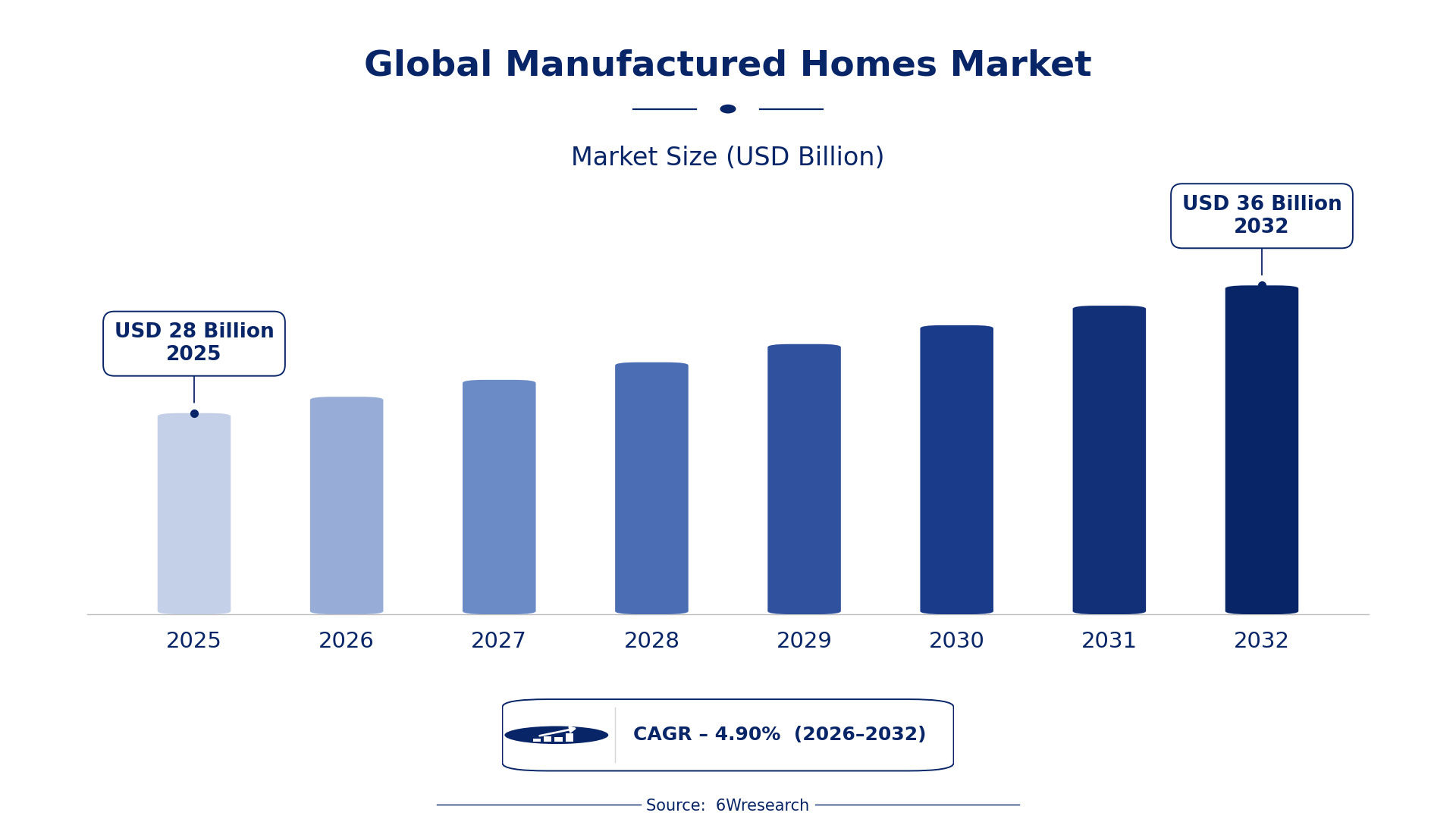
The Global Manufactured Homes Market was estimated at USD 28 Billion in 2025 and is projected to reach USD 36 Billion by 2032, growing at a CAGR of 4.90% from 2026 to 2032.
Global Manufactured Homes Market Synopsis
The Global Manufactured Homes Market is evolving rapidly as affordability and sustainability drive consumer preferences. Urbanization and population growth fuel the need for cost-effective housing solutions, pushing more individuals toward manufactured homes. The sector is set to disrupt traditional housing markets by providing customizable and eco-friendly living options.
Key players are increasingly embracing modern manufacturing techniques to cater to this growing demand. The integration of smart technologies and energy-efficient designs is resonating with environmentally conscious consumers. This evolving landscape highlights a market that uniquely blends innovation with affordability, distinguishing it from conventional real estate sectors.
Global Manufactured Homes Market Year-wise Growth Rate and Key Drivers
This graph illustrates the annual growth rates of the Global Manufactured Homes Market from 2022 to 2032, highlighting a steady upward trajectory and projected expansion over the forecast period.
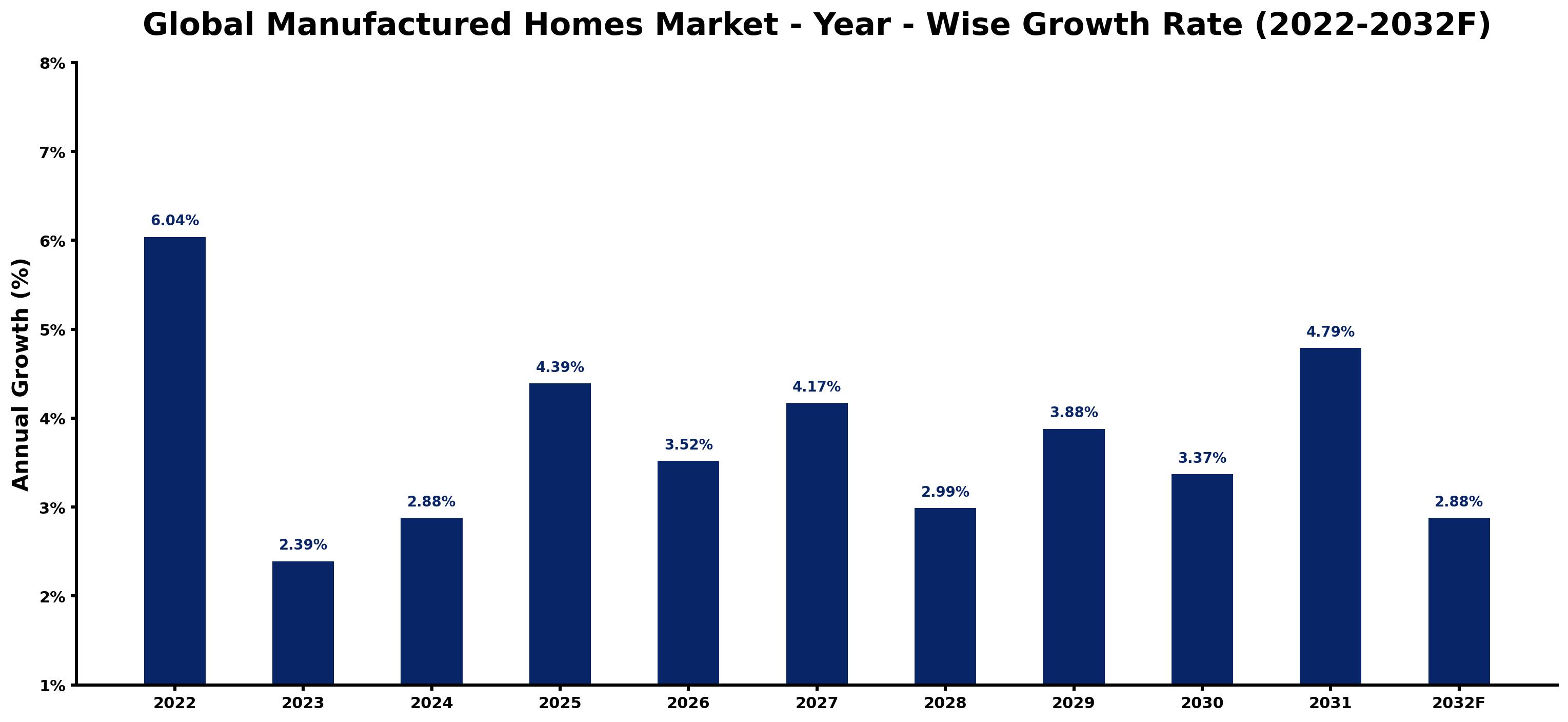
The table below presents the year‑wise growth rates along with the key drivers influencing the market
| Year | Growth Rate (%) | Major Drivers |
| 2022 | 6.04 | In North America, a rising focus on sustainability enhances interest in manufactured homes. |
| 2023 | 2.39 | As building codes evolve, manufactured homes see increasing regulatory compliance demands. |
| 2024 | 2.88 | Manufacturers are responding to shifts in end-user preferences for affordable housing solutions. |
| 2025 | 4.39 | Homebuyers prioritize advanced energy-efficient technologies found in modern manufactured homes. |
| 2026 | 3.52 | A shift toward skilled labor in construction alters the competitive landscape for manufactured homes. |
| 2027 | 4.17 | Material costs for prefabricated components are fluctuating, influencing manufactured home pricing. |
| 2028 | 2.99 | Stage-based strategies in regional markets enable higher penetration of manufactured homes. |
| 2029 | 3.88 | Manufactured home retailers are refining distribution channels to enhance market competitiveness. |
| 2030 | 3.37 | Affordable housing initiatives stimulate investment in modular construction technologies and manufactured homes. |
| 2031 | 4.79 | As supply chain efficiencies improve, the availability of manufactured homes increases substantially. |
| 2032 | 2.88 | Expanding consumer interest in sustainable living drives demand for energy-efficient manufactured homes. |
Note - Market size estimations and growth projections presented in this report are based on 6Wresearch's proprietary research methodology, combining internal industry data, secondary research, and primary validation, updated periodically to reflect current market conditions. As markets evolve rapidly, figures for certain industries may vary slightly and are intended as informed estimates rather than absolute figures. For the most current market sizing, we recommend validating figures with a 6Wresearch analyst.
Global Manufactured Homes Market Key Takeaways
Below are some of the specific key takeaways from the market, including:
- Single-family manufactured homes accounted for approximately 70% market share in 2025.
- The multi-family segment is expected to grow at a CAGR of 6.5% from 2026 to 2032.
- Cavco Industries, a leading player, reported revenues of over USD 1 billion in 2023, showcasing the financial viability of this market.
- New strategies aimed at enhancing consumer perception of manufactured homes are emerging, targeting a wider audience.
- North America commands a substantial share, driven by advanced manufacturing capabilities and consumer preferences.
Evaluation of Restraints in Global Manufactured Homes Market
While the Global Manufactured Homes Market has potential, several restraints pose challenges. One significant factor is the mismatch between public perception and reality; many still associate manufactured homes with lower quality. This perception can lead to resistance among potential buyers, affecting sales. For example, only 30% of consumers view manufactured homes as equal to traditional houses, according to a recent survey. Additionally, strict zoning regulations in various regions further complicate market expansion, with compliance costs exceeding $50,000 in some areas.
Global Manufactured Homes Market Trends
Several transformative trends are currently shaping the Global Manufactured Homes Market. One notable trend is the adoption of advanced technologies such as automation and AI in the manufacturing process. For instance, companies like Clayton Homes have integrated automated assembly lines, reducing labor costs by approximately 20% in recent years. Another trend is the shift toward eco-friendly designs, with a growing focus on sustainable materials. The popularity of modular construction is rising, as speed and efficiency are critical in the current market climate. For example, some manufacturers now offer homes that can be built in as little as 12 weeks, attracting first-time homeowners seeking quick solutions.
Global Manufactured Homes Market Opportunities
Opportunities within the Global Manufactured Homes Market are substantial, particularly in eco-friendly and technologically integrated housing. The rise of smart home technologies is creating new revenue avenues; companies incorporating IoT devices into their designs can differentiate their offerings. For instance, Skyline Champion Corporation has introduced smart home models that include energy-efficient appliances, potentially appealing to younger, tech-savvy buyers. Furthermore, initiatives targeting energy efficiency can unlock project funding; for example, a projected investment of USD 5 million in energy-efficient manufactured homes is expected to catalyze growth in this segment over the next five years.
Global Manufactured Homes Market by Type
In the Global Manufactured Homes Market, the Single Family segment is the largest, holding approximately 70% share in 2025. In contrast, the Multi-Family segment is anticipated to grow the fastest, with a CAGR of 6.5% from 2026 to 2032. The preference for Single Family homes is driven by their appeal for first-time buyers seeking autonomy and customization options. Meanwhile, the Multi-Family segment’s robust growth reflects an industry shift towards affordable housing solutions suitable for larger populations, particularly in urban areas.
Global Manufactured Homes Market by Region
North America is the largest region in the Global Manufactured Homes Market, capturing around 65% share as of 2025, driven by established manufacturing ecosystems and consumer demand for affordable housing. In terms of growth, the Asia-Pacific region is the fastest-growing, expected to exhibit a CAGR of 7.5% from 2026 to 2032. This growth can be attributed to rapid urbanization, increasing investments in infrastructure development, and government policies promoting affordable housing solutions in developing countries.
Government Initiatives in the Global Manufactured Homes Market
The regulatory environment for the Global Manufactured Homes Market is increasingly influenced by various government policies aimed at promoting affordable housing and sustainable construction practices. Recent initiatives focus on enhancing access to manufactured homes, streamlining regulations, and providing financial incentives for manufacturers and buyers alike.
- U.S. Department of Housing and Urban Development (HUD) - "Manufactured Housing Improvement Act" - 2000.
- California Department of Housing and Community Development - "California Manufactured Home Program" - ongoing since 2015, providing financial incentives.
- European Commission - "EU Affordable Housing Initiative" - announced in 2022, aimed at increasing affordable housing stock.
- U.S. Department of Agriculture (USDA) - "Rural Development Direct Housing Loan Program" - active since 1978, recently expanded to support manufactured home buyers.
- National Housing Authority (NHA) - "Affordable Housing Project" - launched in 2021, targeting improvements in standards for manufactured homes.
Future Insights of the Global Manufactured Homes Market
The Global Manufactured Homes Market is anticipated to experience transformative shifts through 2032, particularly with technology integration and sustainable practices gaining traction. Recent initiatives, such as Clayton Homes' efforts in implementing advanced energy-efficient systems, reflect a growing commitment to sustainable housing solutions. This trend is likely to encourage the adoption of innovative materials and modular designs, enhancing efficiency while meeting consumer desires for personalization. Additionally, as urbanization continues to rise, a stronger alignment between industry stakeholders and governmental bodies on zoning and regulations will be crucial for market expansion.
Global Manufactured Homes Market Latest Developments
Recent actions in the Global Manufactured Homes Market underscore the dynamic nature of this sector, with companies pivoting to meet evolving consumer needs.
- In early 2023, Cavco Industries launched a new line of energy-efficient homes, enhancing its product lineup to cater to environmentally conscious buyers, positioning itself better in competitive markets.
- Skyline Champion Corporation is currently expanding its manufacturing capabilities in the Southwest region of the U.S., set to double production capacity by late 2024, enhancing regional market access.
- Recently, Clayton Homes announced a partnership with smart technology firms to embed IoT devices in their latest models, focusing on 2025 for rollout, addressing modern consumer demands for connectivity.
- In 2022, Commodore Homes completed the acquisition of a regional competitor, significantly increasing its market share in the Northeast, strengthening its competitive positioning.
Global Manufactured Homes Market Key Players and Industry Positioning
The competitive landscape of the Global Manufactured Homes Market is moderately consolidated, with a few key players commanding substantial market share through strategic initiatives and strong branding. Companies differentiate based on manufacturing efficiencies, technology integration, and product offerings tailored to consumer preferences.
| Leading Company | Core Strength | Strategic Focus |
|---|---|---|
| Cavco Industries | Energy-efficient designs | Sustainable practices and innovation |
| Skyline Champion Corporation | Large production capacity | Regional market expansion |
| Clayton Homes | Technological integration | Smart home solutions |
| Karsten Homes | Customization options | Targeted customer base |
| Commodore Homes | Acquisitions for market share | Northeastern U.S. focus |
With significant players leveraging their unique strengths, the Global Manufactured Homes Market is set to witness varied growth trajectories, leveraging technology to enhance consumer experiences and streamline operations.
Key Attractiveness of the Report
- 10 Years of Market Numbers
- Historical Data Starting from 2022 to 2025
- Base Year: 2025
- Forecast Data until 2032
- Key Performance Indicators Impacting the Market
- Major Upcoming Developments and Projects
Key Highlights of the Report:
- Global Manufactured Homes Market Outlook
- Market Size of Global Manufactured Homes Market, 2025
- Forecast of Global Manufactured Homes Market, 2032
- Historical Data and Forecast of Global Manufactured Homes Revenues & Volume for the Period 2022-2032
- Global Manufactured Homes Market Trend Evolution
- Global Manufactured Homes Market Drivers and Challenges
- Global Manufactured Homes Price Trends
- Global Manufactured Homes Porter's Five Forces
- Global Manufactured Homes Industry Life Cycle
- Historical Data and Forecast of Global Manufactured Homes Market Revenues & Volume
- Historical Data and Forecast of Global Manufactured Homes Market Revenues & Volume By Type for the Period 2022-2032
- Historical Data and Forecast of Global Manufactured Homes Market Revenues & Volume By Single Family for the Period 2022-2032
- Historical Data and Forecast of Global Manufactured Homes Market Revenues & Volume By Multi-Family for the Period 2022-2032
- Historical Data and Forecast of North America Manufactured Homes Market Revenues & Volume By Type for the Period 2022-2032
- Historical Data and Forecast of North America Manufactured Homes Market Revenues & Volume By Single Family for the Period 2022-2032
- Historical Data and Forecast of North America Manufactured Homes Market Revenues & Volume By Multi-Family for the Period 2022-2032
- Historical Data and Forecast of United States of America Manufactured Homes Market Revenues & Volume for the Period 2022-2032
- Historical Data and Forecast of Canada Manufactured Homes Market Revenues & Volume for the Period 2022-2032
- Historical Data and Forecast of Rest of North America Manufactured Homes Market Revenues & Volume for the Period 2022-2032
- Historical Data and Forecast of Latin America (LATAM) Manufactured Homes Market Revenues & Volume By Type for the Period 2022-2032
- Historical Data and Forecast of Latin America (LATAM) Manufactured Homes Market Revenues & Volume By Single Family for the Period 2022-2032
- Historical Data and Forecast of Latin America (LATAM) Manufactured Homes Market Revenues & Volume By Multi-Family for the Period 2022-2032
- Historical Data and Forecast of Brazil Manufactured Homes Market Revenues & Volume for the Period 2022-2032
- Historical Data and Forecast of Mexico Manufactured Homes Market Revenues & Volume for the Period 2022-2032
- Historical Data and Forecast of Argentina Manufactured Homes Market Revenues & Volume for the Period 2022-2032
- Historical Data and Forecast of Rest of LATAM Manufactured Homes Market Revenues & Volume for the Period 2022-2032
- Historical Data and Forecast of Asia Manufactured Homes Market Revenues & Volume By Type for the Period 2022-2032
- Historical Data and Forecast of Asia Manufactured Homes Market Revenues & Volume By Single Family for the Period 2022-2032
- Historical Data and Forecast of Asia Manufactured Homes Market Revenues & Volume By Multi-Family for the Period 2022-2032
- Historical Data and Forecast of China Manufactured Homes Market Revenues & Volume for the Period 2022-2032
- Historical Data and Forecast of India Manufactured Homes Market Revenues & Volume for the Period 2022-2032
- Historical Data and Forecast of Japan Manufactured Homes Market Revenues & Volume for the Period 2022-2032
- Historical Data and Forecast of Rest of Asia Manufactured Homes Market Revenues & Volume for the Period 2022-2032
- Historical Data and Forecast of Africa Manufactured Homes Market Revenues & Volume By Type for the Period 2022-2032
- Historical Data and Forecast of Africa Manufactured Homes Market Revenues & Volume By Single Family for the Period 2022-2032
- Historical Data and Forecast of Africa Manufactured Homes Market Revenues & Volume By Multi-Family for the Period 2022-2032
- Historical Data and Forecast of South Africa Manufactured Homes Market Revenues & Volume for the Period 2022-2032
- Historical Data and Forecast of Nigeria Manufactured Homes Market Revenues & Volume for the Period 2022-2032
- Historical Data and Forecast of Egypt Manufactured Homes Market Revenues & Volume for the Period 2022-2032
- Historical Data and Forecast of Rest of Africa Manufactured Homes Market Revenues & Volume for the Period 2022-2032
- Historical Data and Forecast of Europe Manufactured Homes Market Revenues & Volume By Type for the Period 2022-2032
- Historical Data and Forecast of Europe Manufactured Homes Market Revenues & Volume By Single Family for the Period 2022-2032
- Historical Data and Forecast of Europe Manufactured Homes Market Revenues & Volume By Multi-Family for the Period 2022-2032
- Historical Data and Forecast of United Kingdom Manufactured Homes Market Revenues & Volume for the Period 2022-2032
- Historical Data and Forecast of France Manufactured Homes Market Revenues & Volume for the Period 2022-2032
- Historical Data and Forecast of Germany Manufactured Homes Market Revenues & Volume for the Period 2022-2032
- Historical Data and Forecast of Rest of Europe Manufactured Homes Market Revenues & Volume for the Period 2022-2032
- Historical Data and Forecast of Middle East Manufactured Homes Market Revenues & Volume By Type for the Period 2022-2032
- Historical Data and Forecast of Middle East Manufactured Homes Market Revenues & Volume By Single Family for the Period 2022-2032
- Historical Data and Forecast of Middle East Manufactured Homes Market Revenues & Volume By Multi-Family for the Period 2022-2032
- Historical Data and Forecast of Saudi Arabia Manufactured Homes Market Revenues & Volume for the Period 2022-2032
- Historical Data and Forecast of UAE Manufactured Homes Market Revenues & Volume for the Period 2022-2032
- Historical Data and Forecast of Turkey Manufactured Homes Market Revenues & Volume for the Period 2022-2032
- Historical Data and Forecast of Rest of Middle East Manufactured Homes Market Revenues & Volume for the Period 2022-2032
- Global Manufactured Homes Market - Key Performance Indicators
- Global Manufactured Homes Market - Import Export Trade Statistics
- Global Manufactured Homes Market - Opportunity Assessment By Countries
- Global Manufactured Homes Market - Opportunity Assessment By Type
- 0
- Global Manufactured Homes Market - Top Companies Market Share
- Global Manufactured Homes Market - Top Companies Profiles
- Global Manufactured Homes Market - Comparison of Players in Technical and Operating Parameters
- Global Manufactured Homes Market - Strategic Recommendations
Markets Covered
The Global Manufactured Homes Market report provides a detailed analysis of the following market segments:
By Regions and Countries:
- North America
- Europe
- LATAM
- Middle East
- Asia
- Africa
By Type:
- Single Family
- Multi-Family






































