Global Media and Entertainment Market Highlights
| Market Size (2025) | USD 2550 Billion |
| Forecast Size (2032) | USD 3750 Billion |
| CAGR | 5.70% |
| Base Year | 2025 |
| Forecast Period | 2026-2032 |
| Largest Region | North America |
| Fastest Growing Region | Asia |
| Largest Segment | Digital Media |
| Fastest Growing Segment | Streaming Services |
| Leading Companies | Netflix, Disney, Amazon, Tencent, Warner Bros. |
Global Media and Entertainment Market Size & Growth Rate (2026-2032)
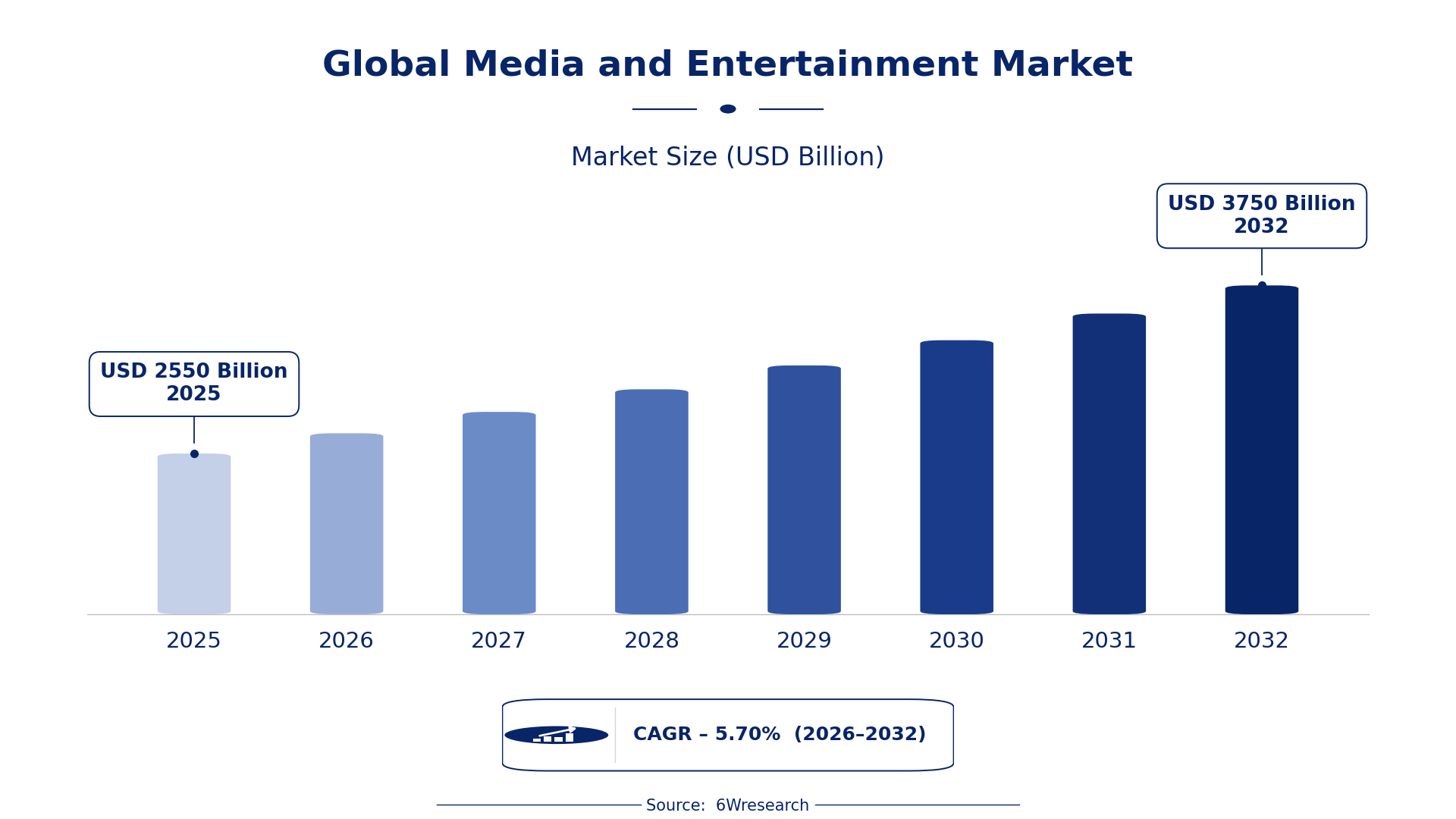
The Global Media and Entertainment Market was estimated at USD 2550 Billion in 2025 and is projected to reach USD 3750 Billion by 2032, growing at a CAGR of 5.70% from 2026 to 2032.
Global Media and Entertainment Market Synopsis
Currently, the Global Media and Entertainment Market is undergoing a transformative period, characterized by shifts in consumer preferences driven by digitalization and mobile consumption. The surge in streaming services and digital content consumption reshapes the entire ecosystem, influencing production, distribution, and monetization strategies across various sectors.
Additionally, the advent of advanced technologies such as artificial intelligence and machine learning is revolutionizing content creation and delivery methods. This market's significance extends beyond entertainment, impacting advertising, consumer engagement, and informational dissemination in diverse industries.
Global Media and Entertainment Market Year-wise Growth Rate and Key Drivers
This graph illustrates the annual growth rates of the Global Media and Entertainment Market from 2022 to 2032, highlighting a steady upward trajectory and projected expansion over the forecast period.
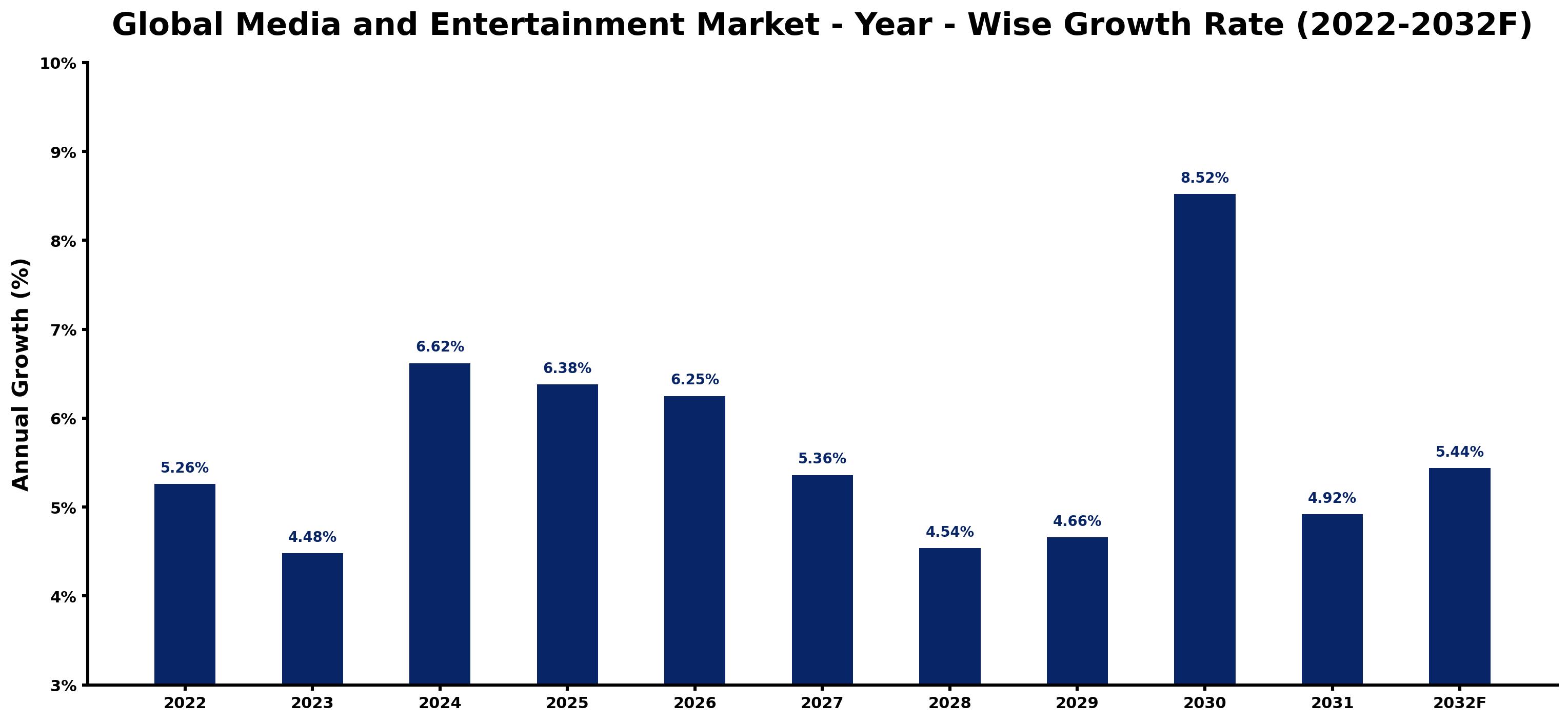
The table below presents the year‑wise growth rates along with the key drivers influencing the market
| Year | Growth Rate (%) | Major Drivers |
| 2022 | 5.26 | A shift toward streaming platforms changes consumer engagement with entertainment content. |
| 2023 | 4.48 | Content distribution networks struggle with supply chain issues affecting media access. |
| 2024 | 6.62 | Enhancing sustainable production practices enables higher-quality media and entertainment outputs. |
| 2025 | 6.38 | Intensifying competition among platforms pressures licensing deals for exclusive entertainment content. |
| 2026 | 6.25 | In the wake of new regulations, ad-supported revenue models transform media monetization strategies. |
| 2027 | 5.36 | Consumers increasingly embrace immersive technologies, elevating engagement in entertainment experiences. |
| 2028 | 4.54 | As material costs rise, production budgets for media projects face tighter constraints. |
| 2029 | 4.66 | Streaming services like Netflix shape audience preferences toward diverse entertainment offerings. |
| 2030 | 8.52 | Investors are channeling funds into mergers and acquisitions within the media sector. |
| 2031 | 4.92 | A growing emphasis on digital skills training enhances workforce capabilities in media production. |
| 2032 | 5.44 | Expanding international distribution channels broadens access to diverse entertainment content. |
Note - Market size estimations and growth projections presented in this report are based on 6Wresearch's proprietary research methodology, combining internal industry data, secondary research, and primary validation, updated periodically to reflect current market conditions. As markets evolve rapidly, figures for certain industries may vary slightly and are intended as informed estimates rather than absolute figures. For the most current market sizing, we recommend validating figures with a 6Wresearch analyst.
Global Media and Entertainment Market Key Takeaways
Below are some of the specific key takeaways from the market, including:
- As of 2025, Streaming Services will dominate the market with an estimated share of ~34%.
- The digital media segment is projected to grow at a CAGR of 7.5% from 2026 to 2032.
- Global advertising spend on digital platforms is expected to reach $600 billion by 2027, highlighting the shift in marketing strategies.
- In 2022, Spotify launched a new advertising campaign aimed at young adults, reflecting a strategic pivot to target younger demographics.
Evaluation of Restraints in Global Media and Entertainment Market
The Global Media and Entertainment Market faces significant challenges, including stringent regulatory frameworks and rising operational costs. For instance, compliance with the EU’s General Data Protection Regulation (GDPR) can incur costs exceeding $1 million for companies that fail to adhere to data protection requirements. Additionally, piracy and copyright infringement represent substantial threats, leading to estimated losses of up to $70 billion annually for the film and music sectors. Such financial burdens compel companies to rethink their business models.
Global Media and Entertainment Market Trends
A major trend in the Global Media and Entertainment Market is the rise of personalized content delivery, powered by data analytics. Companies like Amazon are utilizing artificial intelligence to refine user experiences by curating content tailored to individual preferences. This shift has measurable impact; for example, in 2023, Netflix reported that 80% of its viewing hours come from personalized recommendations. Furthermore, the gaming sector sees emerging trends in interactive and immersive formats, particularly with cloud gaming and VR technology gaining traction. Google’s announcement of Project Stream in 2022, which enables high-definition game streaming, exemplifies this operational change in delivering rich multimedia experiences.
Global Media and Entertainment Market Opportunities
Emerging technologies present significant revenue opportunities within the Global Media and Entertainment Market. Virtual reality (VR) and augmented reality (AR) technologies are poised for explosive growth, with estimates suggesting a market size of $300 billion by 2025. Companies like Oculus and Magic Leap are spearheading innovations that leverage immersive experiences, enabling new avenues for content engagement and advertising. For example, an AR experience launched by Pokémon GO generated over $1 billion in its first year, illustrating the potential for AR-driven applications. Additionally, expanding internet penetration in emerging markets offers companies the ability to tap into new consumer bases, creating a fertile ground for growth and diversification.
Global Media and Entertainment Market by Type
In the Global Media and Entertainment Market, Digital Media is estimated to lead with a share of ~34% in 2025, driven by the increasing preference for online platforms over traditional media. Conversely, Streaming Services are anticipated to be the fastest-growing segment, with a projected CAGR of 7.5% from 2026 to 2032, attributed to the rising popularity of on-demand content and subscription-based models.
Global Media and Entertainment Market by Region
As of 2025, North America is poised to be the largest region in the Global Media and Entertainment Market, commanding an estimated share of approximately 42%. This dominance stems from a robust advertising ecosystem, coupled with a receptive consumer base characterized by high disposable income. Moreover, Asia is expected to emerge as the fastest-growing region, with a CAGR of 8.3% from 2026 to 2032, driven by rising smartphone penetration, expanding online platforms, and a youthful demographic eager for diverse content experiences.
Government Initiatives in the Global Media and Entertainment Market
The regulatory landscape surrounding the Global Media and Entertainment Market is becoming increasingly complex, with governments implementing various policies to stimulate growth and innovation. These initiatives are often aimed at promoting digital content, protecting intellectual property, and ensuring fair market practices across multiple jurisdictions.
- U.S. Federal Communications Commission (FCC) - 2023, Modernizing Media Regulations - This initiative aims to simplify regulations around broadcasting, supporting small media companies and independent creators.
- European Commission - Copyright Directive, 2021 - This legislation reinforces copyright protections for content creators in digital environments, ensuring a competitive landscape for European media companies.
- Government of India - Digital India Initiative, 2015 - A program designed to promote digital media literacy, increase access to the internet, and stimulate local content production within the country.
- United Kingdom Department for Digital, Culture, Media & Sport (DCMS) - Media Investment Fund, 2022 - This ongoing fund supports the development of UK-based media content, promoting local production while enhancing the country's cultural output.
Future Insights of the Global Media and Entertainment Market
The trajectory of the Global Media and Entertainment Market is set to evolve, largely shaped by technological integration and shifting consumer behaviors. By 2032, investments in AI and machine learning are expected to enhance content curation and advertising effectiveness, leading to more personalized user experiences. For instance, Disney's use of machine learning for improved content delivery strategies underscores a broader industry trend toward data-driven decision-making. Consequently, businesses will need to adapt to these advancements to remain competitive and relevant.
Global Media and Entertainment Market Latest Developments
Recent activities in the Global Media and Entertainment Market highlight strategic shifts by leading companies aimed at enhancing market positioning and technological capabilities.
- In June 2023, Netflix launched an innovative advertising tier that allows advertisers to target specific demographics, optimizing ad spend and improving viewer engagement.
- Recently, Disney unveiled plans for a significant investment in virtual reality content, aligning with current trends in immersive experiences and expanding its content repertoire.
- In Q3 of 2023, Amazon announced a partnership with local providers across several Asian countries to strengthen its streaming service presence, leveraging regional content to attract new subscribers.
- March 2023 saw Tencent investing heavily in blockchain technology to secure media rights and enhance content distribution, ensuring a competitive edge in digital content management.
Global Media and Entertainment Market Key Players and Industry Positioning
The competitive landscape of the Global Media and Entertainment Market consists of both consolidated giants and small innovators. Leading companies continually refine their strategies to capture market share, employing diverse approaches that span across technology advancements, regional outreach, and content diversification.
| Leading Company | Core Strength | Strategic Focus |
|---|---|---|
| Netflix | Robust content library | Expanding original programming and advertising tier. |
| Disney | Strong franchise portfolio | Investing in VR and global content adaptation. |
| Amazon | Diverse service portfolio | Enhancing regional partnerships for streaming. |
| Tencent | Technological innovation | Leveraging blockchain for rights management. |
| Warner Bros. | Strong film and TV studio presence | Focus on adaptive streaming and global outreach. |
As these companies maneuver through the market, their strategic emphasis on technology and consumer engagement will likely dictate future success and competitive dynamics.
Key Attractiveness of the Report
- 10 Years of Market Numbers
- Historical Data Starting from 2022 to 2025
- Base Year: 2025
- Forecast Data until 2032
- Key Performance Indicators Impacting the Market
- Major Upcoming Developments and Projects
Key Highlights of the Report:
- Global Media and Entertainment Market Outlook
- Market Size of Global Media and Entertainment Market, 2025
- Forecast of Global Media and Entertainment Market, 2032
- Historical Data and Forecast of Global Media and Entertainment Revenues & Volume for the Period 2022-2032
- Global Media and Entertainment Market Trend Evolution
- Global Media and Entertainment Market Drivers and Challenges
- Global Media and Entertainment Price Trends
- Global Media and Entertainment Porter's Five Forces
- Global Media and Entertainment Industry Life Cycle
- Historical Data and Forecast of Global Media and Entertainment Market Revenues & Volume
- Historical Data and Forecast of Global Media and Entertainment Market Revenues & Volume By Type for the Period 2022-2032
- Historical Data and Forecast of Global Media and Entertainment Market Revenues & Volume By Business-to-business (B2B) for the Period 2022-2032
- Historical Data and Forecast of Global Media and Entertainment Market Revenues & Volume By Book Publishing for the Period 2022-2032
- Historical Data and Forecast of Global Media and Entertainment Market Revenues & Volume By Filmed Entertainment for the Period 2022-2032
- Historical Data and Forecast of Global Media and Entertainment Market Revenues & Volume By Internet Access for the Period 2022-2032
- Historical Data and Forecast of Global Media and Entertainment Market Revenues & Volume By Internet Advertising for the Period 2022-2032
- Historical Data and Forecast of Global Media and Entertainment Market Revenues & Volume By Magazine Publishing for the Period 2022-2032
- Historical Data and Forecast of Global Media and Entertainment Market Revenues & Volume By Music for the Period 2022-2032
- Historical Data and Forecast of Global Business-to-business (B2B) Media and Entertainment Market Revenues & Volume By Newspaper Publishing for the Period 2022-2032
- Historical Data and Forecast of North America Media and Entertainment Market Revenues & Volume By Type for the Period 2022-2032
- Historical Data and Forecast of North America Media and Entertainment Market Revenues & Volume By Business-to-business (B2B) for the Period 2022-2032
- Historical Data and Forecast of North America Media and Entertainment Market Revenues & Volume By Book Publishing for the Period 2022-2032
- Historical Data and Forecast of North America Media and Entertainment Market Revenues & Volume By Filmed Entertainment for the Period 2022-2032
- Historical Data and Forecast of North America Media and Entertainment Market Revenues & Volume By Internet Access for the Period 2022-2032
- Historical Data and Forecast of North America Media and Entertainment Market Revenues & Volume By Internet Advertising for the Period 2022-2032
- Historical Data and Forecast of North America Media and Entertainment Market Revenues & Volume By Magazine Publishing for the Period 2022-2032
- Historical Data and Forecast of North America Media and Entertainment Market Revenues & Volume By Music for the Period 2022-2032
- Historical Data and Forecast of North America Business-to-business (B2B) Media and Entertainment Market Revenues & Volume By Newspaper Publishing for the Period 2022-2032
- Historical Data and Forecast of United States of America Media and Entertainment Market Revenues & Volume for the Period 2022-2032
- Historical Data and Forecast of Canada Media and Entertainment Market Revenues & Volume for the Period 2022-2032
- Historical Data and Forecast of Rest of North America Media and Entertainment Market Revenues & Volume for the Period 2022-2032
- Historical Data and Forecast of Latin America (LATAM) Media and Entertainment Market Revenues & Volume By Type for the Period 2022-2032
- Historical Data and Forecast of Latin America (LATAM) Media and Entertainment Market Revenues & Volume By Business-to-business (B2B) for the Period 2022-2032
- Historical Data and Forecast of Latin America (LATAM) Media and Entertainment Market Revenues & Volume By Book Publishing for the Period 2022-2032
- Historical Data and Forecast of Latin America (LATAM) Media and Entertainment Market Revenues & Volume By Filmed Entertainment for the Period 2022-2032
- Historical Data and Forecast of Latin America (LATAM) Media and Entertainment Market Revenues & Volume By Internet Access for the Period 2022-2032
- Historical Data and Forecast of Latin America (LATAM) Media and Entertainment Market Revenues & Volume By Internet Advertising for the Period 2022-2032
- Historical Data and Forecast of Latin America (LATAM) Media and Entertainment Market Revenues & Volume By Magazine Publishing for the Period 2022-2032
- Historical Data and Forecast of Latin America (LATAM) Media and Entertainment Market Revenues & Volume By Music for the Period 2022-2032
- Historical Data and Forecast of Latin America (LATAM) Business-to-business (B2B) Media and Entertainment Market Revenues & Volume By Newspaper Publishing for the Period 2022-2032
- Historical Data and Forecast of Brazil Media and Entertainment Market Revenues & Volume for the Period 2022-2032
- Historical Data and Forecast of Mexico Media and Entertainment Market Revenues & Volume for the Period 2022-2032
- Historical Data and Forecast of Argentina Media and Entertainment Market Revenues & Volume for the Period 2022-2032
- Historical Data and Forecast of Rest of LATAM Media and Entertainment Market Revenues & Volume for the Period 2022-2032
- Historical Data and Forecast of Asia Media and Entertainment Market Revenues & Volume By Type for the Period 2022-2032
- Historical Data and Forecast of Asia Media and Entertainment Market Revenues & Volume By Business-to-business (B2B) for the Period 2022-2032
- Historical Data and Forecast of Asia Media and Entertainment Market Revenues & Volume By Book Publishing for the Period 2022-2032
- Historical Data and Forecast of Asia Media and Entertainment Market Revenues & Volume By Filmed Entertainment for the Period 2022-2032
- Historical Data and Forecast of Asia Media and Entertainment Market Revenues & Volume By Internet Access for the Period 2022-2032
- Historical Data and Forecast of Asia Media and Entertainment Market Revenues & Volume By Internet Advertising for the Period 2022-2032
- Historical Data and Forecast of Asia Media and Entertainment Market Revenues & Volume By Magazine Publishing for the Period 2022-2032
- Historical Data and Forecast of Asia Media and Entertainment Market Revenues & Volume By Music for the Period 2022-2032
- Historical Data and Forecast of Asia Business-to-business (B2B) Media and Entertainment Market Revenues & Volume By Newspaper Publishing for the Period 2022-2032
- Historical Data and Forecast of China Media and Entertainment Market Revenues & Volume for the Period 2022-2032
- Historical Data and Forecast of India Media and Entertainment Market Revenues & Volume for the Period 2022-2032
- Historical Data and Forecast of Japan Media and Entertainment Market Revenues & Volume for the Period 2022-2032
- Historical Data and Forecast of Rest of Asia Media and Entertainment Market Revenues & Volume for the Period 2022-2032
- Historical Data and Forecast of Africa Media and Entertainment Market Revenues & Volume By Type for the Period 2022-2032
- Historical Data and Forecast of Africa Media and Entertainment Market Revenues & Volume By Business-to-business (B2B) for the Period 2022-2032
- Historical Data and Forecast of Africa Media and Entertainment Market Revenues & Volume By Book Publishing for the Period 2022-2032
- Historical Data and Forecast of Africa Media and Entertainment Market Revenues & Volume By Filmed Entertainment for the Period 2022-2032
- Historical Data and Forecast of Africa Media and Entertainment Market Revenues & Volume By Internet Access for the Period 2022-2032
- Historical Data and Forecast of Africa Media and Entertainment Market Revenues & Volume By Internet Advertising for the Period 2022-2032
- Historical Data and Forecast of Africa Media and Entertainment Market Revenues & Volume By Magazine Publishing for the Period 2022-2032
- Historical Data and Forecast of Africa Media and Entertainment Market Revenues & Volume By Music for the Period 2022-2032
- Historical Data and Forecast of Africa Business-to-business (B2B) Media and Entertainment Market Revenues & Volume By Newspaper Publishing for the Period 2022-2032
- Historical Data and Forecast of South Africa Media and Entertainment Market Revenues & Volume for the Period 2022-2032
- Historical Data and Forecast of Nigeria Media and Entertainment Market Revenues & Volume for the Period 2022-2032
- Historical Data and Forecast of Egypt Media and Entertainment Market Revenues & Volume for the Period 2022-2032
- Historical Data and Forecast of Rest of Africa Media and Entertainment Market Revenues & Volume for the Period 2022-2032
- Historical Data and Forecast of Europe Media and Entertainment Market Revenues & Volume By Type for the Period 2022-2032
- Historical Data and Forecast of Europe Media and Entertainment Market Revenues & Volume By Business-to-business (B2B) for the Period 2022-2032
- Historical Data and Forecast of Europe Media and Entertainment Market Revenues & Volume By Book Publishing for the Period 2022-2032
- Historical Data and Forecast of Europe Media and Entertainment Market Revenues & Volume By Filmed Entertainment for the Period 2022-2032
- Historical Data and Forecast of Europe Media and Entertainment Market Revenues & Volume By Internet Access for the Period 2022-2032
- Historical Data and Forecast of Europe Media and Entertainment Market Revenues & Volume By Internet Advertising for the Period 2022-2032
- Historical Data and Forecast of Europe Media and Entertainment Market Revenues & Volume By Magazine Publishing for the Period 2022-2032
- Historical Data and Forecast of Europe Media and Entertainment Market Revenues & Volume By Music for the Period 2022-2032
- Historical Data and Forecast of Europe Business-to-business (B2B) Media and Entertainment Market Revenues & Volume By Newspaper Publishing for the Period 2022-2032
- Historical Data and Forecast of United Kingdom Media and Entertainment Market Revenues & Volume for the Period 2022-2032
- Historical Data and Forecast of France Media and Entertainment Market Revenues & Volume for the Period 2022-2032
- Historical Data and Forecast of Germany Media and Entertainment Market Revenues & Volume for the Period 2022-2032
- Historical Data and Forecast of Rest of Europe Media and Entertainment Market Revenues & Volume for the Period 2022-2032
- Historical Data and Forecast of Middle East Media and Entertainment Market Revenues & Volume By Type for the Period 2022-2032
- Historical Data and Forecast of Middle East Media and Entertainment Market Revenues & Volume By Business-to-business (B2B) for the Period 2022-2032
- Historical Data and Forecast of Middle East Media and Entertainment Market Revenues & Volume By Book Publishing for the Period 2022-2032
- Historical Data and Forecast of Middle East Media and Entertainment Market Revenues & Volume By Filmed Entertainment for the Period 2022-2032
- Historical Data and Forecast of Middle East Media and Entertainment Market Revenues & Volume By Internet Access for the Period 2022-2032
- Historical Data and Forecast of Middle East Media and Entertainment Market Revenues & Volume By Internet Advertising for the Period 2022-2032
- Historical Data and Forecast of Middle East Media and Entertainment Market Revenues & Volume By Magazine Publishing for the Period 2022-2032
- Historical Data and Forecast of Middle East Media and Entertainment Market Revenues & Volume By Music for the Period 2022-2032
- Historical Data and Forecast of Middle East Business-to-business (B2B) Media and Entertainment Market Revenues & Volume By Newspaper Publishing for the Period 2022-2032
- Historical Data and Forecast of Saudi Arabia Media and Entertainment Market Revenues & Volume for the Period 2022-2032
- Historical Data and Forecast of UAE Media and Entertainment Market Revenues & Volume for the Period 2022-2032
- Historical Data and Forecast of Turkey Media and Entertainment Market Revenues & Volume for the Period 2022-2032
- Historical Data and Forecast of Rest of Middle East Media and Entertainment Market Revenues & Volume for the Period 2022-2032
- Global Media and Entertainment Market - Key Performance Indicators
- Global Media and Entertainment Market - Import Export Trade Statistics
- Global Media and Entertainment Market - Opportunity Assessment By Countries
- Global Media and Entertainment Market - Opportunity Assessment By Type
- 0
- Global Media and Entertainment Market - Top Companies Market Share
- Global Media and Entertainment Market - Top Companies Profiles
- Global Media and Entertainment Market - Comparison of Players in Technical and Operating Parameters
- Global Media and Entertainment Market - Strategic Recommendations
Markets Covered
The Global Media and Entertainment Market report provides a detailed analysis of the following market segments:
By Regions and Countries:
- North America
- Europe
- LATAM
- Middle East
- Asia
- Africa
By Type:
- Business-to-business (B2B)
- Book Publishing
- Filmed Entertainment
- Internet Access
- Internet Advertising
- Magazine Publishing
- Music
- Newspaper Publishing






































