Global Medical Coding Market Highlights
| Market Size (2025) | USD 2.2 Billion |
| Forecast Size (2032) | USD 4.1 Billion |
| CAGR | 8.40% |
| Base Year | 2025 |
| Forecast Period | 2026-2032 |
| Largest Region | North America |
| Fastest Growing Region | Asia |
| Largest Segment | International Classification of Diseases (ICD) |
| Fastest Growing Segment | Current Procedural Terminology (CPT) |
| Leading Companies | Aviacode, Maxim Health Information Services, nThrive, Dolbey Systems, Optum360 |
Global Medical Coding Market Size & Growth Rate (2026-2032)
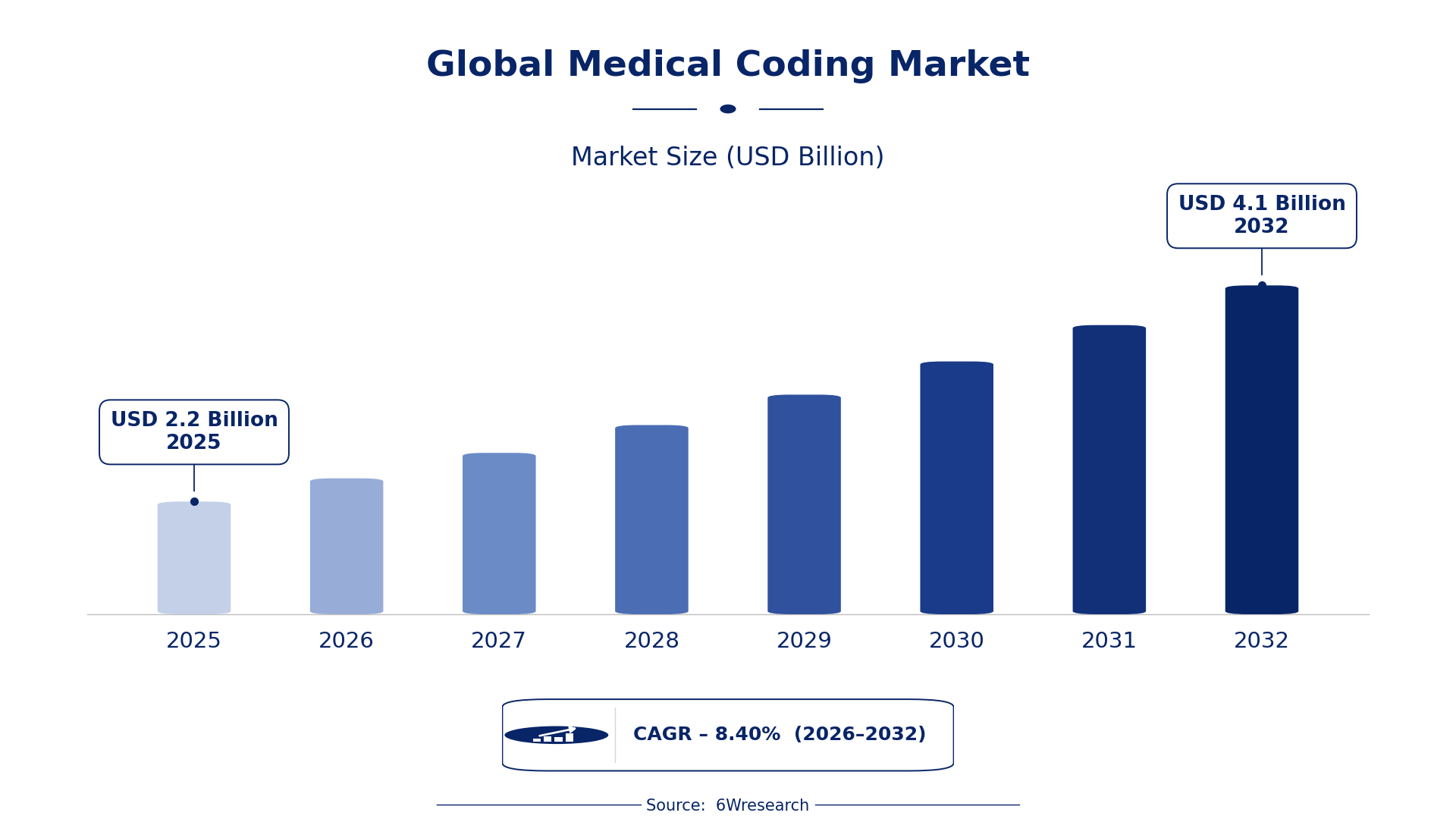
The Global Medical Coding Market was estimated at USD 2.2 Billion in 2025 and is projected to reach USD 4.1 Billion by 2032, growing at a CAGR of 8.40% from 2026 to 2032.
Global Medical Coding Market Synopsis
The Global Medical Coding Market is undergoing a profound transformation, primarily due to the increasing complexity of healthcare services and the growing demand for precise and standardized coding systems. The shift towards electronic health records (EHRs) and value-based care models drives this market, as stakeholders recognize the critical need for accurate documentation in reimbursement processes. Moreover, the rise in chronic diseases necessitates skilled medical coding professionals capable of managing intricate coding structures efficiently.
This market stands distinctly apart from adjacent fields, primarily due to its unique intersection with healthcare regulations and financial reimbursement systems. The increasing emphasis on compliance and accuracy in coding directly influences the demand for specialized coding solutions, poised to attract substantial investment as stakeholders seek to streamline operations and reduce operational risks. Consequently, the future of the Global Medical Coding Market appears robust, reflecting an environment that prioritizes accuracy and efficiency in healthcare delivery.
Global Medical Coding Market Year-wise Growth Rate and Key Drivers
This graph illustrates the annual growth rates of the Global Medical Coding Market from 2022 to 2032, highlighting a steady upward trajectory and projected expansion over the forecast period.
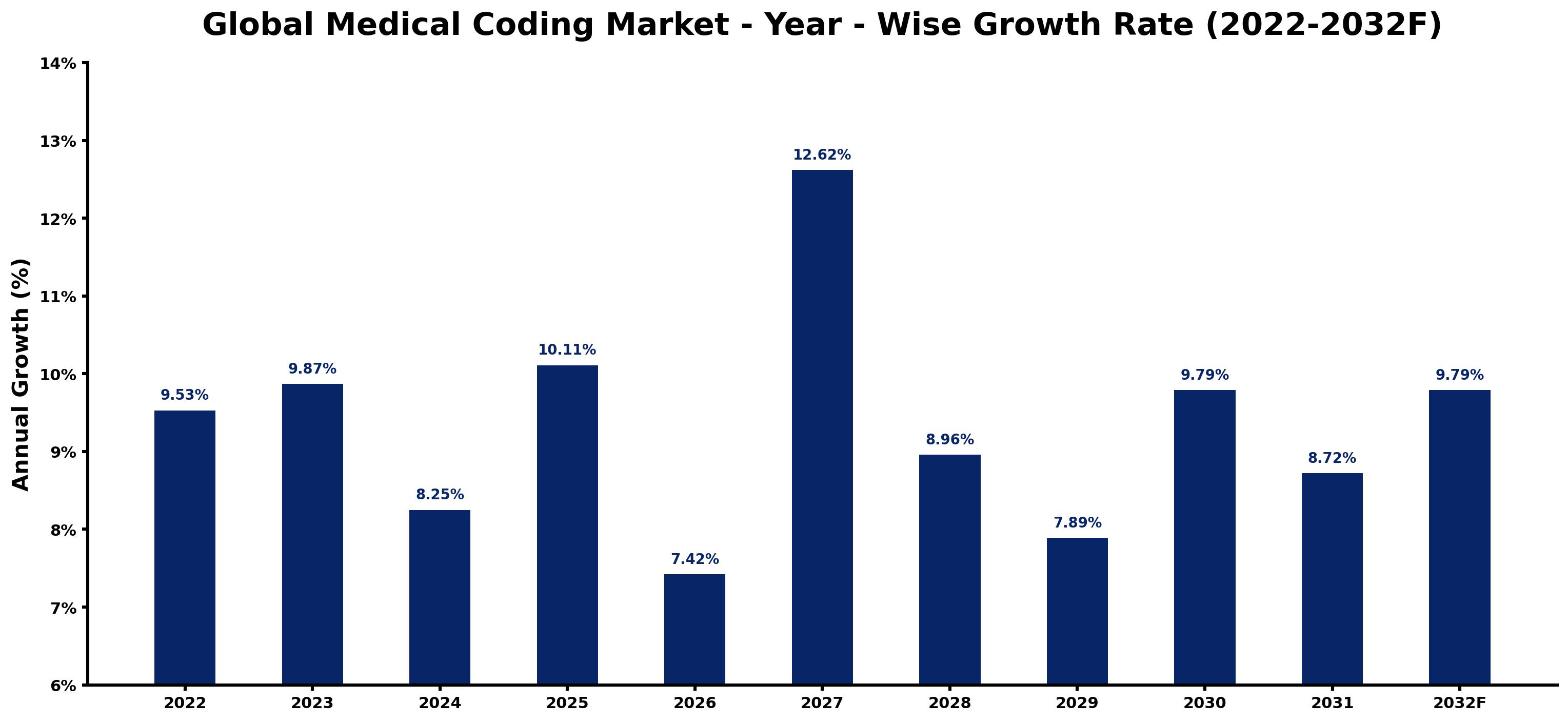
The table below presents the year‑wise growth rates along with the key drivers influencing the market
| Year | Growth Rate (%) | Major Drivers |
| 2022 | 9.53 | A promising sustainability trend encourages hospitals to adopt medical coding systems. |
| 2023 | 9.87 | Advancing telehealth platforms enhance the efficiency of medical coding processes. |
| 2024 | 8.25 | A shift toward preventative care increases the necessity for accurate coding. |
| 2025 | 10.11 | Rising input costs for healthcare technology compel hospitals to optimize coding solutions. |
| 2026 | 7.42 | Healthcare providers strengthen their supply chain to improve access to medical coding resources. |
| 2027 | 12.62 | Healthcare organizations prioritize workforce training to enhance medical coding accuracy. |
| 2028 | 8.96 | Policy modifications streamline the integration of medical coding into reimbursement structures. |
| 2029 | 7.89 | As mergers consolidate healthcare businesses, medical coding becomes a focal point for efficiency. |
| 2030 | 9.79 | In North America, increased demand for quality patient outcomes drives medical coding adoption. |
| 2031 | 8.72 | Artificial intelligence technologies streamline medical coding, simplifying complex diagnostic documentation. |
| 2032 | 9.79 | Healthcare insurers are increasingly investing in advanced medical coding for improved patient outcomes. |
Note - Market size estimations and growth projections presented in this report are based on 6Wresearch's proprietary research methodology, combining internal industry data, secondary research, and primary validation, updated periodically to reflect current market conditions. As markets evolve rapidly, figures for certain industries may vary slightly and are intended as informed estimates rather than absolute figures. For the most current market sizing, we recommend validating figures with a 6Wresearch analyst.
Global Medical Coding Market Key Takeaways
Below are some of the specific key takeaways from the market, including:
- North America commands over 45% market share in 2025, driven by established healthcare infrastructure and stringent regulatory frameworks.
- The International Classification of Diseases (ICD) accounts for approximately 60% of the segment share in 2025, owing to widespread adoption in health facilities.
- Current Procedural Terminology (CPT) is projected to grow at a CAGR of 9.50% from 2026 to 2032, supported by increased outpatient services and coding accuracy requirements.
- The outsourcing of medical coding services is expected to rise, with a projected market share of 30% by 2032 as facilities aim to enhance operational efficiency.
- Technological innovations in coding software solutions are anticipated to accelerate market growth, with investment from companies like nThrive and Optum360 in the field.
Evaluation of Restraints in Global Medical Coding Market
Despite its promising trajectory, the Global Medical Coding Market faces notable challenges. A significant constraint is the ongoing complexity and fluctuation of healthcare regulations, making compliance a costly endeavor. For example, the average annual cost for healthcare organizations to keep coding staff updated on regulatory changes is estimated to exceed $4,000 per employee. Additionally, fierce competition from both local and offshore coding service providers presents a significant threat, pressing organizations to streamline costs while maintaining high-quality coding standards. The shortage of skilled medical coders, especially in emerging specialties, further exacerbates these constraints, leading to potential service shortfalls in critical areas.
Global Medical Coding Market Trends
A significant trend impacting the Global Medical Coding Market is the adoption of artificial intelligence (AI) and machine learning technologies. These innovations enhance coding accuracy and process efficiency, leading to reduced workload for human coders. For instance, companies like nThrive have implemented AI solutions that can automate over 40% of coding tasks, streamlining operations for healthcare providers. An ongoing shift towards outsourcing medical coding services is also notable, as healthcare organizations prioritize cost efficiency, with outsourcing projected to rise by approximately 15% by 2030 to optimize resource allocation. Furthermore, increased investments in coding training and certification programs for professionals are being observed, reflecting a commitment to addressing skill gaps in the industry as healthcare evolves.
Global Medical Coding Market Opportunities
Emerging opportunities within the Global Medical Coding Market are substantial, particularly due to technological advancements and the growing recognition of coding significance in healthcare. One notable opportunity lies in the integration of telemedicine, which necessitates accurate medical coding for reimbursement. For instance, the telehealth market is projected to reach $636 billion by 2028, presenting a considerable demand for coding specialists adept in navigating these new service modalities. Additionally, the expansion of healthcare infrastructure in Asia is anticipated to create a significant market for coding services, with investment from major players like Optum360 seeking to enhance operational capabilities. As organizations adapt to evolving healthcare landscapes, these avenues promise considerable revenue potential for stakeholders focused on growth in medical coding services.
Global Medical Coding Market by Classification System
The Global Medical Coding Market is classified mainly into two systems: International Classification of Diseases (ICD) and Current Procedural Terminology (CPT). The ICD leads the market with an impressive ~60% share in 2025, primarily due to its widespread application across healthcare settings, ensuring comprehensive tracking of diseases. In contrast, the CPT is the fastest-growing segment, projected to exhibit a CAGR of 9.50% from 2026 to 2032. This growth is attributed to the increasing complexity of outpatient services and the urgent need for accurate procedural documentation, offering key advantages in billing and reimbursement procedures.
Global Medical Coding Market by Component
The Global Medical Coding Market can be segmented into two primary components: In-House and Outsourced services. In-House services currently dominate the market with a share of ~70% in 2025, largely due to healthcare facilities leveraging internal resources for coding accuracy and compliance. However, Outsourced coding is expected to be the fastest-growing segment, projected to grow at a CAGR of 9.00% from 2026 to 2032. This shift reflects healthcare providers’ increasing preference for outsourcing to reduce operational costs while maintaining high standards in coding.
Global Medical Coding Market by Region
North America is the largest region in the Global Medical Coding Market, with an estimated market share of ~48% in 2025, driven by advanced healthcare infrastructure and a robust regulatory framework. Conversely, Asia is anticipated to be the fastest-growing region, projected to achieve a CAGR of 10.20% from 2026 to 2032. This growth is fueled by expanding investments in healthcare infrastructure and increasing demand for coding professionals as emerging markets prioritize accurate documentation to support healthcare funding and reimbursement.
Government Initiatives in the Global Medical Coding Market
The regulatory framework surrounding the Global Medical Coding Market is critical in shaping its future direction. Governments and associated agencies worldwide are implementing various initiatives to facilitate compliance and enhance healthcare efficiency. These strategies not only provide financial support but also create an environment that encourages innovation and adherence to coding standards.
- Centers for Medicare & Medicaid Services (CMS), "CMS Strategy to Improve Coding Accuracy," released in February 2022. This initiative aims to strengthen coding standards across various healthcare facilities, thereby improving reimbursement processes.
- World Health Organization (WHO), "International Classification of Diseases Transition Initiative," launched in January 2021. This program facilitates the adoption of the latest ICD standards globally, ensuring uniformity in healthcare documentation.
- Health Information Management Association, "Training Enhancement Initiative," announced in June 2023. This ongoing project focuses on upskilling medical coding professionals in line with evolving healthcare standards.
- Department of Health and Human Services (HHS), "Future Coding Workforce Development Program," set to launch in January 2024. This initiative will allocate funding to educational institutions aimed at creating a skilled future workforce in medical coding.
Future Insights of the Global Medical Coding Market
The Global Medical Coding Market is set to witness transformative shifts through 2032, driven by the integration of advanced technologies such as artificial intelligence and machine learning. Companies like nThrive are leading this charge, with AI systems capable of automating substantial portions of coding tasks. Furthermore, as telemedicine rises, accurate coding becomes crucial for ensuring proper reimbursement, highlighting an increased need for skilled coders. Investments in training programs will also play a vital role, preparing the workforce for new challenges and opportunities in coding.
Global Medical Coding Market Latest Developments
Recent initiatives in the Global Medical Coding Market showcase strategic advancements aimed at enhancing efficiency and accuracy. These developments reflect the competitive landscape's responsiveness to both technological progress and market demands.
- In August 2023, Optum360 launched a new software solution to streamline coding processes, enhancing accuracy and reducing turnaround time within facilities, positioning them as a frontrunner in the market.
- nThrive is currently investing in AI technologies to improve coding precision, with plans for implementation in early 2024, which is expected to elevate the standard for coding accuracy across healthcare organizations.
- Aviacode expanded its operational capabilities in October 2022, opening a new facility dedicated to training and certifying coding professionals, thereby strengthening its position in the outsourcing segment.
- Maxim Health Information Services recently entered a strategic partnership with a telehealth provider in March 2023, enabling them to enhance coding efficiencies for telehealth services, thus capitalizing on the telemedicine growth trend.
Global Medical Coding Market Key Players and Industry Positioning
The competitive landscape of the Global Medical Coding Market is characterized by a mix of established companies and emerging players, each leveraging specialized strengths to carve out their market share. While North American firms dominate due to a robust regulatory environment, newer entrants in Asia are rapidly adapting to changing healthcare needs, indicating a fragmented market ripe for further evolution.
| Leading Company | Core Strength | Strategic Focus |
|---|---|---|
| Aviacode | Expertise in outsourcing medical coding with robust training programs. | Enhancing operational efficiency through workforce development. |
| Maxim Health Information Services | Comprehensive coding solutions across multiple specializations. | Fostering partnerships to integrate telehealth services. |
| nThrive | Advanced AI-driven coding technology. | Improving coding accuracy through technological integration. |
| Dolbey Systems | Strong focus on speech recognition coding solutions. | Expanding product offerings to cater to varied healthcare needs. |
| Optum360 | Comprehensive healthcare management solutions with strong analytics. | Continuous innovation in coding software for efficiency. |
As the industry evolves, competitive differentiation based on technology and service quality will become crucial, ensuring a dynamic marketplace that adapts to healthcare's demands.
Key Attractiveness of the Report
- 10 Years of Market Numbers
- Historical Data Starting from 2022 to 2025
- Base Year: 2025
- Forecast Data until 2032
- Key Performance Indicators Impacting the Market
- Major Upcoming Developments and Projects
Key Highlights of the Report:
- Global Medical Coding Market Outlook
- Market Size of Global Medical Coding Market, 2025
- Forecast of Global Medical Coding Market, 2032
- Historical Data and Forecast of Global Medical Coding Revenues & Volume for the Period 2022-2032
- Global Medical Coding Market Trend Evolution
- Global Medical Coding Market Drivers and Challenges
- Global Medical Coding Price Trends
- Global Medical Coding Porter's Five Forces
- Global Medical Coding Industry Life Cycle
- Historical Data and Forecast of Global Medical Coding Market Revenues & Volume
- Historical Data and Forecast of Global Medical Coding Market Revenues & Volume By Classification System for the Period 2022-2032
- Historical Data and Forecast of Global Medical Coding Market Revenues & Volume By International Classification of Diseases (ICD) for the Period 2022-2032
- Historical Data and Forecast of Global Medical Coding Market Revenues & Volume By Healthcare Common Procedure Code System (HCPCS) for the Period 2022-2032
- Historical Data and Forecast of Global Medical Coding Market Revenues & Volume By Component for the Period 2022-2032
- Historical Data and Forecast of Global Medical Coding Market Revenues & Volume By In-House for the Period 2022-2032
- Historical Data and Forecast of Global Medical Coding Market Revenues & Volume By Outsourced for the Period 2022-2032
- Historical Data and Forecast of North America Medical Coding Market Revenues & Volume By Classification System for the Period 2022-2032
- Historical Data and Forecast of North America Medical Coding Market Revenues & Volume By International Classification of Diseases (ICD) for the Period 2022-2032
- Historical Data and Forecast of North America Medical Coding Market Revenues & Volume By Healthcare Common Procedure Code System (HCPCS) for the Period 2022-2032
- Historical Data and Forecast of North America Medical Coding Market Revenues & Volume By Component for the Period 2022-2032
- Historical Data and Forecast of North America Medical Coding Market Revenues & Volume By In-House for the Period 2022-2032
- Historical Data and Forecast of North America Medical Coding Market Revenues & Volume By Outsourced for the Period 2022-2032
- Historical Data and Forecast of United States of America Medical Coding Market Revenues & Volume for the Period 2022-2032
- Historical Data and Forecast of Canada Medical Coding Market Revenues & Volume for the Period 2022-2032
- Historical Data and Forecast of Rest of North America Medical Coding Market Revenues & Volume for the Period 2022-2032
- Historical Data and Forecast of Latin America (LATAM) Medical Coding Market Revenues & Volume By Classification System for the Period 2022-2032
- Historical Data and Forecast of Latin America (LATAM) Medical Coding Market Revenues & Volume By International Classification of Diseases (ICD) for the Period 2022-2032
- Historical Data and Forecast of Latin America (LATAM) Medical Coding Market Revenues & Volume By Healthcare Common Procedure Code System (HCPCS) for the Period 2022-2032
- Historical Data and Forecast of Latin America (LATAM) Medical Coding Market Revenues & Volume By Component for the Period 2022-2032
- Historical Data and Forecast of Latin America (LATAM) Medical Coding Market Revenues & Volume By In-House for the Period 2022-2032
- Historical Data and Forecast of Latin America (LATAM) Medical Coding Market Revenues & Volume By Outsourced for the Period 2022-2032
- Historical Data and Forecast of Brazil Medical Coding Market Revenues & Volume for the Period 2022-2032
- Historical Data and Forecast of Mexico Medical Coding Market Revenues & Volume for the Period 2022-2032
- Historical Data and Forecast of Argentina Medical Coding Market Revenues & Volume for the Period 2022-2032
- Historical Data and Forecast of Rest of LATAM Medical Coding Market Revenues & Volume for the Period 2022-2032
- Historical Data and Forecast of Asia Medical Coding Market Revenues & Volume By Classification System for the Period 2022-2032
- Historical Data and Forecast of Asia Medical Coding Market Revenues & Volume By International Classification of Diseases (ICD) for the Period 2022-2032
- Historical Data and Forecast of Asia Medical Coding Market Revenues & Volume By Healthcare Common Procedure Code System (HCPCS) for the Period 2022-2032
- Historical Data and Forecast of Asia Medical Coding Market Revenues & Volume By Component for the Period 2022-2032
- Historical Data and Forecast of Asia Medical Coding Market Revenues & Volume By In-House for the Period 2022-2032
- Historical Data and Forecast of Asia Medical Coding Market Revenues & Volume By Outsourced for the Period 2022-2032
- Historical Data and Forecast of China Medical Coding Market Revenues & Volume for the Period 2022-2032
- Historical Data and Forecast of India Medical Coding Market Revenues & Volume for the Period 2022-2032
- Historical Data and Forecast of Japan Medical Coding Market Revenues & Volume for the Period 2022-2032
- Historical Data and Forecast of Rest of Asia Medical Coding Market Revenues & Volume for the Period 2022-2032
- Historical Data and Forecast of Africa Medical Coding Market Revenues & Volume By Classification System for the Period 2022-2032
- Historical Data and Forecast of Africa Medical Coding Market Revenues & Volume By International Classification of Diseases (ICD) for the Period 2022-2032
- Historical Data and Forecast of Africa Medical Coding Market Revenues & Volume By Healthcare Common Procedure Code System (HCPCS) for the Period 2022-2032
- Historical Data and Forecast of Africa Medical Coding Market Revenues & Volume By Component for the Period 2022-2032
- Historical Data and Forecast of Africa Medical Coding Market Revenues & Volume By In-House for the Period 2022-2032
- Historical Data and Forecast of Africa Medical Coding Market Revenues & Volume By Outsourced for the Period 2022-2032
- Historical Data and Forecast of South Africa Medical Coding Market Revenues & Volume for the Period 2022-2032
- Historical Data and Forecast of Nigeria Medical Coding Market Revenues & Volume for the Period 2022-2032
- Historical Data and Forecast of Egypt Medical Coding Market Revenues & Volume for the Period 2022-2032
- Historical Data and Forecast of Rest of Africa Medical Coding Market Revenues & Volume for the Period 2022-2032
- Historical Data and Forecast of Europe Medical Coding Market Revenues & Volume By Classification System for the Period 2022-2032
- Historical Data and Forecast of Europe Medical Coding Market Revenues & Volume By International Classification of Diseases (ICD) for the Period 2022-2032
- Historical Data and Forecast of Europe Medical Coding Market Revenues & Volume By Healthcare Common Procedure Code System (HCPCS) for the Period 2022-2032
- Historical Data and Forecast of Europe Medical Coding Market Revenues & Volume By Component for the Period 2022-2032
- Historical Data and Forecast of Europe Medical Coding Market Revenues & Volume By In-House for the Period 2022-2032
- Historical Data and Forecast of Europe Medical Coding Market Revenues & Volume By Outsourced for the Period 2022-2032
- Historical Data and Forecast of United Kingdom Medical Coding Market Revenues & Volume for the Period 2022-2032
- Historical Data and Forecast of France Medical Coding Market Revenues & Volume for the Period 2022-2032
- Historical Data and Forecast of Germany Medical Coding Market Revenues & Volume for the Period 2022-2032
- Historical Data and Forecast of Rest of Europe Medical Coding Market Revenues & Volume for the Period 2022-2032
- Historical Data and Forecast of Middle East Medical Coding Market Revenues & Volume By Classification System for the Period 2022-2032
- Historical Data and Forecast of Middle East Medical Coding Market Revenues & Volume By International Classification of Diseases (ICD) for the Period 2022-2032
- Historical Data and Forecast of Middle East Medical Coding Market Revenues & Volume By Healthcare Common Procedure Code System (HCPCS) for the Period 2022-2032
- Historical Data and Forecast of Middle East Medical Coding Market Revenues & Volume By Component for the Period 2022-2032
- Historical Data and Forecast of Middle East Medical Coding Market Revenues & Volume By In-House for the Period 2022-2032
- Historical Data and Forecast of Middle East Medical Coding Market Revenues & Volume By Outsourced for the Period 2022-2032
- Historical Data and Forecast of Saudi Arabia Medical Coding Market Revenues & Volume for the Period 2022-2032
- Historical Data and Forecast of UAE Medical Coding Market Revenues & Volume for the Period 2022-2032
- Historical Data and Forecast of Turkey Medical Coding Market Revenues & Volume for the Period 2022-2032
- Historical Data and Forecast of Rest of Middle East Medical Coding Market Revenues & Volume for the Period 2022-2032
- Global Medical Coding Market - Key Performance Indicators
- Global Medical Coding Market - Import Export Trade Statistics
- Global Medical Coding Market - Opportunity Assessment By Countries
- Global Medical Coding Market - Opportunity Assessment By Classification System
- Global Medical Coding Market - Opportunity Assessment By Component
- Global Medical Coding Market - Top Companies Market Share
- Global Medical Coding Market - Top Companies Profiles
- Global Medical Coding Market - Comparison of Players in Technical and Operating Parameters
- Global Medical Coding Market - Strategic Recommendations
Markets Covered
The Global Medical Coding Market report provides a detailed analysis of the following market segments:
By Regions and Countries:
- North America
- Europe
- LATAM
- Middle East
- Asia
- Africa
By Classification System:
- International Classification of Diseases (ICD)
- Healthcare Common Procedure Code System (HCPCS)
By Component:
- In-House
- Outsourced






































