Global Metal Working Fluids Market Highlights
| Market Size (2025) | USD 12 Billion |
| Forecast Size (2032) | USD 18 Billion |
| CAGR | 6.00% |
| Base Year | 2025 |
| Forecast Period | 2026-2032 |
| Largest Region | Asia-Pacific |
| Fastest Growing Region | North America |
| Largest Segment | Forming Fluids |
| Fastest Growing Segment | Protection Fluids |
| Leading Companies | Chevron, Fuchs, Quaker Chemical, ExxonMobil, Houghton International |
Global Metal Working Fluids Market Size & Growth Rate (2026-2032)
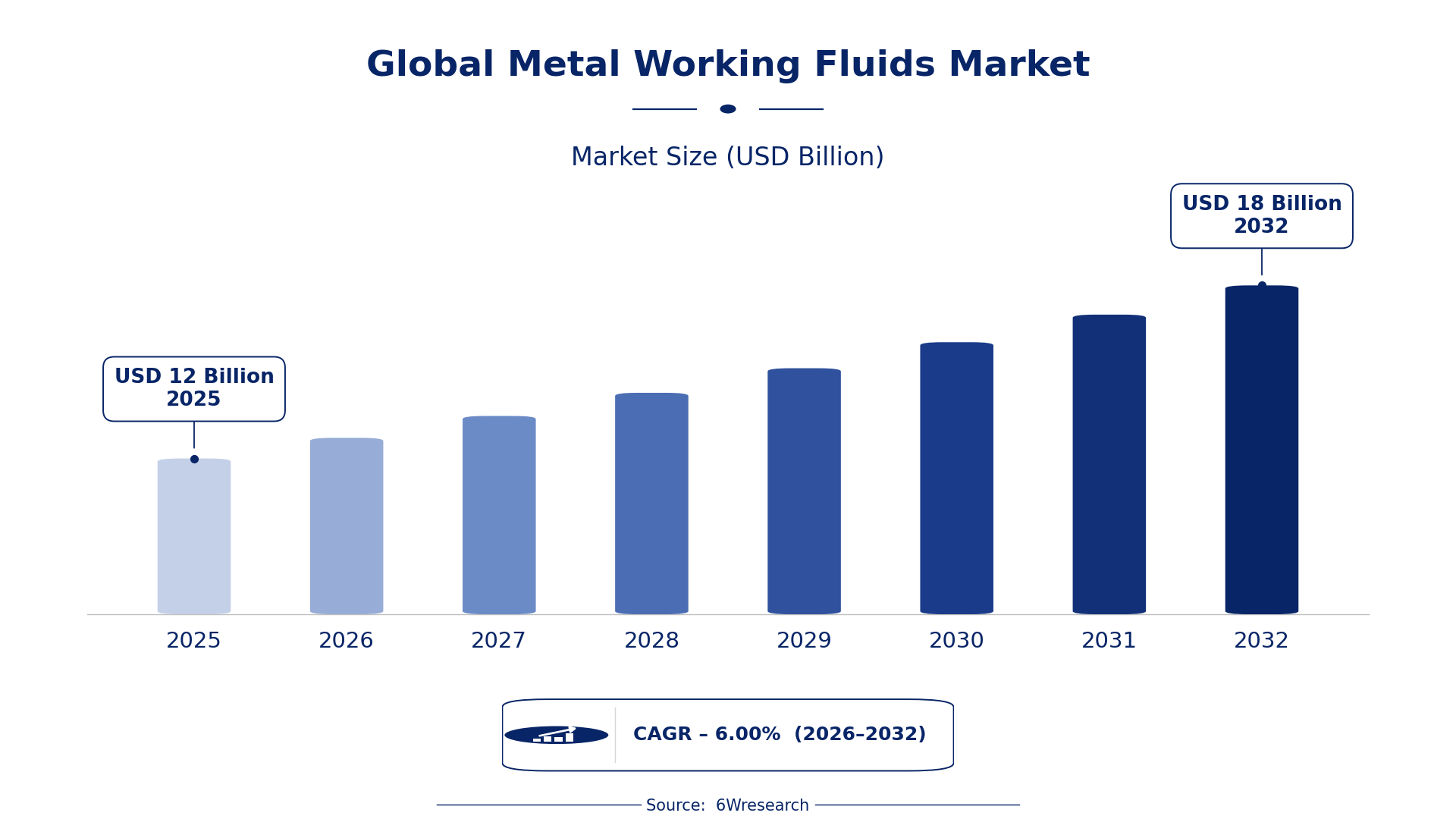
The Global Metal Working Fluids Market was estimated at USD 12 Billion in 2025 and is projected to reach USD 18 Billion by 2032, growing at a CAGR of 6.00% from 2026 to 2032.
Global Metal Working Fluids Market Synopsis
The Global Metal Working Fluids Market is undergoing transformative shifts largely driven by the increasing industrialization in regions like Asia-Pacific. Countries such as China and India are ramping up manufacturing activities, which significantly heightens the requirement for efficient cutting and machining processes. The move towards bio-based fluids highlights a growing concern for environmental impact, aligning industry practices with sustainability goals.
Additionally, this market holds strategic importance across various industries, including automotive and aerospace. The demand for high-performance metalworking fluids capable of enhancing tool life and machining efficiency is elevating competitive dynamics among key players. The differentiation between metalworking fluids and adjacent markets stems from their unique application processes and tailored formulations that cater specifically to precision manufacturing needs.
Global Metal Working Fluids Market Year-wise Growth Rate and Key Drivers
This graph illustrates the annual growth rates of the Global Metal Working Fluids Market from 2022 to 2032, highlighting a steady upward trajectory and projected expansion over the forecast period.
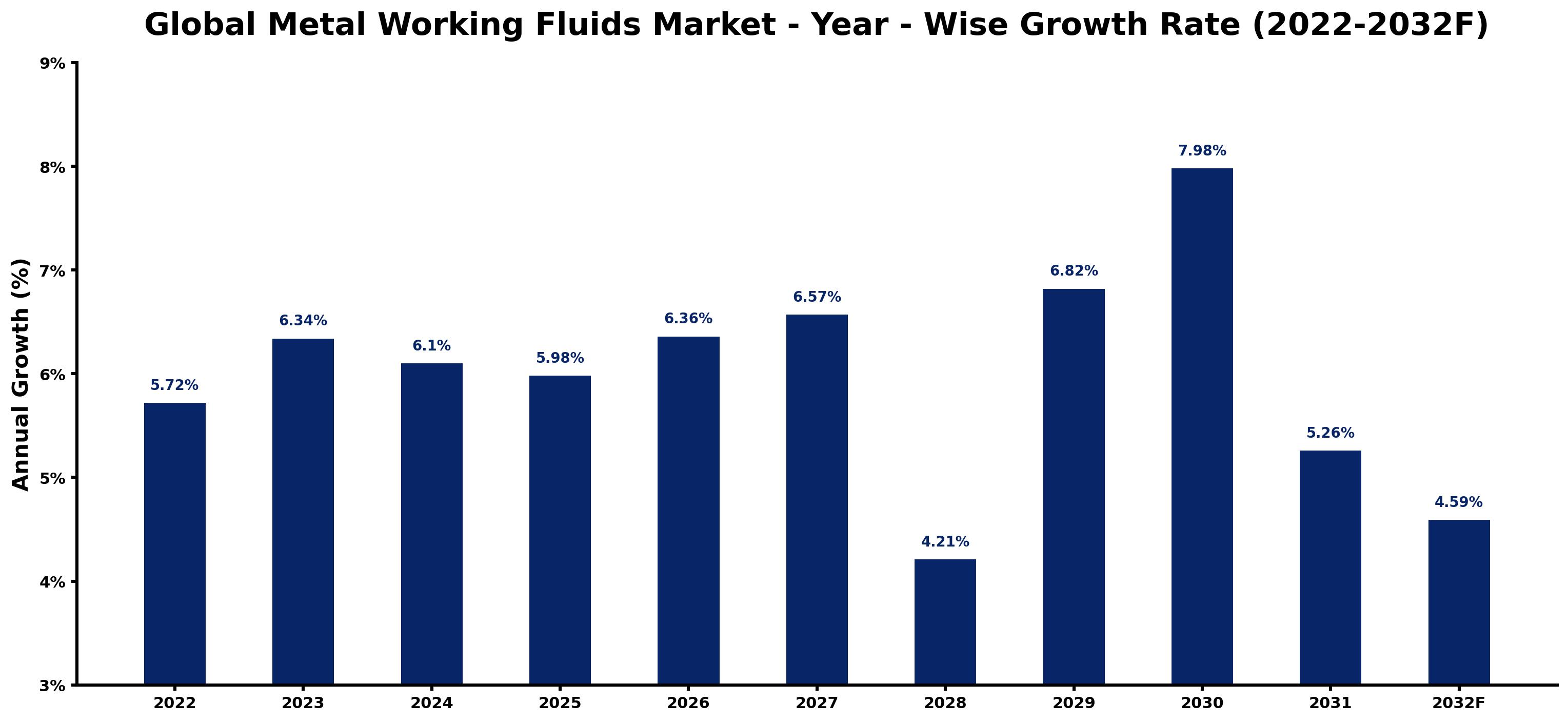
The table below presents the year‑wise growth rates along with the key drivers influencing the market
| Year | Growth Rate (%) | Major Drivers |
| 2022 | 5.72 | In North America, the demand for sustainable metal working fluids is increasing significantly. |
| 2023 | 6.34 | A competitive shift towards innovative formulations enhances the metal working fluids sector. |
| 2024 | 6.1 | Regulators are tightening compliance standards for metal working fluids, driving market adaptation. |
| 2025 | 5.98 | A shift toward stable petrochemical feedstocks changes the pricing dynamics of metal working fluids. |
| 2026 | 6.36 | Manufacturers are increasingly opting for bio-based metal working fluids to meet green requirements. |
| 2027 | 6.57 | While significant M&A activity consolidates the metal working fluids market, innovation remains vital. |
| 2028 | 4.21 | Advancements in additive manufacturing materials elevate the effectiveness of modern metal working fluids. |
| 2029 | 6.82 | Rising raw material costs compress margins, prompting efficiency improvements in metal working fluids. |
| 2030 | 7.98 | Automotive manufacturers are expanding the use of advanced metal working fluids in production lines. |
| 2031 | 5.26 | High-performance coatings in metal working fluids reflect shifting end-user preferences toward durability. |
| 2032 | 4.59 | Employing skilled labor in formulation development enhances the quality of metal working fluids. |
Note - Market size estimations and growth projections presented in this report are based on 6Wresearch's proprietary research methodology, combining internal industry data, secondary research, and primary validation, updated periodically to reflect current market conditions. As markets evolve rapidly, figures for certain industries may vary slightly and are intended as informed estimates rather than absolute figures. For the most current market sizing, we recommend validating figures with a 6Wresearch analyst.
Global Metal Working Fluids Market Key Takeaways
Below are some of the specific key takeaways from the market, including:
- Asia-Pacific is anticipated to maintain its leadership in market share, accounting for approximately 48% in 2025.
- Protection Fluids are expected to achieve a CAGR of 7.0% from 2026 to 2032, driven by their essential role in prolonging equipment lifespan.
- Chevron has reported increased investments in bio-based metalworking fluid development, positioning itself strategically within sustainability trends.
- The rise of Industry 4.0 technologies is influencing the adoption of high-performance fluids designed for precision applications.
- By 2030, the overall focus on environmentally-friendly formulations is expected to account for over 30% of product sales.
Evaluation of Restraints in Global Metal Working Fluids Market
The Global Metal Working Fluids Market faces considerable challenges due to stringent environmental regulations that govern the use of these products. For instance, the European Union's REACH (Registration, Evaluation, Authorisation and Restriction of Chemicals) regulation requires comprehensive testing and safety data for substances used, which can translate to significant compliance costs. Companies often face costs that can exceed USD 2 Million for full compliance with safety protocols and environmental documentation. A notable example is the impact of volatile raw material prices, which have increased by nearly 20% over the past two years due to supply chain disruptions, further complicating cost management and pricing strategies.
Global Metal Working Fluids Market Trends
Key trends shaping the Global Metal Working Fluids Market include the increasing adoption of eco-friendly formulations and advancements in automation technologies. A prominent player, Fuchs, has introduced high-performance water-based fluids that not only reduce toxicity but also enhance machining efficiency through improved lubrication properties. For example, the company's introduction of their new bio-based product line in 2021 was a direct response to regulatory pressures and customer demand for sustainable solutions. Additionally, the integration of AI and machine learning in manufacturing processes is streamlining fluid application methods, allowing for more precise lubrication in real-time, thus significantly boosting operational efficiency.
Global Metal Working Fluids Market Opportunities
The Global Metal Working Fluids Market presents lucrative opportunities particularly in sectors such as renewable energy and electric vehicle manufacturing. Companies like Quaker Chemical are strategically aligning their product development efforts to cater to the evolving needs of the battery manufacturing sector, anticipating a project growth trajectory of over 5.0% from 2026 to 2032. Furthermore, the escalated investments in defensive manufacturing by governments worldwide provide a favorable environment for producers of high-performance fluids suitable for precision aerospace applications. For example, projects aimed at enhancing military aircraft capabilities are anticipated to lead to increased demands for specialized metalworking fluids.
Global Metal Working Fluids Market by Type
In the Global Metal Working Fluids Market, Forming Fluids currently hold the largest market share at approximately 42% as of 2025, benefiting from their critical role in automotive manufacturing processes where metal shaping is essential. Conversely, Protection Fluids are regarded as the fastest-growing segment, with a projected CAGR of 7.0% from 2026 to 2032. Their ability to offer superior protection against corrosion and wear makes them increasingly favorable among manufacturers seeking to enhance the longevity of machinery and tools.
Global Metal Working Fluids Market by Region
Asia-Pacific is set to remain the largest region, commanding a market share estimated at around 48% in 2025, thanks to strong industrialization efforts, particularly in China and India. However, North America is anticipated to be the fastest-growing region, with a CAGR of 7.5% from 2026 to 2032. This growth can be attributed to robust automotive and aerospace sectors, demanding advanced and customized metalworking fluid solutions. The presence of significant manufacturing clusters further establishes North America as a strategic hub for metalworking fluid suppliers.
Government Initiatives in the Global Metal Working Fluids Market
The regulatory landscape for the Global Metal Working Fluids Market is becoming increasingly impactful, with government initiatives aimed at promoting sustainable practices and enhancing worker safety. These regulations are not only altering manufacturing methods but also influencing the adoption of environmentally friendly fluids. Below are some notable government actions:
- U.S. Environmental Protection Agency (EPA), Green Chemistry Program, initiated in 2019, encourages the development of safer, chemically efficient alternatives, benefiting manufacturers adopting new fluid technologies.
- European Chemicals Agency (ECHA), REACH Regulation, enacted in 2007, mandates detailed safety assessments for chemical substances, impacting the formulation of metalworking fluids.
- Ministry of Economy, Trade and Industry (METI) in Japan, established the Eco-Product Certification in 2020 to promote eco-friendly products in manufacturing, stimulating the development and sales of sustainable metalworking fluids.
- Government of India, National Policy on Chemicals, 2020, aims to encourage local production of cheaper, high-performance metalworking fluids, enhancing domestic capabilities.
Future Insights of the Global Metal Working Fluids Market
The Global Metal Working Fluids Market is expected to undergo significant structural changes by 2032. The shift towards sustainable and bio-based formulations will accelerate as companies like Chevron enhance their R&D efforts in eco-friendly solutions. Concurrently, advancements in automation technologies and IoT applications will reshape how fluids are applied, increasing efficiency and reducing waste. With substantial investments anticipated in high-precision manufacturing processes, particularly within the aerospace and automotive sectors, the competitive focus will shift towards developing specialized fluids that meet demanding operational standards.
Global Metal Working Fluids Market Latest Developments
A series of recent initiatives by leading companies are shaping the competitive landscape of the Global Metal Working Fluids Market.
- In Q2 2023, Houghton International announced the launch of a new line of biodegradable metalworking fluids, aligning with escalating regulatory demands and consumer preferences for sustainable products.
- Recently, Quaker Chemical revealed a strategic partnership with a leading electric vehicle manufacturer to co-develop specialized fluids aimed at battery production, underscoring its commitment to renewable energy sectors.
- ExxonMobil is expanding its product portfolio with the introduction of high-performance cutting fluids tailored for aerospace applications, set to be launched in H1 2024, which reinforces its strong market position.
- Fuchs recently completed the acquisition of a regional competitor in Europe, enhancing its distribution capabilities and market reach while augmenting its product offerings in the forming fluids segment.
Global Metal Working Fluids Market Key Players and Industry Positioning
The competitive structure of the Global Metal Working Fluids Market remains fragmented, with several key players holding substantial shares but facing increasing competition from new entrants and innovations. Leading companies are focusing on niche markets and sustainability, creating differentiated offerings that cater to specific sector needs.
| Leading Company | Core Strength | Strategic Focus |
|---|---|---|
| Chevron | Strong focus on R&D for eco-friendly fluids | Sustainable product development and regional expansion |
| Fuchs | Extensive product portfolio in diverse sectors | Acquisition strategy to boost market presence |
| Quaker Chemical | Expertise in customized solutions for strategic partnerships | Targeting renewable energy and electric vehicle sectors |
| ExxonMobil | Advanced technology and innovation in high-performance fluids | Sector-specific fluid solutions for aerospace and automotive |
| Houghton International | Strong emphasis on biodegradable product lines | Sustainability and compliance with environmental regulations |
The competitive atmosphere is evolving as companies adopt differentiated strategies to enhance their market positions, aligning product offerings with emerging industrial trends and consumer expectations.
Key Attractiveness of the Report
- 10 Years of Market Numbers
- Historical Data Starting from 2022 to 2025
- Base Year: 2025
- Forecast Data until 2032
- Key Performance Indicators Impacting the Market
- Major Upcoming Developments and Projects
Key Highlights of the Report:
- Global Metal Working Fluids Market Outlook
- Market Size of Global Metal Working Fluids Market, 2025
- Forecast of Global Metal Working Fluids Market, 2032
- Historical Data and Forecast of Global Metal Working Fluids Revenues & Volume for the Period 2022-2032
- Global Metal Working Fluids Market Trend Evolution
- Global Metal Working Fluids Market Drivers and Challenges
- Global Metal Working Fluids Price Trends
- Global Metal Working Fluids Porter's Five Forces
- Global Metal Working Fluids Industry Life Cycle
- Historical Data and Forecast of Global Metal Working Fluids Market Revenues & Volume
- Historical Data and Forecast of Global Metal Working Fluids Market Revenues & Volume By Type for the Period 2022-2032
- Historical Data and Forecast of Global Metal Working Fluids Market Revenues & Volume By Removal Fluids for the Period 2022-2032
- Historical Data and Forecast of Global Metal Working Fluids Market Revenues & Volume By Forming Fluids for the Period 2022-2032
- Historical Data and Forecast of Global Metal Working Fluids Market Revenues & Volume By Protection Fluids for the Period 2022-2032
- Historical Data and Forecast of Global Metal Working Fluids Market Revenues & Volume By Treating Fluids for the Period 2022-2032
- Historical Data and Forecast of North America Metal Working Fluids Market Revenues & Volume By Type for the Period 2022-2032
- Historical Data and Forecast of North America Metal Working Fluids Market Revenues & Volume By Removal Fluids for the Period 2022-2032
- Historical Data and Forecast of North America Metal Working Fluids Market Revenues & Volume By Forming Fluids for the Period 2022-2032
- Historical Data and Forecast of North America Metal Working Fluids Market Revenues & Volume By Protection Fluids for the Period 2022-2032
- Historical Data and Forecast of North America Metal Working Fluids Market Revenues & Volume By Treating Fluids for the Period 2022-2032
- Historical Data and Forecast of United States of America Metal Working Fluids Market Revenues & Volume for the Period 2022-2032
- Historical Data and Forecast of Canada Metal Working Fluids Market Revenues & Volume for the Period 2022-2032
- Historical Data and Forecast of Rest of North America Metal Working Fluids Market Revenues & Volume for the Period 2022-2032
- Historical Data and Forecast of Latin America (LATAM) Metal Working Fluids Market Revenues & Volume By Type for the Period 2022-2032
- Historical Data and Forecast of Latin America (LATAM) Metal Working Fluids Market Revenues & Volume By Removal Fluids for the Period 2022-2032
- Historical Data and Forecast of Latin America (LATAM) Metal Working Fluids Market Revenues & Volume By Forming Fluids for the Period 2022-2032
- Historical Data and Forecast of Latin America (LATAM) Metal Working Fluids Market Revenues & Volume By Protection Fluids for the Period 2022-2032
- Historical Data and Forecast of Latin America (LATAM) Metal Working Fluids Market Revenues & Volume By Treating Fluids for the Period 2022-2032
- Historical Data and Forecast of Brazil Metal Working Fluids Market Revenues & Volume for the Period 2022-2032
- Historical Data and Forecast of Mexico Metal Working Fluids Market Revenues & Volume for the Period 2022-2032
- Historical Data and Forecast of Argentina Metal Working Fluids Market Revenues & Volume for the Period 2022-2032
- Historical Data and Forecast of Rest of LATAM Metal Working Fluids Market Revenues & Volume for the Period 2022-2032
- Historical Data and Forecast of Asia Metal Working Fluids Market Revenues & Volume By Type for the Period 2022-2032
- Historical Data and Forecast of Asia Metal Working Fluids Market Revenues & Volume By Removal Fluids for the Period 2022-2032
- Historical Data and Forecast of Asia Metal Working Fluids Market Revenues & Volume By Forming Fluids for the Period 2022-2032
- Historical Data and Forecast of Asia Metal Working Fluids Market Revenues & Volume By Protection Fluids for the Period 2022-2032
- Historical Data and Forecast of Asia Metal Working Fluids Market Revenues & Volume By Treating Fluids for the Period 2022-2032
- Historical Data and Forecast of China Metal Working Fluids Market Revenues & Volume for the Period 2022-2032
- Historical Data and Forecast of India Metal Working Fluids Market Revenues & Volume for the Period 2022-2032
- Historical Data and Forecast of Japan Metal Working Fluids Market Revenues & Volume for the Period 2022-2032
- Historical Data and Forecast of Rest of Asia Metal Working Fluids Market Revenues & Volume for the Period 2022-2032
- Historical Data and Forecast of Africa Metal Working Fluids Market Revenues & Volume By Type for the Period 2022-2032
- Historical Data and Forecast of Africa Metal Working Fluids Market Revenues & Volume By Removal Fluids for the Period 2022-2032
- Historical Data and Forecast of Africa Metal Working Fluids Market Revenues & Volume By Forming Fluids for the Period 2022-2032
- Historical Data and Forecast of Africa Metal Working Fluids Market Revenues & Volume By Protection Fluids for the Period 2022-2032
- Historical Data and Forecast of Africa Metal Working Fluids Market Revenues & Volume By Treating Fluids for the Period 2022-2032
- Historical Data and Forecast of South Africa Metal Working Fluids Market Revenues & Volume for the Period 2022-2032
- Historical Data and Forecast of Nigeria Metal Working Fluids Market Revenues & Volume for the Period 2022-2032
- Historical Data and Forecast of Egypt Metal Working Fluids Market Revenues & Volume for the Period 2022-2032
- Historical Data and Forecast of Rest of Africa Metal Working Fluids Market Revenues & Volume for the Period 2022-2032
- Historical Data and Forecast of Europe Metal Working Fluids Market Revenues & Volume By Type for the Period 2022-2032
- Historical Data and Forecast of Europe Metal Working Fluids Market Revenues & Volume By Removal Fluids for the Period 2022-2032
- Historical Data and Forecast of Europe Metal Working Fluids Market Revenues & Volume By Forming Fluids for the Period 2022-2032
- Historical Data and Forecast of Europe Metal Working Fluids Market Revenues & Volume By Protection Fluids for the Period 2022-2032
- Historical Data and Forecast of Europe Metal Working Fluids Market Revenues & Volume By Treating Fluids for the Period 2022-2032
- Historical Data and Forecast of United Kingdom Metal Working Fluids Market Revenues & Volume for the Period 2022-2032
- Historical Data and Forecast of France Metal Working Fluids Market Revenues & Volume for the Period 2022-2032
- Historical Data and Forecast of Germany Metal Working Fluids Market Revenues & Volume for the Period 2022-2032
- Historical Data and Forecast of Rest of Europe Metal Working Fluids Market Revenues & Volume for the Period 2022-2032
- Historical Data and Forecast of Middle East Metal Working Fluids Market Revenues & Volume By Type for the Period 2022-2032
- Historical Data and Forecast of Middle East Metal Working Fluids Market Revenues & Volume By Removal Fluids for the Period 2022-2032
- Historical Data and Forecast of Middle East Metal Working Fluids Market Revenues & Volume By Forming Fluids for the Period 2022-2032
- Historical Data and Forecast of Middle East Metal Working Fluids Market Revenues & Volume By Protection Fluids for the Period 2022-2032
- Historical Data and Forecast of Middle East Metal Working Fluids Market Revenues & Volume By Treating Fluids for the Period 2022-2032
- Historical Data and Forecast of Saudi Arabia Metal Working Fluids Market Revenues & Volume for the Period 2022-2032
- Historical Data and Forecast of UAE Metal Working Fluids Market Revenues & Volume for the Period 2022-2032
- Historical Data and Forecast of Turkey Metal Working Fluids Market Revenues & Volume for the Period 2022-2032
- Historical Data and Forecast of Rest of Middle East Metal Working Fluids Market Revenues & Volume for the Period 2022-2032
- Global Metal Working Fluids Market - Key Performance Indicators
- Global Metal Working Fluids Market - Import Export Trade Statistics
- Global Metal Working Fluids Market - Opportunity Assessment By Countries
- Global Metal Working Fluids Market - Opportunity Assessment By Type
- 0
- Global Metal Working Fluids Market - Top Companies Market Share
- Global Metal Working Fluids Market - Top Companies Profiles
- Global Metal Working Fluids Market - Comparison of Players in Technical and Operating Parameters
- Global Metal Working Fluids Market - Strategic Recommendations
Markets Covered
The Global Metal Working Fluids Market report provides a detailed analysis of the following market segments:
By Regions and Countries:
- North America
- Europe
- LATAM
- Middle East
- Asia
- Africa
By Type:
- Removal Fluids
- Forming Fluids
- Protection Fluids
- Treating Fluids






































