Global Musical Instruments Market Highlights
| Market Size (2025) | USD 16 Billion |
| Forecast Size (2032) | USD 22 Billion |
| CAGR | 4.70% |
| Base Year | 2025 |
| Forecast Period | 2026-2032 |
| Largest Region | North America |
| Fastest Growing Region | Asia |
| Largest Segment | String Instruments |
| Fastest Growing Segment | Piano & Key Instruments |
| Leading Companies | Yamaha, Fender, Gibson, Roland, Steinway & Sons |
Global Musical Instruments Market Size & Growth Rate (2026-2032)
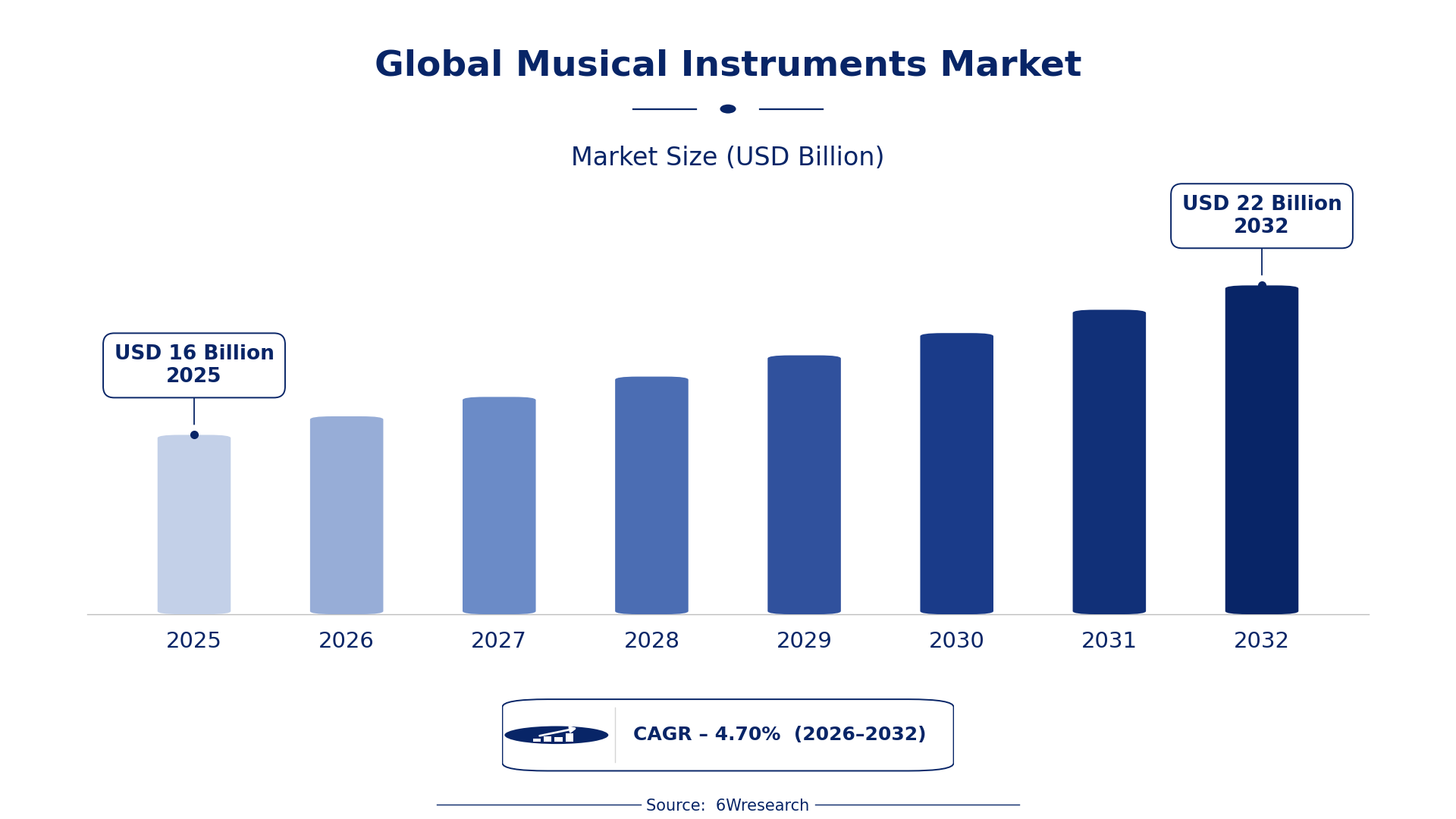
The Global Musical Instruments Market was estimated at USD 16 Billion in 2025 and is projected to reach USD 22 Billion by 2032, growing at a CAGR of 4.70% from 2026 to 2032.
Global Musical Instruments Market Synopsis
The Global Musical Instruments Market is undergoing notable transformation as the convergence of technology and consumer preferences shifts the landscape. The burgeoning interest in music education, especially among the youth, combined with digitization, is reshaping the competitive dynamics of this market. This evolving demand is prompting manufacturers to innovate and adapt their product offerings, positioning themselves for future growth.
Furthermore, the growing trend of online music learning platforms is generating new revenue streams and altering traditional purchasing behaviors. Consumers are now more inclined to invest in digital instruments with sophisticated features, reflecting a desire for convenience and personalization. This trend not only influences product development but also redefines the role and scope of players within the industry.
Global Musical Instruments Market Year-wise Growth Rate and Key Drivers
This graph illustrates the annual growth rates of the Global Musical Instruments Market from 2022 to 2032, highlighting a steady upward trajectory and projected expansion over the forecast period.
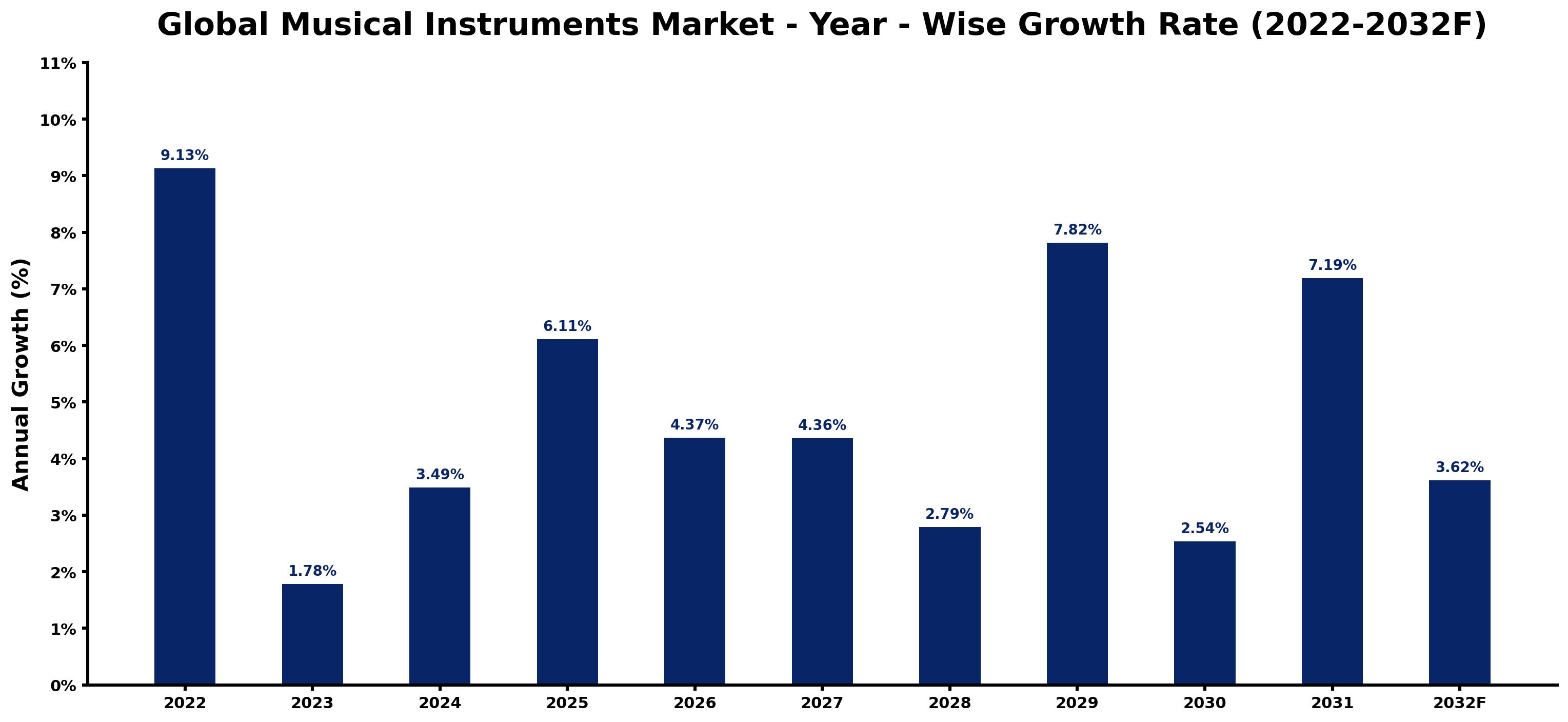
The table below presents the year‑wise growth rates along with the key drivers influencing the market
| Year | Growth Rate (%) | Major Drivers |
| 2022 | 9.13 | As skilled musicians adapt to digital production, musical instrument sales experience a growth surge. |
| 2023 | 1.78 | Sustainability in manufacturing processes impacts the musical instruments sector positively. |
| 2024 | 3.49 | Musicians increasingly prefer innovative digital instruments, changing the competitive landscape significantly. |
| 2025 | 6.11 | From the Americas, musical instrument exports show significant regional expansion to emerging markets. |
| 2026 | 4.37 | The rise in DIY music production fuels demand for affordable musical instruments among consumers. |
| 2027 | 4.36 | A shift toward stricter environmental regulations influences the production methods of musical instruments. |
| 2028 | 2.79 | Investing in new musical instrument startups enhances market capacity and product diversity. |
| 2029 | 7.82 | Rising costs of raw materials for musical instruments drive innovation in sustainable manufacturing methods. |
| 2030 | 2.54 | Manufacturers adapt to evolving supply chain challenges to ensure timely delivery of instruments. |
| 2031 | 7.19 | Online retail platforms increasingly cater to consumers seeking unique musical instrument options. |
| 2032 | 3.62 | Smart musical instruments equipped with advanced technology redefine user experience and engagement. |
Note - Market size estimations and growth projections presented in this report are based on 6Wresearch's proprietary research methodology, combining internal industry data, secondary research, and primary validation, updated periodically to reflect current market conditions. As markets evolve rapidly, figures for certain industries may vary slightly and are intended as informed estimates rather than absolute figures. For the most current market sizing, we recommend validating figures with a 6Wresearch analyst.
Global Musical Instruments Market Key Takeaways
Below are some of the specific key takeaways from the market, including:
- Yamaha Corporation leads the market, contributing approximately 20% of total revenues as of 2025.
- Piano & Key Instruments are forecasted to grow at a distinct CAGR of 5.8% from 2026 to 2032, driven by innovative new products.
- The North American region holds a dominant market share of roughly 48% as of 2025, supported by a robust distribution network.
- Fender recently launched a line of customizable electric guitars in 2023, correlating with the rising trend toward personalization.
- A notable increase of 12% in participation in music education programs across various demographics was recorded from 2021 to 2023.
Evaluation of Restraints in Global Musical Instruments Market
The Global Musical Instruments Market faces various constraints affecting its capacity for growth. High manufacturing costs, particularly for premium string and electronic instruments, can create a barrier to entry for new firms, limiting competition. For instance, the cost of premium-toned woods has risen significantly, with some materials experiencing increases of up to 25% over the last two years due to supply chain disruptions. Additionally, the presence of counterfeit instruments poses significant threats to brand reputation and sales, particularly in developing markets where oversight may be lacking. This complicates consumer trust and can stifle innovation among established producers.
Global Musical Instruments Market Trends
Several key trends are shaping the Global Musical Instruments Market currently. One significant shift is the adoption of digital instruments, like electronic keyboards and software-based applications, as traditional consumers evolve towards tech-integrated solutions. For example, Roland's development of their Jupiter-X series synthesizers, released in 2020, has incorporated advanced sampling technology, attracting both amateur and professional musicians. Another emerging trend is the increase in customization options, where brands like Fender offer bespoke features allowing consumers to design their own instruments, catering to individual preferences. This trend is anticipated to expand, tapping into the growing consumer desire for personal expression through music. Lastly, sustainability in production practices is gaining momentum, as companies begin to adopt eco-friendly materials and manufacturing processes, addressing environmental concerns and attracting environmentally conscious consumers.
Global Musical Instruments Market Opportunities
There are numerous avenues for revenue generation in the Global Musical Instruments Market looking ahead. The surge in interest in music education by schools and institutions presents a significant growth opportunity for instrument makers to penetrate educational markets, particularly in regions with increasing disposable incomes. For example, Yamaha has initiated a program targeting schools in developing countries, with a goal to increase accessibility to instruments by 40% by 2025. The potential for smart musical instruments, which sync with mobile apps for learning and performance enhancement, is another area ripe for exploitation. This sector is projected to generate upwards of USD 2 billion by 2030. Companies that focus on integrating technology, along with musical experiences, stand to capture a substantial share of the evolving market.
Global Musical Instruments Market by Type
String Instruments currently lead the Global Musical Instruments Market, accounting for approximately ~42% share in 2025. Their extensive applications in various music genres, coupled with strong demand from educational institutions, reinforce their market leadership. Meanwhile, the fastest-growing segment is projected to be Piano & Key Instruments, with a robust CAGR of 5.5% from 2026 to 2032. This growth can be attributed to the resurgence of interest in piano playing, fostered by popular online learning platforms and the increasing trend toward music therapy, appealing to a diverse demographic.
Global Musical Instruments Market by End-users
Among end-users, the Commercial Events segment is anticipated to dominate the Global Musical Instruments Market, commanding around ~39% share in 2025. The growing prevalence of live music events and festivals is driving demand in this area. On the other hand, the fastest-growing segment is Music Production/Direction, expected to witness a CAGR of 6.2% from 2026 to 2032. This increase can be linked to the expansion of home studios and the democratization of music production software, allowing more individuals to engage in music creation than ever before.
Global Musical Instruments Market by Region
North America is projected to maintain its leadership in the Global Musical Instruments Market, holding an approximate ~48% share as of 2025, fueled by established manufacturing bases and a high concentration of music consumers. Conversely, the Asia region is anticipated to be the fastest-growing, with a CAGR of 6.1% from 2026 to 2032, spurred by rising disposable incomes and investments in music education, particularly in countries like China and India where cultural shifts are increasingly favoring music participation.
Government Initiatives in the Global Musical Instruments Market
Governmental actions and initiatives play a pivotal role in shaping the regulatory landscape of the Global Musical Instruments Market. Recent programs have aimed at enhancing music education, promoting accessibility, and supporting domestic manufacturing, which collectively foster a healthier market environment.
- The U.S. Department of Education launched the "Arts in Education" program in 2022, providing grants aimed at boosting music programs in public schools, ultimately increasing instrument accessibility for students.
- The European Commission initiated "Creative Europe" in 2021, a program allocating €2.5 billion to support cultural and creative industries, including funding for musical instruments manufacturing and music education initiatives, benefiting local artisans and brands alike.
- In 2023, the Indian Ministry of Culture announced a plan to invest USD 500 million in music education infrastructure, expected to enhance the production of local musical instruments and train a new generation of musicians.
- A planned initiative by the Canadian government to introduce a "National Musical Heritage Fund" aims to establish financial support mechanisms for traditional music makers and artisans throughout the country, set to be launched by 2024.
Future Insights of the Global Musical Instruments Market
As the Global Musical Instruments Market approaches 2032, we anticipate a surge in smart instrument adoption, driven by technological advancements. Notably, Yamaha's introduction of adaptive learning features in its instruments is expected to redefine engagement, particularly among younger players. This shift towards incorporating artificial intelligence in musical instruments will not only enhance user experience but also create new opportunities for gamified learning and collaboration. Furthermore, the continued investment in sustainable manufacturing practices will align with evolving consumer values, fostering loyalty and market differentiation.
Global Musical Instruments Market Latest Developments
Several significant developments are shaping the Global Musical Instruments Market, reflecting the industry's response to emerging consumer trends and technological advancements.
- In early 2023, Fender launched its latest range of electrics equipped with cloud-based tuning features, enhancing playability for users and promoting competitive positioning in the digital segment.
- Roland recently revealed plans for a new synthesizer series, expected to debut in late 2024, featuring enhanced connectivity for integration with modern audio software, appealing to both amateur and professional musicians.
- Steinway & Sons announced an expansion of its handcrafted production facility in New York, aimed at increasing output by 15% by 2025 while maintaining artisanal quality, enhancing their market stature.
- Yamaha is currently piloting an initiative to introduce music education programs in schools across India, which is set to roll out by mid-2024, aimed at increasing instrument accessibility among youth.
Global Musical Instruments Market Key Players and Industry Positioning
The competitive landscape of the Global Musical Instruments Market is moderately consolidated, with a few key players dominating the space while increasingly innovative startups are carving out niches. Established brands leverage their long-standing reputation and manufacturing prowess to maintain an edge, while emerging companies focus on unique features and digital integration to attract new consumers.
| Leading Company | Core Strength | Strategic Focus |
|---|---|---|
| Yamaha | Broad product range with strong brand recognition. | Focus on technology integration in instruments. |
| Fender | Iconic brand in electric guitars with a dedicated following. | Customization and digital enhancement of instruments. |
| Gibson | Premium quality acoustic and electric guitars. | Emphasis on craftsmanship and vintage appeal. |
| Roland | Leader in electronic musical instruments with innovation. | Development of smart technologies in music. |
| Steinway & Sons | Renowned for high-end pianos with artisan craftsmanship. | Maintaining tradition while exploring new designs. |
Continuous innovation and a focus on consumer experience are steering growth among leading companies, ensuring their relevance in a rapidly changing market.
Key Attractiveness of the Report
- 10 Years of Market Numbers
- Historical Data Starting from 2022 to 2025
- Base Year: 2025
- Forecast Data until 2032
- Key Performance Indicators Impacting the Market
- Major Upcoming Developments and Projects
Key Highlights of the Report:
- Global Musical Instruments Market Outlook
- Market Size of Global Musical Instruments Market, 2025
- Forecast of Global Musical Instruments Market, 2032
- Historical Data and Forecast of Global Musical Instruments Revenues & Volume for the Period 2022-2032
- Global Musical Instruments Market Trend Evolution
- Global Musical Instruments Market Drivers and Challenges
- Global Musical Instruments Price Trends
- Global Musical Instruments Porter's Five Forces
- Global Musical Instruments Industry Life Cycle
- Historical Data and Forecast of Global Musical Instruments Market Revenues & Volume
- Historical Data and Forecast of Global Musical Instruments Market Revenues & Volume By Type for the Period 2022-2032
- Historical Data and Forecast of Global Musical Instruments Market Revenues & Volume By Percussion Instruments for the Period 2022-2032
- Historical Data and Forecast of Global Musical Instruments Market Revenues & Volume By String Instruments for the Period 2022-2032
- Historical Data and Forecast of Global Musical Instruments Market Revenues & Volume By Piano & Key Instruments for the Period 2022-2032
- Historical Data and Forecast of Global Musical Instruments Market Revenues & Volume By Organs & Air Blown Instruments for the Period 2022-2032
- Historical Data and Forecast of Global Musical Instruments Market Revenues & Volume By Others for the Period 2022-2032
- Historical Data and Forecast of Global Musical Instruments Market Revenues & Volume By End-users for the Period 2022-2032
- Historical Data and Forecast of Global Musical Instruments Market Revenues & Volume By Commercial Events for the Period 2022-2032
- Historical Data and Forecast of Global Musical Instruments Market Revenues & Volume By Personal Use for the Period 2022-2032
- Historical Data and Forecast of Global Musical Instruments Market Revenues & Volume By Music Production/ Direction for the Period 2022-2032
- Historical Data and Forecast of Global Musical Instruments Market Revenues & Volume By Others for the Period 2022-2032
- Historical Data and Forecast of North America Musical Instruments Market Revenues & Volume By Type for the Period 2022-2032
- Historical Data and Forecast of North America Musical Instruments Market Revenues & Volume By Percussion Instruments for the Period 2022-2032
- Historical Data and Forecast of North America Musical Instruments Market Revenues & Volume By String Instruments for the Period 2022-2032
- Historical Data and Forecast of North America Musical Instruments Market Revenues & Volume By Piano & Key Instruments for the Period 2022-2032
- Historical Data and Forecast of North America Musical Instruments Market Revenues & Volume By Organs & Air Blown Instruments for the Period 2022-2032
- Historical Data and Forecast of North America Musical Instruments Market Revenues & Volume By Others for the Period 2022-2032
- Historical Data and Forecast of North America Musical Instruments Market Revenues & Volume By End-users for the Period 2022-2032
- Historical Data and Forecast of North America Musical Instruments Market Revenues & Volume By Commercial Events for the Period 2022-2032
- Historical Data and Forecast of North America Musical Instruments Market Revenues & Volume By Personal Use for the Period 2022-2032
- Historical Data and Forecast of North America Musical Instruments Market Revenues & Volume By Music Production/ Direction for the Period 2022-2032
- Historical Data and Forecast of North America Musical Instruments Market Revenues & Volume By Others for the Period 2022-2032
- Historical Data and Forecast of United States of America Musical Instruments Market Revenues & Volume for the Period 2022-2032
- Historical Data and Forecast of Canada Musical Instruments Market Revenues & Volume for the Period 2022-2032
- Historical Data and Forecast of Rest of North America Musical Instruments Market Revenues & Volume for the Period 2022-2032
- Historical Data and Forecast of Latin America (LATAM) Musical Instruments Market Revenues & Volume By Type for the Period 2022-2032
- Historical Data and Forecast of Latin America (LATAM) Musical Instruments Market Revenues & Volume By Percussion Instruments for the Period 2022-2032
- Historical Data and Forecast of Latin America (LATAM) Musical Instruments Market Revenues & Volume By String Instruments for the Period 2022-2032
- Historical Data and Forecast of Latin America (LATAM) Musical Instruments Market Revenues & Volume By Piano & Key Instruments for the Period 2022-2032
- Historical Data and Forecast of Latin America (LATAM) Musical Instruments Market Revenues & Volume By Organs & Air Blown Instruments for the Period 2022-2032
- Historical Data and Forecast of Latin America (LATAM) Musical Instruments Market Revenues & Volume By Others for the Period 2022-2032
- Historical Data and Forecast of Latin America (LATAM) Musical Instruments Market Revenues & Volume By End-users for the Period 2022-2032
- Historical Data and Forecast of Latin America (LATAM) Musical Instruments Market Revenues & Volume By Commercial Events for the Period 2022-2032
- Historical Data and Forecast of Latin America (LATAM) Musical Instruments Market Revenues & Volume By Personal Use for the Period 2022-2032
- Historical Data and Forecast of Latin America (LATAM) Musical Instruments Market Revenues & Volume By Music Production/ Direction for the Period 2022-2032
- Historical Data and Forecast of Latin America (LATAM) Musical Instruments Market Revenues & Volume By Others for the Period 2022-2032
- Historical Data and Forecast of Brazil Musical Instruments Market Revenues & Volume for the Period 2022-2032
- Historical Data and Forecast of Mexico Musical Instruments Market Revenues & Volume for the Period 2022-2032
- Historical Data and Forecast of Argentina Musical Instruments Market Revenues & Volume for the Period 2022-2032
- Historical Data and Forecast of Rest of LATAM Musical Instruments Market Revenues & Volume for the Period 2022-2032
- Historical Data and Forecast of Asia Musical Instruments Market Revenues & Volume By Type for the Period 2022-2032
- Historical Data and Forecast of Asia Musical Instruments Market Revenues & Volume By Percussion Instruments for the Period 2022-2032
- Historical Data and Forecast of Asia Musical Instruments Market Revenues & Volume By String Instruments for the Period 2022-2032
- Historical Data and Forecast of Asia Musical Instruments Market Revenues & Volume By Piano & Key Instruments for the Period 2022-2032
- Historical Data and Forecast of Asia Musical Instruments Market Revenues & Volume By Organs & Air Blown Instruments for the Period 2022-2032
- Historical Data and Forecast of Asia Musical Instruments Market Revenues & Volume By Others for the Period 2022-2032
- Historical Data and Forecast of Asia Musical Instruments Market Revenues & Volume By End-users for the Period 2022-2032
- Historical Data and Forecast of Asia Musical Instruments Market Revenues & Volume By Commercial Events for the Period 2022-2032
- Historical Data and Forecast of Asia Musical Instruments Market Revenues & Volume By Personal Use for the Period 2022-2032
- Historical Data and Forecast of Asia Musical Instruments Market Revenues & Volume By Music Production/ Direction for the Period 2022-2032
- Historical Data and Forecast of Asia Musical Instruments Market Revenues & Volume By Others for the Period 2022-2032
- Historical Data and Forecast of China Musical Instruments Market Revenues & Volume for the Period 2022-2032
- Historical Data and Forecast of India Musical Instruments Market Revenues & Volume for the Period 2022-2032
- Historical Data and Forecast of Japan Musical Instruments Market Revenues & Volume for the Period 2022-2032
- Historical Data and Forecast of Rest of Asia Musical Instruments Market Revenues & Volume for the Period 2022-2032
- Historical Data and Forecast of Africa Musical Instruments Market Revenues & Volume By Type for the Period 2022-2032
- Historical Data and Forecast of Africa Musical Instruments Market Revenues & Volume By Percussion Instruments for the Period 2022-2032
- Historical Data and Forecast of Africa Musical Instruments Market Revenues & Volume By String Instruments for the Period 2022-2032
- Historical Data and Forecast of Africa Musical Instruments Market Revenues & Volume By Piano & Key Instruments for the Period 2022-2032
- Historical Data and Forecast of Africa Musical Instruments Market Revenues & Volume By Organs & Air Blown Instruments for the Period 2022-2032
- Historical Data and Forecast of Africa Musical Instruments Market Revenues & Volume By Others for the Period 2022-2032
- Historical Data and Forecast of Africa Musical Instruments Market Revenues & Volume By End-users for the Period 2022-2032
- Historical Data and Forecast of Africa Musical Instruments Market Revenues & Volume By Commercial Events for the Period 2022-2032
- Historical Data and Forecast of Africa Musical Instruments Market Revenues & Volume By Personal Use for the Period 2022-2032
- Historical Data and Forecast of Africa Musical Instruments Market Revenues & Volume By Music Production/ Direction for the Period 2022-2032
- Historical Data and Forecast of Africa Musical Instruments Market Revenues & Volume By Others for the Period 2022-2032
- Historical Data and Forecast of South Africa Musical Instruments Market Revenues & Volume for the Period 2022-2032
- Historical Data and Forecast of Nigeria Musical Instruments Market Revenues & Volume for the Period 2022-2032
- Historical Data and Forecast of Egypt Musical Instruments Market Revenues & Volume for the Period 2022-2032
- Historical Data and Forecast of Rest of Africa Musical Instruments Market Revenues & Volume for the Period 2022-2032
- Historical Data and Forecast of Europe Musical Instruments Market Revenues & Volume By Type for the Period 2022-2032
- Historical Data and Forecast of Europe Musical Instruments Market Revenues & Volume By Percussion Instruments for the Period 2022-2032
- Historical Data and Forecast of Europe Musical Instruments Market Revenues & Volume By String Instruments for the Period 2022-2032
- Historical Data and Forecast of Europe Musical Instruments Market Revenues & Volume By Piano & Key Instruments for the Period 2022-2032
- Historical Data and Forecast of Europe Musical Instruments Market Revenues & Volume By Organs & Air Blown Instruments for the Period 2022-2032
- Historical Data and Forecast of Europe Musical Instruments Market Revenues & Volume By Others for the Period 2022-2032
- Historical Data and Forecast of Europe Musical Instruments Market Revenues & Volume By End-users for the Period 2022-2032
- Historical Data and Forecast of Europe Musical Instruments Market Revenues & Volume By Commercial Events for the Period 2022-2032
- Historical Data and Forecast of Europe Musical Instruments Market Revenues & Volume By Personal Use for the Period 2022-2032
- Historical Data and Forecast of Europe Musical Instruments Market Revenues & Volume By Music Production/ Direction for the Period 2022-2032
- Historical Data and Forecast of Europe Musical Instruments Market Revenues & Volume By Others for the Period 2022-2032
- Historical Data and Forecast of United Kingdom Musical Instruments Market Revenues & Volume for the Period 2022-2032
- Historical Data and Forecast of France Musical Instruments Market Revenues & Volume for the Period 2022-2032
- Historical Data and Forecast of Germany Musical Instruments Market Revenues & Volume for the Period 2022-2032
- Historical Data and Forecast of Rest of Europe Musical Instruments Market Revenues & Volume for the Period 2022-2032
- Historical Data and Forecast of Middle East Musical Instruments Market Revenues & Volume By Type for the Period 2022-2032
- Historical Data and Forecast of Middle East Musical Instruments Market Revenues & Volume By Percussion Instruments for the Period 2022-2032
- Historical Data and Forecast of Middle East Musical Instruments Market Revenues & Volume By String Instruments for the Period 2022-2032
- Historical Data and Forecast of Middle East Musical Instruments Market Revenues & Volume By Piano & Key Instruments for the Period 2022-2032
- Historical Data and Forecast of Middle East Musical Instruments Market Revenues & Volume By Organs & Air Blown Instruments for the Period 2022-2032
- Historical Data and Forecast of Middle East Musical Instruments Market Revenues & Volume By Others for the Period 2022-2032
- Historical Data and Forecast of Middle East Musical Instruments Market Revenues & Volume By End-users for the Period 2022-2032
- Historical Data and Forecast of Middle East Musical Instruments Market Revenues & Volume By Commercial Events for the Period 2022-2032
- Historical Data and Forecast of Middle East Musical Instruments Market Revenues & Volume By Personal Use for the Period 2022-2032
- Historical Data and Forecast of Middle East Musical Instruments Market Revenues & Volume By Music Production/ Direction for the Period 2022-2032
- Historical Data and Forecast of Middle East Musical Instruments Market Revenues & Volume By Others for the Period 2022-2032
- Historical Data and Forecast of Saudi Arabia Musical Instruments Market Revenues & Volume for the Period 2022-2032
- Historical Data and Forecast of UAE Musical Instruments Market Revenues & Volume for the Period 2022-2032
- Historical Data and Forecast of Turkey Musical Instruments Market Revenues & Volume for the Period 2022-2032
- Historical Data and Forecast of Rest of Middle East Musical Instruments Market Revenues & Volume for the Period 2022-2032
- Global Musical Instruments Market - Key Performance Indicators
- Global Musical Instruments Market - Import Export Trade Statistics
- Global Musical Instruments Market - Opportunity Assessment By Countries
- Global Musical Instruments Market - Opportunity Assessment By Type
- Global Musical Instruments Market - Opportunity Assessment By End-users
- Global Musical Instruments Market - Top Companies Market Share
- Global Musical Instruments Market - Top Companies Profiles
- Global Musical Instruments Market - Comparison of Players in Technical and Operating Parameters
- Global Musical Instruments Market - Strategic Recommendations
Markets Covered
The Global Musical Instruments Market report provides a detailed analysis of the following market segments:
By Regions and Countries:
- North America
- Europe
- LATAM
- Middle East
- Asia
- Africa
By Type:
- Percussion Instruments
- String Instruments
- Piano & Key Instruments
- Organs & Air Blown Instruments
- Others
By End-users:
- Commercial Events
- Personal Use
- Music Production/ Direction
- Others






































