Global Noodles & Pasta Market Highlights
| Market Size (2025) | USD 70 Billion |
| Forecast Size (2032) | USD 94 Billion |
| CAGR | 4.30% |
| Base Year | 2025 |
| Forecast Period | 2026-2032 |
| Largest Region | Asia-Pacific |
| Fastest Growing Region | North America |
| Largest Segment | Instant Noodles |
| Fastest Growing Segment | Gluten-free Pasta |
| Leading Companies | Nissin Foods, Nestlé, Kraft Heinz, Barilla, and Unilever |
Global Noodles & Pasta Market Size & Growth Rate (2026-2032)
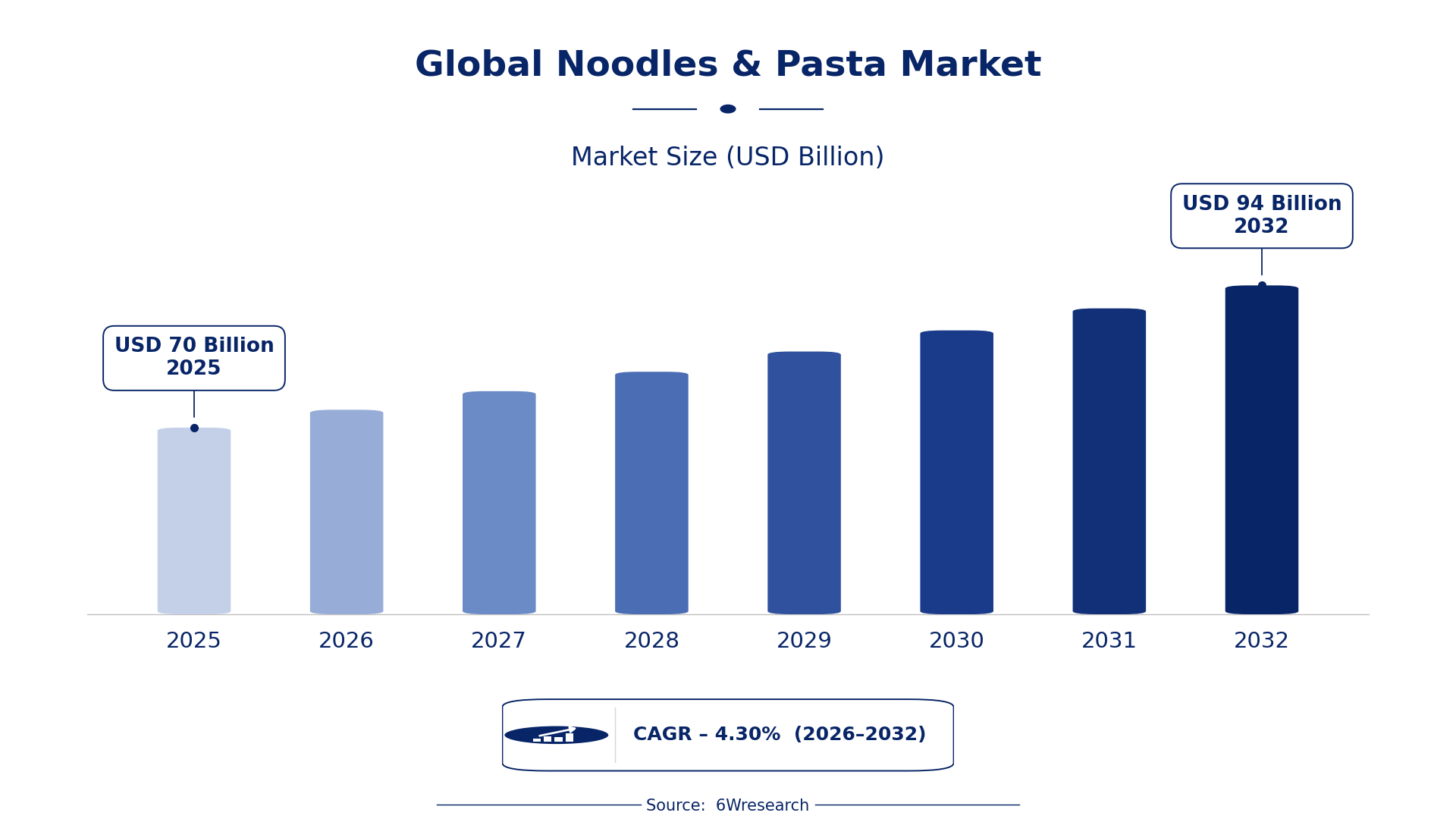
The Global Noodles & Pasta Market was estimated at USD 70 Billion in 2025 and is projected to reach USD 94 Billion by 2032, growing at a CAGR of 4.30% from 2026 to 2032.
Global Noodles & Pasta Market Synopsis
The Global Noodles & Pasta Market finds itself at a pivotal juncture, characterized by changes in consumer preferences and ongoing innovation in product offerings. Instant noodles and pasta products are increasingly aligned with evolving dietary requirements, such as gluten-free and organic options. This adaptability positions the market to capture a broader demographic, particularly among health-conscious consumers.
Given the faster pace of urbanization and increasingly busy lifestyles, convenience remains a key determinant of purchasing behavior. The penetration of e-commerce platforms also aids accessibility, further shaping distribution strategies. In a market defined by intense competition, brands are investing heavily in marketing and product differentiation to capture consumer interest.
Global Noodles & Pasta Market Year-wise Growth Rate and Key Drivers
This graph illustrates the annual growth rates of the Global Noodles & Pasta Market from 2022 to 2032, highlighting a steady upward trajectory and projected expansion over the forecast period.
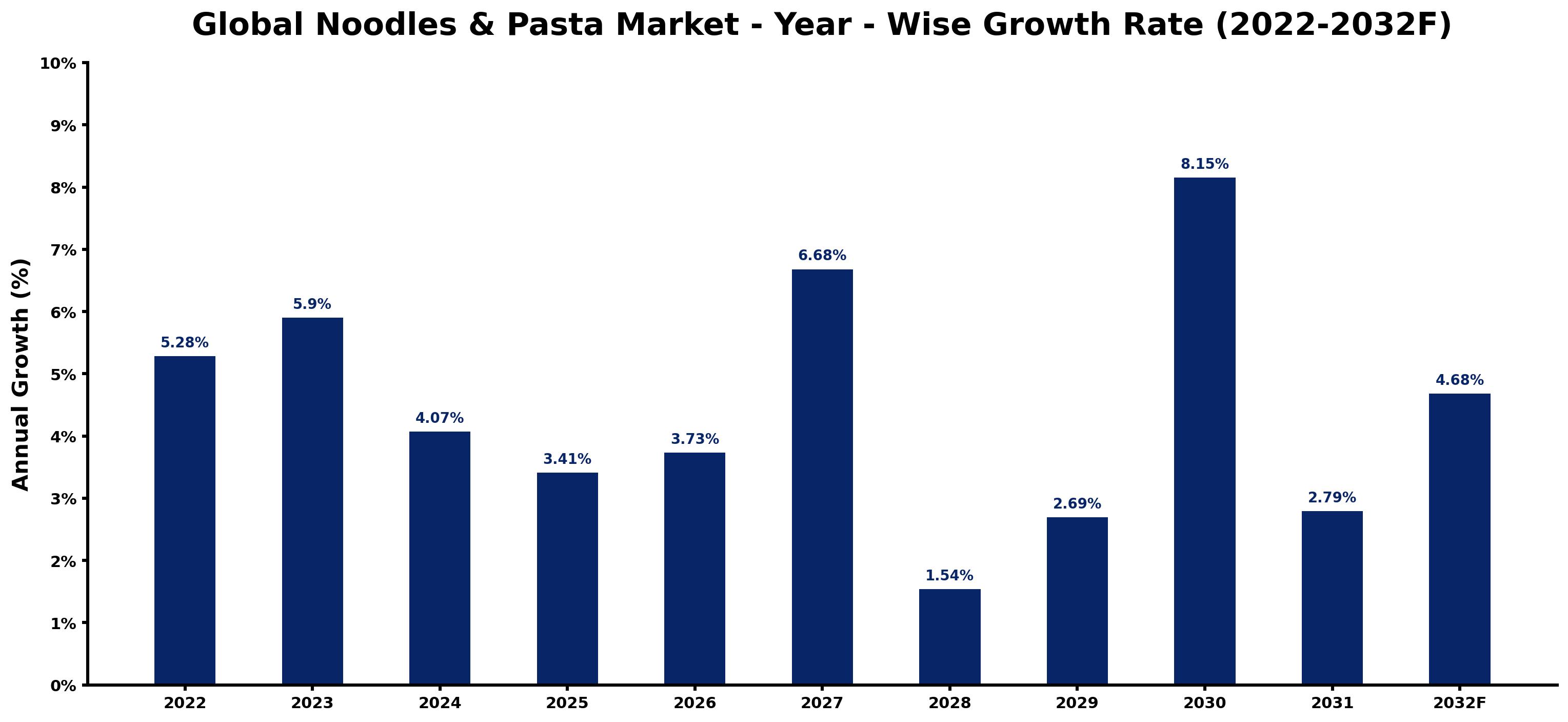
The table below presents the year‑wise growth rates along with the key drivers influencing the market
| Year | Growth Rate (%) | Major Drivers |
| 2022 | 5.28 | In North America, increased regional distribution networks enhance Noodles and Pasta availability. |
| 2023 | 5.9 | Improving supply chain dynamics enables fresher Pasta products to reach consumers faster. |
| 2024 | 4.07 | Families seeking convenient meals encourages growth in Noodles tailored for busy lifestyles. |
| 2025 | 3.41 | Retailer partnerships expand shelf space for premium Pasta brands amid rising consumer interest. |
| 2026 | 3.73 | Fluctuating raw material prices influence the pricing strategies of Noodles producers. |
| 2027 | 6.68 | Sustainable packaging innovations for Pasta resonate with environmentally conscious consumers. |
| 2028 | 1.54 | New health regulations promote clean-label formulations, thereby increasing Noodles market appeal. |
| 2029 | 2.69 | A shift toward premium Noodles reflects changing consumer preferences for quality over price. |
| 2030 | 8.15 | As consumers increasingly prioritize convenience, ready-to-eat Pasta options gain market share. |
| 2031 | 2.79 | Manufacturers' investments in automated production technologies enhance the efficiency of Noodles processing. |
| 2032 | 4.68 | Strategic mergers within the Pasta sector facilitate expansion into emerging markets. |
Note - Market size estimations and growth projections presented in this report are based on 6Wresearch's proprietary research methodology, combining internal industry data, secondary research, and primary validation, updated periodically to reflect current market conditions. As markets evolve rapidly, figures for certain industries may vary slightly and are intended as informed estimates rather than absolute figures. For the most current market sizing, we recommend validating figures with a 6Wresearch analyst.
Global Noodles & Pasta Market Key Takeaways
Below are some of the specific key takeaways from the market, including:
- Asia-Pacific contributed approximately ~50% share in the Global Noodles & Pasta Market in 2025, driven largely by consumption in China and Japan.
- Gluten-free pasta is emerging as a significant segment, projected to see a CAGR of 8.5% from 2026 to 2032, reflecting changing dietary trends.
- Nissin Foods remains a market leader, with substantial investments in product innovation and flavor variety, underscoring its competitive positioning.
- The grocery retail segment accounts for ~65% share of total noodle and pasta sales in 2025, highlighting traditional shopping habits.
- E-commerce channels are anticipated to grow rapidly, recording a CAGR of 15% from 2026 to 2032 as consumer shopping habits shift.
Evaluation of Restraints in Global Noodles & Pasta Market
Rising health concerns among consumers pose a tangible challenge to the Global Noodles & Pasta Market. For instance, the prevalence of gluten-related disorders has paved the way for an estimated 10% annual decline in traditional wheat-based product sales as consumers increasingly shift to gluten-free alternatives. Additionally, fluctuating wheat prices, which can vary by as much as 20% annually, place pressures on profit margins and influence pricing strategies among manufacturers. The intense competition and the need for continuous innovation further complicate the landscape, leading to heightened marketing expenditures.
Global Noodles & Pasta Market Trends
A notable trend in the Global Noodles & Pasta Market is the surge in demand for healthier options, primarily driven by increasing consumer awareness of nutrition. Companies like Kraft Heinz have introduced multiple organic and whole-grain noodles to capture segment share effectively. Additionally, the advent of integrated supply chain management systems is improving efficiency, allowing quicker responses to market needs. For example, Nissin Foods has leveraged AI in its product development processes, refining recipes according to real-time consumer feedback. All these factors contribute to a more agile market capable of meeting diverse consumer demands.
Global Noodles & Pasta Market Opportunities
Future opportunities include the burgeoning market for plant-based protein noodles, targeting the vegan and health-conscious consumer segments. Unilever is expected to launch a new line of eco-friendly packaged plant-based noodles slated for 2025 that targets a market estimated at $5 billion. Additionally, advancements in sustainable packaging technologies present revenue prospects, as consumers increasingly favor brands that are environmentally responsible. For instance, companies adopting biodegradable packaging are projected to tap into the growing sustainability trend, a critical factor in long-term market viability.
Global Noodles & Pasta Market by Form
The Global Noodles & Pasta Market is predominantly led by the Instant Noodles segment, commanding a share of approximately ~45% in 2025. However, the fastest-growing segment is anticipated to be Gluten-free Pasta, projected to grow at a CAGR of 9.2% from 2026 to 2032. The rising consumer preference for gluten-free diets, driven by health consciousness, is propelling the demand for this segment forward, which is further supported by increased product offerings from major brands.
Global Noodles & Pasta Market by Distribution Channel
Currently, Supermarkets and Hypermarkets are the leading distribution channels within the Global Noodles & Pasta Market, holding a share of ~60% in 2025. Conversely, Online Stores are emerging as the fastest-growing channel, projected to expand at a CAGR of 16% from 2026 to 2032. This shift is largely attributed to the convenience and accessibility that e-commerce provides to consumers, particularly post-pandemic, prompting brands to strategize their online presence more robustly.
Global Noodles & Pasta Market by Region
The Asia-Pacific region remains the largest market for noodles and pasta, accounting for approximately ~50% share in 2025. This dominance stems from substantial cultural significance and high consumption rates in countries like China and Japan. North America is identified as the fastest-growing region, with an expected CAGR of 6.5% from 2026 to 2032, driven by changing dietary preferences and a rise in demand for innovative products, such as gluten-free options, facilitated by strong distribution networks.
Government Initiatives in the Global Noodles & Pasta Market
Regulatory frameworks surrounding the Global Noodles & Pasta Market are continually evolving to address health concerns, sustainability, and economic performance within the sector. Various initiatives focus on improving production standards, enhancing food safety, and promoting local manufacturing. Below are notable government initiatives impacting the market:
- Ministry of Food Processing Industries, "Pradhan Mantri Kisan Sampada Yojana," 2019 - This scheme aims to provide incentives for food processing projects, enhancing output and creating jobs in the noodle and pasta sector.
- Food Safety and Standards Authority of India, "Food Safety and Standards (Labeling and Packaging) Regulations," 2021 - This regulation mandates transparent labeling for noodles and pasta products, helping consumers make more informed choices.
- European Commission, "Farm to Fork Strategy," 2020 - An ongoing initiative aiming at sustainable food systems, which includes promoting organic pasta products and increasing their market share.
- U.S. Department of Agriculture, "Local Food for Schools," 2022 - Planned initiative to increase domestic sourcing of pasta in school meal programs, thereby boosting local production and consumption.
Future Insights of the Global Noodles & Pasta Market
In the Global Noodles & Pasta Market, technological advancements will drive efficiency in production and distribution processes. Companies may increasingly adopt automation in manufacturing to meet growing consumer preferences for personalized and health-conscious options. For instance, with Nissin Foods investing in AI-driven supply chain solutions, it illustrates how data analytics can enhance market responsiveness. Such shifts will likely redefine competitive dynamics, enabling firms to reduce costs while improving quality. The integration of eco-friendly practices in packaging will also become a focal point for companies aspiring to connect with environmentally aware consumers.
Global Noodles & Pasta Market Latest Developments
Several noteworthy developments highlight the ongoing evolution of the Global Noodles & Pasta Market, reflecting both consumer trends and competitive strategies:
- In March 2023, Kraft Heinz launched a new range of organic pasta products aimed at health-conscious consumers. This initiative is set to enhance their market positioning by catering to a segment increasingly seeking nutritious options.
- Recently, Nissin Foods completed the opening of a state-of-the-art production facility in Southeast Asia. This expansion supports increased production capacity, enabling faster delivery and a broader variety of products to meet local tastes.
- In late 2023, Barilla announced its commitment to using 100% recyclable packaging by 2025. This move is expected to bolster its appeal among sustainability-minded consumers, aligning with current market trends toward environmental accountability.
- Upcoming in 2024, Unilever plans to introduce a frozen line of plant-based noodles. By diversifying its product range, the company aims to capture the growing market segment of plant-based foods, further engaging health-conscious and vegan consumers.
Global Noodles & Pasta Market Key Players and Industry Positioning
The Global Noodles & Pasta Market exhibits a fragmented competitive structure characterized by several key players vying for market share through differentiated strategies and innovations.
| Leading Company | Core Strength | Strategic Focus |
|---|---|---|
| Nissin Foods | Innovation in instant noodle flavors | Expansion into emerging markets with localized products |
| Nestlé | Strong brand portfolio and global distribution | Emphasis on health and sustainability in product offerings |
| Kraft Heinz | Established market presence and robust marketing | Focus on organic and health-focused product lines |
| Barilla | Expertise in pasta production techniques | Commitment to sustainability and eco-friendly packaging |
| Unilever | Diverse product range including plant-based variants | Strategic push into frozen food and health-oriented products |
As companies navigate a competitive landscape, their ability to adapt and innovate will be essential for capturing growth opportunities in evolving consumer markets.
Key Attractiveness of the Report
- 10 Years of Market Numbers
- Historical Data Starting from 2022 to 2025
- Base Year: 2025
- Forecast Data until 2032
- Key Performance Indicators Impacting the Market
- Major Upcoming Developments and Projects
Key Highlights of the Report:
- Global Noodles & Pasta Market Outlook
- Market Size of Global Noodles & Pasta Market, 2025
- Forecast of Global Noodles & Pasta Market, 2032
- Historical Data and Forecast of Global Noodles & Pasta Revenues & Volume for the Period 2022-2032
- Global Noodles & Pasta Market Trend Evolution
- Global Noodles & Pasta Market Drivers and Challenges
- Global Noodles & Pasta Price Trends
- Global Noodles & Pasta Porter's Five Forces
- Global Noodles & Pasta Industry Life Cycle
- Historical Data and Forecast of Global Noodles & Pasta Market Revenues & Volume
- Historical Data and Forecast of Global Noodles & Pasta Market Revenues & Volume By Form for the Period 2022-2032
- Historical Data and Forecast of Global Noodles & Pasta Market Revenues & Volume By Ambient/Canned for the Period 2022-2032
- Historical Data and Forecast of Global Noodles & Pasta Market Revenues & Volume By Dried for the Period 2022-2032
- Historical Data and Forecast of Global Noodles & Pasta Market Revenues & Volume By Chilled/ Frozen for the Period 2022-2032
- Historical Data and Forecast of Global Noodles & Pasta Market Revenues & Volume By Distibution Channel for the Period 2022-2032
- Historical Data and Forecast of Global Noodles & Pasta Market Revenues & Volume By Supermarkets/Hypermarkets for the Period 2022-2032
- Historical Data and Forecast of Global Noodles & Pasta Market Revenues & Volume By Convenience Stores for the Period 2022-2032
- Historical Data and Forecast of Global Noodles & Pasta Market Revenues & Volume By Online Stores for the Period 2022-2032
- Historical Data and Forecast of Global Noodles & Pasta Market Revenues & Volume By Other Distribution Channels for the Period 2022-2032
- Historical Data and Forecast of North America Noodles & Pasta Market Revenues & Volume By Form for the Period 2022-2032
- Historical Data and Forecast of North America Noodles & Pasta Market Revenues & Volume By Ambient/Canned for the Period 2022-2032
- Historical Data and Forecast of North America Noodles & Pasta Market Revenues & Volume By Dried for the Period 2022-2032
- Historical Data and Forecast of North America Noodles & Pasta Market Revenues & Volume By Chilled/ Frozen for the Period 2022-2032
- Historical Data and Forecast of North America Noodles & Pasta Market Revenues & Volume By Distibution Channel for the Period 2022-2032
- Historical Data and Forecast of North America Noodles & Pasta Market Revenues & Volume By Supermarkets/Hypermarkets for the Period 2022-2032
- Historical Data and Forecast of North America Noodles & Pasta Market Revenues & Volume By Convenience Stores for the Period 2022-2032
- Historical Data and Forecast of North America Noodles & Pasta Market Revenues & Volume By Online Stores for the Period 2022-2032
- Historical Data and Forecast of North America Noodles & Pasta Market Revenues & Volume By Other Distribution Channels for the Period 2022-2032
- Historical Data and Forecast of United States of America Noodles & Pasta Market Revenues & Volume for the Period 2022-2032
- Historical Data and Forecast of Canada Noodles & Pasta Market Revenues & Volume for the Period 2022-2032
- Historical Data and Forecast of Rest of North America Noodles & Pasta Market Revenues & Volume for the Period 2022-2032
- Historical Data and Forecast of Latin America (LATAM) Noodles & Pasta Market Revenues & Volume By Form for the Period 2022-2032
- Historical Data and Forecast of Latin America (LATAM) Noodles & Pasta Market Revenues & Volume By Ambient/Canned for the Period 2022-2032
- Historical Data and Forecast of Latin America (LATAM) Noodles & Pasta Market Revenues & Volume By Dried for the Period 2022-2032
- Historical Data and Forecast of Latin America (LATAM) Noodles & Pasta Market Revenues & Volume By Chilled/ Frozen for the Period 2022-2032
- Historical Data and Forecast of Latin America (LATAM) Noodles & Pasta Market Revenues & Volume By Distibution Channel for the Period 2022-2032
- Historical Data and Forecast of Latin America (LATAM) Noodles & Pasta Market Revenues & Volume By Supermarkets/Hypermarkets for the Period 2022-2032
- Historical Data and Forecast of Latin America (LATAM) Noodles & Pasta Market Revenues & Volume By Convenience Stores for the Period 2022-2032
- Historical Data and Forecast of Latin America (LATAM) Noodles & Pasta Market Revenues & Volume By Online Stores for the Period 2022-2032
- Historical Data and Forecast of Latin America (LATAM) Noodles & Pasta Market Revenues & Volume By Other Distribution Channels for the Period 2022-2032
- Historical Data and Forecast of Brazil Noodles & Pasta Market Revenues & Volume for the Period 2022-2032
- Historical Data and Forecast of Mexico Noodles & Pasta Market Revenues & Volume for the Period 2022-2032
- Historical Data and Forecast of Argentina Noodles & Pasta Market Revenues & Volume for the Period 2022-2032
- Historical Data and Forecast of Rest of LATAM Noodles & Pasta Market Revenues & Volume for the Period 2022-2032
- Historical Data and Forecast of Asia Noodles & Pasta Market Revenues & Volume By Form for the Period 2022-2032
- Historical Data and Forecast of Asia Noodles & Pasta Market Revenues & Volume By Ambient/Canned for the Period 2022-2032
- Historical Data and Forecast of Asia Noodles & Pasta Market Revenues & Volume By Dried for the Period 2022-2032
- Historical Data and Forecast of Asia Noodles & Pasta Market Revenues & Volume By Chilled/ Frozen for the Period 2022-2032
- Historical Data and Forecast of Asia Noodles & Pasta Market Revenues & Volume By Distibution Channel for the Period 2022-2032
- Historical Data and Forecast of Asia Noodles & Pasta Market Revenues & Volume By Supermarkets/Hypermarkets for the Period 2022-2032
- Historical Data and Forecast of Asia Noodles & Pasta Market Revenues & Volume By Convenience Stores for the Period 2022-2032
- Historical Data and Forecast of Asia Noodles & Pasta Market Revenues & Volume By Online Stores for the Period 2022-2032
- Historical Data and Forecast of Asia Noodles & Pasta Market Revenues & Volume By Other Distribution Channels for the Period 2022-2032
- Historical Data and Forecast of China Noodles & Pasta Market Revenues & Volume for the Period 2022-2032
- Historical Data and Forecast of India Noodles & Pasta Market Revenues & Volume for the Period 2022-2032
- Historical Data and Forecast of Japan Noodles & Pasta Market Revenues & Volume for the Period 2022-2032
- Historical Data and Forecast of Rest of Asia Noodles & Pasta Market Revenues & Volume for the Period 2022-2032
- Historical Data and Forecast of Africa Noodles & Pasta Market Revenues & Volume By Form for the Period 2022-2032
- Historical Data and Forecast of Africa Noodles & Pasta Market Revenues & Volume By Ambient/Canned for the Period 2022-2032
- Historical Data and Forecast of Africa Noodles & Pasta Market Revenues & Volume By Dried for the Period 2022-2032
- Historical Data and Forecast of Africa Noodles & Pasta Market Revenues & Volume By Chilled/ Frozen for the Period 2022-2032
- Historical Data and Forecast of Africa Noodles & Pasta Market Revenues & Volume By Distibution Channel for the Period 2022-2032
- Historical Data and Forecast of Africa Noodles & Pasta Market Revenues & Volume By Supermarkets/Hypermarkets for the Period 2022-2032
- Historical Data and Forecast of Africa Noodles & Pasta Market Revenues & Volume By Convenience Stores for the Period 2022-2032
- Historical Data and Forecast of Africa Noodles & Pasta Market Revenues & Volume By Online Stores for the Period 2022-2032
- Historical Data and Forecast of Africa Noodles & Pasta Market Revenues & Volume By Other Distribution Channels for the Period 2022-2032
- Historical Data and Forecast of South Africa Noodles & Pasta Market Revenues & Volume for the Period 2022-2032
- Historical Data and Forecast of Nigeria Noodles & Pasta Market Revenues & Volume for the Period 2022-2032
- Historical Data and Forecast of Egypt Noodles & Pasta Market Revenues & Volume for the Period 2022-2032
- Historical Data and Forecast of Rest of Africa Noodles & Pasta Market Revenues & Volume for the Period 2022-2032
- Historical Data and Forecast of Europe Noodles & Pasta Market Revenues & Volume By Form for the Period 2022-2032
- Historical Data and Forecast of Europe Noodles & Pasta Market Revenues & Volume By Ambient/Canned for the Period 2022-2032
- Historical Data and Forecast of Europe Noodles & Pasta Market Revenues & Volume By Dried for the Period 2022-2032
- Historical Data and Forecast of Europe Noodles & Pasta Market Revenues & Volume By Chilled/ Frozen for the Period 2022-2032
- Historical Data and Forecast of Europe Noodles & Pasta Market Revenues & Volume By Distibution Channel for the Period 2022-2032
- Historical Data and Forecast of Europe Noodles & Pasta Market Revenues & Volume By Supermarkets/Hypermarkets for the Period 2022-2032
- Historical Data and Forecast of Europe Noodles & Pasta Market Revenues & Volume By Convenience Stores for the Period 2022-2032
- Historical Data and Forecast of Europe Noodles & Pasta Market Revenues & Volume By Online Stores for the Period 2022-2032
- Historical Data and Forecast of Europe Noodles & Pasta Market Revenues & Volume By Other Distribution Channels for the Period 2022-2032
- Historical Data and Forecast of United Kingdom Noodles & Pasta Market Revenues & Volume for the Period 2022-2032
- Historical Data and Forecast of France Noodles & Pasta Market Revenues & Volume for the Period 2022-2032
- Historical Data and Forecast of Germany Noodles & Pasta Market Revenues & Volume for the Period 2022-2032
- Historical Data and Forecast of Rest of Europe Noodles & Pasta Market Revenues & Volume for the Period 2022-2032
- Historical Data and Forecast of Middle East Noodles & Pasta Market Revenues & Volume By Form for the Period 2022-2032
- Historical Data and Forecast of Middle East Noodles & Pasta Market Revenues & Volume By Ambient/Canned for the Period 2022-2032
- Historical Data and Forecast of Middle East Noodles & Pasta Market Revenues & Volume By Dried for the Period 2022-2032
- Historical Data and Forecast of Middle East Noodles & Pasta Market Revenues & Volume By Chilled/ Frozen for the Period 2022-2032
- Historical Data and Forecast of Middle East Noodles & Pasta Market Revenues & Volume By Distibution Channel for the Period 2022-2032
- Historical Data and Forecast of Middle East Noodles & Pasta Market Revenues & Volume By Supermarkets/Hypermarkets for the Period 2022-2032
- Historical Data and Forecast of Middle East Noodles & Pasta Market Revenues & Volume By Convenience Stores for the Period 2022-2032
- Historical Data and Forecast of Middle East Noodles & Pasta Market Revenues & Volume By Online Stores for the Period 2022-2032
- Historical Data and Forecast of Middle East Noodles & Pasta Market Revenues & Volume By Other Distribution Channels for the Period 2022-2032
- Historical Data and Forecast of Saudi Arabia Noodles & Pasta Market Revenues & Volume for the Period 2022-2032
- Historical Data and Forecast of UAE Noodles & Pasta Market Revenues & Volume for the Period 2022-2032
- Historical Data and Forecast of Turkey Noodles & Pasta Market Revenues & Volume for the Period 2022-2032
- Historical Data and Forecast of Rest of Middle East Noodles & Pasta Market Revenues & Volume for the Period 2022-2032
- Global Noodles & Pasta Market - Key Performance Indicators
- Global Noodles & Pasta Market - Import Export Trade Statistics
- Global Noodles & Pasta Market - Opportunity Assessment By Countries
- Global Noodles & Pasta Market - Opportunity Assessment By Form
- Global Noodles & Pasta Market - Opportunity Assessment By Distibution Channel
- Global Noodles & Pasta Market - Top Companies Market Share
- Global Noodles & Pasta Market - Top Companies Profiles
- Global Noodles & Pasta Market - Comparison of Players in Technical and Operating Parameters
- Global Noodles & Pasta Market - Strategic Recommendations
Markets Covered
The Global Noodles & Pasta Market report provides a detailed analysis of the following market segments:
By Regions and Countries:
- North America
- Europe
- LATAM
- Middle East
- Asia
- Africa
By Form:
- Ambient/Canned
- Dried
- Chilled/ Frozen
By Distibution Channel:
- Supermarkets/Hypermarkets
- Convenience Stores
- Online Stores
- Other Distribution Channels






































