Global Orthodontics Market Highlights
| Market Size (2025) | USD 1800 Billion |
| Forecast Size (2032) | USD 3000 Billion |
| CAGR | 4.40% |
| Base Year | 2025 |
| Forecast Period | 2026-2032 |
| Largest Region | North America |
| Fastest Growing Region | Asia-Pacific |
| Largest Segment | Instruments |
| Fastest Growing Segment | Supplies |
| Leading Companies | Align Technology, Inc., 3M Company, Danaher Corporation, Dentsply Sirona Inc., Ormco Corporation |
Global Orthodontics Market Size & Growth Rate (2026-2032)
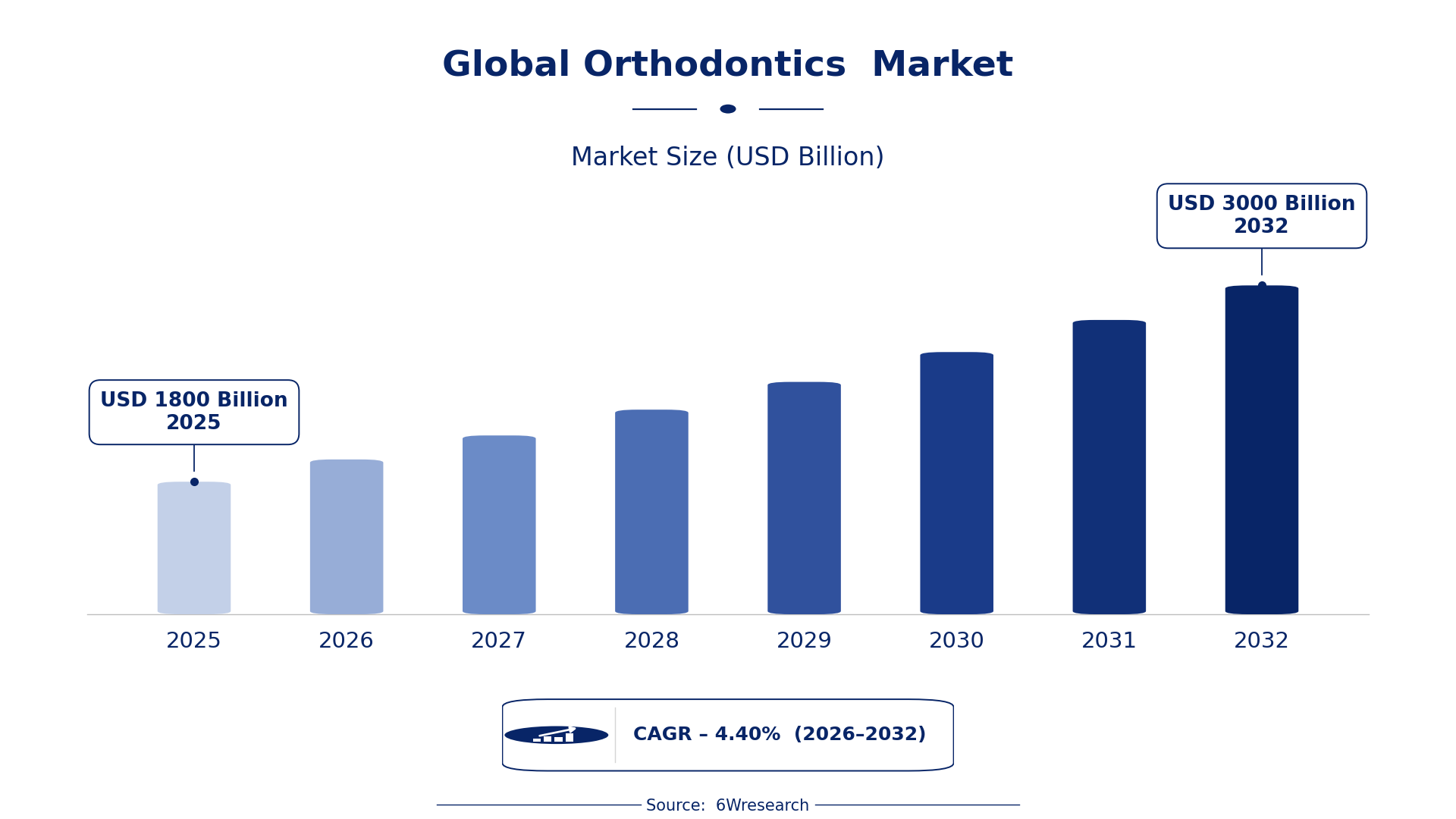
The Global Orthodontics Market was estimated at USD 1800 Billion in 2025 and is projected to reach USD 3000 Billion by 2032, growing at a CAGR of 4.40% from 2026 to 2032.
Global Orthodontics Market Synopsis
Currently, the Global Orthodontics Market is in a transformative phase, driven by heightened awareness surrounding dental health and appearance. As more individuals prioritize orthodontic care, especially clear aligners and visible braces, the market is set to adjust to the demands of both young and adult patients seeking improved aesthetics and comfort.
In addition to consumer preferences, advancements in technology such as 3D imaging and digital orthodontics have redefined treatment protocols. These innovations not only enhance patient experience but also streamline processes for dental practitioners, thus positioning the market for sustained growth in the years ahead.
Global Orthodontics Market Year-wise Growth Rate and Key Drivers
This graph illustrates the annual growth rates of the Global Orthodontics Market from 2022 to 2032, highlighting a steady upward trajectory and projected expansion over the forecast period.
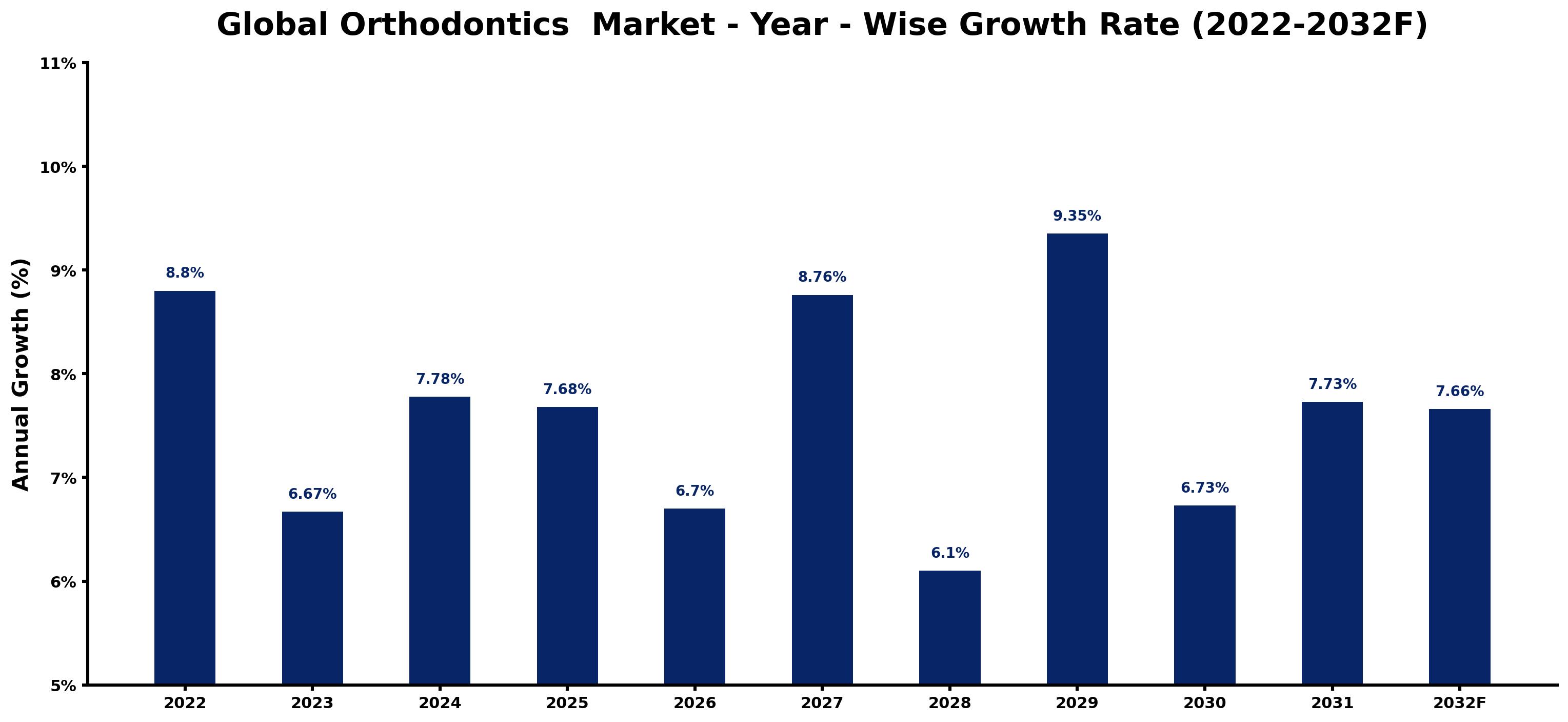
The table below presents the year‑wise growth rates along with the key drivers influencing the market
| Year | Growth Rate (%) | Major Drivers |
| 2022 | 8.8 | Increasing geographic expansion enables access to orthodontics services in new regions. |
| 2023 | 6.67 | Among urban populations, a shift in demand for orthodontics treatments grows significantly. |
| 2024 | 7.78 | Manufacturers face rising raw material costs, impacting pricing strategies for orthodontics products. |
| 2025 | 7.68 | Expanding telehealth platforms enhances patient access to orthodontics consultations and treatments. |
| 2026 | 6.7 | A shift toward biosensor technology changes patient monitoring in orthodontics practices. |
| 2027 | 8.76 | Wearable monitoring devices improve engagement and outcomes in orthodontics treatment plans. |
| 2028 | 6.1 | Patients increasingly prioritize convenience and telehealth options for orthodontics services. |
| 2029 | 9.35 | While reimbursement policies evolve, orthodontics providers adapt strategies to maintain profitability. |
| 2030 | 6.73 | Investments in workforce training enhance service delivery within orthodontics facilities. |
| 2031 | 7.73 | Oral healthcare companies optimize supply chain dynamics to meet rising orthodontics market needs. |
| 2032 | 7.66 | Sustainable materials in orthodontics production align with growing ESG expectations and standards. |
Note - Market size estimations and growth projections presented in this report are based on 6Wresearch's proprietary research methodology, combining internal industry data, secondary research, and primary validation, updated periodically to reflect current market conditions. As markets evolve rapidly, figures for certain industries may vary slightly and are intended as informed estimates rather than absolute figures. For the most current market sizing, we recommend validating figures with a 6Wresearch analyst.
Global Orthodontics Market Key Takeaways
Below are some of the specific key takeaways from the market, including:
- Align Technology, Inc. reported a revenue increase of 25% in 2022, emphasizing the growing market for clear aligners.
- The share of the Instruments segment in the Global Orthodontics Market is estimated to be around 60% in 2025.
- Supplies are projected to grow at a CAGR of 6% from 2026 to 2032, reflecting increasing use of advanced materials.
- North America dominated the market in 2025, accounting for approximately 48% of total revenue.
- The rise in malocclusion cases has resulted in a surge of 30% in patients seeking orthodontic treatment in Asia-Pacific recently.
Evaluation of Restraints in Global Orthodontics Market
Despite the promising growth in the Global Orthodontics Market, several restraints could hinder its full potential. One significant barrier is the high cost of orthodontic treatments, often ranging from USD 3,000 to USD 7,000 per patient, which limits accessibility, especially in emerging economies. Furthermore, limited insurance coverage exacerbates this issue, leaving potential patients deterred from seeking necessary care. For example, studies indicate that only 34% of dental plans cover orthodontic treatments, which significantly impacts demand in price-sensitive regions.
Global Orthodontics Market Trends
The Global Orthodontics Market is currently witnessing notable trends driven by technological advancements and changing consumer preferences. A significant trend is the shift towards clear aligners, as evidenced by Align Technology, which reported that its clear aligner segment alone generated revenues exceeding USD 1 billion in 2021. Additionally, the embrace of 3D printing technology has optimized the manufacturing of orthodontic appliances, allowing for customized solutions. For instance, Dentsply Sirona has introduced a 3D digital platform that enhances patient engagement while streamlining clinical workflows.
Global Orthodontics Market Opportunities
Looking ahead, the Global Orthodontics Market offers several lucrative opportunities. The emerging trend of teledentistry is gaining traction, expected to be a USD 3 billion sector by 2025, providing orthodontic practices more platforms to reach patients remotely. Moreover, the increasing prevalence of malocclusions, projected to grow by 25% by 2030, heightens the demand for orthodontic interventions. An example is a recent strategic investment by Ormco Corporation aimed at enhancing their digital workflow solutions to capitalize on this burgeoning market segment.
Global Orthodontics Market by Product Type
In the Global Orthodontics Market, the Instruments segment leads with a share of approximately 60% in 2025, reflecting its critical role in orthodontic treatments. Conversely, the Supplies segment is anticipated to be the fastest-growing, with a CAGR of 6% from 2026 to 2032. The robust performance of the Instruments category is attributed to its necessity in providing effective treatments, while the Supplies segment's growth can be linked to increasing demand for updated materials used in orthodontics.
Global Orthodontics Market by Region
North America remains the largest region in the Global Orthodontics Market, commanding about 48% of the total market share in 2025. This dominance can be attributed to a well-established healthcare system and a high prevalence of orthodontic treatments. However, the Asia-Pacific region is emerging as the fastest-growing market, projected to have a CAGR of 7% from 2026 to 2032. Factors such as increasing disposable incomes, greater awareness of dental health, and expanding access to orthodontic care in countries like China and India are contributing to this rapid growth.
Government Initiatives in the Global Orthodontics Market
The regulatory framework surrounding the Global Orthodontics Market is influenced by various government initiatives aimed at enhancing healthcare access and standards. Key policies focus on improving dental care infrastructure and ensuring the availability of orthodontic services to a broader population.
- U.S. Department of Health and Human Services, Affordable Care Act, enacted in 2010, aimed at increasing insurance coverage for orthodontic treatments.
- European Commission, EU Dental Health Strategy, initiated in 2023, focuses on promoting oral health and facilitating access to advanced orthodontic care across member states.
- Health Canada, Canadian Oral Health Strategy, launched in 2021, seeks to improve dental care access and specifically emphasizes orthodontic care for children.
- Australian Dental Association, National Oral Health Plan, introduced in 2022, aims to enhance orthodontic services and integrate them into overall dental health policies.
Future Insights of the Global Orthodontics Market
As we look towards 2032, the Global Orthodontics Market is set to experience substantial shifts driven by increased consumer engagement in dental health. With the rise of technological advancements, particularly in 3D imaging and treatment precision, companies like Align Technology are likely to enhance their product offerings. Moreover, the anticipated surge in malocclusion cases could alter treatment protocols and strategies, prompting orthodontic practitioners to adopt more innovative, patient-centric approaches to care.
Global Orthodontics Market Latest Developments
Recent developments in the Global Orthodontics Market highlight the competitive advancements aimed at enhancing service delivery and patient outcomes. Key actions by leading companies illustrate their strategies and responses to market dynamics.
- Align Technology recently launched a new version of its clear aligners, expected to improve user comfort, with plans for a wider rollout by late 2023.
- In early 2023, Danaher Corporation acquired a digital orthodontic solutions provider, boosting its capabilities in the high-demand digital services segment.
- Ormco Corporation is set to introduce an augmented reality tool for orthodontic diagnostics in late 2024, which could enhance treatment planning accuracy.
- Dentsply Sirona launched a series of new orthodontic materials in mid-2023, focused on enhancing the longevity and effectiveness of braces systems.
Global Orthodontics Market Key Players and Industry Positioning
The Global Orthodontics Market is characterized by a mix of consolidated and fragmented elements. Key players dominate specific segments while emerging companies introduce innovative solutions. This dual structure fosters competition and drives advancements, which benefit consumers and practitioners alike.
| Leading Company | Core Strength | Strategic Focus |
|---|---|---|
| Align Technology, Inc. | Market leader in clear aligners. | Focus on digital solutions for improved patient engagement. |
| 3M Company | Innovative material science. | Development of comprehensive orthodontic products. |
| Danaher Corporation | Strong portfolio of dental technology. | Expansion through strategic acquisitions. |
| Dentsply Sirona Inc. | Advanced manufacturing capabilities. | Integration of digital workflows and orthodontic supplies. |
| Ormco Corporation | Strong focus on innovation in treatment solutions. | Investing in digital orthodontics to enhance treatment efficiency. |
Looking ahead, the competition among these companies is expected to intensify as they innovate further, addressing evolving patient needs and expanding their market reach.
Global Orthodontics Market - Key Attractiveness of the Report
- 10 Years of Market Numbers
- Historical Data Starting from 2022 to 2025
- Base Year: 2025
- Forecast Data until 2032
- Key Performance Indicators Impacting the Market
- Major Upcoming Developments and Projects
Key Highlights of the Report:
- Global Orthodontics Market Outlook
- Market Size of Global Orthodontics Market, 2025
- Forecast of Global Orthodontics Market, 2032
- Historical Data and Forecast of Global Orthodontics Revenues & Volume for the Period 2022-2032
- Global Orthodontics Market Trend Evolution
- Global Orthodontics Market Drivers and Challenges
- Global Orthodontics Price Trends
- Global Orthodontics Porter's Five Forces
- Global Orthodontics Industry Life Cycle
- Historical Data and Forecast of Global Orthodontics Market Revenues & Volume
- Historical Data and Forecast of Global Orthodontics Market Revenues & Volume By Product Type for the Period 2022-2032
- Historical Data and Forecast of Global Orthodontics Market Revenues & Volume By Instruments for the Period 2022-2032
- Historical Data and Forecast of Global Orthodontics Market Revenues & Volume By Supplies for the Period 2022-2032
- Historical Data and Forecast of North America Orthodontics Market Revenues & Volume By Product Type for the Period 2022-2032
- Historical Data and Forecast of North America Orthodontics Market Revenues & Volume By Instruments for the Period 2022-2032
- Historical Data and Forecast of North America Orthodontics Market Revenues & Volume By Supplies for the Period 2022-2032
- Historical Data and Forecast of United States of America Orthodontics Market Revenues & Volume for the Period 2022-2032
- Historical Data and Forecast of Canada Orthodontics Market Revenues & Volume for the Period 2022-2032
- Historical Data and Forecast of Rest of North America Orthodontics Market Revenues & Volume for the Period 2022-2032
- Historical Data and Forecast of Latin America (LATAM) Orthodontics Market Revenues & Volume By Product Type for the Period 2022-2032
- Historical Data and Forecast of Latin America (LATAM) Orthodontics Market Revenues & Volume By Instruments for the Period 2022-2032
- Historical Data and Forecast of Latin America (LATAM) Orthodontics Market Revenues & Volume By Supplies for the Period 2022-2032
- Historical Data and Forecast of Brazil Orthodontics Market Revenues & Volume for the Period 2022-2032
- Historical Data and Forecast of Mexico Orthodontics Market Revenues & Volume for the Period 2022-2032
- Historical Data and Forecast of Argentina Orthodontics Market Revenues & Volume for the Period 2022-2032
- Historical Data and Forecast of Rest of LATAM Orthodontics Market Revenues & Volume for the Period 2022-2032
- Historical Data and Forecast of Asia Orthodontics Market Revenues & Volume By Product Type for the Period 2022-2032
- Historical Data and Forecast of Asia Orthodontics Market Revenues & Volume By Instruments for the Period 2022-2032
- Historical Data and Forecast of Asia Orthodontics Market Revenues & Volume By Supplies for the Period 2022-2032
- Historical Data and Forecast of China Orthodontics Market Revenues & Volume for the Period 2022-2032
- Historical Data and Forecast of India Orthodontics Market Revenues & Volume for the Period 2022-2032
- Historical Data and Forecast of Japan Orthodontics Market Revenues & Volume for the Period 2022-2032
- Historical Data and Forecast of Rest of Asia Orthodontics Market Revenues & Volume for the Period 2022-2032
- Historical Data and Forecast of Africa Orthodontics Market Revenues & Volume By Product Type for the Period 2022-2032
- Historical Data and Forecast of Africa Orthodontics Market Revenues & Volume By Instruments for the Period 2022-2032
- Historical Data and Forecast of Africa Orthodontics Market Revenues & Volume By Supplies for the Period 2022-2032
- Historical Data and Forecast of South Africa Orthodontics Market Revenues & Volume for the Period 2022-2032
- Historical Data and Forecast of Nigeria Orthodontics Market Revenues & Volume for the Period 2022-2032
- Historical Data and Forecast of Egypt Orthodontics Market Revenues & Volume for the Period 2022-2032
- Historical Data and Forecast of Rest of Africa Orthodontics Market Revenues & Volume for the Period 2022-2032
- Historical Data and Forecast of Europe Orthodontics Market Revenues & Volume By Product Type for the Period 2022-2032
- Historical Data and Forecast of Europe Orthodontics Market Revenues & Volume By Instruments for the Period 2022-2032
- Historical Data and Forecast of Europe Orthodontics Market Revenues & Volume By Supplies for the Period 2022-2032
- Historical Data and Forecast of United Kingdom Orthodontics Market Revenues & Volume for the Period 2022-2032
- Historical Data and Forecast of France Orthodontics Market Revenues & Volume for the Period 2022-2032
- Historical Data and Forecast of Germany Orthodontics Market Revenues & Volume for the Period 2022-2032
- Historical Data and Forecast of Rest of Europe Orthodontics Market Revenues & Volume for the Period 2022-2032
- Historical Data and Forecast of Middle East Orthodontics Market Revenues & Volume By Product Type for the Period 2022-2032
- Historical Data and Forecast of Middle East Orthodontics Market Revenues & Volume By Instruments for the Period 2022-2032
- Historical Data and Forecast of Middle East Orthodontics Market Revenues & Volume By Supplies for the Period 2022-2032
- Historical Data and Forecast of Saudi Arabia Orthodontics Market Revenues & Volume for the Period 2022-2032
- Historical Data and Forecast of UAE Orthodontics Market Revenues & Volume for the Period 2022-2032
- Historical Data and Forecast of Turkey Orthodontics Market Revenues & Volume for the Period 2022-2032
- Historical Data and Forecast of Rest of Middle East Orthodontics Market Revenues & Volume for the Period 2022-2032
- Global Orthodontics Market - Key Performance Indicators
- Global Orthodontics Market - Import Export Trade Statistics
- Global Orthodontics Market - Opportunity Assessment By Countries
- Global Orthodontics Market - Opportunity Assessment By Product Type
- 0
- Global Orthodontics Market - Top Companies Market Share
- Global Orthodontics Market - Top Companies Profiles
- Global Orthodontics Market - Comparison of Players in Technical and Operating Parameters
- Global Orthodontics Market - Strategic Recommendations
Markets Covered
The Global Orthodontics Market report provides a detailed analysis of the following market segments:
By Regions and Countries:
- North America
- Europe
- LATAM
- Middle East
- Asia
- Africa
By Product Type:
- Instruments
- Supplies






































